Watch Fact of the Day: The Mechanical Alarm That Won Over US Presidents

So, back in 1947, Vulcain rolled out a game-changer: the Cricket wristwatch, which could actually wake you up thanks to its super loud mechanical alarm. This wasn’t just any watch; it turned its case into an acoustic system, delivering a noticeable buzz when the alarm went off. The Cricket became a favorite among U.S. presidents, earning it the nickname “The Presidents’ Watch.” Fast forward to today, and the updated Crickets still bring that cool mechanical charm, buzzing away without any batteries or electronics. It’s a cool reminder of how watchmaking tech stood out way before the digital age!

📅 Sunday, September 6, 2026

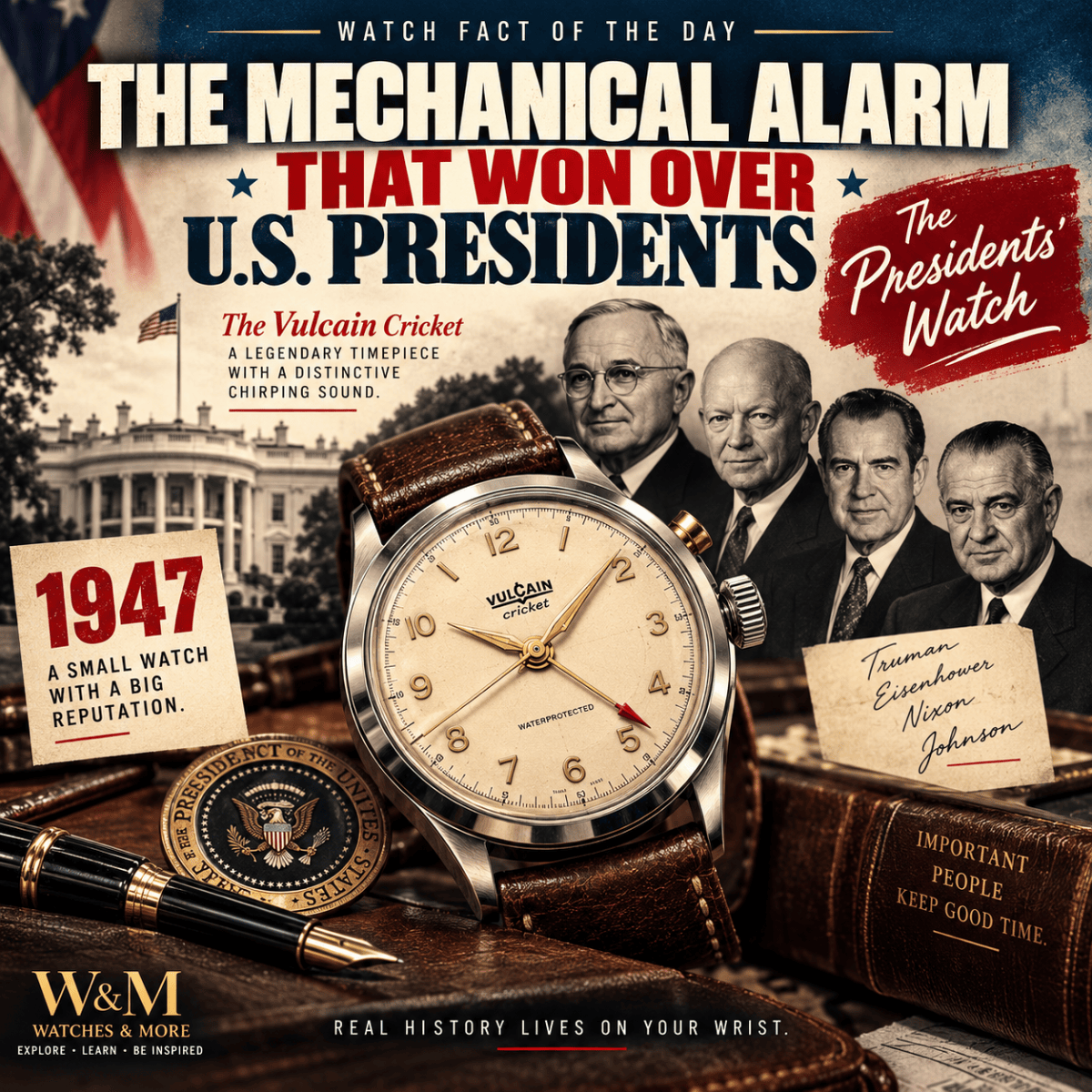
In 1947, Swiss watchmaker Vulcain introduced a wristwatch with a remarkable party trick: it could actually wake you up. The Vulcain Cricket featured a mechanical alarm powerful enough to be genuinely useful, producing the distinctive buzzing sound that inspired its name. Vulcain describes it as the world’s first alarm wristwatch with a sufficiently forceful striking mechanism, and it quickly became one of the company’s defining creations.

Making a mechanical alarm wristwatch was one thing; making one that could actually be heard was another. Vulcain’s solution turned the watch case itself into part of the acoustic system. When the alarm activates, a tiny mechanical hammer rapidly strikes a pin, while the outer caseback functions as a resonance chamber, amplifying the vibrations into the Cricket’s unmistakable sound.
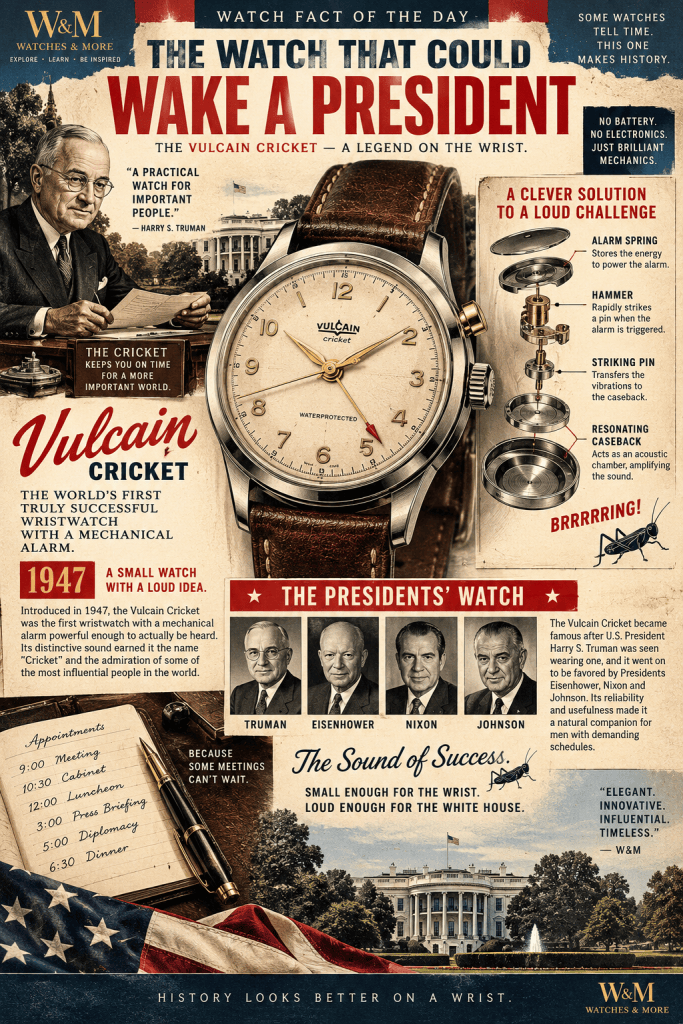
An infographic showcasing the history and features of the Vulcain Cricket watch, including its mechanical alarm designed to wake important figures, with images of U.S. Presidents who wore it, and the watch's key components.

That meant the Cricket wasn’t simply a watch with an extra hand on the dial. It was essentially a tiny mechanical alarm clock engineered for the wrist. The wearer could set an independent alarm time, wind the alarm mechanism, and carry a genuinely audible reminder wherever they went—without batteries, electronics or a speaker.

Then the Cricket found some unusually powerful admirers.

The watch became closely associated with Harry S. Truman, and Vulcain’s history subsequently connects the Cricket with Presidents Dwight D. Eisenhower, Richard Nixon and Lyndon B. Johnson as well. That presidential association became so strong that the Cricket earned its enduring nickname:

“The Presidents’ Watch.”

The connection was particularly appropriate. Before smartphones, digital calendars and electronic reminders, a mechanical alarm could be genuinely practical for someone whose day revolved around meetings and appointments. Set the alarm hand, wind the mechanism, and at the appointed time the little Cricket on your wrist would make sure you noticed.

The basic idea survives today. Modern Cricket movements remain mechanical and hand-wound, and Vulcain’s current V10 alarm calibre uses a double-barrel architecture, with the alarm sounding for approximately 20 seconds. More than 75 years after the original Cricket appeared, the complication remains wonderfully physical: gears, springs, hammer, resonance—and noise.

💡 Did You Know?

The Cricket’s famous sound doesn’t come from an electronic buzzer or miniature speaker. A mechanically driven hammer strikes a pin, creating vibrations that are amplified by the watch’s outer caseback acting as a resonance chamber. In other words, Vulcain didn’t merely put an alarm mechanism inside a wristwatch—it engineered part of the watch case into a miniature acoustic instrument.

SPRING → HAMMER → PIN → RESONANCE CHAMBER → CRICKET! 🦗

⭐ Why It Matters

Today, having an alarm on your wrist sounds completely ordinary. In 1947, making a compact mechanical wristwatch capable of producing an alarm loud enough to be genuinely useful was a significant watchmaking achievement.

And unlike the silent notifications appearing on our wrists today, the Cricket accomplished it with nothing more than mechanical energy and clever acoustics.

NO BATTERY. NO SPEAKER. JUST MECHANICS.


Category: Watch History

Disclaimer: Every effort has been made to keep these watch facts accurate, but the world of horology is full of myths, disputed stories, and fascinating trivia. Consider these facts a starting point for discovery rather than the final word. If you have corrections or additional insights, let us know—we’re always happy to keep the record ticking in the right direction.

🕐 Discover more watch facts, reviews, and buying guides at WatchesAndMore


🛍️ You Might Also Like

As an Amazon Associate and affiliate partner, WatchesAndMore earns from qualifying purchases.
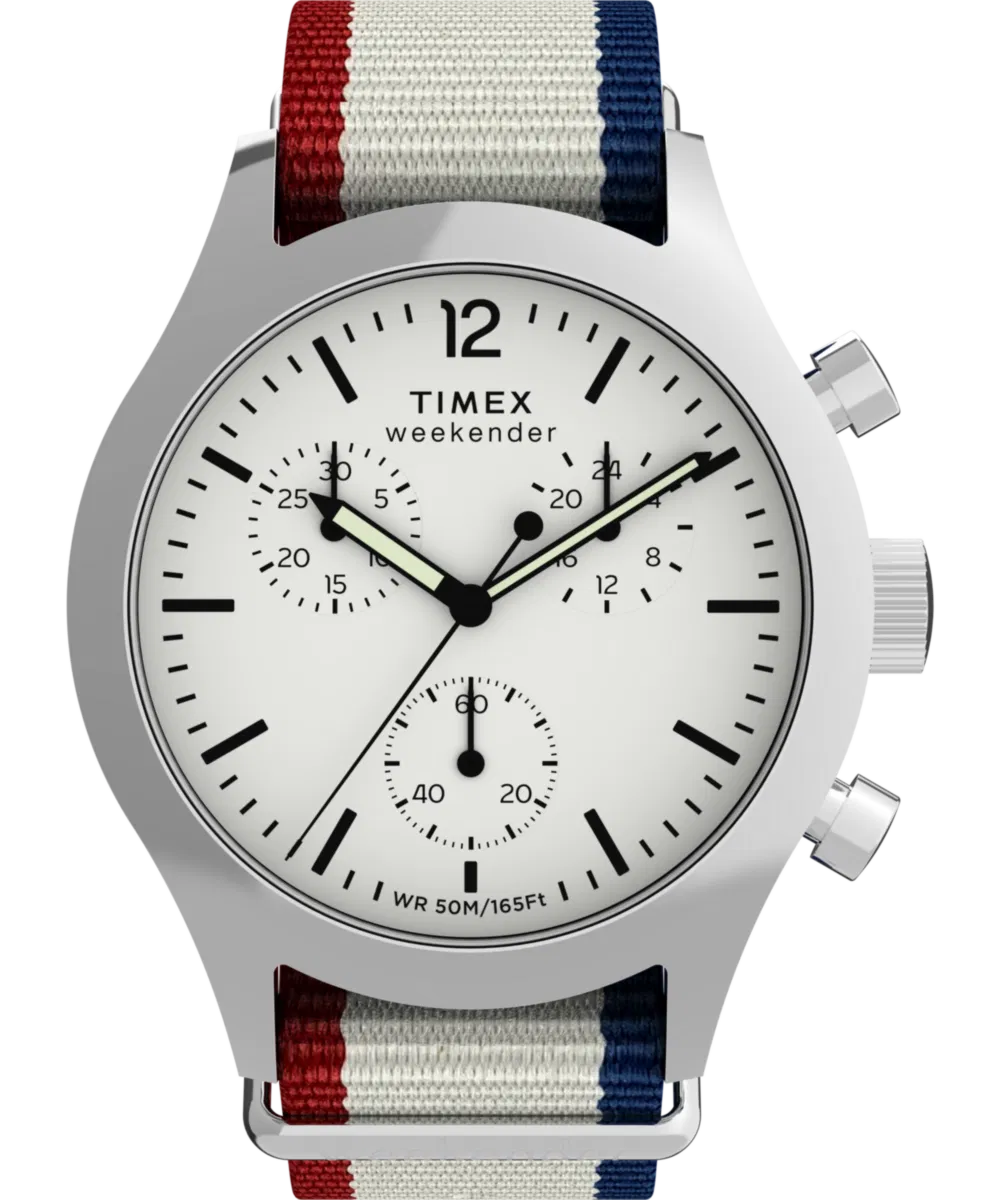
Timex Weekender Chronograph
🔥 Deal of the Day

Timex Weekender Chronograph

Timex

★★★★★ 4.5 (3,041 reviews)

$79
Offer expires in


🔥 Grab This Deal →

Bulova Precisionist


Bulova Precisionist

Bulova

★★★★★ 4.6 (1,100 reviews)

$219


Check Price on Amazon →

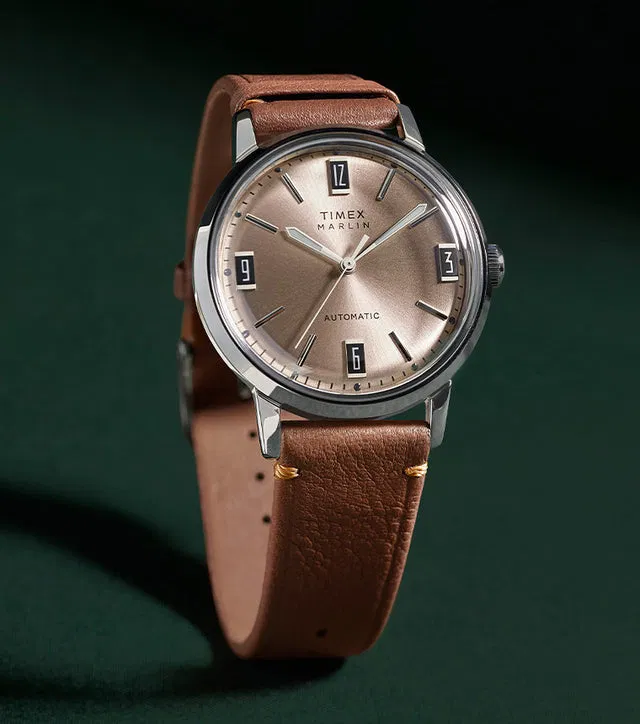
Timex Marlin Automatic 40mm


Timex Marlin Automatic 40mm

Timex

★★★★★ 4.7 (1,106 reviews)

$259


Check Price on Amazon →


Browse all expert-reviewed watches →

ETSY Shop
ETSY Shop
Redbubble Shop
Redbubble Shop
More Watch Facts
More Watch Facts

Watch Fact of the Day: The Omega Speedmaster Was Originally Designed for Auto Racing

The Omega Speedmaster started its journey back in 1957, aimed at motorsport enthusiasts, not astronauts. It was part of Omega’s “Professional Line” with design features like a tachymeter scale for measuring speed, making it a go-to for racers. But plot twist: the Speedmaster ended up being picked for NASA’s Apollo missions, earning its nickname “Moonwatch.” This unexpected shift from the racetrack to space made its story super intriguing. The watch, built for speed on the ground, became legendary for traveling to the Moon. It’s a prime example of how an object’s purpose can evolve dramatically over time.

Watch History: Saturday, September 5, 2026

📅 Saturday, September 5, 2026

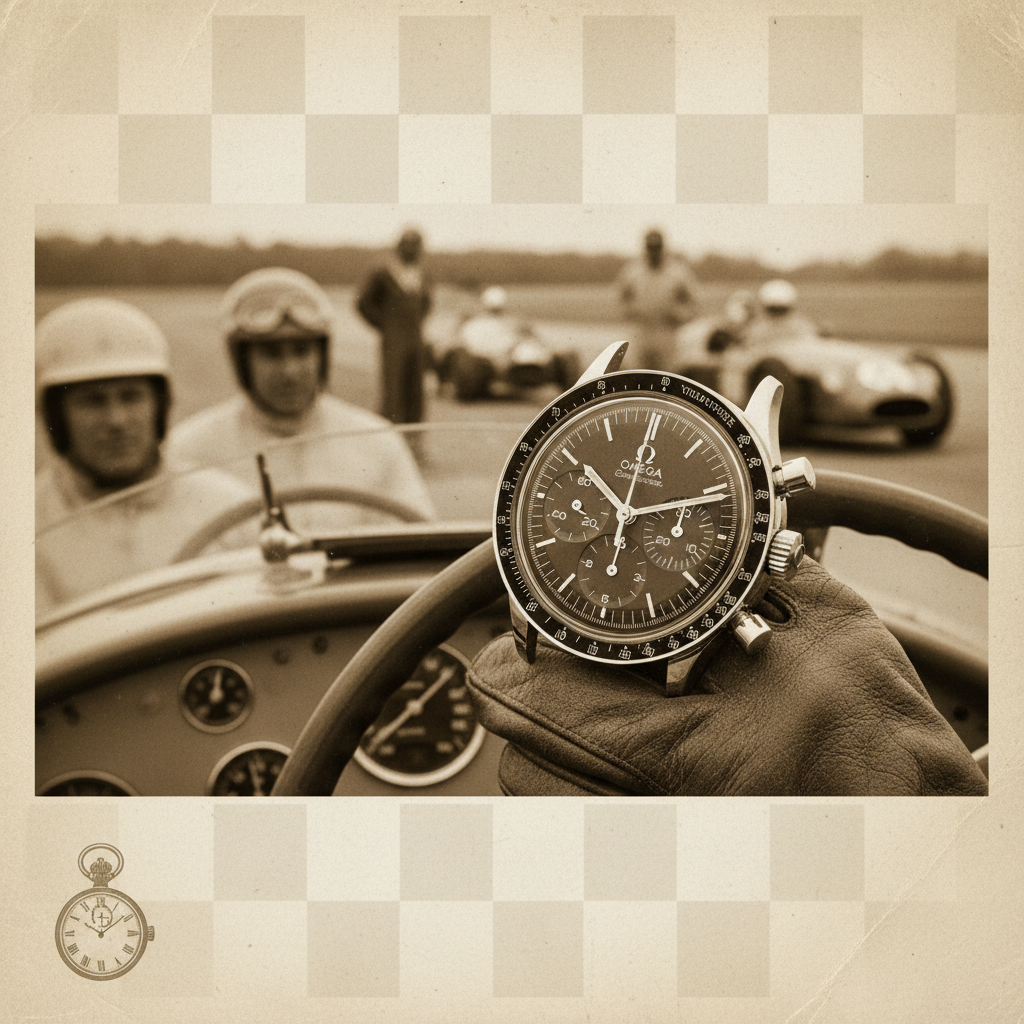
When Omega introduced the Speedmaster in 1957, nobody was designing it with lunar exploration in mind. It debuted as part of Omega’s new “Professional Line,” alongside the Seamaster 300 for divers and the Railmaster for people working around strong magnetic fields. The Speedmaster’s intended arena was much closer to Earth: motorsport and automobile racing.

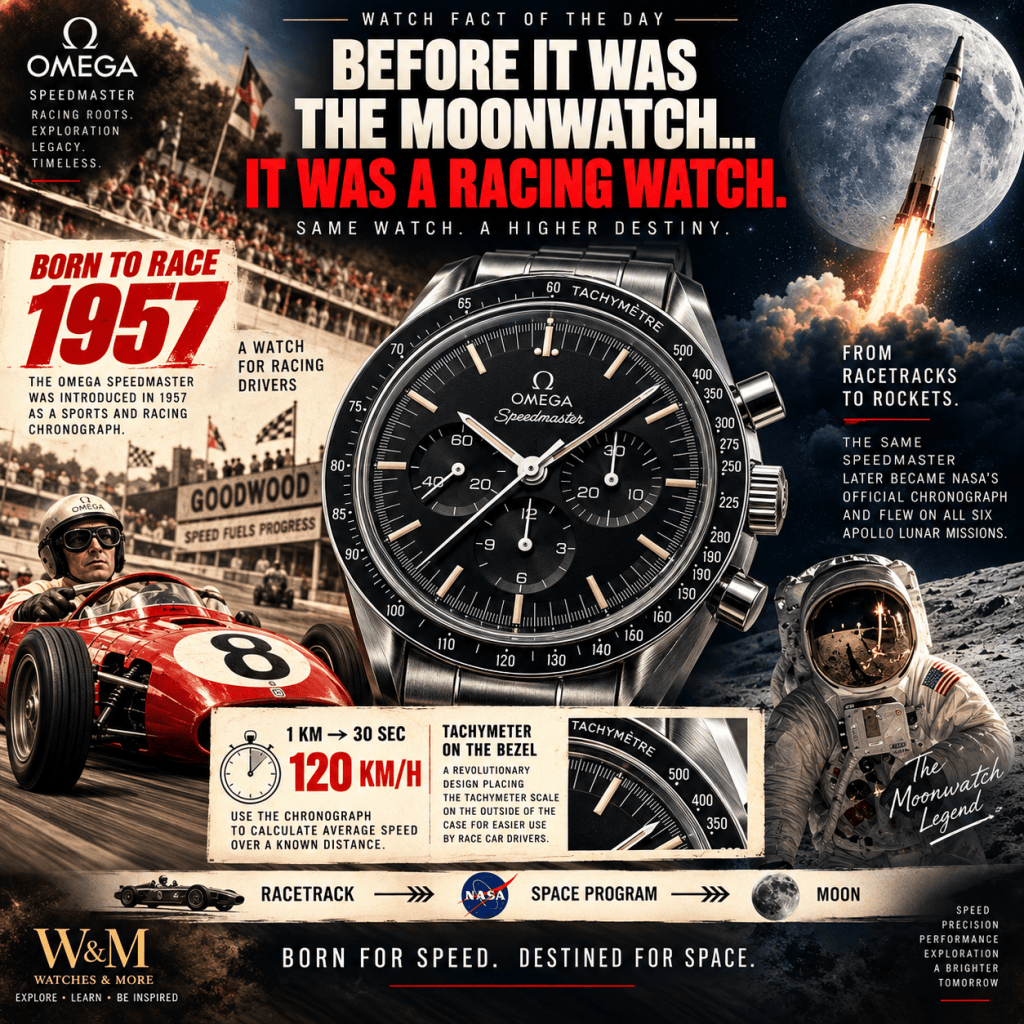
Its name practically gives the game away. The Speedmaster was a chronograph designed to help measure elapsed time and calculate speed, making it naturally suited to drivers, racing enthusiasts and other sporting applications. Central to that identity was its tachymeter scale, positioned prominently around the outside of the dial on the bezel rather than being squeezed onto the dial itself.

That placement became one of the Speedmaster’s most recognizable design features. Used with the chronograph, a tachymeter allows the wearer to calculate average speed over a known distance. Start the chronograph at the beginning of a measured kilometer, stop it at the end, and the chronograph seconds hand indicates the corresponding average speed on the tachymeter scale. Omega’s own instructions still demonstrate the function using the example of calculating the speed of a car over one kilometer.

The original Speedmaster CK2915 therefore looked every bit like a purpose-built sporting instrument: a highly legible dial, chronograph timing capability and that prominent external tachymeter scale. Rather than being born as an astronaut’s watch, its design language belonged to an era of racing circuits, sports cars, stopwatches and increasingly sophisticated wrist chronographs.

And then history took an extraordinary turn.
During the following decade, the Speedmaster found itself being evaluated for an environment its original designers could scarcely have anticipated: spaceflight. The rugged chronograph eventually became associated with NASA’s astronauts and, most famously, the Apollo lunar missions. The racing chronograph had become the Moonwatch.

That’s what makes the Speedmaster’s story so compelling. Omega didn’t sit down in 1957 and attempt to create an icon of space exploration. It created a highly functional sporting chronograph—and the underlying design proved versatile and robust enough to acquire an entirely different identity.

💡 Did You Know?
The Speedmaster’s famous tachymeter isn’t just decoration. Combined with the chronograph, it can calculate average speed over a known distance without electronics, GPS or a speedometer. If a car travels exactly one kilometer in 30 seconds, for example, the chronograph seconds hand points to approximately 120 on the tachymeter scale—meaning an average speed of 120 km/h.

So before we had:
SPEEDMASTER → NASA → APOLLO → MOONWATCH
we had:
RACETRACK → CHRONOGRAPH → TACHYMETER → SPEED
⭐ Why It Matters

The Speedmaster is a wonderful example of how an object’s original purpose doesn’t necessarily determine its legacy. A watch conceived for speed on the ground ultimately became famous for traveling farther from the racetrack than almost any watch imaginable.

Born for the racetrack. Destined for the Moon. 🚗💨⌚🌕


Category: Watch History

Disclaimer: Every effort has been made to keep these watch facts accurate, but the world of horology is full of myths, disputed stories, and fascinating trivia. Consider these facts a starting point for discovery rather than the final word. If you have corrections or additional insights, let us know—we’re always happy to keep the record ticking in the right direction.

🕐 Discover more watch facts, reviews, and buying guides at WatchesAndMore


🛍️ You Might Also Like

As an Amazon Associate and affiliate partner, WatchesAndMore earns from qualifying purchases.

Timex Weekender Chronograph
🔥 Deal of the Day

Timex Weekender Chronograph

Timex

★★★★★ 4.5 (3,041 reviews)

$79

Offer expires in


🔥 Grab This Deal →

Bulova Precisionist


Bulova Precisionist

Bulova

★★★★★ 4.6 (1,100 reviews)

$219


Check Price on Amazon →

Timex Marlin Automatic 40mm


Timex Marlin Automatic 40mm

Timex

★★★★★ 4.7 (1,106 reviews)

$259


Check Price on Amazon →


Browse all 142+ expert-reviewed watches →

Watch Fact of the Day: The Spring Drive’s 28-Year Obstacle Course to Reality

In 1977, Seiko engineer Yoshikazu Akahane kicked off an epic 28-year quest to create the “ever-lasting watch,” merging traditional mainspring mechanics with electric precision. His passion for achieving just one-second accuracy per day led to over 600 prototypes and plenty of challenges. The breakthrough? The Tri-Synchro Regulator, which mixes mechanical, electrical, and electromagnetic energy—no batteries needed! This innovation gave birth to Spring Drive, featuring a smooth, gliding seconds hand instead of the usual ticking one. Sadly, Akahane passed away right before its launch in 1998, but his legacy lives on as a key player in modern watchmaking.

Fun Quirk: Friday, September 4, 2026

📅 Friday, September 4, 2026

In 1977, young Seiko engineer Yoshikazu Akahane began pursuing an idea that sounded almost contradictory: an “ever-lasting watch” powered by a traditional mainspring, yet capable of the extraordinary precision associated with electronic timekeeping. His goal was approximately one second of accuracy per day without abandoning the fundamental spring-driven architecture of mechanical watchmaking. It would become one of the longest and most ambitious development stories in modern horology. Seiko Watch Corporation

The challenge was enormous. Seiko says the journey ultimately stretched across 28 years, countless setbacks and more than 600 prototypes. An early patent application was filed in 1978, but the technology necessary to turn Akahane’s concept into a practical wristwatch simply wasn’t mature enough yet. Improvements in electronics, energy efficiency, mainspring technology and manufacturing would all be necessary before the dream could become reality. Seiko Watch Corporation

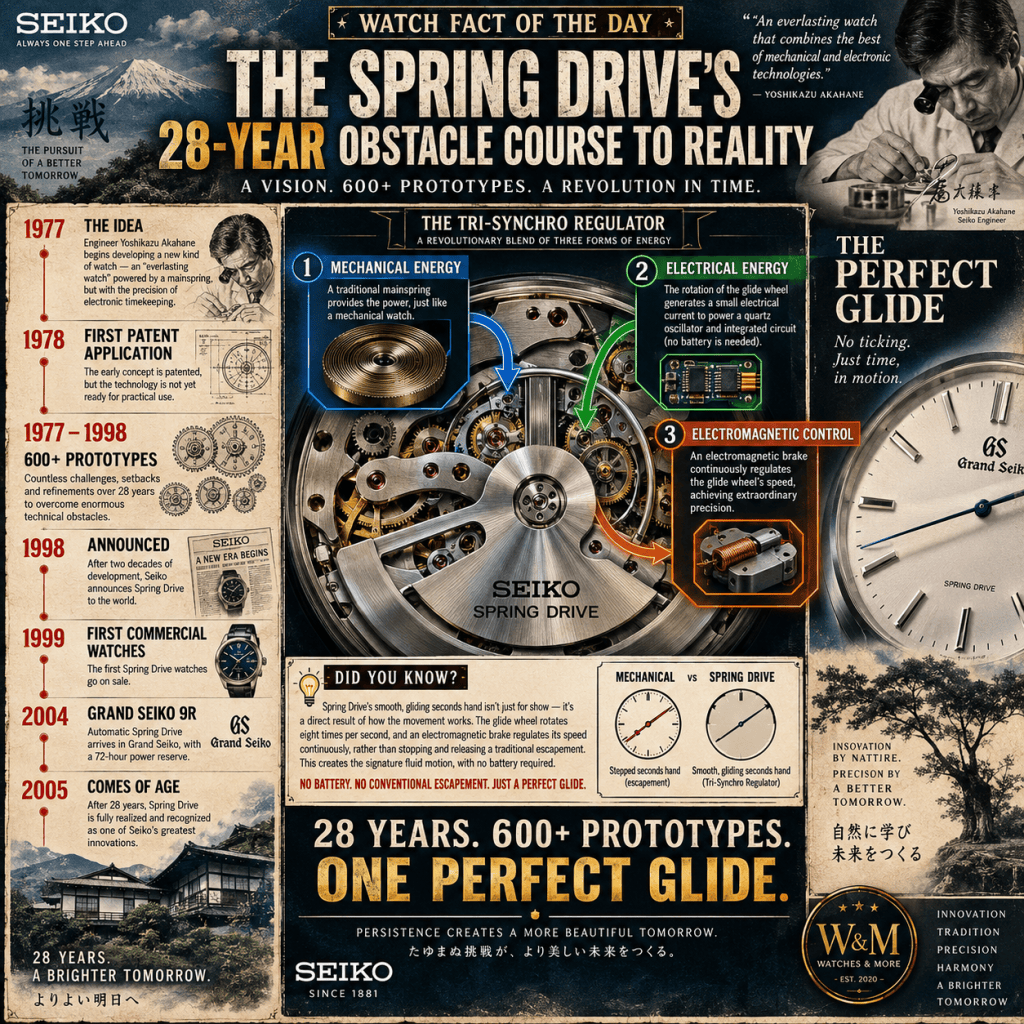
The breakthrough was what became known as the Tri-Synchro Regulator. Instead of a conventional mechanical escapement, Spring Drive coordinates three forms of energy: mechanical, electrical and electromagnetic. The unwinding mainspring drives the gear train and glide wheel; that motion generates a tiny electrical current to power a quartz oscillator and integrated circuit, while an electromagnetic brake regulates the glide wheel’s speed. The watch therefore creates the electricity its regulator requires from the energy already stored in its mainspring. Grand Seiko

And that’s an important distinction: Spring Drive does not contain a battery. Its sole power source is the mainspring. There is no conventional electric motor driving the hands and no secondary battery hidden inside; the electronics exist to regulate the mechanical energy being released through the movement. Grand Seiko

The architecture also created Spring Drive’s most recognizable visual signature: its extraordinary gliding seconds hand. A conventional mechanical watch repeatedly locks and unlocks its gear train through an escapement, producing the familiar series of tiny steps. Spring Drive has no conventional escapement; its glide wheel rotates continuously in one direction, allowing the seconds hand to sweep smoothly and silently around the dial. Seiko Watch Corporation

The timeline is particularly interesting. Spring Drive was announced in 1998 after roughly 20 years of development and 600 prototypes, and the first hand-wound Spring Drive watches followed in 1999. Development continued, however, and in 2004 Grand Seiko introduced the automatic 9R Spring Drive, combining automatic winding, a 72-hour power reserve and one-second-per-day accuracy. Seiko’s broader history describes 2005 as the culmination of the full 28-year journey—the point when “Spring Drive came of age.” Grand Seiko

Sadly, Akahane did not live to see the technology’s commercial success. Grand Seiko records that he died from pneumonia in August 1998, shortly before Spring Drive’s public launch. But the idea he had pursued since 1977 survived him—and eventually became one of Seiko’s defining contributions to modern watchmaking. Grand Seiko

💡 Did You Know?

Spring Drive’s famous smooth seconds hand isn’t simply a cosmetic effect designed to make the watch look different. It is a visible consequence of how the movement regulates time. The glide wheel rotates eight times per second while generating the electricity needed to power the quartz oscillator and IC; an electromagnetic brake continuously controls its speed rather than repeatedly stopping and releasing a traditional escapement. That uninterrupted rotational motion travels through the gear train to produce the mesmerizing glide of the seconds hand.

No battery. No conventional escapement. No ticking seconds hand.

MAINSPRING → ELECTRICITY → QUARTZ REFERENCE → ELECTROMAGNETIC BRAKE → PERFECT GLIDE


Category: Fun Quirk

Disclaimer: Every effort has been made to keep these watch facts accurate, but the world of horology is full of myths, disputed stories, and fascinating trivia. Consider these facts a starting point for discovery rather than the final word. If you have corrections or additional insights, let us know—we’re always happy to keep the record ticking in the right direction.

🕐 Discover more watch facts, reviews, and buying guides at WatchesAndMore


🛍️ You Might Also Like

As an Amazon Associate and affiliate partner, WatchesAndMore earns from qualifying purchases.

Seiko 5 SNK805 Green Military
🔥 Deal of the Day

Seiko 5 SNK805 Green Military

Seiko

★★★★★ 4.8 (6,961 reviews)

$89

Offer expires in


🔥 Grab This Deal →

Seiko 5 SNK809 Automatic


Seiko 5 SNK809 Automatic

Seiko

★★★★★ 4.7 (3,289 reviews)

$99


Check Price on Amazon →

Seiko 5 Sports SRPD55


Seiko 5 Sports SRPD55

Seiko

★★★★★ 4.7 (1,247 reviews)

$275


Check Price on Amazon →


Browse all expert-reviewed watches →

ETSY Shop
ETSY Shop
Redbubble Shop
Redbubble Shop
More Watch Facts
More Watch Facts

Watch Fact of the Day: The Mystery of Zenith’s El Primero Found in an Attic

Back in the early ’70s, Zenith had a rough time during the quartz crisis and decided to destroy all their gear for making the famous El Primero automatic chronograph. But watchmaker Charles Vermot wasn’t about to let that happen. He secretly stashed away the blueprints and tools in the attic, keeping them safe for a decade. Thanks to his sneaky move, the El Primero’s legendary high-frequency movement was preserved and made a comeback when mechanical watches gained popularity again. What a cool story in the watch world! Just a heads up though, watch trivia can get a bit wild, so take these facts with a pinch of salt.

Brand Spotlight: Thursday, September 3, 2026

📅 Thursday, September 3, 2026

During the Quartz Crisis, mechanical watchmaking suddenly looked like yesterday’s technology. In 1975, Zenith’s management decided to cease production of the celebrated El Primero automatic chronograph movement. Charles Vermot, a veteran watchmaker who had worked on the El Primero, believed abandoning it was a terrible mistake—and even wrote to management arguing that mechanical chronographs would someday return to favor. His appeal went unanswered. Zenith Watches

So Vermot did something extraordinary: he disobeyed the order.

Working secretly—and with help from his brother Maurice—Vermot began preserving the specialized equipment required to manufacture the El Primero. Zenith’s own historical account says he saved roughly 150 presses, weighing more than a ton, along with cams, cutting tools, technical drawings, manufacturing plans and other equipment. He carefully catalogued what he saved and moved it, often at night, up 52 steps into a secluded attic area of Zenith’s sprawling manufacture in Le Locle. Zenith Watches

Then came the final touch worthy of a spy movie: the hiding place was walled off. Behind that wall sat the industrial DNA required to manufacture one of watchmaking’s most important chronograph movements. Had those specialized presses and plans disappeared, recreating the El Primero production system would have required enormous investment—and its revival might never have happened. ZENITH Watches

And the movement Vermot was protecting really was special. Introduced in 1969, the El Primero was an integrated automatic chronograph operating at an unusually high 36,000 vibrations per hour, or 5 Hz, allowing its chronograph mechanism to measure elapsed time to one-tenth of a second. It had been one of the landmark movements in the race to develop the automatic chronograph—and only six years later, its production was being abandoned. Zenith Watches

Vermot’s gamble eventually paid off. Zenith returned to Swiss ownership in 1978, and demand for prestigious mechanical chronographs began recovering during the following years. Ebel became an important early customer for existing El Primero movements, and Zenith ultimately restarted El Primero production in 1984 using the manufacturing knowledge and equipment Vermot had preserved. Later, the movement would gain another extraordinary chapter when a modified El Primero became the basis of the automatic Rolex Daytona beginning in 1988. Zenith Watches

The wonderful part of the story is that Vermot wasn’t preserving a museum exhibit. He preserved an entire manufacturing capability—the plans, tooling and knowledge necessary to make the movement again. Zenith today calls him the “saviour” of the El Primero, and the manufacture still celebrates the secret attic where he hid everything.


💡 Did You Know?

When Charles Vermot secretly saved the El Primero, he wasn’t simply hiding a few blueprints in a desk drawer. He preserved roughly 150 presses, along with specialized cams, cutting tools, technical drawings and manufacturing plans—equipment weighing more than a ton—and helped move it up 52 steps into a hidden section of Zenith’s attic. By carefully cataloguing what he saved, Vermot preserved not just the design of the El Primero, but much of the industrial know-how needed to manufacture it again. When mechanical chronographs returned to favor, Zenith could revive production rather than reconstruct the movement’s manufacturing process from scratch.

One man didn’t just save a movement—he saved the ability to make it. ⌚⚙️🔥

Category: Brand Spotlight

Disclaimer: Every effort has been made to keep these watch facts accurate, but the world of horology is full of myths, disputed stories, and fascinating trivia. Consider these facts a starting point for discovery rather than the final word. If you have corrections or additional insights, let us know—we’re always happy to keep the record ticking in the right direction.

🕐 Discover more watch facts, reviews, and buying guides at WatchesAndMore


🛍️ You Might Also Like

As an Amazon Associate and affiliate partner, WatchesAndMore earns from qualifying purchases.

Timex Weekender Chronograph
🔥 Deal of the Day

Timex Weekender Chronograph

Timex

★★★★★ 4.5 (3,041 reviews)

$79

Offer expires in


🔥 Grab This Deal →

Bulova Precisionist


Bulova Precisionist

Bulova

★★★★★ 4.6 (1,100 reviews)

$219


Check Price on Amazon →

Timex Marlin Automatic 40mm


Timex Marlin Automatic 40mm

Timex

★★★★★ 4.7 (1,106 reviews)

$259


Check Price on Amazon →


Browse all 142+ expert-reviewed watches →

Watch Fact of the Day: The Cartier Tank Was Inspired by a WWI Military Tank

In a twist of historical irony, Louis Cartier reimagined military might into wrist candy when he designed the Cartier Tank in 1917, inspired by a tank’s silhouette. Forget round watches; it’s all about those sleek, parallel brancards representing tank tracks while the case resembles a cozy cabin. This watch isn’t just a pretty face; its bold straight lines and architectural vibe broke the mold of traditional designs and made it a timeless beauty. Over a century later, the Tank still exudes elegance, all while its military origins chuckle in the background. Who knew war machines could look so chic?

Brand Spotlight: Tuesday, September 1, 2026

📅 Tuesday, September 1, 2026

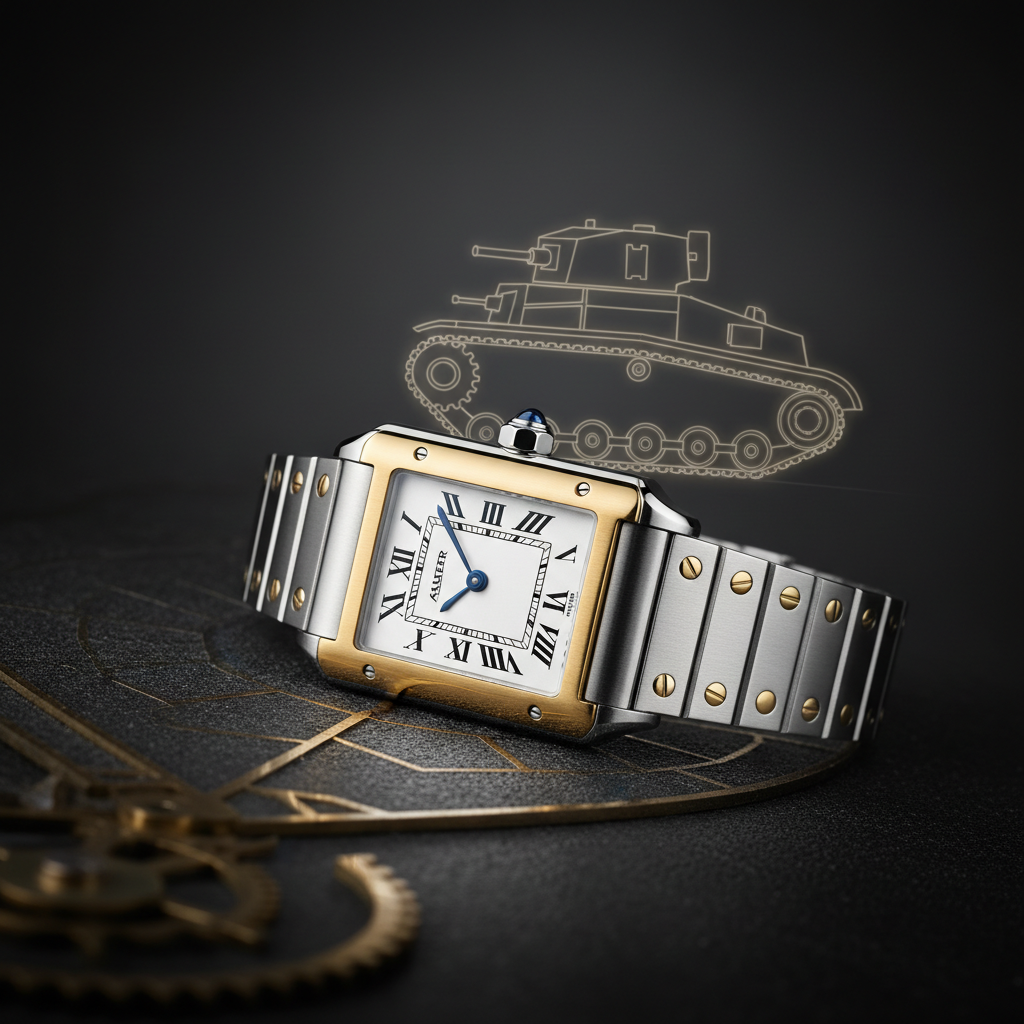
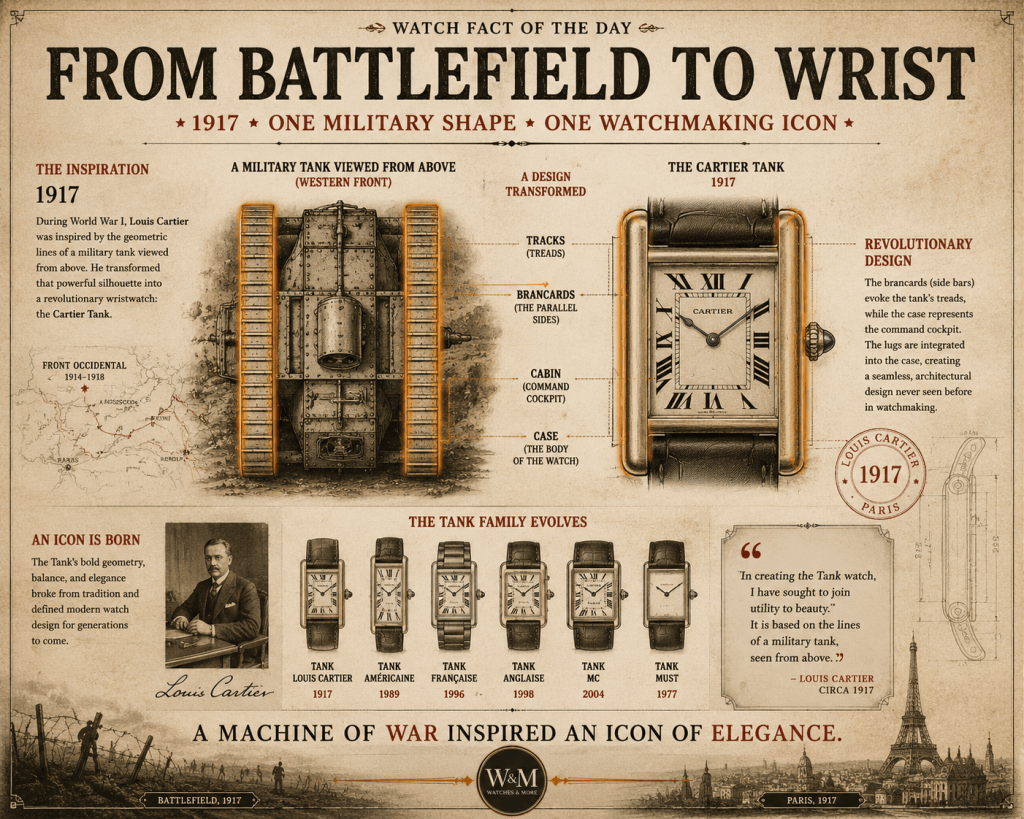
In 1917, while the First World War was still raging across Europe, Louis Cartier created one of the most enduring shapes in watchmaking history. Rather than following the traditional round form of the pocket watch, Cartier drew inspiration from the stark geometry of a military tank viewed from above. The result was a wristwatch whose architecture transformed the machinery of war into something remarkably refined. Denali Development

Look at a Cartier Tank from above and the connection becomes much easier to see. According to Cartier, the watch’s two long parallel brancards represent the tank’s tracks, while the central case corresponds to the vehicle’s cabin. Those brancards became one of the Tank’s defining visual signatures and remain fundamental to the design more than a century later. Denali Development

Infographic detailing the history and design inspiration of the Cartier Tank watch, highlighting its connection to military tanks from World War I and showcasing different models over the years.

But Louis Cartier did more than borrow the silhouette of an armored vehicle. The Tank introduced an important design principle: the case flows directly into the bracelet or strap attachments without interrupting the visual rhythm. Cartier describes the design as moving from the square of the dial toward the rectangle of the bracelet, creating an unusually unified relationship between case and strap. Cartier

That geometry was radical for its time. Watches still carried much of the visual language of round pocket watches, while the Tank embraced straight lines, symmetry and architectural proportions. Its rectangular dial, Roman numerals, chemin-de-fer minute track and distinctive parallel sides helped create a watch that looked unmistakably modern—yet would prove remarkably resistant to changing fashion.

The Tank also became the foundation for an entire family of designs. Cartier continued experimenting with its proportions, eventually producing interpretations including the Tank Louis Cartier, Tank Américaine and Tank Française, while retaining those fundamental parallel brancards that visually connect them to the original idea. Denali Development

More than a century later, that’s perhaps the greatest surprise of the Tank. A design whose inspiration came from one of the most imposing machines of World War I became an enduring symbol of elegance, restraint and sophisticated watch design.

💡 Did You Know?

The Tank’s military inspiration isn’t merely watch-world folklore. Cartier itself describes the design using exactly this visual relationship: the brancards correspond to the tracks and the case to the vehicle’s cabin.


Category: Brand Spotlight

Disclaimer: Every effort has been made to keep these watch facts accurate, but the world of horology is full of myths, disputed stories, and fascinating trivia. Consider these facts a starting point for discovery rather than the final word. If you have corrections or additional insights, let us know—we’re always happy to keep the record ticking in the right direction.

🕐 Discover more watch facts, reviews, and buying guides at WatchesAndMore


🛍️ You Might Also Like

As an Amazon Associate and affiliate partner, WatchesAndMore earns from qualifying purchases.

Timex Weekender Chronograph
🔥 Deal of the Day

Timex Weekender Chronograph

Timex

★★★★★ 4.5 (3,041 reviews)

$79

Offer expires in


🔥 Grab This Deal →

Bulova Precisionist


Bulova Precisionist

Bulova

★★★★★ 4.6 (1,100 reviews)

$219


Check Price on Amazon →

Timex Marlin Automatic 40mm


Timex Marlin Automatic 40mm

Timex

★★★★★ 4.7 (1,106 reviews)

$259


Check Price on Amazon →


Browse all 142+ expert-reviewed watches →

ETSY Shop
ETSY Shop
Redbubble Shop
Redbubble Shop
More Watch Facts
More Watch Facts

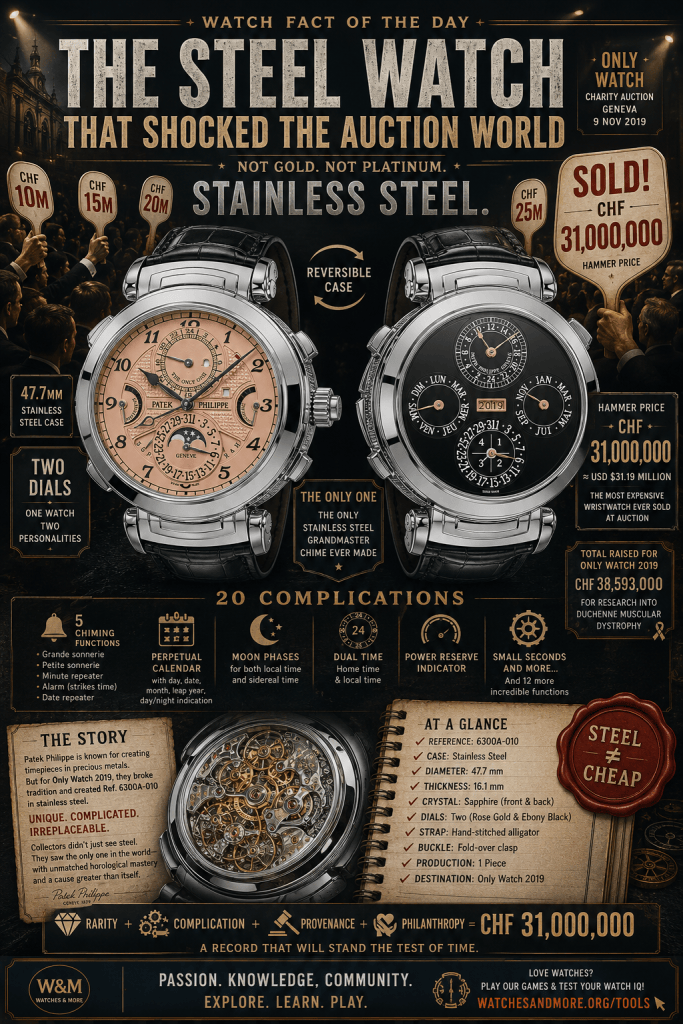
Watch Fact of the Day: The Steel Patek That Shocked the Auction World

Patek Philippe is renowned for precious metals, but when a unique stainless steel Grandmaster Chime was forged for charity, it shattered expectations. Featuring

The Steel Patek That Shocked the Auction World

📅 Sunday, August 30, 2026

Patek Philippe is renowned for precious metals, but when a unique stainless steel Grandmaster Chime was forged for charity, it shattered expectations. Featuring 20 complications and a reversible case, this one-of-a-kind masterpiece fetched a staggering $31.19 million at a 2019 auction, making it the most expensive wristwatch ever sold.


Patek Philippe is synonymous with precious metals and traditional haute horlogerie, but in 2019 the manufacture created something deliberately extraordinary for the Only Watch charity auction: Grandmaster Chime Reference 6300A-010, the first and only version of the Grandmaster Chime produced in stainless steel. In a world where steel would normally be considered less intrinsically valuable than gold or platinum, its uniqueness made it considerably more tantalizing to collectors. Christie’s

And this wasn’t simply a special case wrapped around an ordinary watch. The Grandmaster Chime contains an astonishing 20 complications, making it Patek Philippe’s most complicated wristwatch. Among them are five acoustic functions: grande sonnerie, petite sonnerie, minute repeater, an alarm that actually strikes the programmed time, and a date repeater capable of acoustically sounding the date on demand. Patek identifies the alarm-with-time-strike and date repeater as patented world exclusives. Patek Philippe SA

Then there’s the case itself. The enormous 47.7 mm stainless-steel case uses a patented reversing mechanism, allowing the wearer to rotate the watch and display either of its two faces. One side features a rose-gold-colored dial with applied Breguet numerals; the calendar side is black ebony. Despite the steel exterior, Christie’s specifies that the actual dial plates are made from 18K solid gold. Christie’s

Patek made the Only Watch edition unmistakably unique in another wonderfully unsubtle way. On the alarm subdial appeared three words:

“THE ONLY ONE.”

And it really was. Reference 6300A-010 was created specifically for Only Watch 2019, with Christie’s describing it as the one and only stainless-steel Grandmaster Chime. Christie’s

Then came November 9, 2019, at Christie’s in Geneva. The bidding climbed through territory normally associated with historically important paintings rather than wristwatches. When it finally ended, the hammer had reached an extraordinary:

CHF 31,000,000

That was approximately US$31.1 million, and it established a new world auction record for any watch, not merely a wristwatch. The previous wristwatch auction record had belonged to Paul Newman’s Rolex Daytona, while the famous Patek Philippe Henry Graves Supercomplication had held the broader watch record. The steel Grandmaster Chime surpassed them both. Christie’s

And there’s another reason the result mattered: Only Watch is a charity auction. The event was established to raise funds for research into Duchenne muscular dystrophy, and Christie’s reported that the 2019 auction generated CHF 38,593,000 in total. That means this single Patek accounted for the overwhelming majority of the entire sale’s proceeds. Christie’s

⭐ Why It Matters

The extraordinary irony is that steel helped make the watch more valuable, not less. In ordinary material terms, stainless steel is nowhere near as precious as gold or platinum. But collectors weren’t buying raw material—they were competing for uniqueness, complication, provenance and historical significance.

Category: Record Breaker

Disclaimer: Every effort has been made to keep these watch facts accurate, but the world of horology is full of myths, disputed stories, and fascinating trivia. Consider these facts a starting point for discovery rather than the final word. If you have corrections or additional insights, let us know—we’re always happy to keep the record ticking in the right direction.

🕐 Discover more watch facts, reviews, and buying guides at WatchesAndMore


🛍️ You Might Also Like

As an Amazon Associate and affiliate partner, WatchesAndMore earns from qualifying purchases.

Casio MDV106-1A Duro
🔥 Deal of the Day

Casio MDV106-1A Duro

Casio

★★★★★ 4.6 (8,934 reviews)

$59

Offer expires in


🔥 Grab This Deal →

Seiko 5 Sports SRPD55


Seiko 5 Sports SRPD55

Seiko

★★★★★ 4.7 (1,247 reviews)

$275


Check Price on Amazon →

Citizen Promaster Diver


Citizen Promaster Diver

Citizen

★★★★★ 4.7 (2,192 reviews)

$299


Check Price on Amazon →


Browse all expert-reviewed watches →

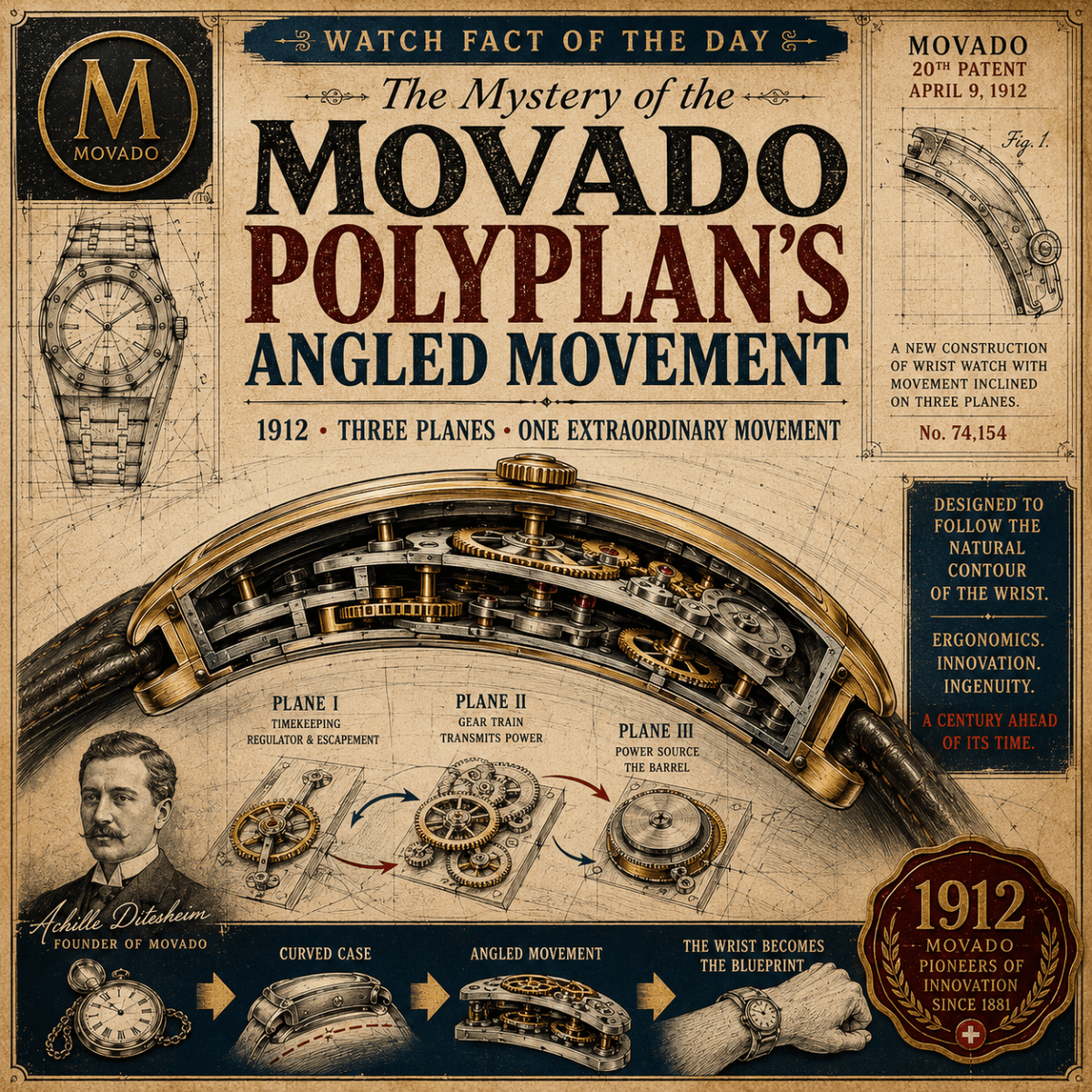
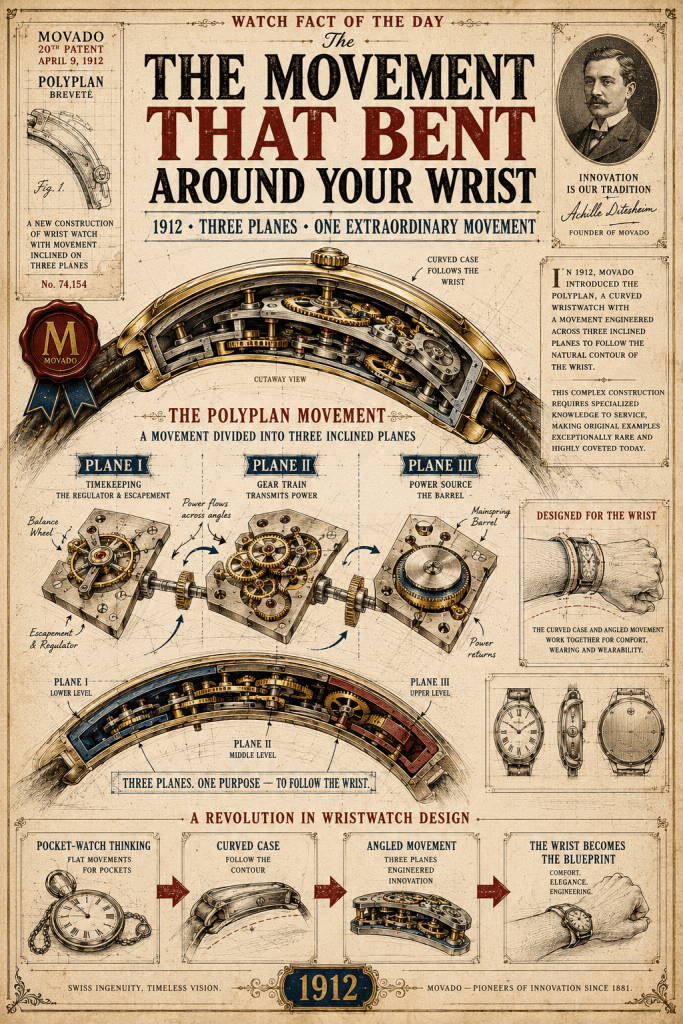
Watch Fact of the Day: The Mystery of the Movado Polyplan’s Angled Movement

Back in 1912, Movado unleashed the Polyplan, a wristwatch that curved and twisted the rules of horology into a pretzel. Unlike flat movements that play nice, the Polyplan’s guts danced across three levels, fitting the wrist like a glove while making any watchmaker cringe in terror at the thought of repairs. Imagine trying to fix a Rubik’s Cube one-handed! Movado wasn’t just thinking outside the box; they flipped the box and sculpted it to the wrist. Fast forward a century, and their quirky innovation seems almost futuristic. Who knew wristwatches could be so avant-garde, or that they’d make a pocket watch feel ancient?

Fun Quirk: Saturday, August 29, 2026

📅 Saturday, August 29, 2026

In 1912, Movado introduced the Polyplan, an extraordinary wristwatch featuring a curved case and a specially engineered movement divided into three inclined planes to fit the wrist ergonomically. Because of this complex construction, watchmakers found them nearly impossible to service, making surviving original examples some of the rarest and most coveted vintage curiosities today.


In 1912, Movado introduced one of the strangest and most ingenious early wristwatch constructions ever attempted: the Polyplan. Rather than placing an ordinary flat movement inside a curved case, Movado engineered the movement itself around the shape of the watch. Its components were arranged across three separate planes positioned at angles to one another, allowing the entire mechanism to follow a case curved around the natural contour of the wrist. The breakthrough was significant enough to earn Movado its 20th patent that year. Movado

That distinction is what makes the Polyplan so fascinating. A conventional movement wants to occupy a single flat plane: mainspring, gear train, escapement and balance are normally organized around one relatively straightforward architecture. The Polyplan instead treated the movement almost like a tiny mechanical structure built around a bend. Different functional sections occupied different levels, yet they still had to transmit power reliably from one part of the movement to another.

The result was an extraordinarily futuristic idea for 1912. Wristwatches themselves were still fighting for acceptance in an era dominated by pocket watches, yet Movado was already asking a remarkably modern ergonomic question: why should the wrist conform to the watch when the watch could conform to the wrist? The elongated curved case hugged the arm rather than sitting like a small flat pocket watch strapped on top of it. Movado’s own history describes the movement as being angled specifically to follow the wrist’s natural contours. Movado

And this is where I’d slightly soften one part of our original fact. I couldn’t verify from a strong primary source that watchmakers historically considered Polyplans “nearly impossible to service.” It’s completely believable that their unusual architecture makes restoration exceptionally specialized, but I’d present that as a consequence of the construction rather than a documented period claim. The safer—and arguably cooler—point is that servicing one requires dealing with a movement whose geometry is fundamentally unlike an ordinary flat calibre.

The Polyplan also wasn’t the end of Movado’s experimentation with wrist-conforming movements. The company later developed the Curviplan, which Movado describes as a reinterpretation of the Polyplan concept in a slimmer form, again using a movement carefully designed to exploit the available space inside the case. The Polyplan therefore wasn’t simply an eccentric one-off—it established an engineering idea that Movado would revisit. Movado

Today, the Polyplan feels almost startlingly contemporary. Modern watchmakers regularly talk about ergonomics, integrated architecture and designing movements specifically around unusual cases. Movado was wrestling with precisely that challenge more than a century ago. Instead of taking a movement and designing a watch around it, the Polyplan effectively reversed the equation: design the watch for the human wrist—and engineer the movement to fit.

📖 Collector’s Note

The name itself gives away the secret: Polyplan—multiple planes. The watch wasn’t merely curved on the outside. Its mechanical architecture was deliberately divided across three inclined planes inside. That’s why a side-profile or cutaway illustration tells the Polyplan story far better than a normal straight-on photograph ever could.

Category: Fun Quirk

Disclaimer: Every effort has been made to keep these watch facts accurate, but the world of horology is full of myths, disputed stories, and fascinating trivia. Consider these facts a starting point for discovery rather than the final word. If you have corrections or additional insights, let us know—we’re always happy to keep the record ticking in the right direction.

🕐 Discover more watch facts, reviews, and buying guides at WatchesAndMore


🛍️ You Might Also Like

As an Amazon Associate and affiliate partner, WatchesAndMore earns from qualifying purchases.

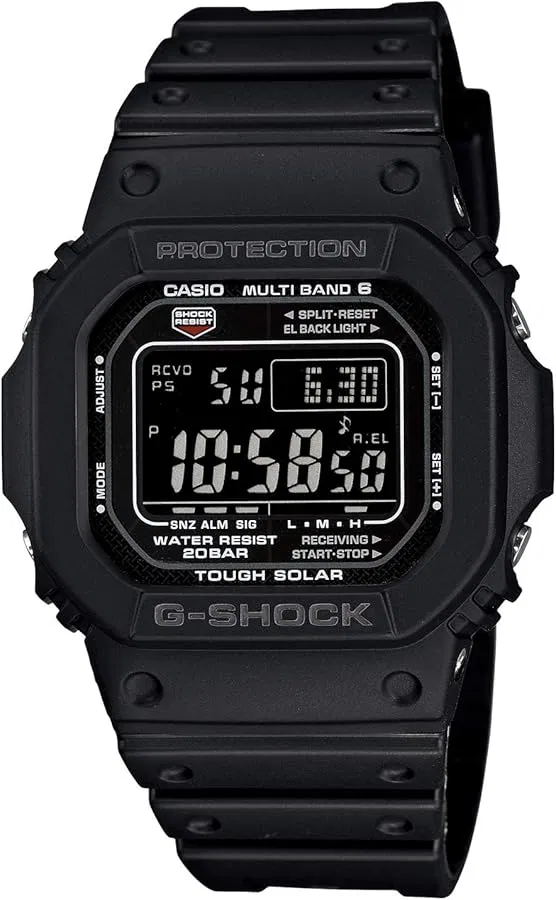
G-Shock GWM5610-1 Solar Atomic
🔥 Deal of the Day

G-Shock GWM5610-1 Solar Atomic

Casio

★★★★★ 4.8 (5,621 reviews)

$129

Offer expires in


🔥 Grab This Deal →

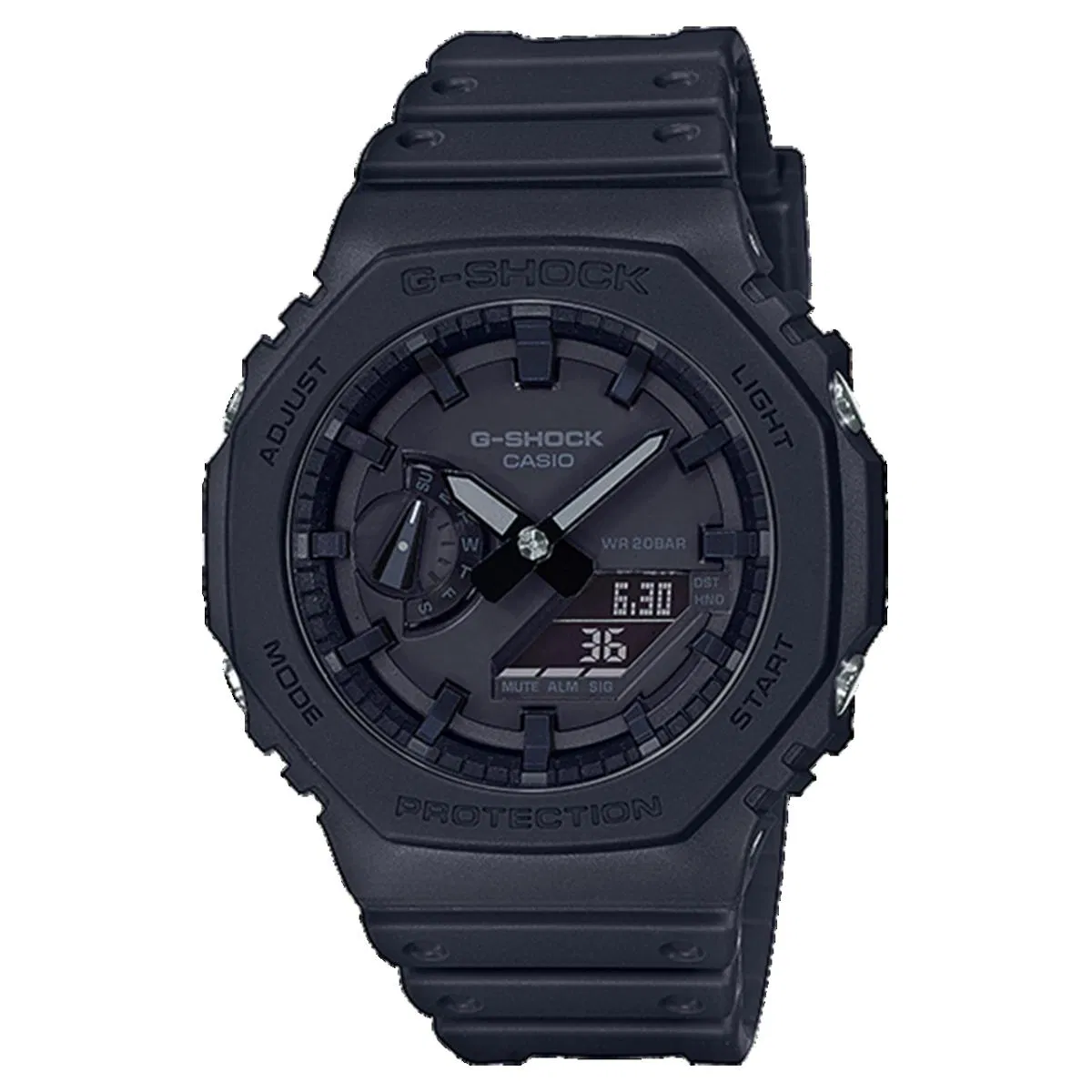
G-Shock GA2100-1A1 CasiOak


G-Shock GA2100-1A1 CasiOak

Casio

★★★★★ 4.8 (2,156 reviews)

$99


Check Price on Amazon →

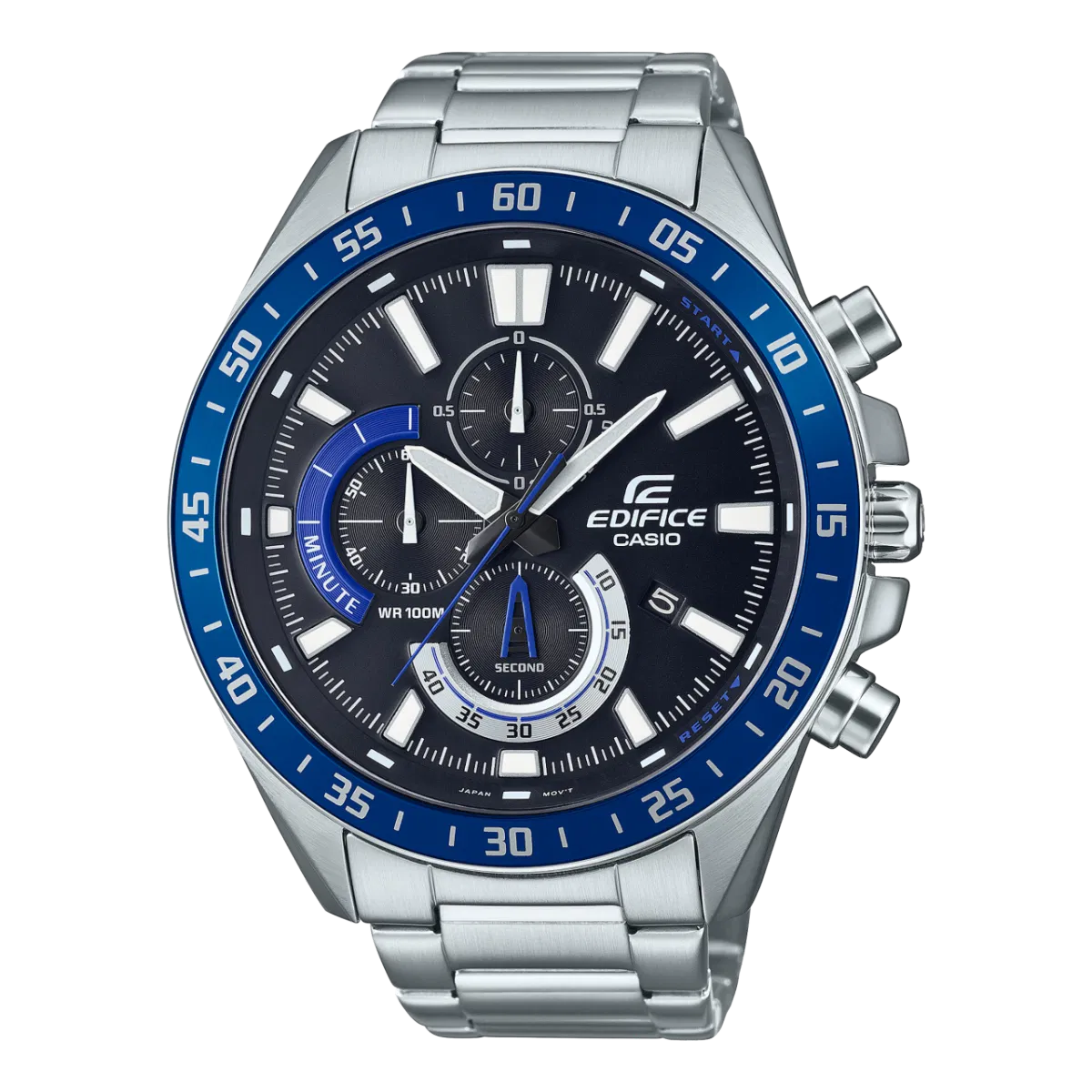
Casio Edifice Chronograph


Casio Edifice Chronograph

Casio

★★★★★ 4.7 (1,264 reviews)

$120


Check Price on Amazon →


Browse all expert-reviewed watches →

Watch Fact of the Day: The Ventura Made Electricity Wearable

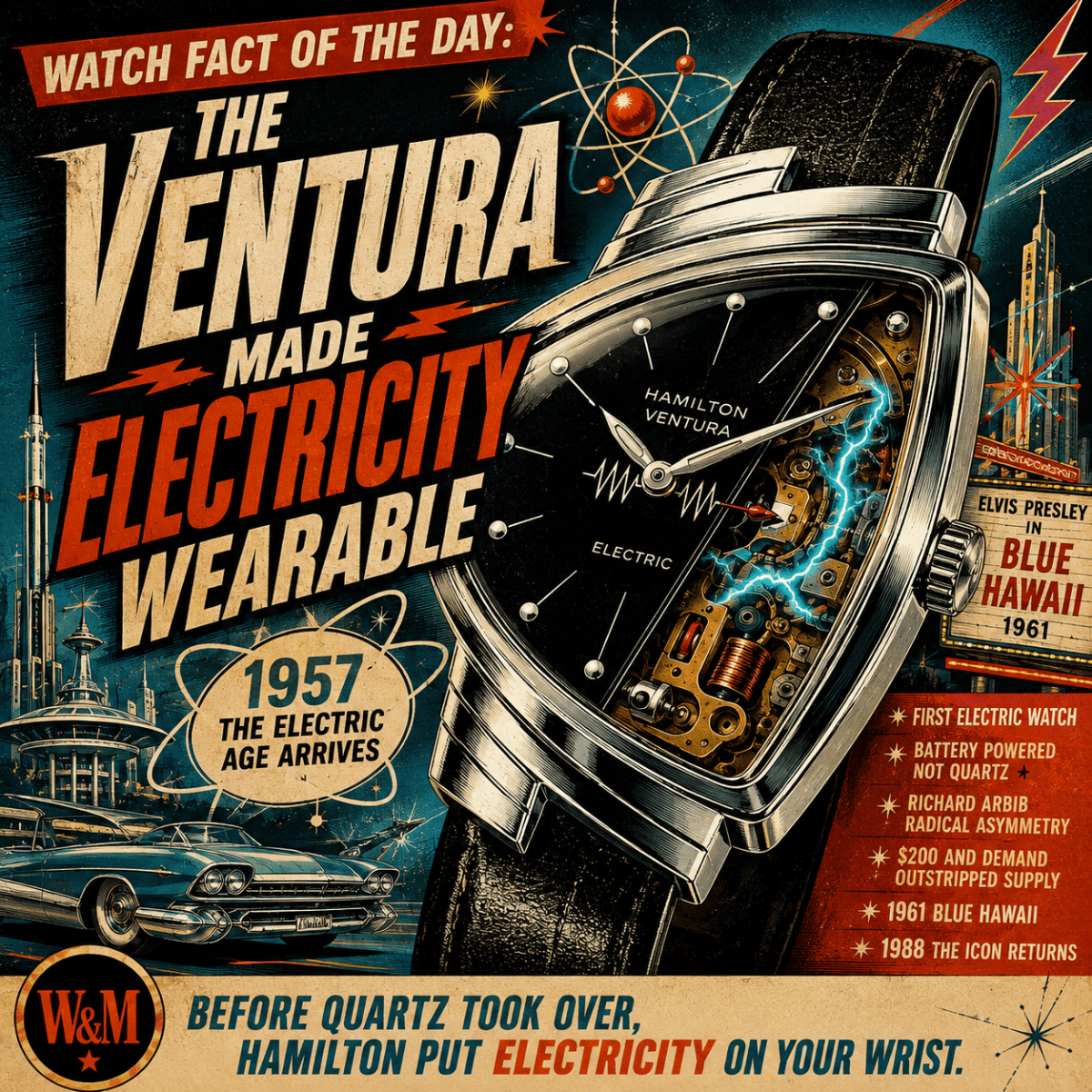
In 1957, Hamilton launched the Ventura, a watch so futuristic it looked like it escaped from a sci-fi flick or a 1950s car showroom. This beauty was heralded as the world’s first electric watch—because who needs winding when you can have a battery? If that wasn’t enough, Elvis Presley donned one in Blue Hawaii, forever linking rock ‘n’ roll with timekeeping. Demand skyrocketed despite its hefty price tag, proving people were willing to shell out serious cash for a glimpse of the future on their wrist. Fast forward to 1988, and voilà, the Ventura rebounded, proving that good design never goes out of style.

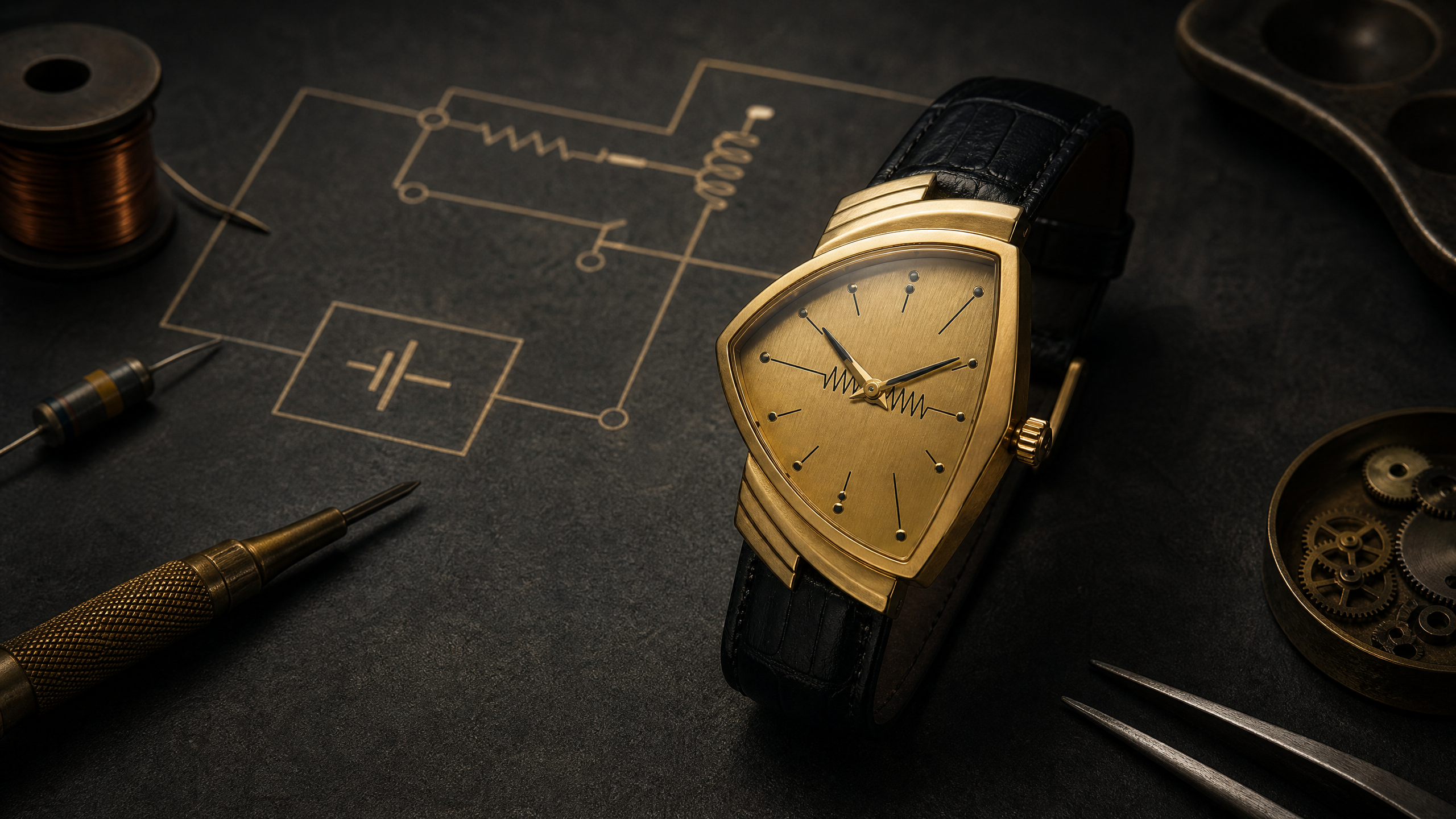
Original editorial illustration inspired by the 1957 Hamilton Ventura electric watch

📅 Wednesday, August 27, 2026

Hamilton introduced the Ventura in 1957, pairing an electric circuit with an asymmetric case created by designer Richard Arbib. Hamilton identifies the Ventura as the first electric watch: a battery supplied power to an electromechanical movement rather than the quartz technology that arrived later. The watch’s bold shape also became part of screen history when Elvis Presley wore a Ventura in the 1961 film Blue Hawaii.

Source note: Hamilton’s Ventura history describes the original 1957 model, its electric circuit, Richard Arbib-designed case, and its appearance in Blue Hawaii.


In 1957, Hamilton unveiled a wristwatch that looked as revolutionary as the technology hidden inside it. The Ventura combined a battery-powered electric movement with an extraordinary asymmetric case created by American industrial designer Richard Arbib. Hamilton calls it the world’s first electric watch, representing a major break from centuries of watches whose energy ultimately came from a wound mainspring. Hamilton Watch

The important distinction is that the Ventura was electric, not quartz. Its battery provided the energy, but this was still an electromechanical watch with moving timekeeping components. The quartz revolution—with a quartz crystal serving as the regulating oscillator—was still more than a decade away. Hamilton says development of its electric watch technology had occupied its engineers for approximately ten years before the Ventura was finally revealed. Hamilton Watch

And then there was that case. Hamilton gave Arbib extraordinary creative freedom, effectively asking him to design without worrying about conventional manufacturing practicality. His futuristic, shield-like asymmetric form looked more like something from a 1950s concept car or science-fiction illustration than a traditional wristwatch. Hamilton then had to solve the practical problems of actually manufacturing it—including forming the unusual case, positioning the crown and attaching the strap or bracelet. Hamilton Watch

The public noticed. Hamilton’s historical material says demand outstripped supply, despite an original price of approximately $200—serious money for a wristwatch in 1957. The combination was unusually powerful: Hamilton wasn’t simply putting new technology inside a conventional case. It gave the electrical age a visual identity that looked deliberately futuristic. Hamilton Watch

Four years later, the Ventura acquired another piece of cultural immortality. Elvis Presley wore one in the 1961 film Blue Hawaii, connecting one of America’s most unconventional watches with one of America’s most unconventional entertainers. The association became so strong that collectors would eventually nickname the Ventura “the Elvis watch.” Hamilton also records that a personal white-gold Ventura belonging to Presley later entered its museum collection. Hamilton Watch

The original Ventura remained in production for seven years before being discontinued. Yet its shape had become too recognizable to disappear permanently. Hamilton revived the design in 1988, and the Ventura has remained part of the brand’s identity ever since, spawning quartz, automatic and other interpretations while retaining Arbib’s unmistakable asymmetric silhouette. Hamilton Watch

⚡ Did You Know?

The Ventura arrived 12 years before 1969’s famous quartz-watch breakthrough. Its battery didn’t vibrate a quartz crystal; it powered an earlier generation of electromechanical timekeeping. That makes the Ventura a fascinating technological bridge between the traditional mechanical wristwatch and the electronic revolution that would transform the watch industry in the decades ahead.

Category: Watch History

Disclaimer: Every effort has been made to keep these watch facts accurate, but the world of horology is full of myths, disputed stories, and fascinating trivia. Consider these facts a starting point for discovery rather than the final word. If you have corrections or additional insights, let us know—we’re always happy to keep the record ticking in the right direction.

🕐 Discover more watch facts, reviews, and buying guides at WatchesAndMore

ETSY Shop
ETSY Shop
Redbubble Shop
Redbubble Shop
More Watch Facts
More Watch Facts

Watch Fact of the Day: How Breguet Sold Time by Subscription

In a time when getting a watch would take as long as waiting for that pizza delivery guy who’s “10 minutes away,” Abraham-Louis Breguet cleverly introduced the subscription watch in 1796. With a mere quarter of the price upfront – a deal even your favorite online retailer would approve of – he snagged a broader audience beyond snooty aristocrats. The minimalist Souscription watch was simple, reliable, and sported just one hand, making it the OG of wristwatch functionality. Fast forward to today, and Breguet’s still at it! They celebrated their 250th with a fresh twist on that classic, proving some ideas are timeless—like pizza deliveries!

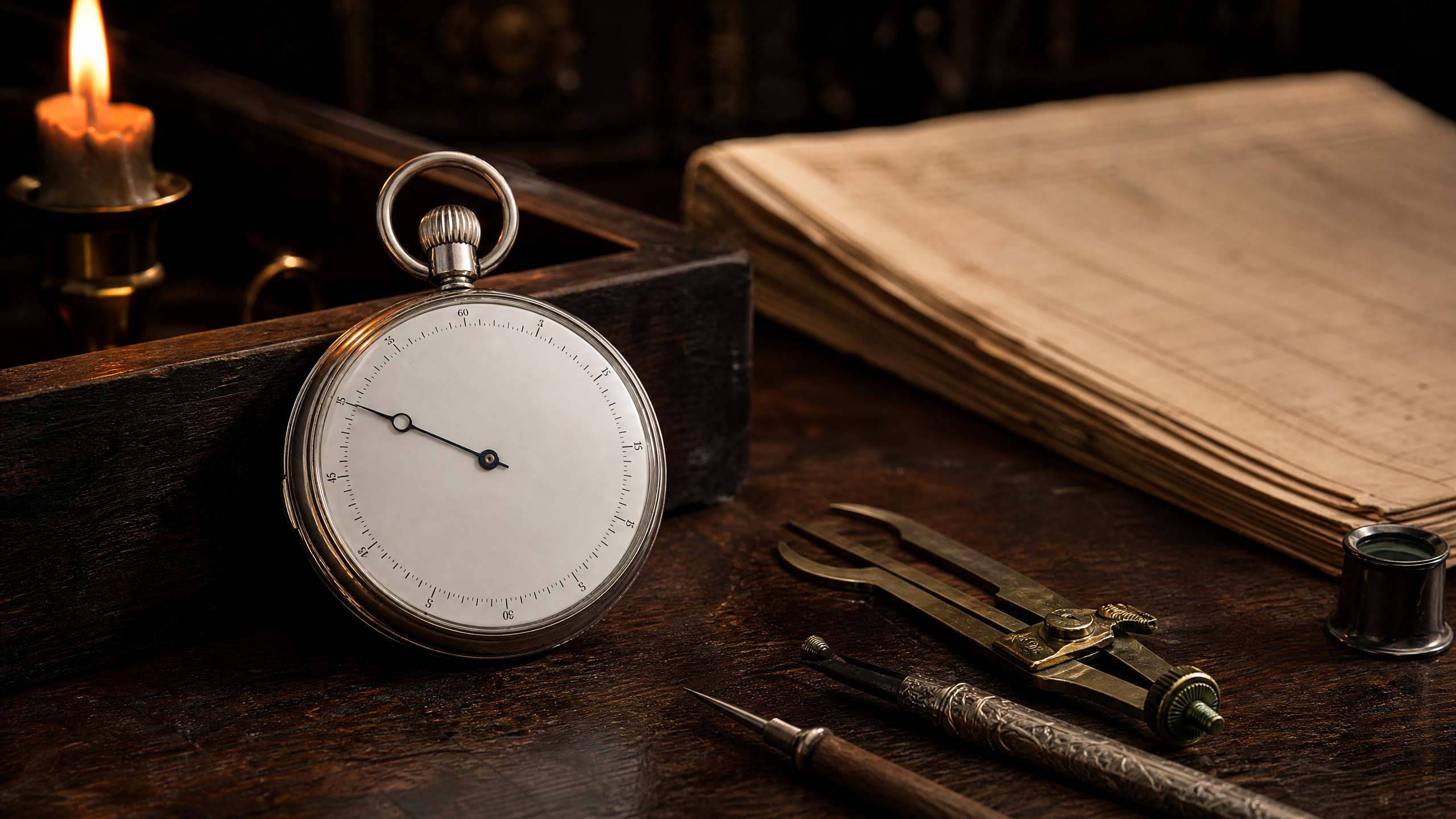
Historically inspired single-hand pocket watch with a white enamel dial on an eighteenth-century watchmaker's desk

📅 Monday, August 25, 2026

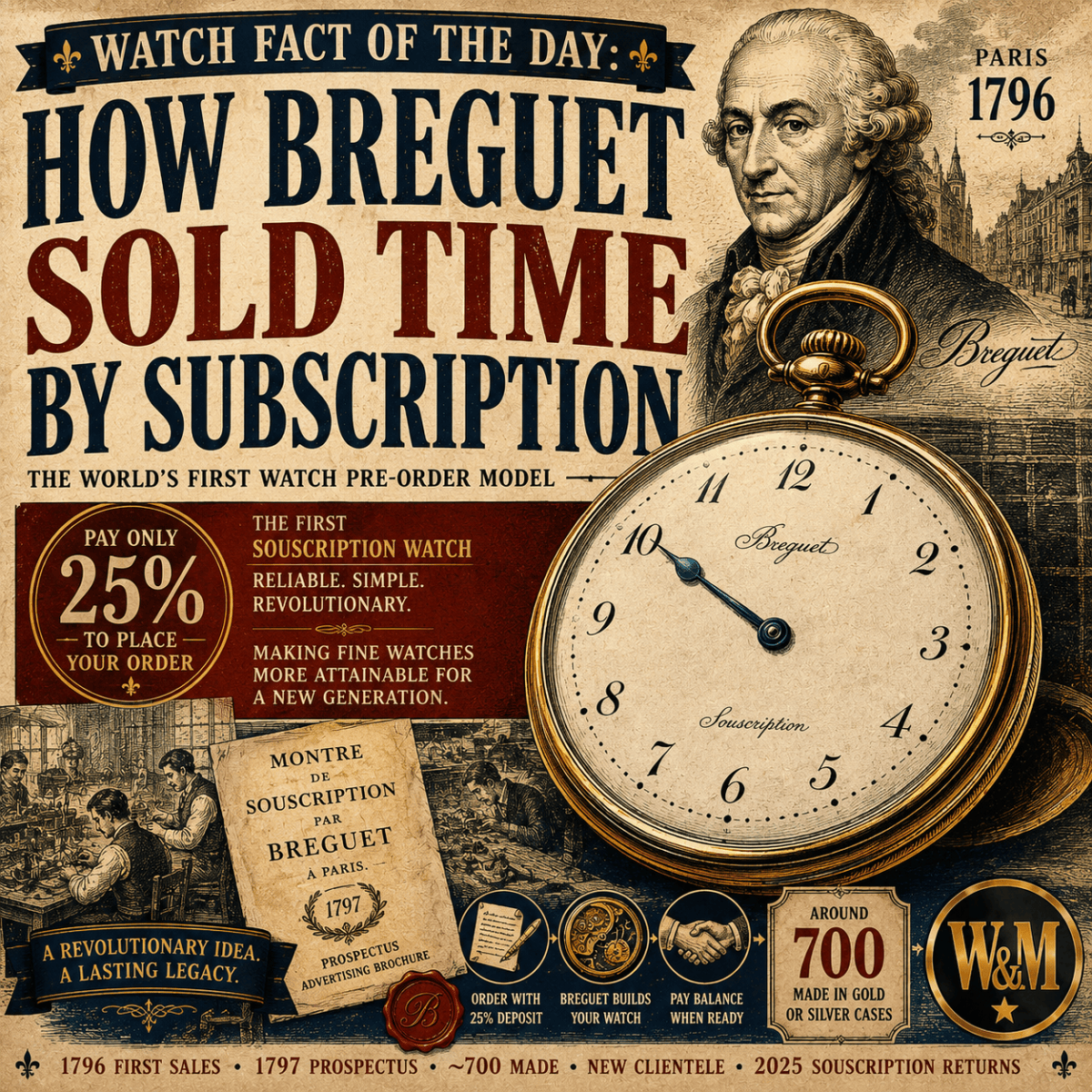
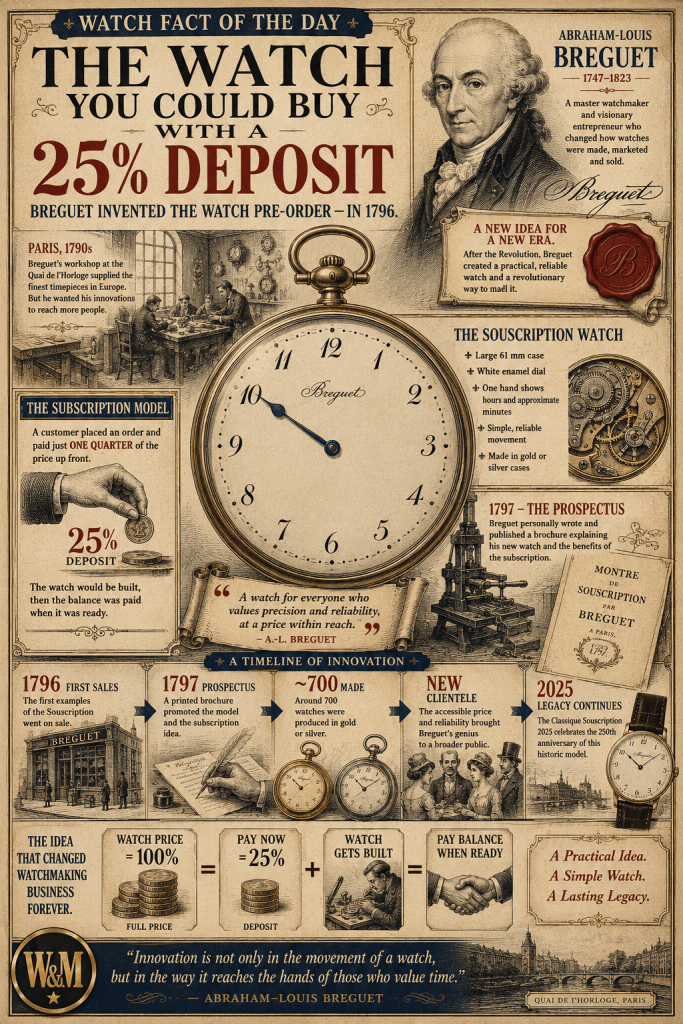
Long before online pre-orders, Abraham-Louis Breguet used a subscription model to make one of his most influential pocket watches more attainable. His large, single-hand Souscription watch was sold with a quarter of the price paid when the order was placed; Breguet’s records describe the design as simple, reliable, and successful enough to reach a broad new clientele.

The first examples went on sale in 1796, and a brochure promoted the model in 1797. Around 700 were made in gold or silver cases, turning a practical sales idea into a lasting chapter of watchmaking history.


In 1796, in the turbulent aftermath of the French Revolution, Abraham-Louis Breguet introduced an ingenious idea that was as much a business innovation as a watchmaking one: the montre de souscription, or subscription watch. Instead of requiring a customer to pay the entire price upfront, Breguet accepted an order with a deposit of one quarter of the purchase price. The remaining amount would be paid when the watch was completed—essentially an extraordinarily early form of the deposit-funded pre-order model familiar to modern consumers.

The watch itself was deliberately different from Breguet’s elaborate prestige pieces. The original Souscription was a substantial pocket watch measuring approximately 61 mm (2⅜ inches) in diameter, with a white enamel dial and just one hand indicating both hours and approximate minutes. Behind that wonderfully sparse face was a specially developed movement emphasizing mechanical simplicity, reliability and economical construction. Breguet describes the watches as both reliable and affordable, allowing his workshop to reach customers beyond the aristocratic clientele normally associated with his name.

Breguet didn’t merely invent the watch and wait for customers to discover it. In 1797, he promoted the Souscription through a printed advertising prospectus explaining the concept directly to potential buyers. Breguet’s modern historical account describes this document as remarkable for its time because the watchmaker personally explained the intentions, technical choices and philosophy behind the creation from the perspective of his customers. In other words, Breguet wasn’t only redesigning the watch—he was rethinking how a watch could be marketed and sold.

The strategy worked. Approximately 700 Souscription watches were eventually produced, offered in either gold or silver cases, and Breguet says most were sold between 1798 and 1805. The model attracted an important new clientele to the House and became one of the foundational chapters in Breguet’s history. One documented experimental example, No. 246, was sold on January 9, 1798, to a customer recorded as Mr. Durbach.

Its influence went beyond sales. Breguet subsequently adapted the Souscription’s calibre architecture for his early montres à tact, ingenious watches that allowed their owners to determine the approximate time by touch rather than having to look directly at the dial. What began as a simplified and more attainable watch therefore became a mechanical foundation Breguet could develop further.

And more than two centuries later, the idea has come full circle. For its 250th anniversary in 2025, Breguet unveiled the Classique Souscription 2025, a modern wristwatch directly inspired by those original pocket watches. It resurrected the white Grand Feu enamel dial, single flame-blued hand and distinctive Breguet numerals while interpreting the architecture of the historic Souscription movement in a new calibre.

💡 Did You Know?

The original Souscription wasn’t simply minimalist for aesthetic reasons. Its single hand and intentionally simplified movement architecture were fundamental to Breguet’s plan to produce a reliable watch at a more attainable price—and then finance orders through a 25% deposit. More than two centuries before online crowdfunding and pre-orders, one of history’s greatest watchmakers had already discovered that customers could help fund production by subscribing before their watch was finished.

Category: Watch History

Disclaimer: Every effort has been made to keep these watch facts accurate, but the world of horology is full of myths, disputed stories, and fascinating trivia. Consider these facts a starting point for discovery rather than the final word. If you have corrections or additional insights, let us know—we’re always happy to keep the record ticking in the right direction.

Source: Breguet — Sale of the first subscription watch.

🕐 Discover more watch facts, reviews, and buying guides at WatchesAndMore

ETSY Shop
ETSY Shop
Redbubble Shop
Redbubble Shop
More Watch Facts
More Watch Facts

Watch Fact of the Day: The Mystery of Rolex’s First Deep-Sea Record

So, back in 1960, Jacques Piccard and Don Walsh took a wild dive in the Trieste bathyscaphe to the Mariana Trench, bringing along an experimental Rolex Deep Sea Special strapped to the outside. This watch handled insane pressures over 10,000 meters deep, proving Rolex’s mechanical genius. When they surfaced after 8.5 hours, the watch was still ticking accurately—like a champ! Fast forward to 2012, filmmaker James Cameron took his own dive, bringing along the vintage watch as a lucky charm. Rolex later launched a production version, tying it all back to those epic deep-sea adventures. Talk about a legacy!

📅 Monday, August 24, 2026

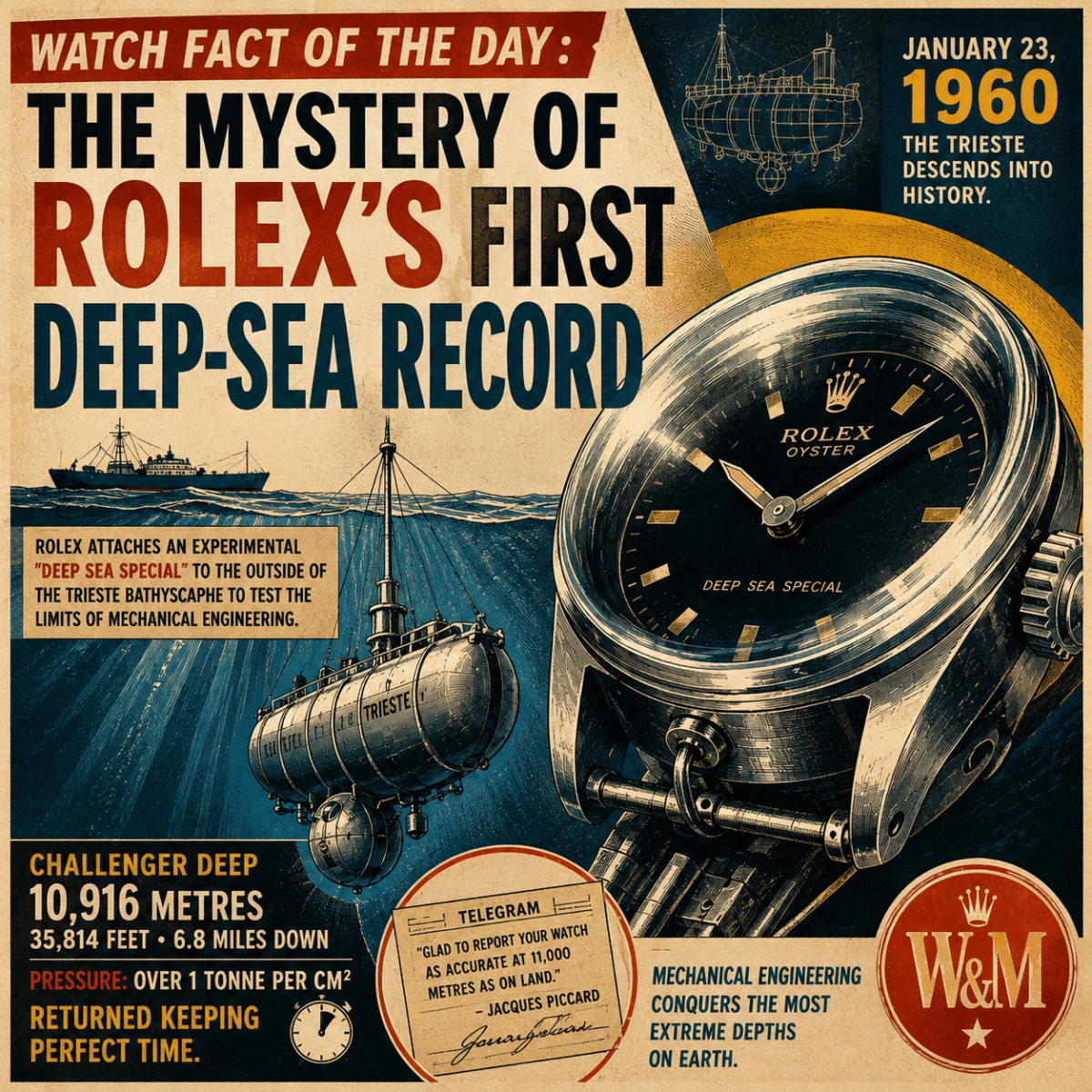
Long before the Deepsea Challenge went to the Mariana Trench, Rolex attached an experimental ‘Deep Sea Special’ watch to the outside of the Trieste bathyscaphe in 1960. The massive bubble-domed timepiece withstood a crushing pressure of over seven miles down in the Challenger Deep and continued ticking normally. When the hatch opened, the watch proved that mechanical engineering could conquer the most extreme depths on Earth.


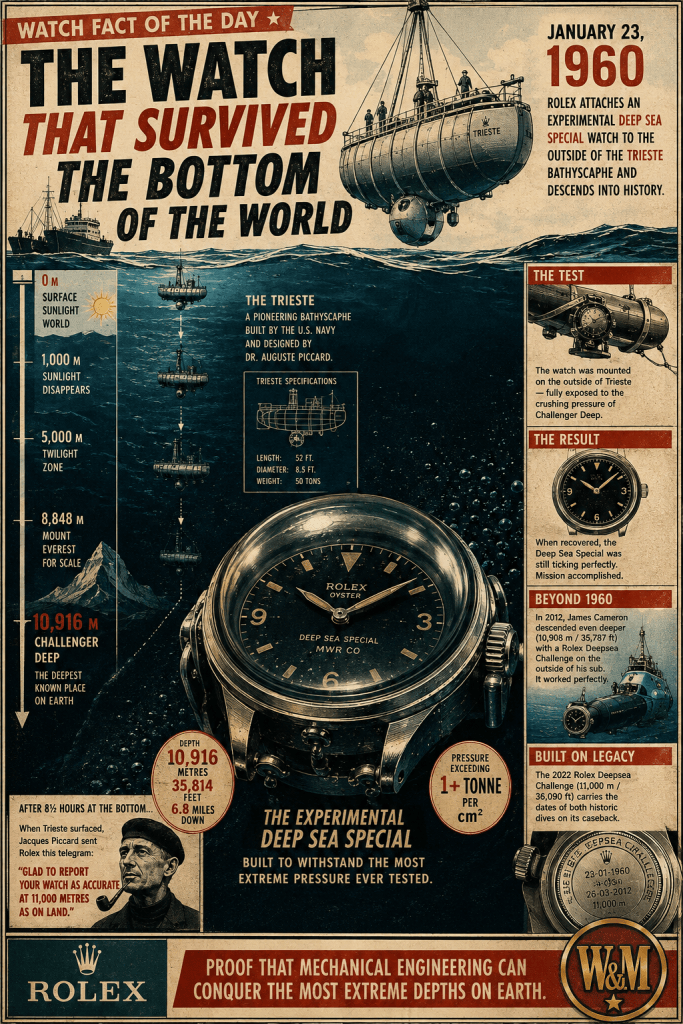
On January 23, 1960, Swiss oceanographer Jacques Piccard and U.S. Navy Lieutenant Don Walsh climbed aboard the experimental bathyscaphe Trieste and began descending into the Mariana Trench. Their destination was Challenger Deep, the deepest known region of Earth’s oceans. Strapped not safely inside the pressure sphere, but deliberately to the outside of the vessel, was an experimental Rolex unlike anything intended for an ordinary wrist: the Deep Sea Special.

The watch was the culmination of years of experimentation. During the 1950s, Rolex had developed successive Deep Sea Special prototypes specifically to explore the limits of waterproof watch construction. For the extraordinary pressure anticipated at Challenger Deep, the watch used a remarkably thick, highly domed crystal, giving the prototype its unmistakable almost bubble-like appearance. Rolex says the third Deep Sea Special was created specifically to withstand the extreme conditions of the Mariana Trench.

Then the Trieste kept going down.

1,000 metres.
5,000 metres.
8,000 metres.
10,000 metres.

Eventually Piccard and Walsh reached a record 10,916 metres — 35,814 feet, or roughly 6.8 miles — beneath the Pacific Ocean. That’s deeper than Mount Everest is tall, with roughly another two kilometres to spare. At that depth, Rolex says the Deep Sea Special endured pressure exceeding one tonne per square centimetre.

And remember where the watch was.

There was no protective pressure cabin around it. While Piccard and Walsh survived inside the Trieste’s heavily reinforced pressure sphere, the Deep Sea Special was exposed directly to the abyssal environment on the exterior of the bathyscaphe. Its case and crystal therefore had to resist the crushing pressure of Challenger Deep while maintaining the sealed environment necessary for the mechanical movement inside.

After approximately eight and a half hours beneath the sea, the Trieste returned to the surface. The experimental watch was recovered—and Rolex reports that it had kept perfect time. The result was dramatic proof that a properly engineered mechanical wristwatch case could remain watertight under one of the most hostile pressure environments accessible on Earth.

Piccard then sent Rolex a telegram that became part of watchmaking folklore:

“Glad to report your watch as accurate at 11,000 metres as on land.”

That is Rolex’s documented wording of Piccard’s message following the dive.

The Story Didn’t End in 1960

For more than half a century, the Trieste achievement stood essentially alone. Then, on March 26, 2012, filmmaker and explorer James Cameron descended solo to Challenger Deep aboard the DEEPSEA CHALLENGER. Once again, an experimental Rolex was mounted outside the submersible—this time the enormous Rolex Deepsea Challenge, engineered for waterproofness to 12,000 metres. Rolex says it remained accurate at more than 10,000 metres and emerged unscathed.

And there’s a wonderful connection between the two expeditions: Cameron actually carried a 1960 Deep Sea Special inside his cockpit during the 2012 dive. He called the vintage watch the “Old Lady” and described it as his good-luck charm—a sister watch to the Deep Sea Special that had made the original journey aboard Trieste 52 years earlier.

That heritage eventually reached a production wristwatch. In 2022, Rolex introduced the titanium Deepsea Challenge, guaranteed waterproof to 11,000 metres (36,090 feet). Its caseback carries the dates 23-01-1960 and 26-03-2012, permanently connecting the production model to the Trieste and Cameron expeditions.

💡 Did You Know?

The famous Deep Sea Special wasn’t tucked into the Trieste’s cockpit as a souvenir—it was attached to the exterior specifically so that the ocean could attack it with essentially the same immense environmental pressure confronting the bathyscaphe itself. At Challenger Deep, Rolex records pressure of more than one tonne per square centimetre, yet when the watch returned to daylight, its mechanical movement was still keeping time

Category: Military Watches

Disclaimer: Every effort has been made to keep these watch facts accurate, but the world of horology is full of myths, disputed stories, and fascinating trivia. Consider these facts a starting point for discovery rather than the final word. If you have corrections or additional insights, let us know—we’re always happy to keep the record ticking in the right direction.

🕐 Discover more watch facts, reviews, and buying guides at WatchesAndMore


🛍️ You Might Also Like

As an Amazon Associate and affiliate partner, WatchesAndMore earns from qualifying purchases.

G-Shock GWM5610-1 Solar Atomic
🔥 Deal of the Day

G-Shock GWM5610-1 Solar Atomic

Casio

★★★★★ 4.8 (5,621 reviews)

$129

Offer expires in


🔥 Grab This Deal →

G-Shock GA2100-1A1 CasiOak


G-Shock GA2100-1A1 CasiOak

Casio

★★★★★ 4.8 (2,156 reviews)

$99


Check Price on Amazon →

Seiko 5 SNK805 Green Military


Seiko 5 SNK805 Green Military

Seiko

★★★★★ 4.8 (6,961 reviews)

$89


Check Price on Amazon →


Browse all expert-reviewed watches →
ETSY Shop
ETSY Shop
Redbubble Shop
Redbubble Shop
More Watch Facts
More Watch Facts