Welcome to Watches & More Co. – where time meets style. I’m passionate about all things horology, from classic mechanical movements to elegant dress watches and rugged tool pieces. This blog is my space to share reviews, insights, and style tips for fellow watch lovers and collectors.
Whether you're new to the world of watches or a seasoned enthusiast, you'll find content here that informs, inspires, and sparks conversation. Beyond timepieces, I occasionally explore related accessories and lifestyle picks that complement a refined look.
Thanks for stopping by – stay timeless.
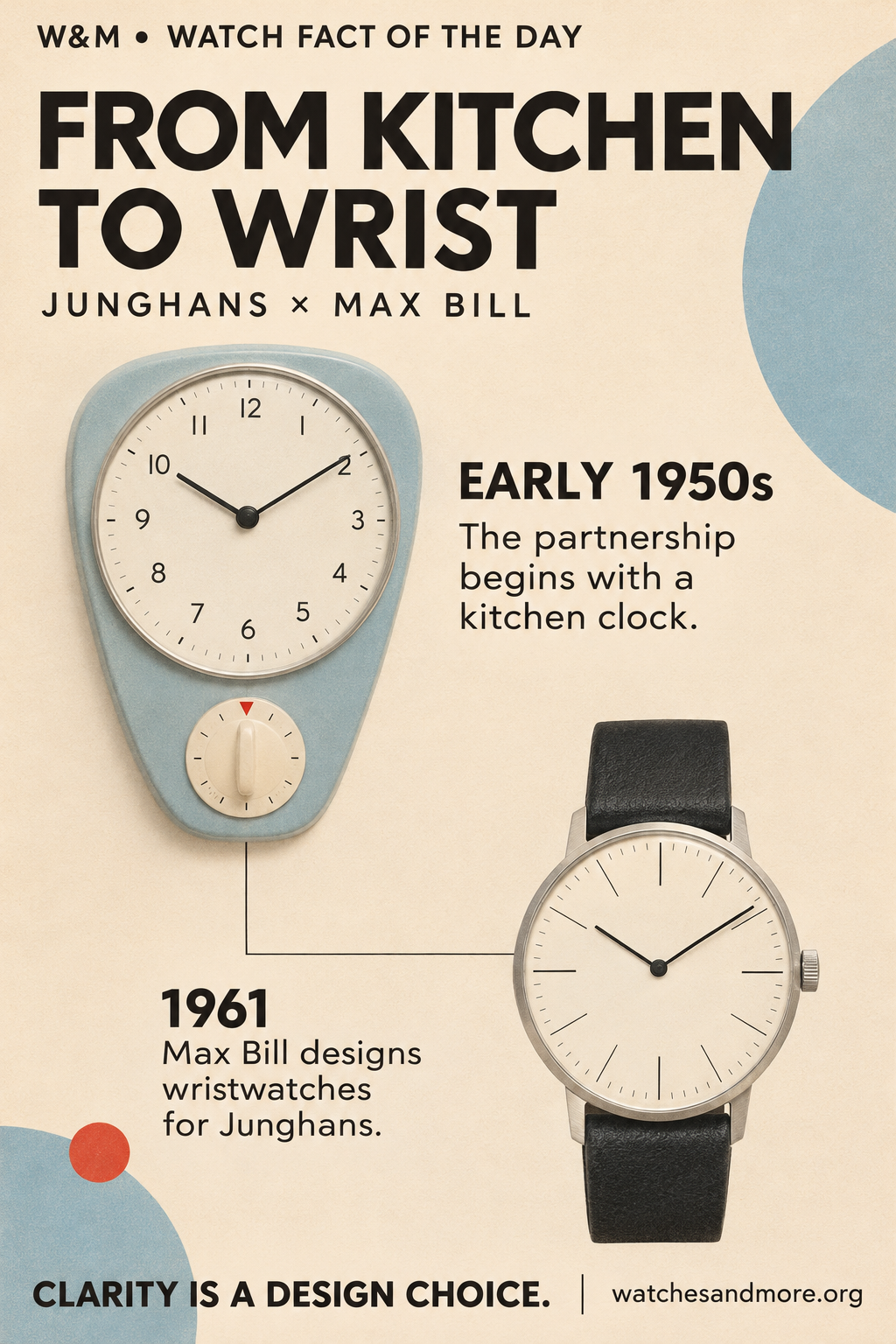
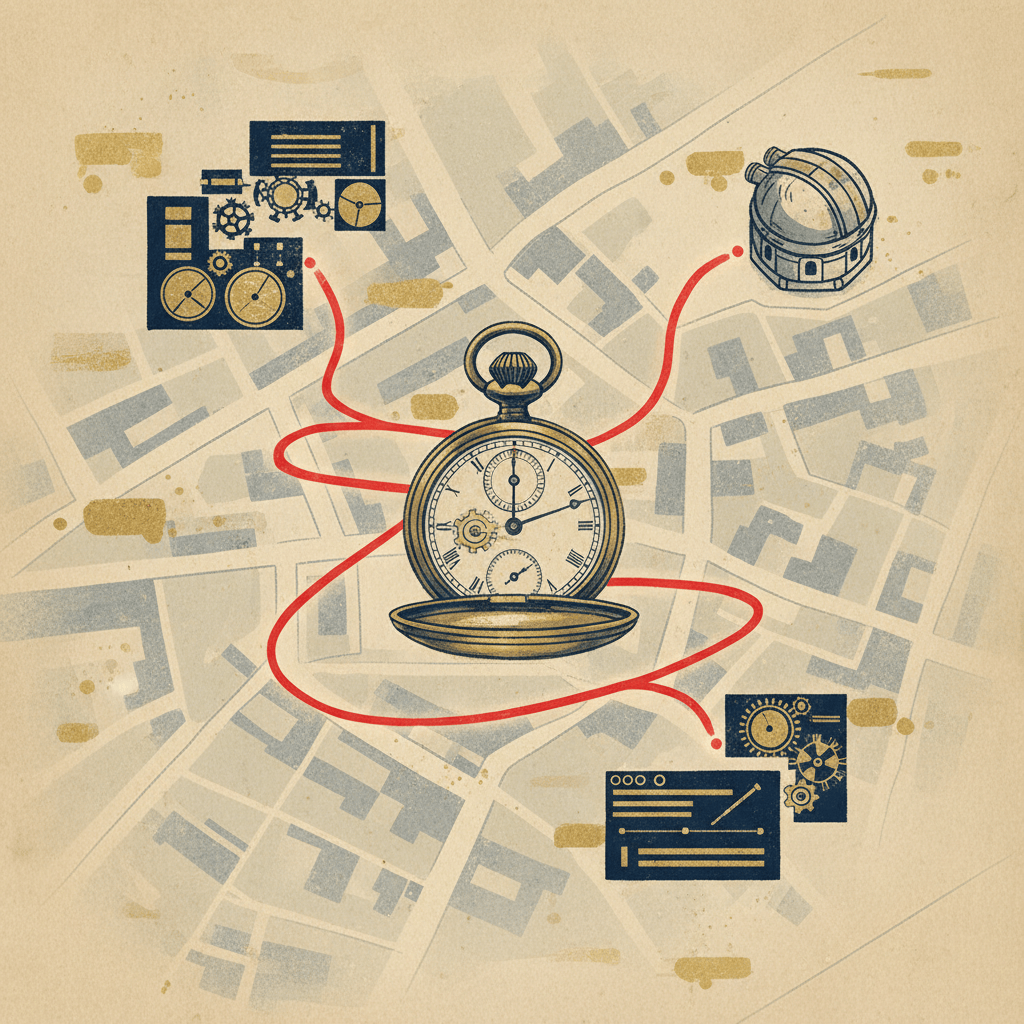
Junghans’s history places industrial scale beside Max Bill’s purist wristwatches in 1961. The partnership’s earlier starting point was a kitchen clock.
Original conceptual editorial illustration; not a photograph of a real watch or person.
2026-11-11 · Watches And More
Twenty thousand watches a day—and a design approach described as purist. Junghans’s own history brings those two ideas together in 1961: it records 6,000 employees, 10,000 machines and exports to 100 countries, while dating Max Bill’s wristwatch designs to that same year. [S1][S1]
For us, that juxtaposition is the story’s irresistible detail. Manufacturing scale answers how much a company can make; restrained design asks what each object should communicate. Those are different ambitions, and neither needs to cancel the other.
💡 Did You Know?
According to Junghans, the partnership began with a kitchen clock, not a wristwatch. In the early 1950s, the company considered commissioning an artist to design that everyday object; Bill developed the resulting clock with students. [S1][S1]
Junghans also records Bill’s studies at the Bauhaus in Dessau and his role as a founder of Ulm’s design school. In the brand’s account, the Bauhaus connection is therefore biographical, not merely a label attached to a clean-looking dial. [S1]
From Kitchen to Wrist: a W&M illustration inspired by Junghans and Max Bill’s mid-century design partnership.
⭐ Why It Matters
Junghans’s collection page explicitly connects its max bill models with the Bauhaus’s clear, minimalist style. That is how the manufacturer presents the partnership’s continuing significance: as a design philosophy carried through the collection, rather than simply a name from its historical timeline. [S2]
❤️ The W&M Take
Our take: the compelling lesson is not that simplicity defeated industry. It is that an everyday object deserved an artist’s attention. We think that makes this partnership worth revisiting: restraint can be a positive design decision, not an absence of imagination.
Disclaimer: Every effort has been made to keep these watch facts accurate, but the world of horology is full of myths, disputed stories, and fascinating trivia. Consider these facts a starting point for discovery rather than the final word. If you have corrections or additional insights, let us know—we’re always happy to keep the record ticking in the right direction.
Orient’s Contemporary collection puts its mechanical heritage beside a broader menu of watch formats, including explicitly solar-powered Stretto entries.
Original conceptual editorial illustration; not a photograph of a real watch or person.
2026-11-10 · Watches And More
In our view, the revealing question about a legacy watchmaker is not simply what it preserves. It is what that heritage leaves it free to change. Orient’s Contemporary collection offers a useful place to ask that question without making one familiar model stand for the whole brand.
In its official brand story, Orient dates its founding to 1950 and emphasizes its longstanding passion for in-house mechanical movements. That is the manufacturer’s account of its identity, rather than independent evidence of superior performance. [S1][S1]
💡 Did You Know?
Contemporary is not a synonym for mechanical. Orient’s collection page lists Stretto Date, Semi Skeleton and Day & Night alongside explicitly solar-powered Stretto entries, plus Flusso Day & Night and Multi Year Calendar. Those names establish the collection’s breadth—not a shared movement specification. [S2]
For us, that is the interesting twist: a mechanical heritage need not become a rule that every expression of the brand must follow.
Watches & More infographic. Watch illustrations and specifications based on Orient’s official Stretto Date and Stretto Solar product references.
⭐ Why It Matters
Orient says its watches accompany lifestyles in over 70 countries and describes Contemporary as a timeless standard renewed by a modern spirit. Its own language connects continuity with adaptation, rather than presenting tradition as an unchanged visual formula. [S1][S2]
The collection page also warns that some website items have limited availability. Its listings should therefore be read as a collection overview, not a promise that every model can be obtained in every market. [S2]
❤️ The W&M Take
Our take: heritage is more compelling as a foundation than as a fence. We think Contemporary makes Orient worth considering as a collection of possibilities, rather than a brand defined by one favorite. The appealing idea is continuity without insisting on sameness.
Disclaimer: Every effort has been made to keep these watch facts accurate, but the world of horology is full of myths, disputed stories, and fascinating trivia. Consider these facts a starting point for discovery rather than the final word. If you have corrections or additional insights, let us know—we’re always happy to keep the record ticking in the right direction.
Jacqueline Dimier approached the 1976 women’s Royal Oak through proportions, preserving its character rather than abandoning its steel and automatic identity.
Original conceptual editorial illustration; not a photograph of a real watch or person.
2026-11-09 · Watches And More
How do you change a watch’s proportions without losing its personality? Jacqueline Dimier’s answer was unusually direct. In Audemars Piguet’s published recollection, she describes preserving the Royal Oak’s character and wanting it to remain big despite prevailing women’s-watch trends. AP Chronicles identifies the result as Model 8638—the first women’s Royal Oak, also called Royal Oak II—launched in 1976. [S2][S1]
💡 Did You Know?
Audemars Piguet gives the case diameter as 29 mm, with eight visible screws retained around the octagonal steel bezel. Inside, the company selected Calibre 2062, measuring just 15.4 mm across. The compact dimensions belonged to both the exterior design and the mechanism—not simply to a smaller dial. [S1][S1]
There was an unexpected setting for its debut, too. AP Chronicles records that the Royal Oak II launched at Parisian jeweller FRED before its presentation at the Basel Fair, and describes the reception as an immediate success. [S2]
⭐ Why It Matters
AP Chronicles frames the design as a challenge to the feminine aesthetic codes of its period: steel, automatic winding and visible screws all remained. Its account also makes an important distinction about authorship. The project was already under way, but Dimier brought it to fruition through a major overhaul of proportions and aesthetic harmony. This institutional history credits her with resolving the design, rather than originating every part of the project. [S2][S2]
❤️ The W&M Take
Our take: the most compelling part of this story is the distinction between reducing dimensions and reducing ambition. We think Dimier’s emphasis on proportions offers a useful way to appreciate design: ask not only what changed, but what the designer refused to surrender. For us, character is something to translate thoughtfully, not a feature reserved for one size or one audience.
Disclaimer: Every effort has been made to keep these watch facts accurate, but the world of horology is full of myths, disputed stories, and fascinating trivia. Consider these facts a starting point for discovery rather than the final word. If you have corrections or additional insights, let us know—we’re always happy to keep the record ticking in the right direction.
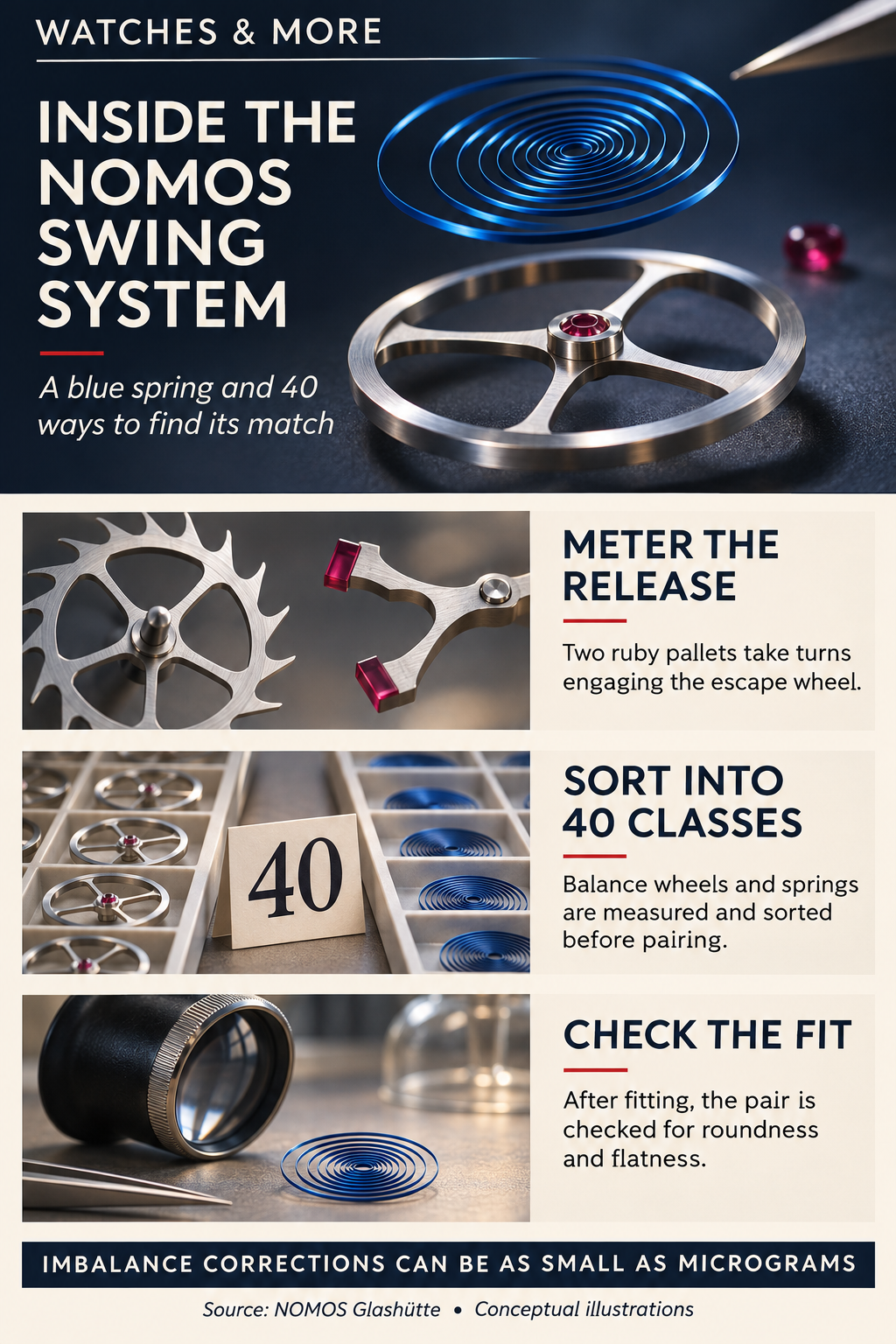
A blue balance spring and 40 classes of component matching reveal the detail behind NOMOS’s proprietary Swing System.
Original conceptual editorial illustration; not a photograph of a real watch or person.
2026-11-08 · Watches And More
Start with the small mechanism, not the dial. NOMOS describes itself as an owner-operated, independent company founded in 1990 by Roland Schwertner. Its Swing System brings that company story inside the movement: an escapement that NOMOS identifies as its own proprietary design. [S2][S1]
According to NOMOS, the assembly includes a balance wheel with a blue balance spring, an escape wheel and a pallet fork carrying synthetic-ruby pallets. The escapement regulates the release of the spring’s stored energy rather than letting it unwind all at once. NOMOS explains that the fork’s two rubies alternately engage the escape-wheel teeth, metering that release. [S1][S1][S1]
Watches & More infographic based on NOMOS Glashütte’s description of the Swing System. Conceptual illustrations.
💡 Did You Know?
NOMOS describes a miniature matchmaking operation: balance wheels and springs are measured and sorted into 40 classes according to their properties. After a spring is fitted to its wheel, the pair is checked again for roundness and flatness. Making the parts is only part of the story; finding the right partners matters, too. [S1][S1]
⭐ Why It Matters
NOMOS’s account connects production with adjustment: it describes making and fine-machining caliber parts, then constructing, assembling, regulating and encasing calibers in Glashütte. At the balance wheel, that work reaches microgram scale. The company says detected imbalances are corrected by removing tiny amounts of material—millionths of a gram. [S2][S2][S1]
❤️ The W&M Take
Our take: the compelling detail is not the word proprietary but the patient process behind it. We think component matching makes independence easier to understand as an engineering ambition, rather than simply a brand identity. For us, that is worth appreciating without treating ownership of an escapement design as proof of superior accuracy.
Disclaimer: Every effort has been made to keep these watch facts accurate, but the world of horology is full of myths, disputed stories, and fascinating trivia. Consider these facts a starting point for discovery rather than the final word. If you have corrections or additional insights, let us know—we’re always happy to keep the record ticking in the right direction.
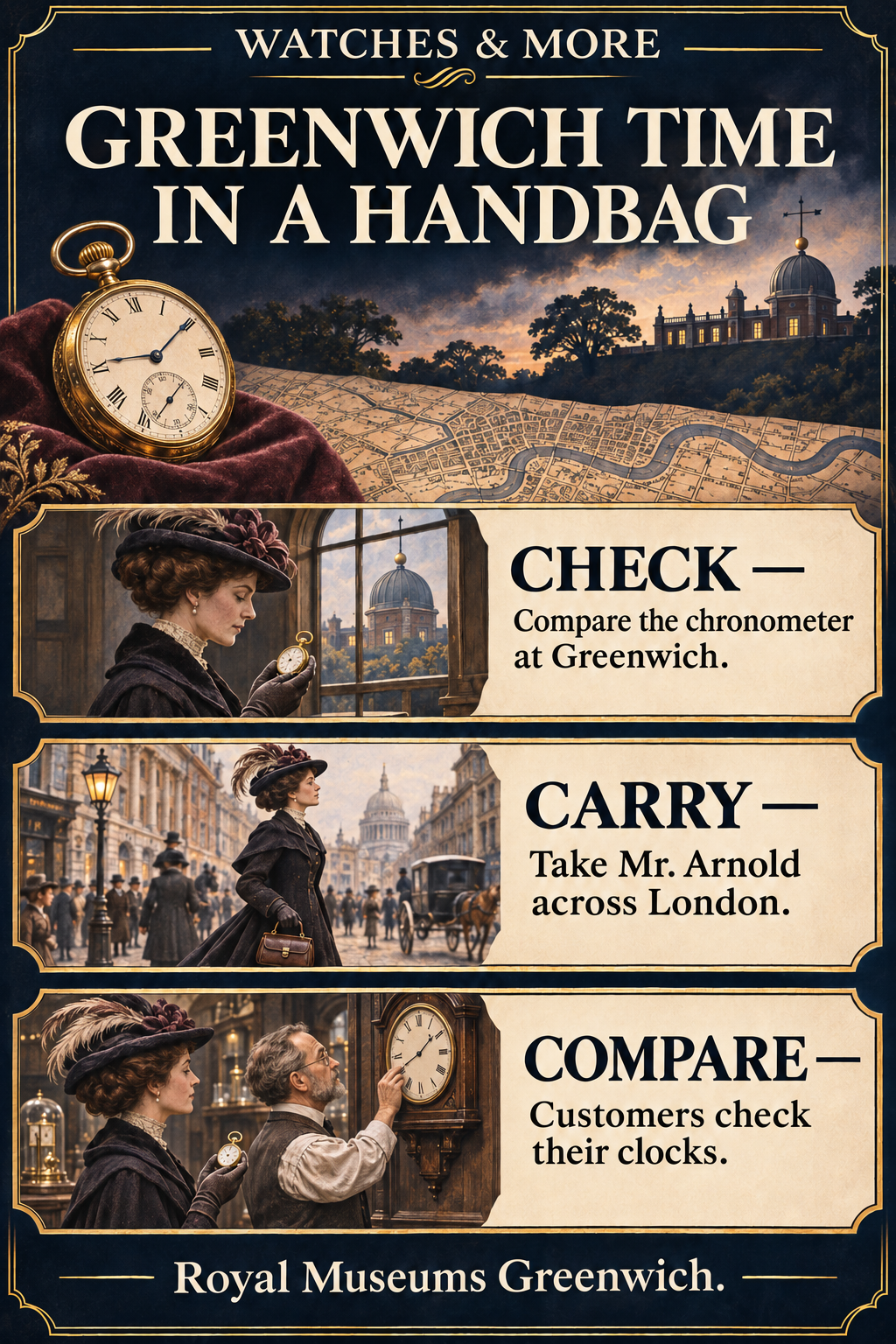
A checked chronometer, a weekly route and 30–40 customers: Ruth Belville made Greenwich time a personal delivery service.
Original conceptual editorial illustration; not a photograph of a real watch or person.
2026-11-07 · Watches And More
The correct time arrived in a handbag. In Royal Museums Greenwich’s account, Ruth Belville travelled weekly to the Royal Observatory, checked her pocket chronometer against its standard clock, then crossed London to visit 30–40 paying customers. They could compare their clocks with hers: precision delivered through a repeatable, personal appointment. [S1][S1]
Watches & More infographic. Editorial illustrations.
💡 Did You Know?
Ruth inherited the service rather than inventing it. Royal Museums Greenwich dates John Belville’s business to 1836; after his death in 1856, Maria continued it, passing the work to their daughter Ruth in 1892. The weekly delivery was a family enterprise across three successive careers. [S1][S1][S1]
The watch had a name, too: the supplied Science Museum Group object-record excerpt says Ruth called it ‘Mr. Arnold’. That record dates the family’s use of the watch from 1834 to Ruth’s retirement in 1940—a different starting point from Greenwich’s 1836 date for the service. [S2][S2]
⭐ Why It Matters
The ritual included more than a glance at a clock. Greenwich describes a Monday journey by public transport, tea with the porter and a certificate of accuracy. The museum characterizes Ruth’s time service as accurate up to a tenth of a second—not merely as an informal exchange of approximate time. [S1][S1]
Greenwich records Ruth’s working period as 48 years, alongside competition and expanding telegraph networks. Its account identifies BBC time broadcasts in 1924 and the speaking clock in 1936 as further challenges. Her route belonged to a changing landscape of time distribution, not a London without alternatives. [S1][S1][S1]
❤️ The W&M Take
For us, the charm is not simply that someone carried time in a handbag. It is that precision becomes a service: check, carry, compare, repeat. We think this story deserves a place beside the celebrated mechanisms of watchmaking, because it directs attention to the patient work that makes an accurate instrument useful.
Disclaimer: Every effort has been made to keep these watch facts accurate, but the world of horology is full of myths, disputed stories, and fascinating trivia. Consider these facts a starting point for discovery rather than the final word. If you have corrections or additional insights, let us know—we’re always happy to keep the record ticking in the right direction.
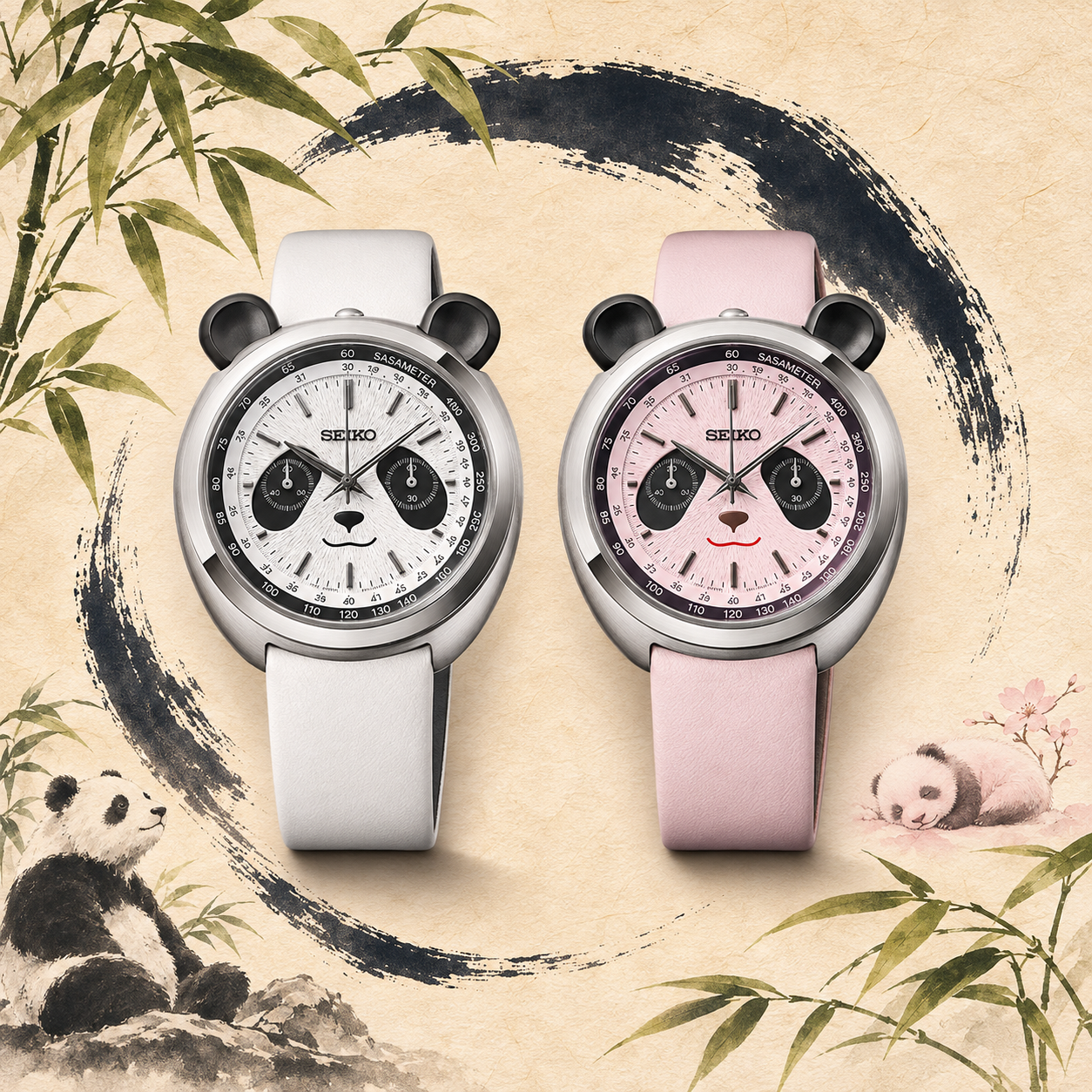
Announced on 2026-10-06, Seiko’s literal panda chronograph gives its animal-inspired face working ears and bamboo-leaf hands.
Original conceptual editorial illustration; not a photograph of a real watch or person.
2026-11-06 · Watches And More
What happens when a watch designer takes a nickname literally? In its announcement dated 2026-10-06, Seiko explained how in-house designer Kiyotaka Sakai turned the “panda” chronograph into an actual panda-inspired watch. As Seiko describes the familiar convention, a white dial and contrasting black subdials supplied the starting point. Sakai took the animal reference further. [S1][S1][S1]
Watches & More infographic. Editorial illustrations.Seiko’s white HHK001 and pink HHK002 panda chronographs in a Watches & More editorial illustration inspired by Seiko’s product photos.
💡 Did You Know?
According to Seiko’s design explanation, the face is built from functional parts: drooping-eye subdials establish the expression, bamboo-leaf hands indicate the time, and recessed ear-shaped pushers operate the chronograph. An embossed radial dial pattern supplies the suggestion of fur, with a nose and mouth positioned at six o’clock. [S2][S2]
The idea also comes in pink. Seiko describes two interpretations: the familiar black-and-white animal and a pink version inspired by a newborn baby panda. The animal reference therefore shapes more than the arrangement of contrasting subdials. [S1]
⭐ Why It Matters
Seiko places the design’s origins in its 2024 “Incredibly Specialized Watch Exhibition,” where seven designers explored seven specialized watches, including one for panda lovers. The company describes the wider power design project, first presented in 2001, as a space for its designers to investigate watches differently from their everyday work. [S1][S1][S1]
❤️ The W&M Take
In our view, the charm is in giving the joke a job. We think the strongest playful designs reward a second look without needing a complicated explanation. Here, the appeal is not simply a cute face: it is the pleasure of seeing familiar controls become part of the character. For us, that makes this a design conversation worth having, whether or not a literal panda belongs in your collection.
Disclaimer: Every effort has been made to keep these watch facts accurate, but the world of horology is full of myths, disputed stories, and fascinating trivia. Consider these facts a starting point for discovery rather than the final word. If you have corrections or additional insights, let us know—we’re always happy to keep the record ticking in the right direction.
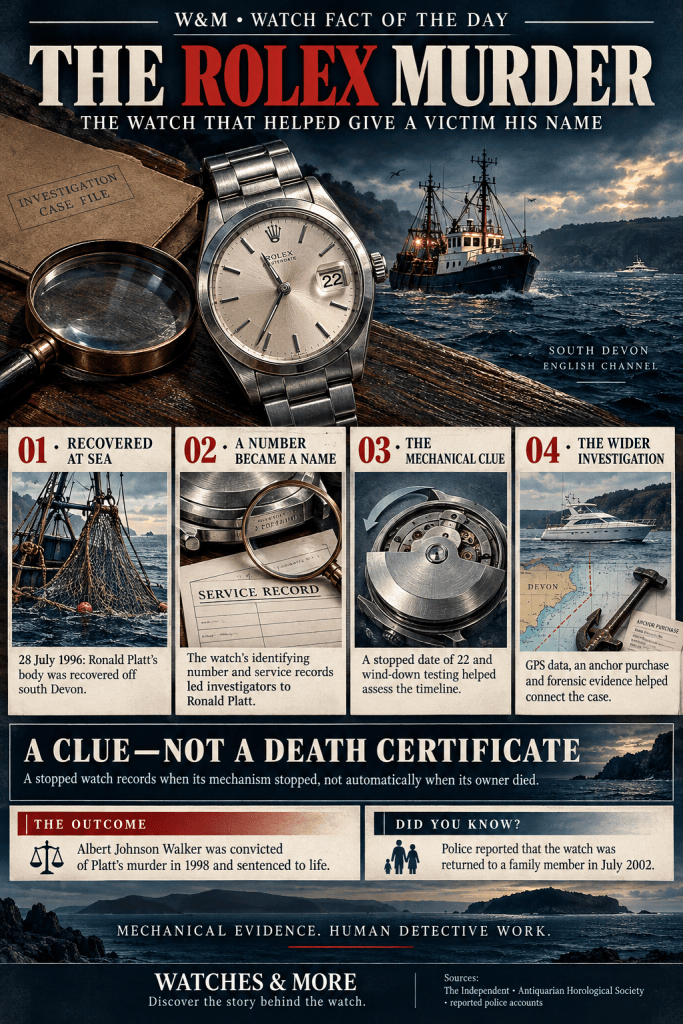
When Ronald Platt’s body was pulled from the sea in 1996, detectives had no name—until they noticed the Rolex on his wrist. This article traces how a serial number, a stopped automatic movement, and other forensic clues exposed an identity thief and helped prove a murder.
An unidentified man. A stolen identity. And a wristwatch that gave detectives somewhere to begin.
The killer took another man’s identity. The watch helped give it back.
On 28 July 1996, a fishing net brought Ronald Joseph Platt’s body out of the sea off south Devon.
At first, investigators did not know his name.
But a Rolex remained on his wrist.
What followed became an extraordinary meeting of mechanical watchmaking and detective work: a serial number opened a paper trail, a stopped display helped investigators examine the timeline, and a man living under someone else’s name began to run out of places to hide.
🌊 The Clue the Sea Had Left Behind Contemporary reporting from the murder trial identified the fishing vessel as the Brixham trawler Malkerry.
Its crew recovered Platt’s body off Teignmouth. The Rolex provided the route to identifying him.
The same reporting described the prosecution’s allegation that Platt had been taken sailing aboard Lady Jane on 20 July and put overboard with a 10 lb anchor weighing him down. The Independent
Eight days separated that date from the recovery.
This was a disturbing discovery—but it was also the beginning of an investigation.
🔎 A Serial Number Became a Name A watch has more than one identity.
There is the brand on its dial. There is its model. And there is the individual number connecting that particular object to its history.
Investigators pursued the Rolex’s identifying number through service records, leading to Ronald Platt and a Harrogate jeweller.
It is easy to imagine the breakthrough as an instant database search. Reporting describes a longer process of enquiries and record tracing. Truth or Fiction?
The important connection was between an object recovered at sea and the person who had previously entrusted it to a watchmaker.
The watch had no electronic memory. Its service history existed on land.
⚙️ Why an Automatic Watch Mattered The Rolex’s movement added another dimension.
An automatic mechanical watch stores energy in a mainspring. Movement of the wrist turns an internal rotor, which drives the winding mechanism.
The spring then releases energy through the movement to keep the watch running.
Rolex calls its automatic winding system the Perpetual rotor. Rolex® (CA)
“Perpetual” does not mean inexhaustible. Once further winding stops, the watch runs only as long as its remaining stored energy allows.
That creates an intriguing forensic possibility: a stopped watch may help reconstruct events, provided investigators understand its condition and behaviour.
📅 What Did the Date Window Reveal? The Antiquarian Horological Society’s account records the display as 11:35, with the date showing 22. The story of time
Later reporting attributes to lead investigator Phil Sincock a test establishing that the watch took approximately 44 hours to wind down. middevonadvertiser.co.uk
Together, the stopped display and wind-down behaviour helped investigators assess a timeline consistent with the July 20 sailing trip.
But a calendar window is not a death certificate.
It records where the mechanism stopped—not, by itself, when its owner died. Its interpretation depends on the watch having been set correctly, its remaining energy, and any subsequent movement or winding.
The Rolex supplied evidence to interpret, rather than an infallible timestamp.
🌊 Was the Channel a Giant Watch-Winder? That image makes a memorable story. It is not supported by the contemporary court reporting examined here.
An ocean-hydraulics expert told the jury that, with the anchor attached, the body would have sunk quickly and remained stationary despite the tides and currents. The Independent
That matters. The assumption that the watch stopped receiving motion helps explain why its remaining running time could be useful.
There is no need to invent weeks of underwater winding to make the mechanical evidence remarkable.
🎭 The Man Living Behind Platt’s Name The investigation led to Albert Johnson Walker, a Canadian fugitive who had used the name David Davis.
Walker had befriended Platt and helped finance his move to Canada. With access to Platt’s documents, Walker assumed his identity.
When the real Platt returned to Britain, his presence threatened that deception.
The man recovered from the sea had a name. Someone else had been using it.
Walker was convicted of Platt’s murder in 1998 and sentenced to life imprisonment. The story of time
🧩 More Than One Piece of Evidence The Rolex did not solve the case alone.
Investigators also examined the yacht’s GPS equipment, documentation concerning the anchor, and forensic material connecting Platt with the boat.
Sincock described recovering navigation information that placed the yacht near the relevant location and tracing an anchor purchase through a receipt. Truth or Fiction?
Mechanical and electronic evidence worked together. Detectives assembled the connections.
💡 Did You Know? The Rolex was eventually returned to Platt’s family.
A police response reported in 2025 stated that a family member received and signed for it in July 2002. middevonadvertiser.co.uk
After serving as evidence, it could once again be a personal possession—a connection to the man who had worn it.
⭐ Why It Matters We often tell watch stories through precision, prestige, or endurance.
This one is about identity.
The important achievement was not simply that a mechanism survived immersion. It was that investigators could connect a durable, traceable object to its owner and use its behaviour alongside other evidence.
A rotor could wind a spring. A serial number could lead to a record. Neither could explain a murder without people asking the right questions.
Ronald Platt’s watch could not speak. It helped investigators recover his name—and uncover what happened to him. ⌚
Watches & More — Discover the story behind the watch.
Disclaimer: Every effort has been made to keep these watch facts accurate, but the world of horology includes disputed stories and changing product information. Treat this article as a starting point for discovery and consult the linked records or manufacturer information for the exact timepiece. Corrections and additional evidence are welcome in the comments.
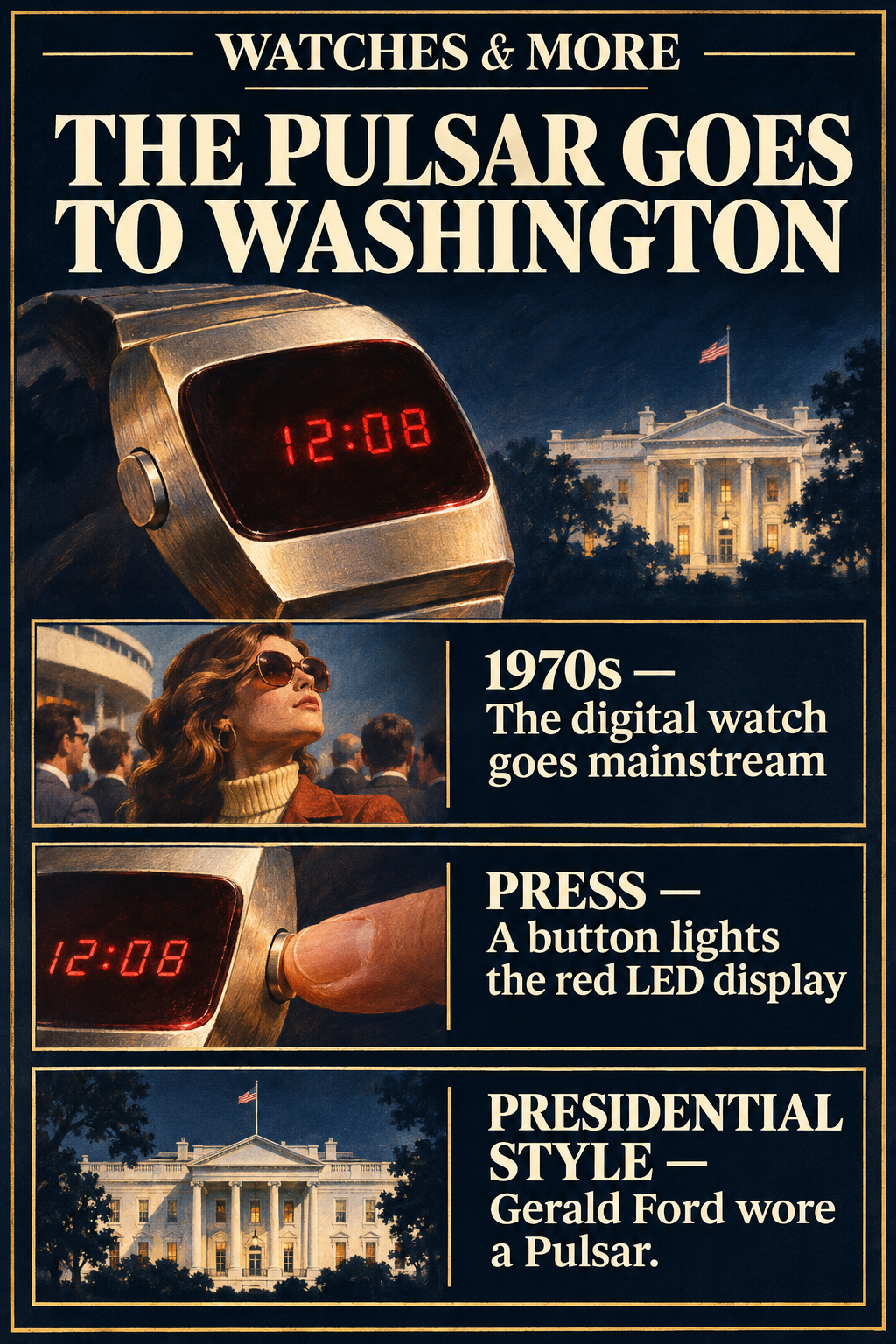
During the height of the 1970s digital watch craze, U.S. President Gerald Ford famously wore a Hamilton Pulsar—the world’s first all-electronic digital watch wi
📅 Thursday, November 5, 2026
During the height of the 1970s digital watch craze, U.S. President Gerald Ford famously wore a Hamilton Pulsar—the world’s first all-electronic digital watch with no moving parts. Opting for a model with a leather strap, Ford’s high-tech accessory was captured by the press during major political hearings, marking a stark shift from traditional luxury gold timepieces to futuristic microchip technology in the Oval Office.
Watches & More infographic. Editorial illustrations.
Category: Faces of Horology
Disclaimer: Every effort has been made to keep these watch facts accurate, but the world of horology is full of myths, disputed stories, and fascinating trivia. Consider these facts a starting point for discovery rather than the final word. If you have corrections or additional insights, let us know—we’re always happy to keep the record ticking in the right direction.
In 1965, Swiss brand Certina released the Biostar, the world’s first and only wristwatch designed to track a person’s daily physical, emotional, and mental bior
📅 Wednesday, November 4, 2026
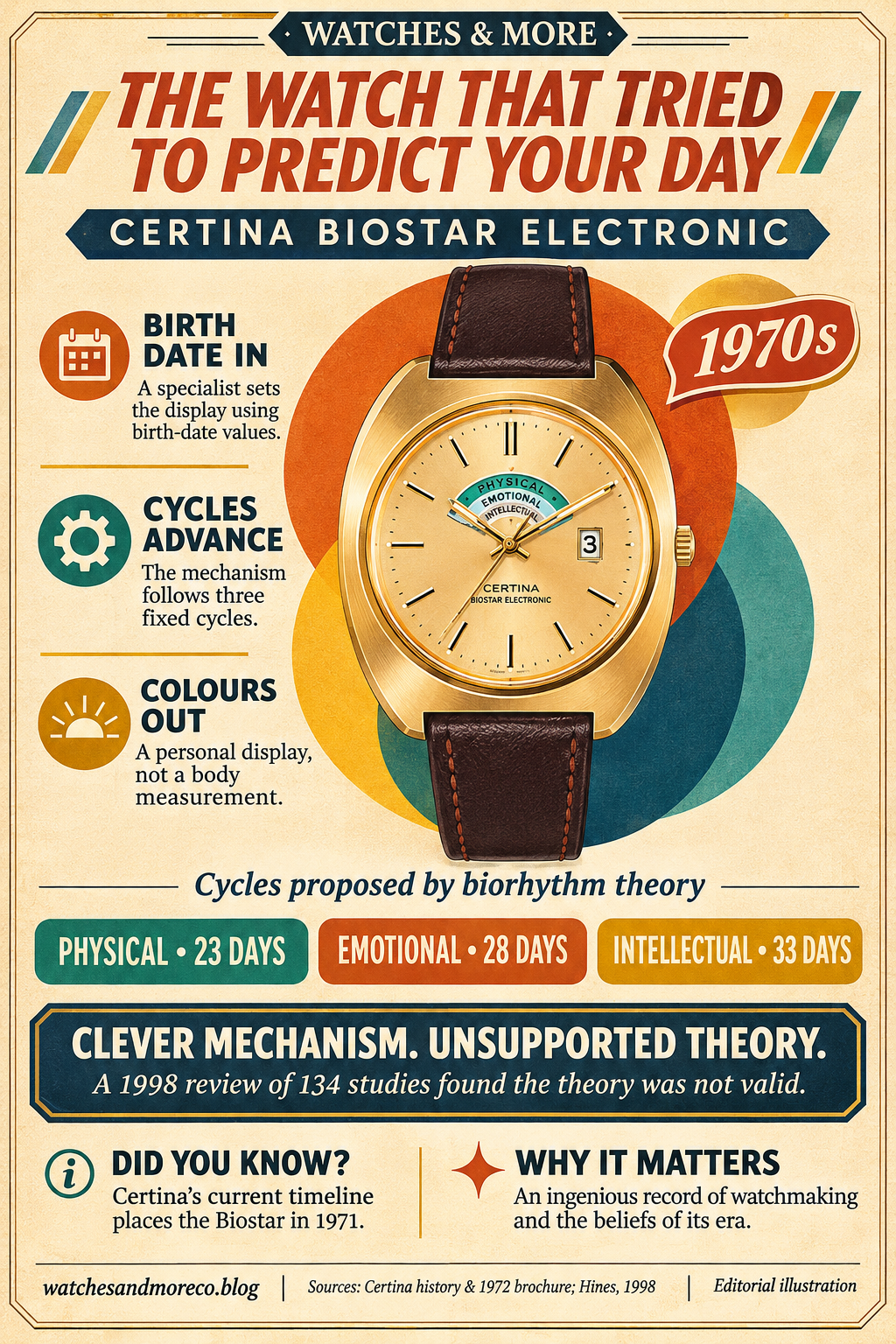
Imagine a watch that promises to tell you what kind of day you are about to have. The Certina Biostar brought that idea to the wrist with a colourful display based on a popular theory of human biorhythms.
It is a fascinating watchmaking object, but understanding it requires a distinction: its display calculated a pattern from a birth date. It did not measure the wearer’s body or detect their mood.
The Biostar calculated proposed cycles; it did not measure the body. Editorial illustration based on Certina history, a 1972 brochure and Hines’s 1998 review.
⌚ A Watch with a Prediction Window
Certina’s current company timeline places the Biostar under 1971 and describes its display of physical, mental and emotional biorhythms. A surviving Certina brochure from 1972 documents the Biostar Electronic, with three coloured indications and a separate weekday display.
The 1972 brochure is a useful anchor for exploring the watch: it records specific electronic models and explains how their unusual display was set. Certina describes the Biostar as the first watch to display these proposed daily rhythms.
🎨 Three Cycles, One Personal Starting Point
The brochure assigns the proposed physical cycle 23 days, emotional cycle 28 days and intellectual cycle 33 days. Its colour key is red, blue and green respectively. These are the periods assumed by the theory, rather than three measurements taken by the watch.
At purchase, a watch specialist used the owner’s date of birth to obtain the setting values and adjust the display. Once set, the mechanism advanced the indications through the prescribed cycles. The result looked personal because its starting point belonged to one wearer.
⚙️ Calculation Is Different from Measurement
A calendar can display a future date because it follows a defined sequence. The Biostar’s appeal rested on a similar idea: mechanically present where a person supposedly stood within repeating cycles. The mechanism could reproduce that sequence without demonstrating that it described the person’s actual condition.
That distinction is the heart of the story. Building an ingenious display and validating the claim behind it are separate achievements. A colourful dial can make an idea feel tangible, but its precision as a mechanism does not establish its accuracy as a prediction.
🔎 What Happened to the Theory?
In 1998, psychologist Terence M. Hines reviewed 134 studies of biorhythm theory. His review concluded that the theory was not valid; reported positive findings were accounted for by methodological and statistical problems. This particular birth-date-based system should not be confused with established biological rhythms such as the daily sleep–wake cycle.
💡 Did You Know?
The 1972 brochure describes the watch specialist setting up the owner’s display using birth-date information. This was a personalised calculation long before an app could put a similar set of predictions on a screen.
⭐ Why It Matters
The Biostar captures a moment when watchmakers explored what else a dial might tell its owner. Its lasting interest comes from that mix of mechanical ingenuity, personalisation and the beliefs of its period.
The mechanism could keep track of the pattern. The pattern could not reliably predict your day.
Would you collect a watch for its ingenious mechanism even if the theory behind its extra display did not hold up?
Category: Fun Quirk
Disclaimer: Every effort has been made to keep these watch facts accurate, but the world of horology is full of myths, disputed stories, and fascinating trivia. Consider these facts a starting point for discovery rather than the final word. If you have corrections or additional insights, let us know—we’re always happy to keep the record ticking in the right direction.