📅 Wednesday, September 23, 2026
Before quartz watches took over the world—and before the Omega Speedmaster became synonymous with spaceflight—another electronic watch was already proving itself in some of the most extreme flying environments imaginable.
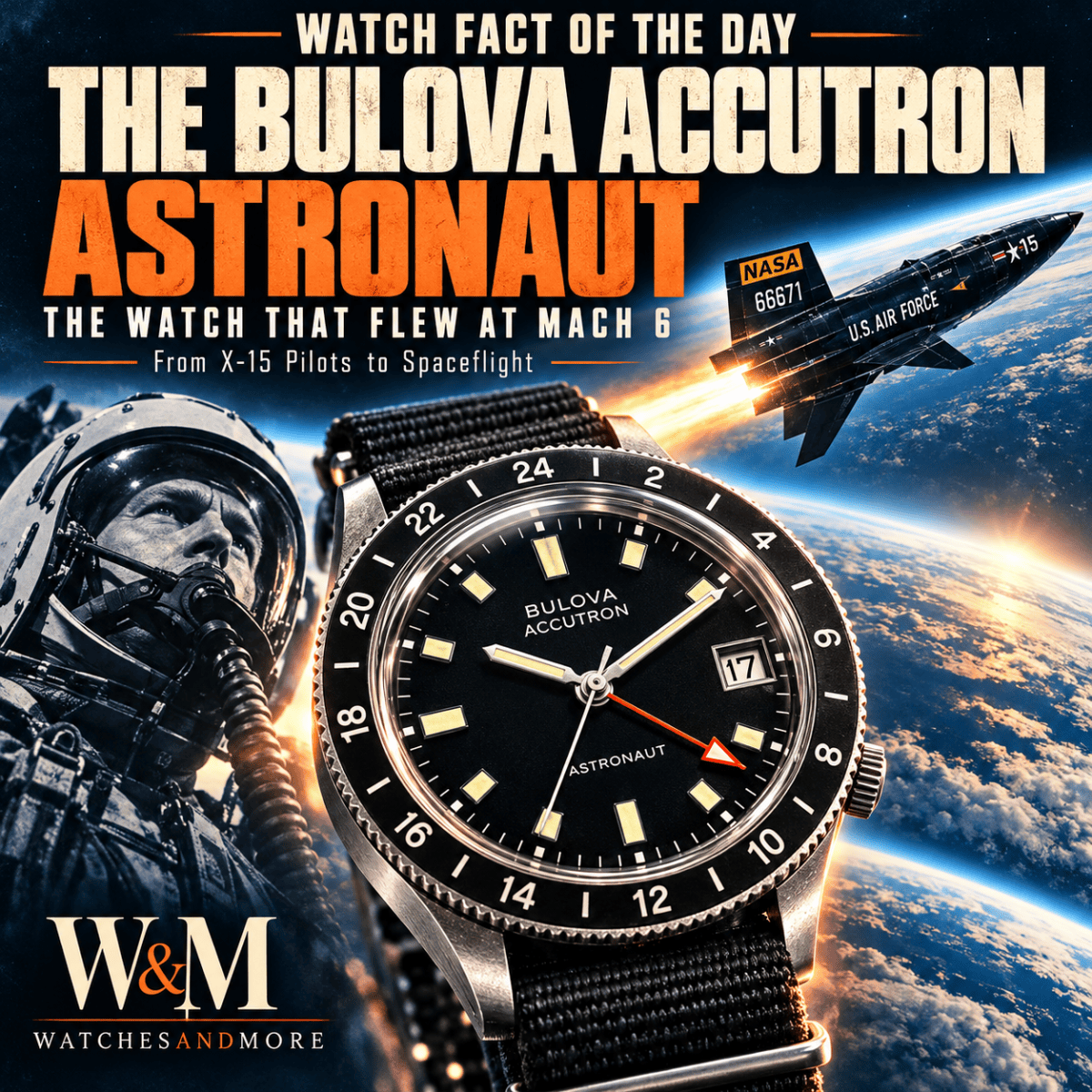
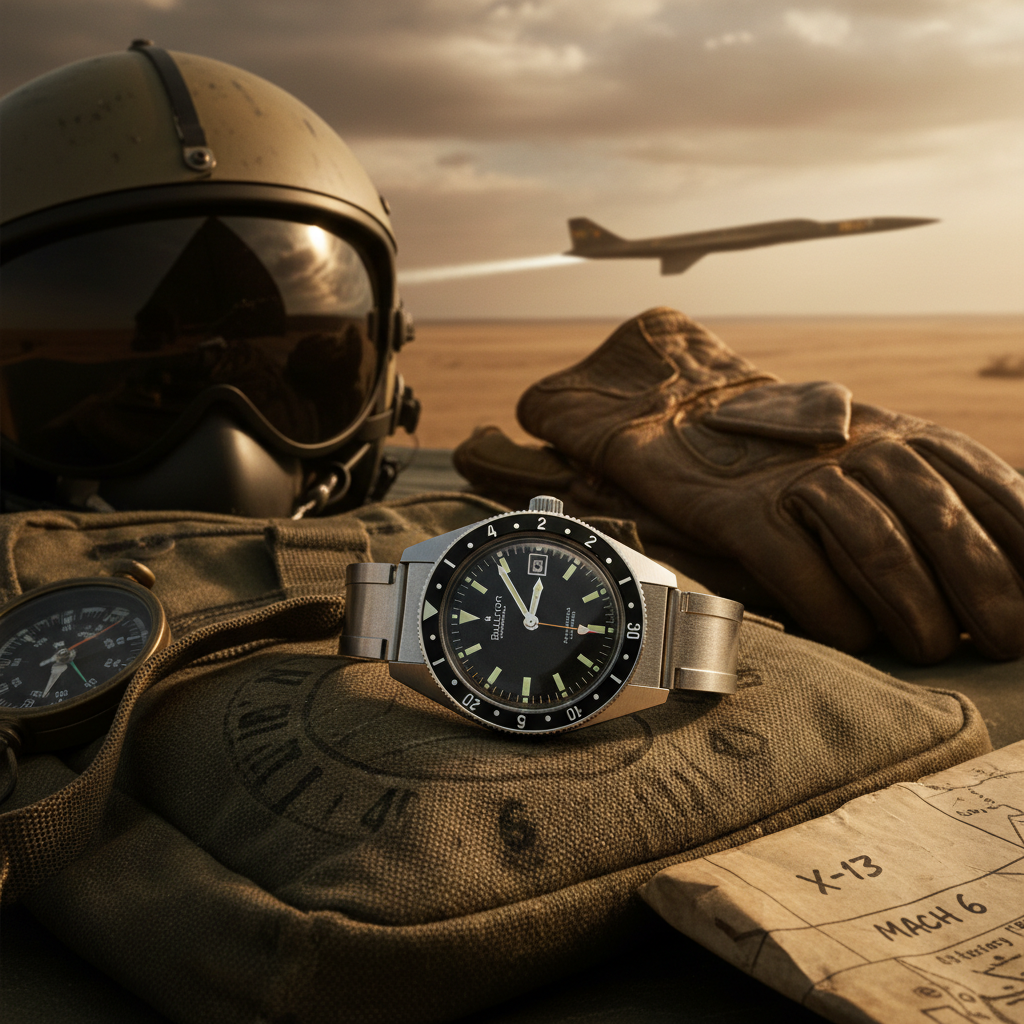
The Bulova Accutron Astronaut, powered by the remarkable Calibre 214 tuning-fork movement, became a tool watch for pilots operating at the very edge of conventional aviation.
Unlike a traditional mechanical watch, the Accutron did not regulate time with a balance wheel oscillating a few times per second.
Instead, its electrically powered tuning fork vibrated at:
360 HZ
That extraordinarily high frequency gave the movement exceptional stability for its era and helped make it well suited to high-speed, high-altitude environments. Historical accounts note that the Accutron’s low-inertia tuning-fork system handled high G-loads and temperature changes particularly well.
🚀 Then Came the X-15
The North American X-15 was not an ordinary airplane.
It was a rocket-powered experimental aircraft launched from beneath a B-52, designed to explore hypersonic flight, high-altitude control, extreme heating, and the edge of space.
Across 199 flights, the program eventually reached:
MACH 6.7
354,200 FEET
The data gathered helped shape later Mercury, Gemini, Apollo, and Space Shuttle development.
And according to Accutron, the Accutron Astronaut became the officially issued watch for X-15 pilots.
That is a remarkable piece of watch history.
This wasn’t merely a watch styled to look futuristic.
It was being worn by pilots flying one of the most advanced experimental aircraft ever built.
🕵️ And Then the CIA Wanted It
The story didn’t stop with the X-15.
The Accutron Astronaut was later issued to CIA pilots flying the Lockheed A-12, the secret reconnaissance aircraft developed for extreme-altitude, Mach 3-class missions. Accutron’s own history specifically notes the watch’s use by A-12 pilots.
Suddenly this one watch had connections to:
rocket planes
high-altitude reconnaissance
NASA
the CIA
early human spaceflight
Not bad for something that hummed instead of ticked. 😂⌚
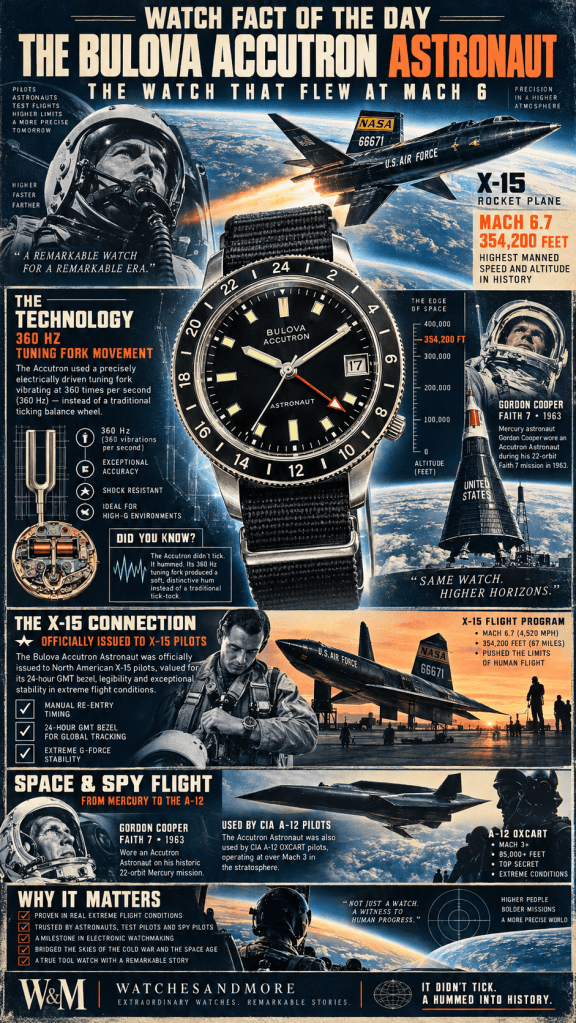
🌎 Gordon Cooper Takes It Into Orbit
On May 15, 1963, Mercury astronaut Gordon Cooper launched aboard Faith 7 for the final mission of Project Mercury.
He completed more than 22 orbits and spent over 34 hours in space. Late in the mission, automatic control and electrical problems forced Cooper to conduct a manual re-entry. Despite those failures, he brought the capsule down with exceptional precision in the Pacific.
Contemporary and later historical accounts show Cooper wearing an Accutron Astronaut during the mission.
Cooper later recalled relying on a wristwatch during his manual re-entry calculations, though NASA’s current mission summaries do not identify the watch model in that specific moment.
So I’d phrase our article carefully:
The Accutron went with him into space.
His manual timing helped bring Faith 7 home.
That gives us the truth without overstating what the surviving NASA documentation specifically proves.
💡 Did You Know?
The Accutron Astronaut wasn’t really designed like a conventional dress watch at all.
It used:
a 24-hour hand
a rotating 24-hour bezel
a tuning-fork movement
electronic regulation
—all features that made it particularly useful to pilots operating across time zones and in demanding flight environments.
And the name Astronaut turned out to be remarkably appropriate.
⭐ Why It Matters
The Accutron Astronaut represents a strange transitional moment in watchmaking.
Mechanical watches still ruled.
Quartz hadn’t yet conquered the industry.
And here was a humming electronic watch using a tuning fork to achieve better stability in extreme environments.
It wasn’t quite mechanical.
It wasn’t quartz.
It was something entirely different.
And it found its way onto the wrists of:
X-15 PILOTS
CIA A-12 PILOTS
MERCURY ASTRONAUTS
That’s a serious résumé.
BEFORE QUARTZ.
BEFORE THE MOONWATCH LEGEND.
THERE WAS THE HUM OF THE ACCUTRON.
Category: Military Watches
Disclaimer: Every effort has been made to keep these watch facts accurate, but the world of horology is full of myths, disputed stories, and fascinating trivia. Consider these facts a starting point for discovery rather than the final word. If you have corrections or additional insights, let us know—we’re always happy to keep the record ticking in the right direction.
🕐 Discover more watch facts, reviews, and buying guides at WatchesAndMore
🛍️ You Might Also Like
As an Amazon Associate and affiliate partner, WatchesAndMore earns from qualifying purchases.