

📅 Friday, September 25, 2026
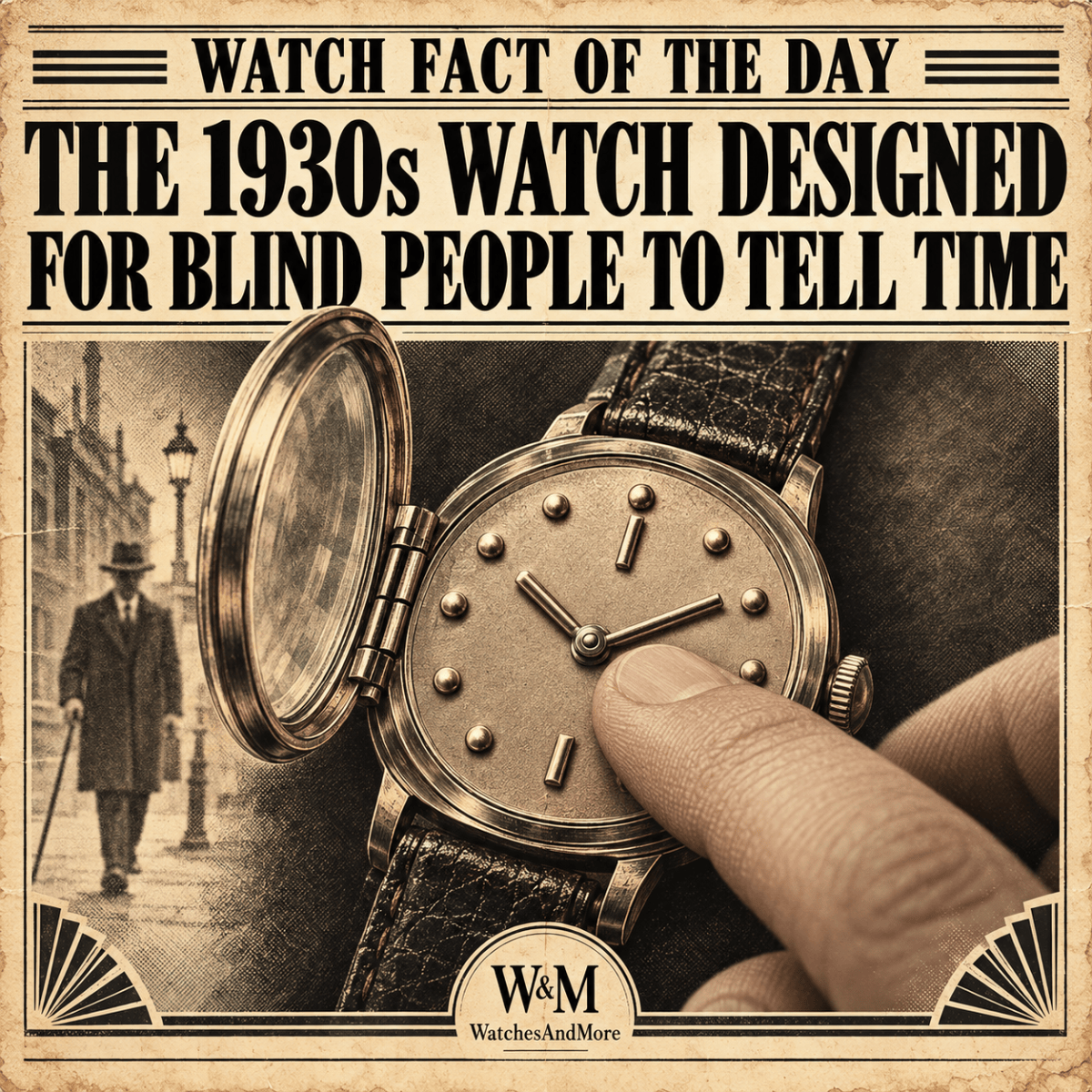
Long before talking watches, smartphones, or voice assistants, watchmakers found a remarkably simple way to make time accessible to people who could not rely on sight:
LET THEM FEEL IT.
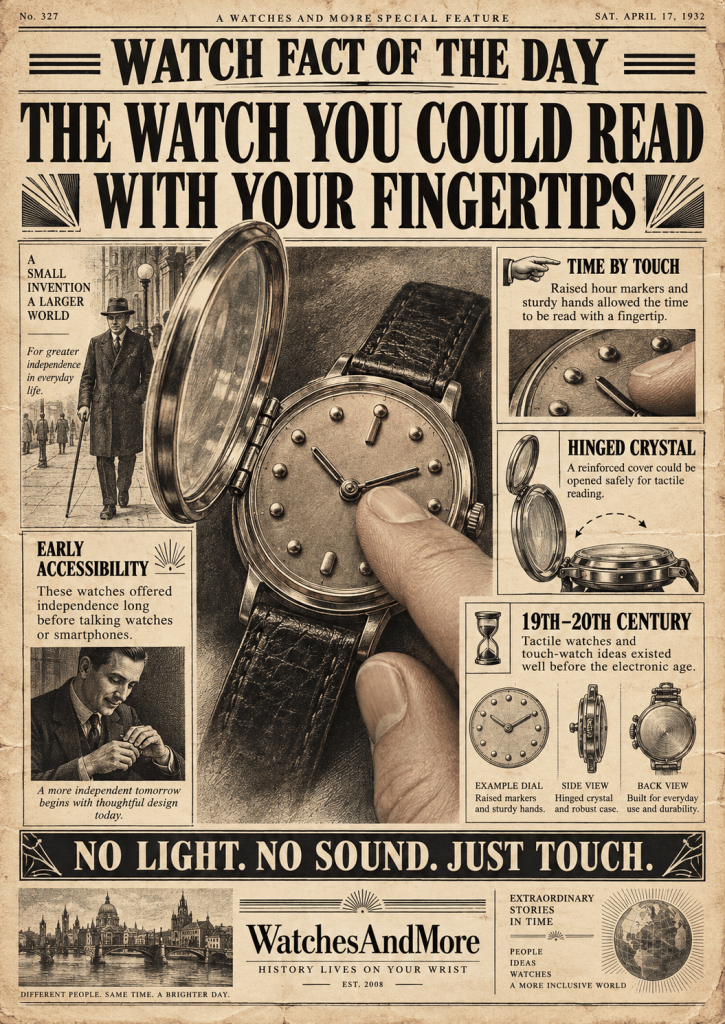
Special tactile or “Braille” watches used raised hour markers and hands that could be read by touch. Many later examples used a hinged crystal or protective cover that could be lifted so the wearer could place a fingertip directly on the dial without damaging the watch during normal wear. The American Foundation for the Blind describes this as the traditional Braille-watch layout: lift the hinged crystal, then feel the hour markers and the positions of the hands.
The idea itself had deep roots. Watches designed to tell time by touch existed centuries earlier. Breguet sold its first famous montre à tact in 1799—a watch with an external pointer and hour markers that could be read without looking at the dial. Those watches were not originally created specifically for blind users, but the same basic principle—translating time into something tactile—would later become especially valuable for accessibility.
By the late 19th and early 20th centuries, purpose-built tactile watches were clearly being made for blind and partially sighted people. Museums Victoria preserves a mid-to-late-19th-century fob watch with raised numerals and Braille markings, and early-20th-century examples continued the concept into wristwatches.
How Did They Work?
A conventional watch tells time visually.
A tactile watch turns the dial into a physical map.
The wearer opens the protective cover and feels:
raised markers → where the hours are
short hand → the hour
long hand → the minutes
The hands had to be robust enough to tolerate gentle touch without being easily displaced, and the protective cover helped keep the dial and hands safe when the watch was closed.
That meant the time could be checked:
SILENTLY.
PRIVATELY.
WITHOUT LIGHT.
💡 Did You Know?
The history of tactile timekeeping is closely connected to another earlier watchmaking idea: reading the time in darkness.
The Smithsonian preserves a “touch watch” given to Helen Keller when she was young. Its design used pins around the case corresponding to the hours and an external moving hand that could be felt by touch. The watch had originally been developed as a way to tell time in the dark, but its tactile design made it especially useful for someone who was blind.
That gives us a beautiful through-line:
TIME BY SIGHT
became
TIME BY SOUND
and also
TIME BY TOUCH
⭐ Why It Matters
This is a great reminder that accessibility design is not a modern invention.
Watchmakers were solving accessibility problems mechanically long before electronics arrived.
No speaker.
No synthesized voice.
No vibration motor.
No screen reader.
Just:
HINGE.
RAISED MARKERS.
STRONG HANDS.
TOUCH.
And that gave blind and low-vision users something incredibly important:
independence.
The watch didn’t announce the time to everyone nearby.
It let the wearer discover it discreetly with a fingertip.
That makes these tactile watches more than curiosities.
They are early examples of inclusive industrial design.
BEFORE WATCHES TALKED…
SOME WERE MADE TO BE FELT.
Category: Fun Quirk
Disclaimer: Every effort has been made to keep these watch facts accurate, but the world of horology is full of myths, disputed stories, and fascinating trivia. Consider these facts a starting point for discovery rather than the final word. If you have corrections or additional insights, let us know—we’re always happy to keep the record ticking in the right direction.
🕐 Discover more watch facts, reviews, and buying guides at WatchesAndMore
🛍️ You Might Also Like
As an Amazon Associate and affiliate partner, WatchesAndMore earns from qualifying purchases.

Browse all 142+ expert-reviewed watches →