
Watch Fact of the Day: Why the Royal Oak’s “Screws” Don’t Turn

In 1970, Gérald Genta flipped the watch world on its head by introducing the Audemars Piguet Royal Oak, a timepiece rocking eight visible hexagonal fasteners that look like screws but behave more like the decorative knobs on a fancy cupboard. These “through-screws” don’t actually tighten at the front; they’re elegantly held in place and adjusted from the back. Think of them as screws with a flair for the dramatic—perfectly aligned for aesthetic pleasure rather than practical purposes. Who knew something so eye-catching could also be a structural hero? Welcome to watchmaking where function meets fashion, and everything else just ticks away!

Fun Quirk: Friday, October 2, 2026

📅 Friday, October 2, 2026

When Gérald Genta designed the Audemars Piguet Royal Oak in 1970, he created one of the most recognizable bezels in watch history.

Eight visible hexagonal fasteners.

Eight polished slots.

Eight perfectly controlled positions around an octagonal bezel.

To most people, they look like ordinary screws.

But they do not work like ordinary screws at all.

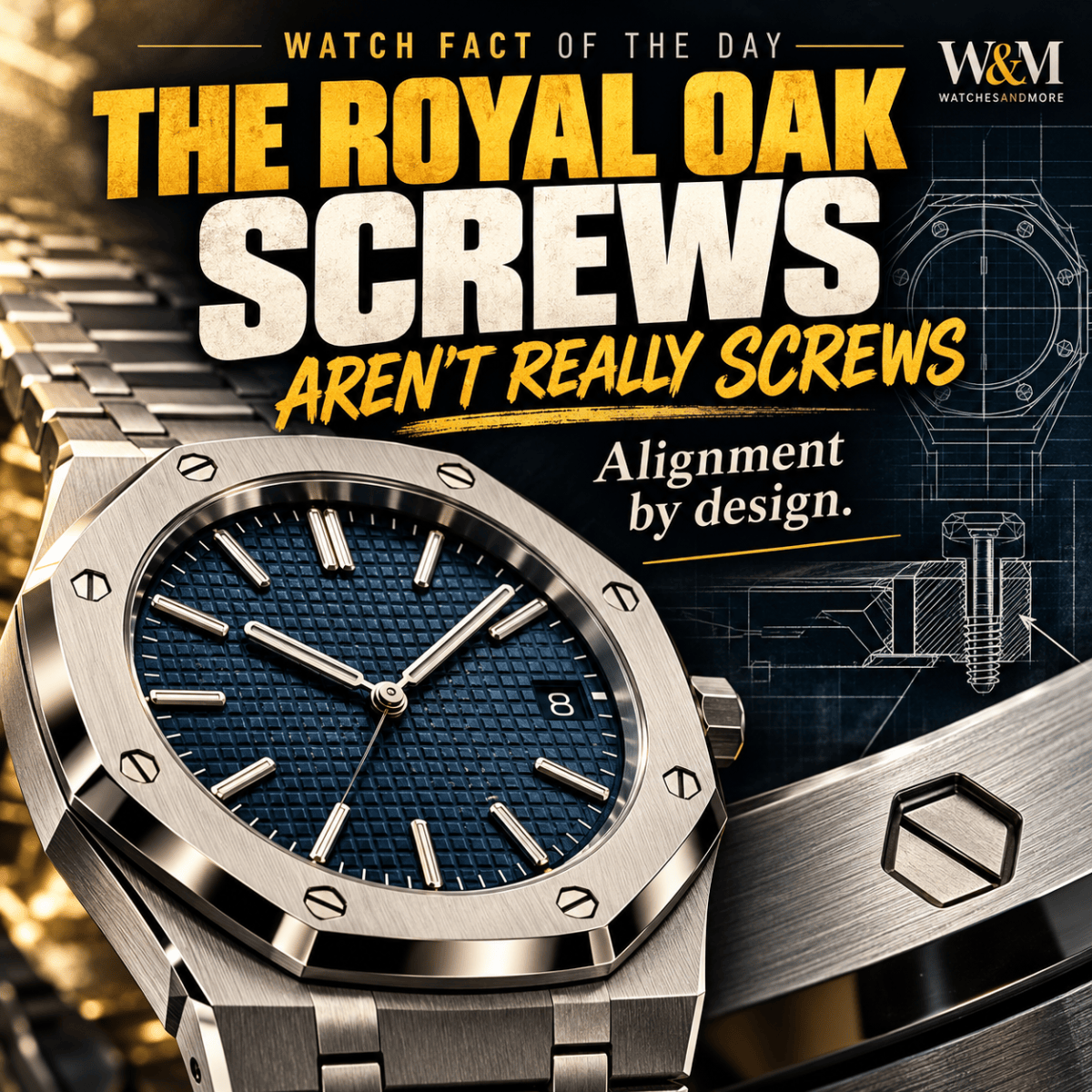
The Royal Oak’s visible fasteners are through-screws. Their hexagonal heads are captured inside matching hexagonal holes in the bezel, which prevents them from turning. From the rear of the watch, round nuts are threaded onto those screws and tightened to clamp the case together and compress the water-resistance gasket. AP Chronicles

That means the visible slot on the front is not used to tighten the watch.

It can simply be oriented precisely for appearance.
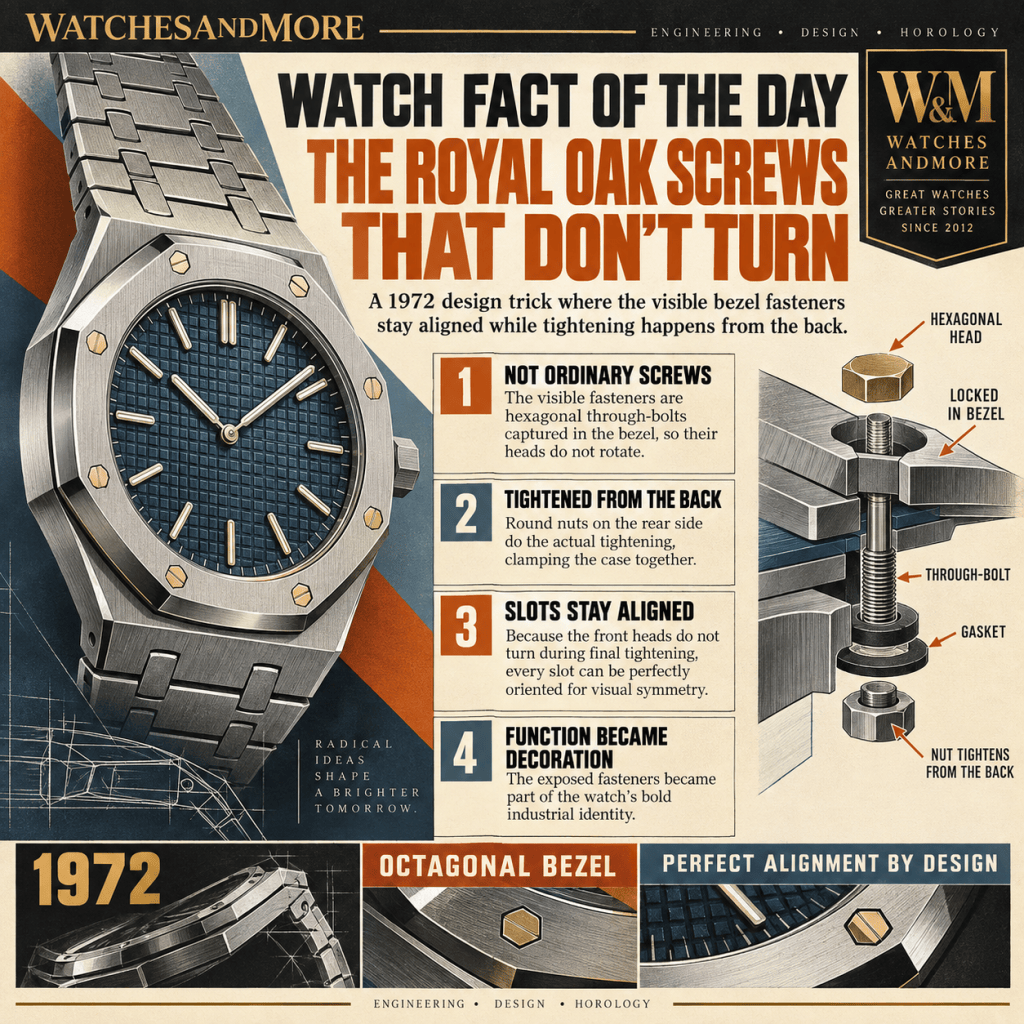
Watch Fact of the Day: Why the Royal Oak’s “Screws” Don’t Turn

THE FRONT DOESN’T TURN.

THE BACK DOES THE TIGHTENING.

And that is why the Royal Oak’s bezel slots can appear so perfectly aligned.

Why Genta Did It This Way

The Royal Oak’s design was inspired in part by the architecture of a diver’s helmet, with visible external fasteners becoming part of the visual identity rather than something to hide.

Genta’s 1970 sketch already showed the concept: a wide bezel, eight exposed hexagonal fasteners, and a large gasket compressed between the bezel and monocoque case. Audemars Piguet’s archives note that the hexagonal heads were intentionally captured so they would not rotate while being locked from below. AP Chronicles

That was radical at the time.

Traditional luxury watchmaking usually concealed functional hardware.

The Royal Oak put it on display.

FUNCTION BECAME DECORATION.

💡 Did You Know?

The neat slot alignment that collectors admire is actually the result of a clever engineering shortcut around a problem that watchmakers normally face.

Ordinary screws cannot simply be tightened until all their slots line up perfectly. Thread starts, screw lengths, tolerances, and final torque all determine where a screw head stops. That is why aligned screws are generally impractical in conventional watchmaking. Hodinkee

The Royal Oak gets around that problem because the front fastener doesn’t rotate during final tightening.

The nut on the back does.

That is the trick.

⭐ Why It Matters

The Royal Oak is full of details where engineering and aesthetics are inseparable.

The screws are not merely decorative.

The alignment is not fake.

And the system is not just visual theater.

The eight through-screws actually help clamp the case together and compress the gasket that contributes to water resistance. AP Chronicles

So one of the most famous decorative details in modern watchmaking is also a real structural part of the watch.

THEY LOOK LIKE SCREWS.

THEY DON’T TURN LIKE SCREWS.

AND THAT’S EXACTLY WHY THEY LINE UP.

This one is absolutely made for a W&M visual.

I’m seeing 1972 Swiss industrial-design magazine × Gérald Genta sketchbook × technical case cutaway.

Headline:

THE ROYAL OAK SCREWS THAT DON’T TURN

Then a cutaway:

HEXAGONAL HEAD
↓
LOCKED IN BEZEL
↓
THROUGH-SCREW
↓
NUT TIGHTENS FROM THE BACK

And the bottom payoff:

PERFECT ALIGNMENT

BY DESIGN, NOT LUCK.

Category: Fun Quirk

Disclaimer: Every effort has been made to keep these watch facts accurate, but the world of horology is full of myths, disputed stories, and fascinating trivia. Consider these facts a starting point for discovery rather than the final word. If you have corrections or additional insights, let us know—we’re always happy to keep the record ticking in the right direction.

🕐 Discover more watch facts, reviews, and buying guides at WatchesAndMore


🛍️ You Might Also Like

As an Amazon Associate and affiliate partner, WatchesAndMore earns from qualifying purchases.
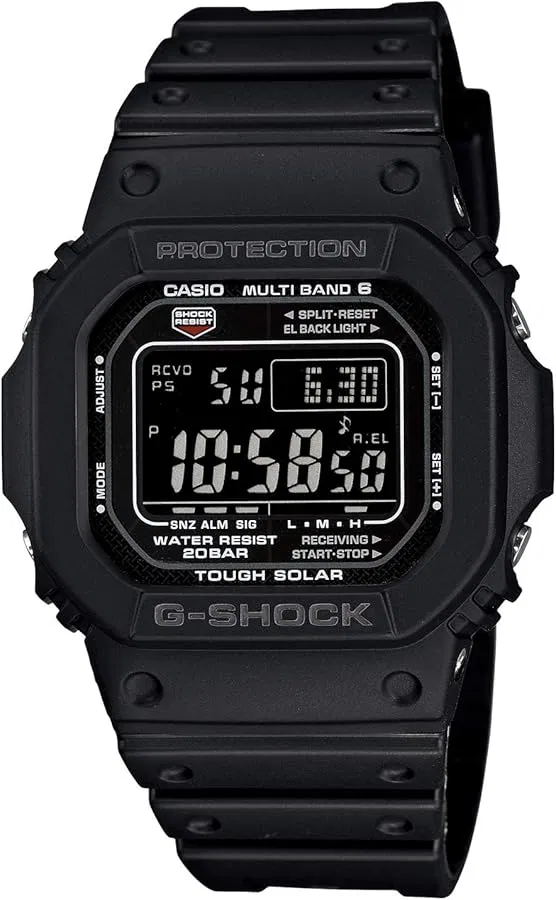
G-Shock GWM5610-1 Solar Atomic
🔥 Deal of the Day

G-Shock GWM5610-1 Solar Atomic

Casio

★★★★★ 4.8 (5,621 reviews)

$129

Offer expires in


🔥 Grab This Deal →

G-Shock GA2100-1A1 CasiOak


G-Shock GA2100-1A1 CasiOak

Casio

★★★★★ 4.8 (2,156 reviews)

$99


Check Price on Amazon →

Casio Edifice Chronograph


Casio Edifice Chronograph

Casio

★★★★★ 4.7 (1,264 reviews)

$120


Check Price on Amazon →


Browse all expert-reviewed watches →

Watch Fact of the Day: The True Watch That First Climbed Mount Everest

On May 29, 1953, Sir Edmund Hillary made history by summiting Mount Everest, all while wearing a humble yet remarkable Smiths De Luxe watch. Unlike the more commonly recognized Rolex Explorer, the Smiths, featuring a unique preparation for extreme cold, showcases the unseen details that make its story compelling. While Rolex supplied watches for the expedition, the Smiths watch directly connects to Hillary’s achievement, symbolizing British craftsmanship. Now displayed at the Science Museum in London, this small timepiece celebrates an extraordinary journey. It reminds us that every watch has a unique tale, and this one reached the very roof of the world.

Military Watches: Thursday, October 1, 2026

📅 Thursday, October 1, 2026

A legendary mountain. A historic ascent. And a British watch that deserves its moment at the summit.

Mention Mount Everest to a watch enthusiast, and the Rolex Explorer probably comes to mind. Its connection to mountaineering is woven into watchmaking history.

But ask which watch Sir Edmund Hillary wore during his successful 1953 summit climb, and another name deserves the spotlight: Smiths De Luxe. The Science Museum Group identifies the surviving watch as the very timepiece Hillary wore on that historic ascent.

Sometimes, the most fascinating watch stories are waiting just beyond the familiar dial.

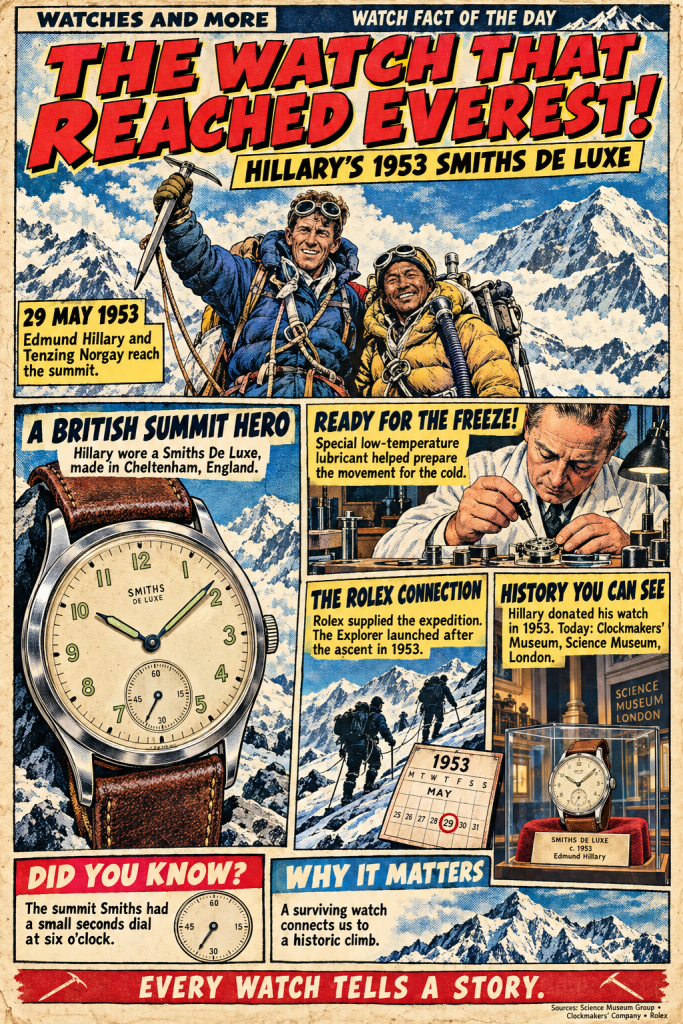
Illustration detailing the Smiths De Luxe watch worn by Edmund Hillary during the 1953 Everest expedition, featuring historical facts and images of climbers and the watch itself.

🏔️ A Small Watch on an Extraordinary Journey

On 29 May 1953, Edmund Hillary and Tenzing Norgay achieved the first confirmed ascent of Mount Everest. It was a shared triumph, supported by a much larger expedition and accomplished in conditions that pushed people and equipment to their limits.

Hillary’s Smiths was made in Cheltenham, England. Its silvered dial featured luminous Arabic numerals and a small seconds display at six o’clock. Inside sat a 15-jewel mechanical movement, protected by a steel waterproof case made by Dennison.

At a glance, it looks remarkably modest for a watch associated with such an enormous achievement.

That is part of its appeal. This was a timekeeper with a job to do.

❄️ The Detail That Helped It Face the Cold

One of the most interesting preparations was hidden inside.

Smiths treated Hillary’s watch with a special lubricant intended to withstand low temperatures. The Clockmakers’ Company confirms this preparation and records that Hillary reported the watch had performed very well.

It is an easy detail to overlook when admiring the dial, but it brings the story into focus: expedition equipment needed preparation for the environment it would encounter.

A handsome case could catch the eye. What happened inside it mattered on the mountain.

👑 Where Does Rolex Fit Into the Story?

Rolex’s Everest connection is real. The company supplied Oyster Perpetual watches to the 1953 expedition and had supported Himalayan exploration since the 1930s.

There is also an important timing detail: Rolex introduced the Explorer following the successful ascent, later in 1953. Its own history describes the model as a watch born from that achievement and the wider experience of expedition testing.

The distinction matters. Equipping an expedition, launching a watch inspired by its success, and identifying the watch Hillary wore to the summit are different historical claims.

The museum record gives Smiths a clear place in Hillary’s story. It does not, by itself, establish that Smiths was the only watch brand present at the summit.

🏛️ From Everest to the Museum

Hillary personally presented his Smiths watch to the Worshipful Company of Clockmakers in 1953.

Today, it is listed on display in the Clockmakers’ Museum gallery at London’s Science Museum—a surviving object connecting British watchmaking with one of the twentieth century’s defining adventures.

There is something special about that. The watch itself survives, allowing visitors to look beyond the legend and see the instrument.

💡 Did You Know?

Hillary’s summit watch had a small seconds subdial at six o’clock. Its appearance is quite different from the familiar black-dial, 3–6–9 design associated with the Rolex Explorer.

⭐ Why It Matters

The Smiths De Luxe reminds us to look closely at watch history. A famous association can draw us into a story; the surviving objects and records help us understand its details.

For watch lovers, that makes this modest British timepiece especially compelling. Its significance comes from the journey it accompanied.

Every watch tells a story. This one reached the roof of the world.

Watches And More — Exploring the stories behind the watches.

Category: Military Watches

Disclaimer: Every effort has been made to keep these watch facts accurate, but the world of horology is full of myths, disputed stories, and fascinating trivia. Consider these facts a starting point for discovery rather than the final word. If you have corrections or additional insights, let us know—we’re always happy to keep the record ticking in the right direction.

🕐 Discover more watch facts, reviews, and buying guides at WatchesAndMore


🛍️ You Might Also Like

As an Amazon Associate and affiliate partner, WatchesAndMore earns from qualifying purchases.

G-Shock GWM5610-1 Solar Atomic
🔥 Deal of the Day

G-Shock GWM5610-1 Solar Atomic

Casio

★★★★★ 4.8 (5,621 reviews)

$129

Offer expires in


🔥 Grab This Deal →

G-Shock GA2100-1A1 CasiOak


G-Shock GA2100-1A1 CasiOak

Casio

★★★★★ 4.8 (2,156 reviews)

$99


Check Price on Amazon →

Seiko 5 SNK805 Green Military


Seiko 5 SNK805 Green Military

Seiko

★★★★★ 4.8 (6,961 reviews)

$89


Check Price on Amazon →


Browse all expert-reviewed watches →

Watch Fact of the Day: How Steve McQueen’s Monaco Came to Be on His Wrist

So, Steve McQueen in “Le Mans” isn’t just about racing; it’s also about the iconic Heuer Monaco watch he wore. He wanted to look the part of a real racer, drawing inspiration from pro racer Jo Siffert, who rocked a different Heuer model. McQueen’s choice of the blue Monaco was influenced by his suit’s branding and practicality during filming. Initially, the Monaco didn’t blow up but eventually gained fame. This watch now carries a story tied to McQueen, blending bold design and cinematic history. It’s a classic case of a small item making big cultural waves.

Watches on Screen: Wednesday, September 30, 2026

📅 Wednesday, September 30, 2026

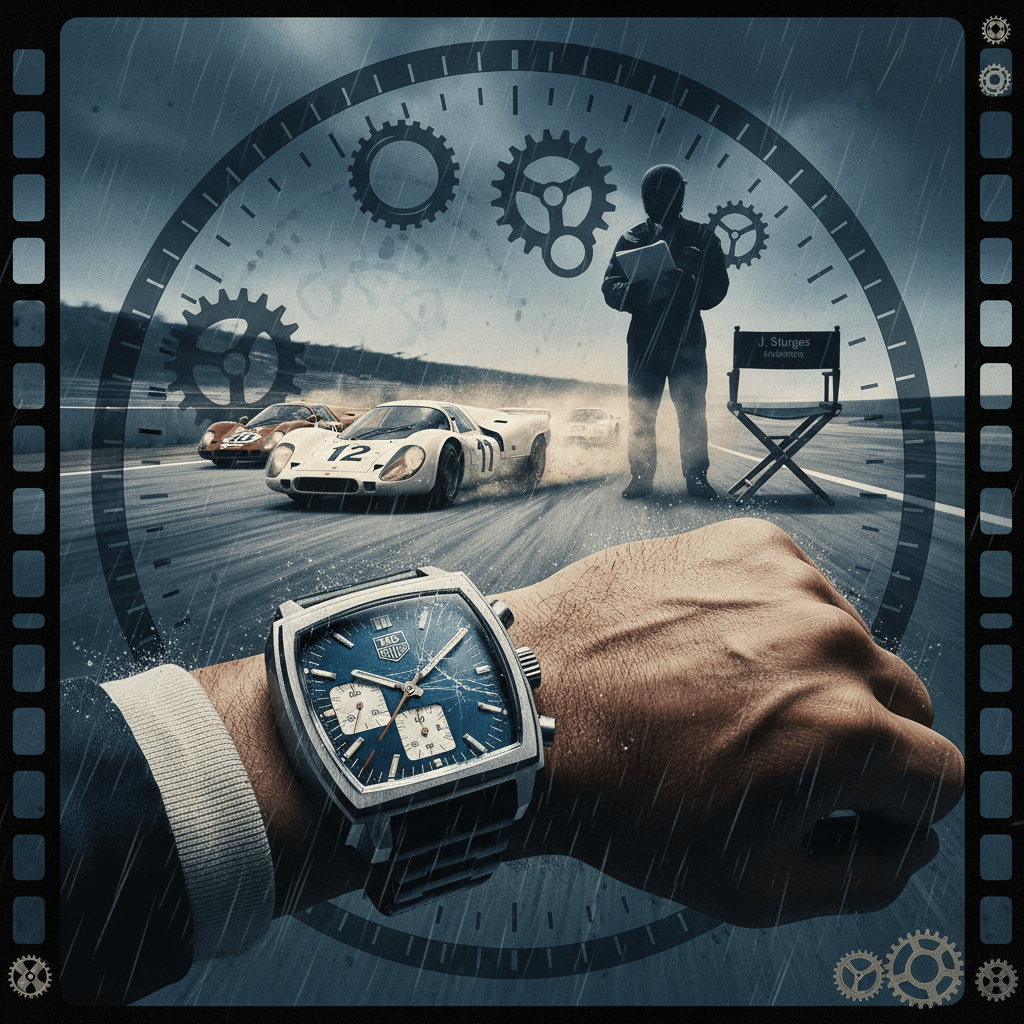
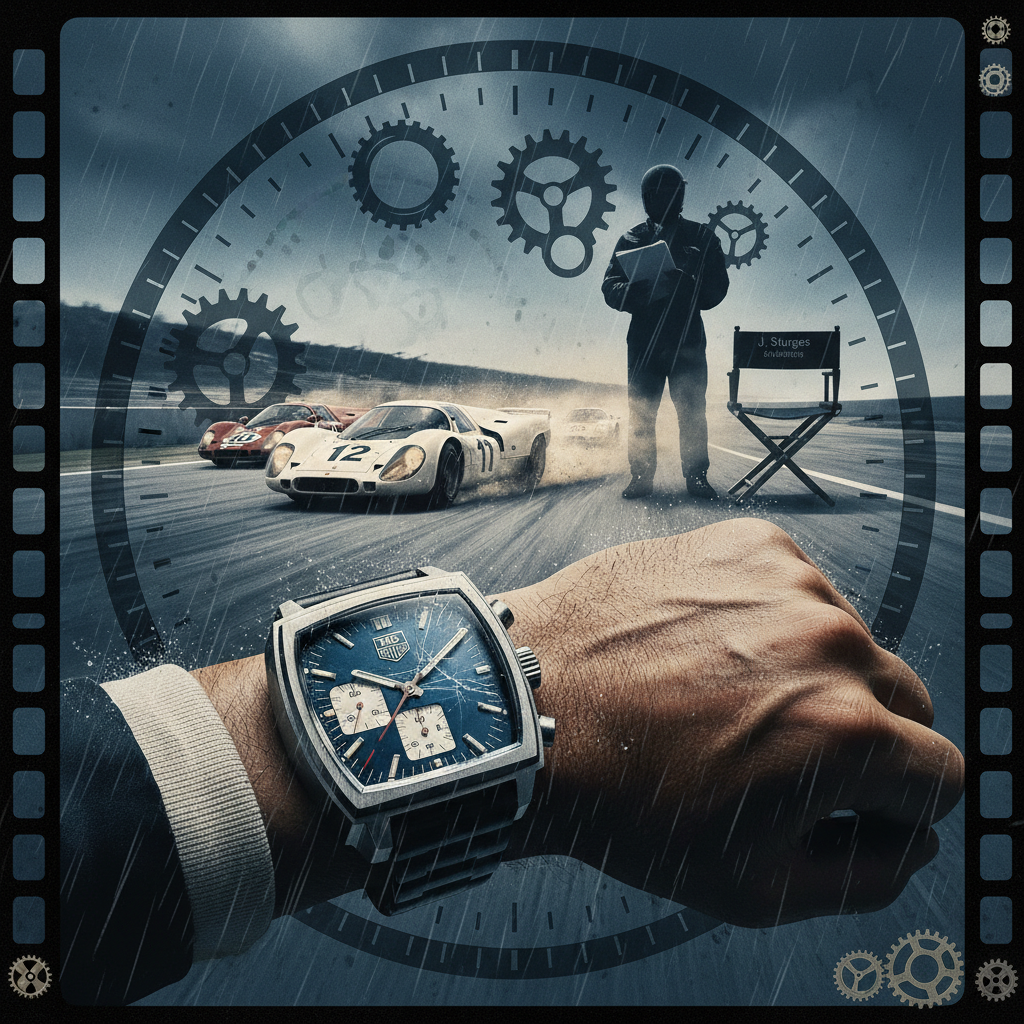
A racing driver, a film prop table, and a square blue chronograph. Sometimes, that is all it takes to make watch history.

Picture Steve McQueen in Le Mans: racing overalls, an expression of absolute concentration, and a Heuer Monaco strapped to his wrist.

The pairing feels inevitable. The King of Cool wearing a watch with enough personality to hold its own beside him.

But behind that famous image is a more interesting story than simply copying another driver’s watch.

He Wanted to Look Like a Real Racer

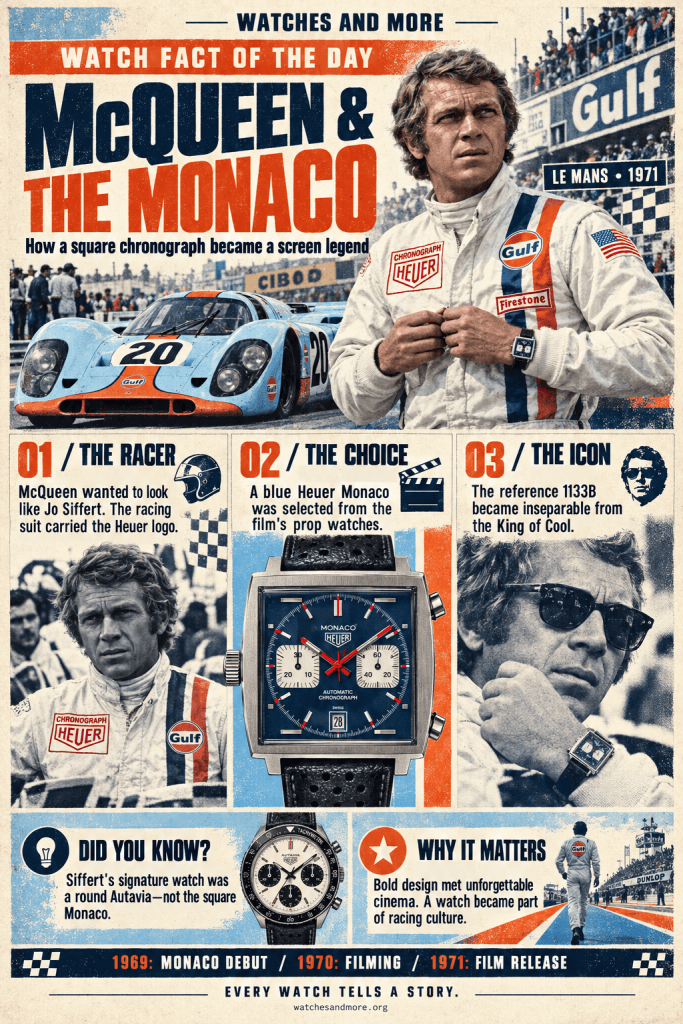
During production in 1970, McQueen wanted his character, Michael Delaney, to look convincing. For inspiration, he turned to professional racing driver Jo Siffert, who was involved with the film and had a relationship with Heuer.

According to Jack Heuer’s recollection, based on accounts from people on set, McQueen indicated that he wanted to look like Siffert. The driver supplied a white racing suit carrying the Heuer logo. The film would reach cinemas in 1971.

That choice helped set the direction for the watch.

If your racing suit says Heuer, a Heuer chronograph makes a pretty convincing finishing touch.

The Twist: Siffert’s Famous Watch Was an Autavia

Here is the detail that often gets lost in the retelling.

McQueen did not simply copy Siffert’s exact watch.

Siffert was famously associated with the Heuer Autavia reference 1163T, particularly the white dial version with blue accents that collectors know as the “Siffert” Autavia. McQueen’s screen watch was the blue dial Monaco reference 1133B.

The inspiration came from Siffert’s racing identity. The square chronograph took its own route into the picture.

And what a route it turned out to be.

A Prop Table Helped Make the Decision

TAG Heuer’s heritage account describes property master Don Nunley presenting McQueen with watches from several brands.

McQueen considered an Omega Speedmaster, but the Heuer branding on his suit helped steer the choice toward a Heuer. He selected a blue Monaco, and Nunley subsequently arranged for more watches and timing equipment to come from the manufacturer for filming.

There was a practical side, too. Jack Heuer’s account says Nunley needed matching watches for different production uses and a spare in case of damage.

A screen icon still has to survive the ordinary business of making a movie.

The Monaco Already Had Something to Say

Introduced in 1969, the Monaco combined a bold square case with Heuer’s new automatic chronograph technology. Its water resistant case, developed by supplier Piquerez, gave the design substance beyond its unusual appearance.

This was a watch that could catch your eye before you knew anything about its movement.

A blue dial. Contrasting white registers. Red accents. A silhouette you could recognise across a room.

On McQueen’s wrist, those details became part of a larger visual language: racing machinery, purposeful equipment, and effortless confidence.

To our eyes, the Monaco looks perfectly cast.

Becoming an Icon Took Time

It is tempting to imagine that Le Mans instantly turned the Monaco into a runaway success.

The history is less tidy. TAG Heuer acknowledges disappointing early sales, and the original collection was discontinued around 1975. A revival followed in 1997, helping establish the Monaco’s enduring place in watch culture.

That makes the story even better.

Some designs need time before the world catches up with them.

The Watches And More Take

The Monaco’s appeal is easy to understand when you look at that famous McQueen image. The watch contributes something unmistakable to the scene.

Its shape has confidence. Its colours have energy. Its connection to the film gives collectors a story they can carry on their own wrists.

And that is one of the pleasures of watches: a small object can hold a surprisingly large piece of culture.

Heuer supplied the chronograph. McQueen gave us an image we still remember.

Would you choose McQueen’s square Monaco or Siffert’s round Autavia? Let us know in the comments.

Every watch tells a story. This one came with racing overalls and the King of Cool.

💡 Did You Know?

Jo Siffert’s signature watch was a round Heuer Autavia—not the square Monaco McQueen wore in Le Mans. McQueen borrowed Siffert’s racing look, then gave the Monaco its own Hollywood identity.

⭐ Why It Matters

The Monaco shows how design and storytelling can work together. Its bold square case made it distinctive; McQueen’s appearance in Le Mans gave it a cultural connection that remains central to its identity.


Category: Watches on Screen

Disclaimer: Every effort has been made to keep these watch facts accurate, but the world of horology is full of myths, disputed stories, and fascinating trivia. Consider these facts a starting point for discovery rather than the final word. If you have corrections or additional insights, let us know—we’re always happy to keep the record ticking in the right direction.

🕐 Discover more watch facts, reviews, and buying guides at WatchesAndMore


🛍️ You Might Also Like

As an Amazon Associate and affiliate partner, WatchesAndMore earns from qualifying purchases.
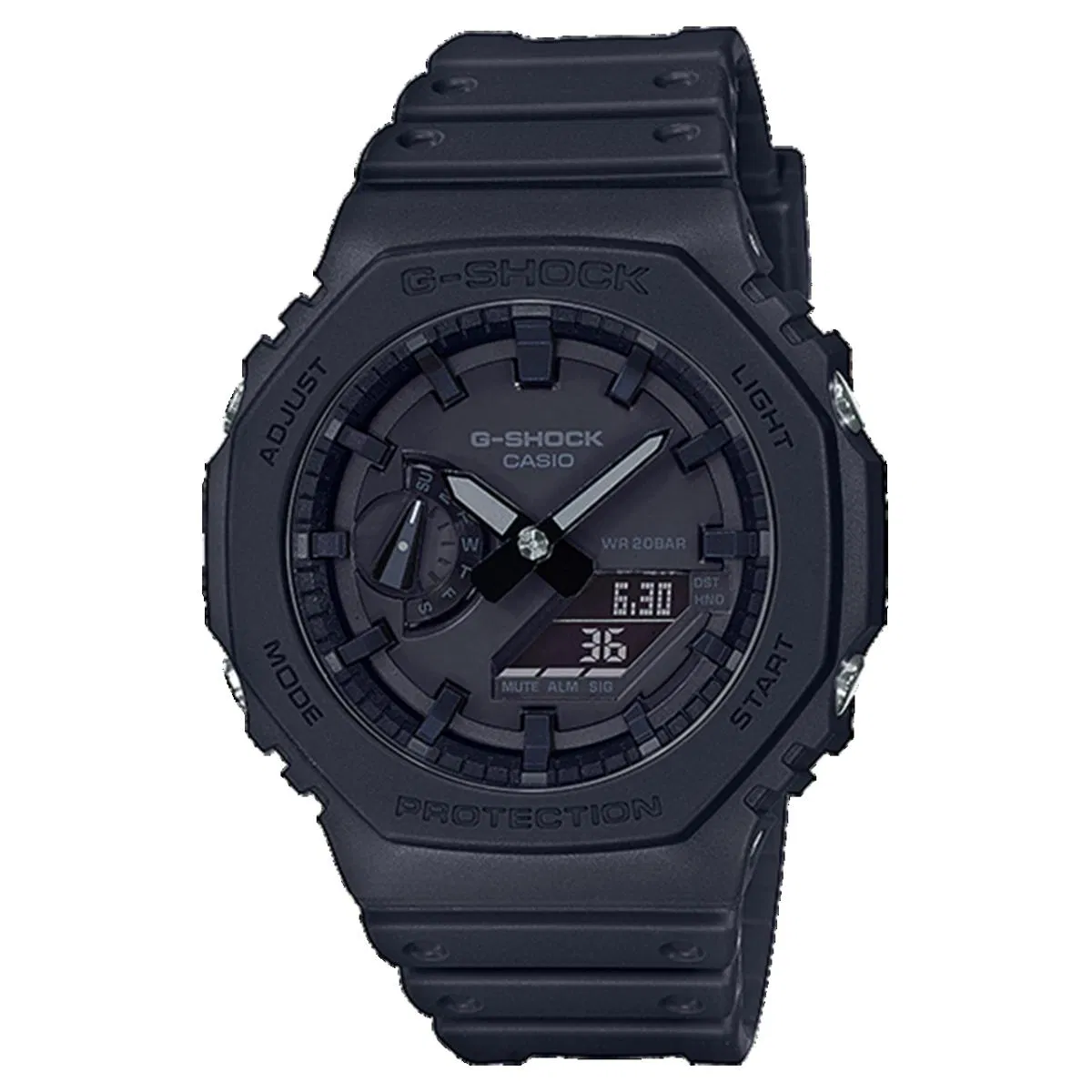
G-Shock GWM5610-1 Solar Atomic
🔥 Deal of the Day

G-Shock GWM5610-1 Solar Atomic

Casio

★★★★★ 4.8 (5,621 reviews)

$129

Offer expires in


🔥 Grab This Deal →

G-Shock GA2100-1A1 CasiOak


G-Shock GA2100-1A1 CasiOak

Casio

★★★★★ 4.8 (2,156 reviews)

$99


Check Price on Amazon →

Seiko 5 SNK805 Green Military


Seiko 5 SNK805 Green Military

Seiko

★★★★★ 4.8 (6,961 reviews)

$89


Check Price on Amazon →


Browse all 142+ expert-reviewed watches →

Watch Fact of the Day: Breguet Built a Watch Docking Station in the 18th Century

In 1795, Abraham-Louis Breguet invented the pendule sympathique, a snazzy gadget that let your pocket watch sync with a master clock — no Wi-Fi required! It’s like a long-lost buddy system for timepieces: drop your watch in its cradle at night, and voilà! Morning reveals it’s perfectly timed. This mechanical marvel did more than just adjust; later models could even wind the watch. Breguet struck royal gold, selling only six of these masterpieces to princes who presumably needed an extra fancy way to tell time. So, next time your watch updates itself, give a nod to Breguet, the original time-broker!

Watch History: Tuesday, September 29, 2026

📅 Tuesday, September 29, 2026

Imagine placing your pocket watch into a clock at night and finding it set to the right time in the morning. No screen. No software. Just gears, springs, and a remarkable idea.

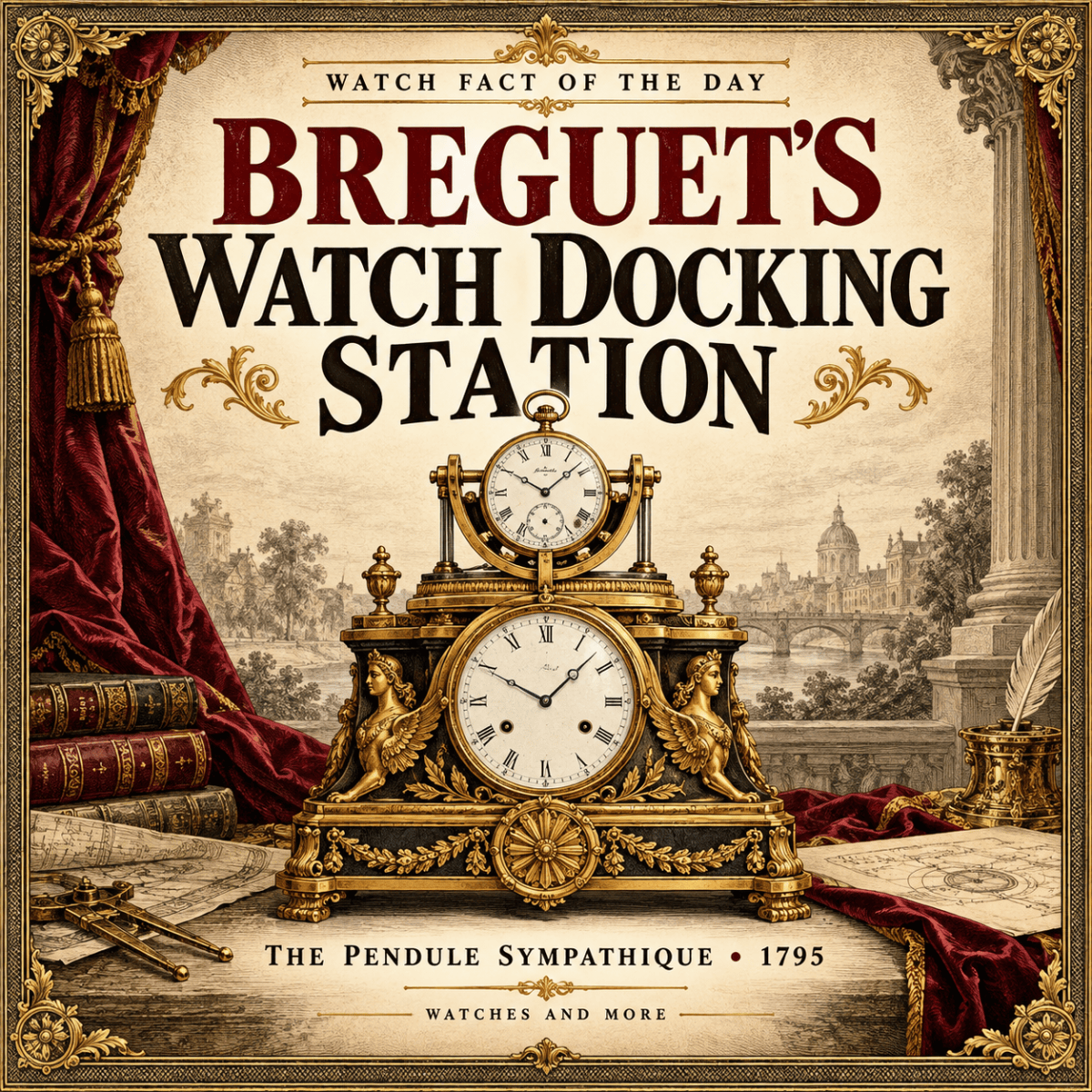
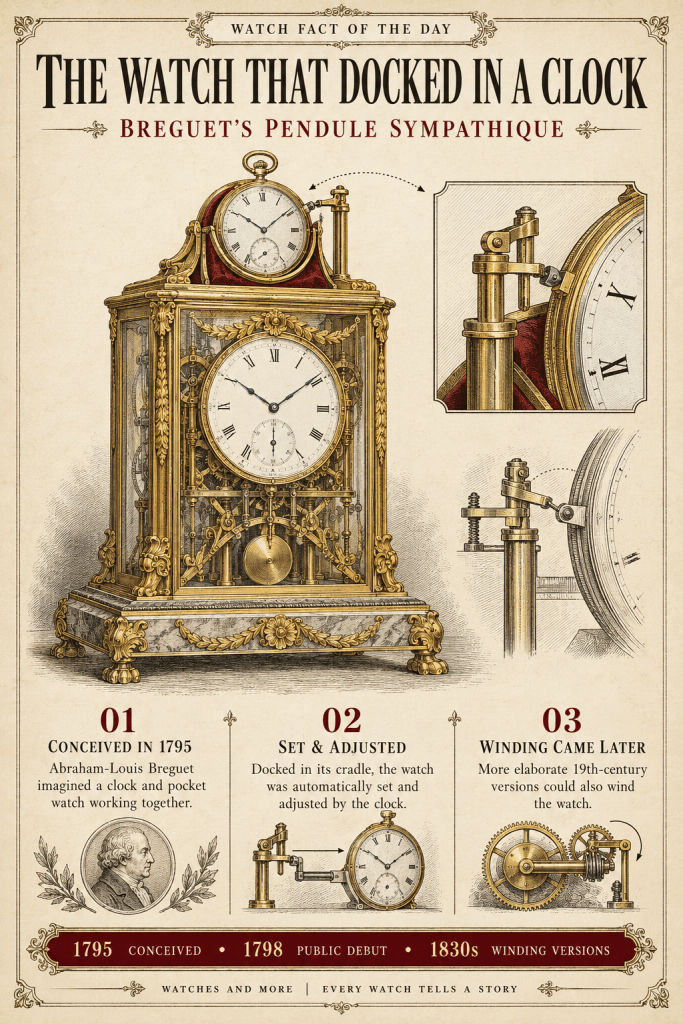
Abraham-Louis Breguet conceived the pendule sympathique in 1795 and first presented it publicly in 1798. It paired a master clock with a portable watch made to fit into a cradle. Once docked, the watch could be automatically set and adjusted by the clock. More than two centuries before we began syncing the devices we carry, Breguet had created a mechanical relationship between two timekeepers.

A Clock and Watch Working Together

The clever part was the connection. The pocket watch could travel with its owner, then return to the clock for correction. Breguet called the system sympathique to express harmony between the two timepieces. That name feels fitting: one kept time at home while the other carried it out into the world.

There is a detail that makes this story even better. The original 1790s concept should not be credited with every feature found in later examples. Breguet describes the early system as automatically setting and adjusting the watch. Later sympathique clocks developed more elaborate mechanisms; a documented 1835 example could also wind its matching watch. The idea evolved from mechanical time synchronization into something even closer to what we would now call a docking station.

An illustrated infographic about Breguet's Pendule Sympathique, showcasing a clock and docked pocket watch, including historical facts about its conception in 1795, its automatic setting feature, and later winding versions from the 1830s.

Fit for Royalty

These were extraordinary creations, and their buyers reflected that. According to Breguet, Abraham-Louis sold just five, each different, before his death in 1823. His son Antoine-Louis sold one more in 1830. All six went to kings or princes. One clock-and-watch pair was sold in 1814 to Britain’s Prince Regent, the future King George IV.

Why It Still Matters

Today, we barely think about a watch updating itself. Breguet’s achievement invites us to stop and picture what that required when every instruction had to be carried out by a physical mechanism.

The pendule sympathique is a reminder that watchmaking has always been about more than displaying the hour. Sometimes it is about imagining a new way for timepieces to work together—and then finding a way to build it.

Watch Fact of the Day: Breguet conceived a clock that could automatically set and adjust its matching pocket watch in 1795. Later versions added automatic winding. The watch dock was a horological idea long before the digital age.

Every watch tells a story. This one tells the story of two timepieces working in sympathy.


Category: Watch History

Disclaimer: Every effort has been made to keep these watch facts accurate, but the world of horology is full of myths, disputed stories, and fascinating trivia. Consider these facts a starting point for discovery rather than the final word. If you have corrections or additional insights, let us know—we’re always happy to keep the record ticking in the right direction.

🕐 Discover more watch facts, reviews, and buying guides at WatchesAndMore


🛍️ You Might Also Like

As an Amazon Associate and affiliate partner, WatchesAndMore earns from qualifying purchases.
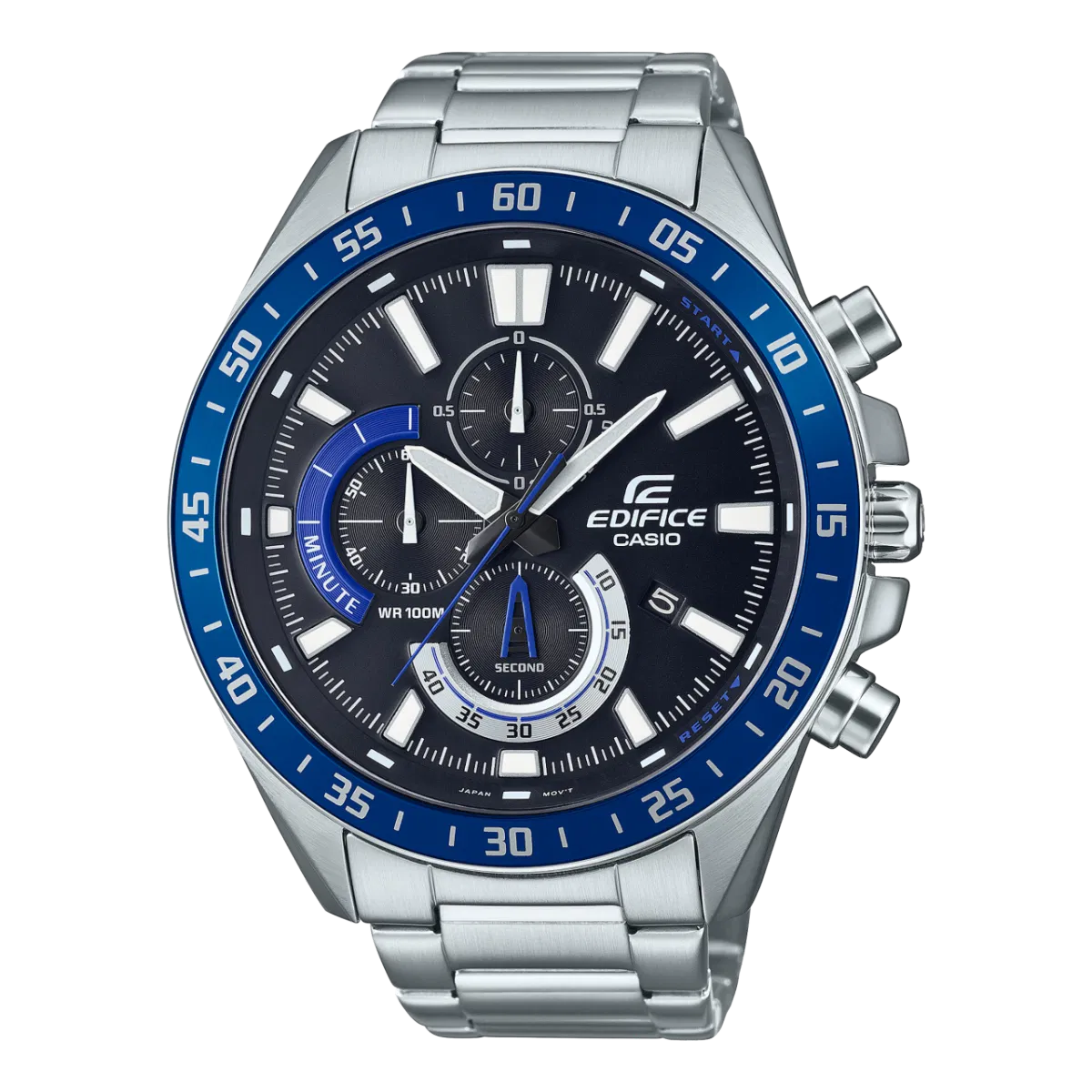
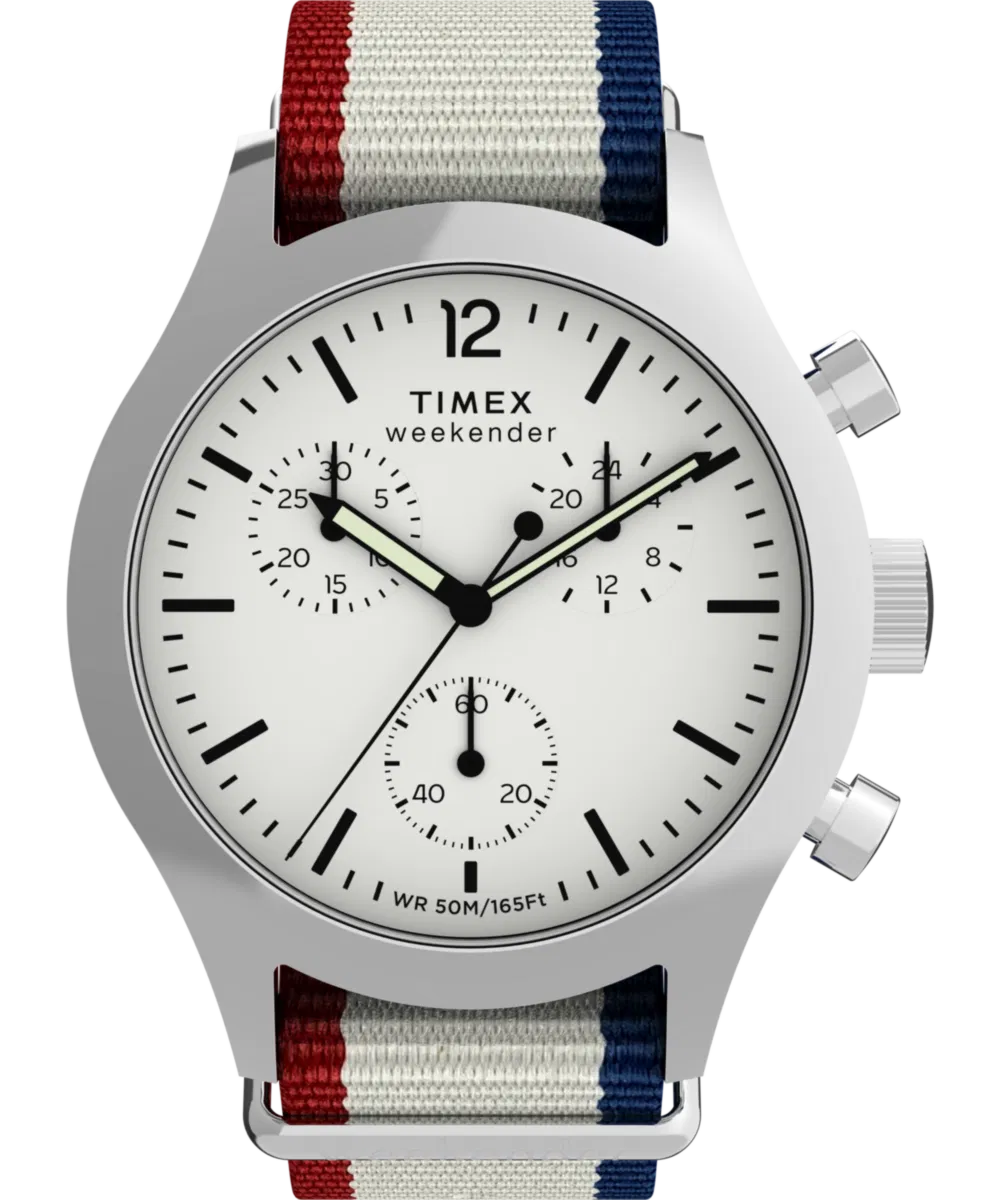
Timex Weekender Chronograph
🔥 Deal of the Day

Timex Weekender Chronograph

Timex

★★★★★ 4.5 (3,041 reviews)

$79

Offer expires in


🔥 Grab This Deal →

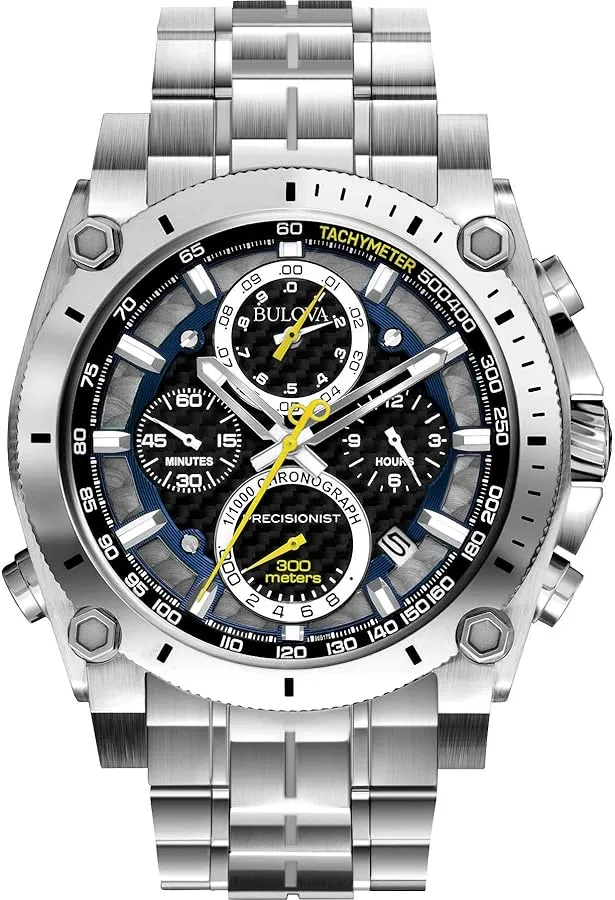
Bulova Precisionist


Bulova Precisionist

Bulova

★★★★★ 4.6 (1,100 reviews)

$219


Check Price on Amazon →

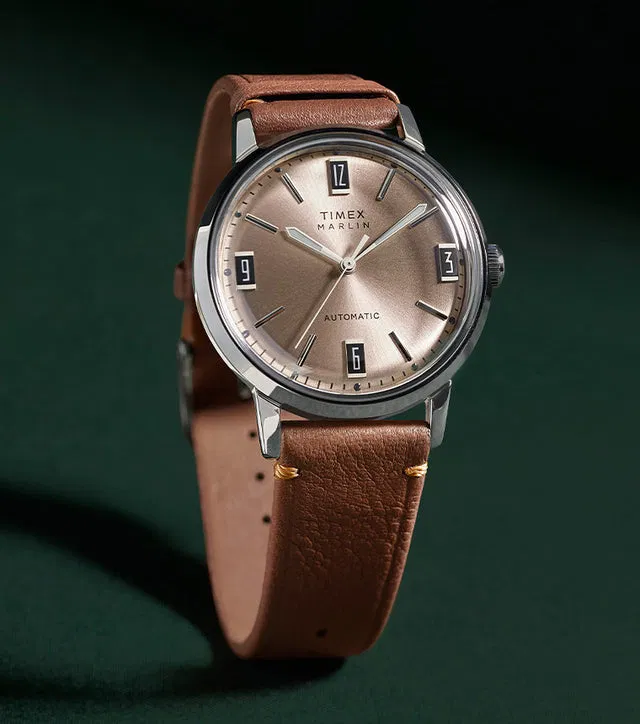
Timex Marlin Automatic 40mm


Timex Marlin Automatic 40mm

Timex

★★★★★ 4.7 (1,106 reviews)

$259


Check Price on Amazon →


Browse all expert-reviewed watches →

ETSY Shop
ETSY Shop
Redbubble Shop
Redbubble Shop
More Watch Facts
More Watch Facts

Citizen’s August Tsuyosa Refresh: A 37mm 60-Hour Automatic and a Black-and-Gilt Shore

Citizen is giving its value-focused Tsuyosa family two distinct directions this August: a compact gold-tone Tsuyosa 60 with a 60-hour automatic movement, and the limited TSUYOSA Shore “Time Slip” with a black gradient dial, rotating bezel, and 100m water resistance.

Citizen’s Tsuyosa line has become one of the most approachable ways into integrated-bracelet automatic watches. This August, the brand is taking that formula in two directions: the compact **TSUYOSA 60 37mm** adds a 60-hour movement to a smaller case, while the **TSUYOSA Shore “Time Slip”** gives the collection a limited-edition, skin-diver-adjacent look with a rotating bezel and 100 metres of water resistance. Both models are listed as available on Citizen’s U.S. site at the time of publication, but neither has been admitted to our Amazon-verified catalogue—so this is a release report, not a shopping recommendation.

TSUYOSA 60 37mm: The Compact Formula Gets the Longer-Running Movement

The **NK0032-56A** packages Citizen’s Caliber 8310 automatic movement in a 37mm gold-tone stainless-steel case. Citizen lists a 60-hour power reserve, sapphire crystal, integrated stainless-steel bracelet, date display, and 50-metre water resistance. The model’s silver-tone textured dial keeps the presentation relatively restrained despite the yellow-gold-tone case and bracelet.

The important part is the combination of size and movement. Citizen had already offered a 37mm Tsuyosa and a larger Tsuyosa 60; this model brings the longer-running Caliber 8310 to the smaller format. For enthusiasts who prefer a compact everyday automatic, that is a more useful change than a purely cosmetic colour update. [See Citizen’s official NK0032-56A details →](https://www.citizenwatch.com/us/en/product/NK0032-56A)

TSUYOSA Shore “Time Slip”: A Limited-Edition Sports Watch with a Different Personality

The **NJ0238-57E** is the more extroverted release. Citizen’s global announcement describes a 12,000-piece worldwide limited edition scheduled for August 2026. The official specifications list a 40mm stainless-steel case, a black-gradient dial, sapphire glass, a one-way rotating bezel, 100-metre water resistance, and the Caliber 8210 automatic movement with approximately 42 hours of running time.

The black dial and rose-gold-tone details create a warm contrast without turning the watch into a formal piece. Its 100m rating makes it appropriate for swimming and snorkeling, but the model should not be confused with Citizen’s purpose-built Promaster Diver line. [Read Citizen’s global release announcement →](https://www.citizenwatch-global.com/news/2026/20260723_2/index.html)

What These Releases Say About Value Automatics

Neither release needs to be treated as a universal recommendation. The gold-tone NK0032-56A is deliberately specific in style, while the limited Shore asks collectors to decide whether the colourway and bezel-equipped case are worth choosing over a standard Tsuyosa. Still, the two models illustrate a useful point: value-oriented automatic watches are increasingly differentiated by proportions, movement reserve, finishing, and use case—not just dial colour.

If you are deciding between a dressier integrated-bracelet look and a tougher everyday watch, use the [Watch Advisor](/watch-finder) to compare verified options already in the catalogue. It will only surface products whose Amazon destinations have passed the site’s exact-model verification process.

Citizen’s August Tsuyosa releases are not trying to be the same watch in two colours. The 37mm TSUYOSA 60 focuses on compact proportions and a longer-running movement; the Shore “Time Slip” leans into limited-edition sports-watch character. Their official details are clear, their imagery is confirmed against Citizen’s product pages, and their release context is worth following. We will not add an Amazon shopping link unless an exact active destination is independently verified first.

*Availability and listed prices can change. This article links to Citizen’s official product information and uses no affiliate purchase CTA for these unverified Amazon destinations.*

Watch Fact of the Day: The Stopwatch That Timed the First Flight at Kitty Hawk

On December 17, 1903, Wilbur and Orville Wright achieved a monumental breakthrough in aviation history, completing the first powered flight at Kitty Hawk. Using an unassuming hand-held stopwatch made by Gallet, they precisely recorded their flights: the first lasted 12 seconds over 120 feet, and the fourth reached 59 seconds across 852 feet. While the stopwatch itself appears ordinary, it symbolized the significance of timing in experimental flight and became an essential witness to this historic event. This simple instrument reminds us that remarkable achievements can stem from the smallest tools, ultimately transforming transportation and exploration for generations to come.

Military Watches: Monday, September 28, 2026

📅 Monday, September 28, 2026

Watch Fact of the Day: The Stopwatch That Timed the First Flight at Kitty Hawk

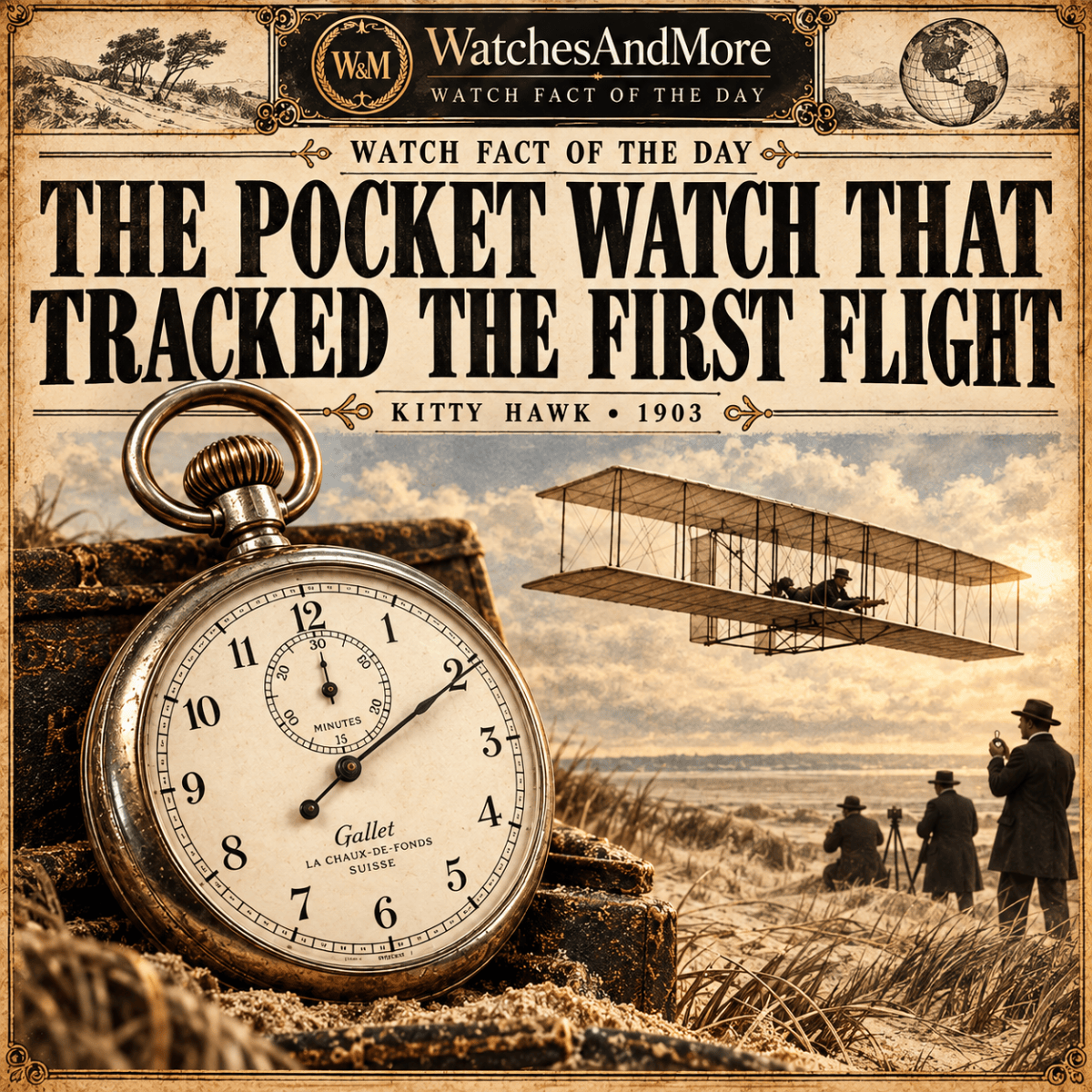
On the morning of December 17, 1903, Wilbur and Orville Wright stood on the windswept dunes near Kitty Hawk, North Carolina, ready to attempt something no one had yet achieved in a controlled, powered aircraft.

At 10:35 a.m., Orville climbed aboard the Wright Flyer.

Wilbur ran alongside.

The aircraft lifted from the rail.

And for exactly:

12 SECONDS

the world changed.

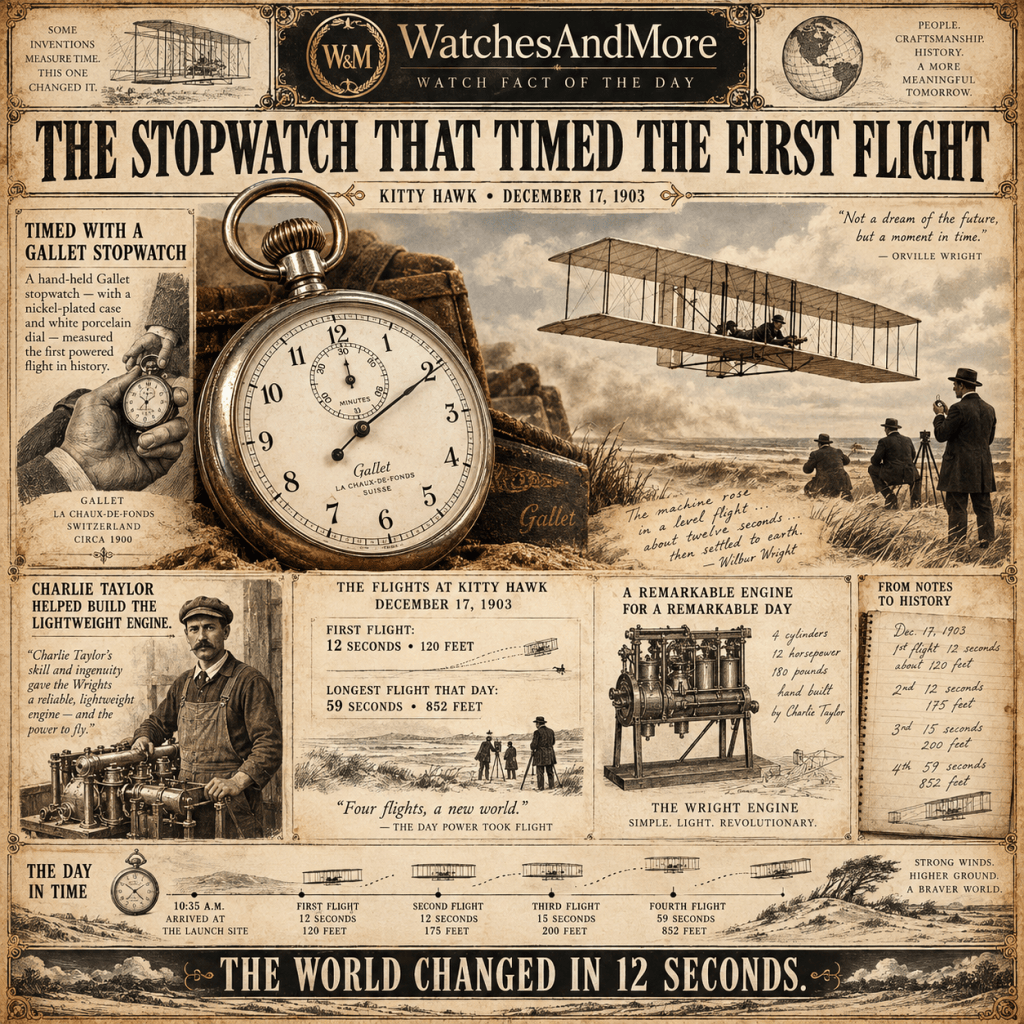
The Flyer traveled 120 feet before touching down. Later that same day, the brothers made three more flights, with the final attempt covering 852 feet in 59 seconds. Air and Space Museum

But how did they know those exact times?

They used a small hand-held stopwatch.

The National Air and Space Museum preserves that stopwatch today and identifies it as the instrument Wilbur and Orville used to time the historic flights at Kitty Hawk. Air and Space Museum

A Tiny Instrument at a Giant Moment

The stopwatch itself is remarkably ordinary-looking.

It has a nickel-plated case, a white porcelain dial with black Arabic numerals, and a smaller inset register for minutes.

No precious metal.

No complicated movement.

No dramatic decoration.

Just a practical timing instrument made by Gallet.

Yet on that cold December morning, it became one of the quiet witnesses to the birth of powered aviation. Smithsonian Institution

Why Timing Mattered

The Wright brothers were not simply trying to make an aircraft leave the ground.

They were conducting experiments.

Every flight produced data:

distance

duration

wind

control

engine performance

The stopwatch turned those fleeting seconds into measurable evidence.

The first flight:

12 SECONDS

120 FEET

The fourth:

59 SECONDS

852 FEET The Library of Congress

Those numbers became part of aviation history because someone measured them.

💡 Did You Know?

The Wright Flyer was powered by a lightweight engine built with the help of their mechanic Charlie Taylor.

Taylor helped design the engine and did virtually all of the machine work needed to produce it. The crankcase was made from aluminum—an important weight-saving choice for the Flyer. Air and Space Museum

So while the stopwatch did not make the airplane fly, it was there to record exactly how long humanity stayed airborne.

That makes it a beautiful reminder that big breakthroughs often depend on very small instruments.

⭐ Why It Matters

The Wright brothers’ stopwatch is not famous because it was luxurious.

It matters because it measured a moment no one had ever measured before.

12 SECONDS

That was enough.

Enough to prove controlled powered flight was possible.

Enough to open the door to aviation.

Enough to change transportation, warfare, exploration, commerce, and eventually spaceflight.

THE AIRPLANE MADE HISTORY.

THE STOPWATCH COUNTED THE SECONDS.


Category: Military Watches

Disclaimer: Every effort has been made to keep these watch facts accurate, but the world of horology is full of myths, disputed stories, and fascinating trivia. Consider these facts a starting point for discovery rather than the final word. If you have corrections or additional insights, let us know—we’re always happy to keep the record ticking in the right direction.

🕐 Discover more watch facts, reviews, and buying guides at WatchesAndMore


🛍️ You Might Also Like

As an Amazon Associate and affiliate partner, WatchesAndMore earns from qualifying purchases.

G-Shock GWM5610-1 Solar Atomic
🔥 Deal of the Day

G-Shock GWM5610-1 Solar Atomic

Casio

★★★★★ 4.8 (5,621 reviews)

$129

Offer expires in


🔥 Grab This Deal →

G-Shock GA2100-1A1 CasiOak


G-Shock GA2100-1A1 CasiOak

Casio

★★★★★ 4.8 (2,156 reviews)

$99


Check Price on Amazon →

Seiko 5 SNK805 Green Military


Seiko 5 SNK805 Green Military

Seiko

★★★★★ 4.8 (6,961 reviews)

$89


Check Price on Amazon →


Browse all expert-reviewed watches →

ETSY Shop
ETSY Shop
Redbubble Shop
Redbubble Shop
More Watch Facts
More Watch Facts

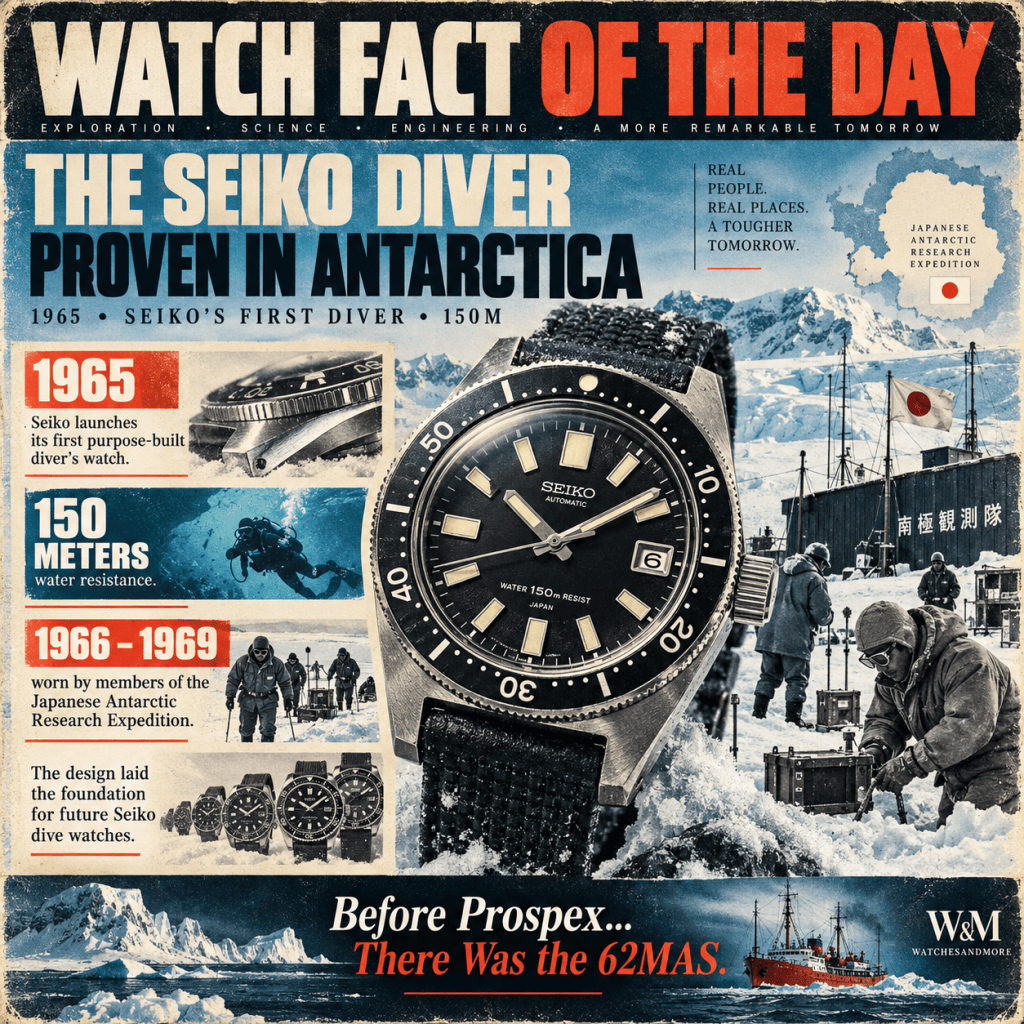
Watch Fact of the Day: The Seiko Diver Proven in Antarctica

In 1965, Seiko unleashed the 62MAS, a watch that made splashes—and probably more than a few ice cubes—out in the wild. Designed for divers, it survived the Antarctic from 1966 to 1969, proving it was ready for action instead of just posing as a pretty accessory. With its tough features and automatic charm, it paved the way for Seiko’s future dive watches, like the Tuna and Turtle. Forget mythical tales; this watch has real icy adventures to brag about. So, while it may not wear a cape, the 62MAS is the true hero of horology—defying nature like a pro!

Military Watches: Sunday, September 27, 2026

📅 Sunday, September 27, 2026

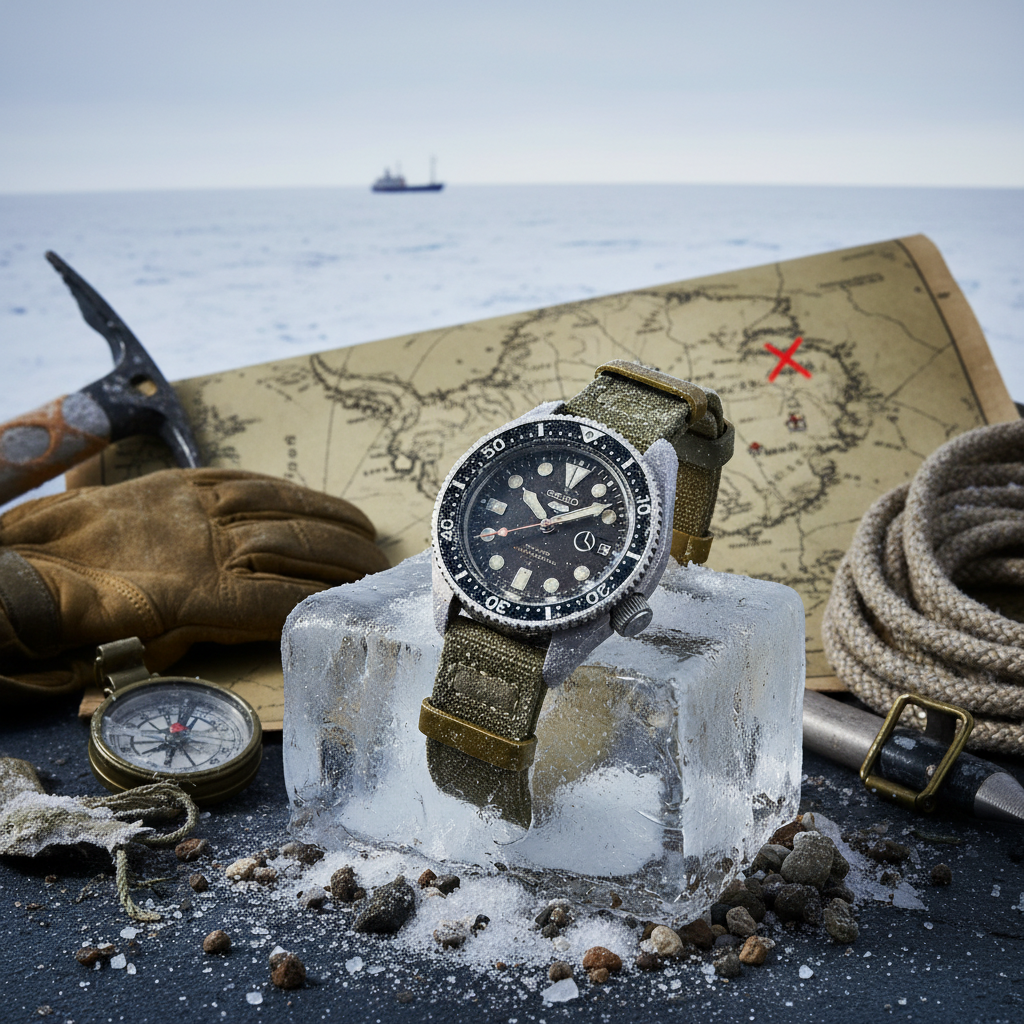
When Seiko introduced the 62MAS in 1965, it became the company’s first purpose-built diver’s watch—and Japan’s first of its kind. With an automatic movement, strong luminous markers, a rotating timing bezel, and 150 meters of water resistance, it was designed to be a serious working tool rather than a fashion accessory. Seiko Philippines (Official Store)

Its real test came soon afterward.

From 1966 to 1969, members of the Japanese Antarctic Research Expedition wore the 62MAS in one of the harshest environments on Earth. Sub-zero temperatures, snow, ice, moisture, and remote field conditions subjected the watch to the kind of punishment that no showroom demonstration could replicate. Seiko later pointed to that Antarctic service as an important early proof of the diver’s durability and reliability. Seiko Philippines (Official Store)

That matters because the 62MAS arrived at a pivotal moment in Seiko’s history.

The company was just beginning to establish itself as a serious maker of professional sports watches, and the 62MAS became the design and engineering foundation for generations of Seiko divers that followed. Its simple black dial, large luminous markers, date window, and no-nonsense case architecture created a visual language Seiko still revisits today. Monochrome Watches

💡 Did You Know?

The 62MAS is known by collectors today by a nickname derived from its 6217-series movement/reference and “automatic self-dater” identity, but its historical significance is much bigger than the nickname itself.

It was the starting point for a dive-watch family tree that eventually produced icons such as the 6105, the Tuna, the Turtle, and the modern Prospex line. Monochrome Watches

⭐ Why It Matters

The 62MAS didn’t need a mythical 50-day-under-the-ice survival story to be impressive.

It already had something better:

REAL ANTARCTIC SERVICE.

That’s what gives the watch its place in Seiko history.

It wasn’t just designed to look rugged.

It was actually used in an environment where equipment failure could matter.

1965 — SEIKO’S FIRST DIVER

1966–1969 — ANTARCTIC EXPEDITION USE

150 METERS — BUILT FOR REAL CONDITIONS


Category: Military Watches

Disclaimer: Every effort has been made to keep these watch facts accurate, but the world of horology is full of myths, disputed stories, and fascinating trivia. Consider these facts a starting point for discovery rather than the final word. If you have corrections or additional insights, let us know—we’re always happy to keep the record ticking in the right direction.

🕐 Discover more watch facts, reviews, and buying guides at WatchesAndMore


🛍️ You Might Also Like

As an Amazon Associate and affiliate partner, WatchesAndMore earns from qualifying purchases.

Seiko 5 SNK805 Green Military
🔥 Deal of the Day

Seiko 5 SNK805 Green Military

Seiko

★★★★★ 4.8 (6,961 reviews)

$89

Offer expires in


🔥 Grab This Deal →

Seiko 5 SNK809 Automatic


Seiko 5 SNK809 Automatic

Seiko

★★★★★ 4.7 (3,289 reviews)

$99


Check Price on Amazon →

Seiko 5 SNK803 Military


Seiko 5 SNK803 Military

Seiko

★★★★★ 4.7 (7,467 reviews)

$89


Check Price on Amazon →


Browse all 142+ expert-reviewed watches →

ETSY Shop
ETSY Shop
Redbubble Shop
Redbubble Shop
More Watch Facts
More Watch Facts

Watch Fact of the Day: The Hidden History of the Waterproof Mechanical Watch

So, back in the day, Swiss watchmakers had a tough time keeping water out of their watches, which could ruin them. Mido was one of the pioneers in tackling this issue with its Aquadura system that used a cork gasket around the crown to keep moisture at bay while still letting you wind or set the time. This innovation led to the Multifort line, focusing on rugged, everyday watches that handle all sorts of conditions. Mido’s cork solution was super effective and paved the way for today’s standards in sports watches, showing that sometimes, old-school materials can do the job just fine.

Watch History: Saturday, September 26, 2026

📅 Saturday, September 26, 2026

Long before modern dive watches became icons, Swiss watchmakers were already fighting one of mechanical horology’s oldest enemies:

WATER.

Moisture could enter through the crown, case joints, or crystal and quickly damage steel components inside the movement. Rust, corrosion, and contaminated lubricants could turn a perfectly good watch into a repair nightmare.

Mido became one of the early brands to take that problem seriously.

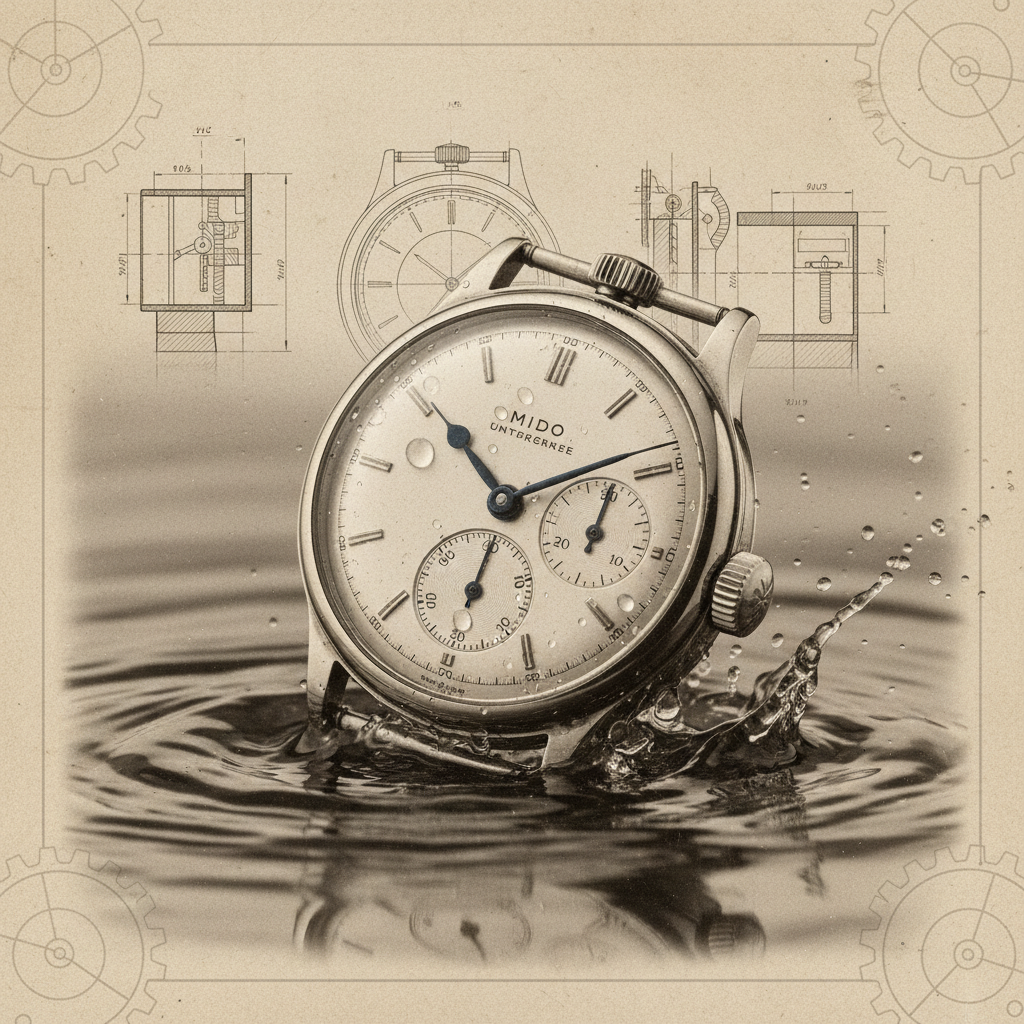
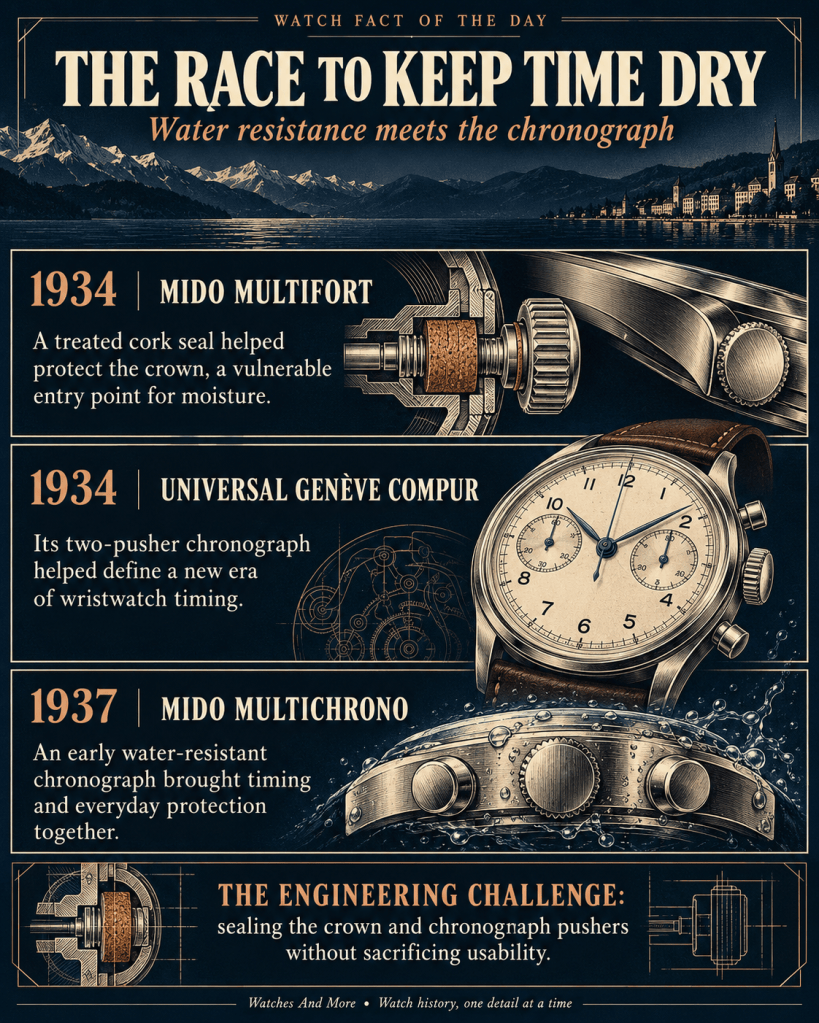
One of its best-known solutions was the Aquadura system, which used a specially treated cork gasket surrounding the crown stem. The cork remained compressed around the winding stem, helping form a barrier against water and dust while still allowing the crown to be operated. Mido’s own technical material continued describing Aquadura as a distinctive system for improving water resistance decades later. MIDO Watches

That sounds simple today.

In the early years of wristwatch engineering, it was anything but.

Why the Crown Was Such a Problem

A watch case can be sealed relatively easily if nothing has to move through it.

But the crown does.

The wearer has to pull it.

Turn it.

Wind the watch.

Set the time.

Every moving interface creates a possible entry point for moisture.

Mido’s cork system addressed that vulnerable area by maintaining pressure around the crown stem rather than relying only on a rigid metal fit.

MOVING PART + FLEXIBLE SEAL = BETTER PROTECTION

That became part of Mido’s broader reputation for practical, robust watches.

Where the Multifort Fits In

The Multifort became one of Mido’s defining lines and was associated with the brand’s push toward durable everyday wristwatches.

Rather than chasing only elegance, Mido leaned into the idea that a watch should be able to handle:

water

dust

shocks

temperature changes

That philosophy helped shape the kind of utility watch we now take for granted.

And eventually, Mido would extend the Multifort family into chronographs and other sportier configurations.

💡 Did You Know?

The clever thing about the Aquadura system was the material choice.

Cork seems primitive next to modern synthetic gaskets, but it had useful properties:

compressible

resilient

capable of maintaining contact around a moving stem

That made it surprisingly effective for early watch sealing.

Modern Mido documentation still describes the Aquadura concept as a cork gasket surrounding the crown stem. MIDO Watches

⭐ Why It Matters

Today we expect a sports watch to survive rain, sweat, washing hands, and sometimes swimming.

That expectation had to come from somewhere.

Early water-resistant watchmaking was built one vulnerable point at a time:

caseback

crystal

crown

pushers

gaskets

The crown was one of the hardest problems.

Mido’s cork-seal approach was an early and elegant answer.

BEFORE SCREW-DOWN CROWNS BECAME STANDARD…

SOME WATCHMAKERS TRUSTED CORK.


Category: Watch History

Disclaimer: Every effort has been made to keep these watch facts accurate, but the world of horology is full of myths, disputed stories, and fascinating trivia. Consider these facts a starting point for discovery rather than the final word. If you have corrections or additional insights, let us know—we’re always happy to keep the record ticking in the right direction.

🕐 Discover more watch facts, reviews, and buying guides at WatchesAndMore


🛍️ You Might Also Like

ETSY Shop
ETSY Shop
Redbubble Shop
Redbubble Shop
More Watch Facts
More Watch Facts

As an Amazon Associate and affiliate partner, WatchesAndMore earns from qualifying purchases.
Mido Ocean Star Automatic
🔥 Deal of the Day

Mido Ocean Star Automatic

Mido

★★★★★ 4.8 (124 reviews)

$1279

Offer expires in


🔥 Grab This Deal →

Also at: Ashford

Timex Weekender Chronograph


Timex Weekender Chronograph

Timex

★★★★★ 4.5 (3,041 reviews)

$79


Check Price on Amazon →

Bulova Precisionist


Bulova Precisionist

Bulova

★★★★★ 4.6 (1,100 reviews)

$219


Check Price on Amazon →


Browse all 142+ expert-reviewed watches →

Watch Fact of the Day: The Watch You Could Read With Your Fingertips

Way back when, before all the tech we have today, watchmakers created tactile or Braille watches for folks who couldn’t see the time. These watches had raised hour markers and hands you could feel, making time-checking super discreet and accessible. The concept isn’t new; similar designs date back to the late 1700s. By the early 1900s, watches specifically for the visually impaired were popping up. They featured protective covers and sturdy hands, allowing wearers to tell the time silently and privately. It’s a cool reminder: accessible design has roots that go way deep, proving independence can come from something as simple as touch.

Fun Quirk: Friday, September 25, 2026

📅 Friday, September 25, 2026

Long before talking watches, smartphones, or voice assistants, watchmakers found a remarkably simple way to make time accessible to people who could not rely on sight:

LET THEM FEEL IT.

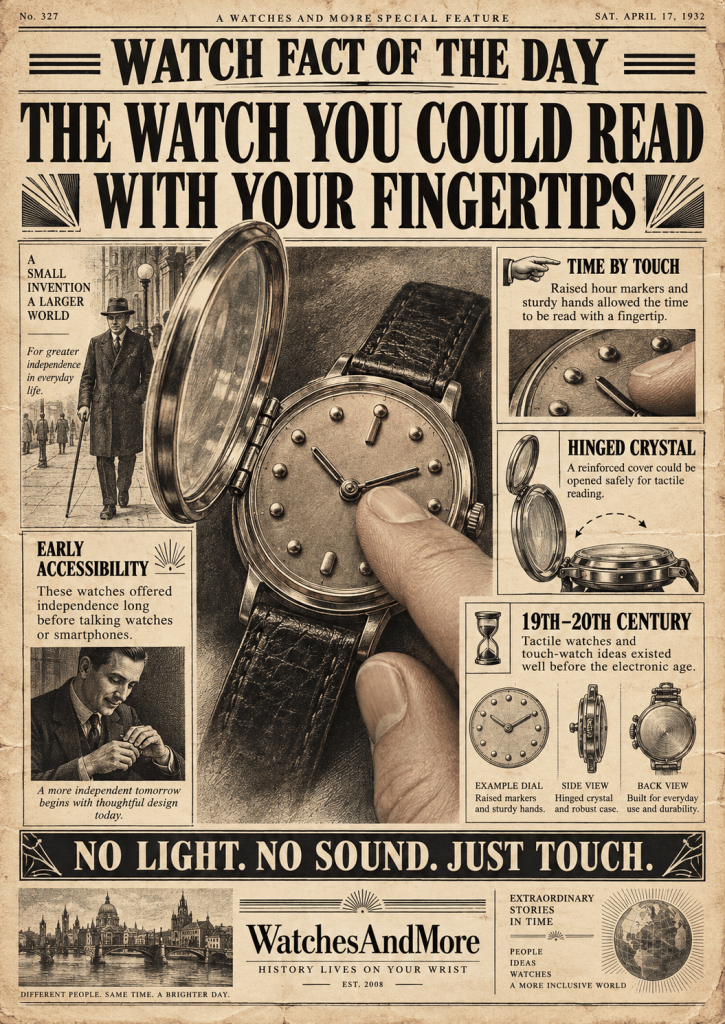
Special tactile or “Braille” watches used raised hour markers and hands that could be read by touch. Many later examples used a hinged crystal or protective cover that could be lifted so the wearer could place a fingertip directly on the dial without damaging the watch during normal wear. The American Foundation for the Blind describes this as the traditional Braille-watch layout: lift the hinged crystal, then feel the hour markers and the positions of the hands.

The idea itself had deep roots. Watches designed to tell time by touch existed centuries earlier. Breguet sold its first famous montre à tact in 1799—a watch with an external pointer and hour markers that could be read without looking at the dial. Those watches were not originally created specifically for blind users, but the same basic principle—translating time into something tactile—would later become especially valuable for accessibility.

By the late 19th and early 20th centuries, purpose-built tactile watches were clearly being made for blind and partially sighted people. Museums Victoria preserves a mid-to-late-19th-century fob watch with raised numerals and Braille markings, and early-20th-century examples continued the concept into wristwatches.

How Did They Work?

A conventional watch tells time visually.

A tactile watch turns the dial into a physical map.

The wearer opens the protective cover and feels:

raised markers → where the hours are

short hand → the hour

long hand → the minutes

The hands had to be robust enough to tolerate gentle touch without being easily displaced, and the protective cover helped keep the dial and hands safe when the watch was closed.

That meant the time could be checked:

SILENTLY.

PRIVATELY.

WITHOUT LIGHT.

💡 Did You Know?

The history of tactile timekeeping is closely connected to another earlier watchmaking idea: reading the time in darkness.

The Smithsonian preserves a “touch watch” given to Helen Keller when she was young. Its design used pins around the case corresponding to the hours and an external moving hand that could be felt by touch. The watch had originally been developed as a way to tell time in the dark, but its tactile design made it especially useful for someone who was blind.

That gives us a beautiful through-line:

TIME BY SIGHT

became

TIME BY SOUND

and also

TIME BY TOUCH

⭐ Why It Matters

This is a great reminder that accessibility design is not a modern invention.

Watchmakers were solving accessibility problems mechanically long before electronics arrived.

No speaker.

No synthesized voice.

No vibration motor.

No screen reader.

Just:

HINGE.

RAISED MARKERS.

STRONG HANDS.

TOUCH.

And that gave blind and low-vision users something incredibly important:

independence.

The watch didn’t announce the time to everyone nearby.

It let the wearer discover it discreetly with a fingertip.

That makes these tactile watches more than curiosities.

They are early examples of inclusive industrial design.

BEFORE WATCHES TALKED…

SOME WERE MADE TO BE FELT.


Category: Fun Quirk

Disclaimer: Every effort has been made to keep these watch facts accurate, but the world of horology is full of myths, disputed stories, and fascinating trivia. Consider these facts a starting point for discovery rather than the final word. If you have corrections or additional insights, let us know—we’re always happy to keep the record ticking in the right direction.

🕐 Discover more watch facts, reviews, and buying guides at WatchesAndMore


🛍️ You Might Also Like

As an Amazon Associate and affiliate partner, WatchesAndMore earns from qualifying purchases.

G-Shock GWM5610-1 Solar Atomic
🔥 Deal of the Day

G-Shock GWM5610-1 Solar Atomic

Casio

★★★★★ 4.8 (5,621 reviews)

$129

Offer expires in


🔥 Grab This Deal →

G-Shock GA2100-1A1 CasiOak


G-Shock GA2100-1A1 CasiOak

Casio

★★★★★ 4.8 (2,156 reviews)

$99


Check Price on Amazon →

Casio Edifice Chronograph


Casio Edifice Chronograph

Casio

★★★★★ 4.7 (1,264 reviews)

$120


Check Price on Amazon →


Browse all 142+ expert-reviewed watches →

Redbubble Shop
Redbubble Shop
More Watch Facts
More Watch Facts
ETSY Shop
ETSY Shop

Watch Fact of the Day: The Gold Apple Watch You Couldn’t Buy

In a bold move in 2015, Apple didn’t just drop a smartwatch; it flung itself into the luxury watch ring with the Apple Watch Edition—18-karat gold versions starting at $10,000! But hold onto your wallets, because designer Karl Lagerfeld was spotted sporting a custom gold model with an exclusive Link Bracelet that Apple didn’t even sell. Soon, Beyoncé and Kanye joined the bling parade, showcasing editions that made the retail price look like pocket change. It’s a weird tale of how tech and luxury collided, reminding us that even in a world packed with software updates, the bling factor remains eternally fashionable!

Watch Culture: Thursday, September 24, 2026

📅 Thursday, September 24, 2026

When Apple entered the smartwatch market in 2015, it didn’t just launch a piece of consumer electronics.

It also tried something almost unheard of for a technology company:

It entered the luxury-watch world.

The most extravagant version was the Apple Watch Edition, made in custom 18-karat yellow or rose gold. Apple said the alloys were specially developed to be harder than standard gold, and the watches were paired with sapphire crystal and premium straps.

At launch, the collection started at roughly US$10,000 and climbed to US$17,000 for the most expensive retail configurations.

That alone was extraordinary.

But Apple went even further.

✨ The Apple Watch You Couldn’t Order

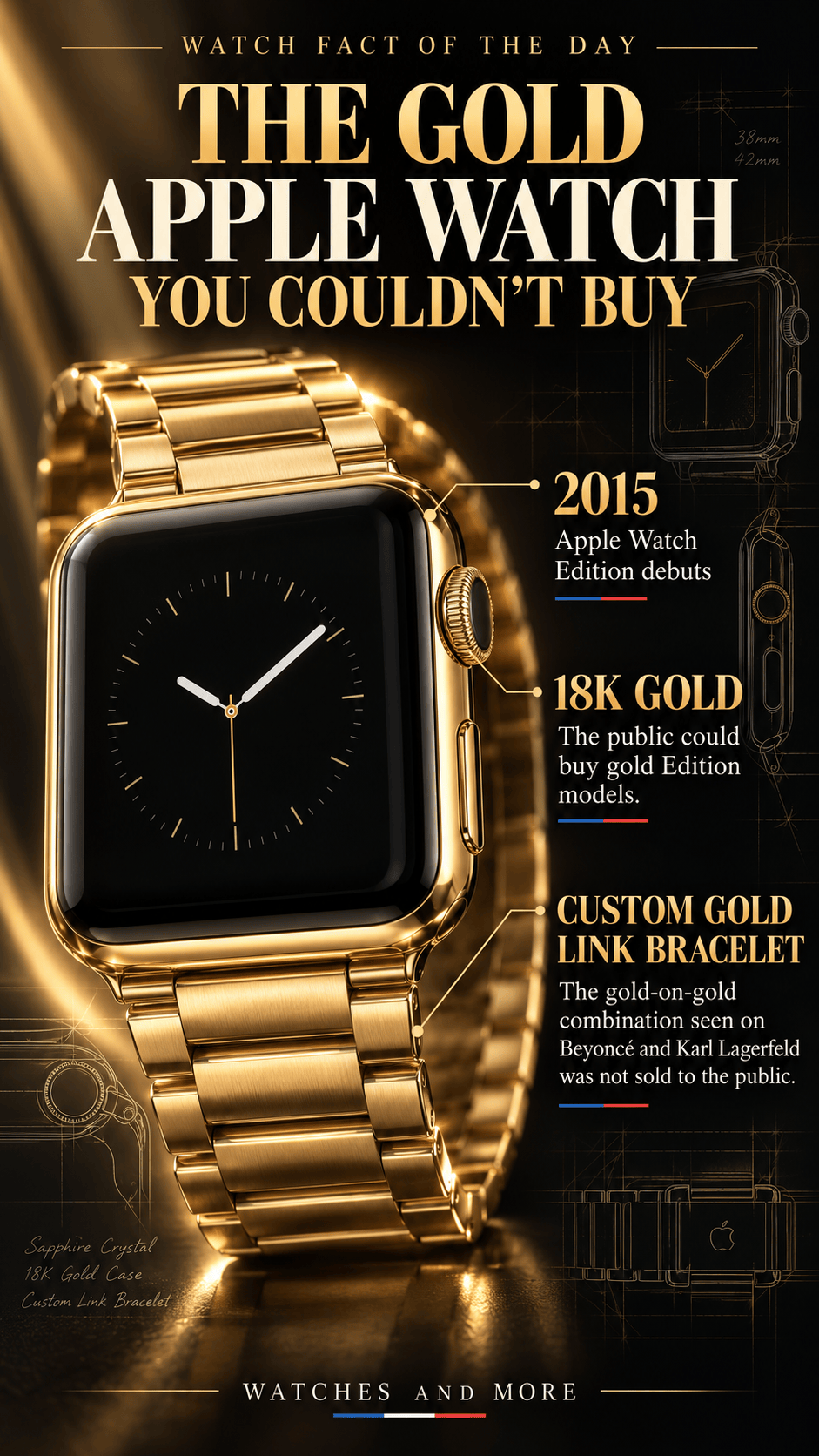
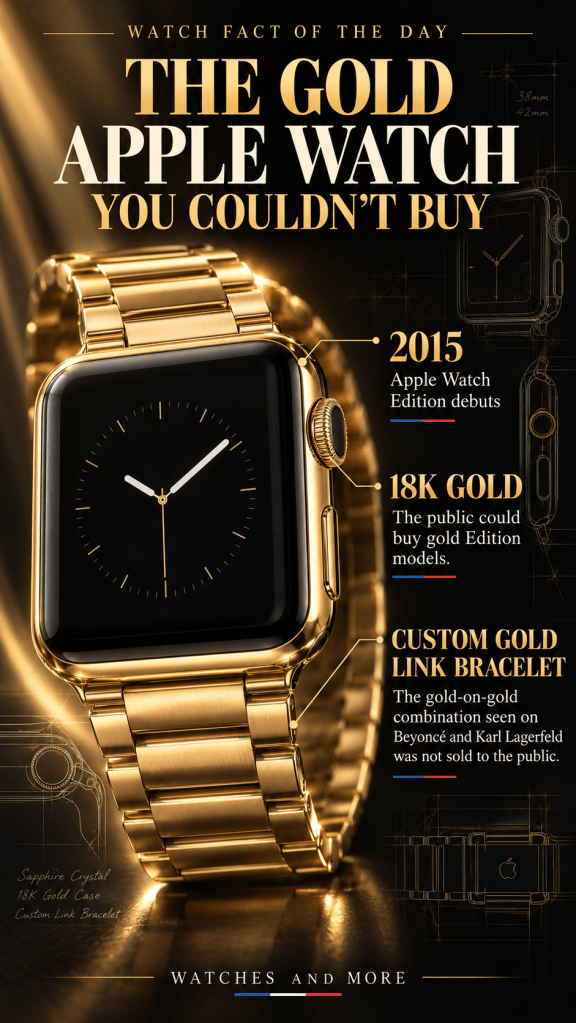
Shortly before the public launch, fashion designer Karl Lagerfeld was photographed wearing a yellow-gold Apple Watch Edition with something Apple did not sell:

A matching solid-gold Link Bracelet.

His assistant described the watch as being specially made for Lagerfeld, and contemporary reports treated it as a custom Apple piece rather than a public retail configuration.

Then Beyoncé appeared wearing what looked like the same gold-on-gold configuration.

And soon after, Kanye West was seen with one too.

By then, it became clear that Apple had created something even more exclusive than the already-expensive Edition:

A GOLD APPLE WATCH THAT MONEY ALONE COULDN’T BUY.

💎 Why the Bracelet Mattered

Apple offered metal Link Bracelets for its stainless-steel watches.

But it never put a gold Link Bracelet into the regular catalogue.

That meant the custom watches seen on Lagerfeld, Beyoncé, and West sat outside the normal product line.

Contemporary reporting suggested that these pieces were likely worth far more than the $17,000 retail Edition, simply because of the amount of gold in the bracelet—but Apple never published an official retail price because the configuration was never publicly sold.

That makes them fascinating from a collector’s perspective.

They are not just rare watches.

They represent a strange moment when:

Silicon Valley

met

fashion

met

luxury horology

met

celebrity culture.

💡 Did You Know?

Apple was very deliberately positioning the first-generation Watch as a fashion object, not merely a gadget.

Before the official launch, Apple previewed the Watch at luxury and fashion venues including Colette in Paris, Selfridges in London, and Isetan in Tokyo.

And seeing custom gold versions on major fashion and music figures reinforced that positioning.

The message was obvious:

THIS WASN’T JUST TECH.

THIS WAS STATUS.

⭐ Why It Matters

The first Apple Watch Edition remains one of the strangest luxury experiments in modern watch history.

Traditional high-end watches often justify their price through:

mechanical complexity

hand finishing

precious metals

heritage

rarity

Apple took a completely different route.

It took a rapidly evolving piece of consumer technology…

and wrapped it in 18-karat gold.

Then, for a tiny number of highly visible people, it made versions that apparently went beyond even the retail Edition.

That creates a fascinating contradiction.

The software aged.

The hardware became obsolete.

But the gold case—and the story behind those custom pieces—remained.

TECHNOLOGY AGED.

THE RARITY DIDN’T.


Category: Watch Culture

Disclaimer: Every effort has been made to keep these watch facts accurate, but the world of horology is full of myths, disputed stories, and fascinating trivia. Consider these facts a starting point for discovery rather than the final word. If you have corrections or additional insights, let us know—we’re always happy to keep the record ticking in the right direction.

🕐 Discover more watch facts, reviews, and buying guides at WatchesAndMore


🛍️ You Might Also Like

As an Amazon Associate and affiliate partner, WatchesAndMore earns from qualifying purchases.
G-Shock GWM5610-1 Solar Atomic
🔥 Deal of the Day

G-Shock GWM5610-1 Solar Atomic

Casio

★★★★★ 4.8 (5,621 reviews)

$129

Offer expires in


🔥 Grab This Deal →

G-Shock GA2100-1A1 CasiOak


G-Shock GA2100-1A1 CasiOak

Casio

★★★★★ 4.8 (2,156 reviews)

$99


Check Price on Amazon →

Seiko 5 SNK805 Green Military


Seiko 5 SNK805 Green Military

Seiko

★★★★★ 4.8 (6,961 reviews)

$89


Check Price on Amazon →


Browse all 142+ expert-reviewed watches →