
Watch Fact of the Day

📅 Sunday, October 11, 2026
Meet the Movado Ermeto—the ingenious travel companion that could wind itself as you opened its case.
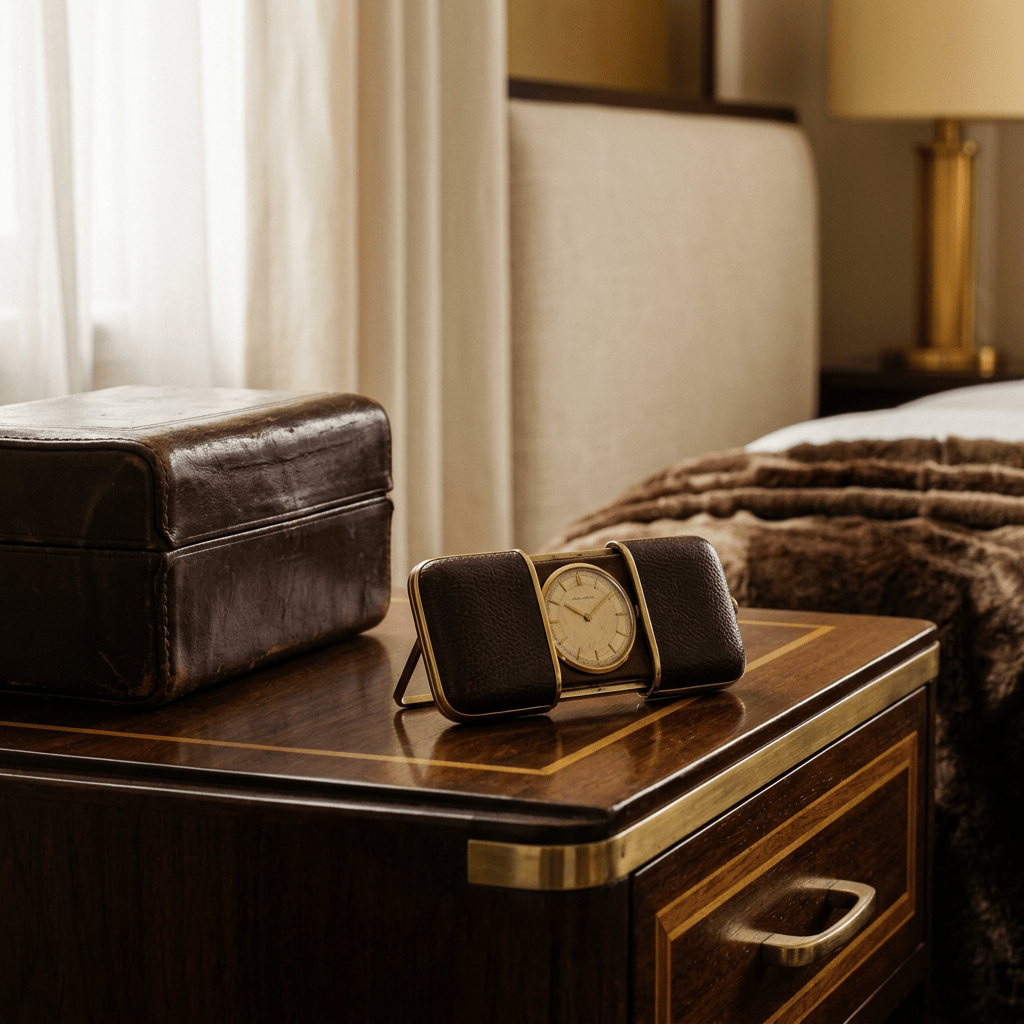
Imagine arriving at a hotel, taking a small leather-covered object from your pocket, and sliding its two halves apart.
A watch appears.
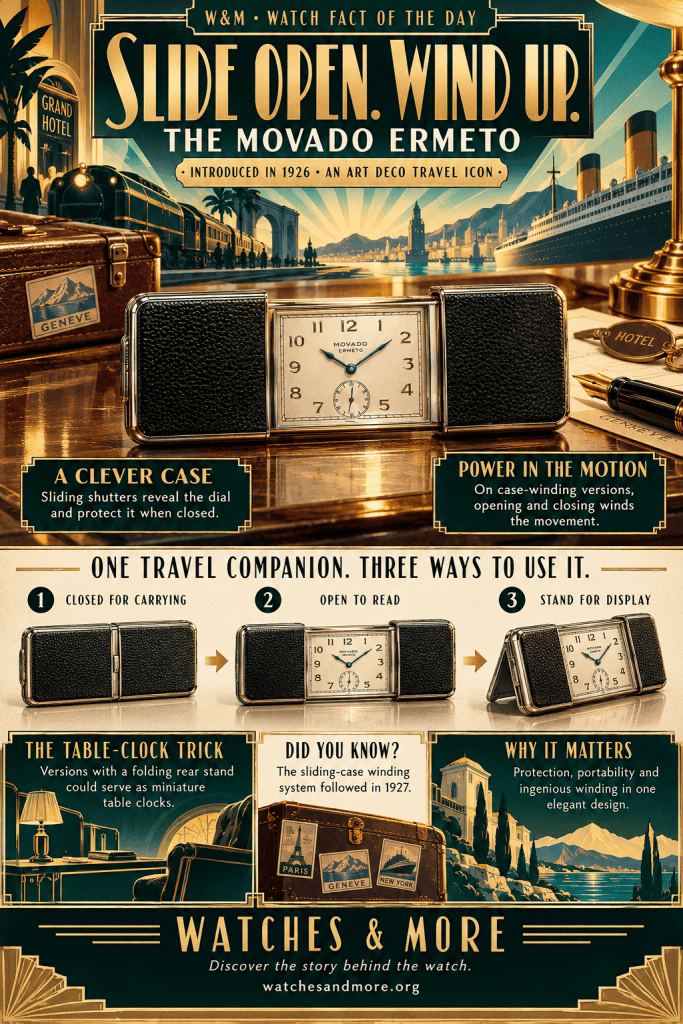
Prop it up beside the bed, and your travelling timepiece becomes a miniature table clock. Better still, on versions equipped with Movado’s ingenious winding system, opening and closing the case helps keep it running.
Long before multifunction gadgets filled our bags, the Movado Ermeto offered a wonderfully mechanical approach to versatility.
🧳 A Travel Idea Born Before the 1930s
Although perfectly at home in the world of interwar travel, the Ermeto’s story began in 1926, rather than 1931.
The protective sliding-case design originated with Huguenin Frères of Le Locle, and Movado brought the model to market.
Christie’s documents an enamel-decorated example hallmarked for 1928, confirming that this distinctive little watch was already established before the thirties began. Christie’s
↔️ Slide Open, Check the Time
The Ermeto’s defining feature was its two-part outer case.
Instead of lifting a conventional pocket-watch lid, the owner pulled the two halves apart to reveal the dial between them. Sliding them together concealed the watch again. Geneva, April 7th, 2021
It was a simple, satisfying interaction: a compact object when closed, a readable timepiece when opened.
Leather was one available finish, but the Ermeto was much more than a watch inside a soft sleeve. Its protective structure was a purpose-built sliding case. Surviving examples also feature elaborate enamel decoration. europastar.com
⚙️ Checking the Time Could Help Power It
The cleverest development followed the original design.
According to Antiquorum’s historical notes, Movado patented the sliding-case winding system in 1927. Movado’s own history confirms its essential trick: opening and closing the case automatically wound the movement. Geneva, April 7th, 2021
For versions equipped with that system, the action of revealing the dial also supplied energy.
Think about that for a moment.
The gesture you made to use the watch helped power the watch.
Early Ermetos were manually wound, so the case-winding feature should not be assumed on every example. europastar.com
🛏️ From Pocket to Bedside
Versions fitted with an integral folding stand could be propped up as small table clocks. europastar.com
That is where the Ermeto’s travel personality really comes alive.
Picture a railway carriage, a neatly packed overnight bag, and a hotel bedside table. A portable timepiece could move between those settings without needing to stay on your wrist.
The “transformation” came from opening and positioning the watch, with the stand supporting it for display. It was a thoughtful change of use rather than a complicated mechanical performance.
🛡️ What Did “Ermeto” Mean?
The name referred to the idea of being sealed or hermetic, emphasising the protection offered by the enclosing case. Christie’s
That deserves a careful distinction: historical protective language does not establish a modern water-resistance rating.
The appeal was the way the watch could be covered for carrying, then revealed when needed.
Protection became part of the design experience.
💡 Did You Know?
The Ermeto family eventually included more elaborate models.
Movado’s own history describes the Calendarmeto, a postwar development featuring day, month, and moon-phase complications. movado.com
The sliding-case idea proved adaptable enough to become a platform for much more than a simple time display.
⭐ Why It Matters
The Ermeto shows how useful innovation can begin with an everyday gesture.
Its designers considered the whole experience: carrying the watch, protecting it, reading it, powering it, and setting it down at the destination.
That is why this little Art Deco traveller still feels inventive.
Slide it open. Reveal the time. Give the journey a little more movement. ⌚🧳✨
Discover more remarkable timepieces in the W&M Watch Fact Archive.
Visit Watches & More and our companion site.
Category: Fun Quirk
Disclaimer: Every effort has been made to keep these watch facts accurate, but the world of horology is full of myths, disputed stories, and fascinating trivia. Consider these facts a starting point for discovery rather than the final word. If you have corrections or additional insights, let us know—we’re always happy to keep the record ticking in the right direction.
🕐 Discover more watch facts, reviews, and buying guides at WatchesAndMore
Read Next
Movado Polyplan: The Watch with a Movement on Three Planes
Vulliamy’s Traveller’s Watch: Two Times Before Time Zones
Join the Conversation
Would you take a mechanical travel clock on your next trip? Share your thoughts in the comments.
Explore watches in the W&M Watch Database.



📚 Sources & Further Reading
Further reading: Christie’s
movado.com
Discover more from WatchesAndMoreCO
Subscribe to get the latest posts sent to your email.


7 thoughts on “Movado Ermeto: The Travel Watch That Became a Table Clock”