

Watch Fact of the Day: The ‘Himalaya’ Dial: A Tribute to Everest’s Unforgiving Heights!

Did you know some watches can age like fine wine, developing a unique ‘Himalaya’ dial finish? It’s as if the watch decided to take a vacation in the mountains, returning with a rustic patina that could make any collector weep with joy—who knew imperfections could be so fashionable? While modern dials try to mimic this natural wear, they can’t quite capture the story behind decades spent in the sun and humidity. In the world of vintage watches, a little weathering gives your timepiece character and value—because who doesn’t love a watch with a backstory that says it’s been through some serious adventures?

Fun Quirk: Monday, August 3, 2026

📅 Monday, August 3, 2026

Did you know that some watches feature a dial known as ‘Himalaya’? This term refers to a specific type of dial finish, often found on vintage chronographs, which develops a unique, mottled, or ‘tropical’ patina over time, resembling the rugged, uneven terrain of the Himalayan mountain range. It’s a highly sought-after aesthetic among collectors, transforming a watch’s appearance into a one-of-a-kind piece of art.


Unlike factory-applied dial finishes, a true Himalaya-style patina is largely the result of time, environmental exposure, and the natural aging of the dial’s lacquer and pigments. Decades of sunlight, humidity, temperature changes, and oxidation can cause the once-uniform surface to develop an intricate landscape of lighter and darker tones. No two examples age in exactly the same way, making each watch completely unique. What was once considered an imperfection has become one of the most desirable characteristics in vintage watch collecting.

Collectors often associate Himalaya dials with the broader world of tropical dials, but the appearance is distinctly different. While many tropical dials simply fade from black to rich shades of brown, a Himalaya dial develops a more textured, marbled appearance with irregular patterns that resemble snow-covered mountain ridges and rocky peaks. These naturally aged dials can dramatically increase the desirability of a vintage watch, particularly when the patina is evenly distributed and complements the overall condition of the timepiece.

Today, the beauty of these naturally aged dials has inspired several modern watchmakers to recreate the look intentionally using advanced finishing techniques. Although contemporary “Himalaya-inspired” dials capture the visual appeal, many enthusiasts believe nothing can truly replicate the character earned through decades of natural aging. It’s another reminder that, in horology, the passage of time doesn’t always diminish a watch—it can make it even more beautiful.


💡 Did You Know?

Some of the most valuable vintage watches owe part of their appeal to their unique dials. In many cases, collectors will pay a significant premium for a watch with an attractive, naturally developed patina because it’s impossible to duplicate authentically. In the world of vintage horology, time itself can become the master craftsman.

Category: Fun Quirk

🕐 Discover more watch facts, reviews, and buying guides at WatchesAndMore


🛍️ You Might Also Like

As an Amazon Associate and affiliate partner, WatchesAndMore earns from qualifying purchases.

G-Shock GWM5610-1 Solar Atomic
🔥 Deal of the Day

G-Shock GWM5610-1 Solar Atomic

Casio

★★★★★ 4.8 (5,621 reviews)

$129

Offer expires in


🔥 Grab This Deal →

G-Shock GA2100-1A1 CasiOak


G-Shock GA2100-1A1 CasiOak

Casio

★★★★★ 4.8 (2,156 reviews)

$99


Check Price on Amazon →

Casio Edifice Chronograph


Casio Edifice Chronograph

Casio

★★★★★ 4.7 (1,264 reviews)

$120


Check Price on Amazon →


Browse all 142+ expert-reviewed watches →

☕ Help Support WatchesAndMore

If you enjoyed this article and would like to help support WatchesAndMore, consider visiting my Etsy Shop or browsing my designs on Redbubble. Every purchase helps support the continued creation of watch reviews, historical articles, buying guides, videos, and all the free content you enjoy here on the website and on YouTube.

Your support allows me to spend more time researching fascinating stories from the world of horology, testing new watches, and producing high-quality content for collectors and enthusiasts around the globe. Whether you’re looking for unique watch-themed merchandise or simply want to support the channel, every order is genuinely appreciated. Thank you for being part of the WatchesAndMore community—your support helps keep the passion for watches alive! ⌚🍻

ETSY Shop
ETSY Shop
Redbubble Shop
Redbubble Shop
More Watch Facts
More Watch Facts

Watch Fact of the Day: The Complication That Pretends to Be a Tourbillon

So, the ‘Poor Man’s Tourbillon’ is basically a watch that shows off its balance wheel, giving it that fancy look without the high price tag of a real tourbillon. It can trick some folks into thinking it’s the real deal. True tourbillons are a whole other beast, made to tackle gravity’s effects on timekeeping, while these budget versions just flaunt the balance wheel for show. They’ve become popular among watch lovers because they keep things affordable and let you see the inner workings of mechanical watches. Plus, they’re a cool way to dive into the world of watchmaking without breaking the bank!

Fun Quirk: Sunday, August 2, 2026

📅 Sunday, August 2, 2026

The ‘Poor Man’s Tourbillon’ is a fascinating misnomer for watches featuring a visible balance wheel, often rotating on its own axis, but lacking the complex rotating cage of a true tourbillon. This design gives the aesthetic appeal of a high-end complication without the astronomical cost or the actual gravity-compensating mechanism. It’s a clever way to showcase the heart of the watch, often found in more affordable mechanical timepieces.


At first glance, these watches can easily fool the untrained eye. A true tourbillon, invented by Abraham-Louis Breguet in 1801, places the balance wheel, escapement, and escape wheel inside a rotating cage designed to average out the effects of gravity on the movement’s accuracy. In contrast, a so-called “Poor Man’s Tourbillon” typically exposes only the balance wheel through an open-heart dial or uses a decorative rotating balance assembly that lacks the intricate mechanics and purpose of a genuine tourbillon. The visual effect is impressive, but the engineering is fundamentally different.

The nickname gained popularity as more affordable mechanical watches entered the market, particularly from manufacturers producing skeletonized or open-heart designs. These watches allowed enthusiasts to enjoy the mesmerizing motion of the oscillating balance wheel without the enormous cost associated with manufacturing a true tourbillon. While a genuine Swiss tourbillon often commands prices ranging from several thousand to hundreds of thousands of dollars, an open-heart mechanical watch can deliver a similarly captivating visual experience for a fraction of the price.

Despite the playful nickname, there’s absolutely nothing wrong with appreciating a “Poor Man’s Tourbillon.” In fact, many collectors view open-heart watches as an excellent introduction to mechanical watchmaking because they reveal the beating heart of the movement in action. Whether it’s an affordable Seiko, Orient, Tissot, or a finely finished Swiss masterpiece, watching the balance wheel oscillate reminds us that every mechanical watch is a tiny machine powered entirely by springs, gears, and human ingenuity.


💡 Did You Know?

A genuine tourbillon typically rotates once every 60 seconds, but some modern manufacturers have developed tourbillons that complete a rotation in 30 seconds, four minutes, or even multiple axes simultaneously. While these variations are visually spectacular, they also demonstrate just how far modern watchmaking has pushed one of horology’s most iconic complications.

Category: Fun Quirk

Disclaimer: Every effort has been made to keep these watch facts accurate, but the world of horology is full of myths, disputed stories, and fascinating trivia. Consider these facts a starting point for discovery rather than the final word. If you have corrections or additional insights, let us know—we’re always happy to keep the record ticking in the right direction.

🕐 Discover more watch facts, reviews, and buying guides at WatchesAndMore


🛍️ You Might Also Like

As an Amazon Associate and affiliate partner, WatchesAndMore earns from qualifying purchases.

G-Shock GWM5610-1 Solar Atomic
🔥 Deal of the Day

G-Shock GWM5610-1 Solar Atomic

Casio

★★★★★ 4.8 (5,621 reviews)

$129

Offer expires in


🔥 Grab This Deal →

G-Shock GA2100-1A1 CasiOak


G-Shock GA2100-1A1 CasiOak

Casio

★★★★★ 4.8 (2,156 reviews)

$99


Check Price on Amazon →

Casio Edifice Chronograph


Casio Edifice Chronograph

Casio

★★★★★ 4.7 (1,264 reviews)

$120


Check Price on Amazon →


Browse all 142+ expert-reviewed watches →

☕ Help Support WatchesAndMore

If you enjoyed this article and would like to help support WatchesAndMore, consider visiting my Etsy Shop or browsing my designs on Redbubble. Every purchase helps support the continued creation of watch reviews, historical articles, buying guides, videos, and all the free content you enjoy here on the website and on YouTube.

Your support allows me to spend more time researching fascinating stories from the world of horology, testing new watches, and producing high-quality content for collectors and enthusiasts around the globe. Whether you’re looking for unique watch-themed merchandise or simply want to support the channel, every order is genuinely appreciated. Thank you for being part of the WatchesAndMore community—your support helps keep the passion for watches alive! ⌚🍻

ETSY Shop
ETSY Shop
Redbubble Shop
Redbubble Shop
More Watch Facts
More Watch Facts

Watch Fact of the Day: The ‘Flyback’ Chronograph Was Invented for Pilots to Reset Instantly!

The flyback chronograph is like the superhero of stopwatches—no capes, just a single-button press! Originally crafted for quick-thinking pilots, it allows for seamless timing without wasting a millisecond, which is crucial when you’re dodging clouds or hostile airspace. Unlike regular chronographs that make you click three times like a sock drawer full of mismatched socks, the flyback simplifies everything, effortlessly transitioning from stop to reset to go. With its intricate inner workings, this Swiss marvel has gained cult status among collectors, proving that even watchmaking can have its flashy moments. Who knew timing could be this heroic?

📅 Thursday, July 30, 2026

Unlike a standard chronograph that requires three presses (stop, reset, start) to time consecutive events, the flyback chronograph allows a single press of a button to stop, reset, and restart the timing function instantaneously. This ingenious complication was initially developed for pilots, enabling them to quickly time successive legs of a journey without losing a beat, crucial for navigation. It significantly streamlined timing operations in demanding cockpit environments.


The flyback chronograph, known in French as “retour en vol” (“return in flight”), became an indispensable tool during the early days of aviation. Before sophisticated onboard navigation systems, pilots relied on precise timing to calculate fuel consumption, airspeed, and course corrections between waypoints. With a standard chronograph, resetting the timer meant briefly stopping the measurement, wasting precious seconds. The flyback mechanism eliminated that delay, allowing the chronograph hand to instantly snap back to zero and continue timing with a single press of the lower pusher.

Mechanically, the flyback chronograph is considerably more complex than a traditional chronograph. A carefully engineered system of levers, cams, hammers, and clutches allows the chronograph to disengage, reset, and restart in one seamless motion without damaging the movement. This additional complexity makes flyback chronographs highly prized among collectors and showcases the remarkable ingenuity of Swiss watchmaking.

Today, the flyback complication remains a favorite among enthusiasts, not only for its practicality but also for its fascinating military and aviation heritage. Iconic models from Breguet, Longines, Blancpain, Zenith, Glashütte Original, and Patek Philippe continue to feature flyback chronographs, proving that a complication born out of necessity has become one of the most admired achievements in mechanical watchmaking.


💡 Did You Know?

Many vintage military pilot chronographs issued to the French Air Force during the 1950s and 1960s featured flyback movements. Pilots could reset and restart the chronograph with a single press while keeping one hand on the aircraft controls—a simple innovation that made navigation faster, safer, and more efficient in the cockpit.

Category: Fun Quirk

Disclaimer: Every effort has been made to keep these watch facts accurate, but the world of horology is full of myths, disputed stories, and fascinating trivia. Consider these facts a starting point for discovery rather than the final word. If you have corrections or additional insights, let us know—we’re always happy to keep the record ticking in the right direction.

🕐 Discover more watch facts, reviews, and buying guides at WatchesAndMore


🛍️ You Might Also Like

As an Amazon Associate and affiliate partner, WatchesAndMore earns from qualifying purchases.

G-Shock GWM5610-1 Solar Atomic
🔥 Deal of the Day

G-Shock GWM5610-1 Solar Atomic

Casio

★★★★★ 4.8 (5,621 reviews)

$129

Offer expires in


🔥 Grab This Deal →

G-Shock GA2100-1A1 CasiOak


G-Shock GA2100-1A1 CasiOak

Casio

★★★★★ 4.8 (2,156 reviews)

$99


Check Price on Amazon →

Casio Edifice Chronograph


Casio Edifice Chronograph

Casio

★★★★★ 4.7 (1,264 reviews)

$120


Check Price on Amazon →


Browse all 142+ expert-reviewed watches →

☕ Help Support WatchesAndMore

If you enjoyed this article and would like to help support WatchesAndMore, consider visiting my Etsy Shop or browsing my designs on Redbubble. Every purchase helps support the continued creation of watch reviews, historical articles, buying guides, videos, and all the free content you enjoy here on the website and on YouTube.

Your support allows me to spend more time researching fascinating stories from the world of horology, testing new watches, and producing high-quality content for collectors and enthusiasts around the globe. Whether you’re looking for unique watch-themed merchandise or simply want to support the channel, every order is genuinely appreciated. Thank you for being part of the WatchesAndMore community—your support helps keep the passion for watches alive! ⌚🍻

ETSY Shop
ETSY Shop
Redbubble Shop
Redbubble Shop
More Watch Facts
More Watch Facts

Watch Fact of the Day: The ‘Geneva Seal’ Is More Than Just a Pretty Stamp!

The Geneva Seal, established in 1886, is a top-notch certification for watch movements, proving they were made and crafted in Geneva with serious attention to detail. It safeguards the reputation of skilled watchmakers by ensuring every part of a certified watch—from bridges to screws—meets high aesthetic and technical standards. After a 2012 update, complete watches now also have to show reliability and performance, not just good looks. Brands like Vacheron Constantin and Roger Dubuis are notable holders of this prestigious seal. So, when you see that tiny Geneva Seal on a watch, you know it’s a masterpiece of Swiss craftsmanship!

📅 Tuesday, July 28, 2026

The Geneva Seal, or Poinçon de Genève, is not merely a decorative emblem but a rigorous certification of quality and craftsmanship for watch movements. Established in 1886, it guarantees that a watch movement was made, assembled, and regulated in the Canton of Geneva, adhering to strict aesthetic and technical criteria. This includes specific finishing techniques for every component, ensuring both beauty and precision, making it one of the most demanding certifications in horology.


Originally created by the Canton of Geneva to protect the reputation of its master watchmakers, the Geneva Seal quickly became one of the most prestigious marks of excellence in Swiss watchmaking. Every component of a certified movement—from bridges and wheels to screws and levers—must meet exacting standards for finishing and construction. Techniques such as anglage (hand-beveled edges), polished screw heads, Geneva stripes (Côtes de Genève), circular graining (perlage), and carefully finished gear teeth are all scrutinized. The result is a movement that is as visually stunning as it is mechanically refined.

While many people associate the Geneva Seal with aesthetics, modern certification goes far beyond appearance. Since the certification was updated in 2012, complete watches—not just movements—must also demonstrate reliability, functionality, water resistance, power reserve, and timekeeping performance. This means a Geneva Seal timepiece isn’t simply beautiful to admire through a sapphire caseback; it’s also expected to perform to the highest standards in everyday use.

Today, only a select group of manufacturers produce Geneva Seal-certified watches, with Vacheron Constantin being perhaps its most famous ambassador. Other prestigious maisons, including Roger Dubuis and selected models from Cartier and Chopard, have also earned the distinction. For collectors, spotting the tiny Geneva Seal engraved on a movement is an assurance that countless hours of skilled hand-finishing and meticulous assembly have gone into creating one of the finest examples of traditional Swiss watchmaking.


💡 Did You Know?

The Geneva Seal is not a chronometer certification. A watch can carry the Geneva Seal without being COSC-certified, and a COSC-certified chronometer does not need a Geneva Seal. One recognizes craftsmanship and finishing, while the other certifies precision and accuracy. A watch that earns both represents an exceptional blend of mechanical performance and artisanal excellence.

Category: Fun Quirk

🕐 Discover more watch facts, reviews, and buying guides at WatchesAndMore


🛍️ You Might Also Like

As an Amazon Associate and affiliate partner, WatchesAndMore earns from qualifying purchases.
G-Shock GA2100-1A1 CasiOak


G-Shock GA2100-1A1 CasiOak

Casio

★★★★★ 4.8 (2,156 reviews)

$99


Check Price on Amazon →

Casio Edifice Chronograph


Casio Edifice Chronograph

Casio

★★★★★ 4.7 (1,264 reviews)

$120


Check Price on Amazon →


Browse all 75+ expert-reviewed watches →

Watch Fact of the Day: The ‘Fumé Dial’ Wasn’t Always a Design Choice, But a Happy Accident!

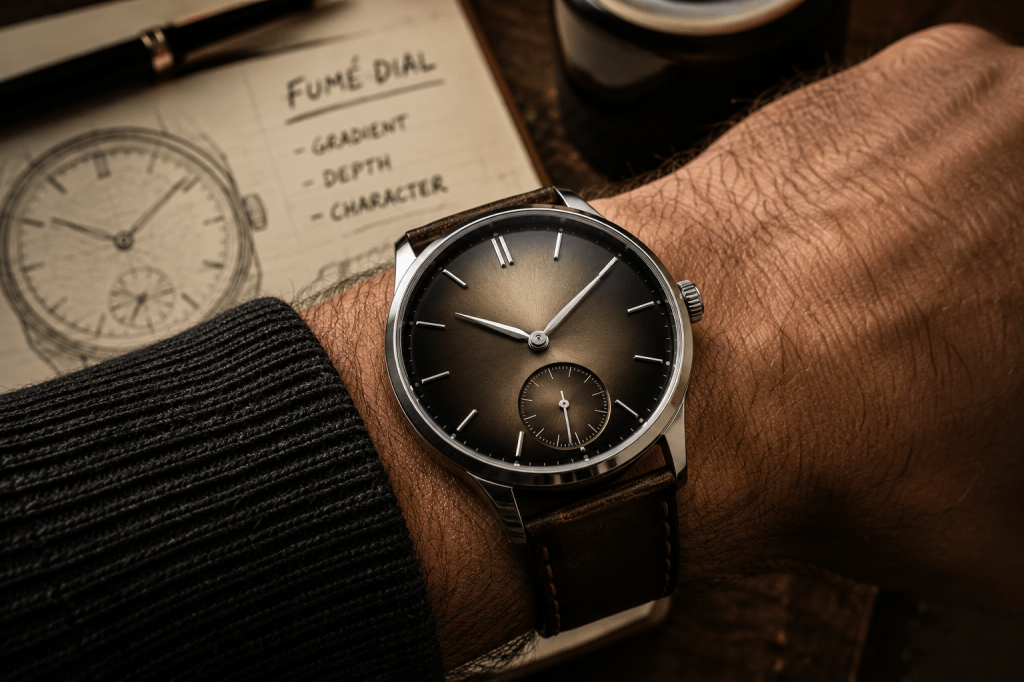
The ‘fumé’ dial, with its cool gradient from light to dark, started as an accident in early watchmaking when pigments dried unevenly. Over time, this quirky effect turned into a stylish feature, giving watches a depth that catches the eye differently in various lighting. H. Moser & Cie is a major player in this trend, helping revive the smoked dial look with their sleek “Concept” designs. These dials, often free of logos, showcase rich colors like midnight blue and burgundy, proving that sometimes so-called imperfections can create stunningly artistic watch faces. Collectors even call some of these dials “sunset effect” for their unique color changes.

📅 Saturday, July 25, 2026

The captivating ‘fumé’ or smoked dial, characterized by its gradient shading from light in the center to dark at the edges, is now a highly sought-after aesthetic. However, this effect was originally an unintended consequence of early dial-making techniques, where pigments would settle unevenly during the drying process. What began as a manufacturing quirk evolved into a deliberate and sophisticated design element, showcasing how ‘imperfections’ can become desirable features in horology.


Fumé dial: a happy accident

As dial manufacturing techniques evolved throughout the 20th century, watchmakers realized that this subtle transition from a bright center to a darker perimeter created an extraordinary sense of depth. Rather than trying to eliminate the effect, manufacturers refined the process using carefully controlled layers of translucent lacquer and multiple stages of spraying and polishing. The result was a dial that appeared to change character depending on the lighting, making even simple three-hand watches feel more luxurious and dynamic.

No company is more closely associated with the modern fumé dial than H. Moser & Cie. Their richly coloured “Concept” dials—often free of logos or hour markers—have helped spark a resurgence in smoked dials among collectors over the past decade. Today, fumé finishes can be found in shades ranging from deep midnight blue and emerald green to burgundy, chocolate brown, and vibrant purple, proving that a dial can be the star of the watch without relying on complicated features.

Creating a high-quality fumé dial remains a demanding process. Achieving a perfectly smooth gradient requires exceptional precision, as even the slightest inconsistency in lacquer application can ruin the effect. The finest examples seem almost to glow from within, drawing the eye toward the centre while naturally framing the hands and hour markers. It’s a perfect example of how artistry and craftsmanship can transform a simple watch face into a miniature work of art.


💡 Did You Know?

Some collectors refer to exceptional fumé dials as having a “sunset effect” because the gradual transition from bright to dark resembles the fading light at dusk. Combined with a sunburst finish beneath the lacquer, the dial can appear to change colour dramatically as it catches the light—making every glance at the watch a little different.

Category: Fun Quirk

Disclaimer: Every effort has been made to keep these watch facts accurate, but the world of horology is full of myths, disputed stories, and fascinating trivia. Consider these facts a starting point for discovery rather than the final word. If you have corrections or additional insights, let us know—we’re always happy to keep the record ticking in the right direction.

🕐 Discover more watch facts, reviews, and buying guides at WatchesAndMore


🛍️ You Might Also Like

As an Amazon Associate and affiliate partner, WatchesAndMore earns from qualifying purchases.

G-Shock GA2100-1A1 CasiOak


G-Shock GA2100-1A1 CasiOak

Casio

★★★★★ 4.8 (2,156 reviews)

$99


Check Price on Amazon →

Casio Edifice Chronograph


Casio Edifice Chronograph

Casio

★★★★★ 4.7 (1,264 reviews)

$120


Check Price on Amazon →


Browse all 75+ expert-reviewed watches →

☕ Help Support WatchesAndMore

If you enjoyed this article and would like to help support WatchesAndMore, consider visiting my Etsy Shop or browsing my designs on Redbubble. Every purchase helps support the continued creation of watch reviews, historical articles, buying guides, videos, and all the free content you enjoy here on the website and on YouTube.

Your support allows me to spend more time researching fascinating stories from the world of horology, testing new watches, and producing high-quality content for collectors and enthusiasts around the globe. Whether you’re looking for unique watch-themed merchandise or simply want to support the channel, every order is genuinely appreciated. Thank you for being part of the WatchesAndMore community—your support helps keep the passion for watches alive! ⌚🍻

More Watch Facts
More Watch Facts

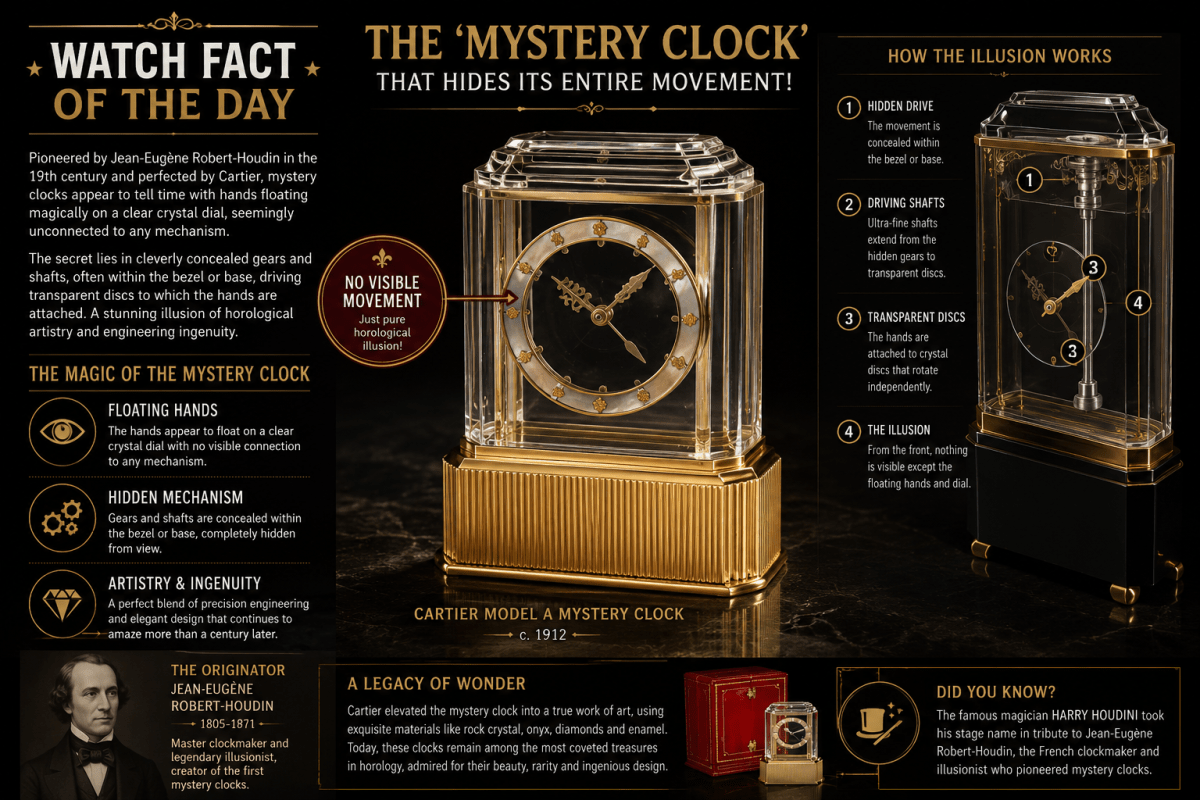
Watch Fact of the Day: The ‘Mystery Clock’ That Hides Its Entire Movement!

So, mystery clocks are these super cool timepieces that create the illusion of hands floating on a crystal dial, thanks to genius engineering by Jean-Eugène Robert-Houdin and later Cartier. Instead of traditional setups, their hands are on almost invisible discs moved by hidden gears. This mix of clockmaking and magic has made them an art form, highly sought after by collectors and royalty alike. Today, original models fetch crazy prices at auctions, proving they still wow people even in our digital age. Fun fact: Harry Houdini’s name pays homage to Robert-Houdin, showcasing the magic blend of these iconic clocks!

📅 Thursday, July 23, 2026

Mystery clocks, pioneered by Jean-Eugène Robert-Houdin in the 19th century and perfected by Cartier, appear to tell time with hands floating magically on a clear crystal dial, seemingly unconnected to any mechanism. The secret lies in cleverly concealed gears and shafts, often within the bezel or base, driving transparent discs to which the hands are attached. This illusion creates a captivating display of horological artistry and engineering ingenuity.


Mystery Clock
Mystery Clock

The illusion is so convincing that even experienced collectors often find themselves searching for the hidden movement. Rather than being attached to a central pinion like a traditional clock, the hands are mounted to nearly invisible crystal discs that rotate independently. These discs are driven by finely machined gears concealed within the clock’s frame, allowing the hands to appear as though they are suspended in mid-air. The effect is equal parts engineering and stage magic—a fitting legacy for Robert-Houdin, who was not only a master clockmaker but also one of history’s greatest illusionists.

In the early 20th century, Cartier elevated the mystery clock into a true work of decorative art. Combining exquisite craftsmanship with luxurious materials such as rock crystal, jade, onyx, enamel, diamonds, and precious metals, Cartier’s mystery clocks became prized possessions of royalty, industrialists, and collectors around the world. Each piece required extraordinary precision to ensure the hidden mechanism remained completely concealed while maintaining flawless timekeeping, making them some of the most technically demanding clocks ever produced.

Today, original mystery clocks rank among the most desirable and valuable creations in horology, often commanding extraordinary prices at auction. More than a century after they first amazed audiences, they continue to blur the line between science, engineering, and illusion. Even in an age of digital technology, few mechanical creations inspire the same sense of wonder as watching a pair of hands glide effortlessly across a crystal dial with no visible connection to the movement that drives them.


💡 Did You Know?

The famous magician Harry Houdini took his stage name in tribute to Jean-Eugène Robert-Houdin, the French clockmaker and illusionist who pioneered mystery clocks. Although Houdini later criticized Robert-Houdin’s work, his legendary stage name remains a lasting tribute to the man whose ingenious mechanical illusions captivated audiences decades earlier.

Category: Fun Quirk

Disclaimer: Every effort has been made to keep these watch facts accurate, but the world of horology is full of myths, disputed stories, and fascinating trivia. Consider these facts a starting point for discovery rather than the final word. If you have corrections or additional insights, let us know—we’re always happy to keep the record ticking in the right direction.

🕐 Discover more watch facts, reviews, and buying guides at WatchesAndMore


🛍️ You Might Also Like

As an Amazon Associate and affiliate partner, WatchesAndMore earns from qualifying purchases.

G-Shock GA2100-1A1 CasiOak


G-Shock GA2100-1A1 CasiOak

Casio

★★★★★ 4.8 (2,156 reviews)

$99


Check Price on Amazon →

Casio Edifice Chronograph


Casio Edifice Chronograph

Casio

★★★★★ 4.7 (1,264 reviews)

$120


Check Price on Amazon →


Browse all 75+ expert-reviewed watches →

The Watch Advisor
Find Your Perfect Watch

Watch Fact of the Day: The ‘Tropical Dial’ Phenomenon: A Desirable Flaw!

So, if you’re into vintage watches, you gotta know about “tropical dials.” These are basically black dials that have faded over time into shades of brown, thanks to things like UV exposure or paint issues. What was once seen as a flaw is now a hot trend, with collectors paying big bucks for these unique pieces. Each tropical dial ages differently, giving each watch its own distinct vibe. Some of these rare watches have even sold for way more than their original black-dial counterparts, showing that sometimes a little “defect” can turn into a treasure. Time really can create beauty!

📅 Monday, July 20, 2026

Many vintage watch collectors highly prize ‘tropical dials,’ where a black dial has faded over decades to shades of brown, often due to UV exposure or manufacturing defects. This discoloration, initially considered a flaw, now commands significant premiums, transforming a defect into a unique and sought-after aesthetic. It’s a testament to how the passage of time can unexpectedly enhance a watch’s value and character.


Among vintage watch collectors, tropical dials are some of the most prized and fascinating examples of nature improving on human craftsmanship. Originally produced with black dials, these watches gradually faded over decades into rich shades of chocolate brown, caramel, or even golden bronze.

This transformation typically occurred due to prolonged UV exposure, environmental conditions, and the chemical composition of the dial’s original paint or lacquer. At the time, manufacturers considered this discoloration an unintended flaw. Today, however, collectors see it as a one-of-a-kind feature that tells the watch’s unique story.

Because no two tropical dials age exactly alike, each develops its own distinctive character. As a result, well-preserved examples often command significant premiums over identical models with standard black dials.

It’s a perfect reminder that, in the world of vintage watches, the passage of time doesn’t just measure history—it can actually create it.

⌚ Fun Fact: Some rare tropical-dial watches have sold for several times the value of the same model with an untouched black dial, proving that sometimes the most beautiful treasures begin as manufacturing mistakes.

Category: Fun Quirk

Disclaimer: Every effort has been made to keep these watch facts accurate, but the world of horology is full of myths, disputed stories, and fascinating trivia. Consider these facts a starting point for discovery rather than the final word. If you have corrections or additional insights, let us know—we’re always happy to keep the record ticking in the right direction.

🕐 Discover more watch facts, reviews, and buying guides at WatchesAndMore


🛍️ You Might Also Like

As an Amazon Associate and affiliate partner, WatchesAndMore earns from qualifying purchases.

G-Shock GA2100-1A1 CasiOak


G-Shock GA2100-1A1 CasiOak

Casio

★★★★★ 4.8 (2,156 reviews)

$99


Check Price on Amazon →

Casio Edifice Chronograph


Casio Edifice Chronograph

Casio

★★★★★ 4.7 (1,264 reviews)

$120


Check Price on Amazon →

The Watch Advisor
Find Your Perfect Watch

Browse all 75+ expert-reviewed watches →

Watch Fact of the Day: The ‘Destro’ Watch: A Left-Handed Twist on Timekeeping

What do you get when you design a watch for lefties? A Destro watch! This quirky timepiece flips the script on traditional wristwatches, moving the crown to the left side so left-handed folks can finally stop giving their wrists the side-eye. But don’t be fooled—many righties are snatching these up just for the comfort and to flaunt their unconventional style. Originating from Italian lingo, “Destro” hints at its right-handed roots, making it a favorite among soldiers and adventurers alike. So, whether you’re a lefty or just a watch rebel, the Destro proves that sometimes it takes a little wrist action to stand out in the horology world!

📅 Saturday, July 18, 2026

While most watches are designed to be worn on the left wrist and wound with the right hand, ‘Destro’ watches are specifically crafted for left-handed wearers. The crown and pushers are positioned on the left side of the watch case, making it easier for left-handed individuals to operate the watch without removing it from their right wrist. This thoughtful design caters to a significant portion of the population often overlooked in standard watch manufacturing.


The "Destro" Watch
The “Destro” Watch

The term “Destro” comes from the Italian word for “right,” referring to watches designed to be worn on the right wrist. While they were created with left-handed wearers in mind, Destro watches also became popular with military personnel, divers, and outdoor professionals who preferred wearing their watch on their dominant hand or wanted to prevent the crown from digging into the back of their wrist during strenuous activity. By relocating the crown to the opposite side of the case, manufacturers improved both comfort and accessibility.

Some of the most recognizable Destro watches have come from brands such as Panerai, Tudor, and TAG Heuer, each embracing the unconventional layout for different reasons. Panerai, in particular, produced several left-handed models for military divers, where practicality always came before tradition. Today, these unusual references are highly sought after by collectors, not only because of their rarity but because they stand out from conventional watch designs.

Interestingly, many people who buy Destro watches aren’t left-handed at all. Some simply enjoy the improved comfort of a left-side crown, while others appreciate owning something a little different from the norm. In a hobby where small details can make a watch truly distinctive, the Destro layout proves that sometimes flipping a familiar design on its head is all it takes to create a future collector’s favorite.

Category: Fun Quirk

Disclaimer: Every effort has been made to keep these watch facts accurate, but the world of horology is full of myths, disputed stories, and fascinating trivia. Consider these facts a starting point for discovery rather than the final word. If you have corrections or additional insights, let us know—we’re always happy to keep the record ticking in the right direction.

🕐 Discover more watch facts, reviews, and buying guides at WatchesAndMore


🛍️ You Might Also Like

As an Amazon Associate and affiliate partner, WatchesAndMore earns from qualifying purchases.

G-Shock GA2100-1A1 CasiOak


G-Shock GA2100-1A1 CasiOak

Casio

★★★★★ 4.8 (2,156 reviews)

$99


Check Price on Amazon →

Casio Edifice Chronograph


Casio Edifice Chronograph

Casio

★★★★★ 4.7 (1,264 reviews)

$120


Check Price on Amazon →

Browse all 75+ expert-reviewed watches →

The Watch Advisor
Find Your Perfect Watch


Watch Fact of the Day: The ‘Poor Man’s Tourbillon’ That Isn’t a Tourbillon At All!

In the high-stakes world of watchmaking, there exists a delightful contraption known as the carousel, affectionately dubbed the “poor man’s tourbillon.” Invented by Danish maestro Bahne Bonniksen in 1892, this nifty device twirls the entire escapement while keeping the driving wheel steady, making it the less fancy cousin of the tourbillon. While the tourbillon struts its complexity like a show-off, the carousel humbly boasts elegance without breaking the bank. Recently revived by savvy watchmakers, this underdog proves that having a different approach to precision can be both charming and practical. So, next time you see one, remember: it’s not cheap, it’s distinctive!

Watch Fact of the Day: The 'Poor Man's Tourbillon' That Isn't a Tourbillon At All!
Watch Fact of the Day: The ‘Poor Man’s Tourbillon’ That Isn’t a Tourbillon At All!

📅 Monday, July 13, 2026

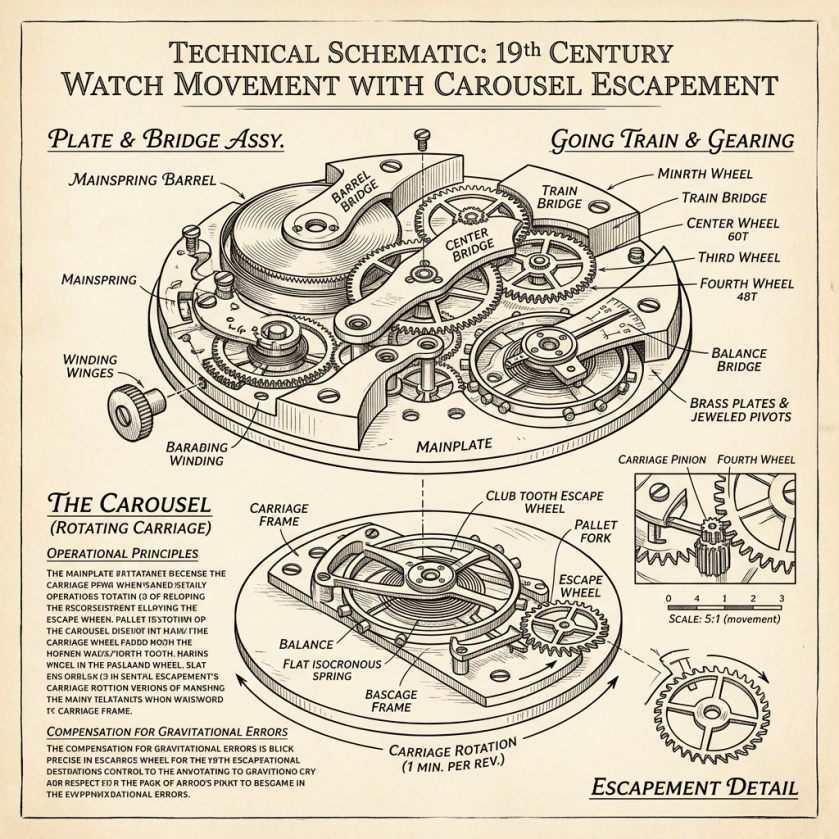
While the tourbillon is a complex mechanism designed to counteract gravity’s effects on a watch’s accuracy, a carousel complication achieves a similar goal but operates differently. Often called a ‘poor man’s tourbillon’ due to its typically simpler construction and lower cost, the carousel rotates the entire escapement, but its driving wheel is fixed, unlike the tourbillon’s rotating cage. This distinction makes it a fascinating alternative for those appreciating horological ingenuity without the tourbillon’s extreme complexity and price tag.

Technical schematic of 19th century watch movement showing mainspring barrel, going train gearing, carousel, and escapement detail with labeled parts
Detailed technical schematic of a 19th century watch movement with carousel escapement.

The carousel was invented in 1892 by Danish watchmaker Bahne Bonniksen, who sought to create a more practical and affordable alternative to Abraham-Louis Breguet’s tourbillon. While both complications rotate the escapement to help average out positional errors caused by gravity, the carousel uses a different gear train and power delivery system. This clever engineering allowed watchmakers to achieve a similar visual spectacle with fewer manufacturing challenges, making the complication more accessible than the exceptionally intricate tourbillon.

For much of the 20th century, the carousel remained a rarity, overshadowed by the prestige of the tourbillon. In recent decades, however, independent watchmakers and innovative brands have revived interest in the complication, showcasing just how elegant and technically impressive the design truly is. Some modern timepieces even combine a carousel with other complications, demonstrating that this once-overlooked invention still has a place in contemporary haute horlogerie.

Although enthusiasts often refer to it as the “poor man’s tourbillon,” that nickname doesn’t do the carousel justice. It’s not a cheaper imitation—it’s a distinct horological invention with its own history, engineering, and charm. For collectors, the carousel represents an alternative path to solving the same centuries-old challenge of precision timekeeping, proving that in watchmaking, there is often more than one brilliant way to tackle a problem.

Category: Fun Quirk

Disclaimer: Every effort has been made to keep these watch facts accurate, but the world of horology is full of myths, disputed stories, and fascinating trivia. Consider these facts a starting point for discovery rather than the final word. If you have corrections or additional insights, let us know—we’re always happy to keep the record ticking in the right direction.

🕐 Discover more watch facts, reviews, and buying guides at WatchesAndMore


🛍️ You Might Also Like

As an Amazon Associate and affiliate partner, WatchesAndMore earns from qualifying purchases.

G-Shock GA2100-1A1 CasiOak


G-Shock GA2100-1A1 CasiOak

Casio

★★★★★ 4.8 (2,156 reviews)

$99


Check Price on Amazon →

Casio Edifice Chronograph


Casio Edifice Chronograph

Casio

★★★★★ 4.7 (1,264 reviews)

$120


Check Price on Amazon →

The Watch Advisor
Find Your Perfect Watch


Browse all 75+ expert-reviewed watches →


Luxury Watches: Secrets of Craftsmanship

In the magical world of high-end watches, some clever watchmakers sneak in tiny, hand-engraved signatures—like little “Hello, I made this!” notes hidden on the tiniest bridges and plates! These marks are so discreet that they require a microscope to find, much like that snack you’re certain you finished but is mysteriously still lingering in your pantry. Unlike the robots churning out everything else, luxury watches are lovingly crafted by skilled artisans who treat each piece like their own child. So, next time you slip on your shiny timepiece, remember: it’s not just telling time; it’s secretly patting itself on the back!

Fun Quirk: Saturday, July 11, 2026

📅 Saturday, July 11, 2026

Many high-end mechanical movements feature an incredibly tiny, hand-engraved signature or mark from the watchmaker who assembled or regulated it. These ‘secret’ marks are often hidden on a bridge or plate, visible only under high magnification, serving as a personal stamp of craftsmanship and pride that few owners ever discover.


This tradition reflects the deeply personal nature of fine watchmaking. Unlike mass-produced products assembled entirely by machines, many luxury mechanical watches still pass through the hands of skilled artisans who spend hours—or even days—assembling, regulating, and finishing a single movement. A discreet signature, hallmark, or engraved initial is a quiet acknowledgment of the craftsperson behind the masterpiece, even if it remains unseen by the watch’s owner for decades.

Not every luxury watch includes an individual watchmaker’s signature, and the practice varies from brand to brand. Independent watchmakers and prestigious maisons such as Philippe Dufour, Kari Voutilainen, and Greubel Forsey are especially known for celebrating hand craftsmanship, with movements featuring elaborate hand-finishing and, in some cases, personal engravings or signatures. These subtle details remind collectors that every exceptional timepiece is the product of human skill as much as mechanical precision.

For many enthusiasts, discovering one of these hidden marks is like uncovering an artist’s signature on the back of a painting. It creates a personal connection between the owner and the person who painstakingly assembled the movement. In an age of automation, these tiny engravings serve as a powerful reminder that some of the world’s finest watches are still built by hand—one component, one adjustment, and sometimes one nearly invisible signature at a time.

Category: Fun Quirk

Disclaimer: Every effort has been made to keep these watch facts accurate, but the world of horology is full of myths, disputed stories, and fascinating trivia. Consider these facts a starting point for discovery rather than the final word. If you have corrections or additional insights, let us know—we’re always happy to keep the record ticking in the right direction.

🕐 Discover more watch facts, reviews, and buying guides at WatchesAndMore


🛍️ You Might Also Like

More Watch Facts
More Watch Facts

As an Amazon Associate and affiliate partner, WatchesAndMore earns from qualifying purchases.

G-Shock GA2100-1A1 CasiOak


G-Shock GA2100-1A1 CasiOak

Casio

★★★★★ 4.8 (2,156 reviews)

$99


Check Price on Amazon →

Casio Edifice Chronograph


Casio Edifice Chronograph

Casio

★★★★★ 4.7 (1,264 reviews)

$120


Check Price on Amazon →


Browse all 75+ expert-reviewed watches →

The Watch Advisor
Find Your Perfect Watch

Affiliate Disclosure: WatchesAndMore (watchesandmore.org) is a participant in the Amazon Services LLC Associates Program, an affiliate advertising program designed to provide a means for sites to earn advertising fees by advertising and linking to Amazon.com and Amazon.ca. As an Amazon Associate, we earn from qualifying purchases at no additional cost to you.