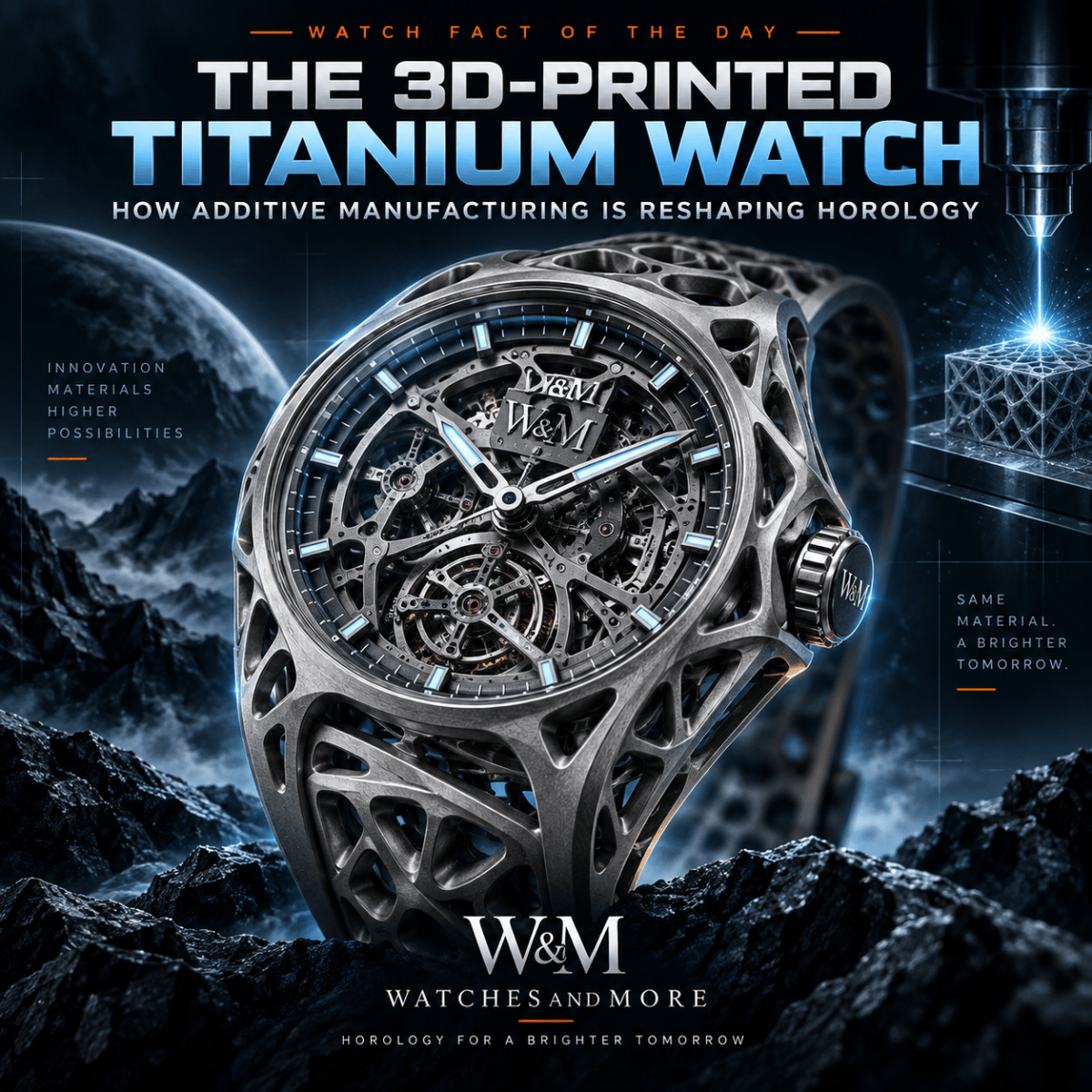

Watch Fact of the Day: The 3D-Printed Titanium Watch That Breaks Traditional Design Rules

The emergence of metal 3D printing marks a transformative revolution in watchmaking, allowing designers to create intricate structures that were previously impossible with traditional methods. Techniques like Selective Laser Melting enable the construction of lightweight yet robust titanium cases, offering innovative designs such as the TAG Heuer Monaco Split-Seconds Chronograph Air 1. Brands like Panerai and independent artisans are also embracing this technology, incorporating unique aesthetics and complex geometries into their creations. This evolution not only expands creative potential but also harmonizes modern manufacturing with traditional craftsmanship, rejuvenating the world of horology with exciting new possibilities.

Fun Quirk: Saturday, September 19, 2026

📅 Saturday, September 19, 2026

For most of watchmaking history, a metal case began as a solid piece of material.

Steel, gold, or titanium would be cut, drilled, milled, turned, and polished until the unwanted material was removed and the final shape emerged.

Metal 3D printing reverses that entire idea.

Instead of carving a watch case out of a solid block, technologies such as Selective Laser Melting (SLM) and Direct Metal Laser Sintering (DMLS) build titanium structures layer by microscopic layer from metal powder. A laser selectively fuses each layer according to a digital model until a complete three-dimensional component exists. TAG Heuer Official Magazine

And that changes what watch designers are physically capable of making.

Traditional machining works beautifully when cutting tools can reach the surfaces that need to be removed. But it becomes far more difficult when designers want internal cavities, enclosed channels, skeletal lattices, deep undercuts, or organic structures hidden inside a case.

Additive manufacturing can simply build those forms into the component from the beginning.
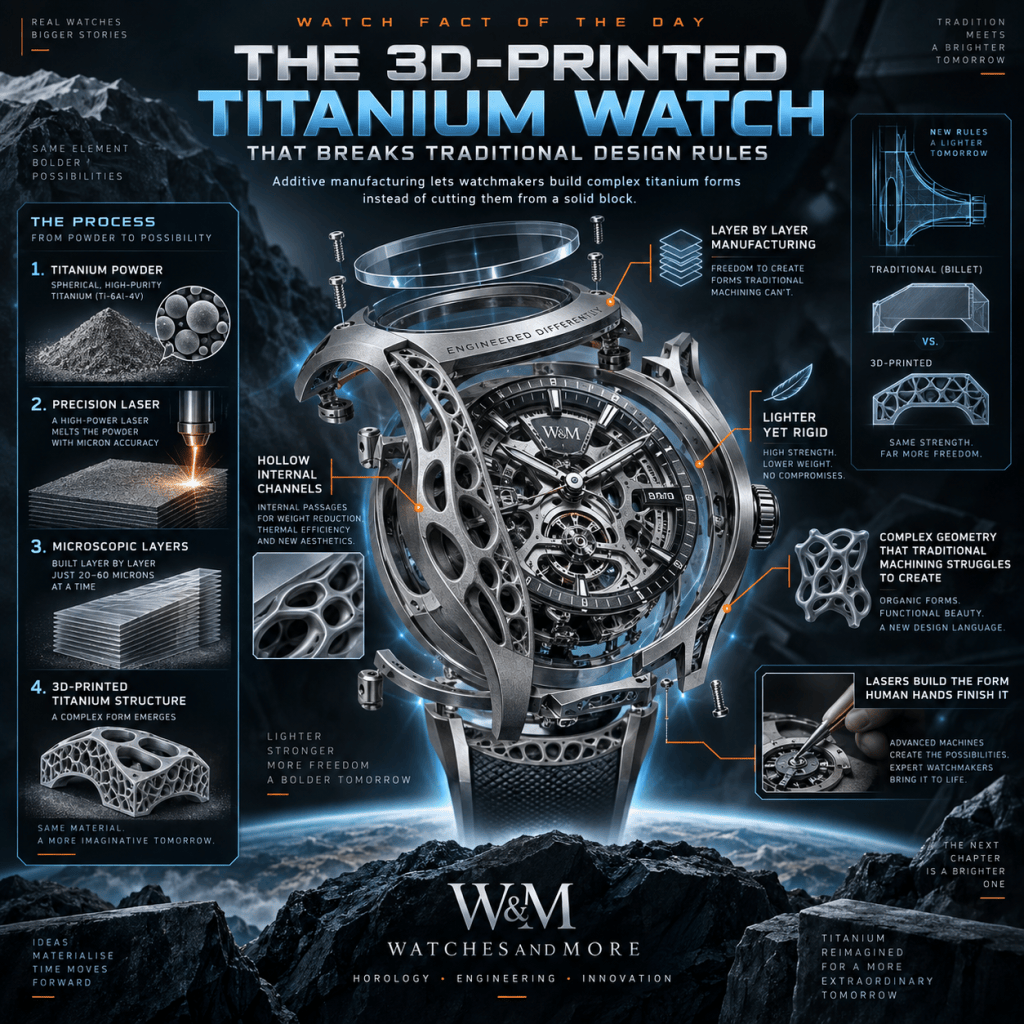
DON’T CUT THE EMPTY SPACE OUT.

BUILD THE EMPTY SPACE IN.

That sounds subtle, but it is a huge shift.

One striking modern example is the TAG Heuer Monaco Split-Seconds Chronograph Air 1, introduced in 2025. Its Grade 5 titanium case is produced using Selective Laser Melting, allowing TAG Heuer to create a dramatically hollowed architecture that the company says would be impossible to manufacture conventionally. The resulting case is less a traditional metal shell and more like a miniature structural chassis inspired by performance engineering. TAG Heuer Official Magazine

Panerai has been exploring a similar idea for years.

Its DMLS titanium cases are built layer by layer from titanium powder and can contain internal cavities that reduce mass while preserving the strength required from a large sports-watch case. Recent technical reporting on Panerai’s DMLS construction cites the brand’s claim that these cases can be about 25% lighter than conventional titanium versions of comparable design, while remaining more than 50% lighter than steel. Time and Watches

Independent watchmakers are pushing the aesthetic side even further.

Dutch brand Holthinrichs uses 3D-printed Grade 5 titanium to create skeletal lugs, complex architectural surfaces, and case geometries shaped by founder Michiel Holthinrichs’ background in architecture. Some models deliberately leave portions of the raw printed texture visible beside hand-polished surfaces, turning the manufacturing process itself into part of the design language. Fratello Watches

And emerging makers such as Apiar have used additive manufacturing to create titanium cases from thousands of extremely thin layers, including open lattice structures that would be considerably harder to realize through conventional machining alone. WatchPro USA

💡 Did You Know?

One of the most fascinating advantages of metal 3D printing is that a watch case can be solid where strength is required and hollow where material contributes little.

That means designers can think more like aerospace engineers:

LOAD PATHS → STRUCTURE

UNNECESSARY MASS → REMOVE IT

INTERNAL SPACE → ENGINEER IT

COMPLEXITY → PRINT IT

Instead of asking:

“CAN A CUTTING TOOL REACH THIS?”

they can ask:

“CAN WE DRAW IT IN 3D?”

That is a fundamentally different design philosophy.

⭐ Why It Matters

For centuries, watch design has been constrained partly by the tools used to manufacture watches.

Lathes encourage certain forms.

Milling machines encourage others.

Stamping creates another set of possibilities.

Additive manufacturing introduces a completely new vocabulary.

HOLLOW STRUCTURES

INTERNAL LATTICES

ORGANIC GEOMETRY

ULTRA-LIGHT TITANIUM

SHAPES THAT CAN’T EASILY BE MILLED

And here’s the part I love:

The finished object can still be hand-finished by traditional craftspeople.

So once again, new technology isn’t necessarily replacing traditional watchmaking.

It’s giving traditional finishing and mechanical horology new shapes to work with.

LASERS BUILD THE FORM.

HUMAN HANDS FINISH IT.


Category: Fun Quirk

Disclaimer: Every effort has been made to keep these watch facts accurate, but the world of horology is full of myths, disputed stories, and fascinating trivia. Consider these facts a starting point for discovery rather than the final word. If you have corrections or additional insights, let us know—we’re always happy to keep the record ticking in the right direction.

🕐 Discover more watch facts, reviews, and buying guides at WatchesAndMore


🛍️ You Might Also Like

As an Amazon Associate and affiliate partner, WatchesAndMore earns from qualifying purchases.
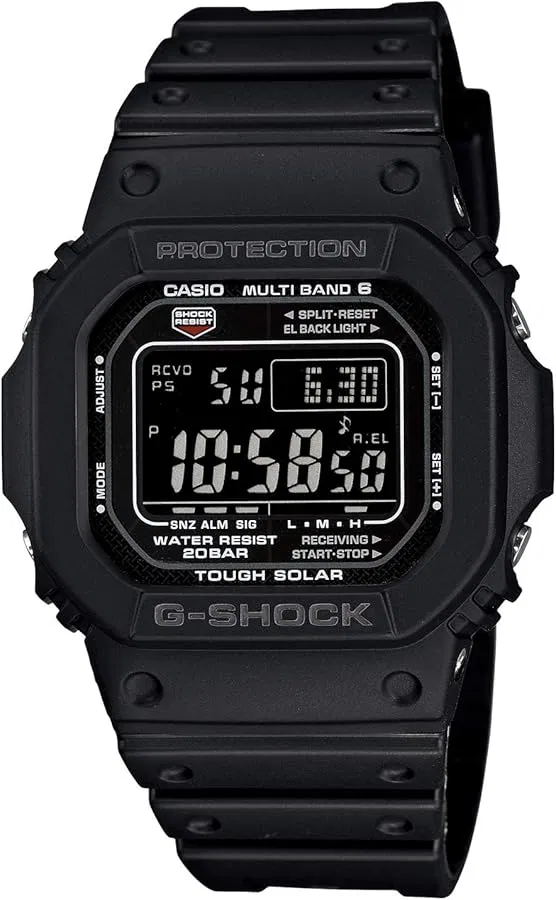
G-Shock GWM5610-1 Solar Atomic
🔥 Deal of the Day

G-Shock GWM5610-1 Solar Atomic

Casio

★★★★★ 4.8 (5,621 reviews)

$129

Offer expires in


🔥 Grab This Deal →

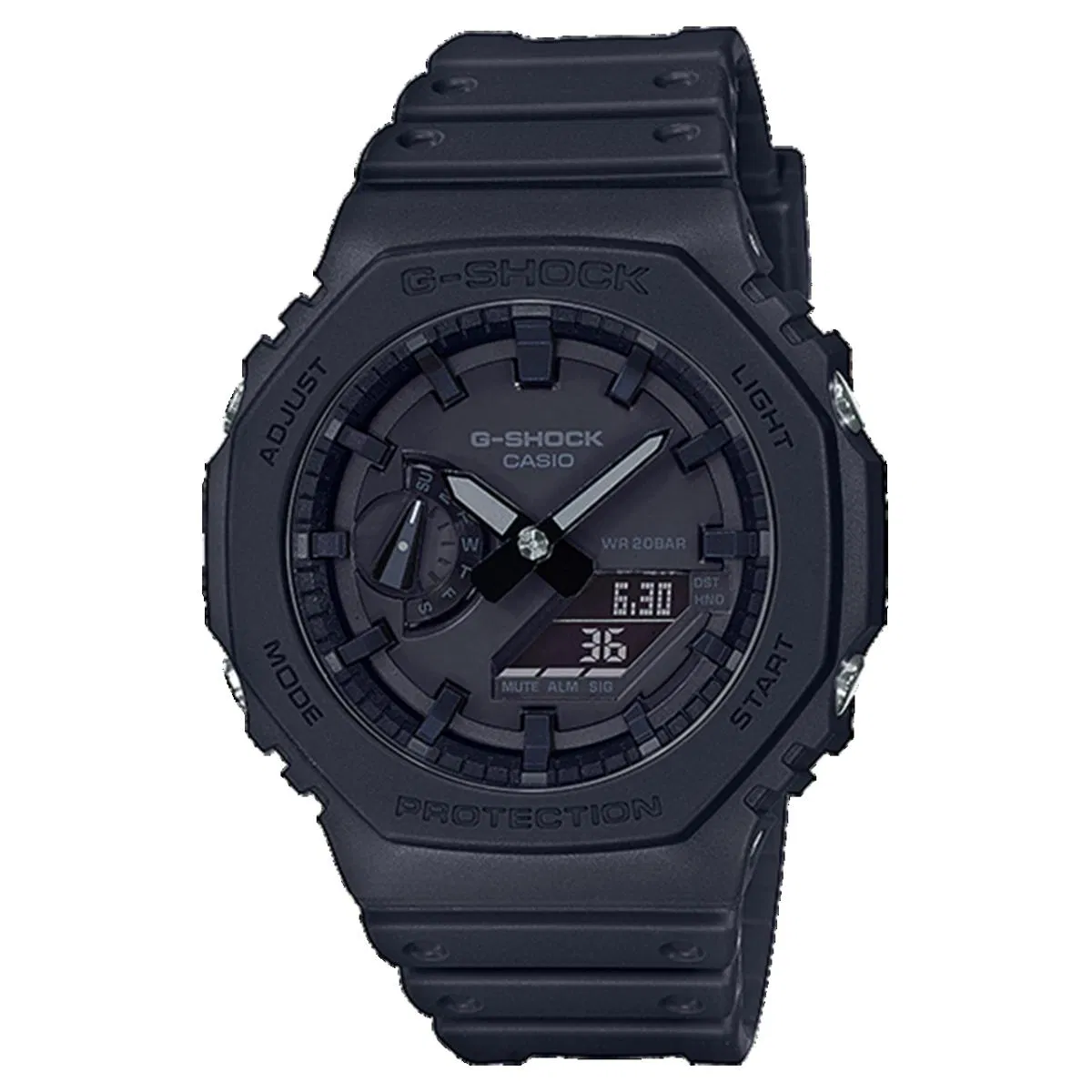
G-Shock GA2100-1A1 CasiOak


G-Shock GA2100-1A1 CasiOak

Casio

★★★★★ 4.8 (2,156 reviews)

$99


Check Price on Amazon →

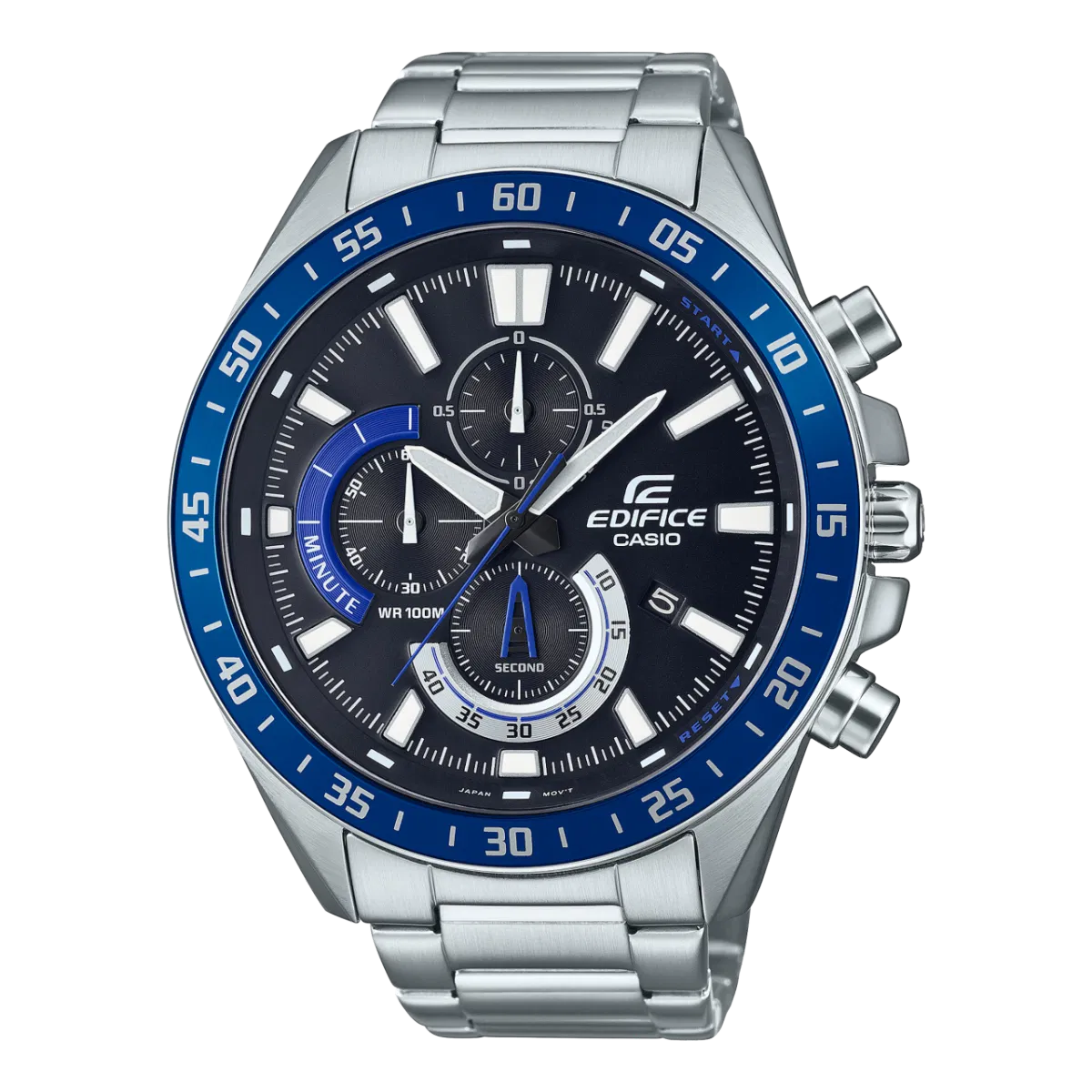
Casio Edifice Chronograph


Casio Edifice Chronograph

Casio

★★★★★ 4.7 (1,264 reviews)

$120


Check Price on Amazon →


Browse all expert-reviewed watches →

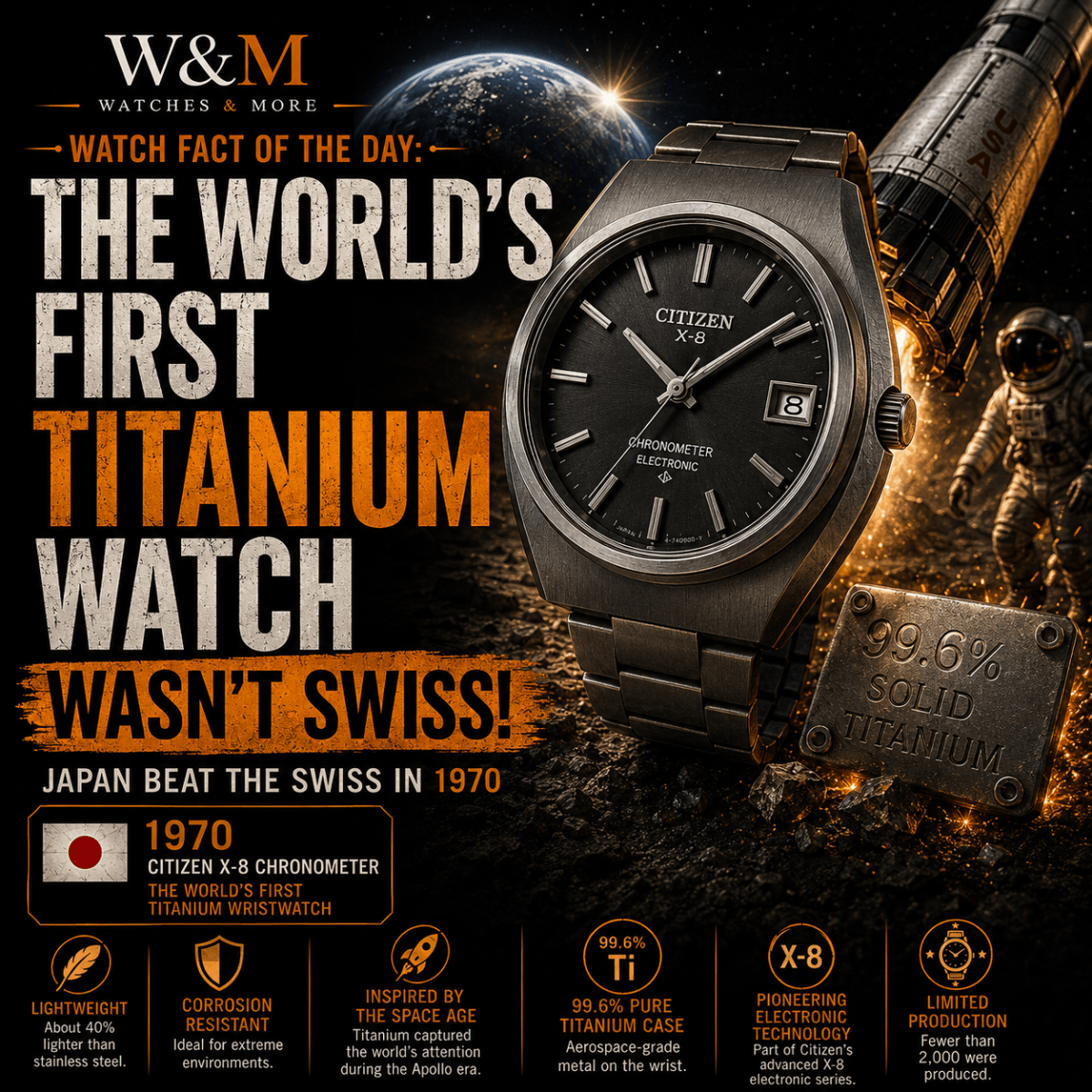
Watch Fact of the Day: The World’s First Titanium Watch Wasn’t Swiss or Swiss-Made!

In 1970, Citizen made the bold move of launching the X-8 Chronometer, the first titanium wristwatch—because who needs stainless steel when you can rock aerospace-grade titanium? While Swiss watchmakers were busy polishing their gold, Citizen decided to take the road less traveled, battling the “triple trouble” of titanium’s machining quirks to create a watch that weighed less than a feather but looked just as fine. With only 2,000 units made, it was a rare gem in the watch world. Fast forward to today, and titanium is everywhere, proving that sometimes, being ahead of the curve really pays off—unless you’re late for dinner!

Watch History: Wednesday, August 12, 2026

📅 Wednesday, August 12, 2026

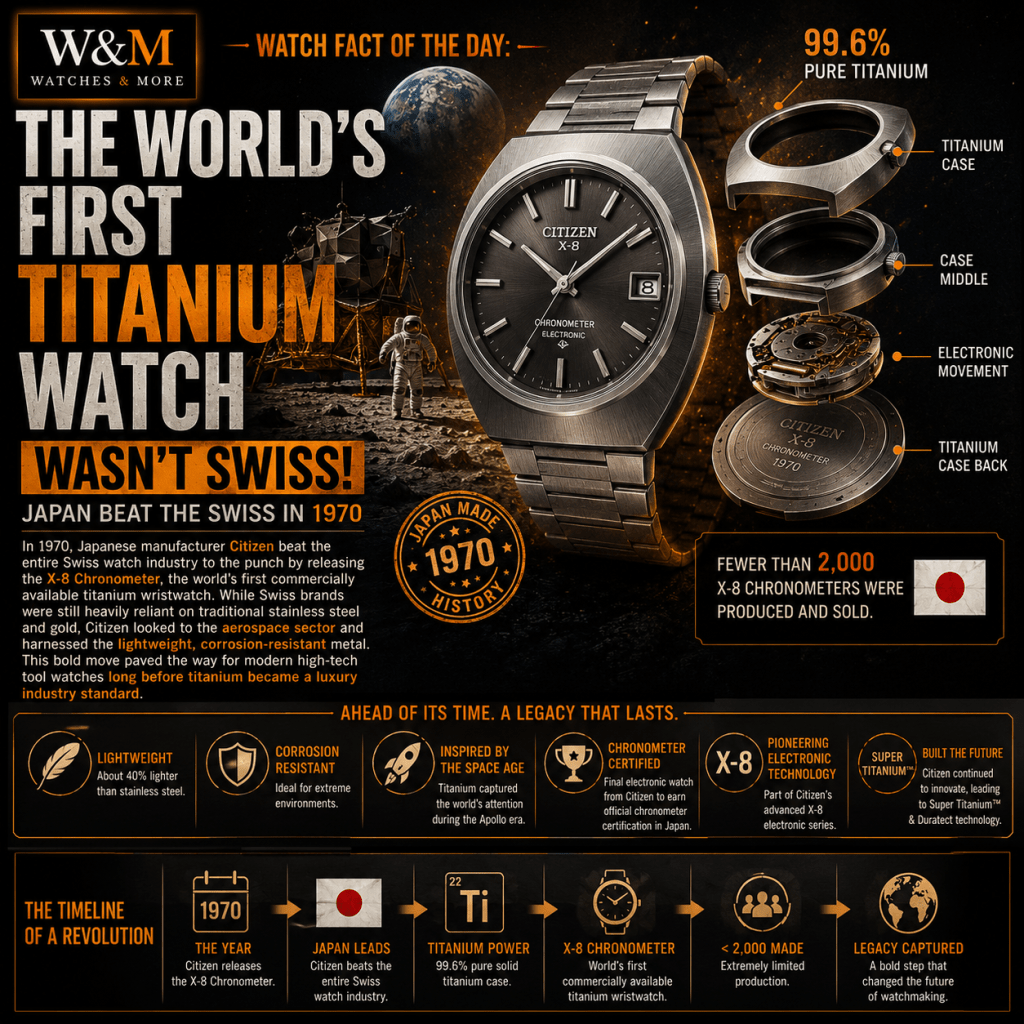
In 1970, Japanese watchmaker Citizen made history by releasing the X-8 Chronometer, recognized as the world’s first titanium wristwatch. While Swiss brands still favored traditional stainless steel and gold, Citizen boldly turned to aerospace-grade titanium—99.6% pure—to harness its lightweight, corrosion-resistant properties. This groundbreaking move not only preceded the Swiss by years but also set the stage for modern high-tech tool watches, long before titanium became a staple in luxury watchmaking.


The timing couldn’t have been better. During the 1960s, the Apollo program had focused global attention on titanium because of its light weight, strength and resistance to corrosion. Citizen’s engineers saw those same characteristics and realized they could make titanium an intriguing material for something far more personal: a wristwatch.

But actually manufacturing one was another matter. Titanium proved so troublesome that Citizen’s engineers nicknamed it “triple trouble” because of the difficulty involved in press-forming, machining and polishing it. Titanium shavings could stick to cutting tools, and achieving the beautifully finished surfaces expected of a watch case presented serious engineering challenges.

The resulting X-8 wasn’t merely an exotic case wrapped around a conventional mechanical watch, either. It belonged to Citizen’s pioneering electronic X-8 family, and the X-8 Chronometer became Citizen’s final electronic watch to receive official certification from the Japan Chronometer Inspection Institute. Production was brief: Citizen says fewer than 2,000 were sold.

More than half a century later, titanium has become a familiar material in everything from serious tool watches to high-end luxury pieces. Citizen itself continued developing the material for decades, eventually combining titanium processing with its Duratect surface-hardening technology to create Super Titanium™.

💡 Did You Know?

Titanium may be famous for being lightweight, but Citizen says pure titanium is about 40% lighter than stainless steel. That meant the 1970 Citizen X-8 Chronometer wasn’t just historically significant for using an exotic Space Age metal—it demonstrated that a watch case could be lighter, corrosion-resistant, and comfortable on the wrist without relying on conventional steel. More than half a century later, titanium has become one of watchmaking’s most desirable high-tech materials. ⌚🚀

Category: Watch History

Disclaimer: Every effort has been made to keep these watch facts accurate, but the world of horology is full of myths, disputed stories, and fascinating trivia. Consider these facts a starting point for discovery rather than the final word. If you have corrections or additional insights, let us know—we’re always happy to keep the record ticking in the right direction.

🕐 Discover more watch facts, reviews, and buying guides at WatchesAndMore


🛍️ You Might Also Like

As an Amazon Associate and affiliate partner, WatchesAndMore earns from qualifying purchases.

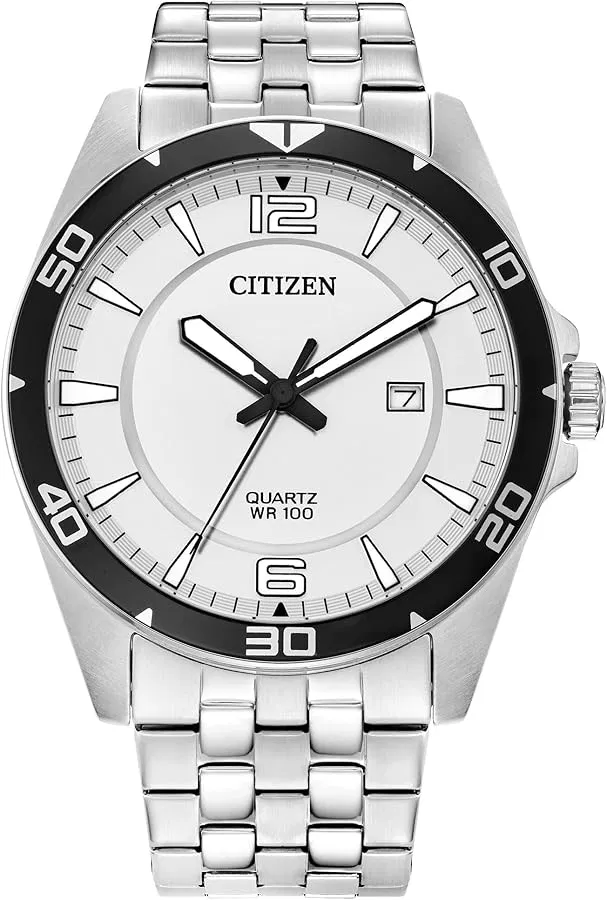
Citizen Quartz Classic Silver-Tone
🔥 Deal of the Day

Citizen Quartz Classic Silver-Tone

Citizen

★★★★★ 4.5 (1,407 reviews)

$120

Offer expires in


🔥 Grab This Deal →

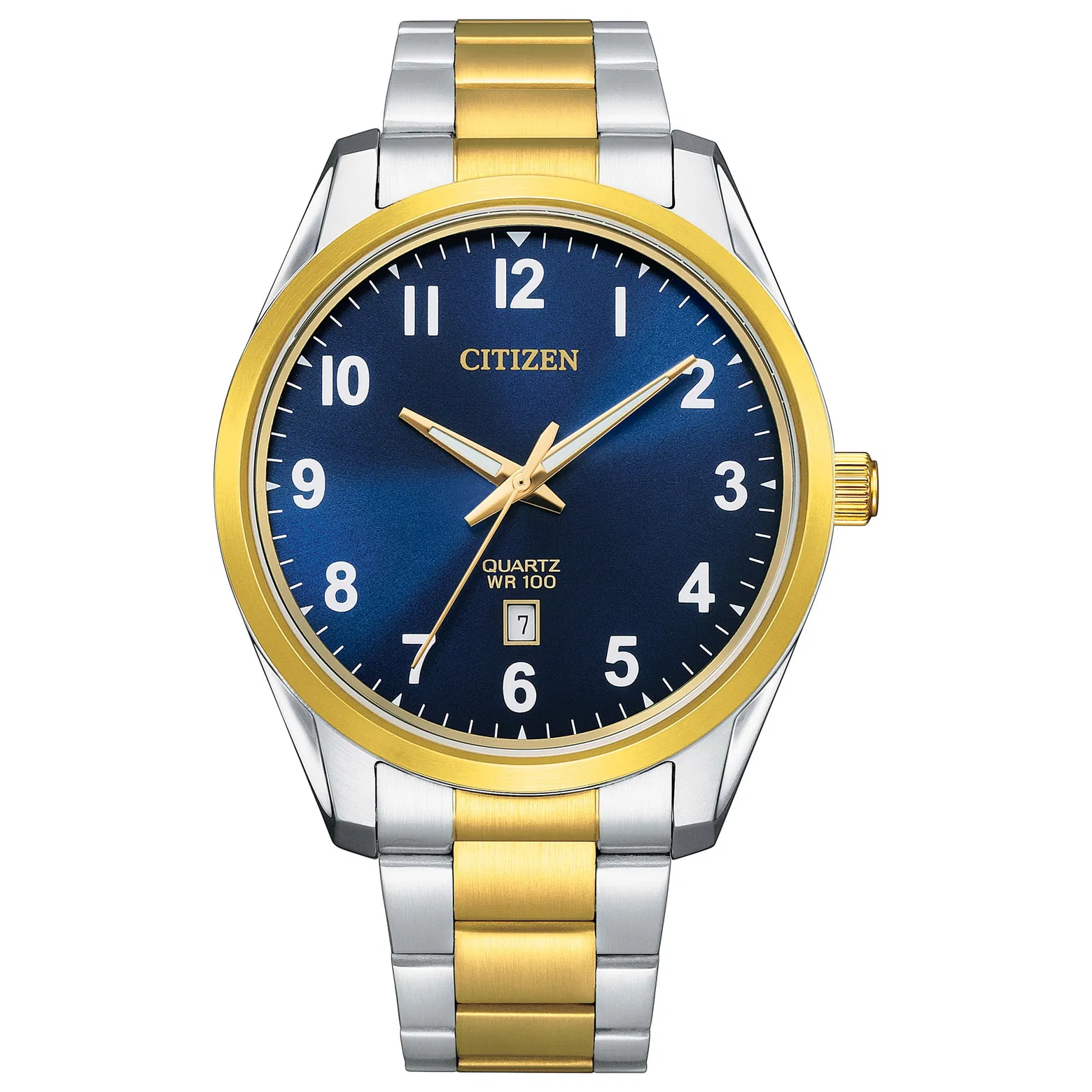
Citizen Quartz Two-Tone


Citizen Quartz Two-Tone

Citizen

★★★★★ 4.8 (2,403 reviews)

$90


Check Price on Amazon →


Browse all 142+ expert-reviewed watches →

ETSY Shop
ETSY Shop
Redbubble Shop
Redbubble Shop
More Watch Facts
More Watch Facts