

📅 Monday, September 7, 2026
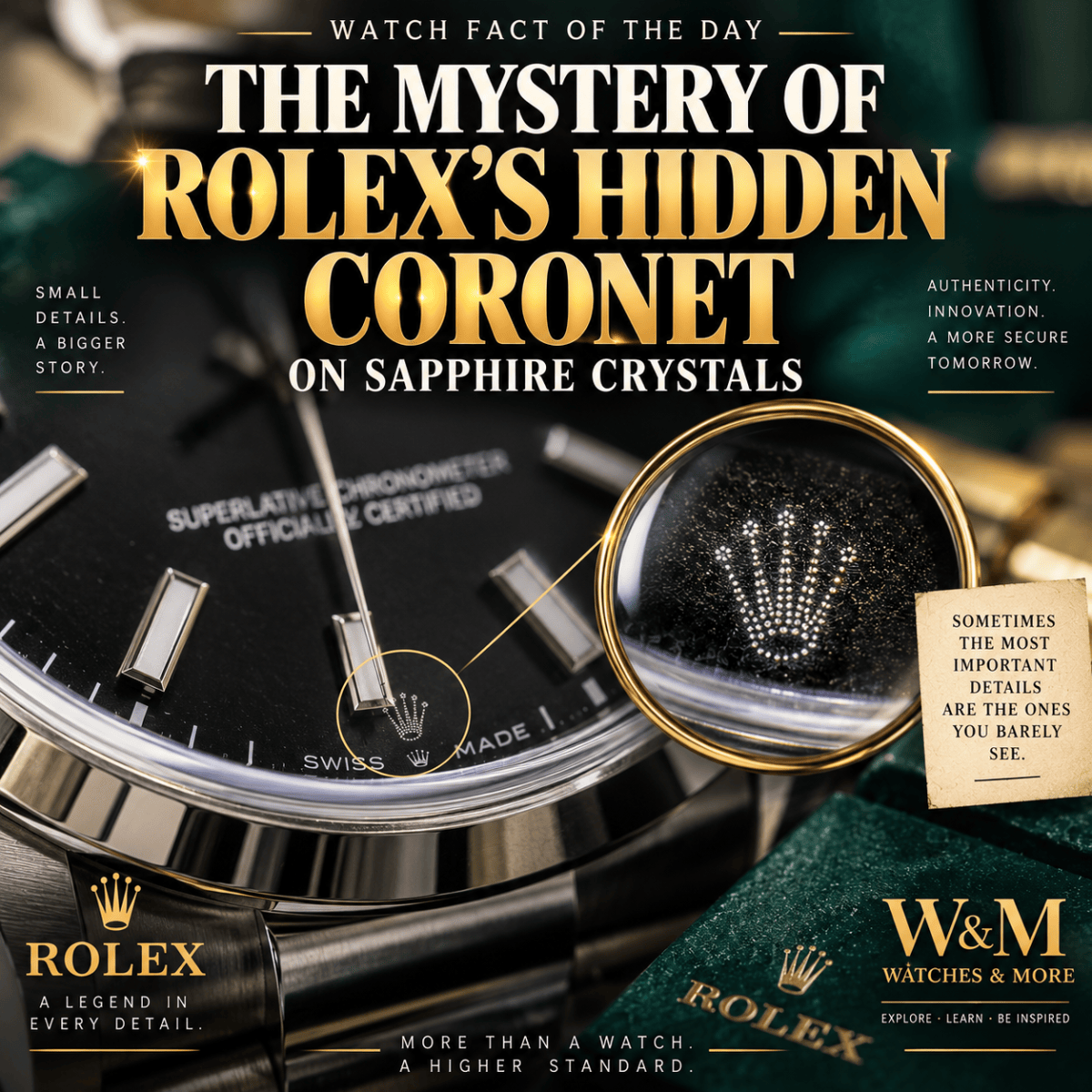
Look closely at the crystal of many modern Rolex watches and there’s a detail most people will never notice. At approximately the 6 o’clock position, just above the dial, Rolex places a microscopic version of its famous five-pointed coronet into the sapphire crystal—a feature collectors commonly call the LEC, or Laser-Etched Coronet. It is deliberately subtle enough to virtually disappear during normal wear.
The feature began appearing around the start of the 2000s, with collector references commonly placing its introduction around 2001 and its broader rollout over the next few years. That’s useful historical context because an authentic Rolex from the transitional period might not necessarily have one, while a replacement crystal fitted later could introduce the marking to an older watch.
And calling it an “etching” can actually undersell how interesting the process is. Rather than simply scratching a crown onto the surface, the genuine marking is formed from numerous microscopic points within the sapphire, allowing the exterior surfaces to remain smooth. Under magnification, the coronet therefore appears less like a printed logo and more like a tiny constellation of dots.
Finding it can become a game in itself. Looking straight down at the watch in ordinary lighting may reveal absolutely nothing. A loupe or magnifying glass combined with strong light hitting the crystal at an angle makes the coronet much easier to spot. Once the light catches those microscopic points correctly, the familiar crown suddenly appears floating above the 6 o’clock marker.
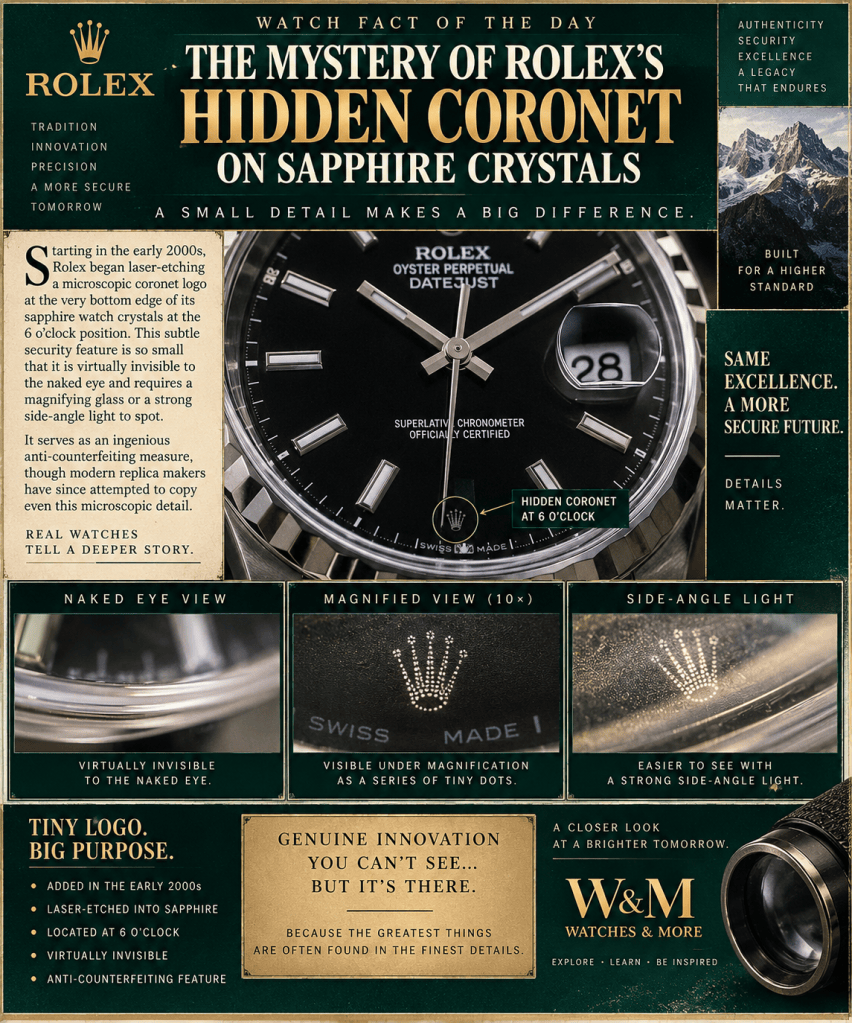
The coronet was introduced as an additional anti-counterfeiting and authentication detail, but there’s an important collector warning: the LEC alone should never be treated as proof that a Rolex is genuine. Modern counterfeiters have attempted to reproduce the marking, and increasingly sophisticated replicas can imitate details that were once considered useful authenticity clues. Authentication needs to consider the entire watch rather than one microscopic crown.
There’s another wrinkle for collectors. Some Rolex service replacement crystals have been documented with an additional tiny “S” incorporated into the coronet, indicating a service crystal. That means finding a slightly different coronet configuration doesn’t automatically tell the whole story—the watch’s age and service history also matter.
💡 Did You Know?
The hidden coronet can be so difficult to see that being too obvious can itself be suspicious. A genuine LEC is intended to remain extremely discreet under ordinary viewing conditions; normally you’ll need careful lighting, magnification, or both before the tiny dotted crown resolves clearly.
Think of it as:
NAKED EYE → ALMOST NOTHING
ANGLED LIGHT → SOMETHING APPEARS
10× LOUPE → 👑
📖 Collector’s Note
The hidden crown is best thought of as one clue rather than an authenticity certificate.
An older genuine watch may legitimately lack it.
A service crystal may have one.
A counterfeit may attempt to reproduce one.
So:
CORONET PRESENT ≠ AUTOMATICALLY GENUINE
CORONET ABSENT ≠ AUTOMATICALLY FAKE
That nuance actually makes this Watch Fact better.
Category: Fun Quirk
Disclaimer: Every effort has been made to keep these watch facts accurate, but the world of horology is full of myths, disputed stories, and fascinating trivia. Consider these facts a starting point for discovery rather than the final word. If you have corrections or additional insights, let us know—we’re always happy to keep the record ticking in the right direction.
🕐 Discover more watch facts, reviews, and buying guides at WatchesAndMore
🛍️ You Might Also Like
As an Amazon Associate and affiliate partner, WatchesAndMore earns from qualifying purchases.