
📅 Thursday, September 10, 2026
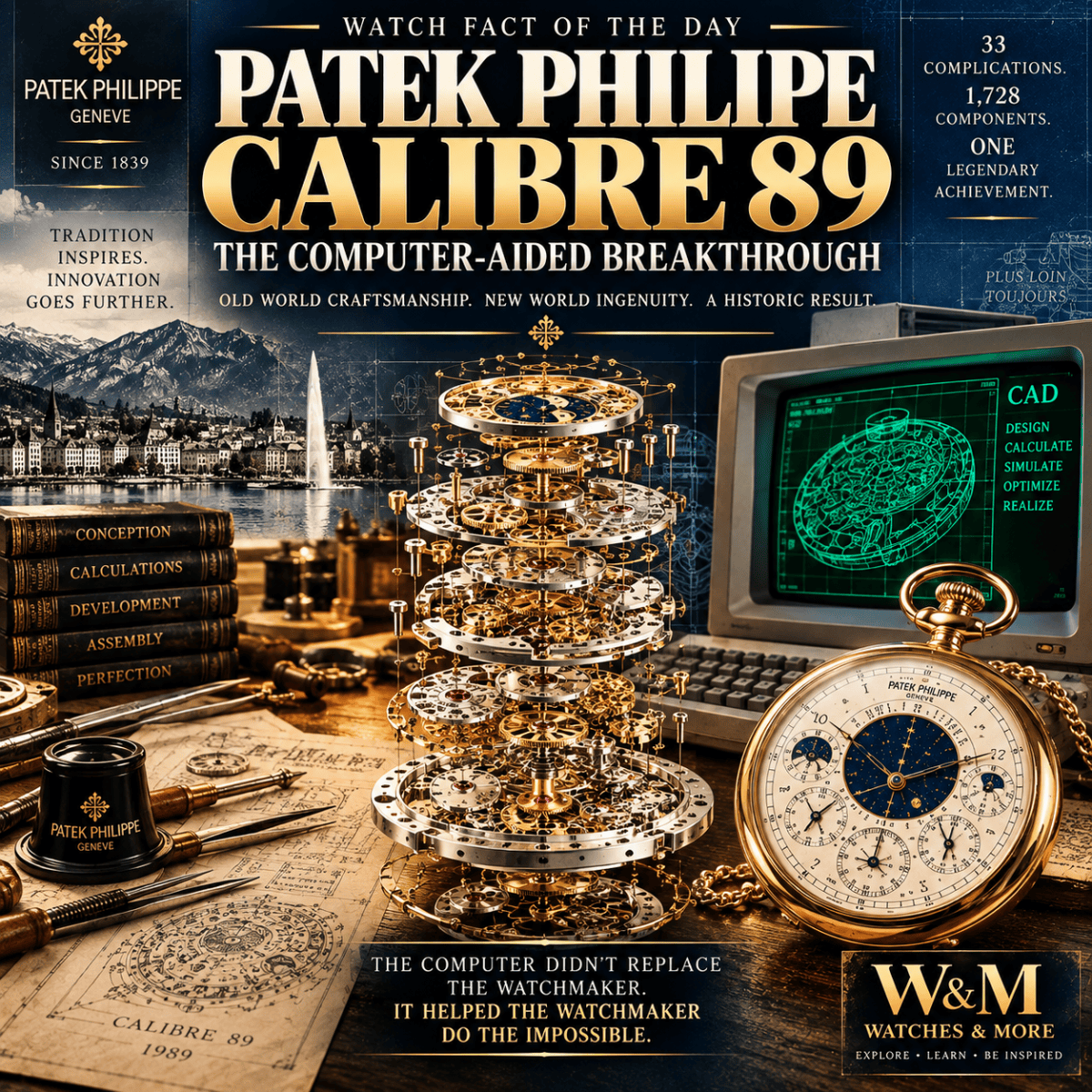
When Patek Philippe began planning an extraordinary watch for its 150th anniversary in 1989, Philippe Stern had an audacious objective: create a mechanical timepiece more complicated than anything the manufacture had built before.
But achieving it would require something decidedly unconventional in traditional Swiss watchmaking.
A computer.
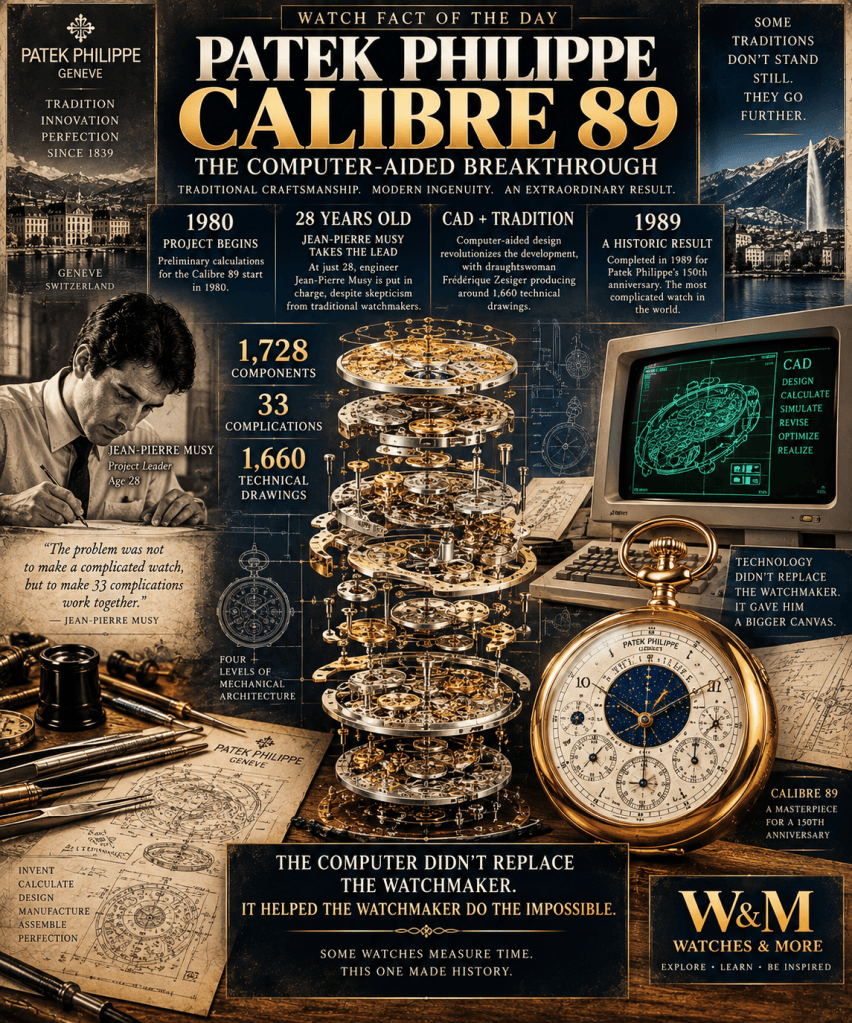
Preliminary calculations for what became the Calibre 89 began in 1980. Philippe Stern entrusted the project to Jean-Pierre Musy, a 28-year-old engineer, rather than placing it exclusively in the hands of Patek’s veteran master watchmakers. It was a controversial decision. Stern later recalled that some traditional watchmakers doubted that a young engineer could successfully construct such an extraordinarily complicated watch. Hodinkee
The problem was staggering.
The finished Calibre 89 contained 1,728 components and incorporated 33 complications, all arranged inside an approximately 89 mm pocket-watch case. Its functions included a secular perpetual calendar, split-seconds chronograph, minute repeater, grande and petite sonnerie, alarm, equation of time, sunrise and sunset indications, sidereal time, celestial chart and even the date of Easter. Patek Philippe
Trying to determine how all those interacting mechanisms could coexist within one movement demanded a new approach.
Musy’s team combined traditional mechanical watchmaking with computer-assisted design and manufacturing techniques. One particularly fascinating contributor was draughtswoman Frédérique Zesiger, who worked directly with a computer to produce approximately 1,660 detailed component drawings. The system could calculate fabrication coordinates and recalculate positions as the movement’s incredibly dense architecture evolved. SJX Watches
This wasn’t replacing watchmakers with computers.
It was using computation to solve geometrical and organizational problems of a complexity that traditional methods made extraordinarily difficult—and then handing those solutions back to highly skilled craftspeople who still had to manufacture, finish, adjust and assemble the actual mechanical watch.
Master watchmaker Paul Buclin was responsible for assembly and finishing, while François Devaud helped coordinate the project. It became a remarkable collaboration between engineering, computer technology and traditional haute horlogerie. SJX Watches
After years of calculations, research and development, a working prototype was ready in July 1988. The yellow-gold Calibre 89 was completed in April 1989, in time to celebrate Patek Philippe’s 150th anniversary. Sothebys.com
The result was extraordinary.
At its introduction, the Calibre 89 became the world’s most complicated mechanical watch, a title it would retain for more than a quarter-century. Sothebys.com
💡 Did You Know?
The computer’s role went far beyond simply making prettier technical drawings.
The movement was constructed across four interconnected levels, and changes in one part of its architecture could affect coordinates elsewhere. Zesiger’s CAD system could recalculate those positions as the design evolved.
At one point, the team even lost the master assembly drawing for the secular calendar mechanism and reconstructed it using the approximately 1,660 individual component drawings that had survived. SJX Watches
Think about that:
1,728 COMPONENTS
33 COMPLICATIONS
1,660 TECHNICAL DRAWINGS
9 YEARS FROM INITIAL CALCULATIONS TO COMPLETION
All to produce one extraordinary mechanical machine. Sothebys.com
⭐ Why It Matters
The Calibre 89 demonstrated something enormously important at the end of the quartz crisis.
Technology didn’t have to replace mechanical watchmaking.
Technology could help mechanical watchmaking become even more ambitious.
Computers could perform calculations, manage geometries and assist manufacturing—but ultimately those digital instructions still had to become physical wheels, levers, springs, cams, pinions and screws assembled by human hands.
That makes the Calibre 89 a fascinating paradox:
One of the greatest achievements of traditional mechanical horology was made possible partly because Patek Philippe was willing to embrace new technology.
OLD WORLD CRAFTSMANSHIP.
NEW WORLD COMPUTATION.
ONE INCREDIBLE WATCH.
Category: Fun Quirk
Disclaimer: Every effort has been made to keep these watch facts accurate, but the world of horology is full of myths, disputed stories, and fascinating trivia. Consider these facts a starting point for discovery rather than the final word. If you have corrections or additional insights, let us know—we’re always happy to keep the record ticking in the right direction.
🕐 Discover more watch facts, reviews, and buying guides at WatchesAndMore



🛍️ You Might Also Like
As an Amazon Associate and affiliate partner, WatchesAndMore earns from qualifying purchases.