Watch Fact of the Day: The ‘Big Ben’ Clock Was Once the World’s Most Accurate Public Timekeeper!

The Great Clock of Westminster, commonly known as Big Ben, was completed in 1859 and became renowned for its precision, attributed to an innovative double three-legged gravity escapement designed by Edmund Beckett Denison. This mechanism effectively minimized external factors that could disrupt the pendulum’s swing, allowing for remarkable accuracy. Clock keepers could fine-tune the clock’s timing using old British pennies to adjust the pendulum’s center of mass. Although modern atomic clocks far exceed its accuracy, Big Ben remains a significant achievement in mechanical horology and a symbol of engineering excellence, with its great bell often mistakenly referred to as Big Ben.

📅 Sunday, July 26, 2026

While not a wristwatch, the Great Clock of Westminster, famously known as Big Ben, was considered the most accurate public clock in the world upon its completion in 1859. Its incredible precision was partly due to its innovative double three-legged gravity escapement, designed by Edmund Beckett Denison, which isolated the pendulum from the varying forces of the clock’s gear train. This design allowed it to maintain accuracy within a second, a remarkable feat for its era and scale.


Big Ben Clock
Big Ben Clock

The secret to the clock’s remarkable accuracy lies in its ingenious engineering rather than sheer size. Denison’s gravity escapement ensured that wind, rain, or the enormous weight of the hands themselves had virtually no effect on the pendulum’s swing. This allowed the pendulum to oscillate with extraordinary consistency, making the Great Clock a benchmark for precision long before electronic timekeeping existed. Its reliability was so impressive that other tower clocks around the world later adopted variations of the same escapement design.

Another fascinating feature is the clock’s surprisingly simple method of regulation. If the clock began running slightly slow, the keeper didn’t adjust gears or springs—instead, old British pennies were placed on top of the pendulum. Each penny raises the pendulum’s centre of mass just enough to make the clock gain approximately 0.4 seconds per day. Adding or removing a single coin allowed the clock’s accuracy to be fine-tuned with incredible precision, a practice that continues to this day.

Although modern atomic clocks have long surpassed it in accuracy, Big Ben remains one of the greatest achievements in mechanical horology. More than 165 years after it first chimed across London, the Great Clock continues to keep remarkably accurate time while standing as one of the world’s most recognizable symbols of engineering excellence. It serves as a reminder that some of history’s finest timekeepers weren’t worn on the wrist—they towered over entire cities.


💡 Did You Know?

Despite popular belief, “Big Ben” is actually the name of the 13.5-ton Great Bell inside the tower—not the clock or the tower itself. The clock is officially known as the Great Clock of Westminster, while the tower has been called the Elizabeth Tower since 2012, when it was renamed to celebrate Queen Elizabeth II’s Diamond Jubilee.

Category: Watch History

🕐 Discover more watch facts, reviews, and buying guides at WatchesAndMore


🛍️ You Might Also Like

As an Amazon Associate and affiliate partner, WatchesAndMore earns from qualifying purchases.
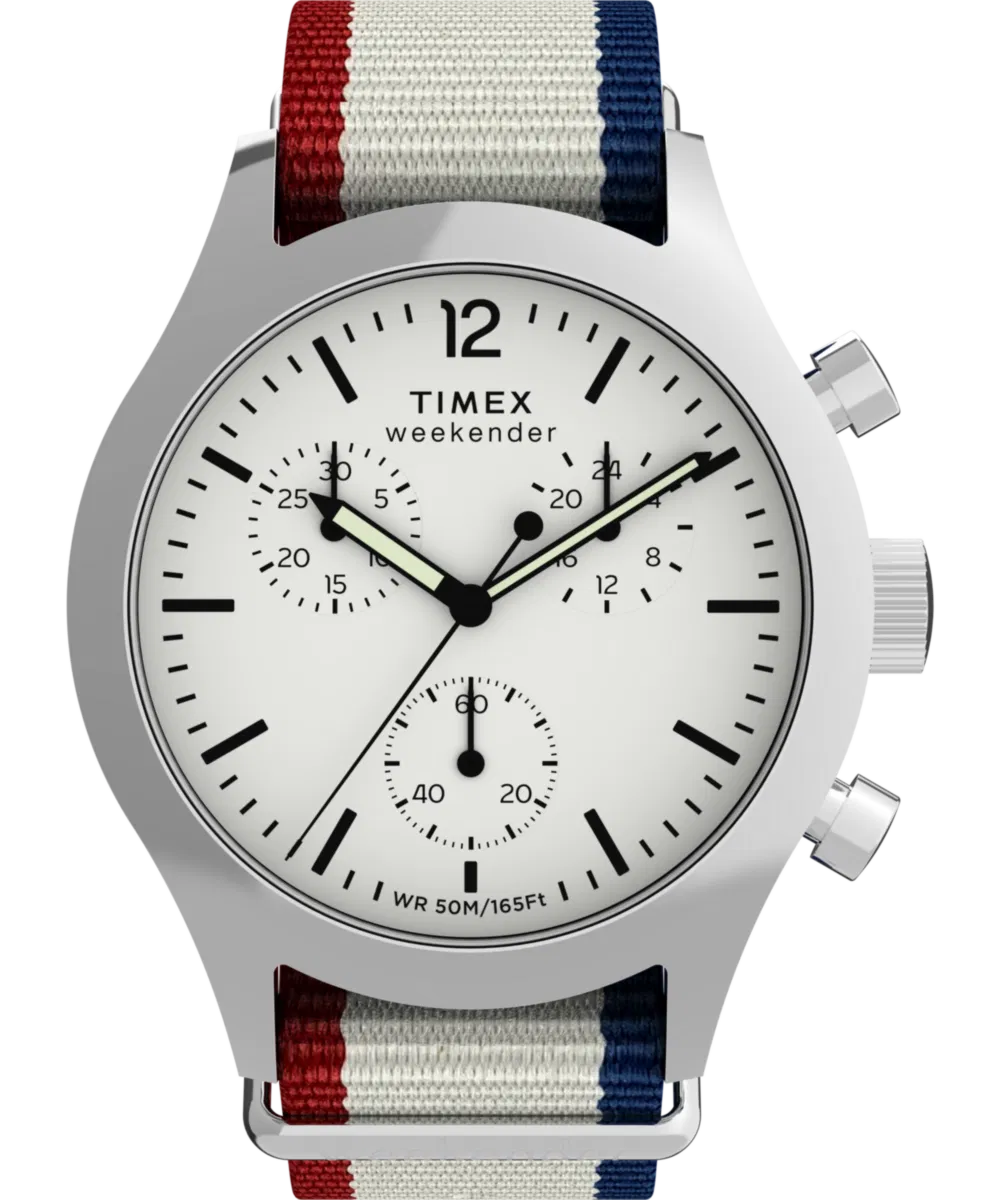
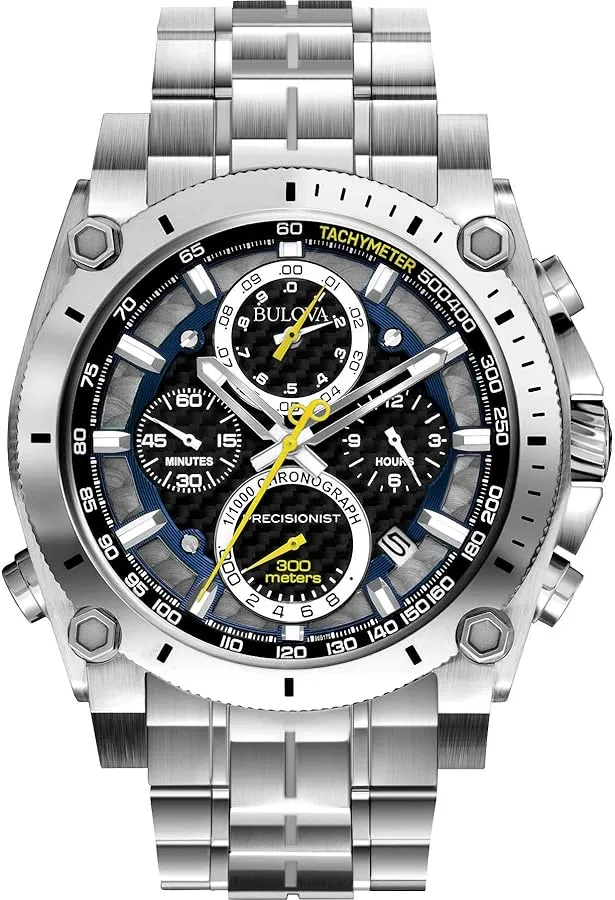
Bulova Precisionist


Bulova Precisionist

Bulova

★★★★★ 4.6 (1,100 reviews)

$219


Check Price on Amazon →

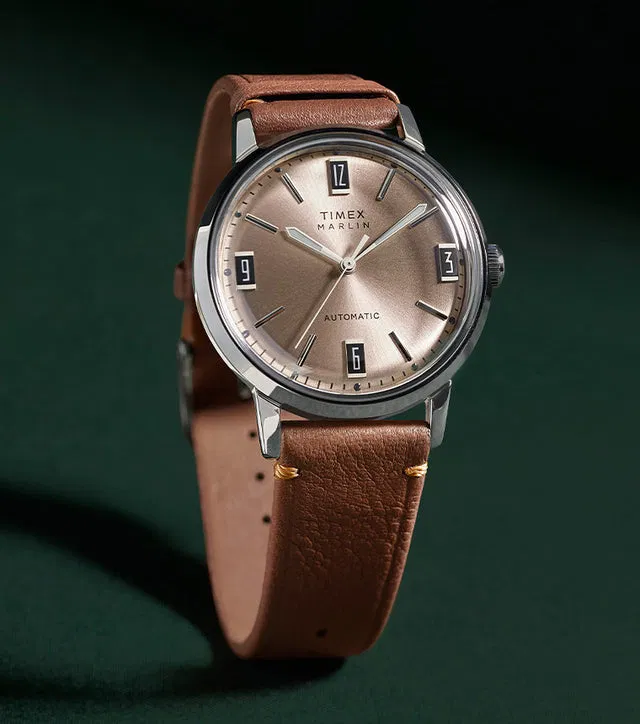
Timex Marlin Automatic 40mm


Timex Marlin Automatic 40mm

Timex

★★★★★ 4.7 (1,106 reviews)

$259


Check Price on Amazon →


Browse all 75+ expert-reviewed watches →

The Casio G-Shock Mudmaster GSG-100-1A is the watch for serious professionals and hardcore outdoor enthusiasts. Its specialized mud resistance, twin sensor technology, and extreme durability make it uniquely capable in environments where ordinary watches fail. While it’s larger and more expensive than standard G-Shocks, the Mudmaster justifies its premium with features and construction quality that can literally save your life in extreme conditions. If your adventures take you to the edge of civilization, the Mudmaster is the watch that will get you back.

The Watch Advisor
Find Your Perfect Watch

Casio G-Shock Mudmaster GSG-100-1A3 – The Ultimate Rugged Adventure Watch! ⏳🌍💪 YouTubeVideo

In this video, we take an in-depth look at the Casio G-Shock Mudmaster GSG-100-1A3, a watch engineered for extreme conditions. Designed for those who brave the toughest terrains, this mud-resistant, shock-resistant, and 200-meter water-resistant timepiece is built to handle the elements

SEE MY REVIEW ON ON MY WatchesAndMore YouTube Channel

☕ Help Support WatchesAndMore

If you enjoyed this article and would like to help support WatchesAndMore, consider visiting my Etsy Shop or browsing my designs on Redbubble. Every purchase helps support the continued creation of watch reviews, historical articles, buying guides, videos, and all the free content you enjoy here on the website and on YouTube.

Your support allows me to spend more time researching fascinating stories from the world of horology, testing new watches, and producing high-quality content for collectors and enthusiasts around the globe. Whether you’re looking for unique watch-themed merchandise or simply want to support the channel, every order is genuinely appreciated. Thank you for being part of the WatchesAndMore community—your support helps keep the passion for watches alive! ⌚🍻

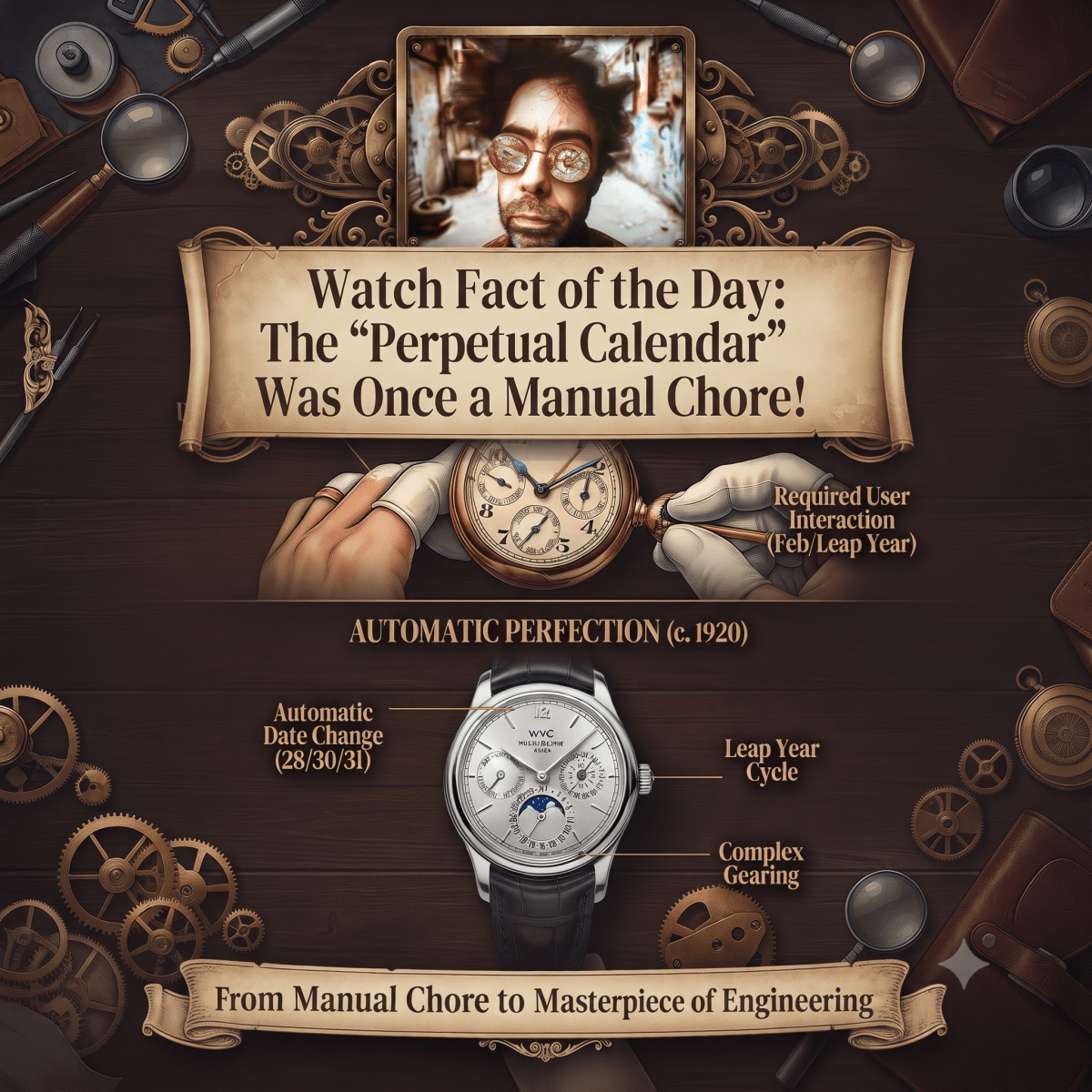
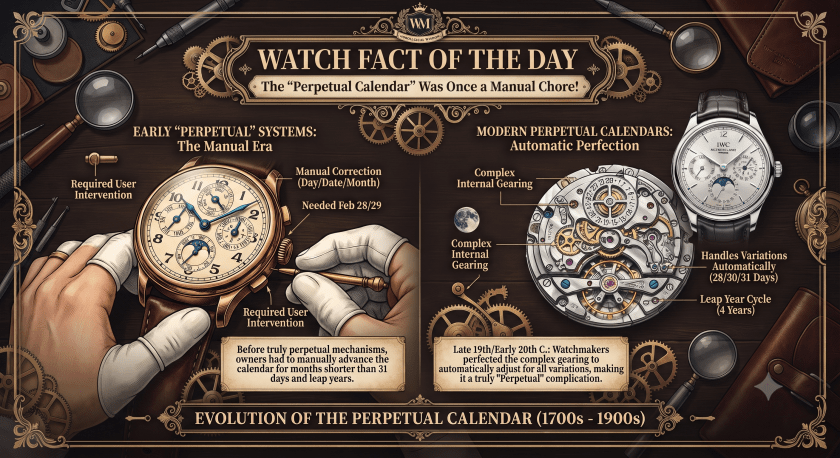
Watch Fact of the Day: The ‘Perpetual Calendar’ Was Once a Manual Chore!

Before perpetual calendars made wristwatches behave like timekeeping wizards, owners had to embark on a monthly ritual of adjusting their watches, playing an endless game of “is it February again?” Fast forward to the late 19th century, when watchmakers conjured up a mechanical marvel that understands leap years, February 29s, and can keep track of time until 2100 (with just one manual nudge). These tiny ticking masterpieces contain a labyrinth of gears, turning them into the wrist’s very own computer. So if you ever wanted to wear a mini engineering triumph and impress your wristwatch friends, now’s your time!

📅 Friday, July 24, 2026

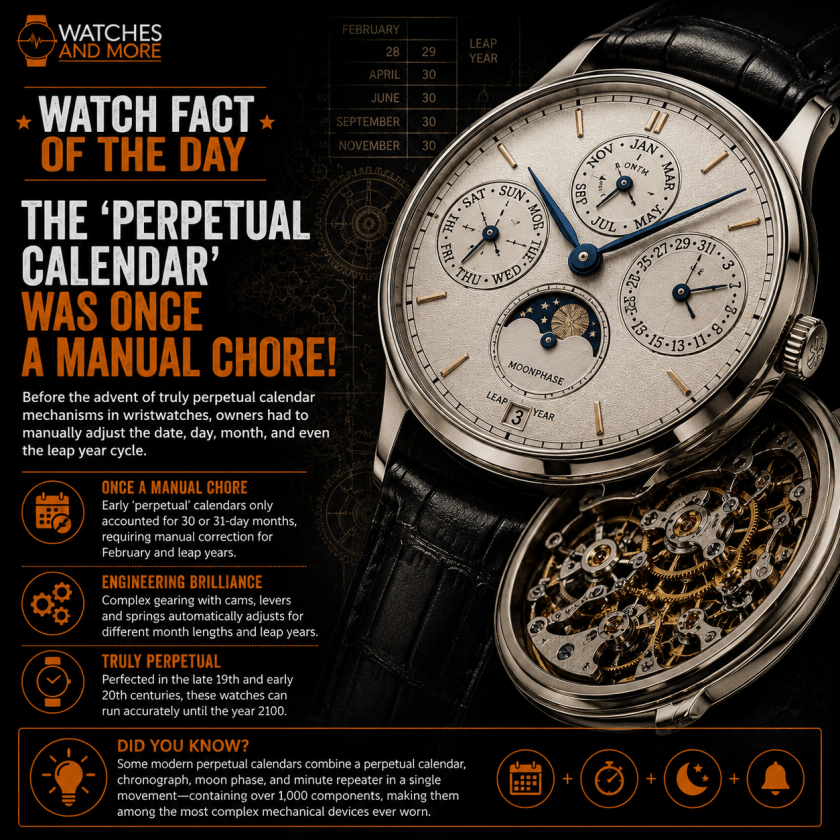
Before the advent of truly perpetual calendar mechanisms in wristwatches, owners had to manually adjust the date, day, month, and even the leap year cycle. Early ‘perpetual’ calendars only accounted for months with 30 or 31 days, requiring manual correction for February and leap years. It wasn’t until the late 19th and early 20th centuries that watchmakers perfected the complex gearing to automatically handle these variations, making it a truly ‘perpetual’ complication.

Watch fact: the perpetual calendar evolution

A true perpetual calendar is one of the greatest achievements in mechanical watchmaking. Using an intricate network of levers, cams, gears, and springs, the movement “knows” the length of each month and automatically advances the calendar accordingly. It even recognizes leap years, correctly displaying February 29 every four years without requiring intervention. Once properly set, a perpetual calendar can continue displaying the correct date until the year 2100, when the Gregorian calendar skips a leap year because century years must be divisible by 400 to qualify. At that point, even these remarkable watches will require a single manual adjustment.

The level of engineering involved is astonishing. Many perpetual calendar movements contain hundreds of additional components dedicated solely to the calendar mechanism. Watchmakers must carefully synchronize every indication—date, day, month, leap year, and often the moon phase—so they all change in perfect harmony, usually around midnight. A tiny mistake during assembly can throw the entire system out of sequence, making these among the most demanding complications to manufacture and service.

Today, perpetual calendars remain one of the “Holy Trinity” of traditional grand complications, alongside the tourbillon and the minute repeater. Prestigious manufacturers such as Patek Philippe, Audemars Piguet, Vacheron Constantin, and IWC continue to produce extraordinary perpetual calendar watches that blend centuries-old mechanical ingenuity with modern precision. For collectors, owning one is like wearing a miniature mechanical computer on the wrist—one that can keep track of the calendar for generations.


Watch fact: the perpetual calendar evolution

💡 Did You Know?

Some modern perpetual calendars are so advanced that they combine a perpetual calendar, chronograph, moon phase, and minute repeater in a single movement. These “grand complications” can contain well over 1,000 individual components, making them some of the most complex mechanical devices ever worn on the wrist.


Disclaimer: Every effort has been made to keep these watch facts accurate, but the world of horology is full of myths, disputed stories, and fascinating trivia. Consider these facts a starting point for discovery rather than the final word. If you have corrections or additional insights, let us know—we’re always happy to keep the record ticking in the right direction.

Category: Watch History

🕐 Discover more watch facts, reviews, and buying guides at WatchesAndMore


🛍️ You Might Also Like

As an Amazon Associate and affiliate partner, WatchesAndMore earns from qualifying purchases.


Browse all 75+ expert-reviewed watches →

The Watch Advisor
Find Your Perfect Watch

Watch Fact of the Day: The ‘Doctor’s Watch’ with a Pulsometer Scale

Back in the day, doctors used specialized watches with pulsometer scales to measure patients’ heart rates. They’d start the stopwatch, count heartbeats for 15 or 30 seconds, then instantly get the beats per minute from the scale—no math required. These watches were key tools for medical pros, especially Swiss brands like Longines and Omega. Even though electronic devices took over, collectors still love these timepieces for their craftsmanship and history. Think of it as a time when watches had a real purpose beyond just telling time, serving as vital instruments alongside stethoscopes in the medical field.

📅 Wednesday, July 22, 2026

Before digital devices, doctors relied on specialized watches to quickly measure a patient’s pulse. These ‘doctor’s watches’ featured a pulsometer scale on the dial or bezel, allowing a physician to start the chronograph, count a specific number of heartbeats (e.g., 15 or 30), and then read the beats per minute directly from the scale. This ingenious complication was a vital diagnostic tool in medical practice for decades.


The pulsometer was one of several purpose-built scales developed for chronographs during the late 19th and early 20th centuries. Unlike a standard tachymeter, which measures speed over a known distance, a pulsometer was calibrated specifically for heart rate. After counting a predetermined number of heartbeats—commonly 15 or 30—the physician could stop the chronograph and read the patient’s pulse directly in beats per minute, eliminating the need for mental calculations during a medical examination.

Many renowned Swiss manufacturers, including Longines, Omega, Universal Genève, and later Patek Philippe, produced elegant chronographs featuring pulsometer scales. These watches became trusted companions for physicians making hospital rounds, house calls, and even battlefield examinations, where speed and accuracy could make a critical difference. The distinctive scales, often printed in red or blue around the edge of the dial, remain some of the most visually striking complications ever created.

Although electronic monitors have long replaced the pulsometer in everyday medical practice, these watches remain highly sought after by collectors. They represent a fascinating period when mechanical watchmaking wasn’t just about telling time—it provided practical tools for professionals. Today, a well-preserved doctor’s chronograph is admired not only for its craftsmanship but also as a reminder of an era when a skilled physician’s most important diagnostic instruments were a stethoscope, a trained eye, and a watch.


💡 Did You Know?

Doctor’s watches weren’t the only profession-specific timepieces. Watchmakers also created telemeter chronographs for measuring the distance of visible events like lightning, tachymeter chronographs for calculating speed, and asthmometer watches designed to help physicians measure a patient’s breathing rate—showcasing just how versatile mechanical chronographs became before the digital age.

Category: Watch History

Disclaimer: Every effort has been made to keep these watch facts accurate, but the world of horology is full of myths, disputed stories, and fascinating trivia. Consider these facts a starting point for discovery rather than the final word. If you have corrections or additional insights, let us know—we’re always happy to keep the record ticking in the right direction.

🕐 Discover more watch facts, reviews, and buying guides at WatchesAndMore


🛍️ You Might Also Like

As an Amazon Associate and affiliate partner, WatchesAndMore earns from qualifying purchases.

Bulova Precisionist


Bulova Precisionist

Bulova

★★★★★ 4.6 (1,100 reviews)

$219


Check Price on Amazon →

Timex Marlin Automatic 40mm


Timex Marlin Automatic 40mm

Timex

★★★★★ 4.7 (1,106 reviews)

$259


Check Price on Amazon →

More Watch Facts
More Watch Facts


Browse all 75+ expert-reviewed watches →


Watch Fact of the Day: The First Watch in Space Was Not a Speedmaster!

So, here’s the scoop: while the Omega Speedmaster is strutting around as the famous ‘Moonwatch’, it’s actually the Russian Strela that rocked the first space mission, making its debut on Yuri Gagarin’s wrist in 1961. Yep, the Soviets were first! Gagarin’s Vostok 1 mission lasted just 108 minutes, but it was a 108-minute thrill ride that sent humanity into orbit, with the sturdy Strela keeping time like a pro. The Speedmaster didn’t join the space party until 1965, earning its Moonwatch title in 1969. So, while the Speedmaster gets the lunar glory, don’t forget the understated Strela, the original space watch trendsetter!

📅 Tuesday, July 21, 2026

While Omega’s Speedmaster is famously known as the ‘Moonwatch’ and the first watch worn on the Moon, the very first wristwatch to journey into space was actually a Russian Strela, worn by Yuri Gagarin in 1961 during his Vostok 1 mission. This often-overlooked detail highlights the pioneering efforts of Soviet cosmonauts in the early space race. The Strela, a chronograph, predates the Speedmaster’s official qualification for space by several years.


Gagarin’s historic Vostok 1 mission on April 12, 1961, lasted just 108 minutes, but it forever changed human history. As the first person to orbit the Earth, every piece of equipment he carried became part of spaceflight legend—including the watch on his wrist. The Soviet-made Strela chronograph was valued for its robust mechanical construction and precise timekeeping, qualities that made it a dependable companion during one of humanity’s greatest achievements.

The Omega Speedmaster wouldn’t enter the history books until several years later. After rigorous testing by NASA in 1965, the Speedmaster became officially certified for all manned space missions and went on to accompany astronauts throughout the Gemini and Apollo programs. Its defining moment came in 1969 when Buzz Aldrin wore his Speedmaster onto the lunar surface, earning the model its enduring “Moonwatch” nickname. While the Speedmaster became synonymous with lunar exploration, the Strela will always hold the distinction of being among the earliest watches worn during mankind’s first ventures into space.

Today, both watches occupy legendary status in horology, each representing a different chapter of the Space Race. The Strela symbolizes the Soviet Union’s groundbreaking achievement of sending the first human into orbit, while the Speedmaster embodies NASA’s remarkable journey to the Moon. Together, they remind us that some of history’s greatest watches earned their reputations not in display cases or advertisements, but by accompanying explorers into the most unforgiving frontier ever encountered.


🚀 Why It Matters

The story of the first watch in space is a reminder that horological history is often more nuanced than popular legend suggests. While the Speedmaster rightly deserves its place as the Moonwatch, the Strela deserves recognition for accompanying humanity’s very first journey beyond our planet—a milestone that forever changed both space exploration and watchmaking history.

Category: Watch History

Disclaimer: Every effort has been made to keep these watch facts accurate, but the world of horology is full of myths, disputed stories, and fascinating trivia. Consider these facts a starting point for discovery rather than the final word. If you have corrections or additional insights, let us know—we’re always happy to keep the record ticking in the right direction.

🕐 Discover more watch facts, reviews, and buying guides at WatchesAndMore


🛍️ You Might Also Like

As an Amazon Associate and affiliate partner, WatchesAndMore earns from qualifying purchases.

Bulova Precisionist


Bulova Precisionist

Bulova

★★★★★ 4.6 (1,100 reviews)

$219


Check Price on Amazon →

Timex Marlin Automatic 40mm


Timex Marlin Automatic 40mm

Timex

★★★★★ 4.7 (1,106 reviews)

$259


Check Price on Amazon →

More Watch Facts
More Watch Facts


Browse all 75+ expert-reviewed watches →

WatchesAndMore.org
Find Your Perfect Watch

Watch Fact of the Day: The ‘Pepsi’ Bezel: A Happy Accident of Color, Not Just Style

Once upon a time in the 1950s, pilots had a dilemma: how to tell if it was cocktail or coffee time at 30,000 feet. Enter the Rolex GMT-Master with its dizzying blue and red ‘Pepsi’ bezel, a brilliant dual-tone decision that transformed navigation into a colorful affair. Designed to help aviators avoid costly blunders, it echoed the Pepsi logo, leading collectors to nickname it the “Pepsi” bezel. Fast forward, and this practical watch feature turned into one of the most coveted horological icons. Who knew that saving pilots from time zone confusion could lead to a frenzy in watch fashion! Cheers to that!

📅 Friday, July 17, 2026

The iconic blue and red ‘Pepsi’ bezel, famously associated with the Rolex GMT-Master, was originally developed for a practical reason: to distinguish between day and night hours for pilots. The red portion indicated daylight hours, while the blue represented nighttime, making it easier for aviators to track time across multiple zones. Its distinctive color combination was a functional design choice that unexpectedly became one of horology’s most recognizable and beloved aesthetic features.


Vintage Rolex GMT-Master watch with faded red and blue bezel and aged dial
A close-up of a vintage Rolex GMT-Master watch showcasing its aged bezel and worn dial.

The story began in the 1950s when commercial aviation was rapidly expanding and international pilots needed an easier way to keep track of multiple time zones. Working closely with Pan American World Airways (Pan Am), Rolex introduced the GMT-Master in 1954 with a rotating 24-hour bezel and an additional GMT hand. The two-tone bezel wasn’t chosen simply because it looked attractive—it allowed pilots to instantly distinguish between daytime and nighttime hours at a glance, reducing the chance of costly navigation errors during long-haul flights.

Over the decades, the blue-and-red bezel took on a life of its own. Collectors affectionately nicknamed it the “Pepsi” bezel because its colors resembled the famous soft drink’s logo, a nickname that Rolex never officially adopted but enthusiasts embraced worldwide. The success of the Pepsi bezel inspired a whole family of colorful GMT nicknames, including the “Coke” (red and black), “Batman” (blue and black), and “Root Beer” (brown and black), proving just how influential a functional design decision had become.

Today, the Pepsi bezel is one of the most recognizable features in all of watchmaking. Modern ceramic versions are incredibly difficult to manufacture because creating a perfectly crisp, two-color ceramic insert requires advanced engineering and precision. What started as a practical solution for airline pilots has evolved into one of the most sought-after and enduring design icons in horological history—a perfect example of how great functionality can become timeless style.

Category: Watch History

Disclaimer: Every effort has been made to keep these watch facts accurate, but the world of horology is full of myths, disputed stories, and fascinating trivia. Consider these facts a starting point for discovery rather than the final word. If you have corrections or additional insights, let us know—we’re always happy to keep the record ticking in the right direction.

🕐 Discover more watch facts, reviews, and buying guides at WatchesAndMore


🛍️ You Might Also Like

As an Amazon Associate and affiliate partner, WatchesAndMore earns from qualifying purchases.

Bulova Precisionist


Bulova Precisionist

Bulova

★★★★★ 4.6 (1,100 reviews)

$219


Check Price on Amazon →

Timex Marlin Automatic 40mm


Timex Marlin Automatic 40mm

Timex

★★★★★ 4.7 (1,106 reviews)

$259


Check Price on Amazon →

More Watch Facts


Browse all 75+ expert-reviewed watches →

Watch Fact of the Day: The ‘Reverso’ That Was Designed for Polo Players, Not Just Style

So, the Jaeger-LeCoultre Reverso watch is a total classic that came out in the 1930s, designed to save watch faces during polo matches. British officers in India were tired of breaking their watches, so they asked Jacques-David LeCoultre for a solution. Enter César de Trey, who teamed up with LeCoultre and designer René-Alfred Chauvot to create the flip case that protects the crystal. This rugged design soon became an Art Deco icon with a sleek look and personalization options. Today, the Reverso is still a luxury favorite, proving great design lasts.

Watch History: Wednesday, July 15, 2026

📅 Wednesday, July 15, 2026

The iconic Jaeger-LeCoultre Reverso watch, famous for its swiveling case, was originally conceived in the early 1930s to protect the watch crystal during rough-and-tumble polo matches. British officers stationed in India, tired of smashing their watch faces during games, challenged Jacques-David LeCoultre to create a timepiece that could withstand the sport. The solution was a case that could flip over, presenting a solid metal back to absorb impacts.


French businessman César de Trey recognized the need after hearing complaints from polo players during a trip to India. He worked with Jaeger-LeCoultre and designer René-Alfred Chauvot, who patented the ingenious reversible case in 1931. The mechanism allowed the watch to slide within its frame and rotate 180 degrees, protecting the delicate crystal in seconds. It was a simple yet revolutionary solution that perfectly blended engineering with elegance.

Although the Reverso was born as a rugged sports watch, it quickly found a second life as a symbol of Art Deco sophistication. Its clean rectangular case, sharp geometric lines, and reversible back made it popular well beyond the polo field. Owners soon discovered they could personalize the solid caseback with engravings, family crests, military insignias, or commemorative messages, transforming each watch into a unique heirloom.

Today, the Reverso is celebrated as one of the most recognizable luxury watches ever created. While few owners will ever wear one during a polo match, its ingenious reversible case remains a reminder that some of horology’s greatest icons began not as fashion statements, but as practical solutions to real-world problems. Nearly a century later, the Reverso continues to prove that exceptional design never goes out of style.

Category: Watch History

Disclaimer: Every effort has been made to keep these watch facts accurate, but the world of horology is full of myths, disputed stories, and fascinating trivia. Consider these facts a starting point for discovery rather than the final word. If you have corrections or additional insights, let us know—we’re always happy to keep the record ticking in the right direction.

🕐 Discover more watch facts, reviews, and buying guides at WatchesAndMore


🛍️ You Might Also Like

As an Amazon Associate and affiliate partner, WatchesAndMore earns from qualifying purchases.

Bulova Precisionist


Bulova Precisionist

Bulova

★★★★★ 4.6 (1,100 reviews)

$219


Check Price on Amazon →

Timex Marlin Automatic 40mm


Timex Marlin Automatic 40mm

Timex

★★★★★ 4.7 (1,106 reviews)

$259


Check Price on Amazon →

The Watch Advisor
Find Your Perfect Watch


Browse all 75+ expert-reviewed watches →

Watch Fact of the Day: The ‘Watchmaker’s Secret’: Why Some Dials Have a Tiny ‘SWISS’ Mark

Once upon a time, those tiny inscriptions on watch dials were like secret codes for horology aficionados—before Swiss regulations put a foot down. A tiny ‘SWISS’ or ‘SWISS A.T.’ was a cheeky way for watchmakers to hint, “Hey, this movement’s legit, even if the casing had a little globetrotting adventure!” Fast forward a few decades, and collectors are scouring the 6 o’clock spot for clues like detectives on a caffeine high. Who knew a few measly letters could be the difference between vintage treasure and knock-off trash? In a world obsessed with precision, even watchmakers understand that good things come in small (and sometimes almost invisible) packages!

Watch History: Tuesday, July 14, 2026

📅 Tuesday, July 14, 2026

Before the ‘Swiss Made’ regulation became standardized, some watchmakers discreetly marked their dials with a tiny ‘SWISS’ or ‘SWISS A.T.’ (for ‘Swiss Ancien Temps’ or ‘Old Swiss’) near the 6 o’clock position. This was often done to indicate that the movement was indeed Swiss, even if the watch was cased or assembled elsewhere, a subtle nod to its origin before stricter labeling laws took hold.


That tiny inscription eventually became one of the most recognizable details in luxury watchmaking. As the reputation of Swiss craftsmanship grew throughout the 20th century, the word “Swiss” evolved from a simple country-of-origin marking into a symbol of precision, reliability, and quality. Collectors today often inspect the small text beneath the 6 o’clock marker because it can reveal valuable clues about a watch’s age, authenticity, and production era.

Over the decades, the markings themselves changed to reflect new materials and evolving regulations. Vintage watches may feature inscriptions such as “T SWISS T” or “SWISS T < 25,” indicating the use of tritium lume, while modern watches typically display “SWISS MADE” after stricter legal standards were introduced. These tiny details help collectors identify whether a dial is original, replaced, or refinished—making a few millimeters of text surprisingly important in the world of horology.

Today, that nearly invisible word at the bottom of the dial represents more than geography. It reflects generations of Swiss innovation, craftsmanship, and watchmaking tradition. For enthusiasts, reading the tiny inscription at 6 o’clock is often the first step in uncovering a watch’s story, proving that some of the most important details in horology are also the easiest to overlook.

Category: Watch History

Disclaimer: Every effort has been made to keep these watch facts accurate, but the world of horology is full of myths, disputed stories, and fascinating trivia. Consider these facts a starting point for discovery rather than the final word. If you have corrections or additional insights, let us know—we’re always happy to keep the record ticking in the right direction.

🕐 Discover more watch facts, reviews, and buying guides at WatchesAndMore


🛍️ You Might Also Like

As an Amazon Associate and affiliate partner, WatchesAndMore earns from qualifying purchases.

Bulova Precisionist


Bulova Precisionist

Bulova

★★★★★ 4.6 (1,100 reviews)

$219


Check Price on Amazon →

Timex Marlin Automatic 40mm


Timex Marlin Automatic 40mm

Timex

★★★★★ 4.7 (1,106 reviews)

$259


Check Price on Amazon →

More Watch Facts
More Watch Facts


Browse all 75+ expert-reviewed watches →

Watch Fact of the Day: The Silent Revolution: Quartz Watches Were Once Expensive Luxury!

In the glamorous world of horology, quartz watches originally cost more than a small car—thanks, Seiko Astron 35SQ, for making our wallets weep on Christmas 1969! These shiny marvels relied on a quartz crystal flickering like it just chugged a double espresso, boasting accuracy that made mechanical counterparts look like they were timing slow-motion races. Fast forward to the ’70s, and voila! What was once an elite luxury turned into a bargain bin favorite, thanks to mass production. The Quartz Crisis had Swiss watchmakers sweating bullets while quartz watches became the everyday go-to. Who knew precision could be so affordable?

Watch History: Friday, July 10, 2026

📅 Friday, July 10, 2026

Before the ‘Quartz Crisis’ made them ubiquitous and affordable, early quartz watches were incredibly expensive, often costing more than their mechanical counterparts. The first commercially available quartz wristwatch, the Seiko Astron 35SQ, launched on Christmas Day 1969, retailed for 450,000 Yen, which was equivalent to a medium-sized car at the time. This high price reflected the immense research and development costs, as well as the cutting-edge technology involved.


When the Astron debuted, owning a quartz watch was a symbol of technological prestige rather than affordability. The movement relied on a tiny quartz crystal vibrating at an astonishing 8,192 times per second, providing a level of accuracy that mechanical watches simply couldn’t match. At a time when most mechanical watches gained or lost several seconds each day, the Astron promised accuracy measured in seconds per month—a breakthrough that seemed almost unbelievable in 1969.

As manufacturing techniques improved throughout the 1970s, production costs fell dramatically. What began as an exclusive luxury innovation quickly became accessible to everyday consumers. Japanese manufacturers, led by Seiko, Citizen, and Casio, perfected mass production, allowing quartz watches to be sold for a fraction of their original cost. This shift forever changed the watch industry, triggering what became known as the Quartz Crisis, a period during which many traditional Swiss mechanical watchmakers struggled to survive as consumers embraced the affordability and accuracy of quartz technology.

Today, it’s easy to think of quartz watches as the budget option, but history tells a very different story. The first quartz watches represented the cutting edge of engineering and were among the most desirable timepieces money could buy. Their success didn’t diminish mechanical watchmaking—it forced the industry to reinvent itself, ultimately leading to the appreciation of craftsmanship, heritage, and artistry that defines today’s luxury mechanical watches. Sometimes, the technologies we take for granted began life as the world’s most exclusive innovations.


Category: Watch History


Disclaimer: Every effort has been made to keep these watch facts accurate, but the world of horology is full of myths, disputed stories, and fascinating trivia. Consider these facts a starting point for discovery rather than the final word. If you have corrections or additional insights, let us know—we’re always happy to keep the record ticking in the right direction.

🕐 Discover more watch facts, reviews, and buying guides at WatchesAndMore


More Watch Facts
More Watch Facts

🛍️ You Might Also Like

As an Amazon Associate and affiliate partner, WatchesAndMore earns from qualifying purchases.

Seiko 5 SNK805 Green Military


Seiko 5 SNK805 Green Military

Seiko

★★★★★ 4.8 (6,961 reviews)

$89


Check Price on Amazon →

Seiko Presage Cocktail Time Blue Moon


Seiko Presage Cocktail Time Blue Moon

Seiko

★★★★★ 4.7 (946 reviews)

$395


Check Price on Amazon →


Browse all 75+ expert-reviewed watches →


Watch Fact of the Day: The First Wristwatch Was Made for a Queen, Not a King!

So, the first wristwatch ever made was crafted by Abraham-Louis Breguet in 1810 for Caroline Murat, Queen of Naples. This fancy oval-shaped watch was pretty revolutionary back then since everyone was using pocket watches. It had a repeater and a thermometer, making it super high-tech for its time. Even though it was made for a queen, wristwatches didn’t catch on for guys until much later—especially during WWI when soldiers needed a quicker way to check the time. This watch set the stage for what would become a global favorite, proving that great ideas often start with just one person.

Watch History: Wednesday, July 8, 2026

📅 Wednesday, July 8, 2026

While men commonly wore pocket watches for centuries, the very first known wristwatch was created in 1810 by Abraham-Louis Breguet for Caroline Murat, Queen of Naples and Napoleon Bonaparte’s youngest sister. It was a delicate, oval-shaped repeater watch with a thermometer, designed to be worn on the wrist, marking a pivotal moment in horological history.


At the time, the idea of wearing a watch on the wrist was considered highly unconventional. Gentlemen almost exclusively carried pocket watches, while bracelets were viewed as fashionable jewelry rather than practical timekeeping devices. Caroline Murat’s commission challenged that convention, combining elegant design with remarkable mechanical complexity in a way that was centuries ahead of its time.

Breguet’s workshop records describe the watch as an extraordinary creation, featuring an ultra-thin movement mounted in an elongated oval case and attached to a bracelet woven from gold and hair. Although the original watch has since been lost to history, surviving correspondence and workshop archives provide fascinating insight into one of the most ambitious commissions of the early 19th century. Today, the piece is widely regarded as the world’s first documented wristwatch.

Ironically, it would take more than a hundred years for wristwatches to become the standard for men. During the late 19th century and especially throughout World War I, soldiers discovered that checking the time on a wristwatch was far more practical than reaching into a pocket during combat. What began as a bespoke luxury created for a queen eventually evolved into the preferred style of watch for millions around the world—a reminder that some of history’s greatest innovations begin as bold ideas for just one remarkable person.


What We Know About the Original Watch

According to Breguet’s archives, the original watch featured:

  • 📅 Commissioned on June 8, 1810
  • 👑 Made for Caroline Murat, Queen of Naples
  • 🔔 Quarter repeater complication
  • 🌡️ Built-in thermometer
  • 🥚 Ultra-thin oval case
  • 🪮 Mounted on a bracelet woven from gold thread and human hair
  • 📦 Delivered in 1812
  • 🔢 Breguet No. 2639
It looked something like this

It looked Similar to this


Category: Watch History

Disclaimer: Every effort has been made to keep these watch facts accurate, but the world of horology is full of myths, disputed stories, and fascinating trivia. Consider these facts a starting point for discovery rather than the final word. If you have corrections or additional insights, let us know—we’re always happy to keep the record ticking in the right direction.

🕐 Discover more watch facts, reviews, and buying guides at WatchesAndMore


🛍️ You Might Also Like

As an Amazon Associate and affiliate partner, WatchesAndMore earns from qualifying purchases.

More Watch Facts
More Watch Facts

The Watch Advisor
Find Your Perfect Watch
Bulova Precisionist


Bulova Precisionist

Bulova

★★★★★ 4.6 (1,100 reviews)

$219


Check Price on Amazon →

Timex Marlin Automatic 40mm


Timex Marlin Automatic 40mm

Timex

★★★★★ 4.7 (1,106 reviews)

$259


Check Price on Amazon →


Browse all 75+ expert-reviewed watches →
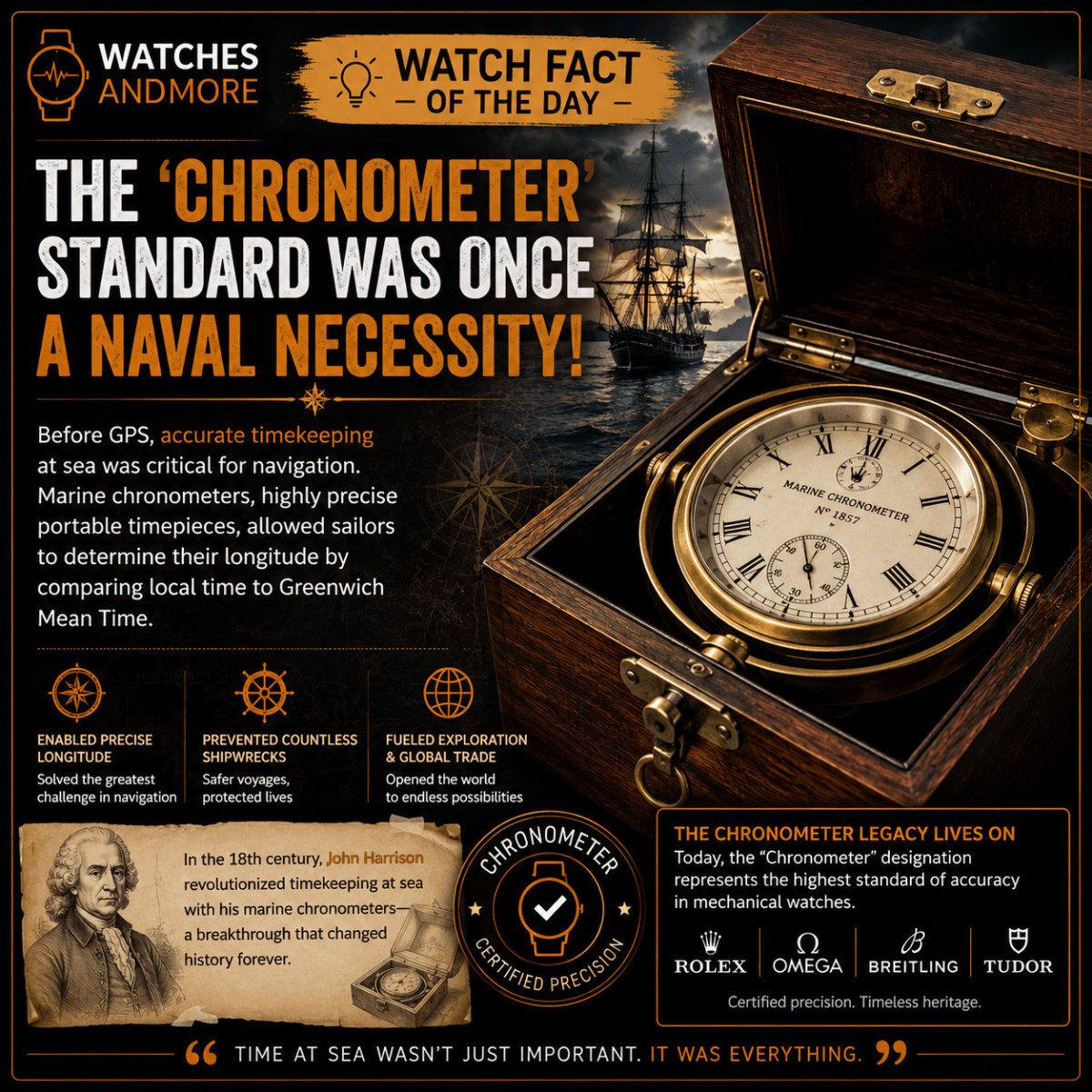

Watch Fact of the Day: The ‘Complication’ That Was Once a Simple Design Flaw

In the world of watches, the moon phase complication is like a fancy hat – it started as a necessity but became a stylish trend. Originally, clockmakers used a rotating lunar disc to cover up design flaws, turning their blunders into a celestial display. As time ticked on, watchmakers realized this moon trick could help farmers figure out when to plant crops and sailors avoid sailing into a moonless mess. These days, moon phases aren’t just about practicality; they’re romantic little reminders that your wrist can be both a timepiece and a dreamy connection to the cosmos. Who knew horology could be so poetic?

Watch History: Monday, July 6, 2026

📅 Monday, July 6, 2026

The moon phase complication, now a beloved and intricate feature on many high-end watches, originated from a practical necessity. Early clockmakers used a rotating disc for the moon to hide imperfections or gaps in the dial’s construction, effectively turning a design challenge into an aesthetic and functional display of celestial motion. This ‘fix’ evolved into one of horology’s most poetic complications.

As clockmaking techniques improved during the 17th and 18th centuries, the moon phase display evolved far beyond its practical origins. Watchmakers realized that a rotating lunar disc could do more than simply conceal part of the mechanism—it could also help farmers, sailors, astronomers, and travellers track the changing phases of the Moon. Long before smartphones and weather apps, knowing the lunar cycle was genuinely useful for navigation, agriculture, and even planning fishing expeditions.

Traditional moon phase watches are surprisingly precise. Most use a 59-tooth gear, allowing two complete lunar cycles to be displayed over 59 days. Since the Moon actually takes 29.53 days to complete one cycle, this simple mechanism is remarkably accurate, requiring only a minor adjustment every two and a half years. More advanced modern moon phase movements can remain accurate for decades—or even centuries—before needing correction.

Today, the moon phase complication is cherished less for its practicality and more for the emotion it brings to a watch. It’s a reminder that mechanical watches are miniature works of art as much as they are instruments for telling time. With every passing day, the tiny moon slowly travels across the dial, connecting the wearer to a celestial rhythm that has guided humanity for thousands of years. Few complications capture the romance of traditional watchmaking quite like a beautifully executed moon phase display.


Disclaimer: Every effort has been made to keep these watch facts accurate, but the world of horology is full of myths, disputed stories, and fascinating trivia. Consider these facts a starting point for discovery rather than the final word. If you have corrections or additional insights, let us know—we’re always happy to keep the record ticking in the right direction.


Category: Watch History

🕐 Discover more watch facts, reviews, and buying guides at WatchesAndMore


The Watch Advisor
Find Your Perfect Watch

🛍️ You Might Also Like

As an Amazon Associate and affiliate partner, WatchesAndMore earns from qualifying purchases.

Bulova Precisionist


Bulova Precisionist

Bulova

★★★★★ 4.6 (1,100 reviews)

$219


Check Price on Amazon →

Timex Marlin Automatic 40mm


Timex Marlin Automatic 40mm

Timex

★★★★★ 4.7 (1,106 reviews)

$259


Check Price on Amazon →


Browse all 75+ expert-reviewed watches →