
📅 Monday, July 27, 2026
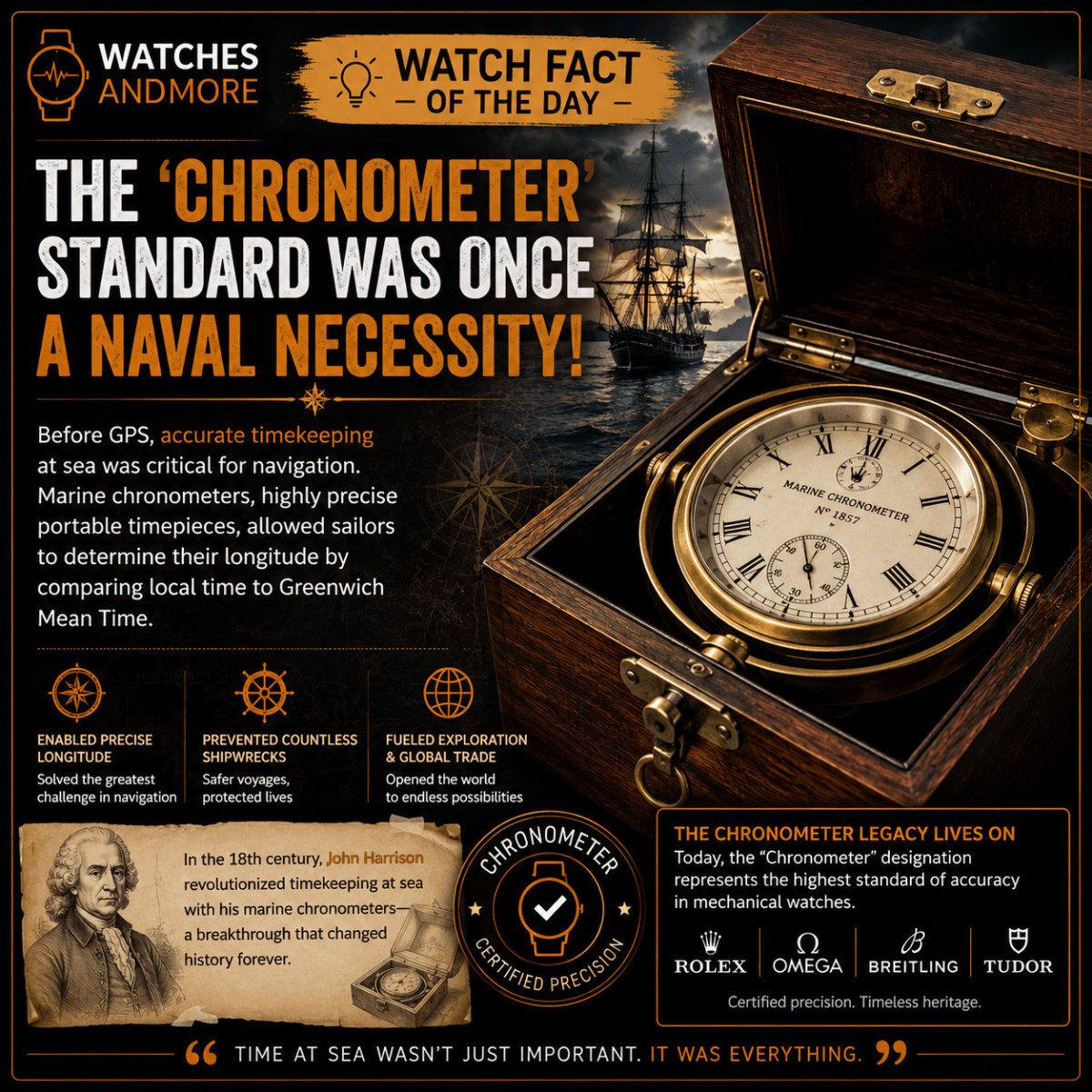
Before GPS, accurate timekeeping at sea was critical for navigation. Marine chronometers, highly precise portable timepieces, allowed sailors to determine their longitude by comparing local time to Greenwich Mean Time. This invention revolutionized seafaring, preventing countless shipwrecks and making global exploration and trade significantly safer.
The breakthrough came in the 18th century when English clockmaker John Harrison solved what had become known as the “Longitude Problem.” For centuries, sailors could determine their latitude with relative ease, but accurately calculating longitude while at sea remained one of navigation’s greatest challenges. Harrison’s revolutionary marine chronometers maintained exceptional accuracy despite the constant motion, changing temperatures, and humidity encountered aboard sailing ships. His work transformed maritime navigation and is considered one of the most important achievements in the history of horology.
The word “chronometer” itself has a very specific meaning in watchmaking. Today, it refers to a watch that has passed rigorous precision testing and earned official certification. In Switzerland, this is typically awarded by the Contrôle Officiel Suisse des Chronomètres (COSC), where each movement is tested over several days in multiple positions and temperatures. Only movements that meet strict accuracy standards are permitted to carry the prestigious “Chronometer” designation on their dial.
Modern chronometer-certified wristwatches continue this tradition of precision. Brands such as Rolex, Omega, Breitling, Tudor, and many others proudly produce chronometer-certified models, blending centuries of timekeeping heritage with modern manufacturing techniques. While GPS and atomic clocks have replaced marine chronometers for navigation, the chronometer certification remains one of the most respected indicators of mechanical accuracy and craftsmanship in the watch industry.
💡 Did You Know?
John Harrison’s first successful marine chronometer, known as H4, looked more like a large pocket watch than a ship’s clock. During sea trials in 1761, it lost only about five seconds on an 81-day voyage to Jamaica—an astonishing level of accuracy that forever changed navigation and proved that precise portable timekeeping was possible.
Category: Watch History
Disclaimer: Every effort has been made to keep these watch facts accurate, but the world of horology is full of myths, disputed stories, and fascinating trivia. Consider these facts a starting point for discovery rather than the final word. If you have corrections or additional insights, let us know—we’re always happy to keep the record ticking in the right direction.
🕐 Discover more watch facts, reviews, and buying guides at WatchesAndMore
🛍️ You Might Also Like
As an Amazon Associate and affiliate partner, WatchesAndMore earns from qualifying purchases.
Browse all 75+ expert-reviewed watches →
☕ Help Support WatchesAndMore
If you enjoyed this article and would like to help support WatchesAndMore, consider visiting my Etsy Shop or browsing my designs on Redbubble. Every purchase helps support the continued creation of watch reviews, historical articles, buying guides, videos, and all the free content you enjoy here on the website and on YouTube.
Your support allows me to spend more time researching fascinating stories from the world of horology, testing new watches, and producing high-quality content for collectors and enthusiasts around the globe. Whether you’re looking for unique watch-themed merchandise or simply want to support the channel, every order is genuinely appreciated. Thank you for being part of the WatchesAndMore community—your support helps keep the passion for watches alive! ⌚🍻