Tide-Tracking Pocket Watches: Timekeeping for the Sea

In the late 1800s, specialized marine pocket watches were developed with tide-predicting complications for naval navigators. These intricate mechanisms factored

Watch Fact of the Day
Military Watches: Tuesday, October 20, 2026

📅 Tuesday, October 20, 2026

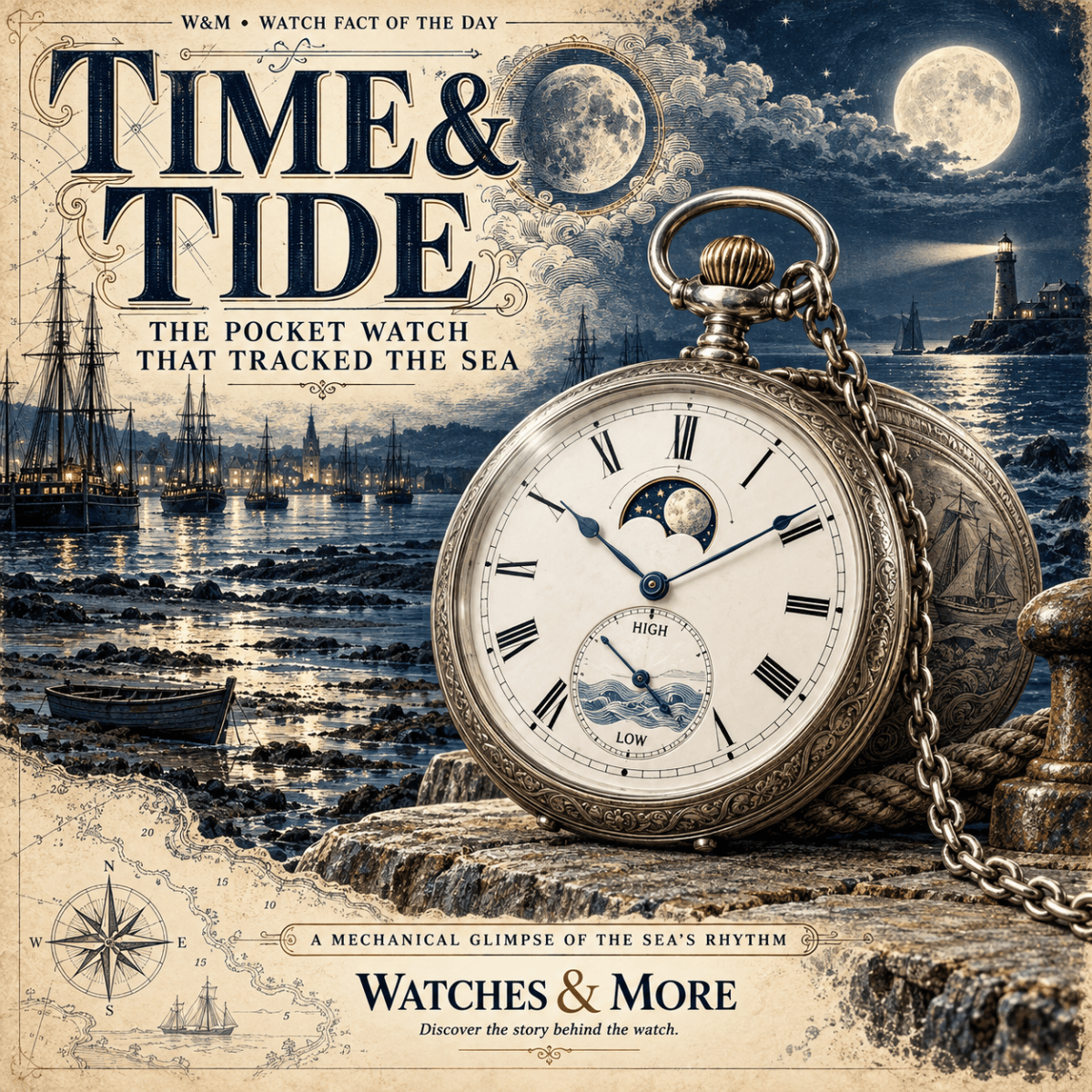
⌚ Watch Fact of the Day: The 19th-Century Pocket Watch That Tracked the Tides

Before tide apps, watchmakers put the rhythms of the Moon and sea onto a dial.

A watch could tell you the hour. An unusual one could also help tell you when the tide would turn.

Imagine a harbour at low water: boats resting on exposed mud, channels narrowing, and a departure waiting on the sea.

For coastal travel, knowing the time was only part of the problem. Knowing the tide mattered too.

Long before digital forecasts, watchmakers found ways to bring tidal information into portable timepieces. One documented example dates to around 1830—earlier than the late-Victorian era we might imagine.

🌊 A Tide Display in Your Pocket

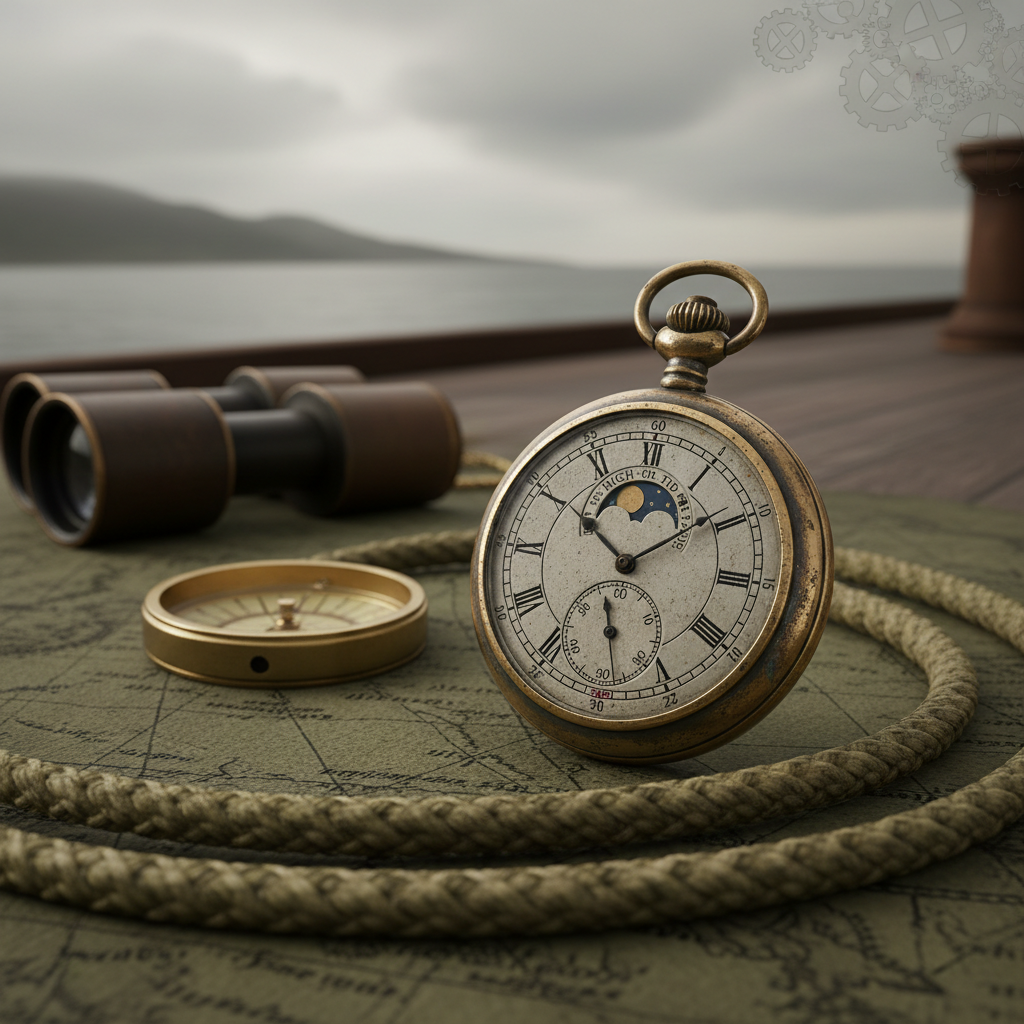
A Bonhams catalogue records a silver, double-sided pocket watch with tidal and moon-age indications, dated circa 1830.

One face combined the time display with calendar information. The other carried additional indications, including the tide and the Moon’s age.

The catalogue describes a key-wound fusee-and-verge movement and a case measuring approximately 55 mm. onthedash.com

This was an ambitious collection of information to carry in a pocket.

But the description does not identify it as standard naval equipment or establish that a particular captain used it. The surviving object supports a more precise claim: nineteenth-century watchmakers built pocket watches with tidal displays.

🌙 Why the Moon Matters

The tide does not follow the ordinary clock neatly.

A mean lunar day lasts approximately 24 hours and 50 minutes. In a simplified semidiurnal pattern, successive high tides are about 12 hours and 25 minutes apart. Tides and water levels

Those repeating astronomical relationships give clockmakers something to represent through gearing and scales.

Think of it as an early mechanical information display: translating a natural cycle into a position you can read.

The exact gearing of the circa-1830 watch is not explained in the auction description, so its mechanism should not be assumed from its dial alone.

⚙️ The Idea Was Older Still

The British Museum holds a remarkable watch by George Margetts, with a gold case hallmarked 1778.

Its enamel astronomical dial showed the Sun and Moon’s positions in the zodiac, the Moon’s age, and high-water times for named ports, including London, Hull, Plymouth, and Dublin.

The display also carried spring- and neap-tide markings. British Museum

That places portable tidal information firmly in the eighteenth century, rather than making it a late-1800s invention.

🧭 A Clever Display, With Local Limits

A tide indication is not a universal forecast for every harbour.

Coastline shape, seabed depth, and weather affect water levels and timing. Some places have one high tide per lunar day; others have two, sometimes of unequal height. National Oceanic and Atmospheric Administration

A repeating lunar cycle provides a useful foundation. It does not capture every local condition.

That makes tidal watches fascinating examples of mechanical modelling, while leaving room for the charts, observations, and local knowledge required at sea.

💡 Did You Know?

The British Museum describes Margetts’s 1778 watch as an eighteenth-century luxury likely intended for a scientifically curious gentleman or amateur astronomer. British Museum

A maritime complication does not automatically make its watch a working sailor’s instrument.

Sometimes, the attraction was carrying an astonishing explanation of the world in your pocket.

⭐ Why It Matters

Tidal watches show how far watchmakers could stretch the purpose of a timepiece.

Beyond counting hours, they sought to connect a small dial with much larger rhythms: the Moon overhead and the water along the shore.

The comparison with a modern tide app is irresistible. Both make a natural cycle easier to consult—but a historical dial represents only what its design can model.

One pocket watch. The Moon’s rhythm. A glimpse of the sea’s timetable. ⌚🌊


Watches & More — Discover the story behind the watch.

Explore more Watch Facts • Our main site • Our companion site

Category: Military Watches

Disclaimer: Every effort has been made to keep these watch facts accurate, but the world of horology is full of myths, disputed stories, and fascinating trivia. Consider these facts a starting point for discovery rather than the final word. If you have corrections or additional insights, let us know—we’re always happy to keep the record ticking in the right direction.

🕐 Discover more watch facts, reviews, and buying guides at WatchesAndMore


Read Next

HMS Beagle’s Pocket Chronometer: Timekeeping on Darwin’s Voyage

Vulliamy’s Traveller’s Watch: Two Times Before Time Zones

Join the Conversation

Which would you use more on a coastal trip: a tide display or a second time zone? Share your thoughts in the comments.

Explore watches in the W&M Watch Database.

ETSY Shop
ETSY Shop
Redbubble Shop
Redbubble Shop
More Watch Facts
More Watch Facts

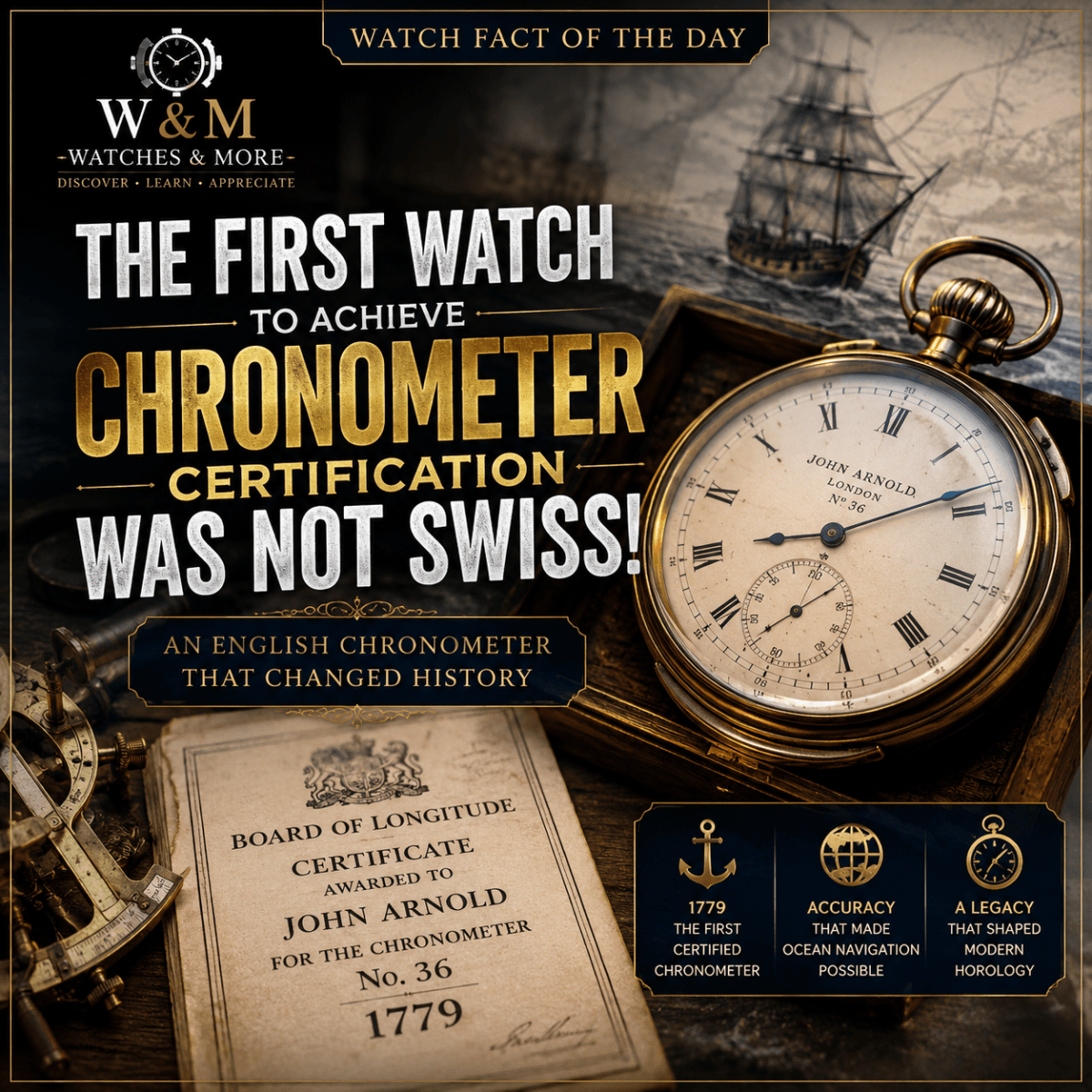
Watch Fact of the Day: The First Watch to Achieve Chronometer Certification Was Not Swiss!

In an unexpected twist of history, the first chronometer certificate didn’t come from Switzerland’s snowy peaks but from England, thanks to John Arnold’s pocket watch in 1779. Arnold’s No. 36 marine chronometer was a navigational superhero, ensuring sailors didn’t end up in the wrong country. While Swiss watchmakers eventually took the crown with their fancy competitions and the absolute tick-tock of precision, it was Arnold who set the timekeeping trend. So, the next time you flaunt your chronometer-certified wristwatch, just remember—its true lineage comes from dodging shipwrecks rather than the Alps. Who knew time could be so dramatic?

Watch History: Wednesday, August 5, 2026

📅 Wednesday, August 5, 2026

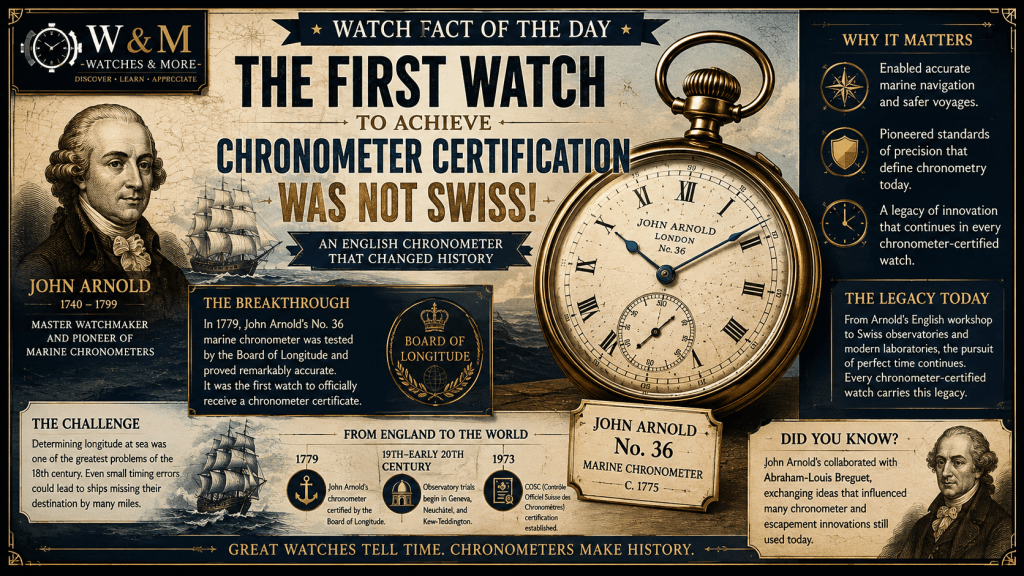
While Switzerland is synonymous with chronometer certification today, the first watch to officially receive a chronometer certificate was actually an English pocket chronometer made by John Arnold in 1779. His famous No. 36 marine chronometer was tested by the Board of Longitude and demonstrated exceptional accuracy, helping solve one of navigation’s greatest challenges. Long before Swiss observatories began certifying wristwatches, Arnold’s pioneering work laid the foundation for the precise timekeeping standards we now associate with the word “chronometer.”


During the 18th century, accurately determining a ship’s longitude at sea was one of the greatest scientific problems of the age. Even small timing errors could result in ships missing their destinations by many miles, often with disastrous consequences. John Arnold, alongside fellow English horologist Thomas Earnshaw, developed increasingly accurate marine chronometers capable of maintaining remarkable precision despite the constant motion, temperature changes, and humidity encountered aboard sailing vessels. Their innovations transformed ocean navigation and greatly improved the safety of global trade and exploration.

It wasn’t until the late 19th and early 20th centuries that Switzerland began establishing formal observatory trials in cities such as Geneva, Neuchâtel, and Kew-Teddington to evaluate the precision of mechanical watches. These competitions pushed manufacturers like Omega, Longines, Zenith, Patek Philippe, and Rolex to pursue ever-greater levels of accuracy. The modern COSC (Contrôle Officiel Suisse des Chronomètres) certification, introduced in 1973, continues this tradition by subjecting watch movements to rigorous multi-day testing in different positions and temperatures before they earn the prestigious title of Chronometer.

Today, the word chronometer has become a hallmark of exceptional precision, but its roots lie not in the mountains of Switzerland, but in Britain’s quest to master the seas. Every chronometer-certified wristwatch worn today carries a legacy that began over 240 years ago with pioneering English watchmakers striving to solve one of humanity’s greatest navigational challenges.


💡 Did You Know?

John Arnold was one of the first watchmakers to collaborate with Abraham-Louis Breguet, exchanging ideas that helped shape the future of precision watchmaking. Their friendship and shared innovations influenced many of the chronometer and escapement designs that would define horology for generations to come.

Category: Watch History

Disclaimer: Every effort has been made to keep these watch facts accurate, but the world of horology is full of myths, disputed stories, and fascinating trivia. Consider these facts a starting point for discovery rather than the final word. If you have corrections or additional insights, let us know—we’re always happy to keep the record ticking in the right direction.

🕐 Discover more watch facts, reviews, and buying guides at WatchesAndMore


☕ Help Support WatchesAndMore

If you enjoyed this article and would like to help support WatchesAndMore, consider visiting my Etsy Shop or browsing my designs on Redbubble. Every purchase helps support the continued creation of watch reviews, historical articles, buying guides, videos, and all the free content you enjoy here on the website and on YouTube.

Your support allows me to spend more time researching fascinating stories from the world of horology, testing new watches, and producing high-quality content for collectors and enthusiasts around the globe. Whether you’re looking for unique watch-themed merchandise or simply want to support the channel, every order is genuinely appreciated. Thank you for being part of the WatchesAndMore community—your support helps keep the passion for watches alive! ⌚🍻

ETSY Shop
ETSY Shop
Redbubble Shop
Redbubble Shop
More Watch Facts
More Watch Facts

🛍️ You Might Also Like

As an Amazon Associate and affiliate partner, WatchesAndMore earns from qualifying purchases.

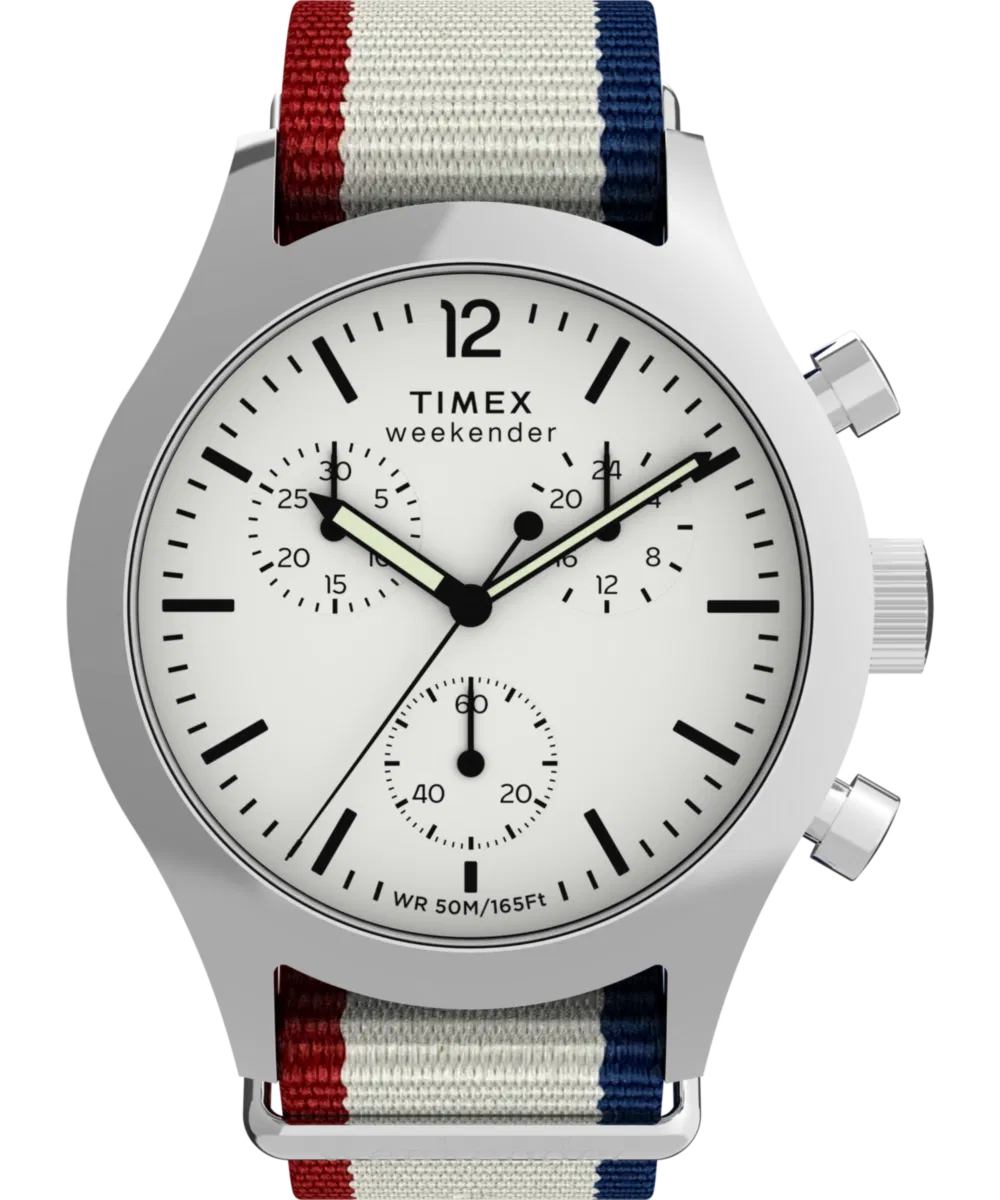
Timex Weekender Chronograph
🔥 Deal of the Day

Timex Weekender Chronograph

Timex

★★★★★ 4.5 (3,041 reviews)

$79

Offer expires in


🔥 Grab This Deal →

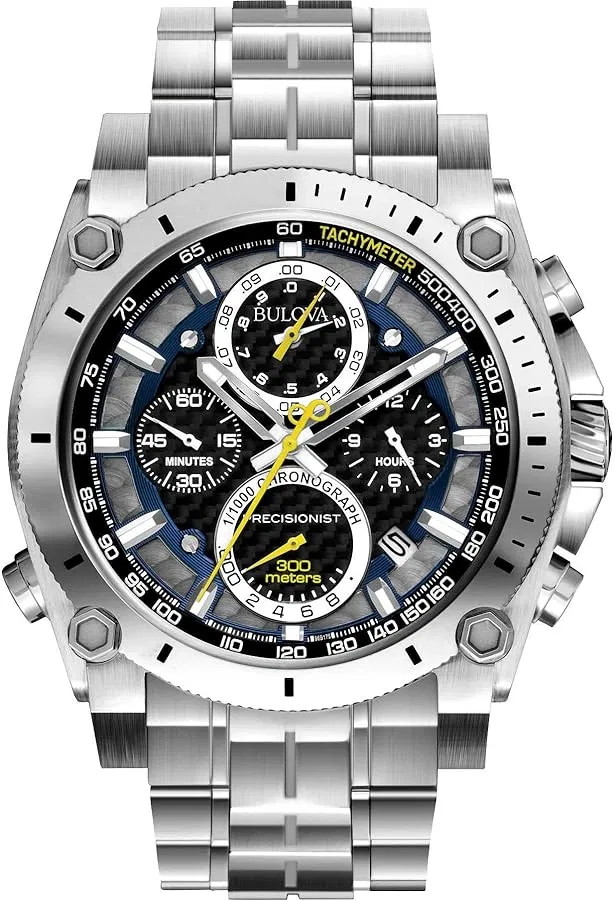
Bulova Precisionist


Bulova Precisionist

Bulova

★★★★★ 4.6 (1,100 reviews)

$219


Check Price on Amazon →

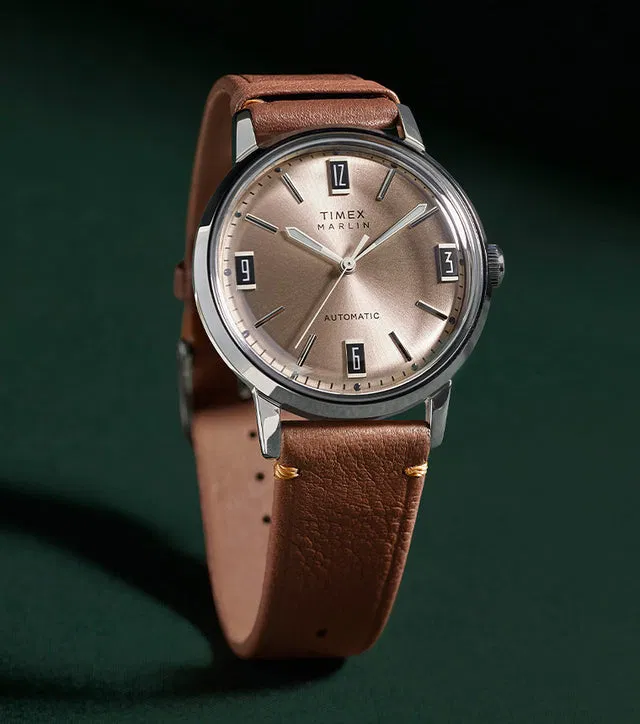
Timex Marlin Automatic 40mm


Timex Marlin Automatic 40mm

Timex

★★★★★ 4.7 (1,106 reviews)

$259


Check Price on Amazon →


Browse all 142+ expert-reviewed watches →

⭐ Why It Matters

Small design decisions can change both the way a watch is read and the way it is recognised. Looking closely makes the dial part of the story rather than a decorative surface.

📚 Sources & Further Reading

Further reading: Fondation de la Haute Horlogerie — watchmaking glossary

Join the Conversation

Which detail in this story interests you most, and would it influence what you wear or collect? Share your thoughts in the comments below.

Read Next

🛍️ Explore designs, gifts and more at the W&M companion shop.