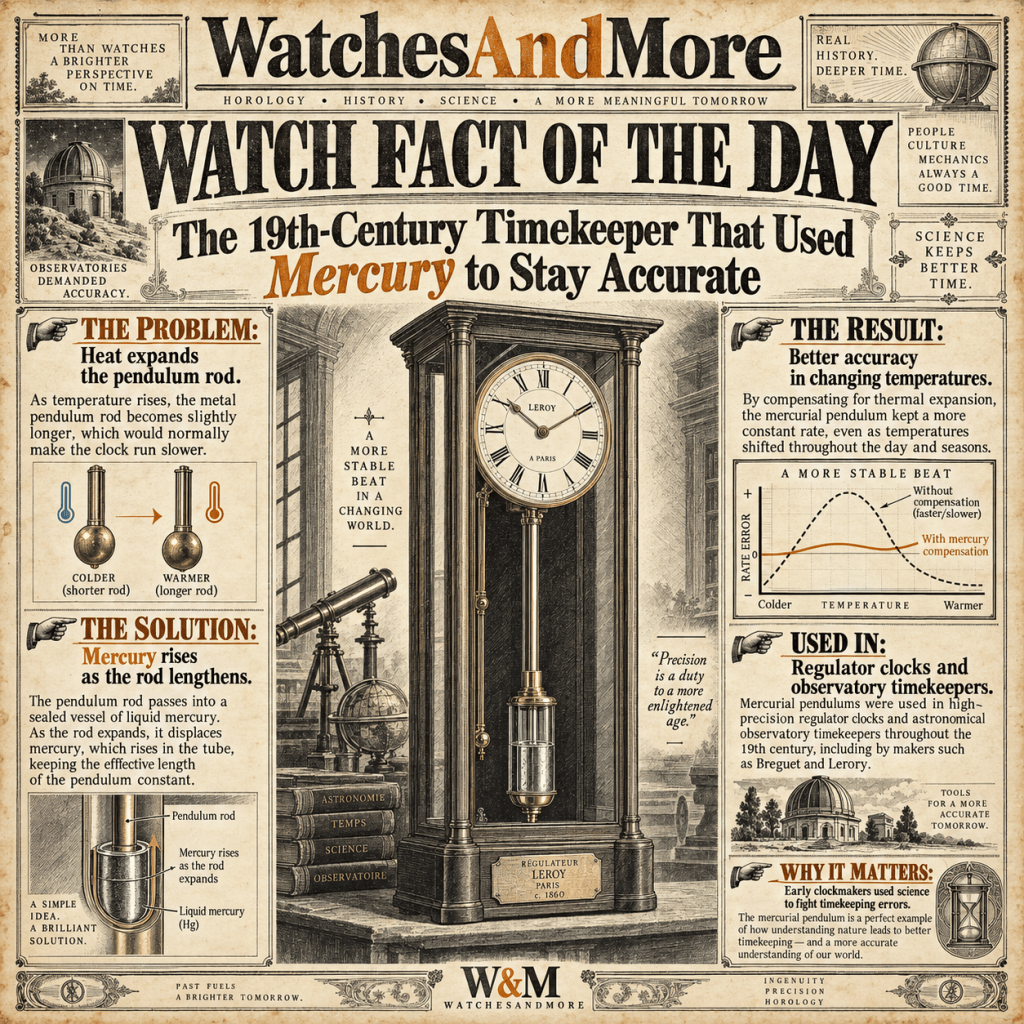
Back in the day, clockmakers were on a mission to combat the effects of temperature on their timepieces. They created mercurial pendulums, where mercury in a jar at the bottom adjusted to heat changes, keeping clocks accurate. This nifty solution was a big deal before the advent of quartz and atomic clocks. While it was an impressive engineering feat, mercury wasn’t the safest material to work with. Eventually, better and safer methods replaced it, but the mercurial pendulum remains a cool example of how creativity and science played a role in crafting precise timepieces. Horology has always been about innovation, not just gears!
📅 Sunday, September 13, 2026
Long before modern alloys and electronic regulation, precision clockmakers searched for clever ways to fight one of timekeeping’s greatest enemies: temperature. As the weather changed, pendulum rods expanded and contracted, altering a clock’s rate. To solve the problem, some 19th-century regulators and observatory clocks used a mercurial pendulum, in which a jar of mercury at the bottom of the pendulum helped offset those changes. As the pendulum rod expanded downward in warmer temperatures, the mercury’s surface rose upward, compensating for the shift and helping the clock maintain far better accuracy.
The idea was both elegant and scientifically ingenious. Rather than fighting physics directly, clockmakers used one physical reaction to counteract another. This made mercurial pendulums an important step in the long quest for precision timekeeping, especially in observatory and regulator clocks where even tiny errors mattered. Before quartz and atomic timekeeping, this was cutting-edge technology—proof that great horology has always been as much about clever engineering as beautiful craftsmanship.
Of course, mercury came with obvious drawbacks. It was heavy, delicate to handle, and hazardous by modern standards, which meant these systems were never especially practical outside high-precision clockmaking. Over time, improved compensation pendulums and safer materials replaced them. Still, the mercurial pendulum remains one of the most fascinating examples of watchmakers and clockmakers using the science of their era to solve the eternal problem of keeping better time.
💡 Did You Know?
The mercurial pendulum wasn’t designed to make a clock run faster or slower on its own—it was designed to help the clock stay consistent as temperatures changed. That distinction made it a major breakthrough for scientific and observatory-grade timekeeping.
⭐ Why It Matters
This story shows that horology has never been just about gears and springs. It has always been about creative problem-solving. Long before computers and electronics, clockmakers were already using chemistry, physics, and materials science to chase greater precision.
Category: Fun Quirk
Disclaimer: Every effort has been made to keep these watch facts accurate, but the world of horology is full of myths, disputed stories, and fascinating trivia. Consider these facts a starting point for discovery rather than the final word. If you have corrections or additional insights, let us know—we’re always happy to keep the record ticking in the right direction.
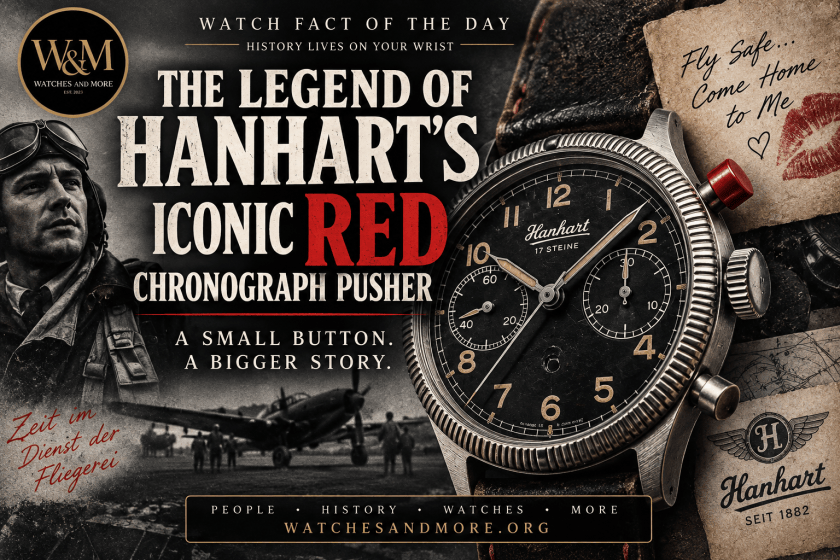
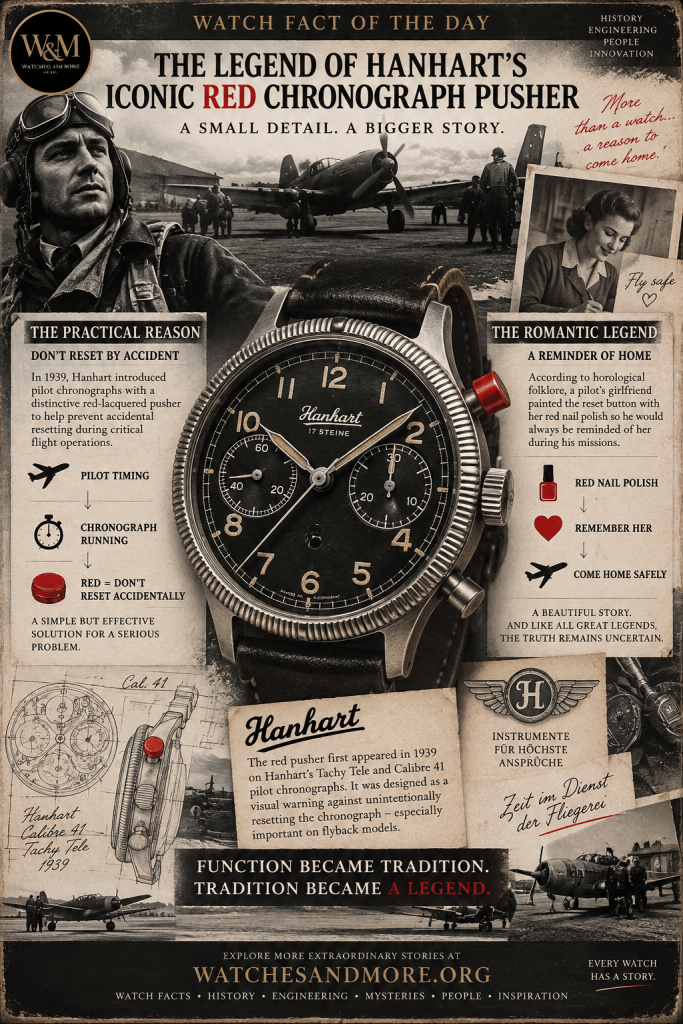
Ah, the infamous red pusher on a Hanhart pilot’s chronograph! It’s like the watch world’s version of a “don’t touch” sign, ensuring pilots don’t accidentally reset their crucial timing—because, you know, hitting the wrong button could be a bit of a timing disaster. Introduced in 1939, this vibrant button has also spawned a whimsical legend: a lovesick pilot had his button painted red with nail polish by his girlfriend, so he’d think of her while soaring through the skies. Whether true or not, it’s a fun tale that adds sparkle to an otherwise serious timepiece. One button, two stories—talk about a ticking mystery!
Watch Fact of the Day: The Legend of Hanhart’s Iconic Red Chronograph Pusher
📅 Saturday, September 12, 2026
Look at a classic Hanhart pilot’s chronograph and one detail immediately jumps out.
That red pusher. 🔴
It has become such a recognizable part of Hanhart’s design language that today it almost functions as a visual signature for the German watchmaker.
But unlike many decorative flourishes in watchmaking, the red button originally had a very practical purpose.
In 1939, Hanhart introduced its Tachy Tele and legendary Calibre 41 pilot chronographs following the company’s first series-produced Calibre 40 chronograph of 1938. Some of these early watches featured a distinctive red-lacquered chronograph pusher. Hanhart Chronographen
The reason was simple:
DON’T PRESS THIS BY ACCIDENT.
For a pilot relying on elapsed time, accidentally resetting the chronograph could erase an important timing measurement. The bright signal color made the reset control immediately recognizable and warned the wearer against pressing it unintentionally. Hanhart itself says the feature was intended to prevent pilots from inadvertently resetting their stopped time. Hanhart Chronographen
But that’s only half the story.
Because somewhere along the way, that little red button acquired one of the most romantic legends in watchmaking.
❤️ The Nail Polish Legend
According to Hanhart’s own telling of the folklore, a pilot prepared to leave home for another flight.
After saying goodbye, he later looked down at his Hanhart chronograph in the hangar and discovered something unexpected.
One of the pushers had been painted red with nail polish by the woman he loved.
The idea was that whenever he looked at the red button during his mission, he would think of her—and remember to return safely home. Hanhart Chronographen
There’s just one problem.
Nobody knows whether it actually happened.
And wonderfully, Hanhart itself acknowledges that uncertainty. On its current 417 ES Heritage material, the manufacture tells the romantic story and then explicitly says that it is unclear whether the legend is true. Hanhart Chronographen
That distinction is important for our Watch Fact.
We have:
DOCUMENTED HISTORY: 🔴 The red pusher served as a visual warning against accidentally resetting the chronograph.
And:
HOROLOGICAL FOLKLORE: ❤️ A pilot’s lover supposedly painted the button with red nail varnish so he would think of her and return safely.
Put those two stories together and you get one of watchmaking’s great little mysteries.
💡 Did You Know?
The red pusher wasn’t merely an aesthetic choice on watches equipped with a flyback chronograph.
A flyback allows the running chronograph to be reset and restarted immediately with a single press. That makes the function extremely useful when timing consecutive events—but it also makes an accidental press particularly consequential.
On modern Hanhart flyback models, the company still explains the red reset pusher as a warning against unintentionally resetting the elapsed time. Hanhart Chronographen
So that tiny splash of color was effectively an early form of human-interface design:
BLACK PUSHER → OPERATE
🔴 RED PUSHER → THINK BEFORE YOU PRESS
And that was happening on a mechanical wristwatch in 1939.
⭐ Why It Matters
This is exactly the kind of story that makes vintage watches fascinating.
You could look at the red pusher and assume:
“That’s just Hanhart’s design signature.”
But behind that tiny detail is an entire story involving aviation, chronograph functionality, cockpit usability, wartime-era watchmaking—and possibly even a bottle of red nail polish.
What began as a practical warning eventually became something much bigger:
A TRADEMARK.
A LEGEND.
A SYMBOL OF HANHART.
And Hanhart continues using the red-pusher identity today. Its modern watches reinterpret the feature using contemporary materials, including red HyCeram® on some current models. Hanhart Chronographen
ONE RED BUTTON.
TWO STORIES.
ONE HOROLOGICAL LEGEND.
And BBC Creative Department is already halfway through the infographic. 😂🔥
This one should look like a 1939 German aviation magazine × pilot’s flight log × wartime mechanical-instrument advertisement.
Centerpiece: enormous vintage Hanhart pilot chronograph, slightly angled, with the red reset button practically glowing against the otherwise desaturated image.
On one side:
THE DOCUMENTED PURPOSE
✈️ PILOT TIMING ↓ ⏱️ CHRONOGRAPH RUNNING ↓ 🔴 RED = DON’T RESET ACCIDENTALLY
On the other:
THE LEGEND
💅 RED NAIL POLISH ↓ ❤️ REMEMBER HER ↓ ✈️ COME HOME SAFELY
And across the top:
WHY WAS THIS BUTTON PAINTED RED?
Then the bottom payoff:
FUNCTION BECAME TRADITION.
TRADITION BECAME A LEGEND.
Ohhhhh yeah.
Category: Military Watches
Disclaimer: Every effort has been made to keep these watch facts accurate, but the world of horology is full of myths, disputed stories, and fascinating trivia. Consider these facts a starting point for discovery rather than the final word. If you have corrections or additional insights, let us know—we’re always happy to keep the record ticking in the right direction.
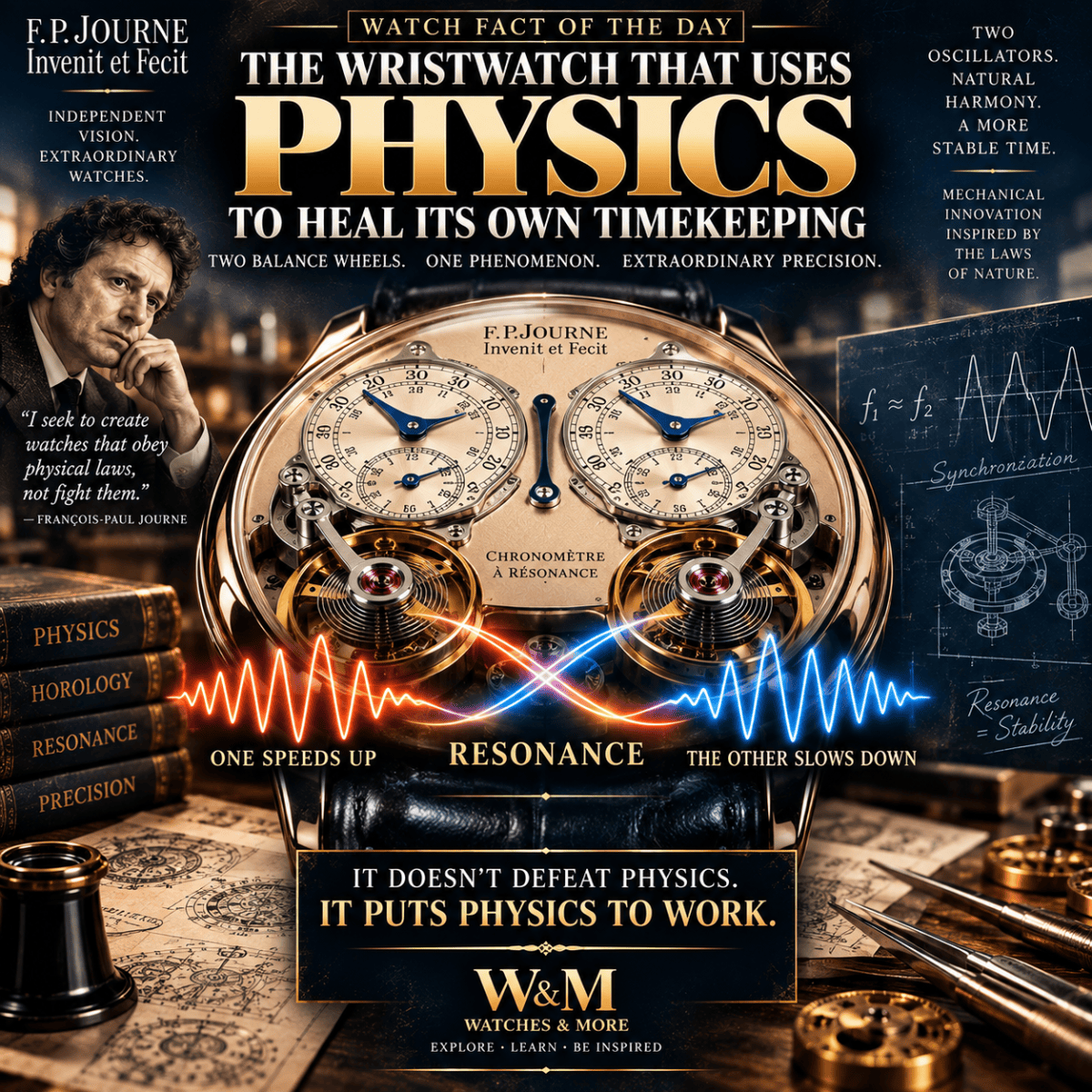
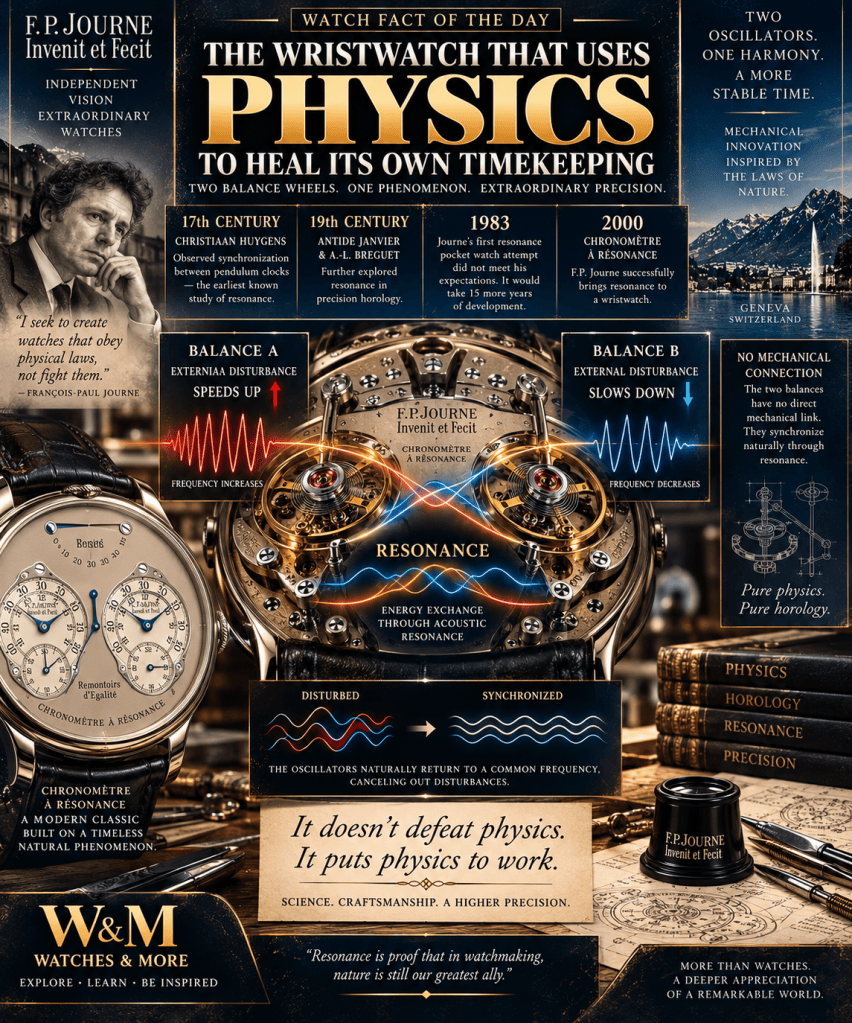
Francois-Paul Journe went big with his F.P. Journe Chronomètre à Résonance—this watch uses not one but two balance wheels for timekeeping! Launched in 2000, it’s based on the idea of resonance, allowing the two movements to sync up naturally when they’re tuned close enough. So, when you move your wrist, if one balance speeds up, the other slows down to keep everything in check. It’s a clever twist on traditional watchmaking, where usually you’d try to block disturbances. Journe’s design proves that two delicate systems can work together to combat movement, changing the game in wristwatch accuracy.
📅 Friday, September 11, 2026
Most mechanical watches rely on a single balance wheel—the tiny oscillating regulator whose rhythmic motion determines how accurately the watch keeps time.
François-Paul Journe decided to use two.
The result was the F.P. Journe Chronomètre à Résonance, unveiled as a wristwatch in 2000 after Journe had spent years pursuing one of horology’s most fascinating physical phenomena: resonance. F.P. Journe
The idea sounds almost impossible.
Inside the original Chronomètre à Résonance are two independent movements, each possessing its own escapement and balance. When their frequencies are adjusted sufficiently close to one another—F.P. Journe specifies a difference of no more than five seconds per day accumulated across six positions—the two oscillators begin interacting through resonance and naturally settle into synchronized opposition. F.P. Journe
And here’s where the physics becomes extraordinary.
Move your wrist and an ordinary mechanical oscillator can be disturbed. In the Résonance, Journe explains that the same disturbance can cause one balance to accelerate while the other slows by a corresponding amount.
Because the two are coupled through resonance, they progressively return toward their shared point of harmony.
The disturbance is therefore counteracted rather than simply being allowed to influence one isolated regulator. F.P. Journe
ONE BALANCE SPEEDS UP ↑
THE OTHER SLOWS DOWN ↓
RESONANCE PULLS THEM BACK TOGETHER ↔
And there is no conventional mechanical transmission connecting the two balances to make this synchronization happen. F.P. Journe describes the Chronomètre à Résonance as using the natural phenomenon of resonance without mechanical transmission between the oscillators. F.P. Journe
The mechanism isn’t fighting physics.
It’s using physics to fight disturbance.
💡 Did You Know?
François-Paul Journe didn’t invent the phenomenon of horological resonance itself.
The story reaches back centuries. Dutch scientist Christiaan Huygens observed synchronization between pendulum clocks in the 17th century, while Antide Janvier and Abraham-Louis Breguet later explored resonance in precision horology. Journe’s achievement was adapting the principle to the extraordinarily difficult environment of a wristwatch, where the mechanism is continually subjected to the movements of its wearer. F.P. Journe
Journe actually attempted a resonance pocket watch in 1983, but it didn’t perform to his expectations. According to F.P. Journe, another 15 years of experience and development were required before he could realize the concept successfully as a wristwatch. F.P. Journe
That makes the eventual watch even more fascinating.
The two balance wheels aren’t merely there because two oscillators look impressive through a caseback.
They are the experiment.
They are the physics.
They are the entire point.
⭐ Why It Matters
Watchmakers traditionally pursue precision by trying to isolate the regulating organ from disturbances or minimize their effects.
Journe pursued another possibility:
What if a second oscillator could help the first?
The resulting watch demonstrates something beautifully counterintuitive: two extremely delicate mechanical systems can interact so that the overall system becomes better able to cope with disturbances encountered on the wrist. F.P. Journe
It’s also worth avoiding the tempting description of one balance permanently “correcting” the other. F.P. Journe explains that each balance alternately acts as exciter and resonator. Neither is simply the master and neither is simply the slave. F.P. Journe
They influence each other.
TWO HEARTBEATS.
ONE FREQUENCY.
Category: Fun Quirk
Disclaimer: Every effort has been made to keep these watch facts accurate, but the world of horology is full of myths, disputed stories, and fascinating trivia. Consider these facts a starting point for discovery rather than the final word. If you have corrections or additional insights, let us know—we’re always happy to keep the record ticking in the right direction.
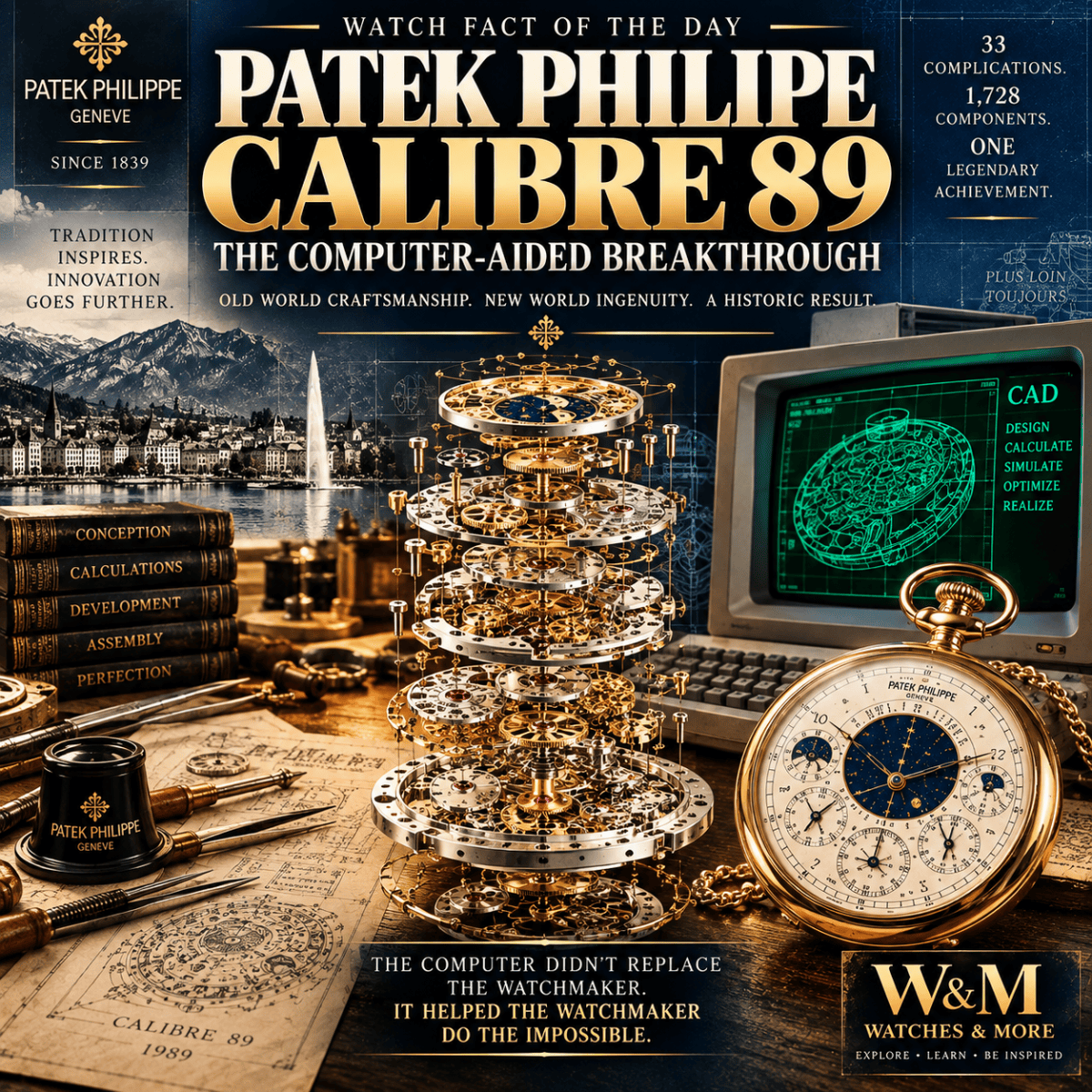
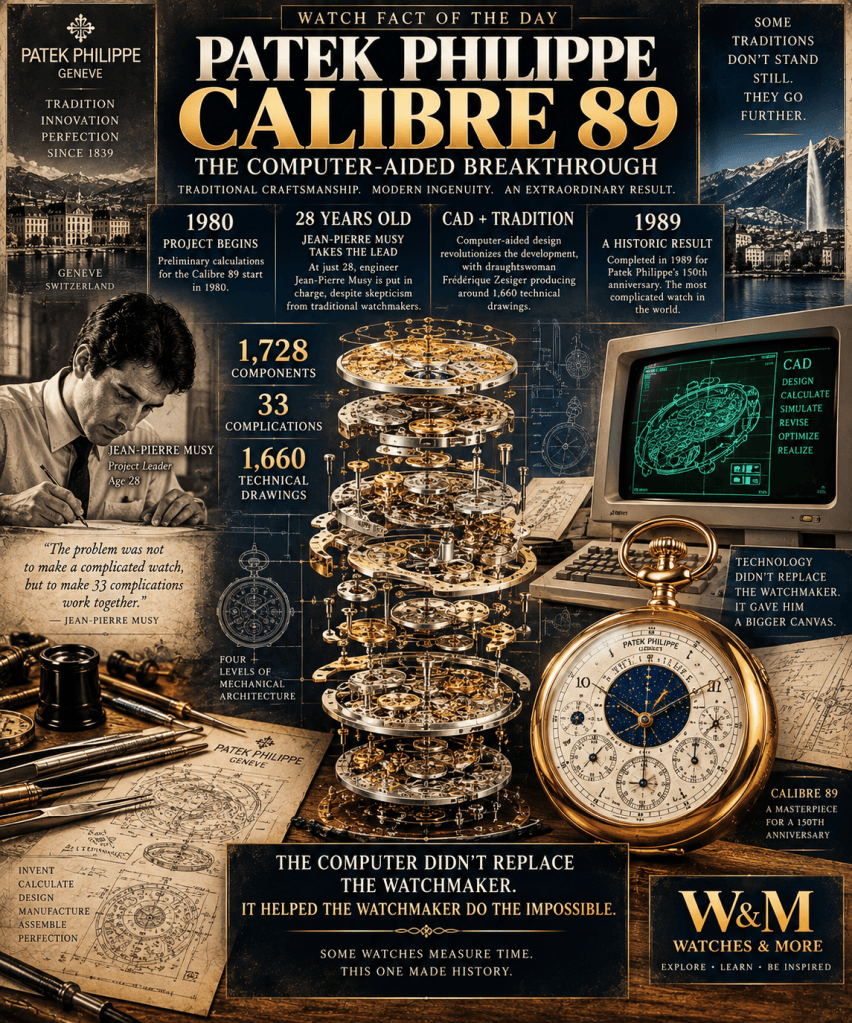
In a thrilling plot twist worthy of any sci-fi blockbuster, Patek Philippe decided to mix the old with the new while crafting the world’s most complicated watch for its 150th anniversary. The Calibre 89, featuring an astonishing 1,728 components and 33 complications, was partly designed with a computer—yes, you read that right! Who knew engineers could shake up Swiss watchmaking? With a team including a genius draughtswoman and some skeptical watchmakers, they created a pocket machine capable of knowing when Easter falls (no, it’s not just chocolate day). The lesson here? Computers can assist watchmakers, but only they can make time truly tick!
📅 Thursday, September 10, 2026
When Patek Philippe began planning an extraordinary watch for its 150th anniversary in 1989, Philippe Stern had an audacious objective: create a mechanical timepiece more complicated than anything the manufacture had built before.
But achieving it would require something decidedly unconventional in traditional Swiss watchmaking.
A computer.
Preliminary calculations for what became the Calibre 89 began in 1980. Philippe Stern entrusted the project to Jean-Pierre Musy, a 28-year-old engineer, rather than placing it exclusively in the hands of Patek’s veteran master watchmakers. It was a controversial decision. Stern later recalled that some traditional watchmakers doubted that a young engineer could successfully construct such an extraordinarily complicated watch. Hodinkee
The problem was staggering.
The finished Calibre 89 contained 1,728 components and incorporated 33 complications, all arranged inside an approximately 89 mm pocket-watch case. Its functions included a secular perpetual calendar, split-seconds chronograph, minute repeater, grande and petite sonnerie, alarm, equation of time, sunrise and sunset indications, sidereal time, celestial chart and even the date of Easter. Patek Philippe
Trying to determine how all those interacting mechanisms could coexist within one movement demanded a new approach.
Musy’s team combined traditional mechanical watchmaking with computer-assisted design and manufacturing techniques. One particularly fascinating contributor was draughtswoman Frédérique Zesiger, who worked directly with a computer to produce approximately 1,660 detailed component drawings. The system could calculate fabrication coordinates and recalculate positions as the movement’s incredibly dense architecture evolved. SJX Watches
This wasn’t replacing watchmakers with computers.
It was using computation to solve geometrical and organizational problems of a complexity that traditional methods made extraordinarily difficult—and then handing those solutions back to highly skilled craftspeople who still had to manufacture, finish, adjust and assemble the actual mechanical watch.
Master watchmaker Paul Buclin was responsible for assembly and finishing, while François Devaud helped coordinate the project. It became a remarkable collaboration between engineering, computer technology and traditional haute horlogerie. SJX Watches
After years of calculations, research and development, a working prototype was ready in July 1988. The yellow-gold Calibre 89 was completed in April 1989, in time to celebrate Patek Philippe’s 150th anniversary. Sothebys.com
The result was extraordinary.
At its introduction, the Calibre 89 became the world’s most complicated mechanical watch, a title it would retain for more than a quarter-century. Sothebys.com
💡 Did You Know?
The computer’s role went far beyond simply making prettier technical drawings.
The movement was constructed across four interconnected levels, and changes in one part of its architecture could affect coordinates elsewhere. Zesiger’s CAD system could recalculate those positions as the design evolved.
At one point, the team even lost the master assembly drawing for the secular calendar mechanism and reconstructed it using the approximately 1,660 individual component drawings that had survived. SJX Watches
Think about that:
1,728 COMPONENTS
33 COMPLICATIONS
1,660 TECHNICAL DRAWINGS
9 YEARS FROM INITIAL CALCULATIONS TO COMPLETION
All to produce one extraordinary mechanical machine. Sothebys.com
⭐ Why It Matters
The Calibre 89 demonstrated something enormously important at the end of the quartz crisis.
Technology didn’t have to replace mechanical watchmaking.
Technology could help mechanical watchmaking become even more ambitious.
Computers could perform calculations, manage geometries and assist manufacturing—but ultimately those digital instructions still had to become physical wheels, levers, springs, cams, pinions and screws assembled by human hands.
That makes the Calibre 89 a fascinating paradox:
One of the greatest achievements of traditional mechanical horology was made possible partly because Patek Philippe was willing to embrace new technology.
OLD WORLD CRAFTSMANSHIP.
NEW WORLD COMPUTATION.
ONE INCREDIBLE WATCH.
Category: Fun Quirk
Disclaimer: Every effort has been made to keep these watch facts accurate, but the world of horology is full of myths, disputed stories, and fascinating trivia. Consider these facts a starting point for discovery rather than the final word. If you have corrections or additional insights, let us know—we’re always happy to keep the record ticking in the right direction.
Longines has been around dealing with counterfeit watch issues since the 19th century, way before it became a luxury brand. They introduced their iconic winged-hourglass symbol to help buyers tell real Longines watches apart from fakes. The trademark was registered in Switzerland in 1889 and went international in 1893, making it the oldest active trademark still in effect today. While the logo has evolved, that original design continues to appear on watch backs. So, after 137 years, Longines has maintained a strong brand identity, navigating through plenty of changes in the watch industry and proving that some things really do stand the test of time.
📅 Wednesday, September 9, 2026
Long before watch companies became global luxury brands, Longines was already thinking about something every modern manufacturer worries about: counterfeiting. As the Saint-Imier watchmaker’s reputation grew during the 19th century, imitation products began attempting to benefit from the name it had established. Longines responded with a symbol that would become one of the most enduring identities in watchmaking—the winged hourglass.
The story actually begins before the trademark registration itself. Longines says that by 1867, it was already using both the Longines name and winged-hourglass symbol as guarantees of origin and quality. The emblem was applied to its watches so buyers could distinguish genuine Longines products from counterfeits.
Then came the legal protection.
In 1889, Ernest Francillon registered the Longines name and winged-hourglass trademark in Switzerland. Four years later, on March 27, 1893, it entered the international system established under the Madrid Agreement as International Registration No. 14. Thirteen international applications had preceded it—but those earlier registrations eventually lapsed.
That left Longines holding an extraordinary distinction.
According to WIPO, the original Longines winged-hourglass mark has been continually used and never modified, making it the oldest valid trademark in WIPO’s International Registry. WIPO was still describing the Longines mark as the oldest trademark remaining in effect in its 2024 Madrid System materials, while a 2026 WIPO feature again identified the winged hourglass as the oldest valid trademark in the International Registry.
And there’s a fascinating wrinkle here: the trademark that holds the record isn’t necessarily identical to the modern Longines logo you see prominently displayed on today’s watch dials.
WIPO explains that the original trademark continues to appear on the backs of Longines watches, while an updated interpretation appears on the dial. The historic registered mark incorporates the winged hourglass within a more elaborate emblem—making the surviving legal identity itself a little piece of 19th-century watchmaking history.
The longevity is remarkable when you consider what happened during those intervening years.
Mechanical watches gave way to wristwatches. Two world wars passed. Aviation transformed transportation. Quartz nearly rewrote the Swiss watch industry. Digital watches arrived. Computers, smartphones and smartwatches followed.
Yet that trademark remained protected.
1889 → 2026: 137 years.
And the story is particularly appropriate for a watch company because the winged hourglass itself represents something Longines has managed exceptionally well:
time passing without identity disappearing.
💡 Did You Know?
Longines wasn’t the first trademark entered into the international registry.
Its international registration was No. 14.
The first thirteen registrations simply didn’t maintain their protection continuously. Longines did. WIPO notes that the first international trademark registration belonged to Swiss chocolate producer Russ-Suchard, but that original registration eventually ceased to be in force.
So Longines didn’t win this record by being first through the door.
IT WON BY NEVER LEAVING.
⭐ Why It Matters
We usually think of trademarks as marketing—something designed to make a company recognizable.
For Longines in the 19th century, the winged hourglass also served a more practical purpose: protecting identity, reputation and authenticity from imitators.
That makes the emblem more than decoration.
It is effectively a 137-year chain of brand identity stretching from a Swiss watch factory in Saint-Imier to the modern international intellectual-property system.
1867 — THE SYMBOL IS USED
1889 — REGISTERED IN SWITZERLAND
1893 — REGISTERED INTERNATIONALLY
TODAY — STILL ACTIVE
And BBC Creative Department has just been handed an absolute gift. 😂⌛🪽
I’m seeing the infographic as a late-1880s Swiss trademark certificate × Belle Époque watchmaker’s advertisement—aged ivory paper, deep Longines blue, burgundy sealing wax, black engraved linework, antique gold foil, elaborate Victorian borders and beautiful copperplate typography.
Dead center: an enormous engraved winged hourglass, with one wing stretching toward 1889 and the other toward TODAY.
Above it:
THE LOGO THAT REFUSED TO AGE
Then an original-looking registration document:
SWITZERLAND — 1889 ↓ MADRID SYSTEM — 1893 ↓ INTERNATIONAL REGISTRATION No. 14 ↓
STILL ACTIVE TODAY
And across the bottom:
137 YEARS.
ONE UNBROKEN IDENTITY.
Then the killer little Collector’s Note:
THIRTEEN TRADEMARKS CAME BEFORE IT.
NONE OF THEM OUTLASTED IT.
Category: Brand Spotlight
Disclaimer: Every effort has been made to keep these watch facts accurate, but the world of horology is full of myths, disputed stories, and fascinating trivia. Consider these facts a starting point for discovery rather than the final word. If you have corrections or additional insights, let us know—we’re always happy to keep the record ticking in the right direction.
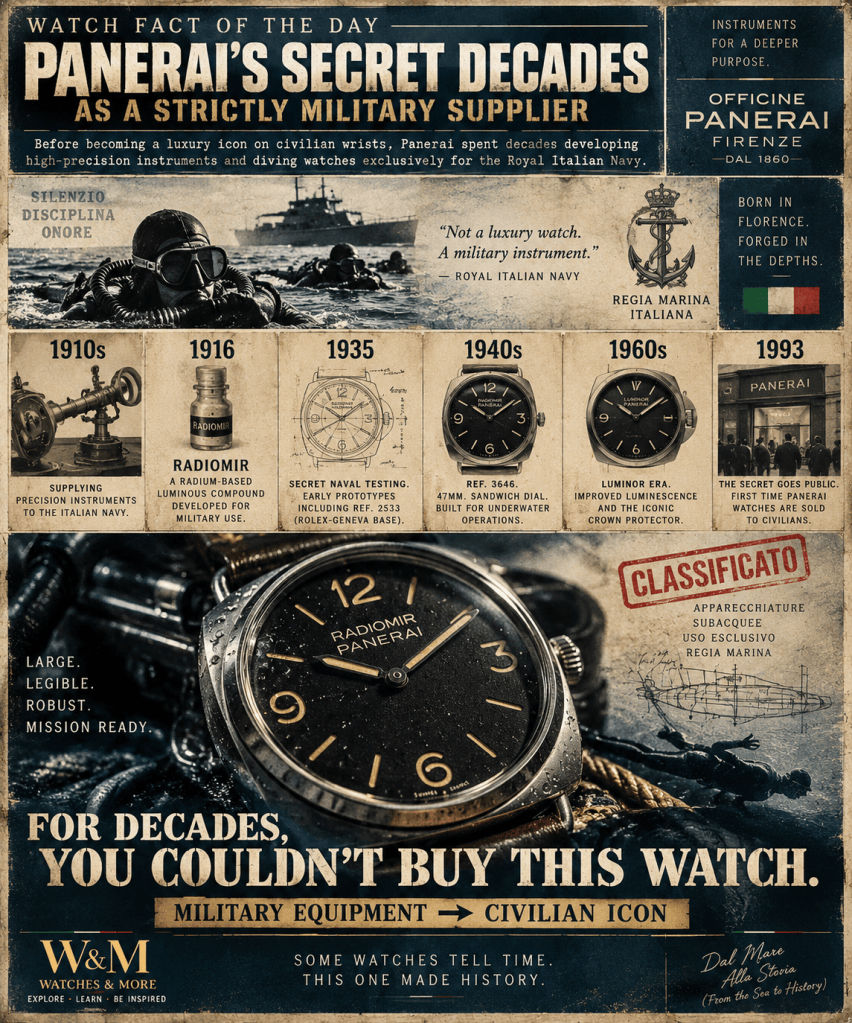
So, Panerai started out making watches for the Italian Navy before becoming a luxury brand we know today. Back in the 1910s, they supplied military gear and developed radium-based compounds for visibility in darkness. They really got going in the 1930s with underwater watches for special ops, leading to the iconic Radiomir in the 40s, which was designed for harsh conditions. But it wasn’t until 1993 that they opened up to civilians, letting everyday folks buy their seriously cool designs. So, what looks like a fashion statement today was actually built for military purposes first.
📅 Tuesday, September 8, 2026
Long before Panerai became one of the most recognizable names in luxury sports watches, its oversized timepieces weren’t sitting in boutique windows. They were being developed as military instruments for Italian naval forces, and for decades the watches and much of the technology behind them remained far removed from the civilian market.
Panerai’s military relationship actually predates its famous diving watches. Beginning in the 1910s, the Florentine company supplied the Italian Navy with precision instruments, including naval combat sights. In 1916, Panerai documented the name Radiomir for a radium-based luminous compound developed to make military instruments readable in darkness.
Then things became considerably more interesting beneath the surface.
In 1935, the Royal Italian Navy began a secret program involving new underwater assault vehicles and operators. Panerai participated by developing specialized instruments, including experimental underwater watches. According to Panerai’s account of Italian Navy archives, several prototypes were commissioned for testing, with Ref. 2533, based on a watch supplied by Rolex-Geneva and modified by Panerai, emerging as the best result.
By the 1940s came the legendary Radiomir Ref. 3646. It was enormous by contemporary standards: approximately 47 mm, with a cushion-shaped steel case, welded wire lugs and a long water-resistant leather strap designed to fit over protective diving clothing. Inside was a hand-wound Cortebert/Rolex 618 pocket-watch-derived calibre.
But arguably its most important feature was what happened in darkness.
Panerai developed its now-famous sandwich dial, using overlapping plates and large cut-out numerals and markers so the luminous material underneath could shine through strongly. Radiomir’s radium-based compound provided extraordinary visibility in poor-light conditions—exactly what naval operators needed underwater. The hazardous radium material was eventually replaced by a lower-radiation tritium-based compound called Luminor, which would give another legendary Panerai family its name.
The watches weren’t luxury accessories. They were purpose-built military tools, developed around requirements for visibility, water resistance, robustness and operation under extreme conditions. Panerai itself says the watches were produced strictly for military use and used by the forces into the early 1970s, while their designs remained protected by military secrecy.
And that’s what makes 1993 such an extraordinary dividing line in Panerai history.
For the first time, Officine Panerai entered the civilian watch market, unveiling limited and numbered versions of the Luminor, Luminor Marina and Mare Nostrum. The collection was presented on September 10, 1993, appropriately enough at the military harbor of La Spezia aboard the Italian Navy vessel Durand De La Penne. Panerai’s own historical account explicitly describes this moment as relieving CEO Dino Zei from maintaining military secrecy over these products.
Suddenly, a design language that had spent decades associated with naval specialists could be purchased by ordinary enthusiasts.
💡 Did You Know?
Those gigantic early Panerai watches weren’t oversized simply to make a fashion statement. The 47 mm case, highly luminous dial, minimal hour markings and long strap all made sense as functional equipment intended to remain legible and wearable in demanding underwater conditions—including over protective clothing.
What looks unmistakably “Panerai” today was largely born from function rather than fashion.
47 MM CASE → MAXIMUM LEGIBILITY SANDWICH DIAL → POWERFUL LUMINESCENCE LONG STRAP → OVER DIVING GEAR ROBUST CONSTRUCTION → MILITARY DUTY
⭐ Why It Matters
Panerai’s story is unusual because the civilian luxury brand effectively arrived after much of its visual identity had already been established for an entirely different purpose.
The cushion-shaped cases, enormous numerals, sandwich dials, luminous displays and later crown-protection system weren’t originally designed to make a watch recognizable from across a cocktail lounge.
They were solutions to military requirements.
Then in 1993, the secret finally stepped into civilian life.
BUILT FOR THE NAVY.
HIDDEN FOR DECADES.
RELEASED TO THE PUBLIC.
Category: Military Watches
Disclaimer: Every effort has been made to keep these watch facts accurate, but the world of horology is full of myths, disputed stories, and fascinating trivia. Consider these facts a starting point for discovery rather than the final word. If you have corrections or additional insights, let us know—we’re always happy to keep the record ticking in the right direction.
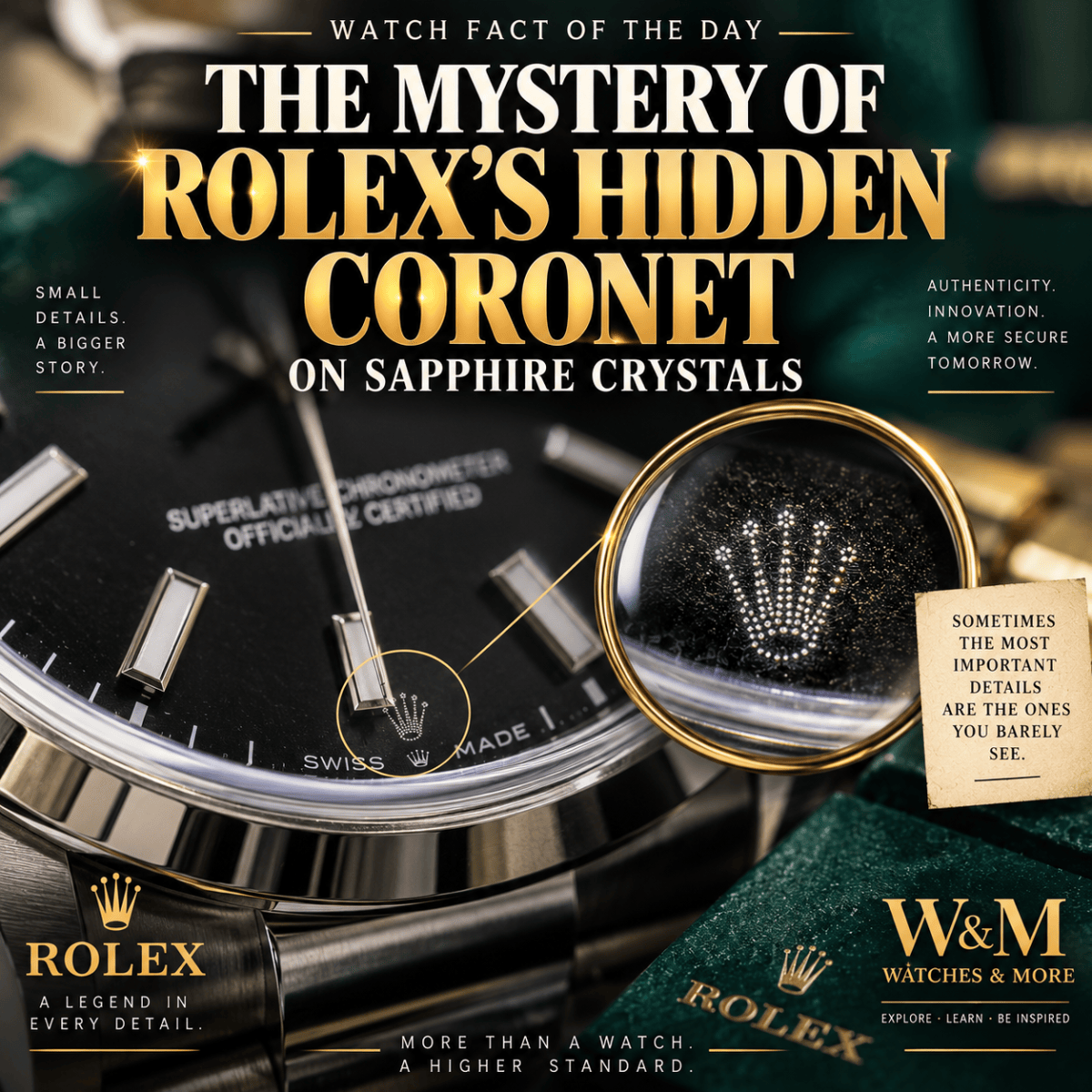
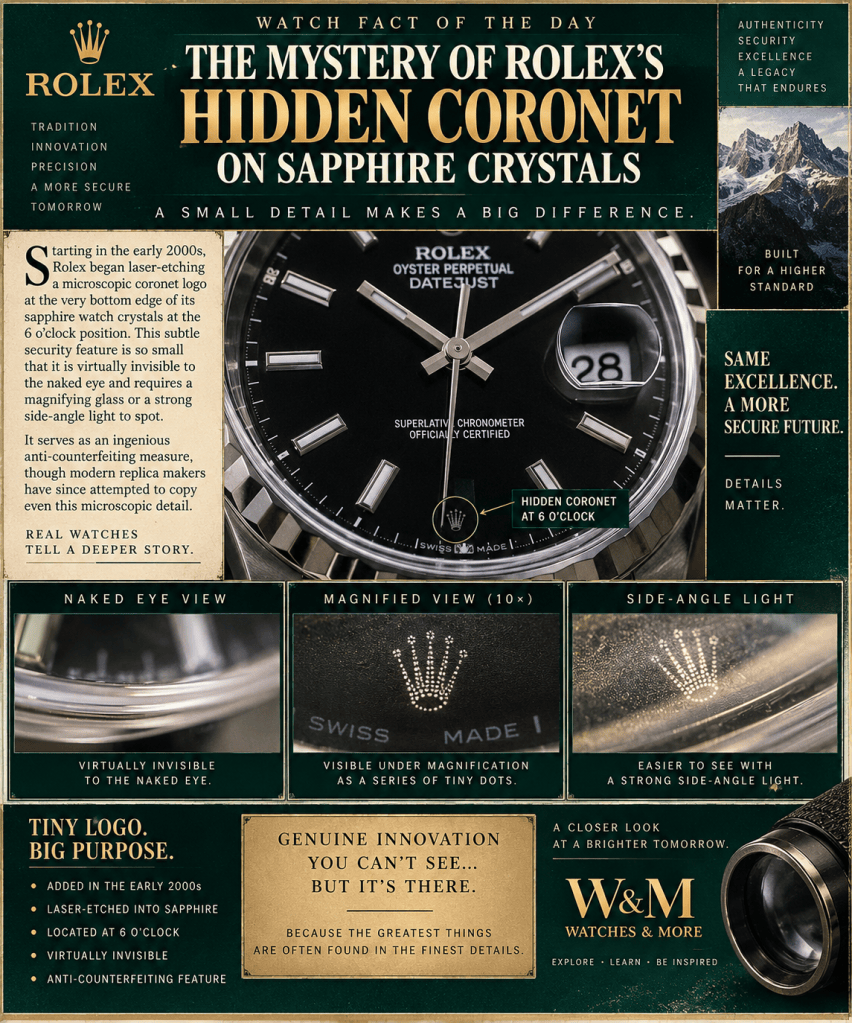
If you’re a Rolex fan, get ready to squint and play detective! At the 6 o’clock position on many modern Rolex watches lies a microscopic coronet—so tiny it’s like it’s playing hide and seek. This sneaky feature started showing up in the early 2000s and is a marvel of watchmaking rather than a mere scratch. But don’t get too excited; that little crown alone doesn’t guarantee authenticity. Counterfeiters have their fancy tricks, making even tiny etchings questionable. So, remember: whether the coronet is present or not, the full watch’s history matters—just like your Tinder profile, it’s all about the bigger picture!
📅 Monday, September 7, 2026
Look closely at the crystal of many modern Rolex watches and there’s a detail most people will never notice. At approximately the 6 o’clock position, just above the dial, Rolex places a microscopic version of its famous five-pointed coronet into the sapphire crystal—a feature collectors commonly call the LEC, or Laser-Etched Coronet. It is deliberately subtle enough to virtually disappear during normal wear.
The feature began appearing around the start of the 2000s, with collector references commonly placing its introduction around 2001 and its broader rollout over the next few years. That’s useful historical context because an authentic Rolex from the transitional period might not necessarily have one, while a replacement crystal fitted later could introduce the marking to an older watch.
And calling it an “etching” can actually undersell how interesting the process is. Rather than simply scratching a crown onto the surface, the genuine marking is formed from numerous microscopic points within the sapphire, allowing the exterior surfaces to remain smooth. Under magnification, the coronet therefore appears less like a printed logo and more like a tiny constellation of dots.
Finding it can become a game in itself. Looking straight down at the watch in ordinary lighting may reveal absolutely nothing. A loupe or magnifying glass combined with strong light hitting the crystal at an angle makes the coronet much easier to spot. Once the light catches those microscopic points correctly, the familiar crown suddenly appears floating above the 6 o’clock marker.
The coronet was introduced as an additional anti-counterfeiting and authentication detail, but there’s an important collector warning: the LEC alone should never be treated as proof that a Rolex is genuine. Modern counterfeiters have attempted to reproduce the marking, and increasingly sophisticated replicas can imitate details that were once considered useful authenticity clues. Authentication needs to consider the entire watch rather than one microscopic crown.
There’s another wrinkle for collectors. Some Rolex service replacement crystals have been documented with an additional tiny “S” incorporated into the coronet, indicating a service crystal. That means finding a slightly different coronet configuration doesn’t automatically tell the whole story—the watch’s age and service history also matter.
💡 Did You Know?
The hidden coronet can be so difficult to see that being too obvious can itself be suspicious. A genuine LEC is intended to remain extremely discreet under ordinary viewing conditions; normally you’ll need careful lighting, magnification, or both before the tiny dotted crown resolves clearly.
The hidden crown is best thought of as one clue rather than an authenticity certificate.
An older genuine watch may legitimately lack it. A service crystal may have one. A counterfeit may attempt to reproduce one.
So:
CORONET PRESENT ≠ AUTOMATICALLY GENUINE
CORONET ABSENT ≠ AUTOMATICALLY FAKE
That nuance actually makes this Watch Fact better.
Category: Fun Quirk
Disclaimer: Every effort has been made to keep these watch facts accurate, but the world of horology is full of myths, disputed stories, and fascinating trivia. Consider these facts a starting point for discovery rather than the final word. If you have corrections or additional insights, let us know—we’re always happy to keep the record ticking in the right direction.
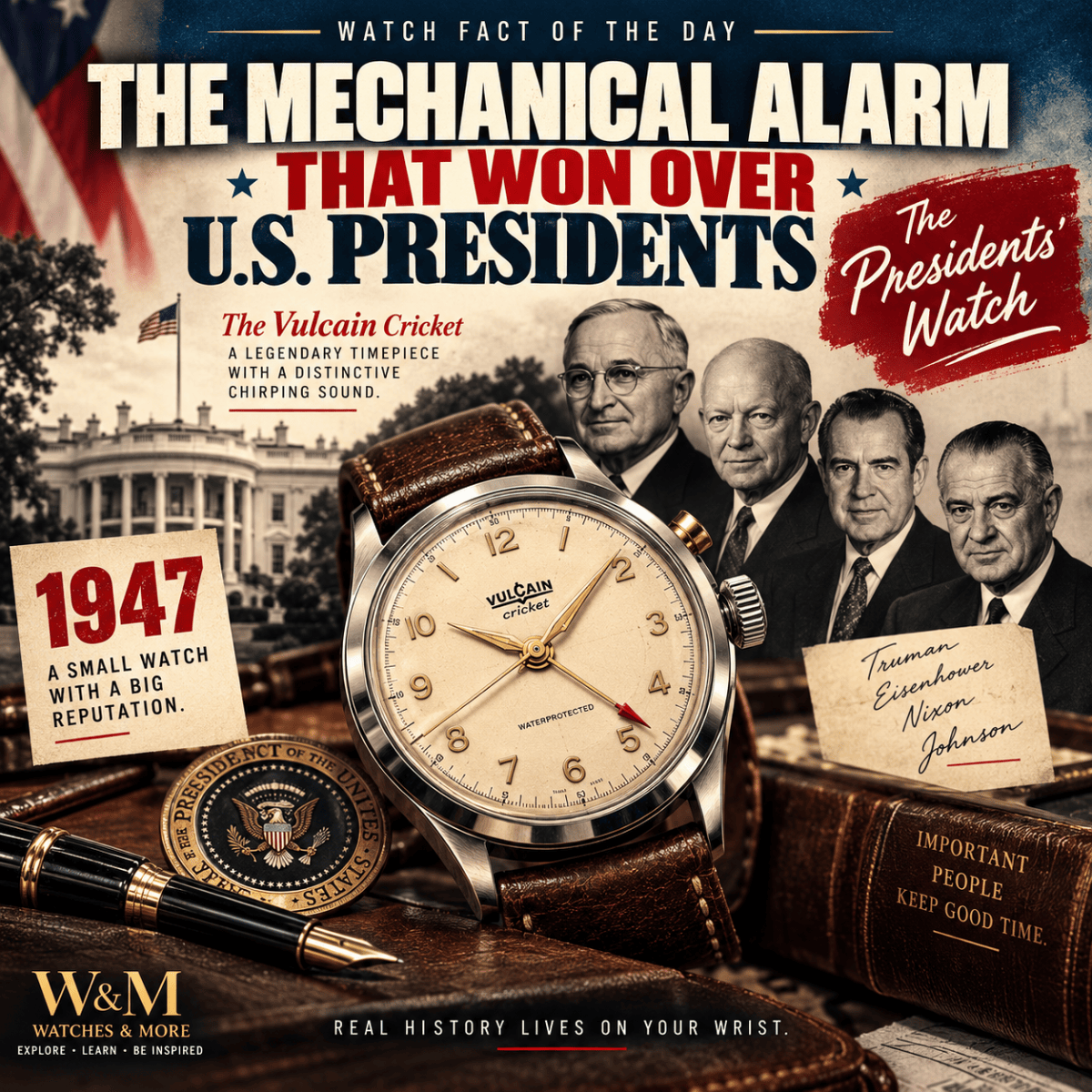
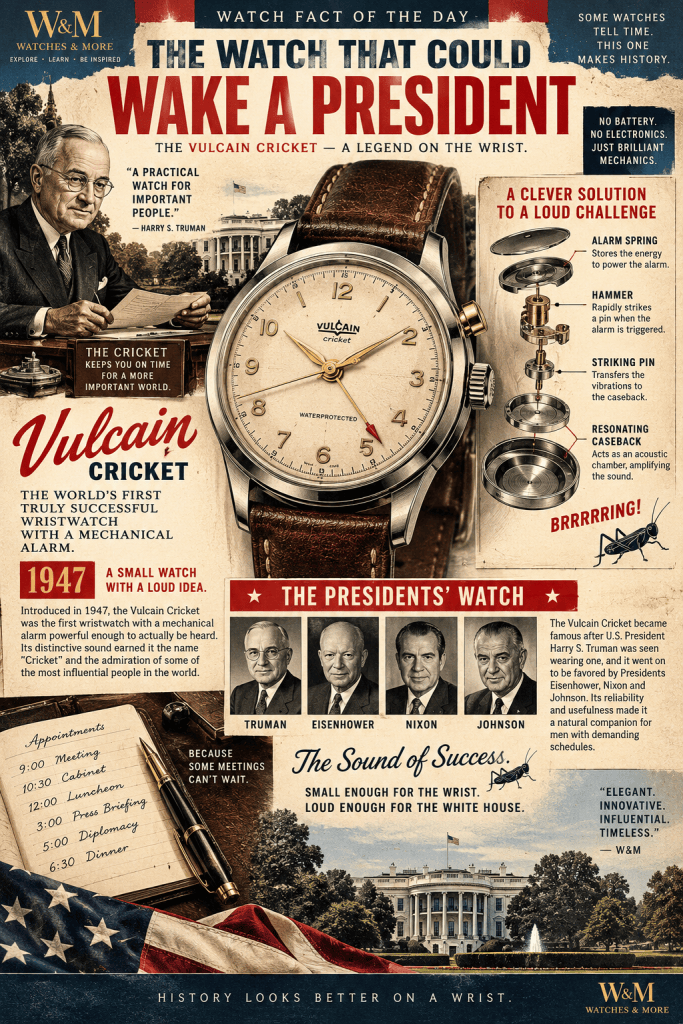
So, back in 1947, Vulcain rolled out a game-changer: the Cricket wristwatch, which could actually wake you up thanks to its super loud mechanical alarm. This wasn’t just any watch; it turned its case into an acoustic system, delivering a noticeable buzz when the alarm went off. The Cricket became a favorite among U.S. presidents, earning it the nickname “The Presidents’ Watch.” Fast forward to today, and the updated Crickets still bring that cool mechanical charm, buzzing away without any batteries or electronics. It’s a cool reminder of how watchmaking tech stood out way before the digital age!
📅 Sunday, September 6, 2026
In 1947, Swiss watchmaker Vulcain introduced a wristwatch with a remarkable party trick: it could actually wake you up. The Vulcain Cricket featured a mechanical alarm powerful enough to be genuinely useful, producing the distinctive buzzing sound that inspired its name. Vulcain describes it as the world’s first alarm wristwatch with a sufficiently forceful striking mechanism, and it quickly became one of the company’s defining creations.
Making a mechanical alarm wristwatch was one thing; making one that could actually be heard was another. Vulcain’s solution turned the watch case itself into part of the acoustic system. When the alarm activates, a tiny mechanical hammer rapidly strikes a pin, while the outer caseback functions as a resonance chamber, amplifying the vibrations into the Cricket’s unmistakable sound.
That meant the Cricket wasn’t simply a watch with an extra hand on the dial. It was essentially a tiny mechanical alarm clock engineered for the wrist. The wearer could set an independent alarm time, wind the alarm mechanism, and carry a genuinely audible reminder wherever they went—without batteries, electronics or a speaker.
Then the Cricket found some unusually powerful admirers.
The watch became closely associated with Harry S. Truman, and Vulcain’s history subsequently connects the Cricket with Presidents Dwight D. Eisenhower, Richard Nixon and Lyndon B. Johnson as well. That presidential association became so strong that the Cricket earned its enduring nickname:
“The Presidents’ Watch.”
The connection was particularly appropriate. Before smartphones, digital calendars and electronic reminders, a mechanical alarm could be genuinely practical for someone whose day revolved around meetings and appointments. Set the alarm hand, wind the mechanism, and at the appointed time the little Cricket on your wrist would make sure you noticed.
The basic idea survives today. Modern Cricket movements remain mechanical and hand-wound, and Vulcain’s current V10 alarm calibre uses a double-barrel architecture, with the alarm sounding for approximately 20 seconds. More than 75 years after the original Cricket appeared, the complication remains wonderfully physical: gears, springs, hammer, resonance—and noise.
💡 Did You Know?
The Cricket’s famous sound doesn’t come from an electronic buzzer or miniature speaker. A mechanically driven hammer strikes a pin, creating vibrations that are amplified by the watch’s outer caseback acting as a resonance chamber. In other words, Vulcain didn’t merely put an alarm mechanism inside a wristwatch—it engineered part of the watch case into a miniature acoustic instrument.
Today, having an alarm on your wrist sounds completely ordinary. In 1947, making a compact mechanical wristwatch capable of producing an alarm loud enough to be genuinely useful was a significant watchmaking achievement.
And unlike the silent notifications appearing on our wrists today, the Cricket accomplished it with nothing more than mechanical energy and clever acoustics.
NO BATTERY. NO SPEAKER. JUST MECHANICS.
Category: Watch History
Disclaimer: Every effort has been made to keep these watch facts accurate, but the world of horology is full of myths, disputed stories, and fascinating trivia. Consider these facts a starting point for discovery rather than the final word. If you have corrections or additional insights, let us know—we’re always happy to keep the record ticking in the right direction.
The Omega Speedmaster started its journey back in 1957, aimed at motorsport enthusiasts, not astronauts. It was part of Omega’s “Professional Line” with design features like a tachymeter scale for measuring speed, making it a go-to for racers. But plot twist: the Speedmaster ended up being picked for NASA’s Apollo missions, earning its nickname “Moonwatch.” This unexpected shift from the racetrack to space made its story super intriguing. The watch, built for speed on the ground, became legendary for traveling to the Moon. It’s a prime example of how an object’s purpose can evolve dramatically over time.
📅 Saturday, September 5, 2026
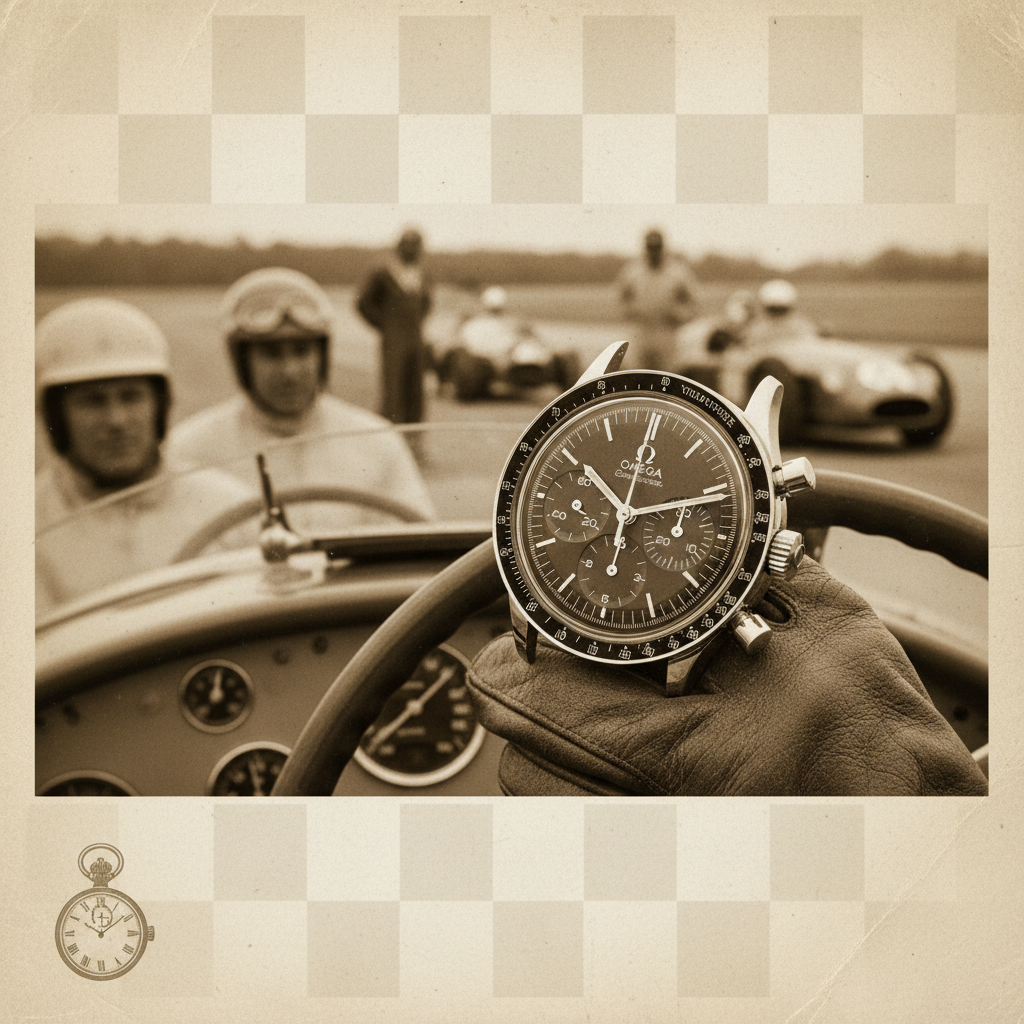
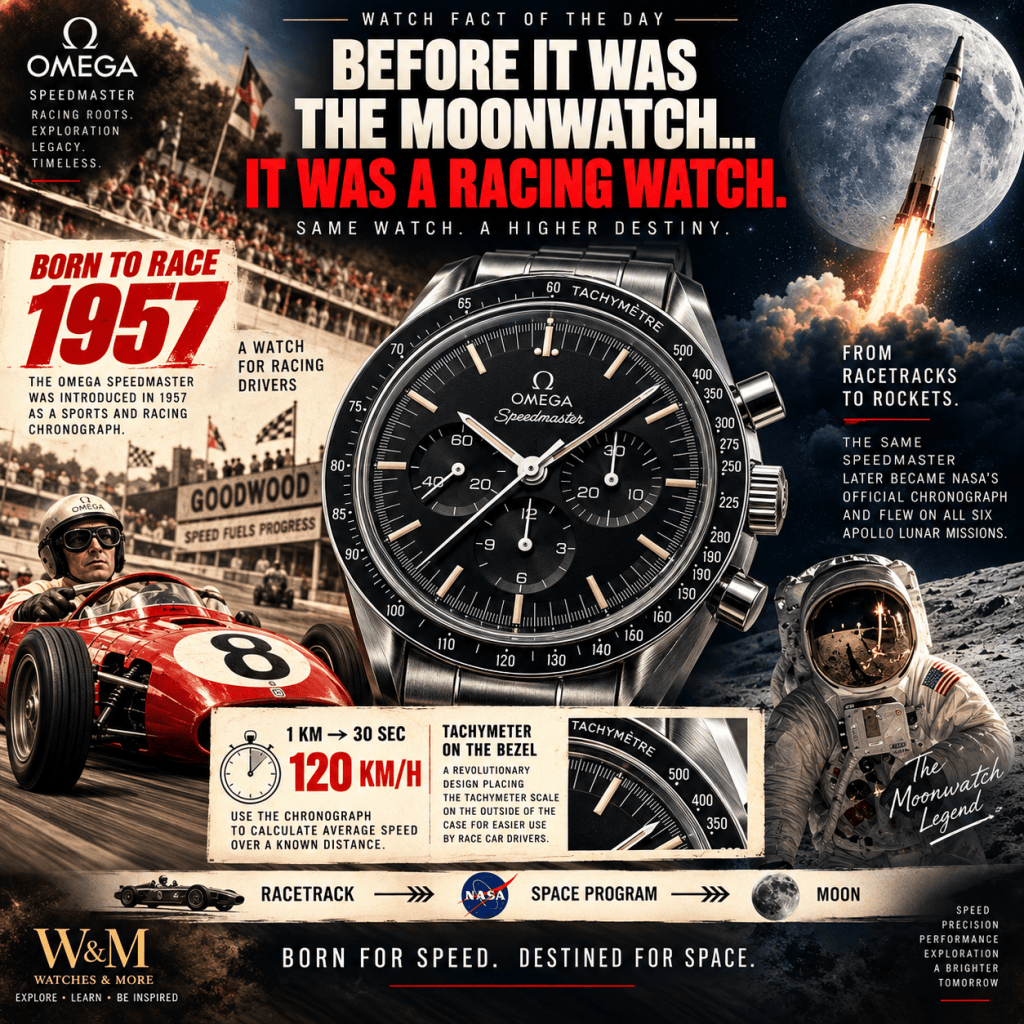
When Omega introduced the Speedmaster in 1957, nobody was designing it with lunar exploration in mind. It debuted as part of Omega’s new “Professional Line,” alongside the Seamaster 300 for divers and the Railmaster for people working around strong magnetic fields. The Speedmaster’s intended arena was much closer to Earth: motorsport and automobile racing.
Its name practically gives the game away. The Speedmaster was a chronograph designed to help measure elapsed time and calculate speed, making it naturally suited to drivers, racing enthusiasts and other sporting applications. Central to that identity was its tachymeter scale, positioned prominently around the outside of the dial on the bezel rather than being squeezed onto the dial itself.
That placement became one of the Speedmaster’s most recognizable design features. Used with the chronograph, a tachymeter allows the wearer to calculate average speed over a known distance. Start the chronograph at the beginning of a measured kilometer, stop it at the end, and the chronograph seconds hand indicates the corresponding average speed on the tachymeter scale. Omega’s own instructions still demonstrate the function using the example of calculating the speed of a car over one kilometer.
The original Speedmaster CK2915 therefore looked every bit like a purpose-built sporting instrument: a highly legible dial, chronograph timing capability and that prominent external tachymeter scale. Rather than being born as an astronaut’s watch, its design language belonged to an era of racing circuits, sports cars, stopwatches and increasingly sophisticated wrist chronographs.
And then history took an extraordinary turn. During the following decade, the Speedmaster found itself being evaluated for an environment its original designers could scarcely have anticipated: spaceflight. The rugged chronograph eventually became associated with NASA’s astronauts and, most famously, the Apollo lunar missions. The racing chronograph had become the Moonwatch.
That’s what makes the Speedmaster’s story so compelling. Omega didn’t sit down in 1957 and attempt to create an icon of space exploration. It created a highly functional sporting chronograph—and the underlying design proved versatile and robust enough to acquire an entirely different identity.
💡 Did You Know? The Speedmaster’s famous tachymeter isn’t just decoration. Combined with the chronograph, it can calculate average speed over a known distance without electronics, GPS or a speedometer. If a car travels exactly one kilometer in 30 seconds, for example, the chronograph seconds hand points to approximately 120 on the tachymeter scale—meaning an average speed of 120 km/h.
So before we had: SPEEDMASTER → NASA → APOLLO → MOONWATCH we had: RACETRACK → CHRONOGRAPH → TACHYMETER → SPEED ⭐ Why It Matters
The Speedmaster is a wonderful example of how an object’s original purpose doesn’t necessarily determine its legacy. A watch conceived for speed on the ground ultimately became famous for traveling farther from the racetrack than almost any watch imaginable.
Born for the racetrack. Destined for the Moon. 🚗💨⌚🌕
Category: Watch History
Disclaimer: Every effort has been made to keep these watch facts accurate, but the world of horology is full of myths, disputed stories, and fascinating trivia. Consider these facts a starting point for discovery rather than the final word. If you have corrections or additional insights, let us know—we’re always happy to keep the record ticking in the right direction.
In 1977, Seiko engineer Yoshikazu Akahane kicked off an epic 28-year quest to create the “ever-lasting watch,” merging traditional mainspring mechanics with electric precision. His passion for achieving just one-second accuracy per day led to over 600 prototypes and plenty of challenges. The breakthrough? The Tri-Synchro Regulator, which mixes mechanical, electrical, and electromagnetic energy—no batteries needed! This innovation gave birth to Spring Drive, featuring a smooth, gliding seconds hand instead of the usual ticking one. Sadly, Akahane passed away right before its launch in 1998, but his legacy lives on as a key player in modern watchmaking.
📅 Friday, September 4, 2026
In 1977, young Seiko engineer Yoshikazu Akahane began pursuing an idea that sounded almost contradictory: an “ever-lasting watch” powered by a traditional mainspring, yet capable of the extraordinary precision associated with electronic timekeeping. His goal was approximately one second of accuracy per day without abandoning the fundamental spring-driven architecture of mechanical watchmaking. It would become one of the longest and most ambitious development stories in modern horology. Seiko Watch Corporation
The challenge was enormous. Seiko says the journey ultimately stretched across 28 years, countless setbacks and more than 600 prototypes. An early patent application was filed in 1978, but the technology necessary to turn Akahane’s concept into a practical wristwatch simply wasn’t mature enough yet. Improvements in electronics, energy efficiency, mainspring technology and manufacturing would all be necessary before the dream could become reality. Seiko Watch Corporation
The breakthrough was what became known as the Tri-Synchro Regulator. Instead of a conventional mechanical escapement, Spring Drive coordinates three forms of energy: mechanical, electrical and electromagnetic. The unwinding mainspring drives the gear train and glide wheel; that motion generates a tiny electrical current to power a quartz oscillator and integrated circuit, while an electromagnetic brake regulates the glide wheel’s speed. The watch therefore creates the electricity its regulator requires from the energy already stored in its mainspring. Grand Seiko
And that’s an important distinction: Spring Drive does not contain a battery. Its sole power source is the mainspring. There is no conventional electric motor driving the hands and no secondary battery hidden inside; the electronics exist to regulate the mechanical energy being released through the movement. Grand Seiko
The architecture also created Spring Drive’s most recognizable visual signature: its extraordinary gliding seconds hand. A conventional mechanical watch repeatedly locks and unlocks its gear train through an escapement, producing the familiar series of tiny steps. Spring Drive has no conventional escapement; its glide wheel rotates continuously in one direction, allowing the seconds hand to sweep smoothly and silently around the dial. Seiko Watch Corporation
The timeline is particularly interesting. Spring Drive was announced in 1998 after roughly 20 years of development and 600 prototypes, and the first hand-wound Spring Drive watches followed in 1999. Development continued, however, and in 2004 Grand Seiko introduced the automatic 9R Spring Drive, combining automatic winding, a 72-hour power reserve and one-second-per-day accuracy. Seiko’s broader history describes 2005 as the culmination of the full 28-year journey—the point when “Spring Drive came of age.” Grand Seiko
Sadly, Akahane did not live to see the technology’s commercial success. Grand Seiko records that he died from pneumonia in August 1998, shortly before Spring Drive’s public launch. But the idea he had pursued since 1977 survived him—and eventually became one of Seiko’s defining contributions to modern watchmaking. Grand Seiko
💡 Did You Know?
Spring Drive’s famous smooth seconds hand isn’t simply a cosmetic effect designed to make the watch look different. It is a visible consequence of how the movement regulates time. The glide wheel rotates eight times per second while generating the electricity needed to power the quartz oscillator and IC; an electromagnetic brake continuously controls its speed rather than repeatedly stopping and releasing a traditional escapement. That uninterrupted rotational motion travels through the gear train to produce the mesmerizing glide of the seconds hand.
No battery. No conventional escapement. No ticking seconds hand.
Disclaimer: Every effort has been made to keep these watch facts accurate, but the world of horology is full of myths, disputed stories, and fascinating trivia. Consider these facts a starting point for discovery rather than the final word. If you have corrections or additional insights, let us know—we’re always happy to keep the record ticking in the right direction.