
Watch Fact of the Day: The ‘Waterproof’ Watch Was Once a Mythical Beast!

In 1926, Rolex decided to make a splash—literally—by patenting the ‘Oyster’ case, transforming the watch industry from a soggy mess of water-resistant myths into a dry haven of genuine waterproofness. Before this revolutionary moment, the idea of waterproof watches was about as reliable as an umbrella in a hurricane. With the ingenious screw-down crown and hermetically sealed design, Rolex flipped the script on watch-making. And while these chronometers are now fashionably safe from pool parties, remember: the world of horology is a wild ride filled with legends and half-told tales, so don your detective hat for more tick-tock trivia!

📅 Friday, July 31, 2026

Before Rolex patented the ‘Oyster’ case in 1926, truly waterproof watches were largely theoretical. Early attempts at water resistance involved fragile gaskets and screw-down crowns, but none offered reliable protection against the elements. The Oyster case, with its patented screw-down crown, case back, and bezel, revolutionized watchmaking by creating a hermetically sealed environment, making genuine waterproofness a reality for the first time.


The Watch That Defied Water

The breakthrough came from Hans Wilsdorf, founder of Rolex, who recognized that moisture and dust were the greatest enemies of a mechanical watch. By engineering a case that sealed tightly using a screw-down bezel, threaded case back, and the innovative Twinlock-style screw-down crown concept, Rolex created a watch capable of withstanding conditions that would have quickly destroyed earlier timepieces. The name “Oyster” was chosen because, like the shell of an oyster, the case formed a protective barrier around its precious contents.

The Oyster’s reputation was cemented in 1927 when British swimmer Mercedes Gleitze wore a Rolex Oyster while attempting to swim across the English Channel. Although she did not complete the crossing due to the harsh conditions, the watch remained fully functional after spending more than ten hours in cold seawater. Rolex capitalized on the achievement with one of history’s first truly successful testimonial advertising campaigns, displaying Oyster watches in aquariums in jewelry store windows to demonstrate their remarkable water resistance.

Today, nearly every modern sports watch owes something to the innovations pioneered by the Oyster case. Screw-down crowns, threaded case backs, synthetic gaskets, and improved sealing systems have become industry standards, allowing dive watches to withstand depths of hundreds—and in some cases thousands—of meters. What was once considered almost mythical in the early 20th century has become an everyday expectation for modern wristwatches.


💡 Did You Know?

The term “waterproof” is no longer used by most watch manufacturers. Instead, watches are rated as “water resistant” because no watch is permanently impervious to water. Gaskets age, seals wear, and regular pressure testing is recommended to ensure a watch continues to perform as intended—especially before swimming or diving.

Category: Watch History

Disclaimer: Every effort has been made to keep these watch facts accurate, but the world of horology is full of myths, disputed stories, and fascinating trivia. Consider these facts a starting point for discovery rather than the final word. If you have corrections or additional insights, let us know—we’re always happy to keep the record ticking in the right direction.

🕐 Discover more watch facts, reviews, and buying guides at WatchesAndMore


🛍️ You Might Also Like

As an Amazon Associate and affiliate partner, WatchesAndMore earns from qualifying purchases.
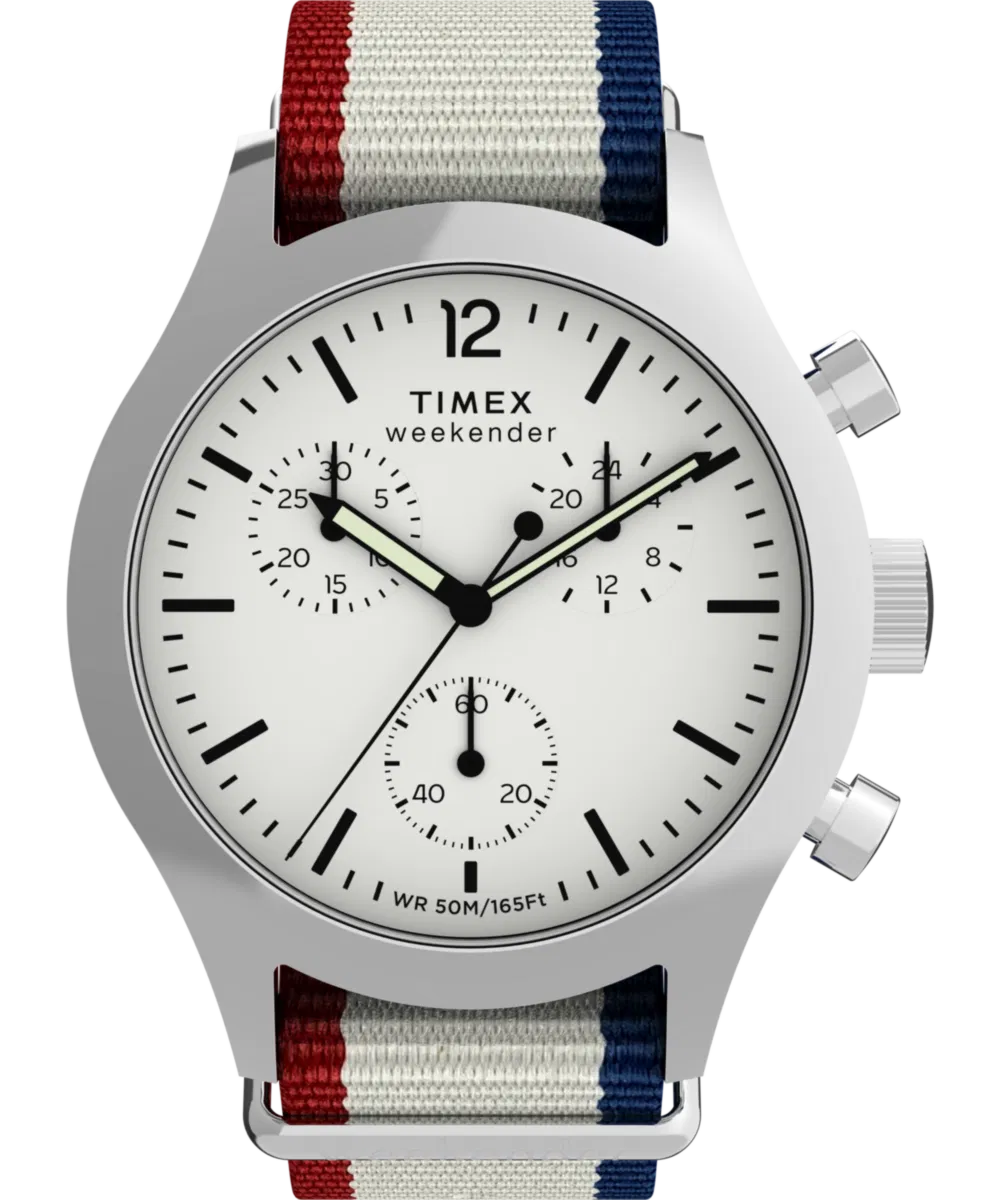
Timex Weekender Chronograph
🔥 Deal of the Day

Timex Weekender Chronograph

Timex

★★★★★ 4.5 (3,041 reviews)

$79
Offer expires in


🔥 Grab This Deal →

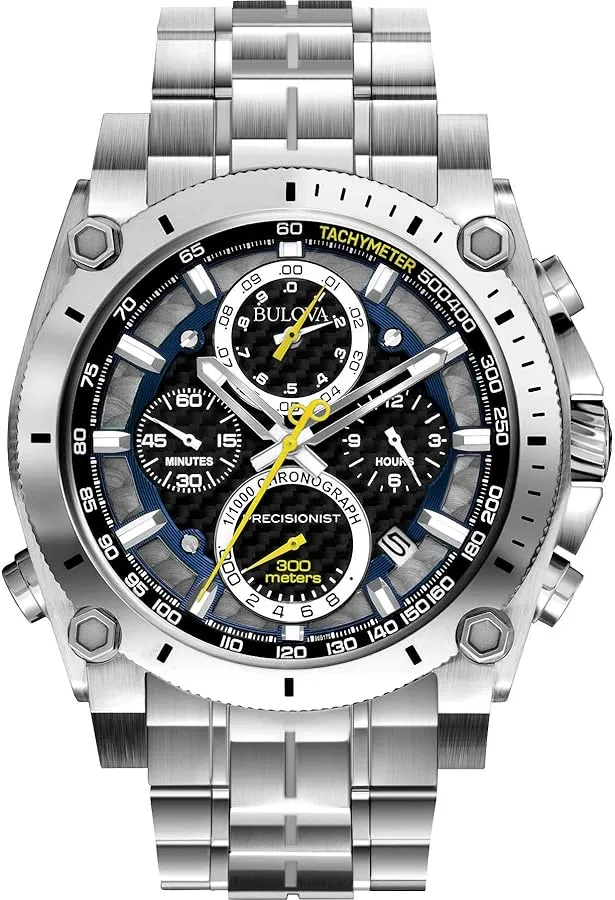
Bulova Precisionist


Bulova Precisionist

Bulova

★★★★★ 4.6 (1,100 reviews)

$219


Check Price on Amazon →

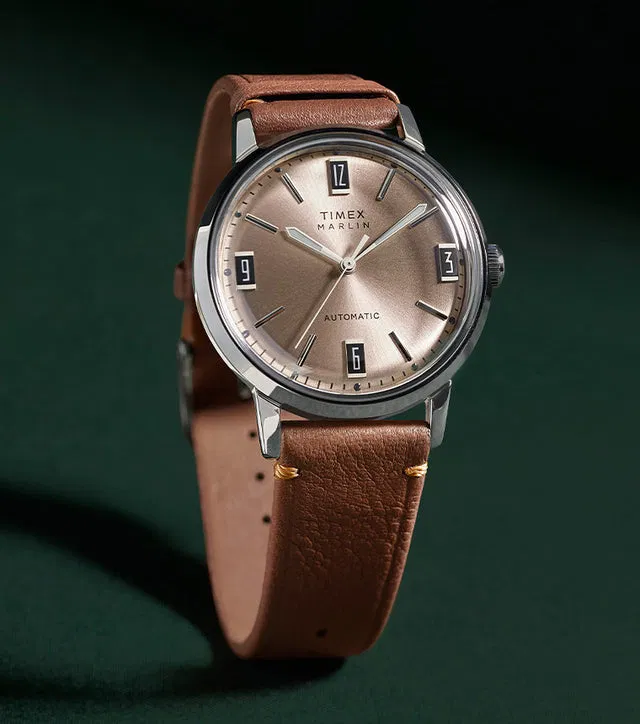
Timex Marlin Automatic 40mm


Timex Marlin Automatic 40mm

Timex

★★★★★ 4.7 (1,106 reviews)

$259


Check Price on Amazon →


Browse all 142+ expert-reviewed watches →

☕ Help Support WatchesAndMore

If you enjoyed this article and would like to help support WatchesAndMore, consider visiting my Etsy Shop or browsing my designs on Redbubble. Every purchase helps support the continued creation of watch reviews, historical articles, buying guides, videos, and all the free content you enjoy here on the website and on YouTube.

Your support allows me to spend more time researching fascinating stories from the world of horology, testing new watches, and producing high-quality content for collectors and enthusiasts around the globe. Whether you’re looking for unique watch-themed merchandise or simply want to support the channel, every order is genuinely appreciated. Thank you for being part of the WatchesAndMore community—your support helps keep the passion for watches alive! ⌚🍻

ETSY Shop
ETSY Shop
Redbubble Shop
Redbubble Shop
More Watch Facts
More Watch Facts

Watch Fact of the Day: The ‘Flyback’ Chronograph Was Invented for Pilots to Reset Instantly!

The flyback chronograph is like the superhero of stopwatches—no capes, just a single-button press! Originally crafted for quick-thinking pilots, it allows for seamless timing without wasting a millisecond, which is crucial when you’re dodging clouds or hostile airspace. Unlike regular chronographs that make you click three times like a sock drawer full of mismatched socks, the flyback simplifies everything, effortlessly transitioning from stop to reset to go. With its intricate inner workings, this Swiss marvel has gained cult status among collectors, proving that even watchmaking can have its flashy moments. Who knew timing could be this heroic?

📅 Thursday, July 30, 2026

Unlike a standard chronograph that requires three presses (stop, reset, start) to time consecutive events, the flyback chronograph allows a single press of a button to stop, reset, and restart the timing function instantaneously. This ingenious complication was initially developed for pilots, enabling them to quickly time successive legs of a journey without losing a beat, crucial for navigation. It significantly streamlined timing operations in demanding cockpit environments.


The flyback chronograph, known in French as “retour en vol” (“return in flight”), became an indispensable tool during the early days of aviation. Before sophisticated onboard navigation systems, pilots relied on precise timing to calculate fuel consumption, airspeed, and course corrections between waypoints. With a standard chronograph, resetting the timer meant briefly stopping the measurement, wasting precious seconds. The flyback mechanism eliminated that delay, allowing the chronograph hand to instantly snap back to zero and continue timing with a single press of the lower pusher.

Mechanically, the flyback chronograph is considerably more complex than a traditional chronograph. A carefully engineered system of levers, cams, hammers, and clutches allows the chronograph to disengage, reset, and restart in one seamless motion without damaging the movement. This additional complexity makes flyback chronographs highly prized among collectors and showcases the remarkable ingenuity of Swiss watchmaking.

Today, the flyback complication remains a favorite among enthusiasts, not only for its practicality but also for its fascinating military and aviation heritage. Iconic models from Breguet, Longines, Blancpain, Zenith, Glashütte Original, and Patek Philippe continue to feature flyback chronographs, proving that a complication born out of necessity has become one of the most admired achievements in mechanical watchmaking.


💡 Did You Know?

Many vintage military pilot chronographs issued to the French Air Force during the 1950s and 1960s featured flyback movements. Pilots could reset and restart the chronograph with a single press while keeping one hand on the aircraft controls—a simple innovation that made navigation faster, safer, and more efficient in the cockpit.

Category: Fun Quirk

Disclaimer: Every effort has been made to keep these watch facts accurate, but the world of horology is full of myths, disputed stories, and fascinating trivia. Consider these facts a starting point for discovery rather than the final word. If you have corrections or additional insights, let us know—we’re always happy to keep the record ticking in the right direction.

🕐 Discover more watch facts, reviews, and buying guides at WatchesAndMore


🛍️ You Might Also Like

As an Amazon Associate and affiliate partner, WatchesAndMore earns from qualifying purchases.

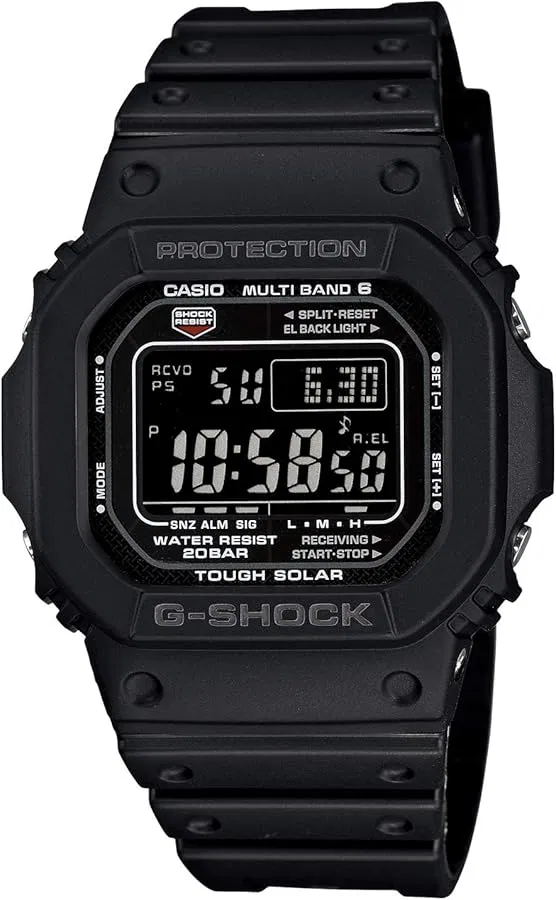
G-Shock GWM5610-1 Solar Atomic
🔥 Deal of the Day

G-Shock GWM5610-1 Solar Atomic

Casio

★★★★★ 4.8 (5,621 reviews)

$129

Offer expires in


🔥 Grab This Deal →

G-Shock GA2100-1A1 CasiOak


G-Shock GA2100-1A1 CasiOak

Casio

★★★★★ 4.8 (2,156 reviews)

$99


Check Price on Amazon →

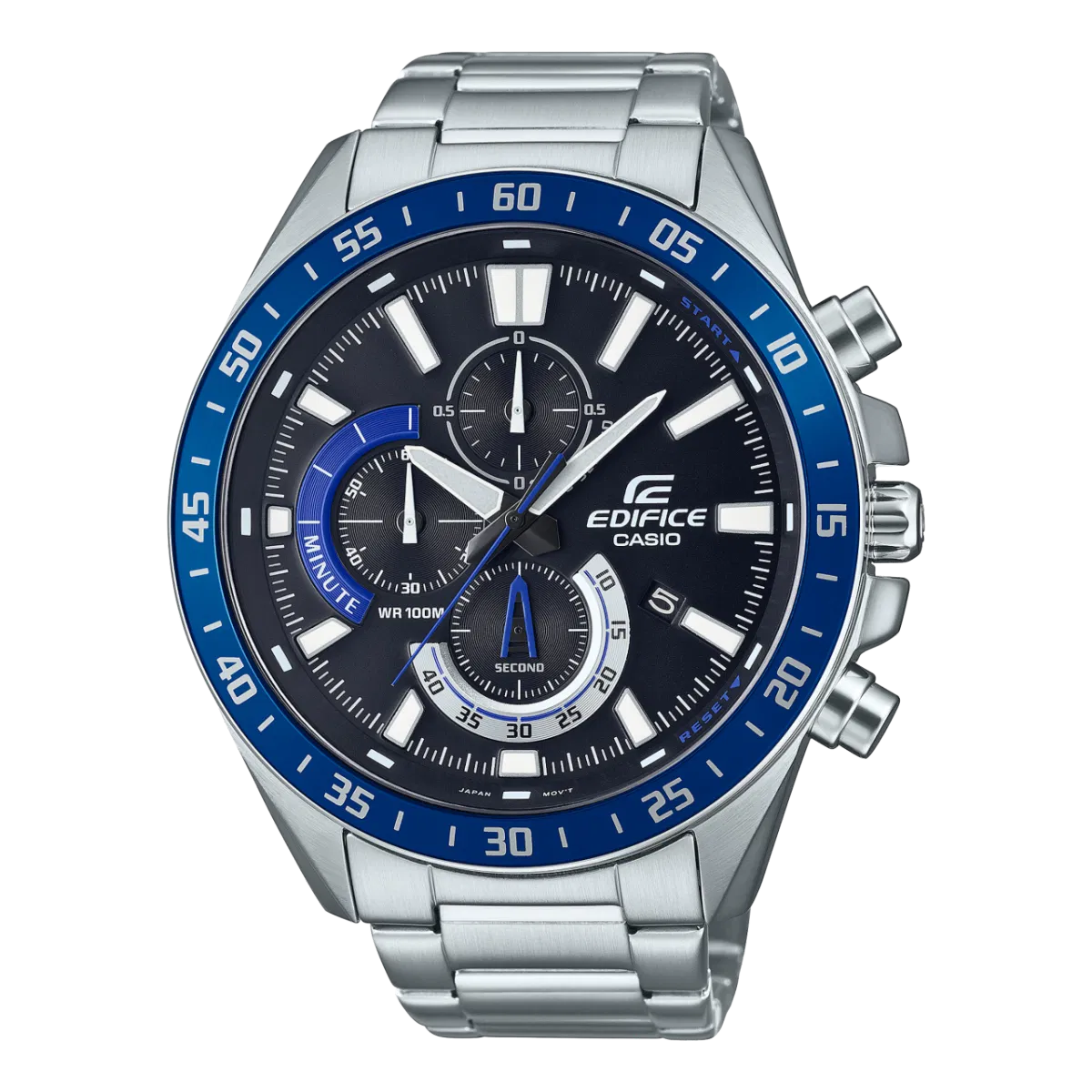
Casio Edifice Chronograph


Casio Edifice Chronograph

Casio

★★★★★ 4.7 (1,264 reviews)

$120


Check Price on Amazon →


Browse all 142+ expert-reviewed watches →

☕ Help Support WatchesAndMore

If you enjoyed this article and would like to help support WatchesAndMore, consider visiting my Etsy Shop or browsing my designs on Redbubble. Every purchase helps support the continued creation of watch reviews, historical articles, buying guides, videos, and all the free content you enjoy here on the website and on YouTube.

Your support allows me to spend more time researching fascinating stories from the world of horology, testing new watches, and producing high-quality content for collectors and enthusiasts around the globe. Whether you’re looking for unique watch-themed merchandise or simply want to support the channel, every order is genuinely appreciated. Thank you for being part of the WatchesAndMore community—your support helps keep the passion for watches alive! ⌚🍻

ETSY Shop
ETSY Shop
Redbubble Shop
Redbubble Shop
More Watch Facts
More Watch Facts

Watch Fact of the Day: The ‘Hack’ Function in Watches Was Born from Military Precision!

In a world where timing is everything, the ‘hack’ function on watches turns out to be the military’s secret sauce for synchronized chaos. Originally developed so soldiers could set their watches down to the tick, it transformed into a beloved feature for everyone, from casual timekeepers to luxury aficionados. The name comes from troops “hacking” their watches to get the exact second, proving precision can be key to success or failure—whether you’re bombarding an enemy or just trying to catch the bus. So, the next time you set your mechanical marvel, remember: it’s not just about fashion; it’s about historical warfare chic!

📅 Wednesday, July 29, 2026

The ‘hack’ function, which stops the second hand when the crown is pulled out, was not originally a feature for casual time-setting. It was developed during wartime to allow soldiers to synchronize their watches precisely to a master clock, ensuring coordinated movements and attacks. This military requirement for exact timing eventually became a common and useful feature in many mechanical watches.


The term “hack” comes from the military phrase “hack your watches,” an order given to troops to synchronize their timepieces to the exact second. By stopping the seconds hand, every soldier could wait for the command to resume the movement simultaneously, ensuring perfectly coordinated operations. Whether planning artillery barrages, airborne assaults, or naval maneuvers, precise timing often meant the difference between success and failure.

Early military watches from manufacturers such as Longines, Omega, Hamilton, IWC, and later Rolex incorporated hacking seconds to meet stringent military specifications. During World War II, synchronized timekeeping became essential across all branches of the armed forces. Pilots coordinated bombing runs, navigators calculated precise positions, and infantry units executed attacks based on synchronized watches rather than unreliable battlefield communications.

Today, the hack function is a standard feature on many mechanical watches, from affordable field watches to luxury Swiss timepieces. While most owners use it simply to set their watch accurately against an atomic clock or smartphone, its origins are rooted in one of the most demanding environments imaginable. It’s a small complication with a fascinating history, demonstrating how military innovation often finds its way into everyday life.


💡 Did You Know?

Many modern watch enthusiasts still synchronize their mechanical watches to internet-based atomic clocks or official time signals using the hack function. Pulling the crown at exactly 60 seconds, waiting for the reference clock to roll over to the next minute, and then pushing the crown back in allows the watch to be set almost perfectly to the second—a practice that continues a military tradition dating back more than 80 years.

Category: Watch History

Disclaimer: Every effort has been made to keep these watch facts accurate, but the world of horology is full of myths, disputed stories, and fascinating trivia. Consider these facts a starting point for discovery rather than the final word. If you have corrections or additional insights, let us know—we’re always happy to keep the record ticking in the right direction.

🕐 Discover more watch facts, reviews, and buying guides at WatchesAndMore


🛍️ You Might Also Like

As an Amazon Associate and affiliate partner, WatchesAndMore earns from qualifying purchases.

Timex Weekender Chronograph
🔥 Deal of the Day

Timex Weekender Chronograph

Timex

★★★★★ 4.5 (3,041 reviews)

$79

Offer expires in


🔥 Grab This Deal →

Bulova Precisionist


Bulova Precisionist

Bulova

★★★★★ 4.6 (1,100 reviews)

$219


Check Price on Amazon →

Timex Marlin Automatic 40mm


Timex Marlin Automatic 40mm

Timex

★★★★★ 4.7 (1,106 reviews)

$259


Check Price on Amazon →


Browse all 142+ expert-reviewed watches →

☕ Help Support WatchesAndMore

If you enjoyed this article and would like to help support WatchesAndMore, consider visiting my Etsy Shop or browsing my designs on Redbubble. Every purchase helps support the continued creation of watch reviews, historical articles, buying guides, videos, and all the free content you enjoy here on the website and on YouTube.

Your support allows me to spend more time researching fascinating stories from the world of horology, testing new watches, and producing high-quality content for collectors and enthusiasts around the globe. Whether you’re looking for unique watch-themed merchandise or simply want to support the channel, every order is genuinely appreciated. Thank you for being part of the WatchesAndMore community—your support helps keep the passion for watches alive! ⌚🍻

ETSY Shop
ETSY Shop
Redbubble Shop
Redbubble Shop
More Watch Facts
More Watch Facts

The Watch Advisor
Find Your Perfect Watch

Watch Fact of the Day: The ‘Geneva Seal’ Is More Than Just a Pretty Stamp!

The Geneva Seal, established in 1886, is a top-notch certification for watch movements, proving they were made and crafted in Geneva with serious attention to detail. It safeguards the reputation of skilled watchmakers by ensuring every part of a certified watch—from bridges to screws—meets high aesthetic and technical standards. After a 2012 update, complete watches now also have to show reliability and performance, not just good looks. Brands like Vacheron Constantin and Roger Dubuis are notable holders of this prestigious seal. So, when you see that tiny Geneva Seal on a watch, you know it’s a masterpiece of Swiss craftsmanship!

📅 Tuesday, July 28, 2026

The Geneva Seal, or Poinçon de Genève, is not merely a decorative emblem but a rigorous certification of quality and craftsmanship for watch movements. Established in 1886, it guarantees that a watch movement was made, assembled, and regulated in the Canton of Geneva, adhering to strict aesthetic and technical criteria. This includes specific finishing techniques for every component, ensuring both beauty and precision, making it one of the most demanding certifications in horology.


Originally created by the Canton of Geneva to protect the reputation of its master watchmakers, the Geneva Seal quickly became one of the most prestigious marks of excellence in Swiss watchmaking. Every component of a certified movement—from bridges and wheels to screws and levers—must meet exacting standards for finishing and construction. Techniques such as anglage (hand-beveled edges), polished screw heads, Geneva stripes (Côtes de Genève), circular graining (perlage), and carefully finished gear teeth are all scrutinized. The result is a movement that is as visually stunning as it is mechanically refined.

While many people associate the Geneva Seal with aesthetics, modern certification goes far beyond appearance. Since the certification was updated in 2012, complete watches—not just movements—must also demonstrate reliability, functionality, water resistance, power reserve, and timekeeping performance. This means a Geneva Seal timepiece isn’t simply beautiful to admire through a sapphire caseback; it’s also expected to perform to the highest standards in everyday use.

Today, only a select group of manufacturers produce Geneva Seal-certified watches, with Vacheron Constantin being perhaps its most famous ambassador. Other prestigious maisons, including Roger Dubuis and selected models from Cartier and Chopard, have also earned the distinction. For collectors, spotting the tiny Geneva Seal engraved on a movement is an assurance that countless hours of skilled hand-finishing and meticulous assembly have gone into creating one of the finest examples of traditional Swiss watchmaking.


💡 Did You Know?

The Geneva Seal is not a chronometer certification. A watch can carry the Geneva Seal without being COSC-certified, and a COSC-certified chronometer does not need a Geneva Seal. One recognizes craftsmanship and finishing, while the other certifies precision and accuracy. A watch that earns both represents an exceptional blend of mechanical performance and artisanal excellence.

Category: Fun Quirk

🕐 Discover more watch facts, reviews, and buying guides at WatchesAndMore


🛍️ You Might Also Like

As an Amazon Associate and affiliate partner, WatchesAndMore earns from qualifying purchases.

G-Shock GA2100-1A1 CasiOak


G-Shock GA2100-1A1 CasiOak

Casio

★★★★★ 4.8 (2,156 reviews)

$99


Check Price on Amazon →

Casio Edifice Chronograph


Casio Edifice Chronograph

Casio

★★★★★ 4.7 (1,264 reviews)

$120


Check Price on Amazon →


Browse all 75+ expert-reviewed watches →

Watch Fact of the Day: The ‘Chronometer’ Standard Was Once a Naval Necessity!

Ahoy, time travelers! Before GPS made sailing as easy as pie, sailors fought the “Longitude Problem” armed with nothing but a pint-sized pocket watch and a prayer. Enter John Harrison and his marine chronometers in the 18th century, which were more reliable than your cousin Bob’s fish stories. He lost only five seconds during an 81-day sea adventure, turning shipwrecks into relics of the past. Today, watches sporting the “Chronometer” label are the crème de la crème in watchmaking, with brands like Rolex strutting their stuff. So, while GPS may have an edge now, the tale of timekeeping legend lives on—just like that fish story!

📅 Monday, July 27, 2026

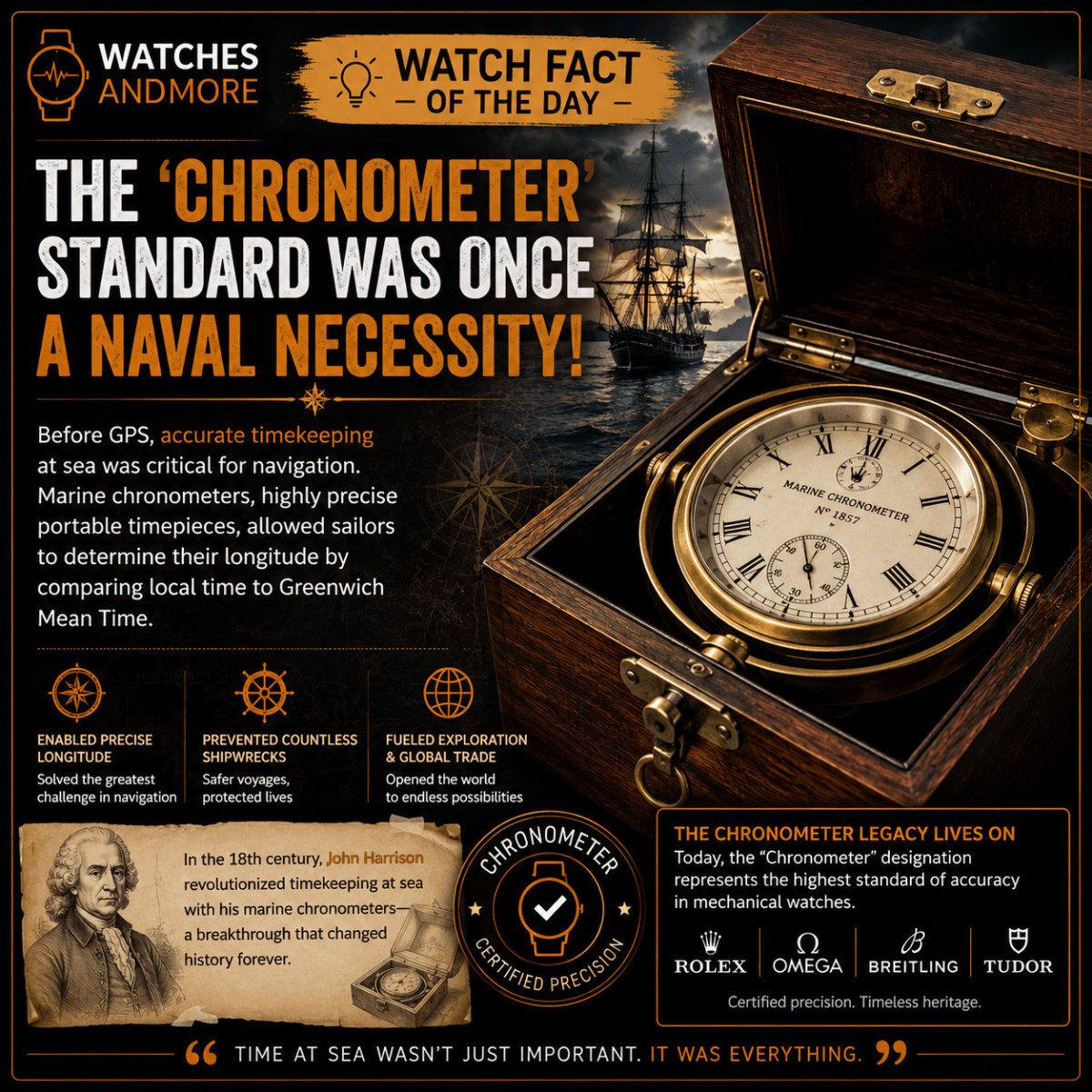
Before GPS, accurate timekeeping at sea was critical for navigation. Marine chronometers, highly precise portable timepieces, allowed sailors to determine their longitude by comparing local time to Greenwich Mean Time. This invention revolutionized seafaring, preventing countless shipwrecks and making global exploration and trade significantly safer.


The breakthrough came in the 18th century when English clockmaker John Harrison solved what had become known as the “Longitude Problem.” For centuries, sailors could determine their latitude with relative ease, but accurately calculating longitude while at sea remained one of navigation’s greatest challenges. Harrison’s revolutionary marine chronometers maintained exceptional accuracy despite the constant motion, changing temperatures, and humidity encountered aboard sailing ships. His work transformed maritime navigation and is considered one of the most important achievements in the history of horology.

The word “chronometer” itself has a very specific meaning in watchmaking. Today, it refers to a watch that has passed rigorous precision testing and earned official certification. In Switzerland, this is typically awarded by the Contrôle Officiel Suisse des Chronomètres (COSC), where each movement is tested over several days in multiple positions and temperatures. Only movements that meet strict accuracy standards are permitted to carry the prestigious “Chronometer” designation on their dial.

Modern chronometer-certified wristwatches continue this tradition of precision. Brands such as Rolex, Omega, Breitling, Tudor, and many others proudly produce chronometer-certified models, blending centuries of timekeeping heritage with modern manufacturing techniques. While GPS and atomic clocks have replaced marine chronometers for navigation, the chronometer certification remains one of the most respected indicators of mechanical accuracy and craftsmanship in the watch industry.


💡 Did You Know?

John Harrison’s first successful marine chronometer, known as H4, looked more like a large pocket watch than a ship’s clock. During sea trials in 1761, it lost only about five seconds on an 81-day voyage to Jamaica—an astonishing level of accuracy that forever changed navigation and proved that precise portable timekeeping was possible.

Category: Watch History

Disclaimer: Every effort has been made to keep these watch facts accurate, but the world of horology is full of myths, disputed stories, and fascinating trivia. Consider these facts a starting point for discovery rather than the final word. If you have corrections or additional insights, let us know—we’re always happy to keep the record ticking in the right direction.

🕐 Discover more watch facts, reviews, and buying guides at WatchesAndMore


🛍️ You Might Also Like

As an Amazon Associate and affiliate partner, WatchesAndMore earns from qualifying purchases.

Bulova Precisionist


Bulova Precisionist

Bulova

★★★★★ 4.6 (1,100 reviews)

$219


Check Price on Amazon →

Timex Marlin Automatic 40mm


Timex Marlin Automatic 40mm

Timex

★★★★★ 4.7 (1,106 reviews)

$259


Check Price on Amazon →


Browse all 75+ expert-reviewed watches →

☕ Help Support WatchesAndMore

If you enjoyed this article and would like to help support WatchesAndMore, consider visiting my Etsy Shop or browsing my designs on Redbubble. Every purchase helps support the continued creation of watch reviews, historical articles, buying guides, videos, and all the free content you enjoy here on the website and on YouTube.

Your support allows me to spend more time researching fascinating stories from the world of horology, testing new watches, and producing high-quality content for collectors and enthusiasts around the globe. Whether you’re looking for unique watch-themed merchandise or simply want to support the channel, every order is genuinely appreciated. Thank you for being part of the WatchesAndMore community—your support helps keep the passion for watches alive! ⌚🍻
More Watch Facts
More Watch Facts

Watch Fact of the Day: The ‘Big Ben’ Clock Was Once the World’s Most Accurate Public Timekeeper!

The Great Clock of Westminster, commonly known as Big Ben, was completed in 1859 and became renowned for its precision, attributed to an innovative double three-legged gravity escapement designed by Edmund Beckett Denison. This mechanism effectively minimized external factors that could disrupt the pendulum’s swing, allowing for remarkable accuracy. Clock keepers could fine-tune the clock’s timing using old British pennies to adjust the pendulum’s center of mass. Although modern atomic clocks far exceed its accuracy, Big Ben remains a significant achievement in mechanical horology and a symbol of engineering excellence, with its great bell often mistakenly referred to as Big Ben.

📅 Sunday, July 26, 2026

While not a wristwatch, the Great Clock of Westminster, famously known as Big Ben, was considered the most accurate public clock in the world upon its completion in 1859. Its incredible precision was partly due to its innovative double three-legged gravity escapement, designed by Edmund Beckett Denison, which isolated the pendulum from the varying forces of the clock’s gear train. This design allowed it to maintain accuracy within a second, a remarkable feat for its era and scale.


Big Ben Clock
Big Ben Clock

The secret to the clock’s remarkable accuracy lies in its ingenious engineering rather than sheer size. Denison’s gravity escapement ensured that wind, rain, or the enormous weight of the hands themselves had virtually no effect on the pendulum’s swing. This allowed the pendulum to oscillate with extraordinary consistency, making the Great Clock a benchmark for precision long before electronic timekeeping existed. Its reliability was so impressive that other tower clocks around the world later adopted variations of the same escapement design.

Another fascinating feature is the clock’s surprisingly simple method of regulation. If the clock began running slightly slow, the keeper didn’t adjust gears or springs—instead, old British pennies were placed on top of the pendulum. Each penny raises the pendulum’s centre of mass just enough to make the clock gain approximately 0.4 seconds per day. Adding or removing a single coin allowed the clock’s accuracy to be fine-tuned with incredible precision, a practice that continues to this day.

Although modern atomic clocks have long surpassed it in accuracy, Big Ben remains one of the greatest achievements in mechanical horology. More than 165 years after it first chimed across London, the Great Clock continues to keep remarkably accurate time while standing as one of the world’s most recognizable symbols of engineering excellence. It serves as a reminder that some of history’s finest timekeepers weren’t worn on the wrist—they towered over entire cities.


💡 Did You Know?

Despite popular belief, “Big Ben” is actually the name of the 13.5-ton Great Bell inside the tower—not the clock or the tower itself. The clock is officially known as the Great Clock of Westminster, while the tower has been called the Elizabeth Tower since 2012, when it was renamed to celebrate Queen Elizabeth II’s Diamond Jubilee.

Category: Watch History

🕐 Discover more watch facts, reviews, and buying guides at WatchesAndMore


🛍️ You Might Also Like

As an Amazon Associate and affiliate partner, WatchesAndMore earns from qualifying purchases.

Bulova Precisionist


Bulova Precisionist

Bulova

★★★★★ 4.6 (1,100 reviews)

$219


Check Price on Amazon →

Timex Marlin Automatic 40mm


Timex Marlin Automatic 40mm

Timex

★★★★★ 4.7 (1,106 reviews)

$259


Check Price on Amazon →


Browse all 75+ expert-reviewed watches →

The Casio G-Shock Mudmaster GSG-100-1A is the watch for serious professionals and hardcore outdoor enthusiasts. Its specialized mud resistance, twin sensor technology, and extreme durability make it uniquely capable in environments where ordinary watches fail. While it’s larger and more expensive than standard G-Shocks, the Mudmaster justifies its premium with features and construction quality that can literally save your life in extreme conditions. If your adventures take you to the edge of civilization, the Mudmaster is the watch that will get you back.

The Watch Advisor
Find Your Perfect Watch

Casio G-Shock Mudmaster GSG-100-1A3 – The Ultimate Rugged Adventure Watch! ⏳🌍💪 YouTubeVideo

In this video, we take an in-depth look at the Casio G-Shock Mudmaster GSG-100-1A3, a watch engineered for extreme conditions. Designed for those who brave the toughest terrains, this mud-resistant, shock-resistant, and 200-meter water-resistant timepiece is built to handle the elements

SEE MY REVIEW ON ON MY WatchesAndMore YouTube Channel

☕ Help Support WatchesAndMore

If you enjoyed this article and would like to help support WatchesAndMore, consider visiting my Etsy Shop or browsing my designs on Redbubble. Every purchase helps support the continued creation of watch reviews, historical articles, buying guides, videos, and all the free content you enjoy here on the website and on YouTube.

Your support allows me to spend more time researching fascinating stories from the world of horology, testing new watches, and producing high-quality content for collectors and enthusiasts around the globe. Whether you’re looking for unique watch-themed merchandise or simply want to support the channel, every order is genuinely appreciated. Thank you for being part of the WatchesAndMore community—your support helps keep the passion for watches alive! ⌚🍻

Watch Fact of the Day: The ‘Fumé Dial’ Wasn’t Always a Design Choice, But a Happy Accident!

The ‘fumé’ dial, with its cool gradient from light to dark, started as an accident in early watchmaking when pigments dried unevenly. Over time, this quirky effect turned into a stylish feature, giving watches a depth that catches the eye differently in various lighting. H. Moser & Cie is a major player in this trend, helping revive the smoked dial look with their sleek “Concept” designs. These dials, often free of logos, showcase rich colors like midnight blue and burgundy, proving that sometimes so-called imperfections can create stunningly artistic watch faces. Collectors even call some of these dials “sunset effect” for their unique color changes.

📅 Saturday, July 25, 2026

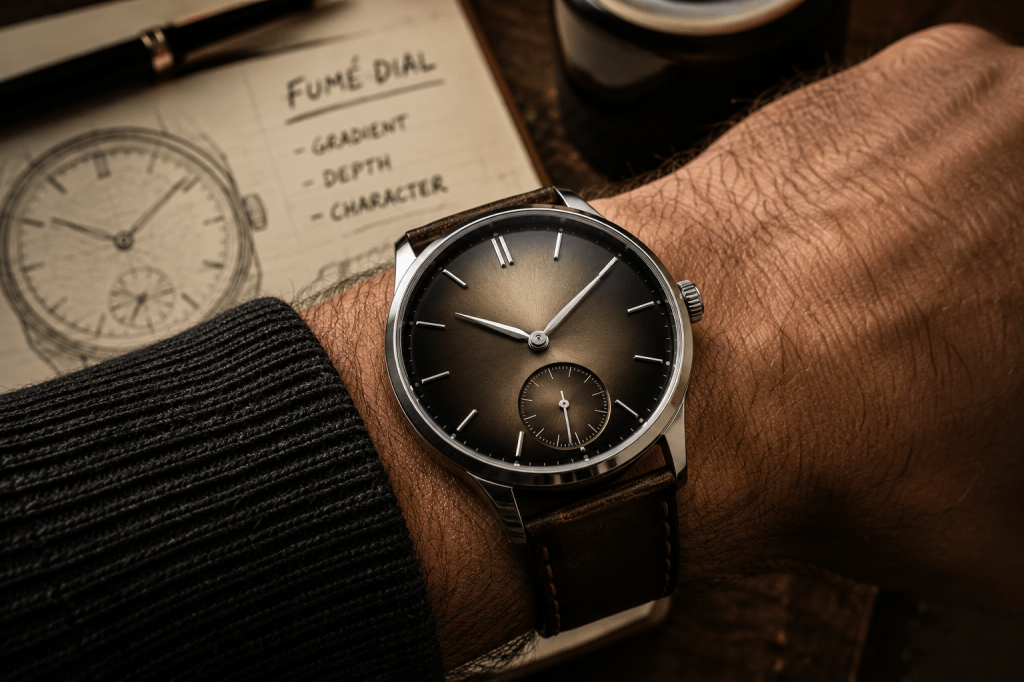
The captivating ‘fumé’ or smoked dial, characterized by its gradient shading from light in the center to dark at the edges, is now a highly sought-after aesthetic. However, this effect was originally an unintended consequence of early dial-making techniques, where pigments would settle unevenly during the drying process. What began as a manufacturing quirk evolved into a deliberate and sophisticated design element, showcasing how ‘imperfections’ can become desirable features in horology.


Fumé dial: a happy accident

As dial manufacturing techniques evolved throughout the 20th century, watchmakers realized that this subtle transition from a bright center to a darker perimeter created an extraordinary sense of depth. Rather than trying to eliminate the effect, manufacturers refined the process using carefully controlled layers of translucent lacquer and multiple stages of spraying and polishing. The result was a dial that appeared to change character depending on the lighting, making even simple three-hand watches feel more luxurious and dynamic.

No company is more closely associated with the modern fumé dial than H. Moser & Cie. Their richly coloured “Concept” dials—often free of logos or hour markers—have helped spark a resurgence in smoked dials among collectors over the past decade. Today, fumé finishes can be found in shades ranging from deep midnight blue and emerald green to burgundy, chocolate brown, and vibrant purple, proving that a dial can be the star of the watch without relying on complicated features.

Creating a high-quality fumé dial remains a demanding process. Achieving a perfectly smooth gradient requires exceptional precision, as even the slightest inconsistency in lacquer application can ruin the effect. The finest examples seem almost to glow from within, drawing the eye toward the centre while naturally framing the hands and hour markers. It’s a perfect example of how artistry and craftsmanship can transform a simple watch face into a miniature work of art.


💡 Did You Know?

Some collectors refer to exceptional fumé dials as having a “sunset effect” because the gradual transition from bright to dark resembles the fading light at dusk. Combined with a sunburst finish beneath the lacquer, the dial can appear to change colour dramatically as it catches the light—making every glance at the watch a little different.

Category: Fun Quirk

Disclaimer: Every effort has been made to keep these watch facts accurate, but the world of horology is full of myths, disputed stories, and fascinating trivia. Consider these facts a starting point for discovery rather than the final word. If you have corrections or additional insights, let us know—we’re always happy to keep the record ticking in the right direction.

🕐 Discover more watch facts, reviews, and buying guides at WatchesAndMore


🛍️ You Might Also Like

As an Amazon Associate and affiliate partner, WatchesAndMore earns from qualifying purchases.

G-Shock GA2100-1A1 CasiOak


G-Shock GA2100-1A1 CasiOak

Casio

★★★★★ 4.8 (2,156 reviews)

$99


Check Price on Amazon →

Casio Edifice Chronograph


Casio Edifice Chronograph

Casio

★★★★★ 4.7 (1,264 reviews)

$120


Check Price on Amazon →


Browse all 75+ expert-reviewed watches →

☕ Help Support WatchesAndMore

If you enjoyed this article and would like to help support WatchesAndMore, consider visiting my Etsy Shop or browsing my designs on Redbubble. Every purchase helps support the continued creation of watch reviews, historical articles, buying guides, videos, and all the free content you enjoy here on the website and on YouTube.

Your support allows me to spend more time researching fascinating stories from the world of horology, testing new watches, and producing high-quality content for collectors and enthusiasts around the globe. Whether you’re looking for unique watch-themed merchandise or simply want to support the channel, every order is genuinely appreciated. Thank you for being part of the WatchesAndMore community—your support helps keep the passion for watches alive! ⌚🍻

More Watch Facts
More Watch Facts

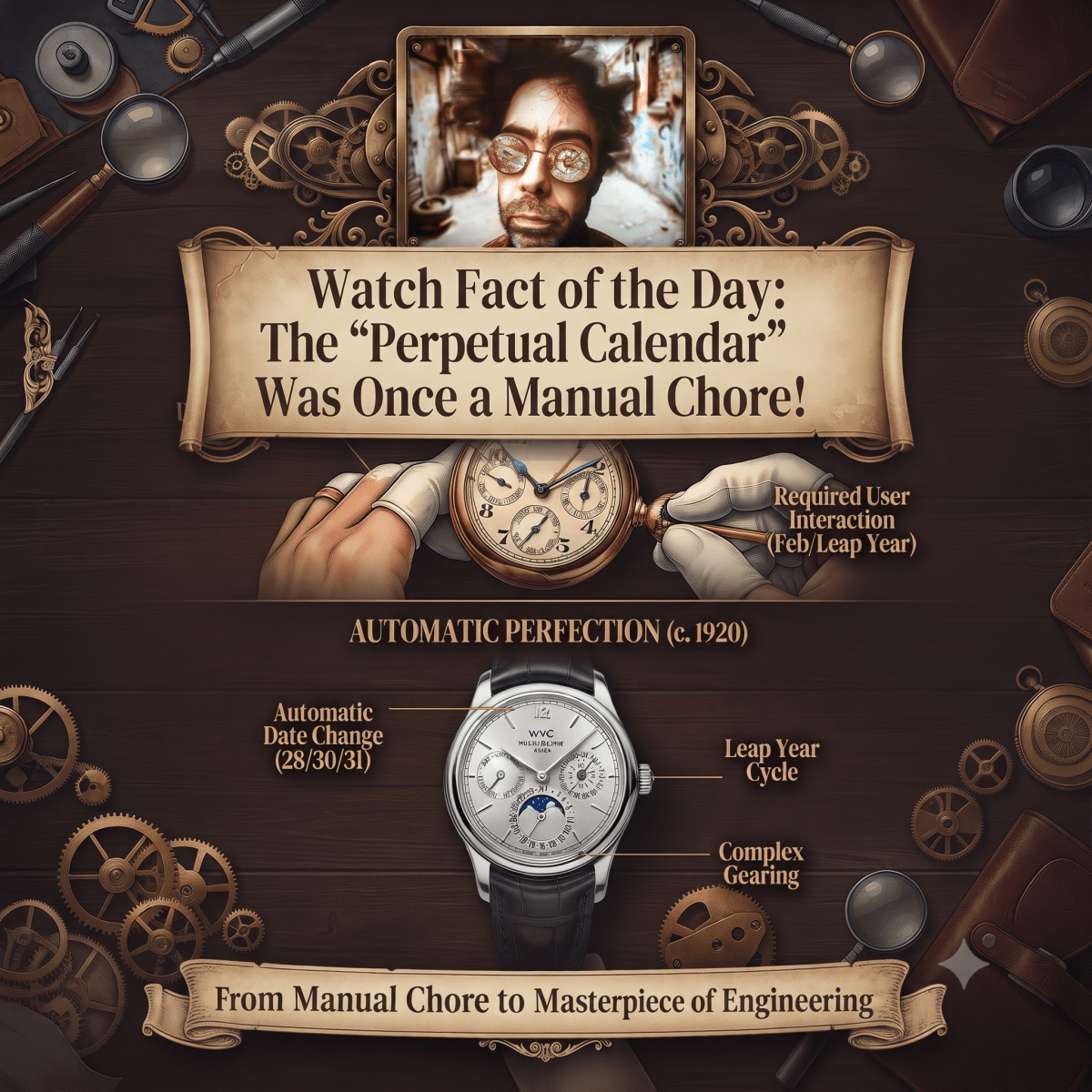
Watch Fact of the Day: The ‘Perpetual Calendar’ Was Once a Manual Chore!

Before perpetual calendars made wristwatches behave like timekeeping wizards, owners had to embark on a monthly ritual of adjusting their watches, playing an endless game of “is it February again?” Fast forward to the late 19th century, when watchmakers conjured up a mechanical marvel that understands leap years, February 29s, and can keep track of time until 2100 (with just one manual nudge). These tiny ticking masterpieces contain a labyrinth of gears, turning them into the wrist’s very own computer. So if you ever wanted to wear a mini engineering triumph and impress your wristwatch friends, now’s your time!

📅 Friday, July 24, 2026

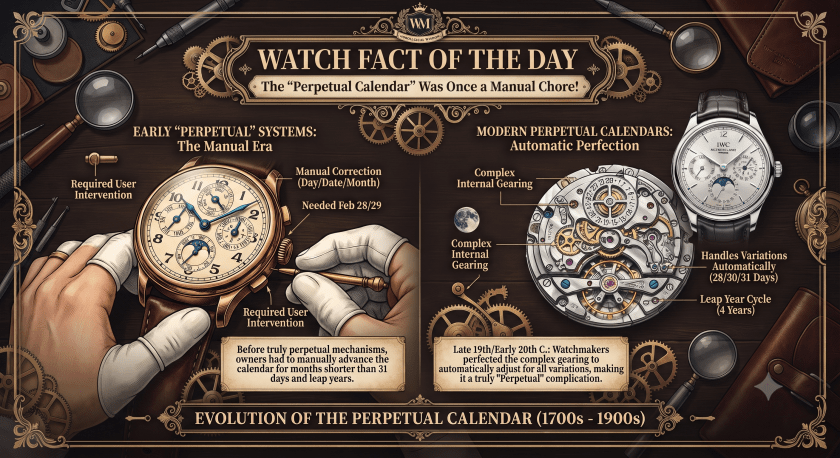
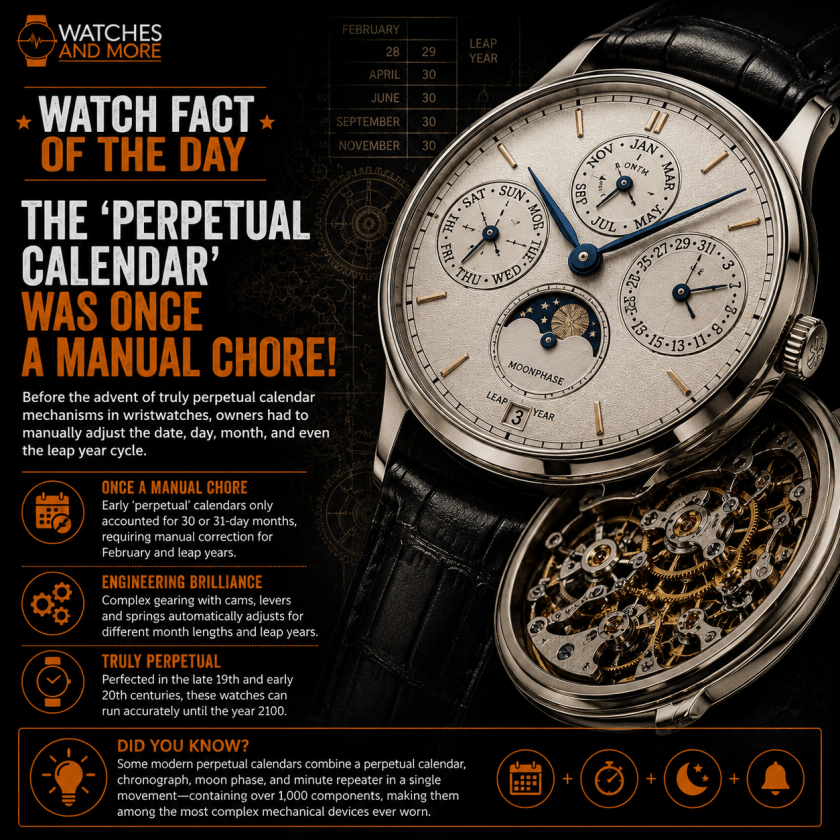
Before the advent of truly perpetual calendar mechanisms in wristwatches, owners had to manually adjust the date, day, month, and even the leap year cycle. Early ‘perpetual’ calendars only accounted for months with 30 or 31 days, requiring manual correction for February and leap years. It wasn’t until the late 19th and early 20th centuries that watchmakers perfected the complex gearing to automatically handle these variations, making it a truly ‘perpetual’ complication.

Watch fact: the perpetual calendar evolution

A true perpetual calendar is one of the greatest achievements in mechanical watchmaking. Using an intricate network of levers, cams, gears, and springs, the movement “knows” the length of each month and automatically advances the calendar accordingly. It even recognizes leap years, correctly displaying February 29 every four years without requiring intervention. Once properly set, a perpetual calendar can continue displaying the correct date until the year 2100, when the Gregorian calendar skips a leap year because century years must be divisible by 400 to qualify. At that point, even these remarkable watches will require a single manual adjustment.

The level of engineering involved is astonishing. Many perpetual calendar movements contain hundreds of additional components dedicated solely to the calendar mechanism. Watchmakers must carefully synchronize every indication—date, day, month, leap year, and often the moon phase—so they all change in perfect harmony, usually around midnight. A tiny mistake during assembly can throw the entire system out of sequence, making these among the most demanding complications to manufacture and service.

Today, perpetual calendars remain one of the “Holy Trinity” of traditional grand complications, alongside the tourbillon and the minute repeater. Prestigious manufacturers such as Patek Philippe, Audemars Piguet, Vacheron Constantin, and IWC continue to produce extraordinary perpetual calendar watches that blend centuries-old mechanical ingenuity with modern precision. For collectors, owning one is like wearing a miniature mechanical computer on the wrist—one that can keep track of the calendar for generations.


Watch fact: the perpetual calendar evolution

💡 Did You Know?

Some modern perpetual calendars are so advanced that they combine a perpetual calendar, chronograph, moon phase, and minute repeater in a single movement. These “grand complications” can contain well over 1,000 individual components, making them some of the most complex mechanical devices ever worn on the wrist.


Disclaimer: Every effort has been made to keep these watch facts accurate, but the world of horology is full of myths, disputed stories, and fascinating trivia. Consider these facts a starting point for discovery rather than the final word. If you have corrections or additional insights, let us know—we’re always happy to keep the record ticking in the right direction.

Category: Watch History

🕐 Discover more watch facts, reviews, and buying guides at WatchesAndMore


🛍️ You Might Also Like

As an Amazon Associate and affiliate partner, WatchesAndMore earns from qualifying purchases.


Browse all 75+ expert-reviewed watches →

The Watch Advisor
Find Your Perfect Watch

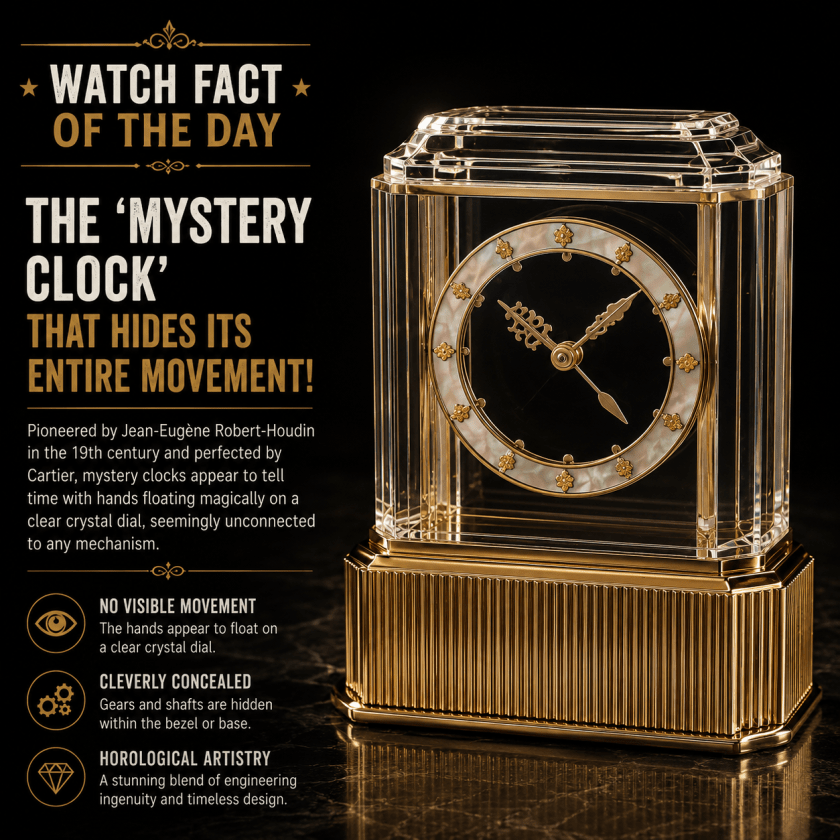
Watch Fact of the Day: The ‘Mystery Clock’ That Hides Its Entire Movement!

So, mystery clocks are these super cool timepieces that create the illusion of hands floating on a crystal dial, thanks to genius engineering by Jean-Eugène Robert-Houdin and later Cartier. Instead of traditional setups, their hands are on almost invisible discs moved by hidden gears. This mix of clockmaking and magic has made them an art form, highly sought after by collectors and royalty alike. Today, original models fetch crazy prices at auctions, proving they still wow people even in our digital age. Fun fact: Harry Houdini’s name pays homage to Robert-Houdin, showcasing the magic blend of these iconic clocks!

📅 Thursday, July 23, 2026

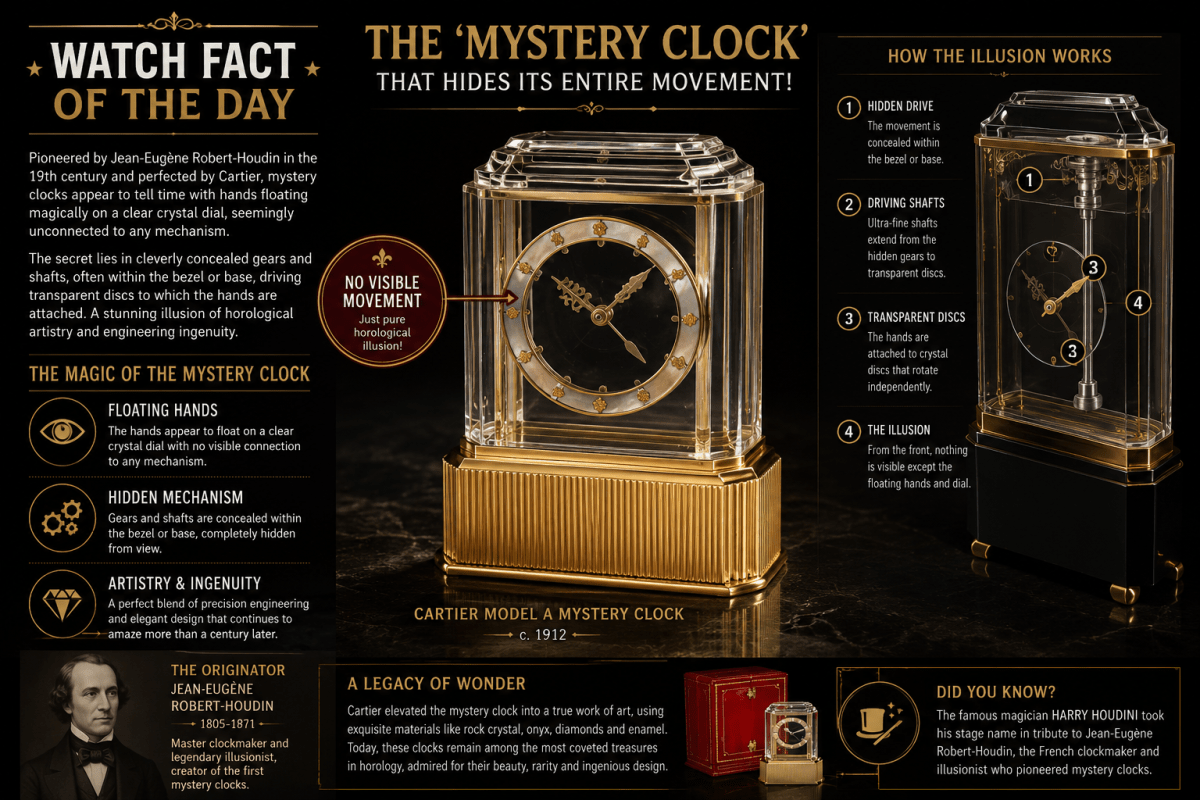
Mystery clocks, pioneered by Jean-Eugène Robert-Houdin in the 19th century and perfected by Cartier, appear to tell time with hands floating magically on a clear crystal dial, seemingly unconnected to any mechanism. The secret lies in cleverly concealed gears and shafts, often within the bezel or base, driving transparent discs to which the hands are attached. This illusion creates a captivating display of horological artistry and engineering ingenuity.


Mystery Clock
Mystery Clock

The illusion is so convincing that even experienced collectors often find themselves searching for the hidden movement. Rather than being attached to a central pinion like a traditional clock, the hands are mounted to nearly invisible crystal discs that rotate independently. These discs are driven by finely machined gears concealed within the clock’s frame, allowing the hands to appear as though they are suspended in mid-air. The effect is equal parts engineering and stage magic—a fitting legacy for Robert-Houdin, who was not only a master clockmaker but also one of history’s greatest illusionists.

In the early 20th century, Cartier elevated the mystery clock into a true work of decorative art. Combining exquisite craftsmanship with luxurious materials such as rock crystal, jade, onyx, enamel, diamonds, and precious metals, Cartier’s mystery clocks became prized possessions of royalty, industrialists, and collectors around the world. Each piece required extraordinary precision to ensure the hidden mechanism remained completely concealed while maintaining flawless timekeeping, making them some of the most technically demanding clocks ever produced.

Today, original mystery clocks rank among the most desirable and valuable creations in horology, often commanding extraordinary prices at auction. More than a century after they first amazed audiences, they continue to blur the line between science, engineering, and illusion. Even in an age of digital technology, few mechanical creations inspire the same sense of wonder as watching a pair of hands glide effortlessly across a crystal dial with no visible connection to the movement that drives them.


💡 Did You Know?

The famous magician Harry Houdini took his stage name in tribute to Jean-Eugène Robert-Houdin, the French clockmaker and illusionist who pioneered mystery clocks. Although Houdini later criticized Robert-Houdin’s work, his legendary stage name remains a lasting tribute to the man whose ingenious mechanical illusions captivated audiences decades earlier.

Category: Fun Quirk

Disclaimer: Every effort has been made to keep these watch facts accurate, but the world of horology is full of myths, disputed stories, and fascinating trivia. Consider these facts a starting point for discovery rather than the final word. If you have corrections or additional insights, let us know—we’re always happy to keep the record ticking in the right direction.

🕐 Discover more watch facts, reviews, and buying guides at WatchesAndMore


🛍️ You Might Also Like

As an Amazon Associate and affiliate partner, WatchesAndMore earns from qualifying purchases.

G-Shock GA2100-1A1 CasiOak


G-Shock GA2100-1A1 CasiOak

Casio

★★★★★ 4.8 (2,156 reviews)

$99


Check Price on Amazon →

Casio Edifice Chronograph


Casio Edifice Chronograph

Casio

★★★★★ 4.7 (1,264 reviews)

$120


Check Price on Amazon →


Browse all 75+ expert-reviewed watches →

The Watch Advisor
Find Your Perfect Watch

Watch Fact of the Day: The ‘Doctor’s Watch’ with a Pulsometer Scale

Back in the day, doctors used specialized watches with pulsometer scales to measure patients’ heart rates. They’d start the stopwatch, count heartbeats for 15 or 30 seconds, then instantly get the beats per minute from the scale—no math required. These watches were key tools for medical pros, especially Swiss brands like Longines and Omega. Even though electronic devices took over, collectors still love these timepieces for their craftsmanship and history. Think of it as a time when watches had a real purpose beyond just telling time, serving as vital instruments alongside stethoscopes in the medical field.

📅 Wednesday, July 22, 2026

Before digital devices, doctors relied on specialized watches to quickly measure a patient’s pulse. These ‘doctor’s watches’ featured a pulsometer scale on the dial or bezel, allowing a physician to start the chronograph, count a specific number of heartbeats (e.g., 15 or 30), and then read the beats per minute directly from the scale. This ingenious complication was a vital diagnostic tool in medical practice for decades.


The pulsometer was one of several purpose-built scales developed for chronographs during the late 19th and early 20th centuries. Unlike a standard tachymeter, which measures speed over a known distance, a pulsometer was calibrated specifically for heart rate. After counting a predetermined number of heartbeats—commonly 15 or 30—the physician could stop the chronograph and read the patient’s pulse directly in beats per minute, eliminating the need for mental calculations during a medical examination.

Many renowned Swiss manufacturers, including Longines, Omega, Universal Genève, and later Patek Philippe, produced elegant chronographs featuring pulsometer scales. These watches became trusted companions for physicians making hospital rounds, house calls, and even battlefield examinations, where speed and accuracy could make a critical difference. The distinctive scales, often printed in red or blue around the edge of the dial, remain some of the most visually striking complications ever created.

Although electronic monitors have long replaced the pulsometer in everyday medical practice, these watches remain highly sought after by collectors. They represent a fascinating period when mechanical watchmaking wasn’t just about telling time—it provided practical tools for professionals. Today, a well-preserved doctor’s chronograph is admired not only for its craftsmanship but also as a reminder of an era when a skilled physician’s most important diagnostic instruments were a stethoscope, a trained eye, and a watch.


💡 Did You Know?

Doctor’s watches weren’t the only profession-specific timepieces. Watchmakers also created telemeter chronographs for measuring the distance of visible events like lightning, tachymeter chronographs for calculating speed, and asthmometer watches designed to help physicians measure a patient’s breathing rate—showcasing just how versatile mechanical chronographs became before the digital age.

Category: Watch History

Disclaimer: Every effort has been made to keep these watch facts accurate, but the world of horology is full of myths, disputed stories, and fascinating trivia. Consider these facts a starting point for discovery rather than the final word. If you have corrections or additional insights, let us know—we’re always happy to keep the record ticking in the right direction.

🕐 Discover more watch facts, reviews, and buying guides at WatchesAndMore


🛍️ You Might Also Like

As an Amazon Associate and affiliate partner, WatchesAndMore earns from qualifying purchases.

Bulova Precisionist


Bulova Precisionist

Bulova

★★★★★ 4.6 (1,100 reviews)

$219


Check Price on Amazon →

Timex Marlin Automatic 40mm


Timex Marlin Automatic 40mm

Timex

★★★★★ 4.7 (1,106 reviews)

$259


Check Price on Amazon →

More Watch Facts
More Watch Facts


Browse all 75+ expert-reviewed watches →