
📅 Thursday, July 30, 2026
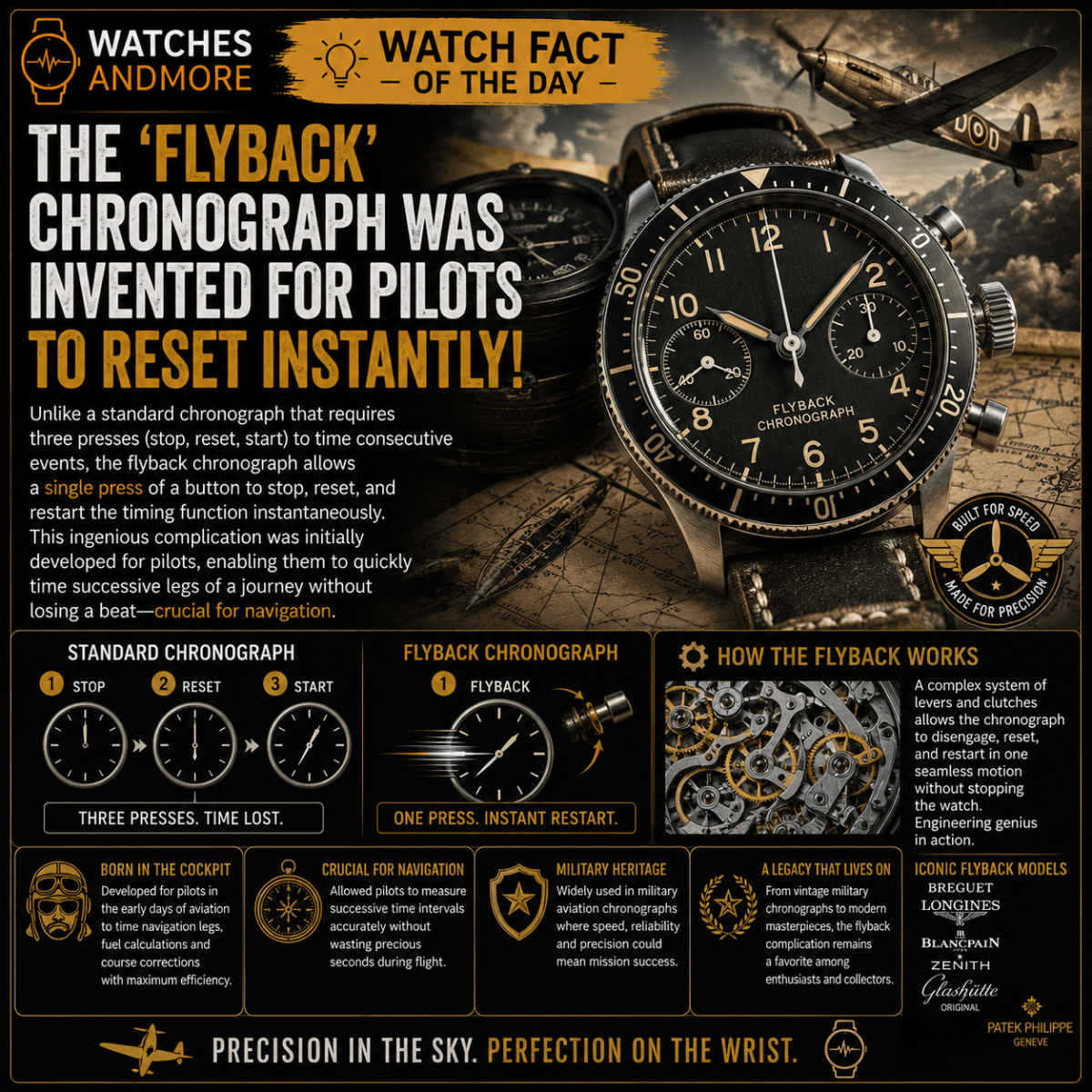
Unlike a standard chronograph that requires three presses (stop, reset, start) to time consecutive events, the flyback chronograph allows a single press of a button to stop, reset, and restart the timing function instantaneously. This ingenious complication was initially developed for pilots, enabling them to quickly time successive legs of a journey without losing a beat, crucial for navigation. It significantly streamlined timing operations in demanding cockpit environments.
The flyback chronograph, known in French as “retour en vol” (“return in flight”), became an indispensable tool during the early days of aviation. Before sophisticated onboard navigation systems, pilots relied on precise timing to calculate fuel consumption, airspeed, and course corrections between waypoints. With a standard chronograph, resetting the timer meant briefly stopping the measurement, wasting precious seconds. The flyback mechanism eliminated that delay, allowing the chronograph hand to instantly snap back to zero and continue timing with a single press of the lower pusher.
Mechanically, the flyback chronograph is considerably more complex than a traditional chronograph. A carefully engineered system of levers, cams, hammers, and clutches allows the chronograph to disengage, reset, and restart in one seamless motion without damaging the movement. This additional complexity makes flyback chronographs highly prized among collectors and showcases the remarkable ingenuity of Swiss watchmaking.
Today, the flyback complication remains a favorite among enthusiasts, not only for its practicality but also for its fascinating military and aviation heritage. Iconic models from Breguet, Longines, Blancpain, Zenith, Glashütte Original, and Patek Philippe continue to feature flyback chronographs, proving that a complication born out of necessity has become one of the most admired achievements in mechanical watchmaking.
💡 Did You Know?
Many vintage military pilot chronographs issued to the French Air Force during the 1950s and 1960s featured flyback movements. Pilots could reset and restart the chronograph with a single press while keeping one hand on the aircraft controls—a simple innovation that made navigation faster, safer, and more efficient in the cockpit.
Category: Fun Quirk
Disclaimer: Every effort has been made to keep these watch facts accurate, but the world of horology is full of myths, disputed stories, and fascinating trivia. Consider these facts a starting point for discovery rather than the final word. If you have corrections or additional insights, let us know—we’re always happy to keep the record ticking in the right direction.
🕐 Discover more watch facts, reviews, and buying guides at WatchesAndMore
🛍️ You Might Also Like
As an Amazon Associate and affiliate partner, WatchesAndMore earns from qualifying purchases.



Browse all 142+ expert-reviewed watches →
☕ Help Support WatchesAndMore
If you enjoyed this article and would like to help support WatchesAndMore, consider visiting my Etsy Shop or browsing my designs on Redbubble. Every purchase helps support the continued creation of watch reviews, historical articles, buying guides, videos, and all the free content you enjoy here on the website and on YouTube.
Your support allows me to spend more time researching fascinating stories from the world of horology, testing new watches, and producing high-quality content for collectors and enthusiasts around the globe. Whether you’re looking for unique watch-themed merchandise or simply want to support the channel, every order is genuinely appreciated. Thank you for being part of the WatchesAndMore community—your support helps keep the passion for watches alive! ⌚🍻




 WatchesAndMoreCO