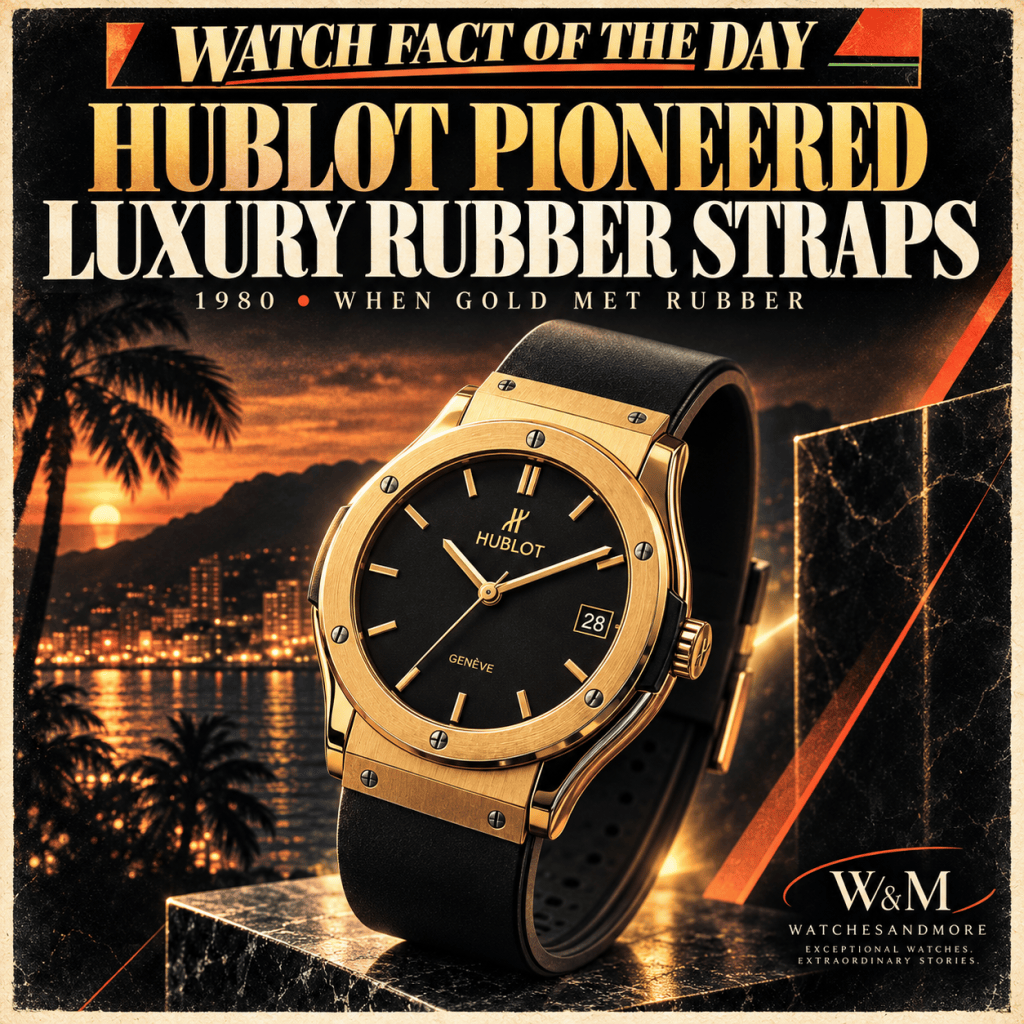
https://youtube.com/shorts/JZRqC9UTHVk?si=bptpMfLQnJCuMNKn
https://youtube.com/shorts/JZRqC9UTHVk?si=bptpMfLQnJCuMNKn
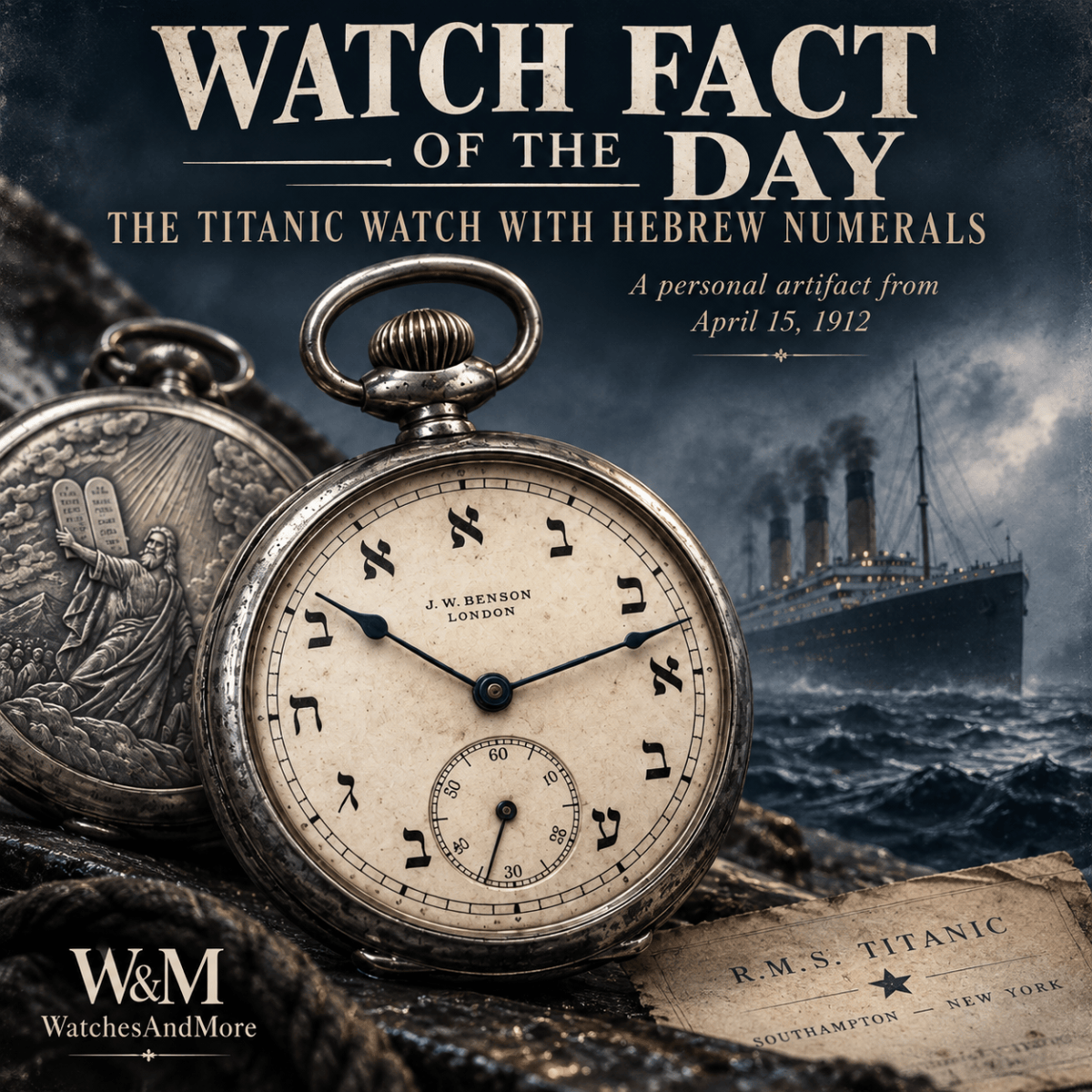
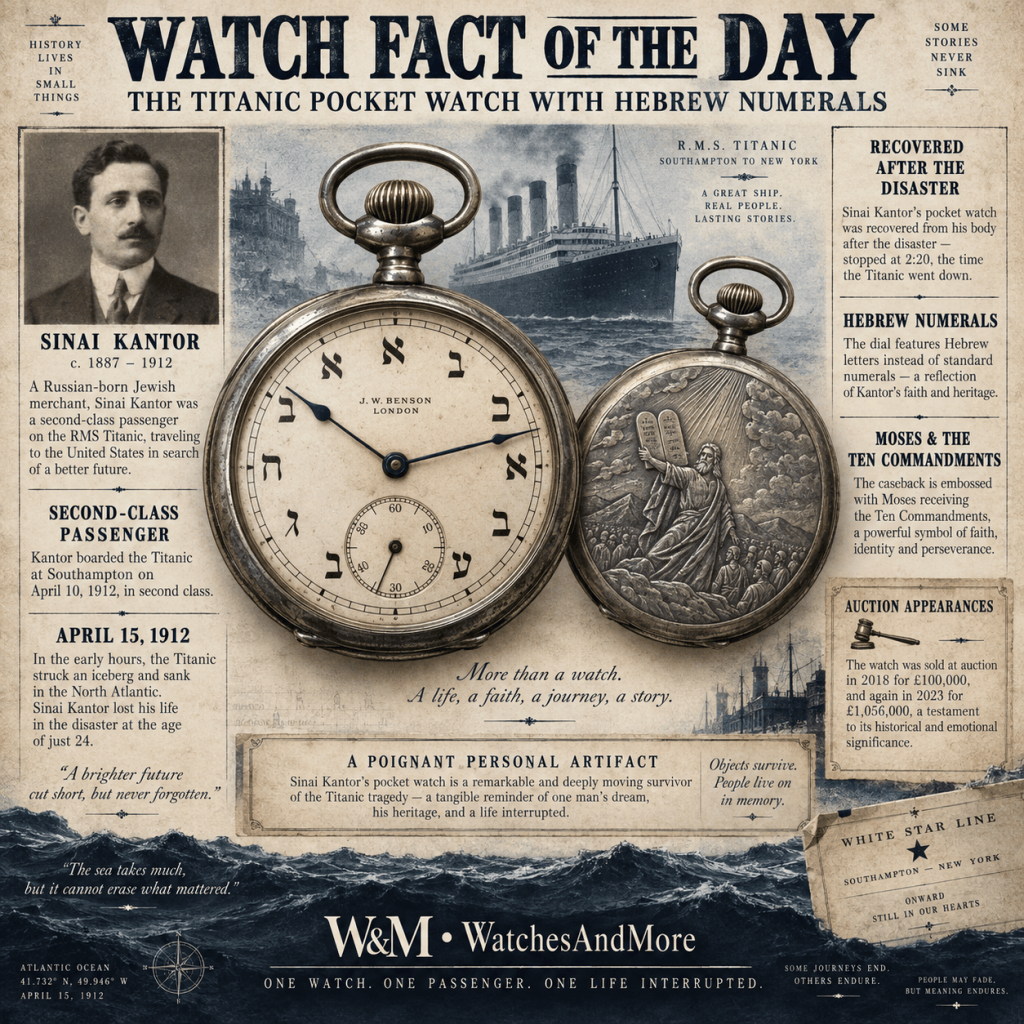
Sinai Kantor’s pocket watch, recovered from the Titanic wreckage, is a poignant artifact of human tragedy and resilience. This Swiss-made timepiece bears Hebrew numerals and an embossed depiction of Moses, connecting deeply to Kantor’s Jewish identity. As a second-class passenger, Sinai aimed to start anew in America with his wife, Miriam, who survived the disaster. The watch stopped around 2:25 a.m., leaving a haunting reminder of that fateful night. Its sale at auctions for impressive sums underscores its significance as a personal relic amidst the Titanic’s vast history, humanizing a tale often told through cold statistics.
📅 Thursday, September 17, 2026
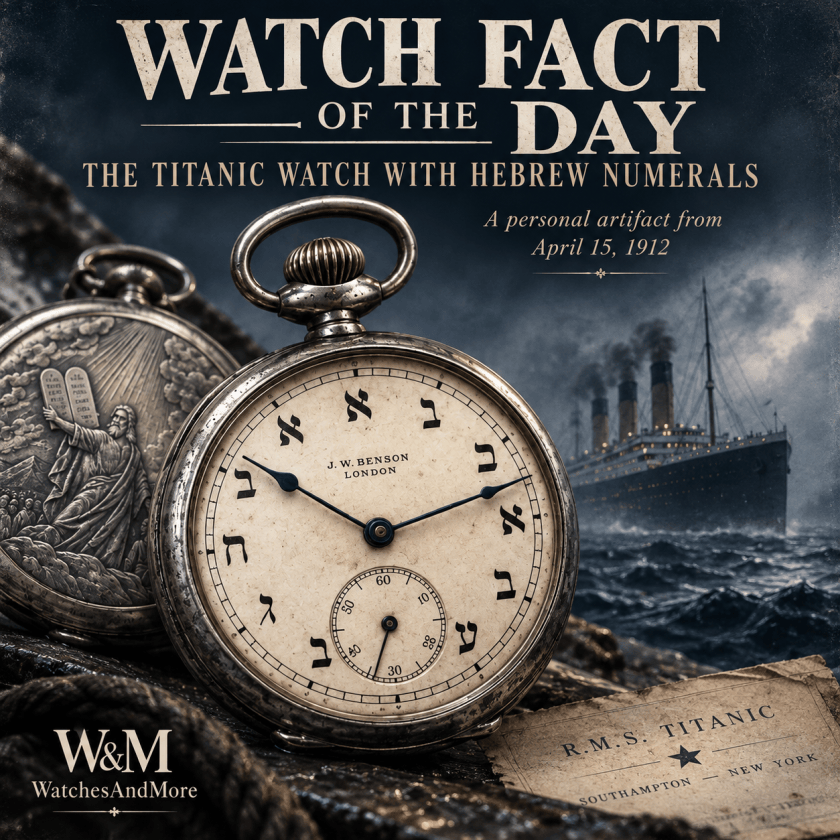
Among the many personal objects recovered after the sinking of the RMS Titanic, one pocket watch stands out for both its appearance and the story of the man who carried it.
The watch belonged to Sinai Kantor, a 34-year-old Jewish immigrant from Vitebsk in the Russian Empire who was traveling to New York with his 24-year-old wife, Miriam. The couple boarded Titanic at Southampton as second-class passengers, hoping to begin a new life in America. Sinai was a furrier and reportedly intended to sell furs to help finance further study after their arrival. Miriam survived the disaster; Sinai did not.
What makes Kantor’s watch extraordinary is its unmistakably personal design.
The Swiss-made, open-face pocket watch has Hebrew letters in place of conventional numerals around the dial. Its back cover carries an embossed scene of Moses holding the Ten Commandments, making the watch not only a timekeeper but also an object closely connected to Kantor’s Jewish identity.
When Titanic sank in the North Atlantic in the early hours of April 15, 1912, Kantor was among the passengers who lost their lives. His body was later recovered by the cable ship CS Mackay-Bennett, and the pocket watch was among the belongings ultimately returned to his widow. Surviving documentation lists a “silver watch and strap” among his recovered effects, helping establish the watch’s provenance.
More than a century in salt water left its mark.
The hands are now almost completely deteriorated, the dial is stained, and the movement shows extensive rust. Yet dried water marks on the dial have been interpreted as indicating that the watch stopped at approximately 2:25 a.m. — only a few minutes after Titanic disappeared beneath the surface. That detail should be treated as an interpretation of the surviving marks rather than absolute proof of the exact moment the mechanism stopped, but it adds an undeniably haunting dimension to the object.
The watch has also become a significant Titanic collectible.
In 2018, Heritage Auctions sold it for $57,500. Then in 2023, it appeared at auction again and sold for £97,000, roughly $118,700 at the time. The dramatic increase reflects not just the watch itself, but the importance collectors place on objects with strong provenance and a deeply documented personal story.
Sinai and Miriam Kantor were not traveling as wealthy first-class passengers.
They were second-class immigrants heading toward a new life in New York.
Miriam survived in Lifeboat No. 12, while Sinai’s body was recovered days later. His effects eventually made their way back to her after considerable administrative effort.
That makes this watch much more than Titanic memorabilia.
It is one of the few surviving personal objects that still connects us directly to an individual passenger.
Titanic is often remembered through statistics:
more than 1,500 dead
one enormous ship
one catastrophic night
But objects like Sinai Kantor’s pocket watch bring the story back down to human scale.
A watch.
A husband.
A wife.
A journey toward a new life.
A dial marked with Hebrew letters.
A back cover showing Moses and the Ten Commandments.
And a movement scarred by the Atlantic more than a century ago.
Category: Watch History
Disclaimer: Every effort has been made to keep these watch facts accurate, but the world of horology is full of myths, disputed stories, and fascinating trivia. Consider these facts a starting point for discovery rather than the final word. If you have corrections or additional insights, let us know—we’re always happy to keep the record ticking in the right direction.
🕐 Discover more watch facts, reviews, and buying guides at WatchesAndMore
As an Amazon Associate and affiliate partner, WatchesAndMore earns from qualifying purchases.
Timex
★★★★★ 4.5 (3,041 reviews)
$79

Browse all 142+ expert-reviewed watches →
Further reading: Fondation de la Haute Horlogerie — watchmaking glossary
Which detail in this story interests you most, and would it influence what you wear or collect? Share your thoughts in the comments below.
🛍️ Explore designs, gifts and more at the W&M companion shop.
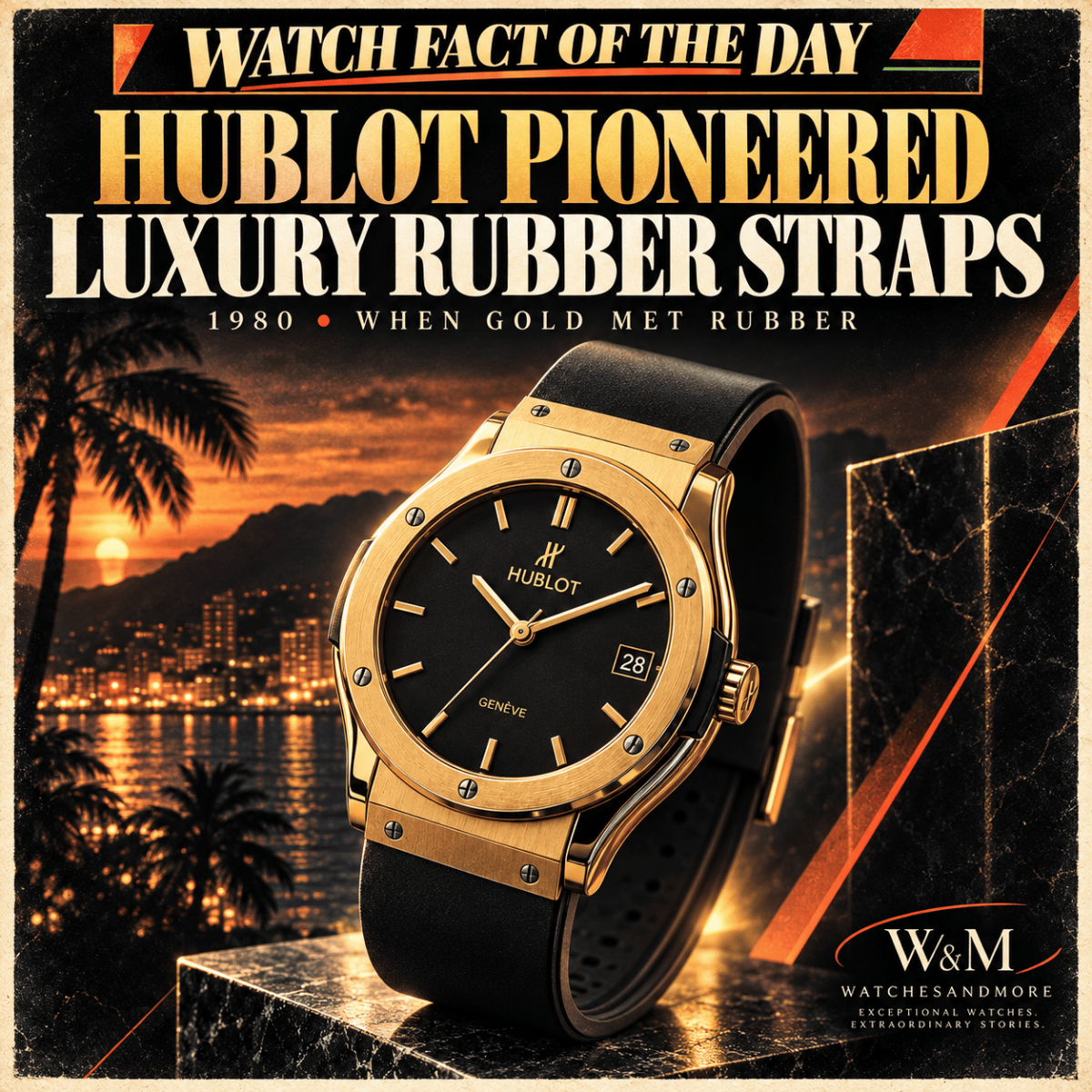
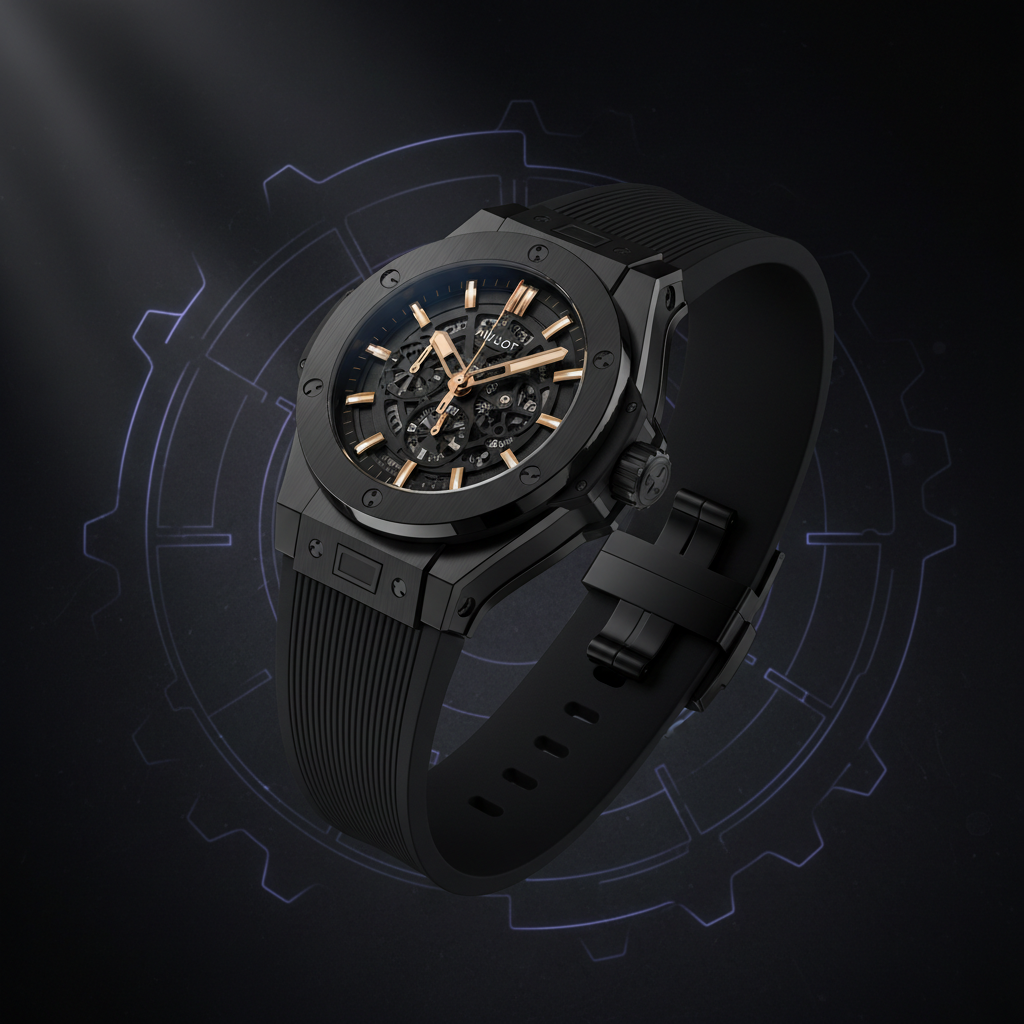
In 1980, Carlo Crocco revolutionized luxury watchmaking by introducing Hublot, the first watch to combine gold with a rubber strap, challenging traditional norms. This innovative blend not only transformed perceptions of materials in high-end timepieces but also ignited a movement known as the “Art of Fusion.” Crocco’s design, inspired by a ship’s porthole, emphasized the beauty in contrast, creating a lasting impact on the industry. Today, rubber straps are ubiquitous in luxury collections, proving that daring creativity can reshape conventions. Hublot’s legacy continues to inspire, encouraging a bold approach to design that merges sophistication with modernity.
📅 Wednesday, September 16, 2026
Today, seeing a six-figure luxury watch on a rubber strap barely raises an eyebrow.
In 1980, it was borderline heresy.
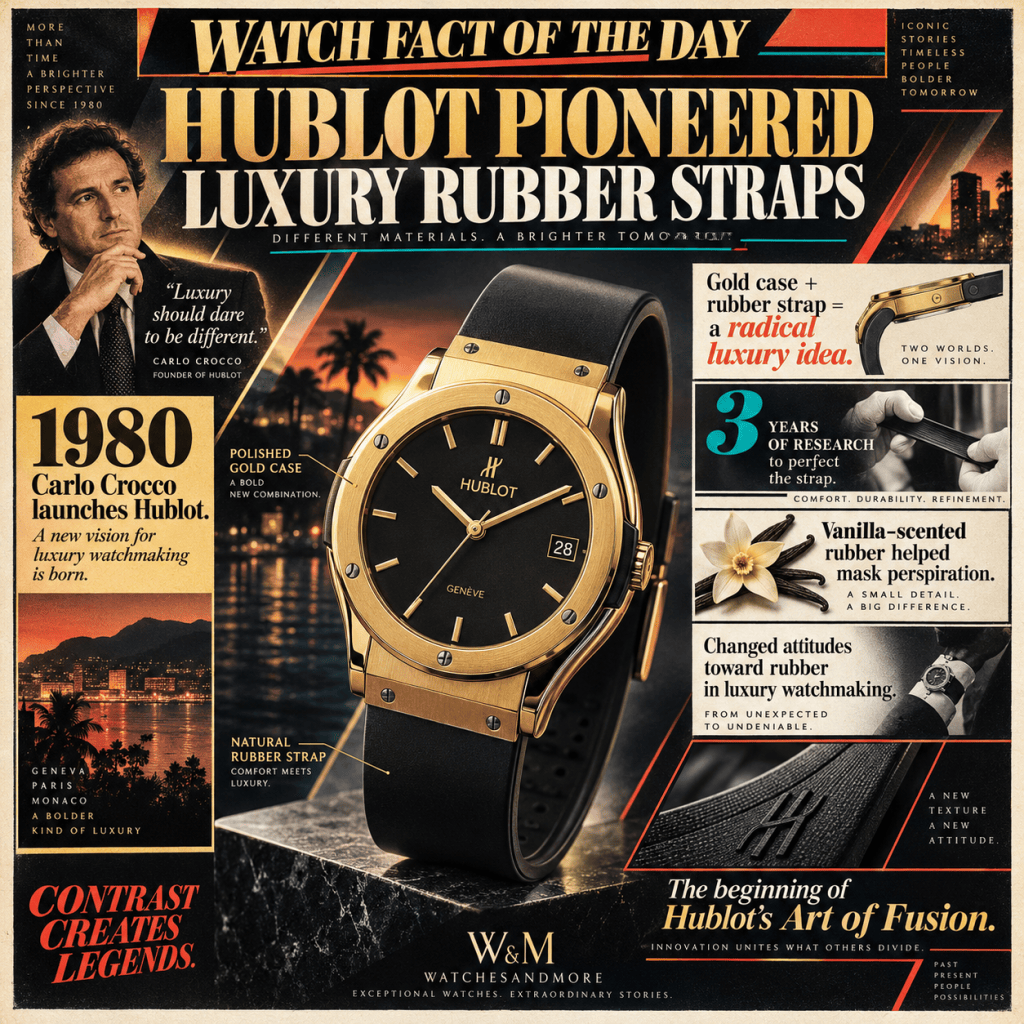
When Italian entrepreneur Carlo Crocco introduced the first Hublot, he paired a gold luxury watch with a black natural-rubber strap—a combination that challenged one of the most traditional assumptions in Swiss watchmaking. Precious metals belonged on leather or matching metal bracelets. Rubber belonged on utilitarian sports equipment. Crocco decided they belonged together. Hublot
The watch itself was inspired by a ship’s porthole—“hublot” in French—with a round bezel secured by visible screws, a minimalist black dial, and an integrated rubber strap flowing directly from the case. The contrast was the whole point: refined gold above, modern rubber below. Hublot
And the strap wasn’t an afterthought.
Historical Hublot material says Crocco spent roughly three years developing the natural-rubber strap, refining its comfort, durability, and fit before the watch’s 1980 launch. Adfpr
That matters because Hublot wasn’t simply putting a cheap strap on an expensive watch.
It was deliberately redefining what a luxury material combination could look like.
At the time, those two materials seemed to belong to completely different worlds.
And that tension became Hublot’s identity.
The original concept became the seed of what Hublot would later call the:
The philosophy was bigger than rubber itself.
It was the idea that watchmaking could deliberately combine materials that traditional luxury normally kept apart:
gold + rubber
ceramic + metal
carbon + precious materials
sapphire + mechanical watchmaking
Jean-Claude Biver later made that distinction explicit: the message wasn’t simply rubber—it was fusion. Hodinkee
That first 1980 watch was therefore much more important than it might look today.
Because now?
Rubber straps are everywhere in high-end watchmaking.
Patek Philippe, Richard Mille, IWC, Chanel, Hermès and many others have embraced sporty elastomer or composite straps in luxury collections. What once looked shocking became normal. South China Morning Post
Hublot’s early success came from asking a very simple design question:
Crocco didn’t make rubber luxurious by pretending it was leather.
He made the contrast itself luxurious.
That was the breakthrough.
And that combination helped establish one of the strongest material philosophies in modern watch design.
Category: Brand Spotlight
Disclaimer: Every effort has been made to keep these watch facts accurate, but the world of horology is full of myths, disputed stories, and fascinating trivia. Consider these facts a starting point for discovery rather than the final word. If you have corrections or additional insights, let us know—we’re always happy to keep the record ticking in the right direction.
🕐 Discover more watch facts, reviews, and buying guides at WatchesAndMore
As an Amazon Associate and affiliate partner, WatchesAndMore earns from qualifying purchases.
Timex
★★★★★ 4.5 (3,041 reviews)
$79

Browse all expert-reviewed watches →
Further reading: Fondation de la Haute Horlogerie — watchmaking glossary
Which detail in this story interests you most, and would it influence what you wear or collect? Share your thoughts in the comments below.
🛍️ Explore designs, gifts and more at the W&M companion shop.
Imagine a clock that runs on room temperature changes instead of batteries, motors, or your daily winding efforts—enter the Jaeger-LeCoultre Atmos! This genius contraption, dating back to 1928, uses a sealed capsule that flexes with temperature shifts, cranking itself up like a lazy friend who suddenly remembers they owe you lunch. With just a 1°C change, it can keep ticking for 48 hours, consuming less energy than a light bulb. So, if you want to impress your guests with a clock that’s basically a temperature leech, the Atmos is the way to go—just don’t forget to keep your thermostat cozy!

📅 Tuesday, September 15, 2026
Imagine a mechanical clock that you never plug in, never replace a battery in, and normally never wind by hand.
That is the extraordinary idea behind the Jaeger-LeCoultre Atmos.
Its mechanism traces back to an invention by Jean-Léon Reutter in 1928, later developed and brought to market by Jaeger-LeCoultre during the 1930s. Instead of depending on a conventional winding routine, the Atmos captures tiny changes in the temperature of the room around it and converts those changes into mechanical energy.

At the heart of the system is a hermetically sealed capsule connected to the clock’s mainspring mechanism. As the surrounding temperature rises or falls, the material inside the capsule expands or contracts. That movement flexes a membrane and gradually winds the clock.
No motor.
No wall plug.
No daily winding ritual.
Just:
Jaeger-LeCoultre says a change of only 1°C in ambient temperature can provide approximately 48 hours of power reserve. That is possible because the Atmos consumes an astonishingly small amount of energy. Its slow-moving ring-shaped balance operates at just 0.02 Hz, and the manufacture says it consumes roughly 250 times less energy than the balance of a conventional wristwatch.
That efficiency is really the secret.
The Atmos does not produce energy from nothing.
Instead, it needs so little energy that ordinary temperature fluctuations in a room can supply enough mechanical work to keep it operating. Jaeger-LeCoultre even calculates that approximately 60 million Atmos clocks would consume the same amount of energy as a single 15-watt light bulb.
And that gives the Atmos one of the most poetic operating principles in horology.
A sunny afternoon warms the room slightly.
Night arrives and the temperature falls.
The sealed capsule responds.
The mechanism quietly winds itself.
The clock continues.
The Atmos became so closely associated with Swiss craftsmanship that it was used as an official gift of the Swiss Confederation and became known as the “President’s Clock.” Jaeger-LeCoultre notes that heads of state and prominent visitors to Switzerland received examples during the 20th century.
But the part I love most is still the engineering.
A temperature change most of us would never even notice—
—can give the Atmos enough stored energy for roughly:
Most mechanical timepieces are designed around storing energy that we deliberately give them.
Wind the crown.
Wind the key.
Move your wrist.
Replace the battery.
The Atmos takes a completely different approach.
It quietly harvests energy already present in the environment.
That makes it less like a conventional clock and more like a tiny mechanical energy-harvesting machine.
Just:
Category: Fun Quirk
Disclaimer: Every effort has been made to keep these watch facts accurate, but the world of horology is full of myths, disputed stories, and fascinating trivia. Consider these facts a starting point for discovery rather than the final word. If you have corrections or additional insights, let us know—we’re always happy to keep the record ticking in the right direction.
🕐 Discover more watch facts, reviews, and buying guides at WatchesAndMore
As an Amazon Associate and affiliate partner, WatchesAndMore earns from qualifying purchases.

Browse all 142+ expert-reviewed watches →
Further reading: Fondation de la Haute Horlogerie — watchmaking glossary
Which detail in this story interests you most, and would it influence what you wear or collect? Share your thoughts in the comments below.
🛍️ Explore designs, gifts and more at the W&M companion shop.
In the wild and wacky world of 1970s watches, the Bulova Computron strutted onto the scene like a flashy futuristic disco ball. With its dazzling red LED display angled right at your face, this timepiece was less “watch” and more “dashboard for your wrist.” Forget wrist rotations; just a quick side glance got you the time while you cruised at breakneck speeds. No round dials, no hands, just pure electric glory in a trapezoidal shape. Basically, if you wanted to feel like a space-age driver while checking the time, the Computron was your ticket to the future—one battery-saving light show at a time!

📅 Monday, September 14, 2026
Introduced in the mid-1970s, the Bulova Computron became one of the most futuristic digital watches of its era. Instead of placing the display flat on top of the wrist like a conventional watch, Bulova angled the glowing red LED readout toward the wearer—an arrangement that made it especially easy to glance at while driving.
The Computron’s shape was unlike almost anything else on the market. Its trapezoidal case, integrated bracelet, and recessed red LED display looked more like a piece of automotive instrumentation than a traditional wristwatch. In an era obsessed with space-age design, electronic technology, and the promise of a computerized future, the Computron looked exactly like a watch from tomorrow.

That angled display gave it a practical advantage. Rather than rotating the wrist dramatically to see the time, the wearer could glance toward the side of the case. This made the Computron especially appealing to motorists and helped cement its reputation as one of the classic “driver’s watches” of the digital age.
Like most early LED watches, the display was not continuously illuminated. LEDs consumed significant battery power, so the wearer typically activated the display only when needed. Press a control, and the dark face suddenly came alive with glowing red numerals—a tiny electronic light show on the wrist.
💡 Did You Know?
The Computron’s design was almost the opposite of a normal watch.
Traditional watches are built around the idea that the dial should face directly upward.
The Computron asked a different question:
WHAT IF THE DISPLAY FACED YOU INSTEAD?
That one design decision transformed the watch from a simple digital timekeeper into something that felt more like a dashboard instrument worn on the wrist.
⭐ Why It Matters
The Computron is a perfect example of how radically watch design changed during the 1970s.
This was a period when brands were no longer limited by the visual language of mechanical movements, round dials, and traditional hands. Electronic technology gave designers permission to rethink what a watch could look like.
The Computron embraced that freedom completely.
NO HANDS.
NO ROUND DIAL.
NO TRADITIONAL WATCH SHAPE.
Just:
RED LEDs.
ANGLED DISPLAY.
PURE 1970s FUTURISM.
Category: Fun Quirk
Disclaimer: Every effort has been made to keep these watch facts accurate, but the world of horology is full of myths, disputed stories, and fascinating trivia. Consider these facts a starting point for discovery rather than the final word. If you have corrections or additional insights, let us know—we’re always happy to keep the record ticking in the right direction.
🕐 Discover more watch facts, reviews, and buying guides at WatchesAndMore
As an Amazon Associate and affiliate partner, WatchesAndMore earns from qualifying purchases.

Browse all 142+ expert-reviewed watches →
The movement, case, dial and strap contribute different things to a watch’s character. Comparing those parts separately can reveal why two similar-looking watches feel different to own.
The details are most useful when connected to the wearer’s needs and the design’s purpose. This story offers another way to look beyond the name on the dial.
Further reading: Fondation de la Haute Horlogerie — watchmaking glossary
Which detail in this story interests you most, and would it influence what you wear or collect? Share your thoughts in the comments below.
🛍️ Explore designs, gifts and more at the W&M companion shop.
Back in the day, clockmakers were on a mission to combat the effects of temperature on their timepieces. They created mercurial pendulums, where mercury in a jar at the bottom adjusted to heat changes, keeping clocks accurate. This nifty solution was a big deal before the advent of quartz and atomic clocks. While it was an impressive engineering feat, mercury wasn’t the safest material to work with. Eventually, better and safer methods replaced it, but the mercurial pendulum remains a cool example of how creativity and science played a role in crafting precise timepieces. Horology has always been about innovation, not just gears!

📅 Sunday, September 13, 2026
Long before modern alloys and electronic regulation, precision clockmakers searched for clever ways to fight one of timekeeping’s greatest enemies: temperature. As the weather changed, pendulum rods expanded and contracted, altering a clock’s rate. To solve the problem, some 19th-century regulators and observatory clocks used a mercurial pendulum, in which a jar of mercury at the bottom of the pendulum helped offset those changes. As the pendulum rod expanded downward in warmer temperatures, the mercury’s surface rose upward, compensating for the shift and helping the clock maintain far better accuracy.
The idea was both elegant and scientifically ingenious. Rather than fighting physics directly, clockmakers used one physical reaction to counteract another. This made mercurial pendulums an important step in the long quest for precision timekeeping, especially in observatory and regulator clocks where even tiny errors mattered. Before quartz and atomic timekeeping, this was cutting-edge technology—proof that great horology has always been as much about clever engineering as beautiful craftsmanship.

Of course, mercury came with obvious drawbacks. It was heavy, delicate to handle, and hazardous by modern standards, which meant these systems were never especially practical outside high-precision clockmaking. Over time, improved compensation pendulums and safer materials replaced them. Still, the mercurial pendulum remains one of the most fascinating examples of watchmakers and clockmakers using the science of their era to solve the eternal problem of keeping better time.
The mercurial pendulum wasn’t designed to make a clock run faster or slower on its own—it was designed to help the clock stay consistent as temperatures changed. That distinction made it a major breakthrough for scientific and observatory-grade timekeeping.
This story shows that horology has never been just about gears and springs. It has always been about creative problem-solving. Long before computers and electronics, clockmakers were already using chemistry, physics, and materials science to chase greater precision.
Category: Fun Quirk
Disclaimer: Every effort has been made to keep these watch facts accurate, but the world of horology is full of myths, disputed stories, and fascinating trivia. Consider these facts a starting point for discovery rather than the final word. If you have corrections or additional insights, let us know—we’re always happy to keep the record ticking in the right direction.
🕐 Discover more watch facts, reviews, and buying guides at WatchesAndMore
As an Amazon Associate and affiliate partner, WatchesAndMore earns from qualifying purchases.
Browse all 142+ expert-reviewed watches →
Further reading: Fondation de la Haute Horlogerie — watchmaking glossary
Which detail in this story interests you most, and would it influence what you wear or collect? Share your thoughts in the comments below.
🛍️ Explore designs, gifts and more at the W&M companion shop.
Ah, the infamous red pusher on a Hanhart pilot’s chronograph! It’s like the watch world’s version of a “don’t touch” sign, ensuring pilots don’t accidentally reset their crucial timing—because, you know, hitting the wrong button could be a bit of a timing disaster. Introduced in 1939, this vibrant button has also spawned a whimsical legend: a lovesick pilot had his button painted red with nail polish by his girlfriend, so he’d think of her while soaring through the skies. Whether true or not, it’s a fun tale that adds sparkle to an otherwise serious timepiece. One button, two stories—talk about a ticking mystery!

📅 Saturday, September 12, 2026
Look at a classic Hanhart pilot’s chronograph and one detail immediately jumps out.
It has become such a recognizable part of Hanhart’s design language that today it almost functions as a visual signature for the German watchmaker.
But unlike many decorative flourishes in watchmaking, the red button originally had a very practical purpose.
In 1939, Hanhart introduced its Tachy Tele and legendary Calibre 41 pilot chronographs following the company’s first series-produced Calibre 40 chronograph of 1938. Some of these early watches featured a distinctive red-lacquered chronograph pusher. Hanhart Chronographen
The reason was simple:
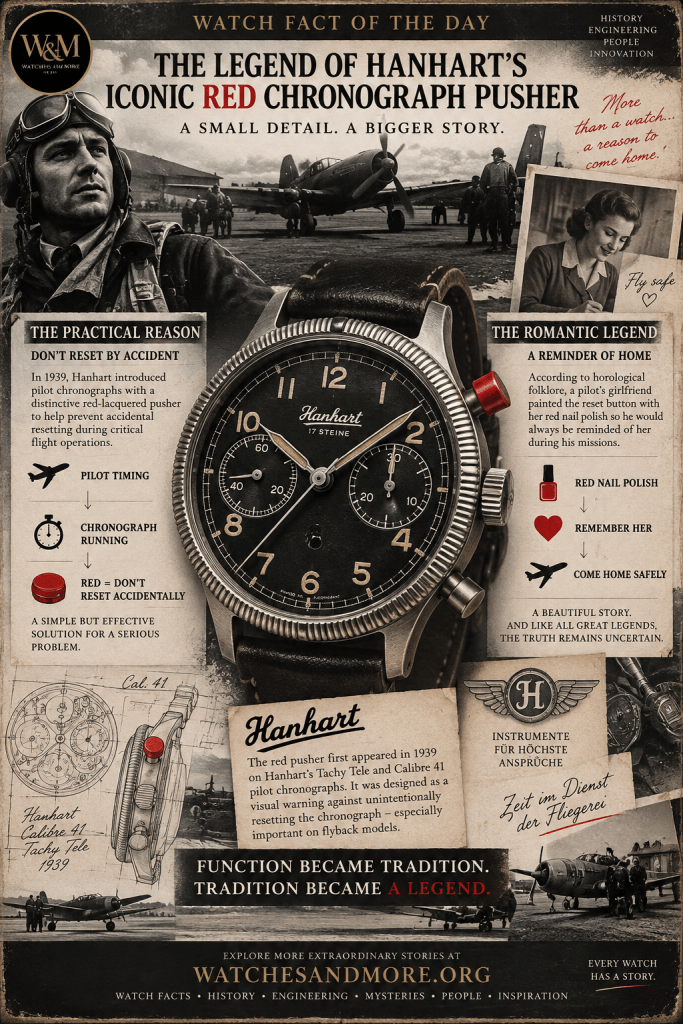
For a pilot relying on elapsed time, accidentally resetting the chronograph could erase an important timing measurement. The bright signal color made the reset control immediately recognizable and warned the wearer against pressing it unintentionally. Hanhart itself says the feature was intended to prevent pilots from inadvertently resetting their stopped time. Hanhart Chronographen
But that’s only half the story.
Because somewhere along the way, that little red button acquired one of the most romantic legends in watchmaking.
According to Hanhart’s own telling of the folklore, a pilot prepared to leave home for another flight.
After saying goodbye, he later looked down at his Hanhart chronograph in the hangar and discovered something unexpected.
One of the pushers had been painted red with nail polish by the woman he loved.
The idea was that whenever he looked at the red button during his mission, he would think of her—and remember to return safely home. Hanhart Chronographen
There’s just one problem.
And wonderfully, Hanhart itself acknowledges that uncertainty. On its current 417 ES Heritage material, the manufacture tells the romantic story and then explicitly says that it is unclear whether the legend is true. Hanhart Chronographen
That distinction is important for our Watch Fact.
We have:
DOCUMENTED HISTORY: 🔴
The red pusher served as a visual warning against accidentally resetting the chronograph.
And:
HOROLOGICAL FOLKLORE: ❤️
A pilot’s lover supposedly painted the button with red nail varnish so he would think of her and return safely.
Put those two stories together and you get one of watchmaking’s great little mysteries.
The red pusher wasn’t merely an aesthetic choice on watches equipped with a flyback chronograph.
A flyback allows the running chronograph to be reset and restarted immediately with a single press. That makes the function extremely useful when timing consecutive events—but it also makes an accidental press particularly consequential.
On modern Hanhart flyback models, the company still explains the red reset pusher as a warning against unintentionally resetting the elapsed time. Hanhart Chronographen
So that tiny splash of color was effectively an early form of human-interface design:
And that was happening on a mechanical wristwatch in 1939.
This is exactly the kind of story that makes vintage watches fascinating.
You could look at the red pusher and assume:
“That’s just Hanhart’s design signature.”
But behind that tiny detail is an entire story involving aviation, chronograph functionality, cockpit usability, wartime-era watchmaking—and possibly even a bottle of red nail polish.
What began as a practical warning eventually became something much bigger:
And Hanhart continues using the red-pusher identity today. Its modern watches reinterpret the feature using contemporary materials, including red HyCeram® on some current models. Hanhart Chronographen
And BBC Creative Department is already halfway through the infographic. 😂🔥
This one should look like a 1939 German aviation magazine × pilot’s flight log × wartime mechanical-instrument advertisement.
Almost everything is monochrome:
charcoal • aged ivory • aircraft aluminium • faded leather • black-and-white photography
Except for ONE THING.
Brilliant deep red.
Centerpiece: enormous vintage Hanhart pilot chronograph, slightly angled, with the red reset button practically glowing against the otherwise desaturated image.
On one side:
THE DOCUMENTED PURPOSE
✈️ PILOT TIMING
↓
⏱️ CHRONOGRAPH RUNNING
↓
🔴 RED = DON’T RESET ACCIDENTALLY
On the other:
THE LEGEND
💅 RED NAIL POLISH
↓
❤️ REMEMBER HER
↓
✈️ COME HOME SAFELY
And across the top:
Then the bottom payoff:
Ohhhhh yeah.
Category: Military Watches
Disclaimer: Every effort has been made to keep these watch facts accurate, but the world of horology is full of myths, disputed stories, and fascinating trivia. Consider these facts a starting point for discovery rather than the final word. If you have corrections or additional insights, let us know—we’re always happy to keep the record ticking in the right direction.
🕐 Discover more watch facts, reviews, and buying guides at WatchesAndMore
As an Amazon Associate and affiliate partner, WatchesAndMore earns from qualifying purchases.
Browse all 142+ expert-reviewed watches →
Further reading: Hanhart Chronographen
Hanhart Chronographen
Hanhart Chronographen
Which detail in this story interests you most, and would it influence what you wear or collect? Share your thoughts in the comments below.
🛍️ Explore designs, gifts and more at the W&M companion shop.
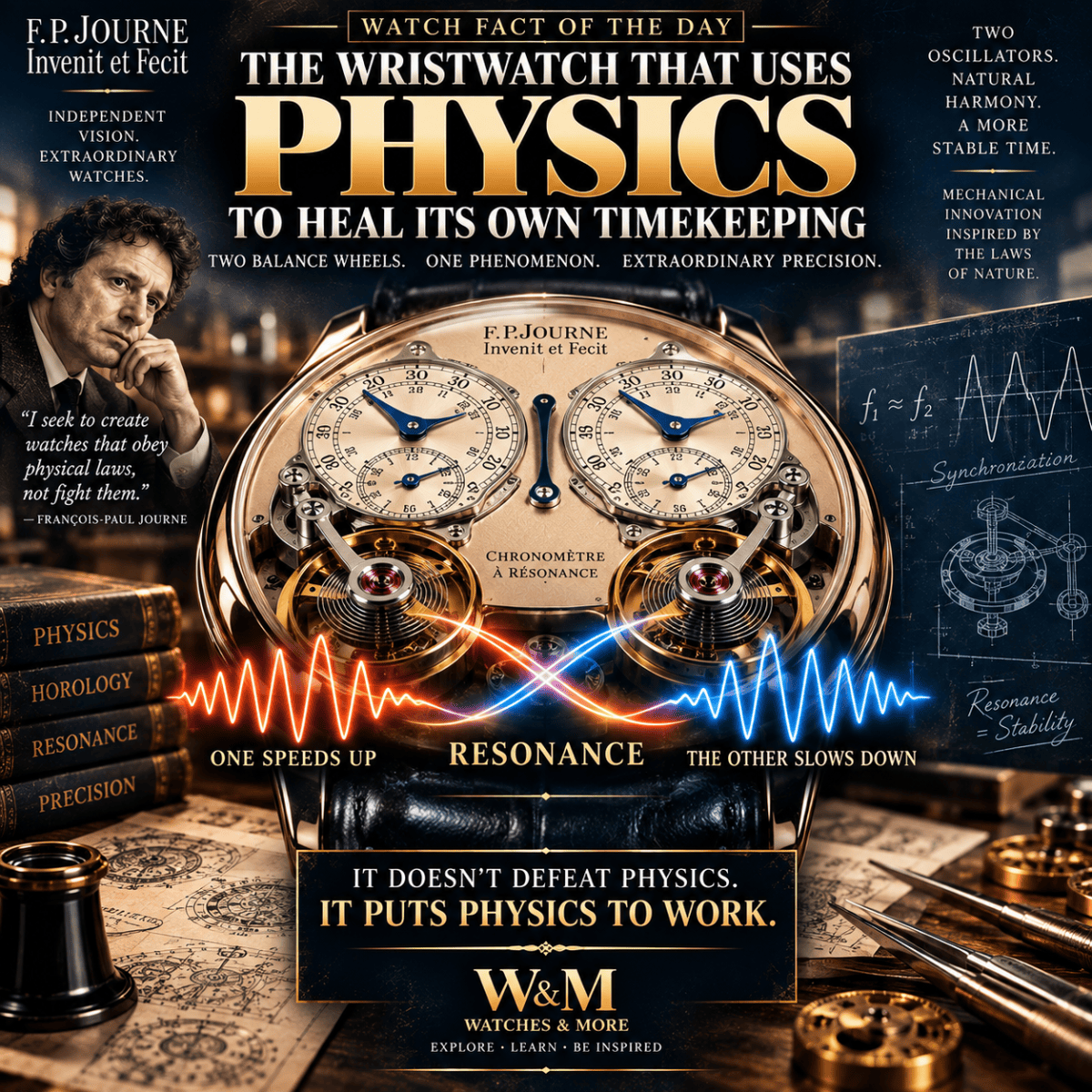
Francois-Paul Journe went big with his F.P. Journe Chronomètre à Résonance—this watch uses not one but two balance wheels for timekeeping! Launched in 2000, it’s based on the idea of resonance, allowing the two movements to sync up naturally when they’re tuned close enough. So, when you move your wrist, if one balance speeds up, the other slows down to keep everything in check. It’s a clever twist on traditional watchmaking, where usually you’d try to block disturbances. Journe’s design proves that two delicate systems can work together to combat movement, changing the game in wristwatch accuracy.

📅 Friday, September 11, 2026
Most mechanical watches rely on a single balance wheel—the tiny oscillating regulator whose rhythmic motion determines how accurately the watch keeps time.
François-Paul Journe decided to use two.
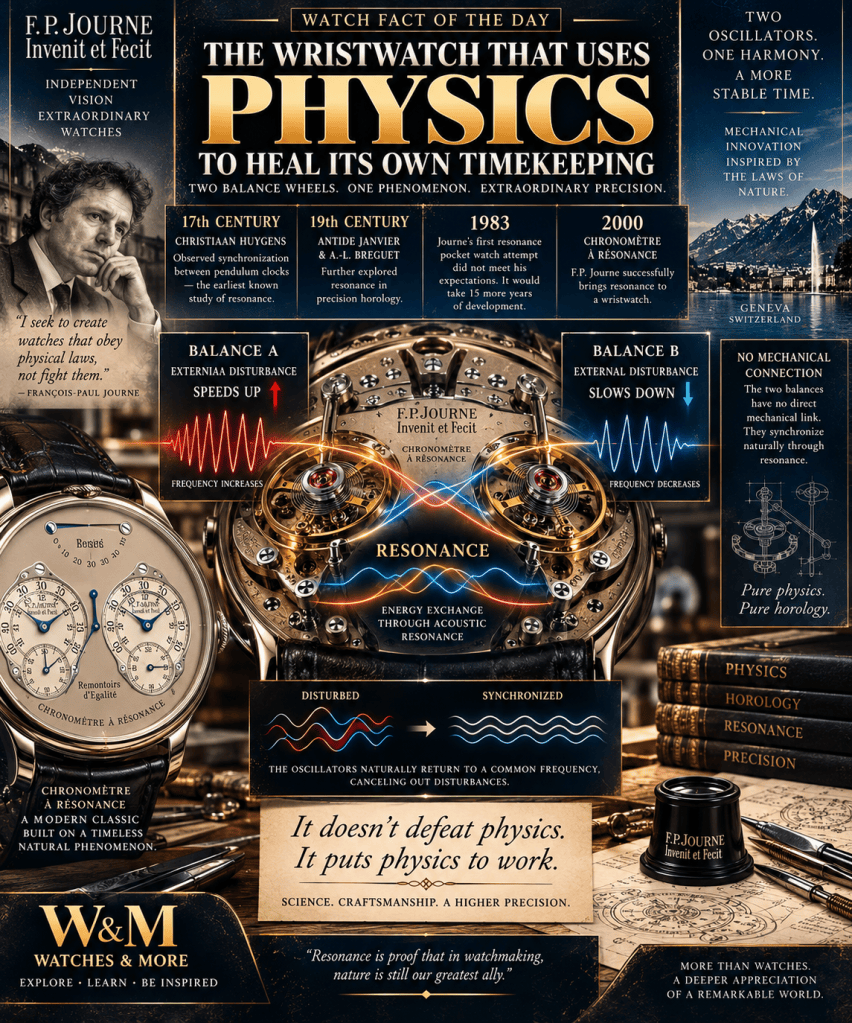
The result was the F.P. Journe Chronomètre à Résonance, unveiled as a wristwatch in 2000 after Journe had spent years pursuing one of horology’s most fascinating physical phenomena: resonance. F.P. Journe
The idea sounds almost impossible.
Inside the original Chronomètre à Résonance are two independent movements, each possessing its own escapement and balance. When their frequencies are adjusted sufficiently close to one another—F.P. Journe specifies a difference of no more than five seconds per day accumulated across six positions—the two oscillators begin interacting through resonance and naturally settle into synchronized opposition. F.P. Journe
And here’s where the physics becomes extraordinary.
Move your wrist and an ordinary mechanical oscillator can be disturbed. In the Résonance, Journe explains that the same disturbance can cause one balance to accelerate while the other slows by a corresponding amount.
Because the two are coupled through resonance, they progressively return toward their shared point of harmony.
The disturbance is therefore counteracted rather than simply being allowed to influence one isolated regulator. F.P. Journe
And there is no conventional mechanical transmission connecting the two balances to make this synchronization happen. F.P. Journe describes the Chronomètre à Résonance as using the natural phenomenon of resonance without mechanical transmission between the oscillators. F.P. Journe
François-Paul Journe didn’t invent the phenomenon of horological resonance itself.
The story reaches back centuries. Dutch scientist Christiaan Huygens observed synchronization between pendulum clocks in the 17th century, while Antide Janvier and Abraham-Louis Breguet later explored resonance in precision horology. Journe’s achievement was adapting the principle to the extraordinarily difficult environment of a wristwatch, where the mechanism is continually subjected to the movements of its wearer. F.P. Journe
Journe actually attempted a resonance pocket watch in 1983, but it didn’t perform to his expectations. According to F.P. Journe, another 15 years of experience and development were required before he could realize the concept successfully as a wristwatch. F.P. Journe
That makes the eventual watch even more fascinating.
The two balance wheels aren’t merely there because two oscillators look impressive through a caseback.
They are the experiment.
They are the physics.
They are the entire point.
Watchmakers traditionally pursue precision by trying to isolate the regulating organ from disturbances or minimize their effects.
Journe pursued another possibility:
What if a second oscillator could help the first?
The resulting watch demonstrates something beautifully counterintuitive: two extremely delicate mechanical systems can interact so that the overall system becomes better able to cope with disturbances encountered on the wrist. F.P. Journe
It’s also worth avoiding the tempting description of one balance permanently “correcting” the other. F.P. Journe explains that each balance alternately acts as exciter and resonator. Neither is simply the master and neither is simply the slave. F.P. Journe
They influence each other.
Category: Fun Quirk
Disclaimer: Every effort has been made to keep these watch facts accurate, but the world of horology is full of myths, disputed stories, and fascinating trivia. Consider these facts a starting point for discovery rather than the final word. If you have corrections or additional insights, let us know—we’re always happy to keep the record ticking in the right direction.
🕐 Discover more watch facts, reviews, and buying guides at WatchesAndMore
As an Amazon Associate and affiliate partner, WatchesAndMore earns from qualifying purchases.
Browse all 142+ expert-reviewed watches →
Further reading: F.P. Journe
F.P. Journe
F.P. Journe
Which detail in this story interests you most, and would it influence what you wear or collect? Share your thoughts in the comments below.
🛍️ Explore designs, gifts and more at the W&M companion shop.
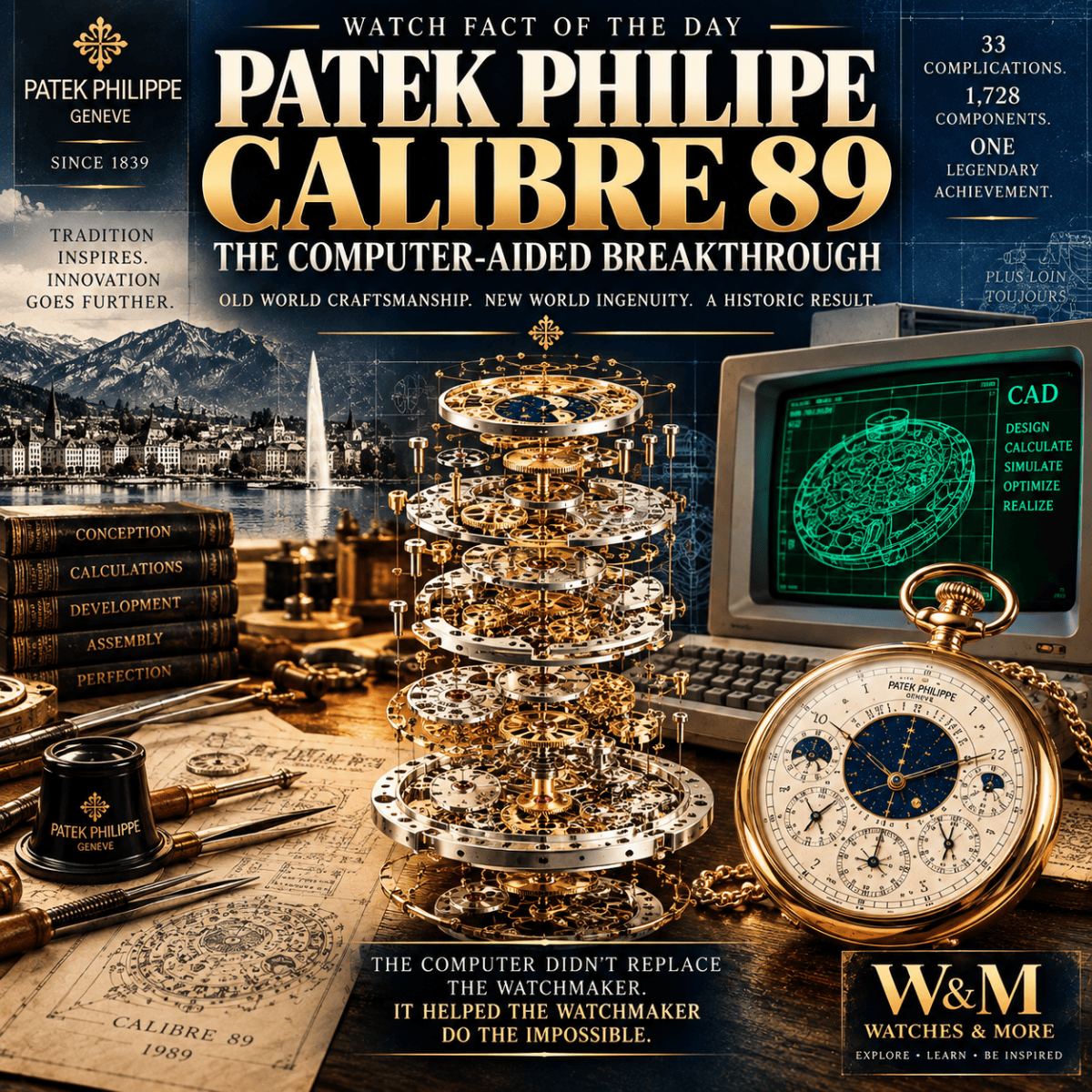
In a thrilling plot twist worthy of any sci-fi blockbuster, Patek Philippe decided to mix the old with the new while crafting the world’s most complicated watch for its 150th anniversary. The Calibre 89, featuring an astonishing 1,728 components and 33 complications, was partly designed with a computer—yes, you read that right! Who knew engineers could shake up Swiss watchmaking? With a team including a genius draughtswoman and some skeptical watchmakers, they created a pocket machine capable of knowing when Easter falls (no, it’s not just chocolate day). The lesson here? Computers can assist watchmakers, but only they can make time truly tick!

📅 Thursday, September 10, 2026
When Patek Philippe began planning an extraordinary watch for its 150th anniversary in 1989, Philippe Stern had an audacious objective: create a mechanical timepiece more complicated than anything the manufacture had built before.
But achieving it would require something decidedly unconventional in traditional Swiss watchmaking.
Preliminary calculations for what became the Calibre 89 began in 1980. Philippe Stern entrusted the project to Jean-Pierre Musy, a 28-year-old engineer, rather than placing it exclusively in the hands of Patek’s veteran master watchmakers. It was a controversial decision. Stern later recalled that some traditional watchmakers doubted that a young engineer could successfully construct such an extraordinarily complicated watch. Hodinkee
The problem was staggering.
The finished Calibre 89 contained 1,728 components and incorporated 33 complications, all arranged inside an approximately 89 mm pocket-watch case. Its functions included a secular perpetual calendar, split-seconds chronograph, minute repeater, grande and petite sonnerie, alarm, equation of time, sunrise and sunset indications, sidereal time, celestial chart and even the date of Easter. Patek Philippe
Trying to determine how all those interacting mechanisms could coexist within one movement demanded a new approach.
Musy’s team combined traditional mechanical watchmaking with computer-assisted design and manufacturing techniques. One particularly fascinating contributor was draughtswoman Frédérique Zesiger, who worked directly with a computer to produce approximately 1,660 detailed component drawings. The system could calculate fabrication coordinates and recalculate positions as the movement’s incredibly dense architecture evolved. SJX Watches
This wasn’t replacing watchmakers with computers.
It was using computation to solve geometrical and organizational problems of a complexity that traditional methods made extraordinarily difficult—and then handing those solutions back to highly skilled craftspeople who still had to manufacture, finish, adjust and assemble the actual mechanical watch.
Master watchmaker Paul Buclin was responsible for assembly and finishing, while François Devaud helped coordinate the project. It became a remarkable collaboration between engineering, computer technology and traditional haute horlogerie. SJX Watches
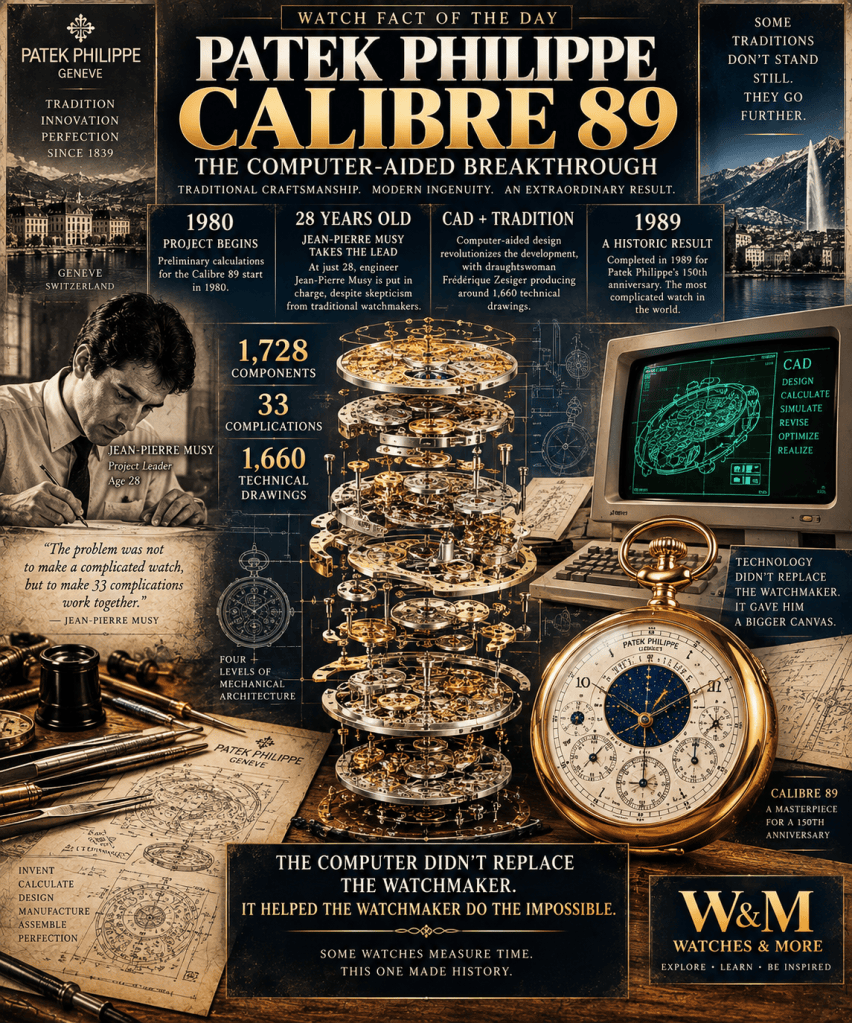
After years of calculations, research and development, a working prototype was ready in July 1988. The yellow-gold Calibre 89 was completed in April 1989, in time to celebrate Patek Philippe’s 150th anniversary. Sothebys.com
The result was extraordinary.
At its introduction, the Calibre 89 became the world’s most complicated mechanical watch, a title it would retain for more than a quarter-century. Sothebys.com
The computer’s role went far beyond simply making prettier technical drawings.
The movement was constructed across four interconnected levels, and changes in one part of its architecture could affect coordinates elsewhere. Zesiger’s CAD system could recalculate those positions as the design evolved.
At one point, the team even lost the master assembly drawing for the secular calendar mechanism and reconstructed it using the approximately 1,660 individual component drawings that had survived. SJX Watches
Think about that:
1,728 COMPONENTS
33 COMPLICATIONS
1,660 TECHNICAL DRAWINGS
9 YEARS FROM INITIAL CALCULATIONS TO COMPLETION
All to produce one extraordinary mechanical machine. Sothebys.com
The Calibre 89 demonstrated something enormously important at the end of the quartz crisis.
Computers could perform calculations, manage geometries and assist manufacturing—but ultimately those digital instructions still had to become physical wheels, levers, springs, cams, pinions and screws assembled by human hands.
That makes the Calibre 89 a fascinating paradox:
One of the greatest achievements of traditional mechanical horology was made possible partly because Patek Philippe was willing to embrace new technology.
Category: Fun Quirk
Disclaimer: Every effort has been made to keep these watch facts accurate, but the world of horology is full of myths, disputed stories, and fascinating trivia. Consider these facts a starting point for discovery rather than the final word. If you have corrections or additional insights, let us know—we’re always happy to keep the record ticking in the right direction.
🕐 Discover more watch facts, reviews, and buying guides at WatchesAndMore



As an Amazon Associate and affiliate partner, WatchesAndMore earns from qualifying purchases.
Browse all expert-reviewed watches →
Further reading: Patek Philippe
Sothebys.com
Sothebys.com
Which detail in this story interests you most, and would it influence what you wear or collect? Share your thoughts in the comments below.
🛍️ Explore designs, gifts and more at the W&M companion shop.
Longines has been around dealing with counterfeit watch issues since the 19th century, way before it became a luxury brand. They introduced their iconic winged-hourglass symbol to help buyers tell real Longines watches apart from fakes. The trademark was registered in Switzerland in 1889 and went international in 1893, making it the oldest active trademark still in effect today. While the logo has evolved, that original design continues to appear on watch backs. So, after 137 years, Longines has maintained a strong brand identity, navigating through plenty of changes in the watch industry and proving that some things really do stand the test of time.

📅 Wednesday, September 9, 2026
Long before watch companies became global luxury brands, Longines was already thinking about something every modern manufacturer worries about: counterfeiting. As the Saint-Imier watchmaker’s reputation grew during the 19th century, imitation products began attempting to benefit from the name it had established. Longines responded with a symbol that would become one of the most enduring identities in watchmaking—the winged hourglass.
The story actually begins before the trademark registration itself. Longines says that by 1867, it was already using both the Longines name and winged-hourglass symbol as guarantees of origin and quality. The emblem was applied to its watches so buyers could distinguish genuine Longines products from counterfeits.

Then came the legal protection.
In 1889, Ernest Francillon registered the Longines name and winged-hourglass trademark in Switzerland. Four years later, on March 27, 1893, it entered the international system established under the Madrid Agreement as International Registration No. 14. Thirteen international applications had preceded it—but those earlier registrations eventually lapsed.
That left Longines holding an extraordinary distinction.
According to WIPO, the original Longines winged-hourglass mark has been continually used and never modified, making it the oldest valid trademark in WIPO’s International Registry. WIPO was still describing the Longines mark as the oldest trademark remaining in effect in its 2024 Madrid System materials, while a 2026 WIPO feature again identified the winged hourglass as the oldest valid trademark in the International Registry.
And there’s a fascinating wrinkle here: the trademark that holds the record isn’t necessarily identical to the modern Longines logo you see prominently displayed on today’s watch dials.
WIPO explains that the original trademark continues to appear on the backs of Longines watches, while an updated interpretation appears on the dial. The historic registered mark incorporates the winged hourglass within a more elaborate emblem—making the surviving legal identity itself a little piece of 19th-century watchmaking history.
The longevity is remarkable when you consider what happened during those intervening years.
Mechanical watches gave way to wristwatches. Two world wars passed. Aviation transformed transportation. Quartz nearly rewrote the Swiss watch industry. Digital watches arrived. Computers, smartphones and smartwatches followed.
Yet that trademark remained protected.
1889 → 2026: 137 years.
And the story is particularly appropriate for a watch company because the winged hourglass itself represents something Longines has managed exceptionally well:
time passing without identity disappearing.
Longines wasn’t the first trademark entered into the international registry.
Its international registration was No. 14.
The first thirteen registrations simply didn’t maintain their protection continuously. Longines did. WIPO notes that the first international trademark registration belonged to Swiss chocolate producer Russ-Suchard, but that original registration eventually ceased to be in force.
So Longines didn’t win this record by being first through the door.
We usually think of trademarks as marketing—something designed to make a company recognizable.
For Longines in the 19th century, the winged hourglass also served a more practical purpose: protecting identity, reputation and authenticity from imitators.
That makes the emblem more than decoration.
It is effectively a 137-year chain of brand identity stretching from a Swiss watch factory in Saint-Imier to the modern international intellectual-property system.
And BBC Creative Department has just been handed an absolute gift. 😂⌛🪽
I’m seeing the infographic as a late-1880s Swiss trademark certificate × Belle Époque watchmaker’s advertisement—aged ivory paper, deep Longines blue, burgundy sealing wax, black engraved linework, antique gold foil, elaborate Victorian borders and beautiful copperplate typography.
Dead center: an enormous engraved winged hourglass, with one wing stretching toward 1889 and the other toward TODAY.
Above it:
Then an original-looking registration document:
SWITZERLAND — 1889
↓
MADRID SYSTEM — 1893
↓
INTERNATIONAL REGISTRATION No. 14
↓
And across the bottom:
Then the killer little Collector’s Note:
THIRTEEN TRADEMARKS CAME BEFORE IT.
NONE OF THEM OUTLASTED IT.
Category: Brand Spotlight
Disclaimer: Every effort has been made to keep these watch facts accurate, but the world of horology is full of myths, disputed stories, and fascinating trivia. Consider these facts a starting point for discovery rather than the final word. If you have corrections or additional insights, let us know—we’re always happy to keep the record ticking in the right direction.
🕐 Discover more watch facts, reviews, and buying guides at WatchesAndMore
As an Amazon Associate and affiliate partner, WatchesAndMore earns from qualifying purchases.
Browse all expert-reviewed watches →
Further reading: Fondation de la Haute Horlogerie — watchmaking glossary
Which detail in this story interests you most, and would it influence what you wear or collect? Share your thoughts in the comments below.
🛍️ Explore designs, gifts and more at the W&M companion shop.