Watch Fact of the Day
📅 Wednesday, October 14, 2026
Before time zones simplified travel, an extra minute hand helped travellers navigate a world of different local times.
Imagine stepping off a train, checking your pocket watch, and discovering that the town clock disagrees.
Your watch is running perfectly. So is the clock.
The problem? You have arrived somewhere with a different idea of what time it is.
In the nineteenth century, travel could mean negotiating a patchwork of local times. Watchmakers responded with ingenious ways to keep more than one time in view.
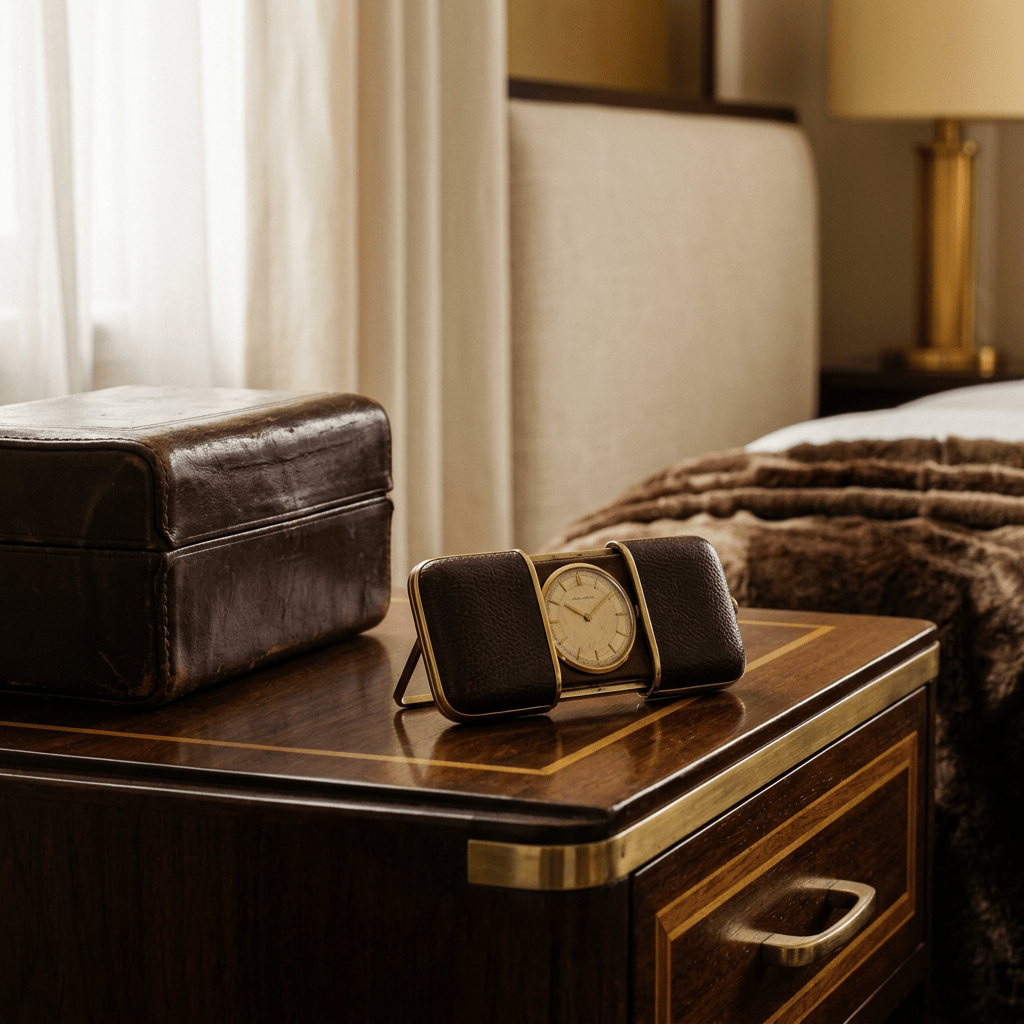
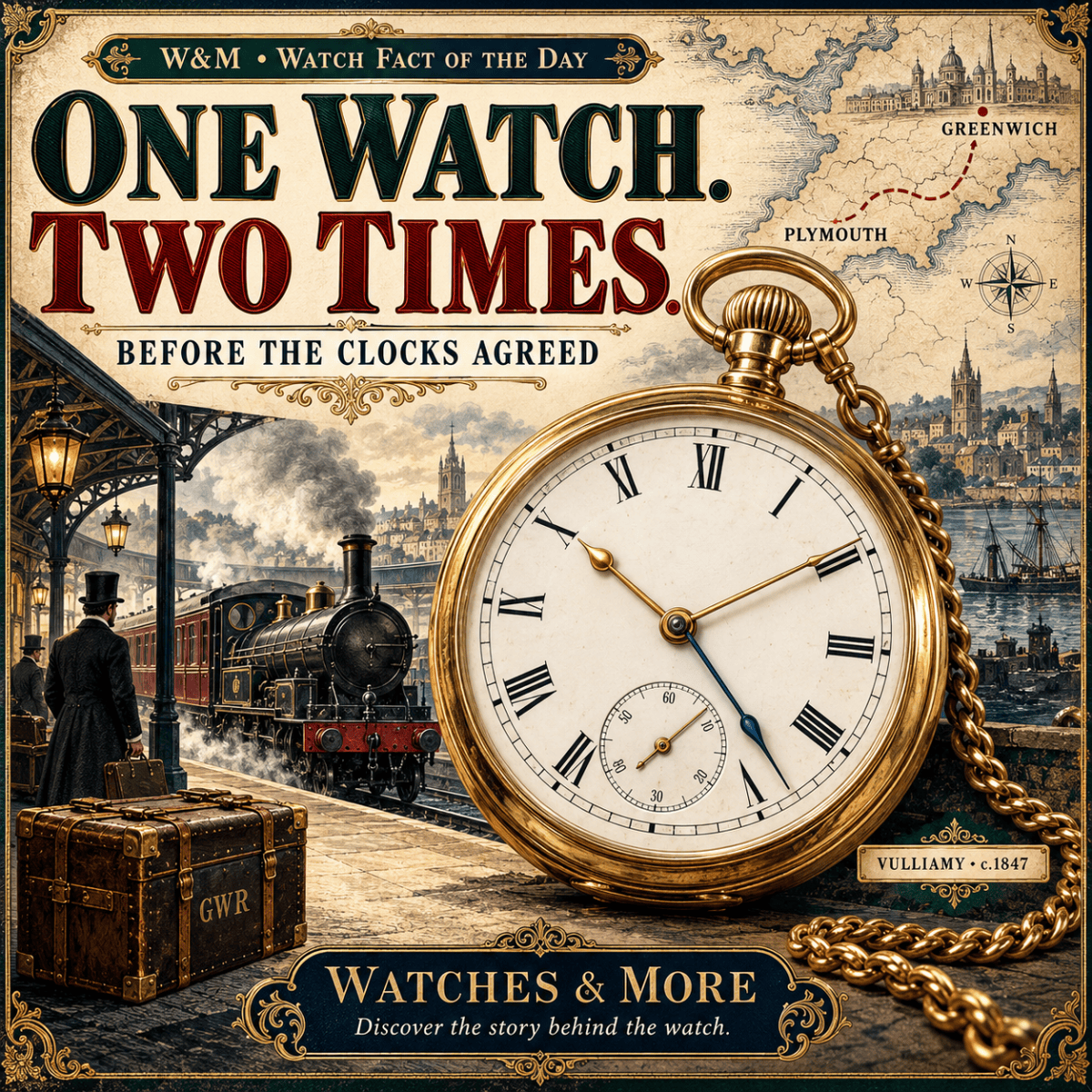
One surviving example makes the story especially tangible: a gold traveller’s watch by Vulliamy, dating to about 1847, now in the collection of Royal Museums Greenwich. Royal Museums Greenwich
☀️ When Time Belonged to the Town
Before uniform timekeeping became established, British communities used local mean time, linked to their longitude.
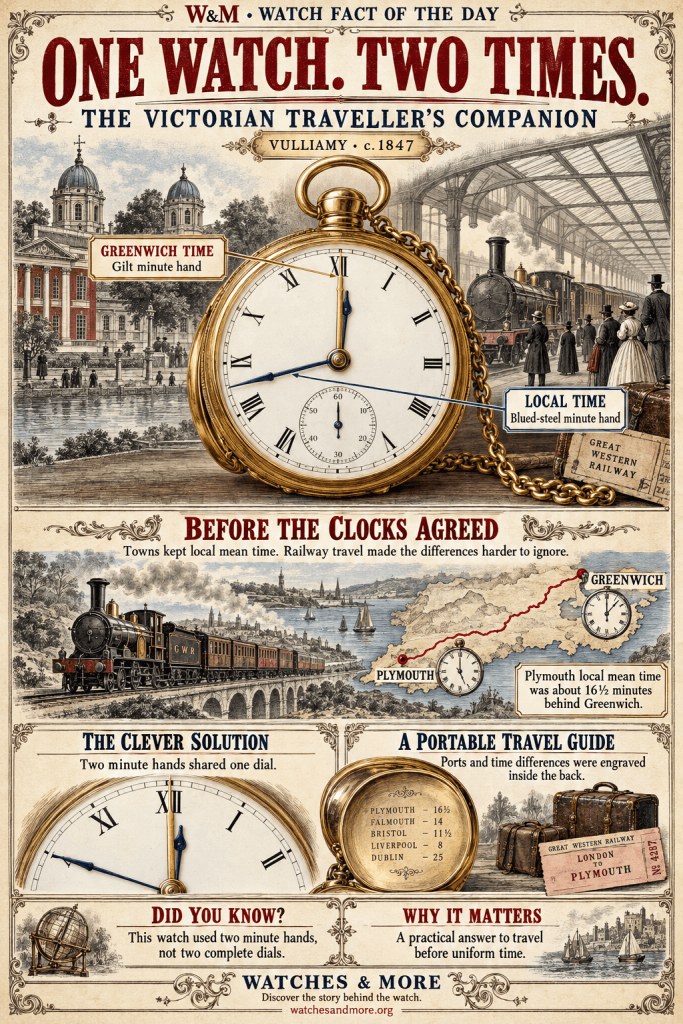
The difference between places might be measured in minutes, rather than the neat one-hour steps familiar from many modern time zones. Royal Museums Greenwich gives Plymouth as approximately 16½ minutes behind Greenwich.
Slow journeys made these differences manageable. Faster railway travel made them harder to ignore. rmg.co.uk
A timetable demands agreement. A collection of towns keeping different times makes that agreement considerably more complicated.
🚂 One Journey, More Than One Clock
For travellers, the challenge was practical: keep track of the reference time used for a journey while also knowing the time observed at the destination.
Picture a traveller asking two questions:
“What time does my train leave?”
“And what time does this town think it is?”
A watch that could show both offered a useful bridge between those two answers.
This is the fascinating setting for Vulliamy’s unusual pocket watch.
⌚ The Clever Part? Two Minute Hands
The museum’s example has an 18-carat-gold case, a Roman-numeral dial, and a small seconds display at six o’clock.
But its distinguishing feature is easy to miss: two minute hands sharing one main dial.
The museum identifies its purpose as displaying Greenwich Mean Time alongside another local time. Inside the back are engraved ports and their time differences—a compact travel reference built into the watch itself. Royal Museums Greenwich
This particular design is a reminder that early two-time watches did not all need two complete dials.
Sometimes, an extra hand told the story.
🧭 A Travel Companion Before the Modern GMT
It is tempting to call such a watch a Victorian GMT.
The comparison works as a way of understanding the need: travellers wanted a convenient reference to more than one place’s time.
But describing a specific nineteenth-century mechanism requires specific evidence. Two time displays alone do not establish that a watch has two independent movements or complete gear trains.
For this example, the documented feature is the additional minute hand.
That makes the design especially evocative: a small difference on the dial reveals a large difference in how people organised their lives.
🇨🇦 A Canadian Connection to Time Reform
Later in the century, Sir Sandford Fleming became closely associated with the campaign for worldwide standard time.
The Smithsonian records a watch belonging to Fleming, made by Nicole, Nielsen & Co. and ordered through London retailer E. White, that reflected both zoned and local time. National Museum of American History
It offers another tangible link between portable timekeeping and the effort to bring order to the world’s clocks.
💡 Did You Know?
On Vulliamy’s traveller’s watch, the gilt minute hand showed Greenwich time, while the steel minute hand could be set to the place being visited.
Colour helped the owner distinguish the two readings. rmg.co.uk
⭐ Why It Matters
This watch captures a problem that modern travellers rarely need to think about: the difference between keeping accurate time and agreeing on which time to use.
Its extra hand was more than an unusual detail. It made a complicated travel problem visible—and offered its owner a practical way to manage it.
One pocket watch. Two local times. A glimpse of the world before the clocks agreed. ⌚🚂🌍
Discover more remarkable timepieces in the W&M Watch Fact Archive.
Visit Watches & More and our companion site.
Category: Fun Quirk
Disclaimer: Every effort has been made to keep these watch facts accurate, but the world of horology is full of myths, disputed stories, and fascinating trivia. Consider these facts a starting point for discovery rather than the final word. If you have corrections or additional insights, let us know—we’re always happy to keep the record ticking in the right direction.
🕐 Discover more watch facts, reviews, and buying guides at WatchesAndMore
Read Next
Tide-Tracking Pocket Watches: Timekeeping for the Sea
Longines Weems: The Second-Setting Watch for Early Aviators
Join the Conversation
Would you use a second time display for travel or to keep in touch with someone far away? Share your thoughts in the comments.
Explore watches in the W&M Watch Database.



📚 Sources & Further Reading
Further reading: Royal Museums Greenwich
rmg.co.uk
National Museum of American History