In 1931, Movado introduced the Ermeto, a pocket-sized watch encased in a sliding leather sleeve that automatically wound the movement every time the case was op
📅 Sunday, October 11, 2026
In 1931, Movado introduced the Ermeto, a pocket-sized watch encased in a sliding leather sleeve that automatically wound the movement every time the case was opened and closed. This ingenious design allowed the rugged timepiece to double as a bedside table clock or a pocket watch, making it a favorite among interwar travelers. Its hermetically sealed case protected the delicate movement from dust and moisture, giving birth to a truly versatile mid-century marvel.
Category: Fun Quirk
Disclaimer: Every effort has been made to keep these watch facts accurate, but the world of horology is full of myths, disputed stories, and fascinating trivia. Consider these facts a starting point for discovery rather than the final word. If you have corrections or additional insights, let us know—we’re always happy to keep the record ticking in the right direction.
In 1912, Movado introduced the Polyplan, a revolutionary wristwatch designed to fit the curve of the wrist by curving the watch case itself. To achieve this, th
📅 Friday, October 9, 2026
In 1912, Movado introduced the Polyplan, a revolutionary wristwatch designed to fit the curve of the wrist by curving the watch case itself. To achieve this, the internal movement had to be built on three distinct planes, presenting an extraordinary engineering challenge for watchmakers. Because they were so difficult and expensive to produce, fewer than a thousand were ever made, making them among the rarest vintage oddities today.
Category: Fun Quirk
Disclaimer: Every effort has been made to keep these watch facts accurate, but the world of horology is full of myths, disputed stories, and fascinating trivia. Consider these facts a starting point for discovery rather than the final word. If you have corrections or additional insights, let us know—we’re always happy to keep the record ticking in the right direction.
Back in 1912, Movado unleashed the Polyplan, a wristwatch that curved and twisted the rules of horology into a pretzel. Unlike flat movements that play nice, the Polyplan’s guts danced across three levels, fitting the wrist like a glove while making any watchmaker cringe in terror at the thought of repairs. Imagine trying to fix a Rubik’s Cube one-handed! Movado wasn’t just thinking outside the box; they flipped the box and sculpted it to the wrist. Fast forward a century, and their quirky innovation seems almost futuristic. Who knew wristwatches could be so avant-garde, or that they’d make a pocket watch feel ancient?
📅 Saturday, August 29, 2026
In 1912, Movado introduced the Polyplan, an extraordinary wristwatch featuring a curved case and a specially engineered movement divided into three inclined planes to fit the wrist ergonomically. Because of this complex construction, watchmakers found them nearly impossible to service, making surviving original examples some of the rarest and most coveted vintage curiosities today.
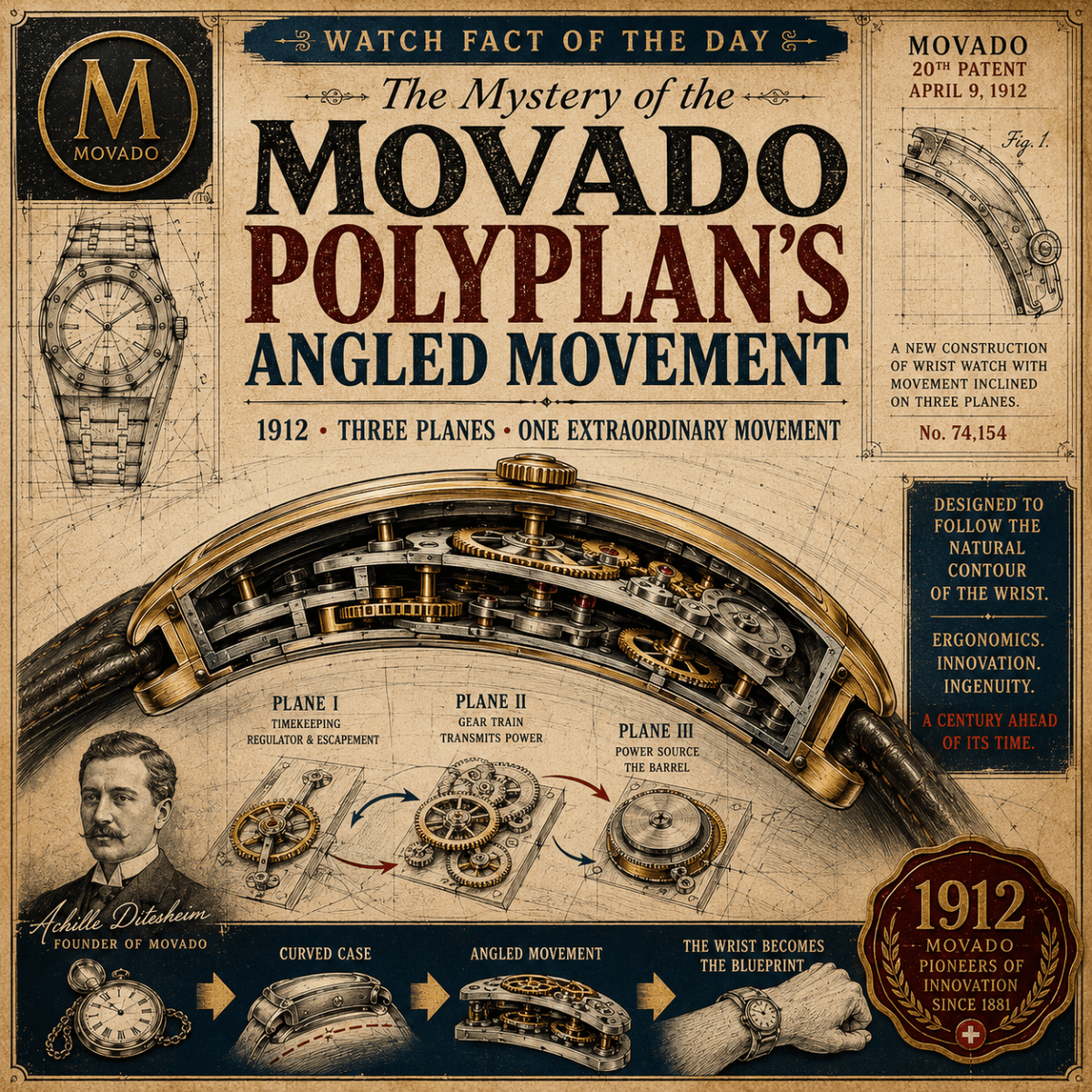
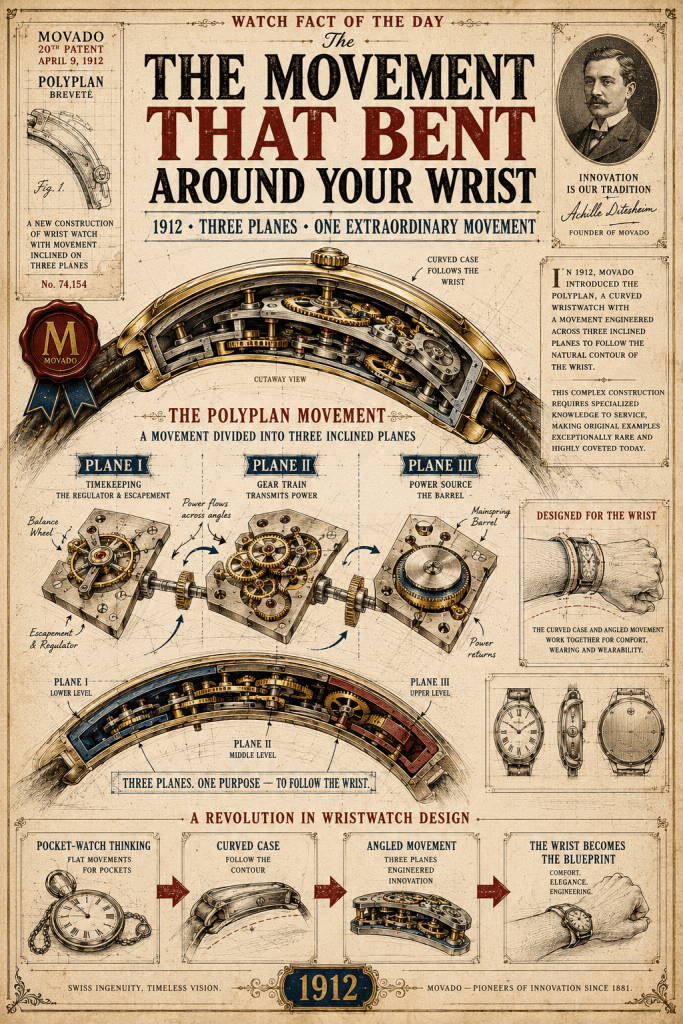
In 1912, Movado introduced one of the strangest and most ingenious early wristwatch constructions ever attempted: the Polyplan. Rather than placing an ordinary flat movement inside a curved case, Movado engineered the movement itself around the shape of the watch. Its components were arranged across three separate planes positioned at angles to one another, allowing the entire mechanism to follow a case curved around the natural contour of the wrist. The breakthrough was significant enough to earn Movado its 20th patent that year. Movado
That distinction is what makes the Polyplan so fascinating. A conventional movement wants to occupy a single flat plane: mainspring, gear train, escapement and balance are normally organized around one relatively straightforward architecture. The Polyplan instead treated the movement almost like a tiny mechanical structure built around a bend. Different functional sections occupied different levels, yet they still had to transmit power reliably from one part of the movement to another.
The result was an extraordinarily futuristic idea for 1912. Wristwatches themselves were still fighting for acceptance in an era dominated by pocket watches, yet Movado was already asking a remarkably modern ergonomic question: why should the wrist conform to the watch when the watch could conform to the wrist? The elongated curved case hugged the arm rather than sitting like a small flat pocket watch strapped on top of it. Movado’s own history describes the movement as being angled specifically to follow the wrist’s natural contours. Movado
And this is where I’d slightly soften one part of our original fact. I couldn’t verify from a strong primary source that watchmakers historically considered Polyplans “nearly impossible to service.” It’s completely believable that their unusual architecture makes restoration exceptionally specialized, but I’d present that as a consequence of the construction rather than a documented period claim. The safer—and arguably cooler—point is that servicing one requires dealing with a movement whose geometry is fundamentally unlike an ordinary flat calibre.
The Polyplan also wasn’t the end of Movado’s experimentation with wrist-conforming movements. The company later developed the Curviplan, which Movado describes as a reinterpretation of the Polyplan concept in a slimmer form, again using a movement carefully designed to exploit the available space inside the case. The Polyplan therefore wasn’t simply an eccentric one-off—it established an engineering idea that Movado would revisit. Movado
Today, the Polyplan feels almost startlingly contemporary. Modern watchmakers regularly talk about ergonomics, integrated architecture and designing movements specifically around unusual cases. Movado was wrestling with precisely that challenge more than a century ago. Instead of taking a movement and designing a watch around it, the Polyplan effectively reversed the equation: design the watch for the human wrist—and engineer the movement to fit.
📖 Collector’s Note
The name itself gives away the secret: Polyplan—multiple planes. The watch wasn’t merely curved on the outside. Its mechanical architecture was deliberately divided across three inclined planes inside. That’s why a side-profile or cutaway illustration tells the Polyplan story far better than a normal straight-on photograph ever could.
Category: Fun Quirk
Disclaimer: Every effort has been made to keep these watch facts accurate, but the world of horology is full of myths, disputed stories, and fascinating trivia. Consider these facts a starting point for discovery rather than the final word. If you have corrections or additional insights, let us know—we’re always happy to keep the record ticking in the right direction.
So, the Movado Museum dial is this super iconic watch face designed by Nathan George Horwitt back in 1947. It’s all about that minimalist vibe with just a gold dot at 12 o’clock, symbolizing the sun at noon. Rather than cluttering up the dial with numbers, Horwitt wanted to focus on the flow of time like a sundial. It wasn’t just a trend; this design became a part of Movado’s identity and eventually got a spot at the Museum of Modern Art, marking it as a significant piece in watch history. Talk about less is more!
📅 Sunday, August 23, 2026
Designed by Bauhaus-influenced artist Nathan George Horwitt in 1947, the iconic Movado Museum dial features a single gold dot at 12 o’clock representing the sun at high noon. While Movado eventually adopted it as their signature look, the design was originally created with the philosophical goal of representing time as a continuous movement rather than mathematical intervals. It became the first watch dial ever acquired by the Museum of Modern Art in New York.
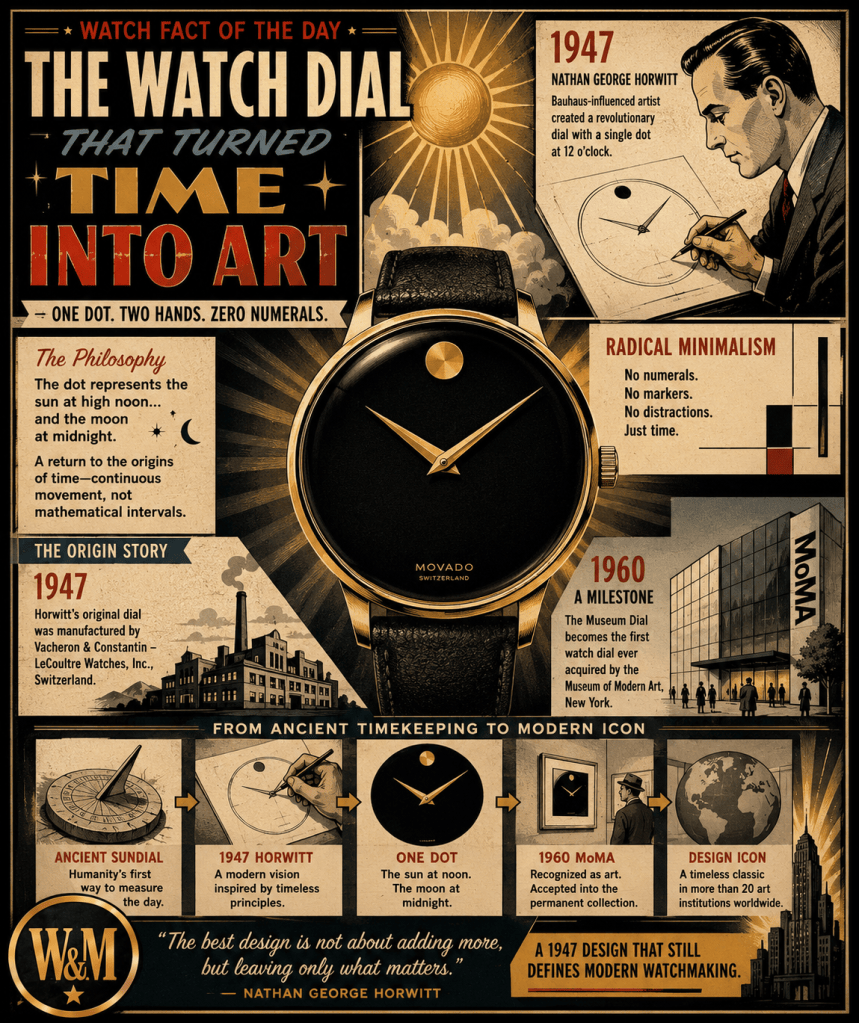
In 1947, American industrial designer Nathan George Horwitt created one of the most radical watch dials of the 20th century by doing something almost unthinkable: he removed virtually everything. No numerals. No conventional hour markers. No decorative clutter. Against the stark dial remained only the hands and a single circular marker at 12 o’clock. Horwitt’s minimalist creation would eventually become inseparable from Movado and one of the most instantly recognizable designs in modern watchmaking.
But that solitary dot wasn’t merely minimalist decoration. Horwitt looked back to perhaps humanity’s oldest method of measuring the day: the sundial. Movado explains that the dot represents the sun at high noon—and the moon at midnight. Rather than covering the dial with numbers that divide time into discrete units, Horwitt stripped the display back to a relationship between the movement of the hands and one celestial reference point.
That makes the Museum Dial a fascinating paradox. It looks futuristic, yet its central idea reaches back thousands of years. A mechanical watch—one of humanity’s most sophisticated timekeeping machines—was visually reduced to something reminiscent of watching a shadow travel around a sundial beneath the sun. Movado describes Horwitt’s design as an exploration of the concept of time that removed unnecessary complications and returned time-telling to its origins.
But Here’s Where the Story Gets Really Interesting…
The dial wasn’t originally born as simply another Movado model. MoMA’s own collection identifies the 1947 object as Nathan George Horwitt’s “Wristwatch Face” and lists its manufacturer as Vacheron & Constantin—Le Coultre Watches, Inc., Switzerland. The museum records it as white gold with an enameled dial and credits it as a gift from Horwitt himself. That makes the early history considerably more interesting than the simplified version in which Horwitt simply designed “the Movado dial” in 1947.
Horwitt’s design subsequently became deeply associated with Movado, and the company transformed that extraordinarily sparse visual language into its defining identity. Today the Museum concept appears throughout Movado’s collections, and the company says versions of the design can be found in more than 20 art institutions around the world.
Then came the achievement that gave the design its enduring name. In 1960, the Museum Dial entered the permanent collection of New York’s Museum of Modern Art. Movado describes it as the first watch dial accepted into MoMA’s permanent collection, while MoMA’s current catalogue confirms the object number 335.1960, its 1947 design date and Horwitt as its designer.
There’s something wonderfully appropriate about that recognition. Most watchmakers spend enormous effort adding information to a dial—indices, scales, complications, subdials and displays. Horwitt achieved immortality by doing almost exactly the opposite. He took nearly everything away.
Category: Brand Spotlight
Disclaimer: Every effort has been made to keep these watch facts accurate, but the world of horology is full of myths, disputed stories, and fascinating trivia. Consider these facts a starting point for discovery rather than the final word. If you have corrections or additional insights, let us know—we’re always happy to keep the record ticking in the right direction.