
The Niagara Watch Claim—and the Real Challenge of Lighting a Dial

The claimed 1935 Niagara flashlight watch remains unverified. The documented history of tactile watches and powered dial lighting still tells an ingenious story.

Watch Fact of the Day

Fun Quirk: Friday, October 16, 2026

📅 Friday, October 16, 2026

A watch can keep excellent time and still tell you very little in a dark room.

Our earlier short post described a 1935 Niagara watch that doubled as a miniature electric flashlight. During this expanded review, we could not establish that specific model, date, or construction from independent historical documentation. That claim should be treated as unverified.

🔎 A Correction Before a Bigger Story

A dated advertisement, patent, museum entry, or identifiable surviving example would help establish the anecdote. Repetition across our own posts is not independent evidence. Rather than invent details, we can explore the genuine problem behind it.

How does a watch communicate when there is insufficient light to read its dial? The answer does not always have to involve illuminating the display.

🌙 Finding Time Without Looking

Breguet’s tact watches, available from 1799, used an external pointer and raised markers to communicate an approximate time by touch. They approached darkness by changing the way information reached the wearer.

That is an important design principle: a difficulty with one interface may be solved by choosing another. The owner does not need a brighter dial if the relevant information can be felt.

💡 Making the Dial Glow

Powered illumination takes a different approach. Timex’s history describes the application of electroluminescent technology to analog and digital watches with INDIGLO in the early 1990s.

Instead of directing a small beam towards the display, the technology illuminates a broad surface. The dial appears to glow when activated, changing how it can be read in darkness.

💡 Did You Know?

The main text of Timex’s historical article dates a series of INDIGLO releases to 1992. That provides a documented example of powered dial lighting; it does not verify the much earlier Niagara claim or establish a universal first.

⭐ Why It Matters

Legibility is an engineering achievement alongside accuracy. A useful watch must communicate under the conditions in which its owner needs it.

This correction also shows why watch stories need evidence. An uncertain anecdote can become a starting point for a better-documented exploration, provided the uncertainty is made clear.

The challenge of reading time in the dark is real, even when a particular tale about solving it remains unproven.

📚 Sources & Further Reading

Timex — INDIGLO: A Luminous History

Breguet — Tact watches


Category: Fun Quirk

Disclaimer: Every effort has been made to keep these watch facts accurate, but the world of horology is full of myths, disputed stories, and fascinating trivia. Consider these facts a starting point for discovery rather than the final word. If you have corrections or additional insights, let us know—we’re always happy to keep the record ticking in the right direction.

🕐 Discover more watch facts, reviews, and buying guides at WatchesAndMore


Read Next

Tritium Watch Tubes: How Dials Glow Without Charging

The Radium Girls: The Human Cost of Glowing Watch Dials

Join the Conversation

Which do you prefer for night-time readability: a backlight or glowing markers? Share your thoughts in the comments.
Explore watches in the W&M Watch Database.

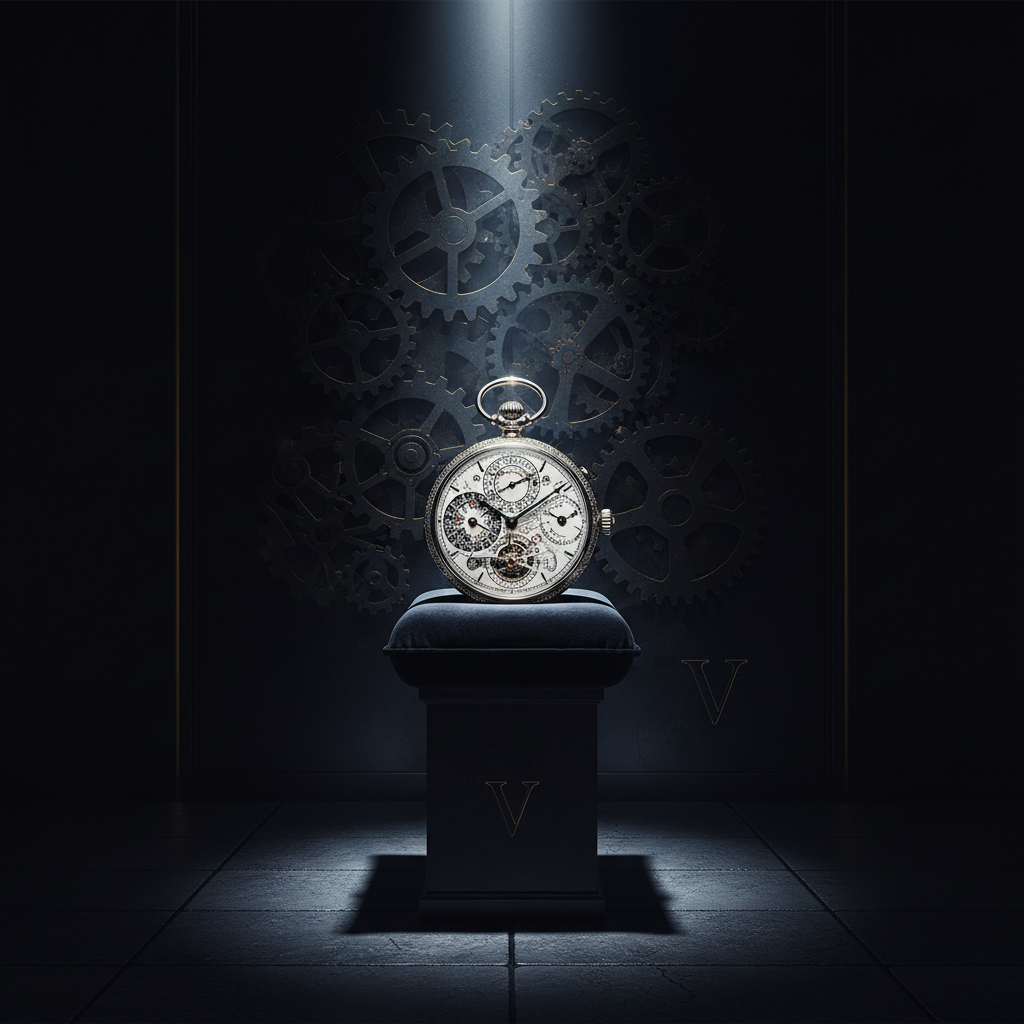
Vacheron Constantin 57260: A Pocket Watch with 57 Complications

Reference 57260 combined 57 complications with a mechanical Hebrew perpetual calendar. Discover why its significance goes beyond a record count.

Watch Fact of the Day

Record Breaker: Thursday, October 15, 2026

📅 Thursday, October 15, 2026

A complicated watch can reconcile calendars, track celestial cycles, and give a voice to the passing hours.

Vacheron Constantin’s Reference 57260 is an exercise in mechanical coordination. Its 57 complications are impressive individually; the larger achievement is making them share a single portable object.

⚙️ An Ambition Measured in Years

Vacheron describes eight years of research by three master watchmakers. A double-sided display, more than 2,800 components, and 242 jewels convey the scale of the undertaking.

It was the most complicated watch when introduced. The earlier article’s claim that it remains the most complicated ever created was too broad. A historical record should be presented in the context of its time.

📅 A Calendar Written in Gears

The Hebrew perpetual calendar is a central achievement. A lunisolar calendar must relate lunar months to the solar year and account for a pattern of additional months, presenting a different problem from a simple advancing date.

Vacheron identifies the 19-year Metonic cycle as central to the mechanism. The watch physically embodies a system of calendar rules, allowing a cultural way of organizing time to become a working mechanical display.

🔔 Different Ways to Experience Time

Other functions include chiming, astronomical indications, and a split-seconds chronograph with opposing retrograde displays. The second dial presents the sky associated with the owner’s home city.

These systems answer different questions. A chronograph measures an interval, a calendar identifies a day within a cycle, and a repeater expresses a reading through sound. Their coexistence is the heart of the challenge.

💡 Did You Know?

An automatic night-silence feature suspends the watch’s striking between 10 p.m. and 8 a.m. Extraordinary complication still has to accommodate the very ordinary human need for sleep.

⭐ Why It Matters

A complication count makes a striking headline, but the relationships between systems are just as important. Energy, controls, and readable displays must be considered together.

The Hebrew calendar also reminds us that the familiar Gregorian date is not the only system mechanical watchmaking can attempt to understand.

The remarkable question is how watchmakers teach a mechanism the rules of so many kinds of time.

📚 Sources & Further Reading

Vacheron Constantin — Reference 57260


Category: Record Breaker

Disclaimer: Every effort has been made to keep these watch facts accurate, but the world of horology is full of myths, disputed stories, and fascinating trivia. Consider these facts a starting point for discovery rather than the final word. If you have corrections or additional insights, let us know—we’re always happy to keep the record ticking in the right direction.

🕐 Discover more watch facts, reviews, and buying guides at WatchesAndMore


Read Next

Henry Graves and the Patek Philippe Supercomplication

Tide-Tracking Pocket Watches: Timekeeping for the Sea

Join the Conversation

Which complication would you want most in a dream watch? Share your thoughts in the comments.

Explore watches in the W&M Watch Database.

Titanic’s Pocket Watch Mystery: Why Does It Show 3:07?

The story of Robert Douglas Norman, a Titanic passenger, shines a light on the personal narratives often lost in history’s grand scale. His gold pocket watch, recovered after the tragedy, stopped at 3:07, raising questions about its time-setting amidst the ship’s sinking. Although Norman did not survive, his heroic actions in helping a fellow passenger find safety are highlighted through this object, symbolizing the humanity behind a historical event. The watch serves as a poignant reminder that every timepiece carries a story, bridging the past and present, making the memory of Norman and his journey feel timeless and significant.

Watch Fact of the Day

Frozen hands. A puzzling time. And a human story behind one of Titanic’s most poignant surviving objects.

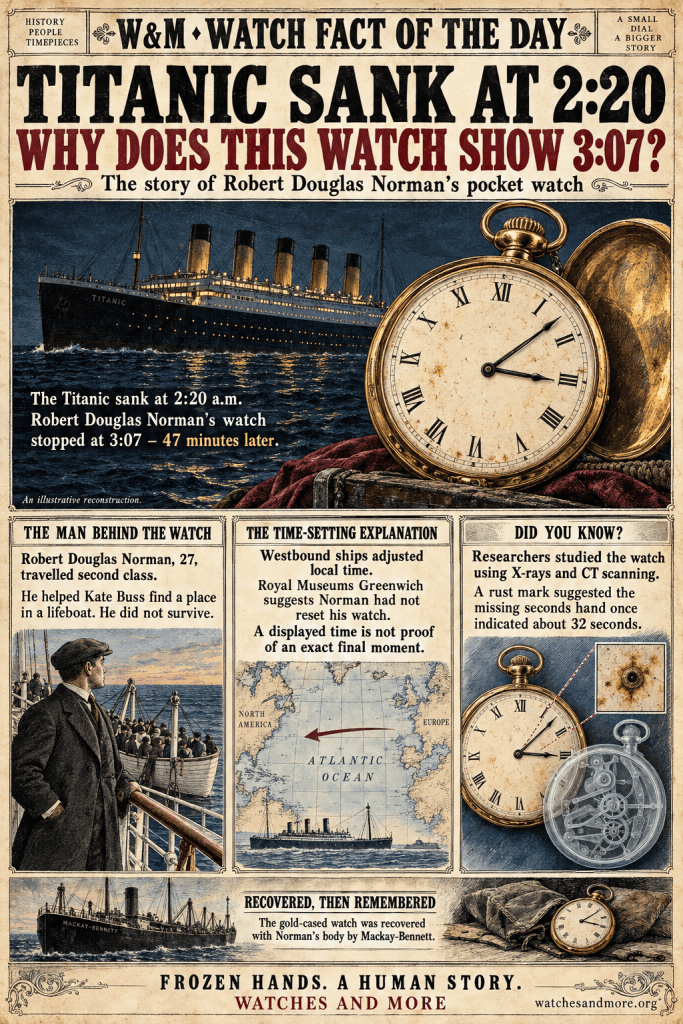
Titanic disappeared beneath the Atlantic at approximately 2:20 a.m. on April 15, 1912.

Yet a pocket watch recovered from one of its passengers shows 3:07.

Forty-seven minutes later.

Was the watch wrong? Had it continued running after the ship sank? Or was something else behind those motionless hands?

The explanation offered by Royal Museums Greenwich concerns an easily overlooked part of ocean travel: the time passengers set on their watches.

But before we explore the mystery, we should meet the man who carried it.

🧳 A Journey That Never Reached Its Destination

Robert Douglas Norman was 27, travelling aboard Titanic as a second-class passenger.

He was heading to Vancouver to visit his brother, with plans for further travel. Like so many aboard the liner, he had a destination, people waiting for him, and a future beyond the voyage.

His gold-cased pocket watch was one of the personal belongings that would eventually help preserve his story.

Today, its significance reaches far beyond its value as a timepiece.

🚢 A Place in a Lifeboat

According to Royal Museums Greenwich, Norman helped fellow passenger Kate Buss find a place in a lifeboat. He remained aboard and did not survive.

When the recovery vessel Mackay-Bennett later recovered his body, the watch was found among his clothing. Its rusted hands showed seven minutes past three.

That is what makes this object so affecting.

It connects a familiar historical event with one individual—and an act of assistance during a terrible night.

🕰️ Why 3:07 Doesn’t Match 2:20

A passenger’s watch was only as closely aligned with ship time as its setting allowed.

On a westbound Atlantic crossing, clocks were adjusted as the ship moved toward a different local time. Passengers needed to adjust their own watches accordingly.

Royal Museums Greenwich explains that Norman apparently had not reset his watch to the ship’s latest local time. Its displayed time therefore should not be read as directly equivalent to the recorded sinking time.

The important word is “apparently.” This is the museum’s explanation, rather than something the watch can independently prove.

The hands preserve a reading—not an automatically synchronised timestamp.

🔬 What Can a Stopped Watch Really Tell Us?

A recovered watch is physical evidence, but interpreting it requires care.

Was it running immediately before entering the water? How accurately was it set? How quickly did water stop the movement?

Horology curator Rory McEvoy explored these questions in a study of Norman’s watch using X-ray imaging and computed tomography, or CT. He described the 3:07 reading as intriguing and considered it probable that the unwaterproofed watch would have stopped within a minute of immersion.

That makes the frozen hands compelling evidence to investigate, rather than a precise record of Norman’s final moment.

Sometimes, the most fascinating watch story begins with asking what we can—and cannot—learn from the dial.

💡 Did You Know?

Researchers found a trace of a missing seconds hand.

McEvoy’s study reports that the watch’s seconds hand had deteriorated completely. However, a mark left in the rust on the dial suggested it had indicated approximately 32 seconds when it stopped.

Even a component that no longer survives can leave evidence behind.

⭐ Why It Matters

Titanic’s story is often told through the scale of the ship and the magnitude of the disaster.

A personal object brings that history closer.

Norman’s watch reminds us that the passengers were individuals carrying ordinary possessions toward extraordinary changes in their lives.

Its stopped hands invite a question about time. Its ownership asks us to remember a person.

That is where this watch’s deepest significance lies.

❤️ The W&M Take: More Than Frozen Hands

At Watches And More, we believe every watch has a story.

This one holds a particularly moving connection between an everyday object, an interrupted journey, and a passenger remembered for helping someone else reach a lifeboat.

The difference between 2:20 and 3:07 draws us into the investigation.

Robert Douglas Norman gives us a reason to remember it.

The watch stopped. Its power to tell his story did not.


⌚ Explore more stories behind remarkable timepieces:

What everyday object would you most want preserved to tell your story to future generations?

Read Next

HMS Beagle’s Pocket Chronometer: Timekeeping on Darwin’s Voyage

Abraham Lincoln’s Pocket Watch and Its Hidden Inscription

Join the Conversation

Which historic timepiece would you most like to see in a museum? Share your thoughts in the comments.
ETSY Shop
ETSY Shop
Redbubble Shop
Redbubble Shop
More Watch Facts
More Watch Facts

📚 Sources & Further Reading

Further reading: Fondation de la Haute Horlogerie — watchmaking glossary

Category: Watch Facts

Disclaimer: Every effort has been made to keep these watch facts accurate, but the world of horology includes disputed stories and changing product information. Treat this article as a starting point for discovery and consult the linked records or manufacturer information for the exact timepiece. Corrections and additional evidence are welcome in the comments.

Explore watches in the W&M Watch Database.

Vulliamy’s Traveller’s Watch: Two Times Before Time Zones

Picture this: you’re in the 1800s, stepping off a train, only to find that your pocket watch and the town clock are about to start a heated debate over what time it really is. Enter the genius Vulliamy watch with two minute hands! One hand proudly displays Greenwich Mean Time, while the other hand helplessly asks, “What time do you think it is, folks?” This quirky timepiece was the ultimate travel companion, helping bewildered adventurers juggle different local times like a circus performer. Who knew one watch could hold so much drama? Talk about a time-telling soap opera!

Watch Fact of the Day

Fun Quirk: Wednesday, October 14, 2026

📅 Wednesday, October 14, 2026

Before time zones simplified travel, an extra minute hand helped travellers navigate a world of different local times.

Imagine stepping off a train, checking your pocket watch, and discovering that the town clock disagrees.

Your watch is running perfectly. So is the clock.

The problem? You have arrived somewhere with a different idea of what time it is.

In the nineteenth century, travel could mean negotiating a patchwork of local times. Watchmakers responded with ingenious ways to keep more than one time in view.

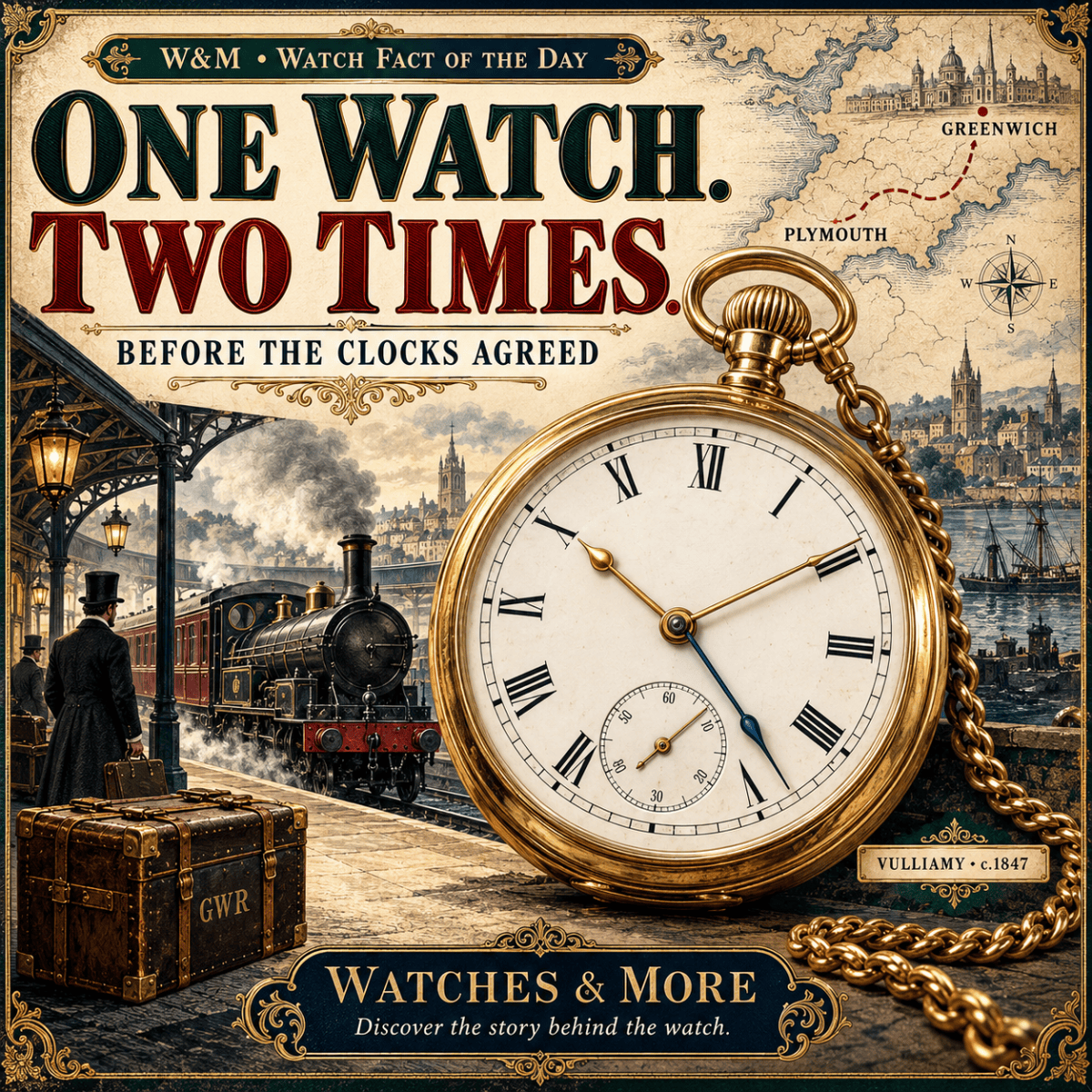
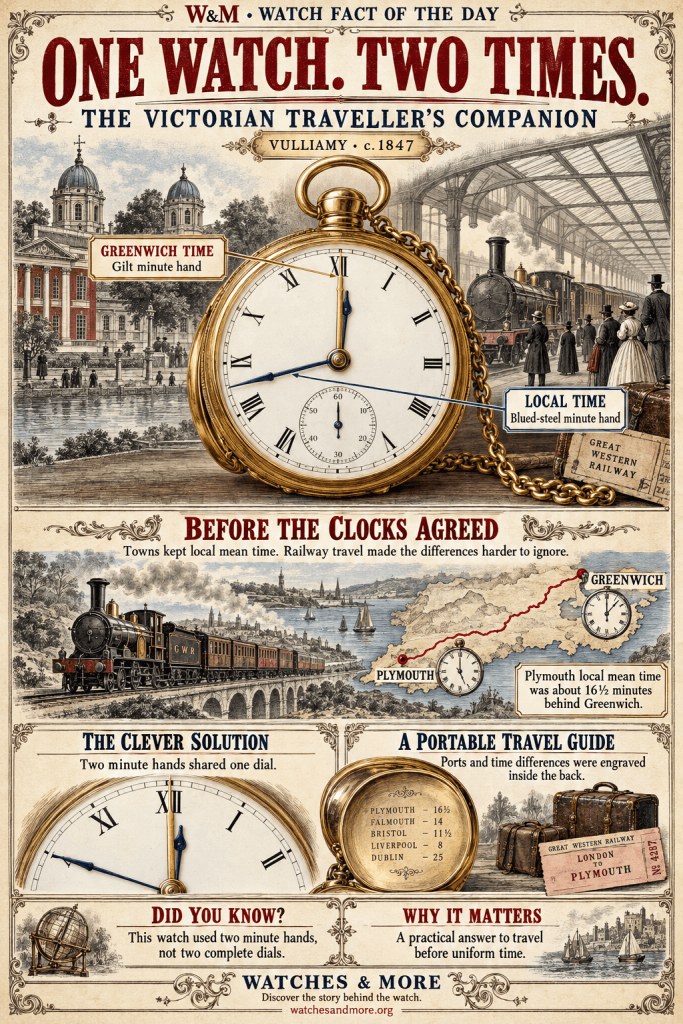
One surviving example makes the story especially tangible: a gold traveller’s watch by Vulliamy, dating to about 1847, now in the collection of Royal Museums Greenwich. Royal Museums Greenwich

☀️ When Time Belonged to the Town

Before uniform timekeeping became established, British communities used local mean time, linked to their longitude.

The difference between places might be measured in minutes, rather than the neat one-hour steps familiar from many modern time zones. Royal Museums Greenwich gives Plymouth as approximately 16½ minutes behind Greenwich.

Slow journeys made these differences manageable. Faster railway travel made them harder to ignore. rmg.co.uk

A timetable demands agreement. A collection of towns keeping different times makes that agreement considerably more complicated.

🚂 One Journey, More Than One Clock

For travellers, the challenge was practical: keep track of the reference time used for a journey while also knowing the time observed at the destination.

Picture a traveller asking two questions:

“What time does my train leave?”

“And what time does this town think it is?”

A watch that could show both offered a useful bridge between those two answers.

This is the fascinating setting for Vulliamy’s unusual pocket watch.

⌚ The Clever Part? Two Minute Hands

The museum’s example has an 18-carat-gold case, a Roman-numeral dial, and a small seconds display at six o’clock.

But its distinguishing feature is easy to miss: two minute hands sharing one main dial.

The museum identifies its purpose as displaying Greenwich Mean Time alongside another local time. Inside the back are engraved ports and their time differences—a compact travel reference built into the watch itself. Royal Museums Greenwich

This particular design is a reminder that early two-time watches did not all need two complete dials.

Sometimes, an extra hand told the story.

🧭 A Travel Companion Before the Modern GMT

It is tempting to call such a watch a Victorian GMT.

The comparison works as a way of understanding the need: travellers wanted a convenient reference to more than one place’s time.

But describing a specific nineteenth-century mechanism requires specific evidence. Two time displays alone do not establish that a watch has two independent movements or complete gear trains.

For this example, the documented feature is the additional minute hand.

That makes the design especially evocative: a small difference on the dial reveals a large difference in how people organised their lives.

🇨🇦 A Canadian Connection to Time Reform

Later in the century, Sir Sandford Fleming became closely associated with the campaign for worldwide standard time.

The Smithsonian records a watch belonging to Fleming, made by Nicole, Nielsen & Co. and ordered through London retailer E. White, that reflected both zoned and local time. National Museum of American History

It offers another tangible link between portable timekeeping and the effort to bring order to the world’s clocks.

💡 Did You Know?

On Vulliamy’s traveller’s watch, the gilt minute hand showed Greenwich time, while the steel minute hand could be set to the place being visited.

Colour helped the owner distinguish the two readings. rmg.co.uk

⭐ Why It Matters

This watch captures a problem that modern travellers rarely need to think about: the difference between keeping accurate time and agreeing on which time to use.

Its extra hand was more than an unusual detail. It made a complicated travel problem visible—and offered its owner a practical way to manage it.

One pocket watch. Two local times. A glimpse of the world before the clocks agreed. ⌚🚂🌍


Discover more remarkable timepieces in the W&M Watch Fact Archive.

Visit Watches & More and our companion site.

Category: Fun Quirk

Disclaimer: Every effort has been made to keep these watch facts accurate, but the world of horology is full of myths, disputed stories, and fascinating trivia. Consider these facts a starting point for discovery rather than the final word. If you have corrections or additional insights, let us know—we’re always happy to keep the record ticking in the right direction.

🕐 Discover more watch facts, reviews, and buying guides at WatchesAndMore


Read Next

Tide-Tracking Pocket Watches: Timekeeping for the Sea

Longines Weems: The Second-Setting Watch for Early Aviators

Join the Conversation

Would you use a second time display for travel or to keep in touch with someone far away? Share your thoughts in the comments.

Explore watches in the W&M Watch Database.

ETSY Shop
ETSY Shop
More Watch Facts
More Watch Facts
Redbubble Shop
Redbubble Shop

📚 Sources & Further Reading

Further reading: Royal Museums Greenwich
rmg.co.uk
National Museum of American History

Abraham Lincoln’s Pocket Watch and Its Hidden Inscription

Inside Abraham Lincoln’s pocket watch, a watchmaker hid an optimistic political secret during the American Civil War. When repairman Jonathan Dillon opened the

Watch Fact of the Day

Faces of Horology: Tuesday, October 13, 2026

📅 Tuesday, October 13, 2026

Inside a president’s watch, an ordinary craftsman left an extraordinary message.

A gold pocket watch can hold more than gears, springs, and the passing seconds.

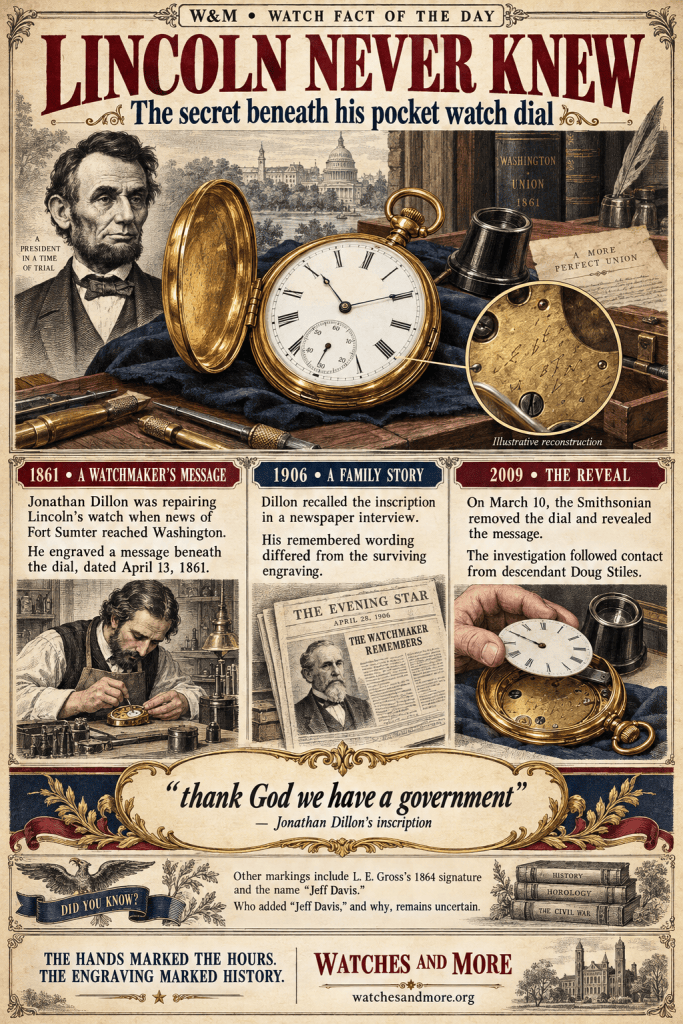
Abraham Lincoln’s held a hidden reaction to the outbreak of the American Civil War—a message scratched into its inner workings by a watchmaker.

The remarkable part?

According to the Smithsonian, Lincoln never knew it was there.

Up nextPlaylist — 5 videos5 videos

⚒️ A Repair Interrupted by History

In April 1861, Jonathan Dillon was repairing Lincoln’s watch at M.W. Galt and Co. in Washington, D.C., when news arrived that Confederate forces had attacked Fort Sumter.

Dillon responded with the tools of his trade.

He removed the dial and engraved a message on the metal beneath it, recording the attack and expressing gratitude that the country had a government. His inscription carries the date April 13, 1861, although the attack began on April 12.

Once concealed behind the dial, his words became a private record of a public crisis.

A watchmaker had found an unusual place to leave his mark on history.

🔍 A Family Story Meets the Evidence

Decades later, Dillon recalled the incident in a 1906 New York Times interview. His remembered wording included an optimistic declaration about slavery’s end.

But recollection and inscription would turn out to differ.

After Dillon’s great-great-grandson, Doug Stiles, contacted the Smithsonian, the museum investigated. On March 10, 2009, master watchmaker George Thomas carefully dismantled the timepiece and revealed the engraving.

The family story had a physical foundation.

The message was really there.

✍️ What the Watch Actually Said

The engraving records Fort Sumter’s attack, Dillon’s name, Washington, and the date. Its memorable expression of reassurance reads:

“thank God we have a government”

The inscription does not contain the explicit statement about slavery that Dillon later remembered.

That distinction makes the discovery especially compelling: opening the watch allowed historians to compare a story handed down through time with the original evidence.

💡 Did You Know?

Dillon wasn’t the only person to write inside the watch.

The Smithsonian identifies an 1864 signature by watchmaker L. E. Gross, as well as the name “Jeff Davis.” Who added that name, and whether it was a joke or an expression of Confederate sympathy, remains uncertain.

Behind one dial lay several intriguing traces of human history.

⭐ Why It Matters

This watch preserves something a grand monument rarely can: an individual’s immediate response to an uncertain moment.

Dillon was a craftsman at his bench when world-changing news reached him. His engraving reminds us that history happens to ordinary people, too—and sometimes they leave extraordinary evidence behind.

It also shows why examining an object matters. The surviving words tell their own story.

❤️ The W&M Take: History Beneath the Dial

At Watches And More, we believe every watch has a story.

Lincoln’s carried one its owner apparently never heard: a watchmaker’s declaration, tucked beneath the face that displayed the time.

The hands marked the hours. The hidden engraving marked a moment in history.


⌚ Keep exploring:

If you could leave a message inside a watch for someone to discover a century later, what would it say?

Category: Faces of Horology

Disclaimer: Every effort has been made to keep these watch facts accurate, but the world of horology is full of myths, disputed stories, and fascinating trivia. Consider these facts a starting point for discovery rather than the final word. If you have corrections or additional insights, let us know—we’re always happy to keep the record ticking in the right direction.

🕐 Discover more watch facts, reviews, and buying guides at WatchesAndMore


Read Next

Titanic’s Pocket Watch Mystery: Why Does It Show 3:07?

HMS Beagle’s Pocket Chronometer: Timekeeping on Darwin’s Voyage

Join the Conversation

What message would you leave inside a watch for someone to discover? Share your thoughts in the comments.

Explore watches in the W&M Watch Database.

📚 Sources & Further Reading

Further reading: Fondation de la Haute Horlogerie — watchmaking glossary

1980s LCD Game Watches: An Arcade on Your Wrist

Once upon a time, before smartwatches decided to take over our wrists, there were tiny game watches that promised alien-slaying fun right on your wrist! Imagine battling invaders while also checking the time—multitasking level: expert! The first digital watches, like Seiko’s groundbreaking quartz chronograph, paved the way for the cheeky Casio GM-10, which snuck an arcade into your daily life. These little tech wonders transformed waiting into a thrilling space adventure, proving you don’t need a giant screen to have big fun. So, next time you glance at your wrist, remember: it once contained galaxies of gaming excitement!

Watch Fact of the Day

Fun Quirk: Monday, October 12, 2026

📅 Monday, October 12, 2026

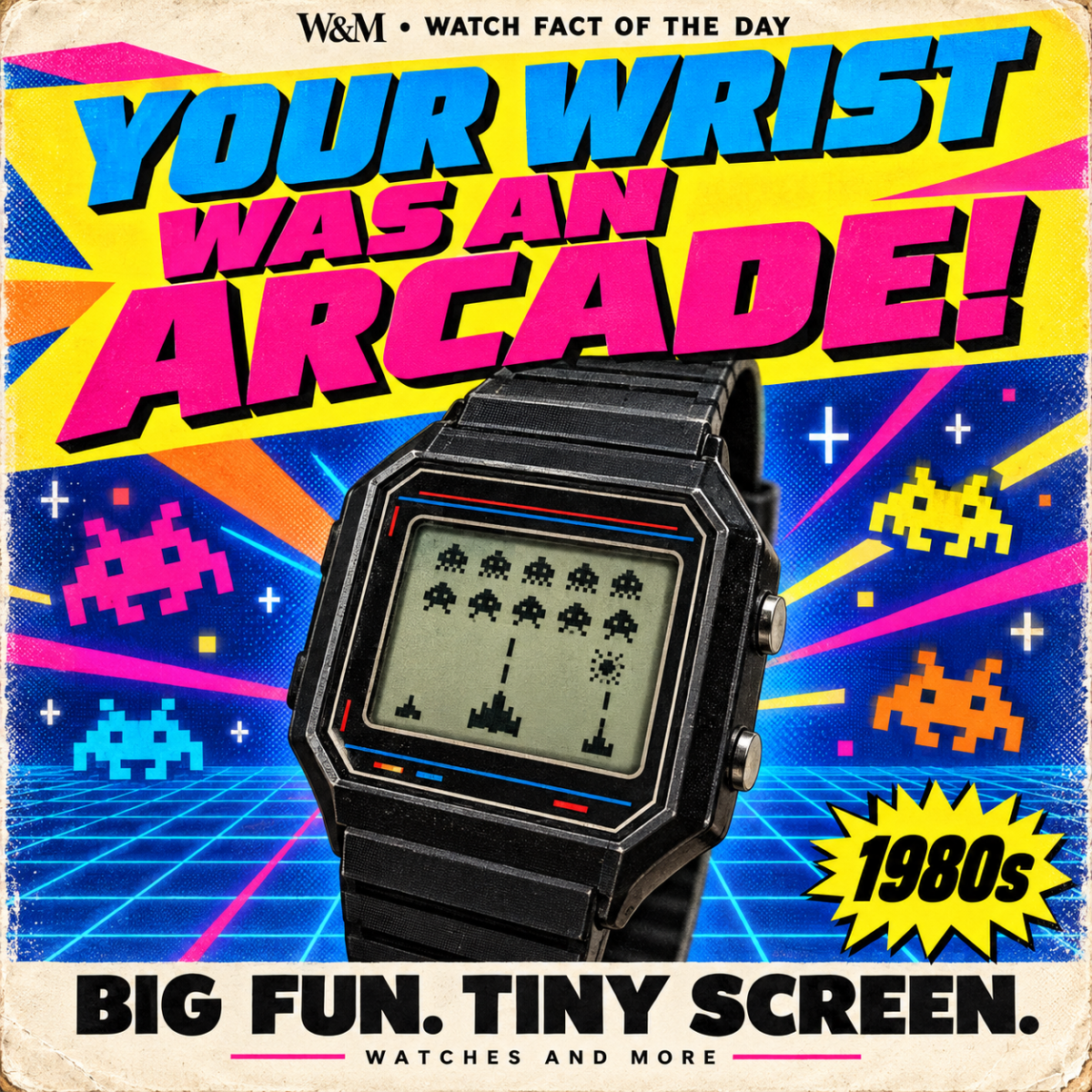
Before smartwatches, a few tiny buttons and an LCD screen were all you needed to battle aliens between checking the time.

Imagine looking down at your watch and facing an alien invasion.

Your mission? Move your spaceship, fire back, and survive—on a screen small enough to hide beneath your sleeve.

Welcome to the wonderfully geeky world of LCD game watches, where timekeeping met arcade action and your wrist became the coolest gadget in the room.

For a generation discovering digital technology, these watches offered something irresistible: a little piece of the future you could actually wear.

⏱️ First Came the Digital Revolution

Before watches could entertain us, manufacturers had to squeeze increasingly capable electronics into remarkably small cases.

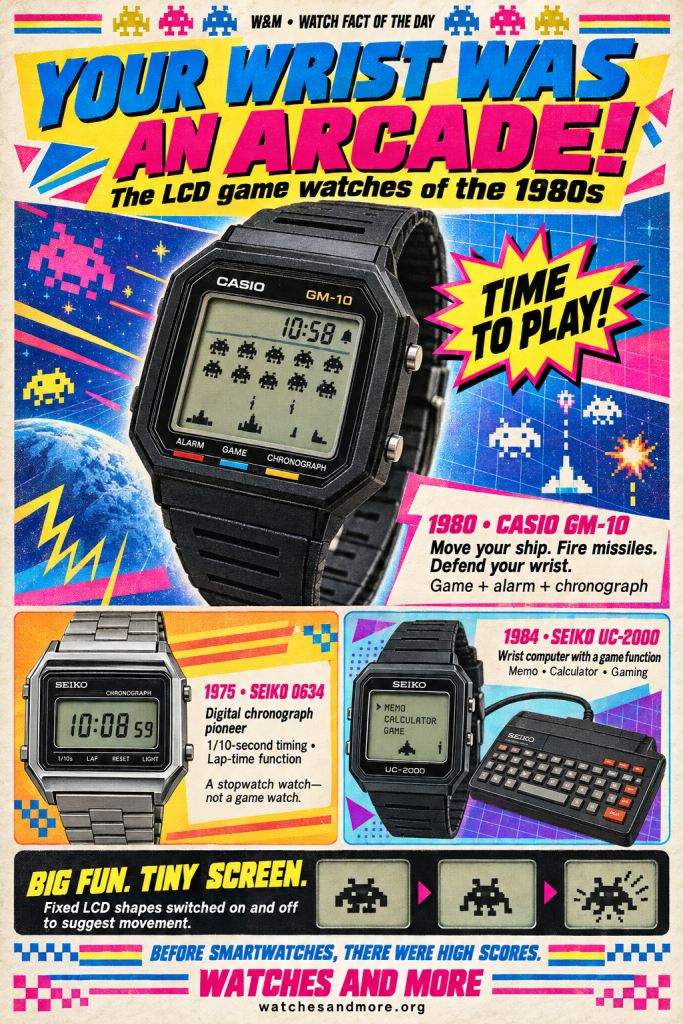
In 1975, Seiko introduced its 0634 digital quartz chronograph, which the company identifies as the world’s first digital quartz watch with a chronograph. It measured elapsed time to one-tenth of a second, included a lap-time function, and featured an internal light.

That watch didn’t contain a game. But it belonged to an exciting new era in which buttons and digital displays expanded what a wristwatch could do.

Once your watch could time a race, the next question practically asked itself:

Could it let you play one?

👾 Meet the Tiny Wrist Arcade

One memorable example was the Casio GM-10, also known as the Game-10, documented by vintage electronics specialists as a 1980 model.

Its attraction was a miniature space battle. Using two buttons on the right side, players manoeuvred a ship and fired missiles at attacking aliens. It also offered an alarm and chronograph, so the entertainment came alongside practical watch functions.

Think about the appeal.

An arcade machine was something you visited. A home console was something you sat down to play.

This game went wherever your wrist went.

Waiting around suddenly had possibilities. So did the dangerous phrase: “Just one more go.”

🕹️ Big Imagination, Tiny Screen

The magic of these early game watches came from how much entertainment designers could squeeze into so little space.

Many used fixed LCD shapes that switched on and off in sequence, creating the impression of movement. The games depended on simple actions, timing, and repetition rather than elaborate graphics.

A few changing shapes could become a challenge. A tiny button could become the difference between survival and defeat.

There’s a lovely design lesson in that: you don’t need a huge screen to create a big moment.

💡 Did You Know?

Seiko also put gaming into a wrist computer.

Its 1984 UC-2000 worked with an external controller and keyboard, using electromagnetic induction to transfer character data. Alongside memo and calculator functions, Seiko’s official history lists a game function.

That makes a fascinating pairing: Casio’s miniature arcade action and Seiko’s more ambitious approach to wrist computing.

The wrist was becoming a place to experiment.

⭐ Why It Matters

Game watches deserve a place in wearable technology history because they made a compelling promise:

A watch could be something you interacted with for pleasure.

We can see them as early expressions of an idea that modern smartwatches would explore much further: the wrist as a home for useful tools, information, and entertainment.

That’s a historical connection, rather than proof that game watches directly caused the smartwatch revolution. Their contribution was helping make a multifunction watch feel exciting—and personal.

They didn’t simply tell you the time.

They gave you a reason to spend a little time with them.

❤️ The W&M Take: High Scores, Small Screens, Huge Charm

At Watches And More, we love watches with a story. And a watch that lets you defend your wrist against aliens? That’s a pretty good one.

These little electronic adventures capture a wonderful moment in design history, when digital displays felt futuristic and manufacturers were willing to ask playful questions.

What else could a watch become?

Sometimes the answer was a calculator. Sometimes it was a wrist computer.

And sometimes, gloriously, it was an arcade.

Before gaming lived in our pockets, a little of it lived on our wrists.


⌚ Keep exploring the world of watches:

What would you choose for your wrist: a space battle, a racing game, or good old-fashioned timekeeping?

Category: Fun Quirk

Disclaimer: Every effort has been made to keep these watch facts accurate, but the world of horology is full of myths, disputed stories, and fascinating trivia. Consider these facts a starting point for discovery rather than the final word. If you have corrections or additional insights, let us know—we’re always happy to keep the record ticking in the right direction.

🕐 Discover more watch facts, reviews, and buying guides at WatchesAndMore


Read Next

Casio F-91W: The Everyday Watch in Counter-Terrorism Files

Hamilton Pulsar P1: The 1972 LED Time Computer

Join the Conversation

Did you own a game watch—and which game would you bring back? Share your thoughts in the comments.

Explore watches in the W&M Watch Database.

ETSY Shop
ETSY Shop
Redbubble Shop
Redbubble Shop
More Watch Facts
More Watch Facts

📚 Sources & Further Reading

Further reading: Fondation de la Haute Horlogerie — watchmaking glossary

Movado Ermeto: The Travel Watch That Became a Table Clock

In 1931, Movado introduced the Ermeto, a pocket-sized watch encased in a sliding leather sleeve that automatically wound the movement every time the case was op

Watch Fact of the Day

Fun Quirk: Sunday, October 11, 2026

📅 Sunday, October 11, 2026

Meet the Movado Ermeto—the ingenious travel companion that could wind itself as you opened its case.

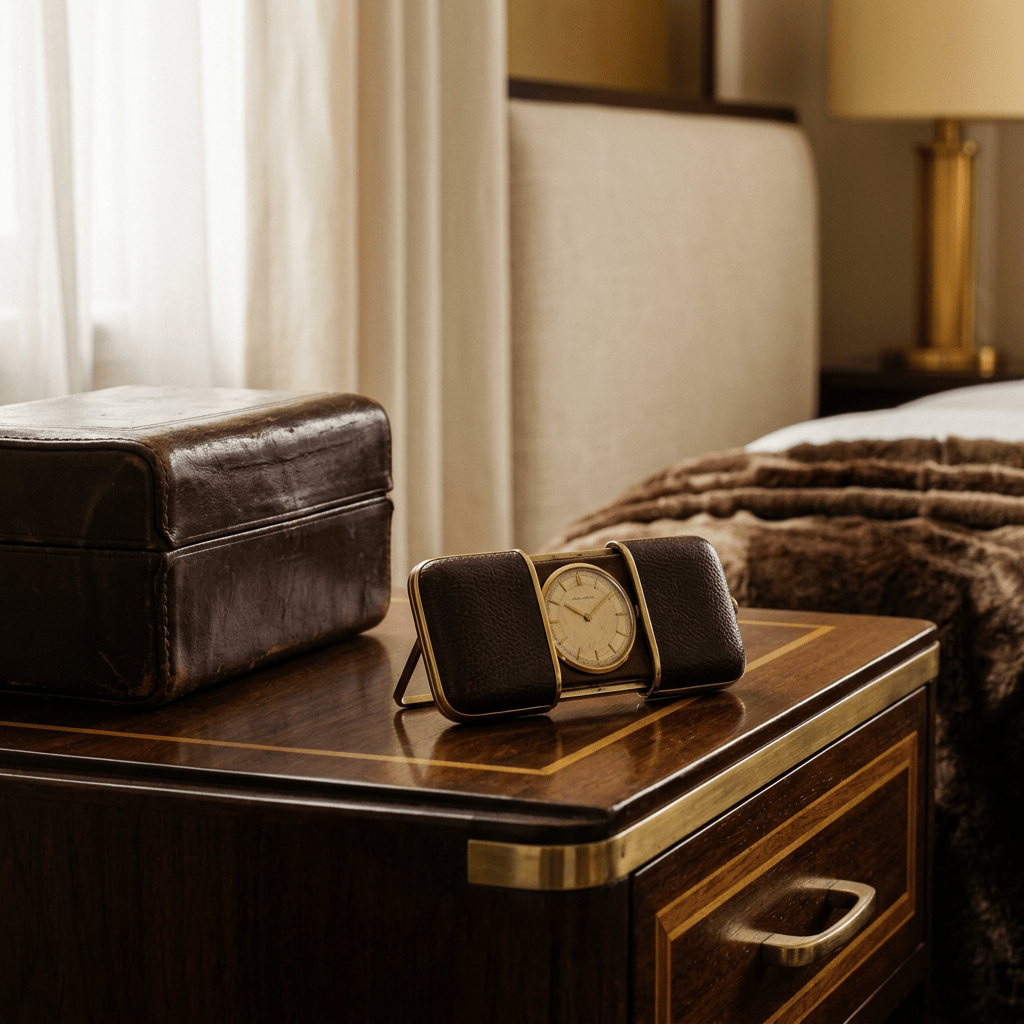
Imagine arriving at a hotel, taking a small leather-covered object from your pocket, and sliding its two halves apart.

A watch appears.

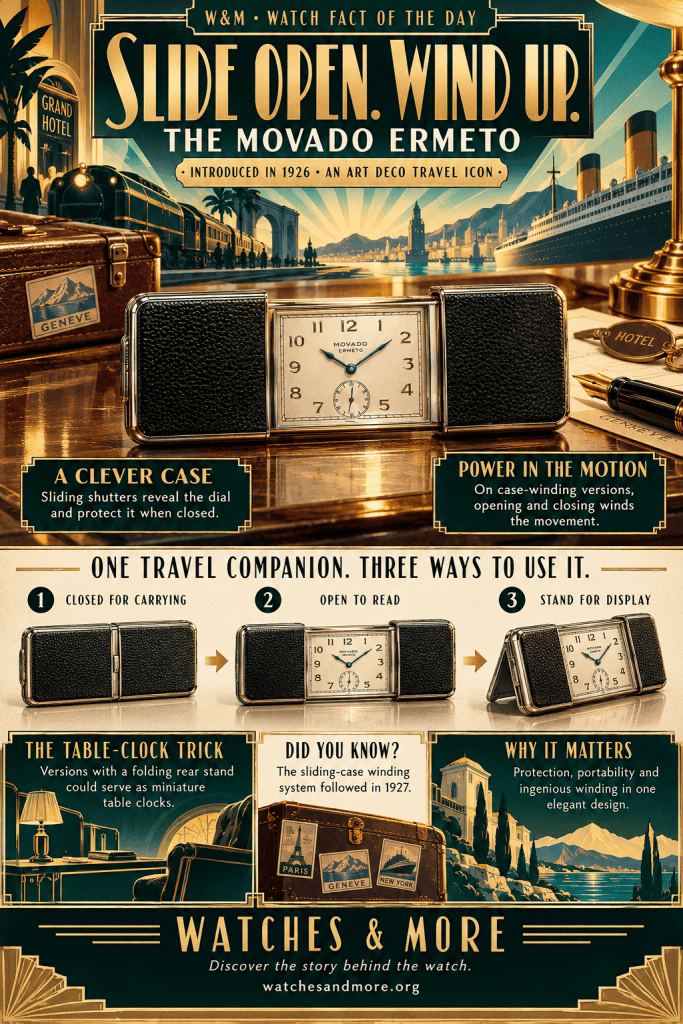
Prop it up beside the bed, and your travelling timepiece becomes a miniature table clock. Better still, on versions equipped with Movado’s ingenious winding system, opening and closing the case helps keep it running.

Long before multifunction gadgets filled our bags, the Movado Ermeto offered a wonderfully mechanical approach to versatility.

🧳 A Travel Idea Born Before the 1930s

Although perfectly at home in the world of interwar travel, the Ermeto’s story began in 1926, rather than 1931.

The protective sliding-case design originated with Huguenin Frères of Le Locle, and Movado brought the model to market.

Christie’s documents an enamel-decorated example hallmarked for 1928, confirming that this distinctive little watch was already established before the thirties began. Christie’s

↔️ Slide Open, Check the Time

The Ermeto’s defining feature was its two-part outer case.

Instead of lifting a conventional pocket-watch lid, the owner pulled the two halves apart to reveal the dial between them. Sliding them together concealed the watch again. Geneva, April 7th, 2021

It was a simple, satisfying interaction: a compact object when closed, a readable timepiece when opened.

Leather was one available finish, but the Ermeto was much more than a watch inside a soft sleeve. Its protective structure was a purpose-built sliding case. Surviving examples also feature elaborate enamel decoration. europastar.com

⚙️ Checking the Time Could Help Power It

The cleverest development followed the original design.

According to Antiquorum’s historical notes, Movado patented the sliding-case winding system in 1927. Movado’s own history confirms its essential trick: opening and closing the case automatically wound the movement. Geneva, April 7th, 2021

For versions equipped with that system, the action of revealing the dial also supplied energy.

Think about that for a moment.

The gesture you made to use the watch helped power the watch.

Early Ermetos were manually wound, so the case-winding feature should not be assumed on every example. europastar.com

🛏️ From Pocket to Bedside

Versions fitted with an integral folding stand could be propped up as small table clocks. europastar.com

That is where the Ermeto’s travel personality really comes alive.

Picture a railway carriage, a neatly packed overnight bag, and a hotel bedside table. A portable timepiece could move between those settings without needing to stay on your wrist.

The “transformation” came from opening and positioning the watch, with the stand supporting it for display. It was a thoughtful change of use rather than a complicated mechanical performance.

🛡️ What Did “Ermeto” Mean?

The name referred to the idea of being sealed or hermetic, emphasising the protection offered by the enclosing case. Christie’s

That deserves a careful distinction: historical protective language does not establish a modern water-resistance rating.

The appeal was the way the watch could be covered for carrying, then revealed when needed.

Protection became part of the design experience.

💡 Did You Know?

The Ermeto family eventually included more elaborate models.

Movado’s own history describes the Calendarmeto, a postwar development featuring day, month, and moon-phase complications. movado.com

The sliding-case idea proved adaptable enough to become a platform for much more than a simple time display.

⭐ Why It Matters

The Ermeto shows how useful innovation can begin with an everyday gesture.

Its designers considered the whole experience: carrying the watch, protecting it, reading it, powering it, and setting it down at the destination.

That is why this little Art Deco traveller still feels inventive.

Slide it open. Reveal the time. Give the journey a little more movement. ⌚🧳✨


Discover more remarkable timepieces in the W&M Watch Fact Archive.

Visit Watches & More and our companion site.

Category: Fun Quirk

Disclaimer: Every effort has been made to keep these watch facts accurate, but the world of horology is full of myths, disputed stories, and fascinating trivia. Consider these facts a starting point for discovery rather than the final word. If you have corrections or additional insights, let us know—we’re always happy to keep the record ticking in the right direction.

🕐 Discover more watch facts, reviews, and buying guides at WatchesAndMore


Read Next

Movado Polyplan: The Watch with a Movement on Three Planes

Vulliamy’s Traveller’s Watch: Two Times Before Time Zones

Join the Conversation

Would you take a mechanical travel clock on your next trip? Share your thoughts in the comments.
Explore watches in the W&M Watch Database.

ETSY Shop
ETSY Shop
More Watch Facts
More Watch Facts
Redbubble Shop
Redbubble Shop

📚 Sources & Further Reading

Further reading: Christie’s
movado.com

Tritium Watch Tubes: How Dials Glow Without Charging

In the 1970s, strict safety regulations surrounding radioactive materials prompted watchmakers to experiment with novel ways to display luminous elements. The r

Watch Fact of the Day

Fun Quirk: Saturday, October 10, 2026

📅 Saturday, October 10, 2026

No flashlight. No backlight button. Just a little atomic science keeping the dial visible in the dark.

Imagine putting your watch in a dark drawer.

Hours later, you take it out. Its markers are still glowing—even though you never charged them under a lamp.

For watches fitted with tritium gas tubes, that’s the everyday magic: miniature light sources that generate their own illumination.

It’s a fascinating meeting of watchmaking, glass engineering, and physics. And those little glowing bars give the dial a character all its own.

🔬 Tiny Tubes, Clever Science

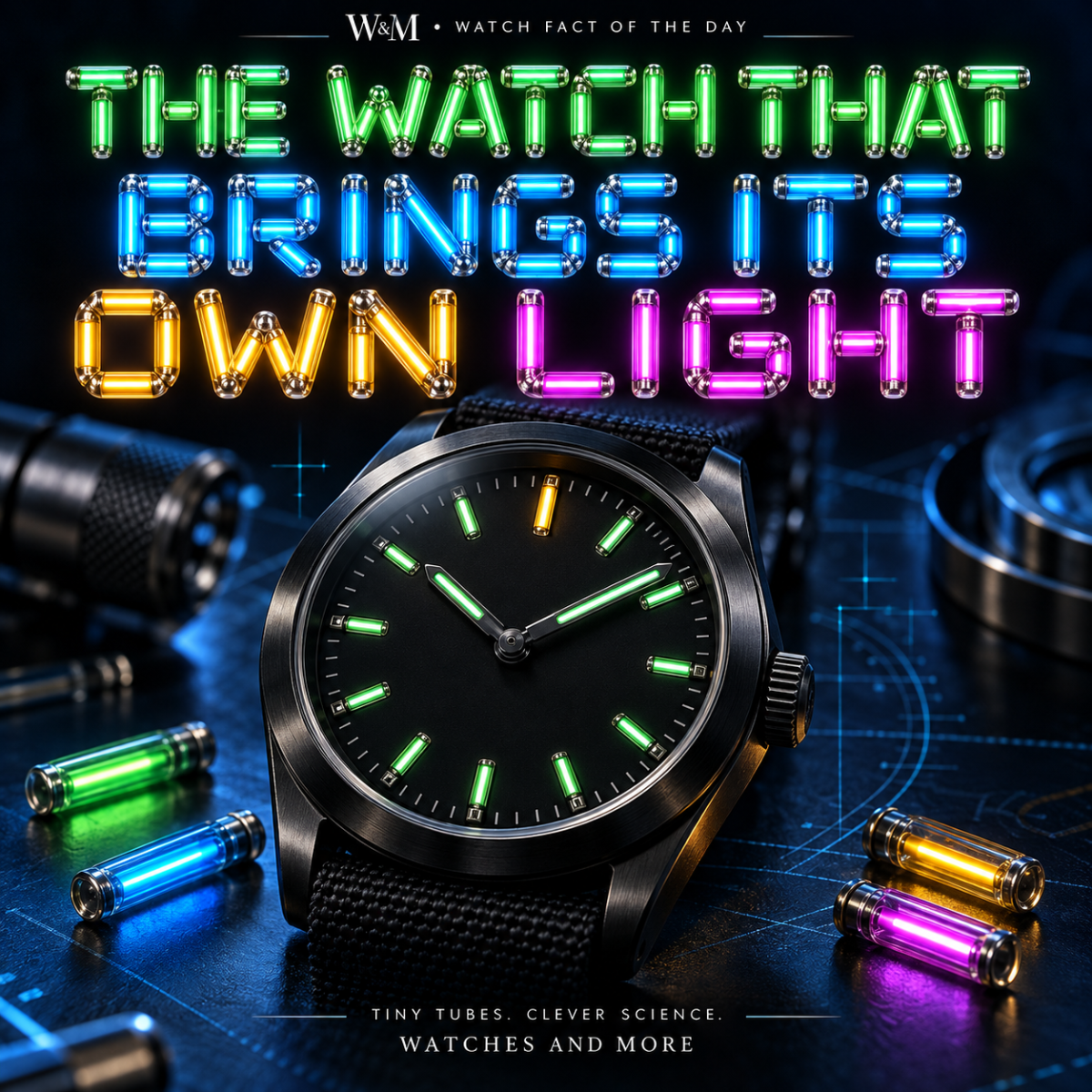
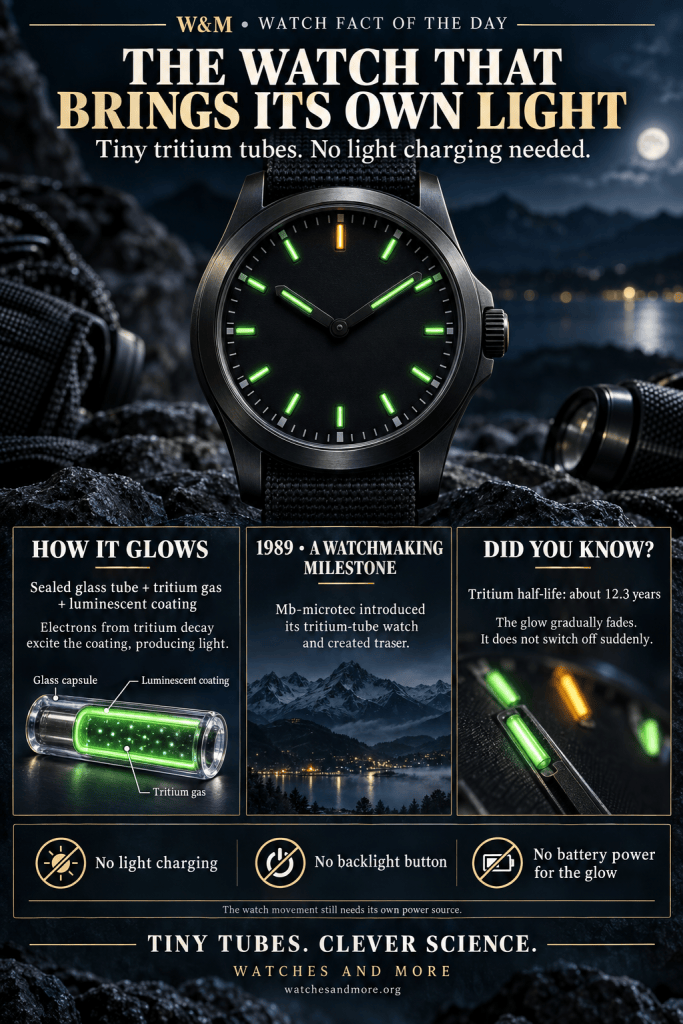
A tritium light tube is a miniature sealed glass capsule. Inside is tritium gas, while the inner surface carries a luminescent coating.

Tritium is a radioactive isotope of hydrogen. As it decays, it releases electrons that excite the coating, producing light. The coating determines the colour of the glow.

The result is wonderfully practical: illumination that needs no external light to charge it and no electricity from the watch battery.

The watch movement still needs its own power source. The glowing tubes handle their lighting independently.

Tiny capsules. Big idea.

⏱️ A Documented Watchmaking Milestone

Swiss specialist mb-microtec traces its history to 1969. Its official timeline identifies 1989 as the year it developed and introduced its self-illuminating watch, leading to the creation of the traser brand.

That milestone belongs to the story of sealed gas-tube illumination.

It’s worth keeping the terminology straight: tritium luminous paint and tritium gas tubes are different ways of using radioactive energy to produce light. A painted luminous marker isn’t a miniature glass capsule.

The tubes brought a distinctive physical element to the watch face—small components that could be positioned where readability mattered.

Watch Fact of the Day: The Tiny Tritium Tubes That Made Watches Glow Without Charging 🌙⌚

🌙 A Dial That Brings Its Own Light

Luminox provides a familiar example of this approach. Its watches place self-powered micro-gas tubes on the hands and hour markers, with tubes also used on bezels where required. They glow without needing exposure to an external light source.

For the wearer, the appeal is simple.

You can check the time in darkness without first reaching for a light or pressing a button.

For a designer, there’s another attraction: the little bars become part of the dial’s visual language. They can give it an instrument-like appearance, with the lighting components clearly contributing to its layout.

Function becomes part of the look.

💡 Did You Know?

The glow gradually weakens over time.

Tritium has a half-life of approximately 12.3 years. After that period, roughly half the original tritium remains. Its declining activity contributes to reduced light output as the tubes age.

A half-life isn’t an expiry date. The tubes don’t suddenly switch off on an anniversary.

Their light fades progressively—a reminder that even this remarkable technology follows the clock of physics.

⭐ Why It Matters

Tritium tubes offer an elegant solution to a very ordinary problem: reading the time when there’s little or no light.

They also show how a useful component can shape a product’s identity.

Those visible capsules help create the purposeful appearance associated with many tactical and outdoor watches. Their appeal comes from the connection between what you see and what it does.

It’s watch design with a practical reason behind the glow.

❤️ The W&M Take: A Little Physics on Your Wrist

Some watches impress us with elaborate movements. Others win us over with rugged cases or beautiful dials.

A tritium-tube watch adds another kind of fascination: tiny sealed light sources quietly doing their job in the dark.

No charging ritual for the lume. No button required.

Just a clever piece of engineering that makes an everyday glance at your wrist a little more interesting.

Sometimes the coolest watch feature is the one you appreciate after the lights go out.


⌚ Explore more watch stories:

What’s your favourite way to light up a watch: glowing paint, tritium tubes, or a classic digital backlight?

Category: Fun Quirk

Disclaimer: Every effort has been made to keep these watch facts accurate, but the world of horology is full of myths, disputed stories, and fascinating trivia. Consider these facts a starting point for discovery rather than the final word. If you have corrections or additional insights, let us know—we’re always happy to keep the record ticking in the right direction.

🕐 Discover more watch facts, reviews, and buying guides at WatchesAndMore


Read Next

The Radium Girls: The Human Cost of Glowing Watch Dials

The Niagara Watch: An Unusual Approach to Dial Lighting

Join the Conversation

Do you prefer tritium tubes, luminous paint, or a digital backlight? Share your thoughts in the comments.

Explore watches in the W&M Watch Database.

ETSY Shop
ETSY Shop
Redbubble Shop
Redbubble Shop
More Watch Facts
More Watch Facts

📚 Sources & Further Reading

Further reading: Fondation de la Haute Horlogerie — watchmaking glossary

Movado Polyplan: The Watch with a Movement on Three Planes

Movado’s 1912 Polyplan arranged its movement on three angled planes. Explore a watch that reshaped its mechanism to follow the wrist.

Watch Fact of the Day

Fun Quirk: Friday, October 9, 2026

📅 Friday, October 9, 2026

A curved case can help a watch follow the wrist. Movado changed the architecture of the mechanism inside as well.

The Movado Polyplan asks a simple design question with a difficult mechanical answer: if the wrist is curved, why must the movement remain flat? Solving it required more than reshaping a protective shell.

📐 Three Planes Instead of One

Movado’s official history identifies the Polyplan as its twentieth patent in 1912. The movement was built on three angled planes, allowing it to fit a case shaped around the wrist’s contours.

This is the distinction that makes the design compelling. A curved case may contain a relatively flat mechanism with unused space around it. The Polyplan made the internal layout part of the same design response.

⚙️ When the Interior Follows the Exterior

A movement needs stable supports, a path for transmitting power, and room for its regulating components. Altering its architecture means considering those needs together rather than treating the case as an independent styling exercise.

The Polyplan’s interest is therefore architectural as much as visual. The watch’s outside shape expresses a decision that reaches into its working structure.

⌚ Comfort as a Design Brief

Modern fit discussions often focus on diameter, thickness, and lug-to-lug length. The Polyplan adds another consideration: how the whole object relates to the surface on which it is worn.

It invites us to think of the wrist as the starting point for a watch, rather than simply a place to attach an existing mechanism. That is a useful design lesson well beyond horology.

💡 Did You Know?

Movado’s heritage includes other experiments in form and function, including the Ermeto travel watch and the later Curviplan. The Polyplan belongs within a broader history of questioning the familiar watch format.

⭐ Why It Matters

A clear objective can require changes deep inside an object. Improving its relationship with the wearer may demand more than a new outline or a different strap.

Exact production totals and claims that the watches were impossible to service require separate evidence. The documented three-plane architecture is already remarkable enough to carry the story.

A memorable design can begin with the decision that the mechanism should adapt to its wearer.

📚 Sources & Further Reading

Movado — Official history, The Polyplan


Category: Fun Quirk

Disclaimer: Every effort has been made to keep these watch facts accurate, but the world of horology is full of myths, disputed stories, and fascinating trivia. Consider these facts a starting point for discovery rather than the final word. If you have corrections or additional insights, let us know—we’re always happy to keep the record ticking in the right direction.

🕐 Discover more watch facts, reviews, and buying guides at WatchesAndMore


Read Next

Movado Ermeto: The Travel Watch That Became a Table Clock

Zodiac Astrographic: The 1969 Watch with Floating Hands

Join the Conversation

Would an unusual case shape influence your next watch choice? Share your thoughts in the comments.
Explore watches in the W&M Watch Database.

HMS Beagle’s Pocket Chronometer: Timekeeping on Darwin’s Voyage

Ah, the tale of Charles Darwin’s trusty pocket watch, affectionately called “K.” This little timepiece didn’t just help you catch the bus—oh no, it navigated the high seas! Before GPS made it a couch potato, this stalwart chronometer hopped aboard HMS Beagle like a true adventurer. From 1831 to 1836, it helped map uncharted territories and summon crucial measurements to support Darwin’s theories, proving that sometimes, understanding the vast universe comes down to knowing if it’s tea time! So, next time you glance at your wrist, remember: watches have been making history, one tick at a time.

Watch Fact of the Day

Military Watches: Thursday, October 8, 2026

📅 Thursday, October 8, 2026

Watch Fact of the Day: The Pocket Watch That Sailed With Charles Darwin ⌚🌍

Before GPS, a remarkably accurate pocket timekeeper helped an expedition find its place in the world.

Charles Darwin’s voyage aboard HMS Beagle helped transform our understanding of life on Earth.

But alongside the specimens, notebooks, and geological observations was another extraordinary scientific story: the precision timekeeping that helped the expedition map the world.

Among its instruments was a pocket chronometer small enough to carry ashore—and important enough to earn its place in the history of exploration.

⚓ Meet Chronometer “K”

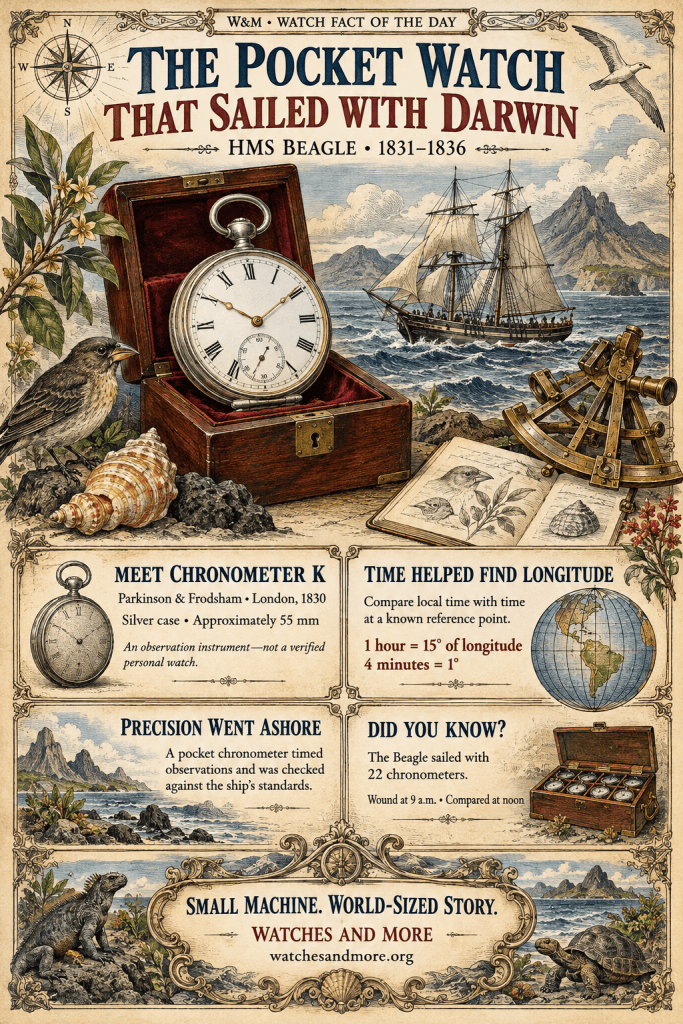
A surviving pocket chronometer made by Parkinson & Frodsham of London in 1830 is documented as having travelled on the Beagle’s second voyage, from 1831 to 1836, with Darwin aboard.

Known on the ship as “K,” it served as an observation chronometer, helping survey the South American coast. It was also taken ashore in the Galápagos Islands. Its silver case measures approximately 55 mm across, and it was supplied with a mahogany box.

This was much more than a handsome pocket watch.

It was portable precision equipment for a world without satellite navigation.

Watch Fact of the Day: The Pocket Watch That Sailed With Charles Darwin

🧭 Why Finding Your Location Required Knowing the Time

At sea, knowing how far east or west you had travelled presented a formidable challenge.

One solution was to compare local time, determined through astronomical observations, with the time at a known reference location.

Because Earth turns through 360 degrees in 24 hours, one hour of time difference corresponds to 15 degrees of longitude. Just four minutes represents one degree.

That made an accurate timekeeper enormously valuable.

A watch could help answer a question far bigger than “What time is it?”

“Where are we?”

🔭 Precision That Went Ashore

Captain Robert FitzRoy’s account describes a pocket chronometer carried by hand in a small box for timing observations.

Before and after those observations, it was compared with the expedition’s standard chronometers. That checking mattered: the portable instrument connected field measurements with the carefully maintained timekeepers aboard ship.

Picture the contrast.

A small mechanical timepiece, protected in its box. A sextant directed toward the sky. An unfamiliar coastline waiting to be measured.

Exploration depended on curiosity—but it also depended on reliable instruments.

🌿 The Darwin Connection—Without the Embellishment

The Beagle voyage provided observations and collections that contributed to Darwin’s later development of evolution by natural selection. The pocket chronometer supported the expedition’s surveying work.

Those are powerful connections in their own right.

We don’t need to imagine Darwin personally consulting this particular watch for every discovery. Its documented role places it aboard the same remarkable expedition, helping establish the geographical framework within which exploration took place.

It sailed with Darwin. That alone is an extraordinary story.

💡 Did You Know?

The Beagle carried 22 chronometers when it sailed from England.

FitzRoy described a dedicated cabin where the instruments were secured in boxes surrounded by sawdust. They were wound daily at nine and compared at noon, with the routine entrusted to George James Stebbing.

Some instruments failed during the voyage, but FitzRoy reported that none of the expedition’s measurements depended on fewer than twelve chronometers.

Precision came from careful routines and comparison—not simply trusting one watch.

⭐ Why It Matters

This story reveals a quieter side of scientific discovery.

We remember the naturalist, the islands, and the ideas. Behind them stood instrument makers and surveyors whose work helped make the expedition possible.

A pocket chronometer brought meticulous engineering into the field. It linked the movement of tiny mechanical components with measurements on a planetary scale.

Sometimes, understanding a big world begins with a very small machine.

❤️ The W&M Take: A Watch With a World of History

At Watches And More, we believe every watch has a story.

This one connects London watchmaking, ocean voyages, coastal surveys, and an expedition that changed how humanity understood nature.

Its importance goes far beyond its silver case.

It reminds us that watches have been tools for discovery—carried wherever people needed dependable time to explore unfamiliar places.

Darwin studied the world. Precision timekeepers helped his expedition navigate it.


⌚ Keep exploring:

Which watch story fascinates you most: ocean exploration, aviation, or the journey into space?

Category: Military Watches

Disclaimer: Every effort has been made to keep these watch facts accurate, but the world of horology is full of myths, disputed stories, and fascinating trivia. Consider these facts a starting point for discovery rather than the final word. If you have corrections or additional insights, let us know—we’re always happy to keep the record ticking in the right direction.

🕐 Discover more watch facts, reviews, and buying guides at WatchesAndMore


Read Next

Tide-Tracking Pocket Watches: Timekeeping for the Sea

Longines Weems: The Second-Setting Watch for Early Aviators

Join the Conversation

Which appeals to you more: a marine chronometer or an aviation watch? Share your thoughts in the comments.

Explore watches in the W&M Watch Database.

ETSY Shop
ETSY Shop
Redbubble Shop
Redbubble Shop
More Watch Facts
More Watch Facts

📚 Sources & Further Reading

Further reading: Fondation de la Haute Horlogerie — watchmaking glossary