

Frozen hands. A puzzling time. And a human story behind one of Titanic’s most poignant surviving objects.
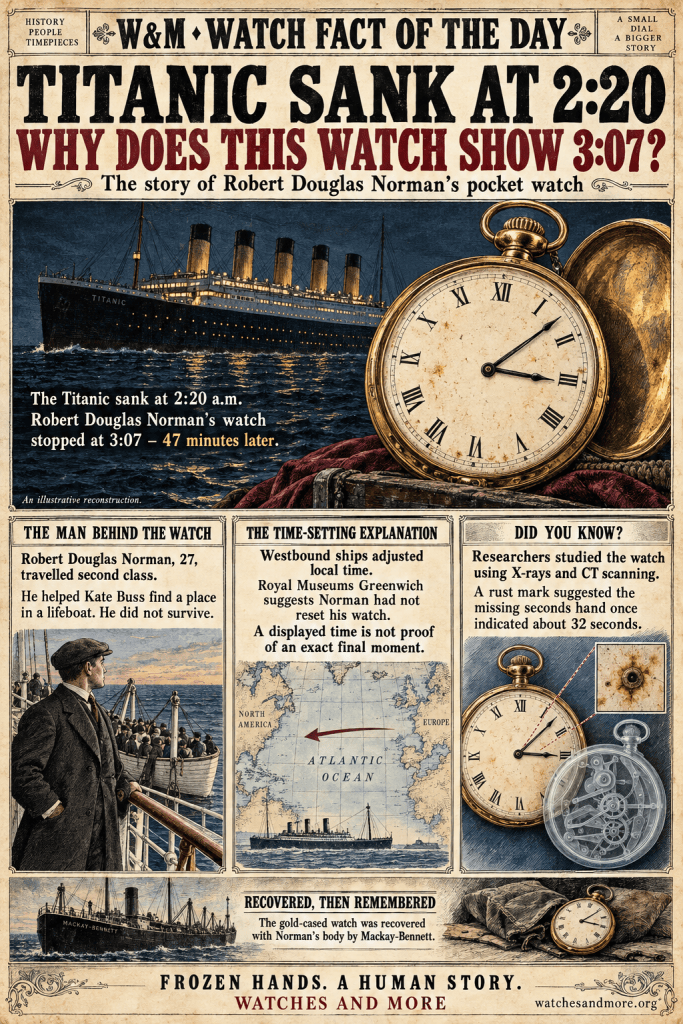
Titanic disappeared beneath the Atlantic at approximately 2:20 a.m. on April 15, 1912.
Yet a pocket watch recovered from one of its passengers shows 3:07.
Forty-seven minutes later.
Was the watch wrong? Had it continued running after the ship sank? Or was something else behind those motionless hands?
The explanation offered by Royal Museums Greenwich concerns an easily overlooked part of ocean travel: the time passengers set on their watches.
But before we explore the mystery, we should meet the man who carried it.
🧳 A Journey That Never Reached Its Destination
Robert Douglas Norman was 27, travelling aboard Titanic as a second-class passenger.
He was heading to Vancouver to visit his brother, with plans for further travel. Like so many aboard the liner, he had a destination, people waiting for him, and a future beyond the voyage.
His gold-cased pocket watch was one of the personal belongings that would eventually help preserve his story.
Today, its significance reaches far beyond its value as a timepiece.
🚢 A Place in a Lifeboat
According to Royal Museums Greenwich, Norman helped fellow passenger Kate Buss find a place in a lifeboat. He remained aboard and did not survive.
When the recovery vessel Mackay-Bennett later recovered his body, the watch was found among his clothing. Its rusted hands showed seven minutes past three.
That is what makes this object so affecting.
It connects a familiar historical event with one individual—and an act of assistance during a terrible night.
🕰️ Why 3:07 Doesn’t Match 2:20
A passenger’s watch was only as closely aligned with ship time as its setting allowed.
On a westbound Atlantic crossing, clocks were adjusted as the ship moved toward a different local time. Passengers needed to adjust their own watches accordingly.
Royal Museums Greenwich explains that Norman apparently had not reset his watch to the ship’s latest local time. Its displayed time therefore should not be read as directly equivalent to the recorded sinking time.
The important word is “apparently.” This is the museum’s explanation, rather than something the watch can independently prove.
The hands preserve a reading—not an automatically synchronised timestamp.
🔬 What Can a Stopped Watch Really Tell Us?
A recovered watch is physical evidence, but interpreting it requires care.
Was it running immediately before entering the water? How accurately was it set? How quickly did water stop the movement?
Horology curator Rory McEvoy explored these questions in a study of Norman’s watch using X-ray imaging and computed tomography, or CT. He described the 3:07 reading as intriguing and considered it probable that the unwaterproofed watch would have stopped within a minute of immersion.
That makes the frozen hands compelling evidence to investigate, rather than a precise record of Norman’s final moment.
Sometimes, the most fascinating watch story begins with asking what we can—and cannot—learn from the dial.
💡 Did You Know?
Researchers found a trace of a missing seconds hand.
McEvoy’s study reports that the watch’s seconds hand had deteriorated completely. However, a mark left in the rust on the dial suggested it had indicated approximately 32 seconds when it stopped.
Even a component that no longer survives can leave evidence behind.
⭐ Why It Matters
Titanic’s story is often told through the scale of the ship and the magnitude of the disaster.
A personal object brings that history closer.
Norman’s watch reminds us that the passengers were individuals carrying ordinary possessions toward extraordinary changes in their lives.
Its stopped hands invite a question about time. Its ownership asks us to remember a person.
That is where this watch’s deepest significance lies.
❤️ The W&M Take: More Than Frozen Hands
At Watches And More, we believe every watch has a story.
This one holds a particularly moving connection between an everyday object, an interrupted journey, and a passenger remembered for helping someone else reach a lifeboat.
The difference between 2:20 and 3:07 draws us into the investigation.
Robert Douglas Norman gives us a reason to remember it.
The watch stopped. Its power to tell his story did not.
⌚ Explore more stories behind remarkable timepieces:
What everyday object would you most want preserved to tell your story to future generations?