
Watch Fact of the Day

📅 Saturday, October 17, 2026
Meet the Zodiac Astrographic—the mechanical watch that put a little orbit on your wrist.
Imagine looking down at your watch and finding something missing.
The hands are there. They are moving. But the familiar arms connecting them to the centre have vanished.
Meanwhile, a tiny red dot travels around the dial like a satellite on a mission.
Welcome to the Zodiac Astrographic, a watch that made telling the time feel like peering into the future.
🚀 Born When the Future Looked Like Space
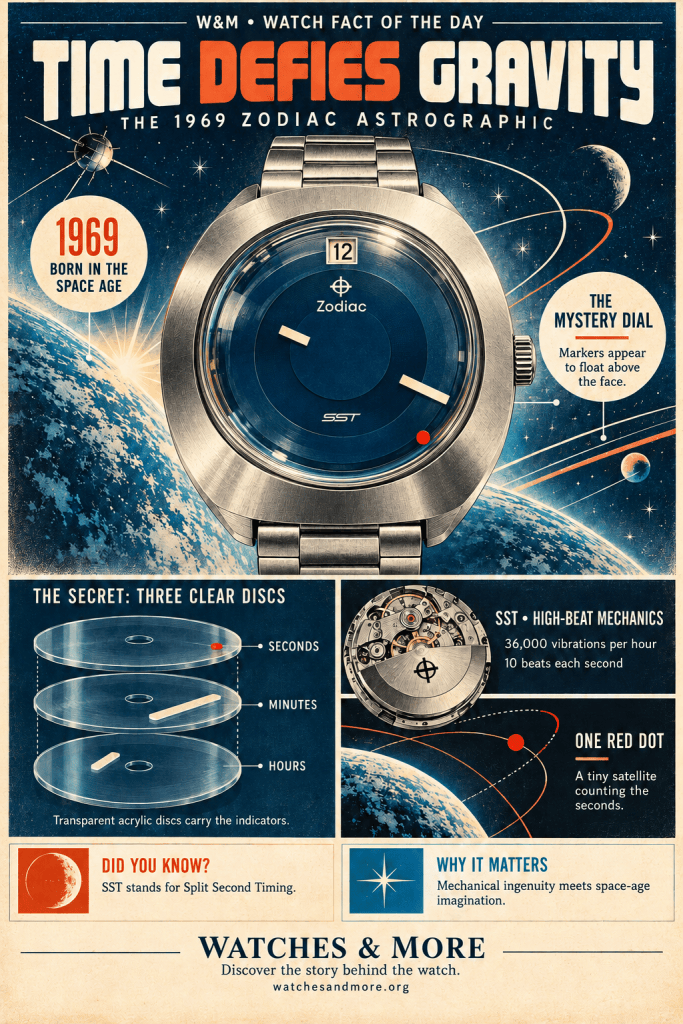
Zodiac introduced the Astrographic in 1969, the year of the Apollo 11 Moon landing. Its floating display and unconventional case design reflected the space-age optimism of the moment.
Zodiac’s parent company, Fossil Group, explicitly connects the original design with the excitement surrounding space exploration. This was a watch intended to look forward. Fossil Group
Its appeal is easy to understand: why settle for ordinary hands when your wrist could host something resembling a miniature orbital system?
🪄 The Secret Behind the Floating Hands
The mystery was an ingenious optical illusion.
Rather than conventional hands extending from a visible central attachment, the vintage Astrographic used three stacked transparent acrylic discs, carrying the hour indicator, minute indicator, and red seconds dot.
The movement rotated the discs. Their transparency made the indicators appear unsupported above the dial. For the original vintage model, acrylic is the supported description; sapphire should not be assumed. fratellowatches.com
Think of three clear records turning at different speeds, each carrying just one visible mark. You notice the marks; the surfaces supporting them largely disappear.
The mechanics remained connected. The design made those connections hard to see.
🔴 A Little Red Satellite
The red seconds dot supplied the finishing touch.
Zodiac describes the original as having a small red moon orbiting the dial. Against the floating hour and minute indicators, that simple dot gave the display a personality all its own. Zodiac Watches®
You could read the time—or spend a moment watching your own tiny celestial performance.
No actual weightlessness required.
⚙️ A Fast-Beat Heart Beneath the Illusion
The Astrographic SST paired its unusual display with high-beat mechanical watchmaking.
The vintage calibre 88D examined by Fratello runs at 36,000 vibrations per hour, equivalent to 5 Hz: five complete balance oscillations, or ten beats, each second.
That produces small, frequent advances of the red dot, giving its journey a smooth-looking flow.
SST stands for “Split Second Timing.” It is Zodiac’s designation here, rather than a claim that the watch contains a split-seconds chronograph. fratellowatches.com
🛸 A Different Way to Imagine a Watch
What makes the Astrographic memorable is the way the whole idea works together.
The name suggests the heavens. The display resembles orbiting objects. The case gives the illusion a suitably futuristic home.
It invites you to stop thinking about hands and start thinking about motion.
That is a remarkable achievement for something whose everyday job is still simply to tell you whether you are late.
💡 Did You Know?
For its 50th anniversary, Zodiac revisited the Astrographic with a limited edition inspired by Mars.
The red-dot seconds indicator fitted that theme beautifully: the original’s little orbiting moon could now evoke the Red Planet. Fossil Group
Half a century later, the space-age idea still had somewhere to go.
⭐ Why It Matters
The Astrographic shows how a watch can create wonder through the way it presents familiar information.
Hours, minutes, and seconds are ordinary. Making them appear to drift independently transforms the experience.
Its lasting appeal comes from that playful meeting of engineering and imagination.
Some watches tell you the time. This one makes time look like it has escaped gravity. 🔴🚀⌚
Discover more remarkable timepieces in the W&M Watch Fact Archive.
Visit Watches & More and our companion site.
Category: Fun Quirk
Disclaimer: Every effort has been made to keep these watch facts accurate, but the world of horology is full of myths, disputed stories, and fascinating trivia. Consider these facts a starting point for discovery rather than the final word. If you have corrections or additional insights, let us know—we’re always happy to keep the record ticking in the right direction.
🕐 Discover more watch facts, reviews, and buying guides at WatchesAndMore
Read Next
Hamilton Pulsar P1: The 1972 LED Time Computer
Hermès Le Temps Suspendu: The Watch That Hides the Time
Join the Conversation
Would you choose floating hands over a traditional watch dial? Share your thoughts in the comments.
Explore watches in the W&M Watch Database.



📚 Sources & Further Reading
Further reading: WatchesAndMore — original artwork and current product listings