Junghans and Max Bill: A Kitchen Clock Before the Purist Wristwatch

Junghans’s history places industrial scale beside Max Bill’s purist wristwatches in 1961. The partnership’s earlier starting point was a kitchen clock.

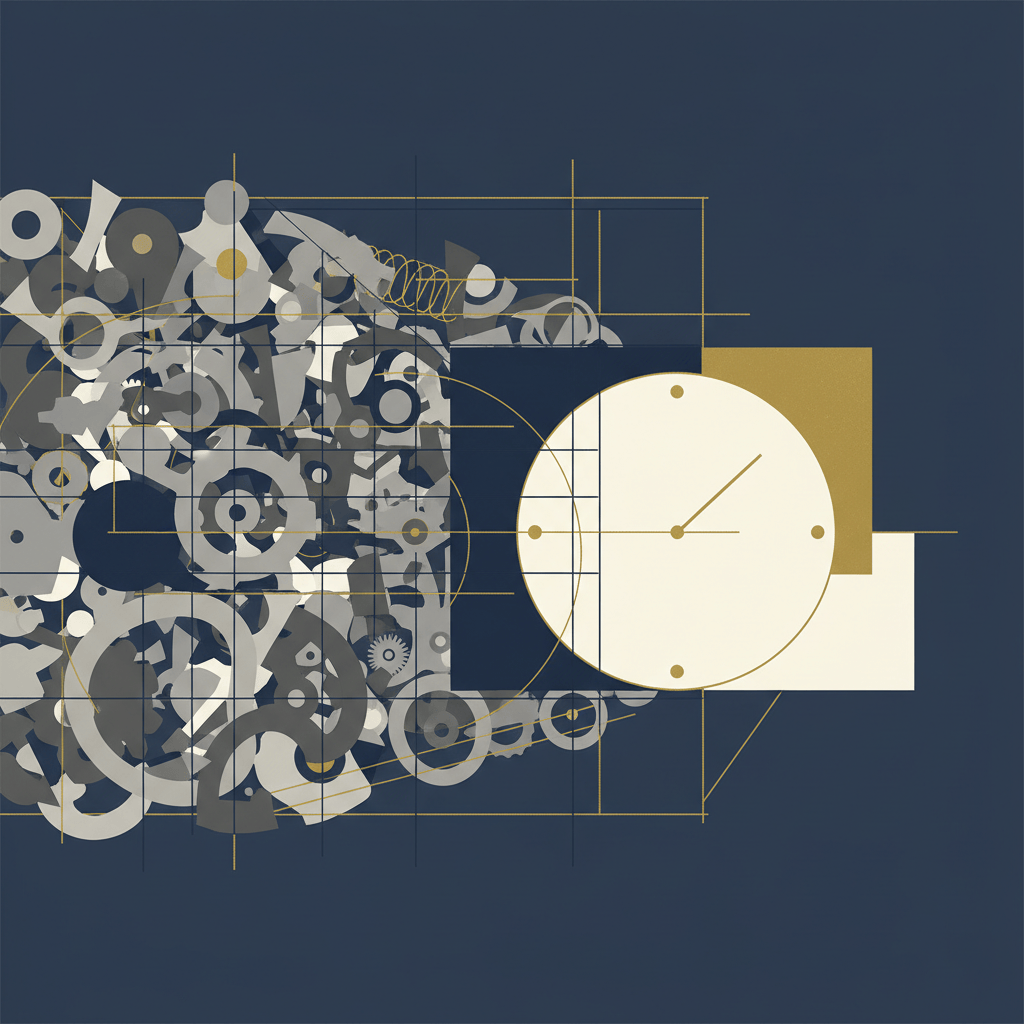
Abstract illustration contrasting repeated component shapes with a blank cream dial and geometric drafting lines.
Original conceptual editorial illustration; not a photograph of a real watch or person.

2026-11-11 · Watches And More

Twenty thousand watches a day—and a design approach described as purist. Junghans’s own history brings those two ideas together in 1961: it records 6,000 employees, 10,000 machines and exports to 100 countries, while dating Max Bill’s wristwatch designs to that same year. [S1] [S1]

For us, that juxtaposition is the story’s irresistible detail. Manufacturing scale answers how much a company can make; restrained design asks what each object should communicate. Those are different ambitions, and neither needs to cancel the other.

💡 Did You Know?

According to Junghans, the partnership began with a kitchen clock, not a wristwatch. In the early 1950s, the company considered commissioning an artist to design that everyday object; Bill developed the resulting clock with students. [S1] [S1]

Junghans also records Bill’s studies at the Bauhaus in Dessau and his role as a founder of Ulm’s design school. In the brand’s account, the Bauhaus connection is therefore biographical, not merely a label attached to a clean-looking dial. [S1]
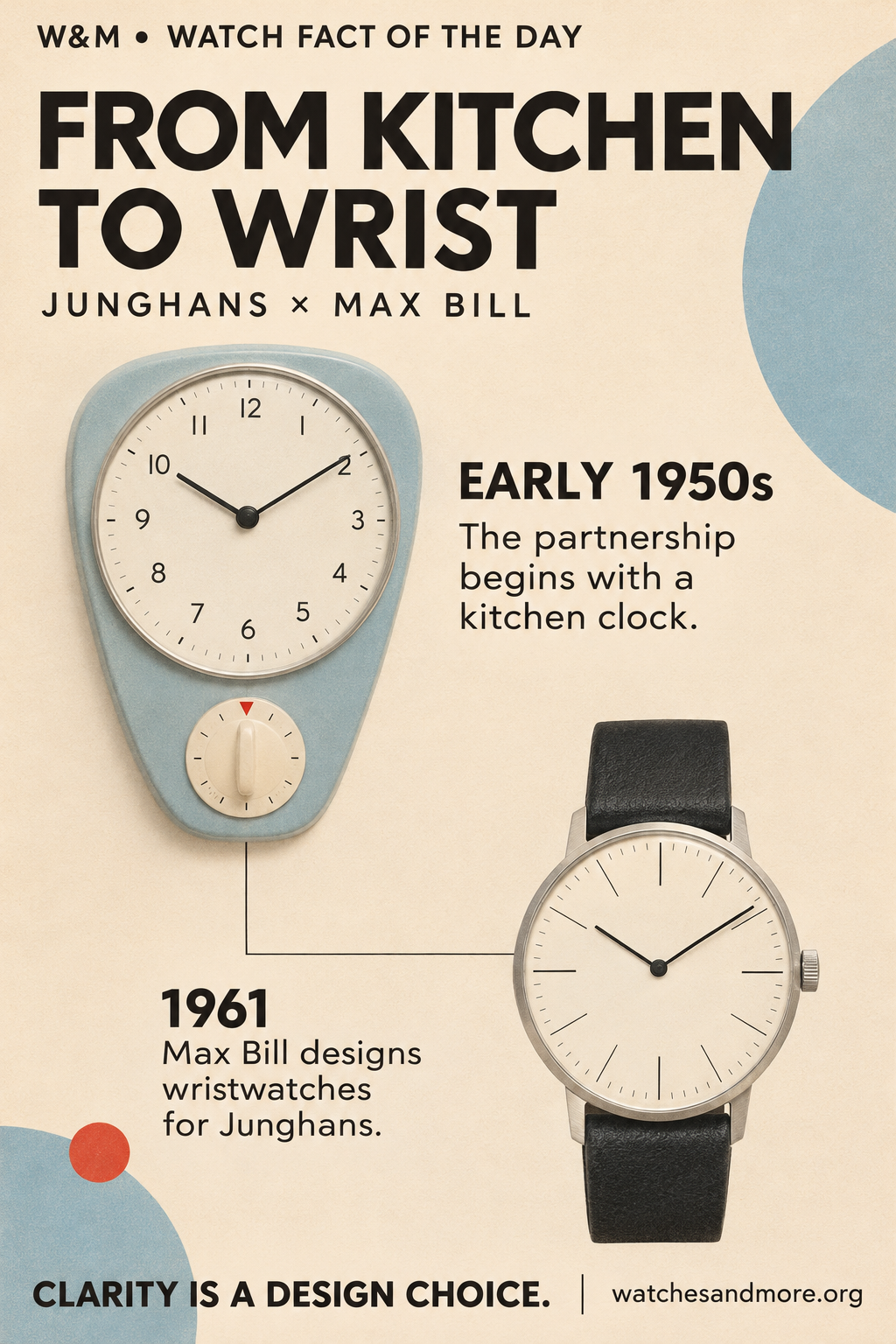
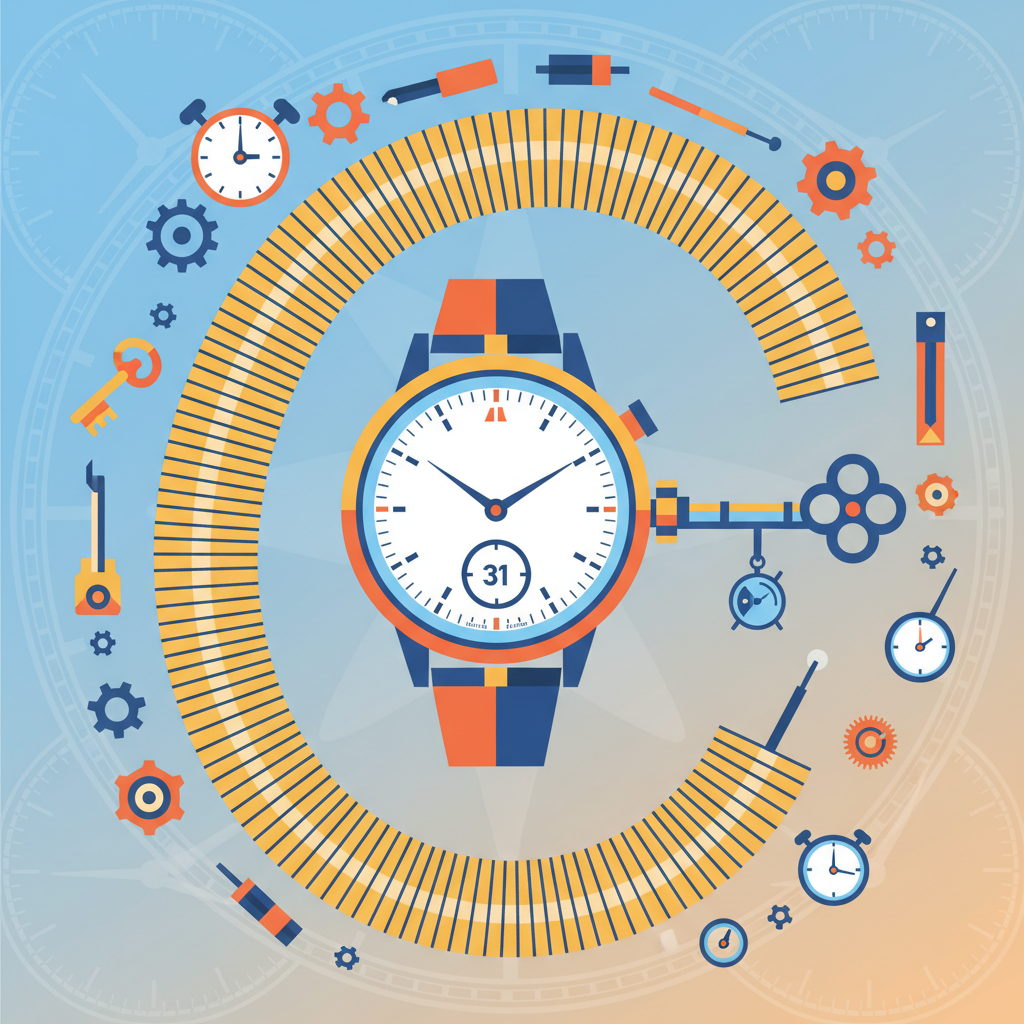
Mid-century-style timeline showing the Junghans and Max Bill partnership beginning with a kitchen clock in the early 1950s and reaching wristwatch design in 1961.
From Kitchen to Wrist: a W&M illustration inspired by Junghans and Max Bill’s mid-century design partnership.

⭐ Why It Matters

Junghans’s collection page explicitly connects its max bill models with the Bauhaus’s clear, minimalist style. That is how the manufacturer presents the partnership’s continuing significance: as a design philosophy carried through the collection, rather than simply a name from its historical timeline. [S2]

❤️ The W&M Take

Our take: the compelling lesson is not that simplicity defeated industry. It is that an everyday object deserved an artist’s attention. We think that makes this partnership worth revisiting: restraint can be a positive design decision, not an absence of imagination.

Sources

Disclaimer: Every effort has been made to keep these watch facts accurate, but the world of horology is full of myths, disputed stories, and fascinating trivia. Consider these facts a starting point for discovery rather than the final word. If you have corrections or additional insights, let us know—we’re always happy to keep the record ticking in the right direction.

Read Next

Watches And More · Watch Fact Archive · Companion site

What gives a watch its strongest identity: a distinctive shape, a clear dial, or the story of the person who designed it?

Inside NOMOS’s Swing System: A Blue Spring and 40 Ways to Find Its Match

A blue balance spring and 40 classes of component matching reveal the detail behind NOMOS’s proprietary Swing System.

Abstract illustration of a blue spring curve, ruby-toned accents and metallic circular forms under cool workshop light.
Original conceptual editorial illustration; not a photograph of a real watch or person.

2026-11-08 · Watches And More

Start with the small mechanism, not the dial. NOMOS describes itself as an owner-operated, independent company founded in 1990 by Roland Schwertner. Its Swing System brings that company story inside the movement: an escapement that NOMOS identifies as its own proprietary design. [S2] [S1]

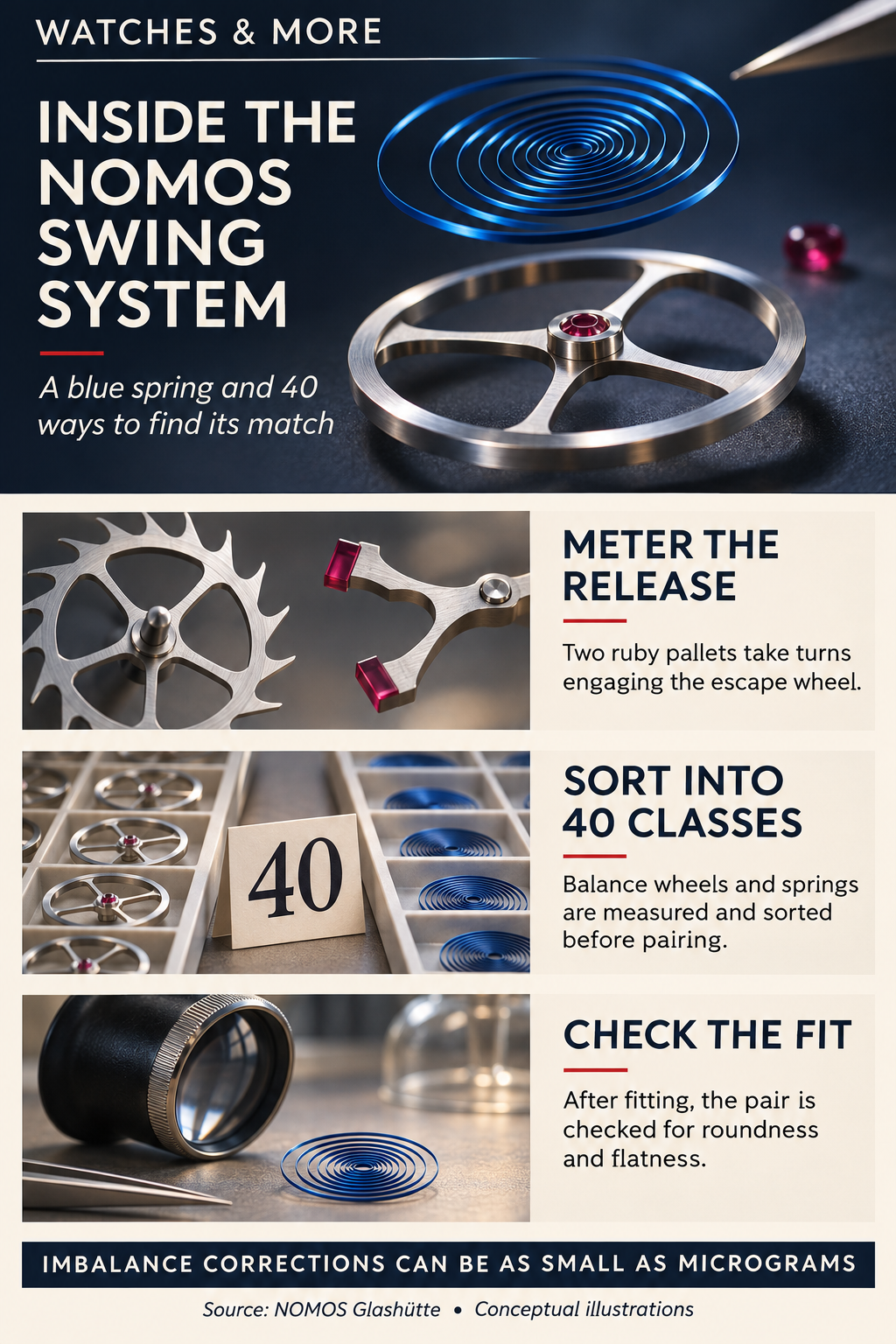
According to NOMOS, the assembly includes a balance wheel with a blue balance spring, an escape wheel and a pallet fork carrying synthetic-ruby pallets. The escapement regulates the release of the spring’s stored energy rather than letting it unwind all at once. NOMOS explains that the fork’s two rubies alternately engage the escape-wheel teeth, metering that release. [S1] [S1] [S1]

NOMOS Swing System infographic showing the blue balance spring, ruby pallets, 40 sorting classes, and the final fit check.
Watches & More infographic based on NOMOS Glashütte’s description of the Swing System. Conceptual illustrations.

💡 Did You Know?

NOMOS describes a miniature matchmaking operation: balance wheels and springs are measured and sorted into 40 classes according to their properties. After a spring is fitted to its wheel, the pair is checked again for roundness and flatness. Making the parts is only part of the story; finding the right partners matters, too. [S1] [S1]

⭐ Why It Matters

NOMOS’s account connects production with adjustment: it describes making and fine-machining caliber parts, then constructing, assembling, regulating and encasing calibers in Glashütte. At the balance wheel, that work reaches microgram scale. The company says detected imbalances are corrected by removing tiny amounts of material—millionths of a gram. [S2] [S2] [S1]

❤️ The W&M Take

Our take: the compelling detail is not the word proprietary but the patient process behind it. We think component matching makes independence easier to understand as an engineering ambition, rather than simply a brand identity. For us, that is worth appreciating without treating ownership of an escapement design as proof of superior accuracy.

Sources

Disclaimer: Every effort has been made to keep these watch facts accurate, but the world of horology is full of myths, disputed stories, and fascinating trivia. Consider these facts a starting point for discovery rather than the final word. If you have corrections or additional insights, let us know—we’re always happy to keep the record ticking in the right direction.

Read Next

Watches And More · Watch Fact Archive · Companion site

What interests you more about a movement: who makes its components, or how those components are matched and finished?

Watch Fact of the Day: The Watch with 1.85-Meter Mainsprings That Requires a Key to Wind

In a time-bending twist, A. Lange & Söhne’s Lange 31 hit the watch scene like a marvel of engineering! This timepiece boasts a jaw-dropping 31-day power reserve, courtesy of two springs stretched longer than your neighbor’s last fishing tale at 1.85 meters each! Winding this gigantic power pack isn’t a simple twist of the wrist; you’ll need a miniature mechanical key, not unlike something Indiana Jones would use, to avoid a wrist workout worthy of an Olympic gold medal. All that energy unfurling requires clever tech to keep things steady, ensuring you don’t lose track of time—unless you’re setting it back to 2016!

Fun Quirk: Monday, August 10, 2026

📅 Monday, August 10, 2026

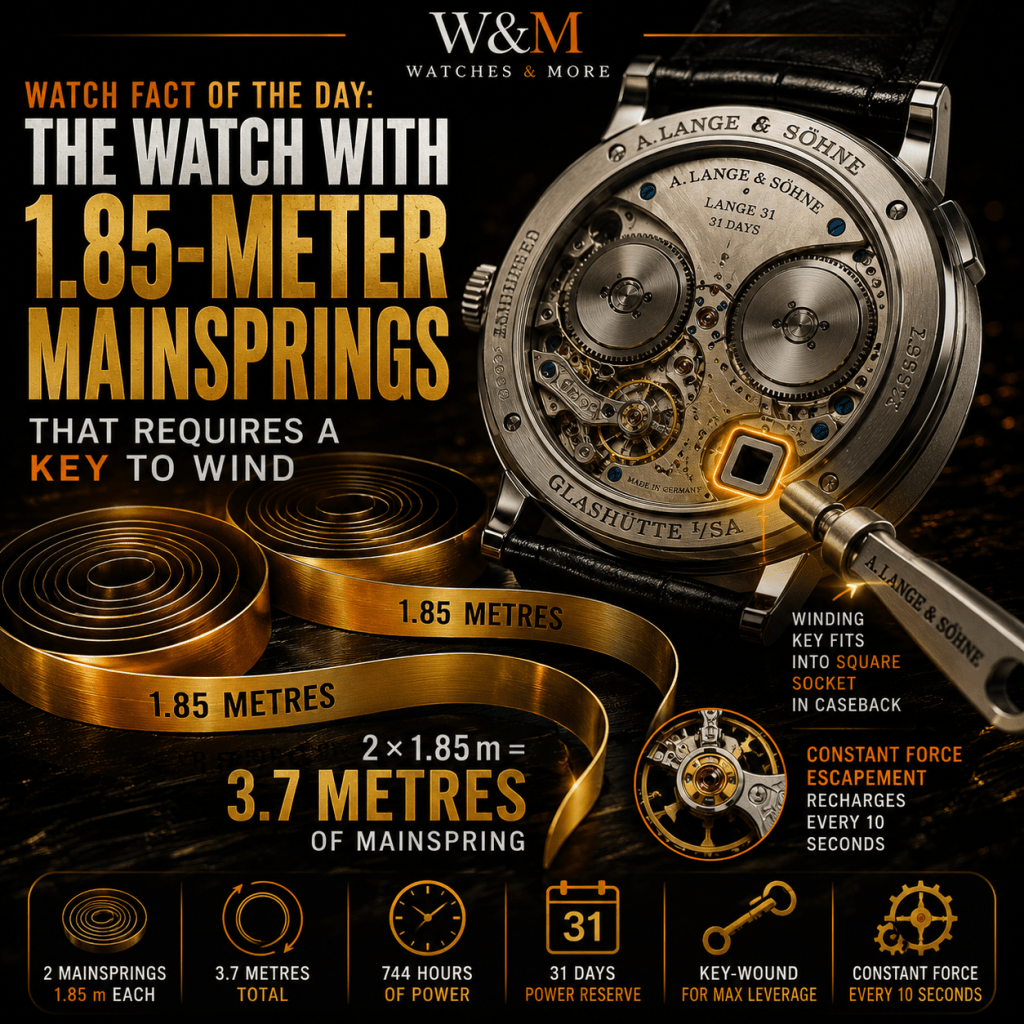
When A. Lange & Söhne introduced the Lange 31, it became the world’s first mechanical wristwatch with a massive 31-day power reserve. To store that much energy, its movement houses two colossal mainsprings that each measure 1.85 meters long—roughly ten times the length of a standard spring. Because winding such immense tension by hand via a traditional crown would be agonizingly slow, the watch must be wound using a miniature mechanical key inserted directly into the caseback!


Imagine wearing a mechanical watch that can run for an entire month after a single winding. When A. Lange & Söhne created the extraordinary LANGE 31, it became the world’s first mechanical wristwatch with a 31-day power reserve—an astonishing 744 hours of stored mechanical energy.

Achieving that endurance required something enormous by wristwatch standards. Hidden inside the L034.1 movement are two mainsprings, each measuring 1.85 metres (1,850 mm) long—roughly ten times the length found in a conventional mechanical wristwatch. Together, that’s an incredible 3.7 metres of mainspring packed inside a wristwatch.

But all that stored energy created another problem: how do you wind it? Turning a conventional crown enough to tension two enormous mainsprings would be cumbersome and time-consuming. Lange’s wonderfully mechanical solution was to give the owner a separate winding key. Inserted into a square socket recessed into the sapphire caseback, the key provides substantially greater leverage than an ordinary crown-based winding system.

And storing the energy was only half the challenge. Fully wound mainsprings this powerful deliver enormous torque, which gradually declines as they unwind. Lange therefore developed a patented constant-force escapement that sits between the twin mainspring barrel and going train, releasing a controlled amount of energy to the escapement. In the LANGE 31, its remontoire spring is recharged every ten seconds, helping maintain consistent balance amplitude throughout the enormous power reserve.

Category: Fun Quirk

Disclaimer: Every effort has been made to keep these watch facts accurate, but the world of horology is full of myths, disputed stories, and fascinating trivia. Consider these facts a starting point for discovery rather than the final word. If you have corrections or additional insights, let us know—we’re always happy to keep the record ticking in the right direction.

🕐 Discover more watch facts, reviews, and buying guides at WatchesAndMore


🛍️ You Might Also Like

As an Amazon Associate and affiliate partner, WatchesAndMore earns from qualifying purchases.

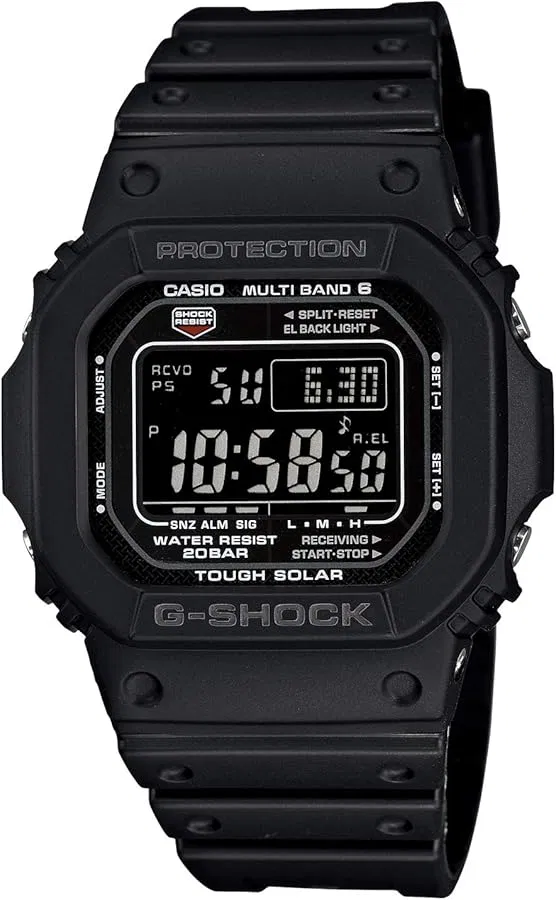
G-Shock GWM5610-1 Solar Atomic
🔥 Deal of the Day

G-Shock GWM5610-1 Solar Atomic

Casio

★★★★★ 4.8 (5,621 reviews)

$129

Offer expires in


🔥 Grab This Deal →

G-Shock GA2100-1A1 CasiOak


G-Shock GA2100-1A1 CasiOak

Casio

★★★★★ 4.8 (2,156 reviews)

$99


Check Price on Amazon →

Casio Edifice Chronograph


Casio Edifice Chronograph

Casio

★★★★★ 4.7 (1,264 reviews)

$120


Check Price on Amazon →


Browse all 142+ expert-reviewed watches →

ETSY Shop
ETSY Shop
Redbubble Shop
Redbubble Shop
More Watch Facts
More Watch Facts

💡 Did You Know?

Power reserve describes how long a wound watch can keep running. Accuracy describes how closely it keeps time; the two specifications answer different questions.

⭐ Why It Matters

Following the route from stored energy to the hands makes a complex mechanism easier to understand. Its value lies in the problem it was designed to address.

📚 Sources & Further Reading

Further reading: A. Lange & Söhne

Join the Conversation

Which detail in this story interests you most, and would it influence what you wear or collect? Share your thoughts in the comments below.

Read Next

🛍️ Explore designs, gifts and more at the W&M companion shop.