
📅 Wednesday, August 27, 2026
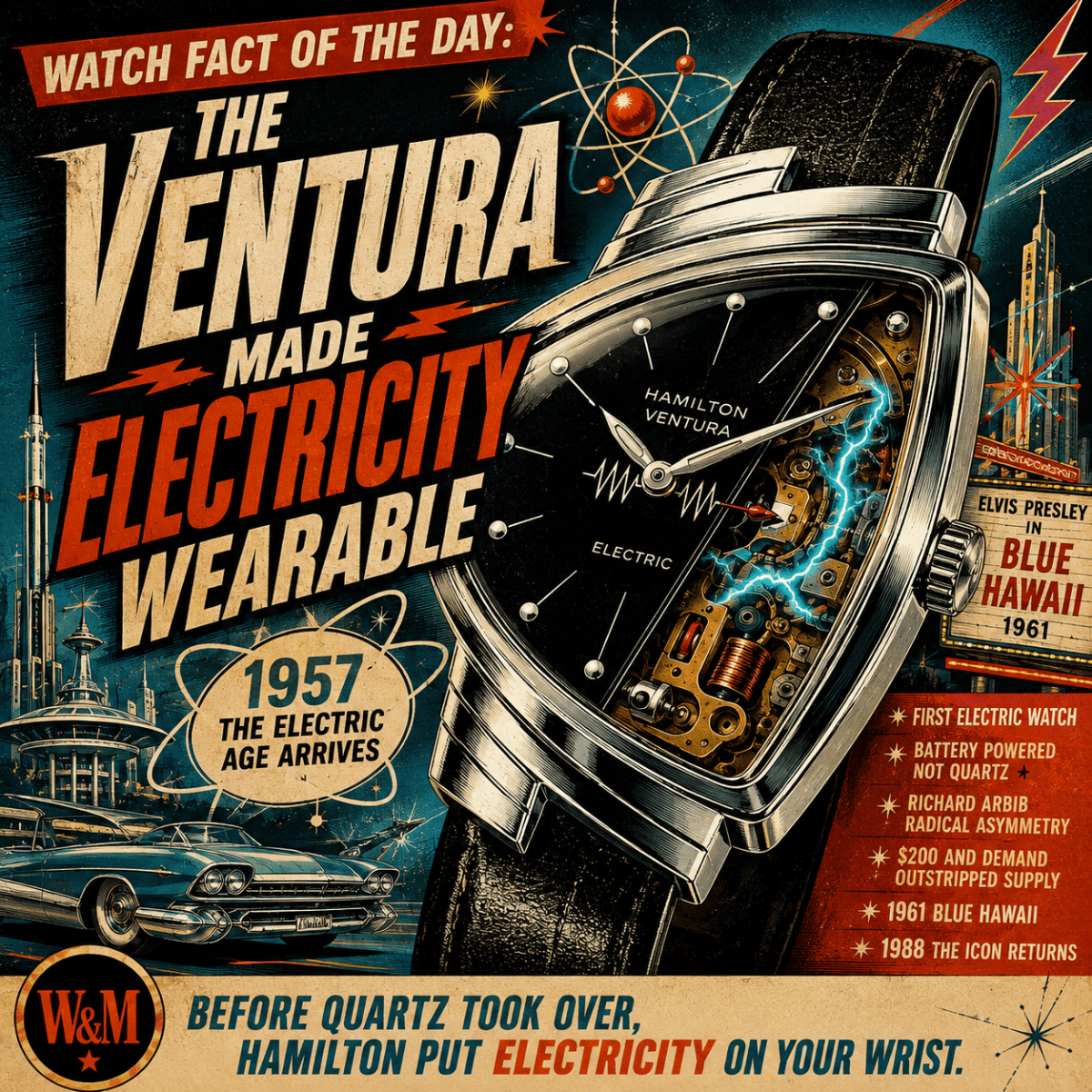
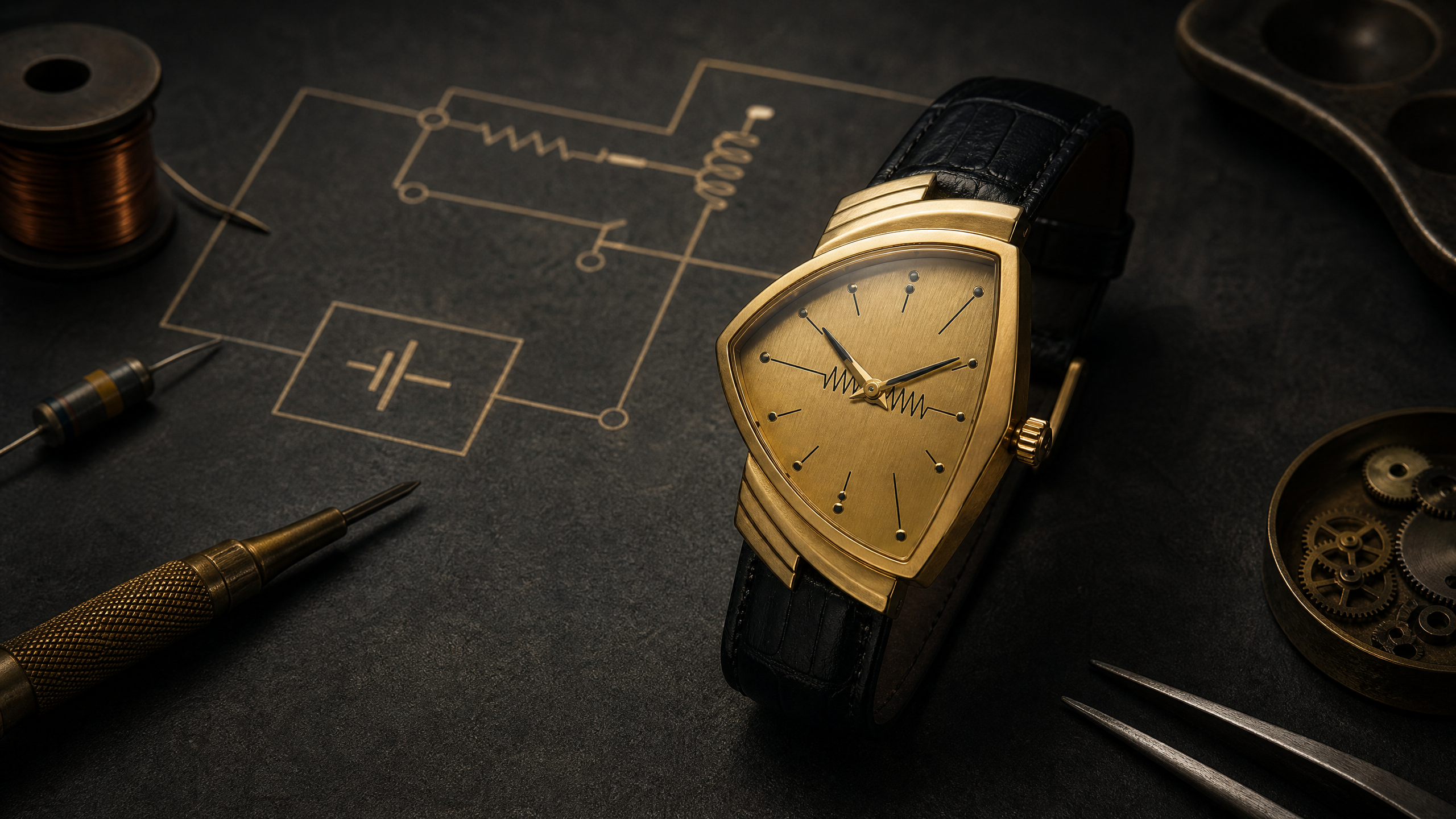
Hamilton introduced the Ventura in 1957, pairing an electric circuit with an asymmetric case created by designer Richard Arbib. Hamilton identifies the Ventura as the first electric watch: a battery supplied power to an electromechanical movement rather than the quartz technology that arrived later. The watch’s bold shape also became part of screen history when Elvis Presley wore a Ventura in the 1961 film Blue Hawaii.
Source note: Hamilton’s Ventura history describes the original 1957 model, its electric circuit, Richard Arbib-designed case, and its appearance in Blue Hawaii.
In 1957, Hamilton unveiled a wristwatch that looked as revolutionary as the technology hidden inside it. The Ventura combined a battery-powered electric movement with an extraordinary asymmetric case created by American industrial designer Richard Arbib. Hamilton calls it the world’s first electric watch, representing a major break from centuries of watches whose energy ultimately came from a wound mainspring. Hamilton Watch
The important distinction is that the Ventura was electric, not quartz. Its battery provided the energy, but this was still an electromechanical watch with moving timekeeping components. The quartz revolution—with a quartz crystal serving as the regulating oscillator—was still more than a decade away. Hamilton says development of its electric watch technology had occupied its engineers for approximately ten years before the Ventura was finally revealed. Hamilton Watch
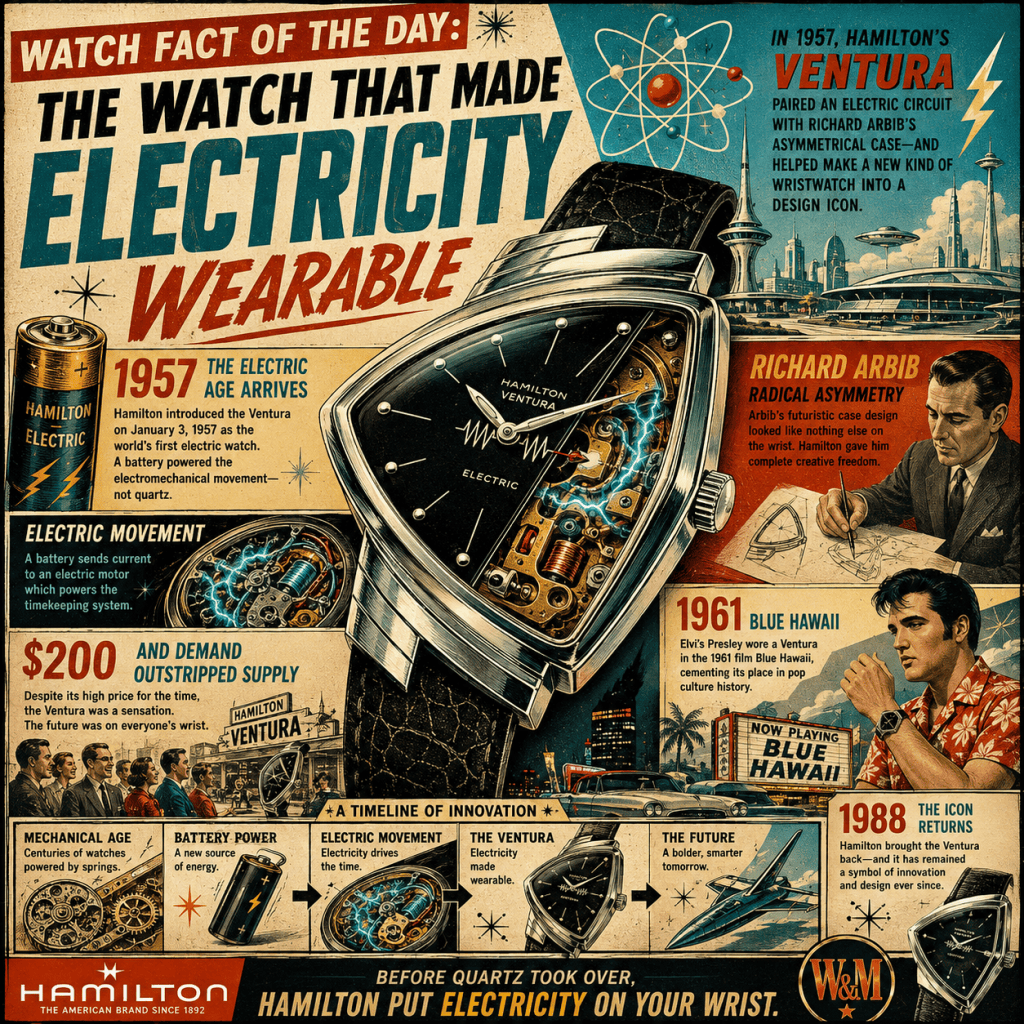
And then there was that case. Hamilton gave Arbib extraordinary creative freedom, effectively asking him to design without worrying about conventional manufacturing practicality. His futuristic, shield-like asymmetric form looked more like something from a 1950s concept car or science-fiction illustration than a traditional wristwatch. Hamilton then had to solve the practical problems of actually manufacturing it—including forming the unusual case, positioning the crown and attaching the strap or bracelet. Hamilton Watch
The public noticed. Hamilton’s historical material says demand outstripped supply, despite an original price of approximately $200—serious money for a wristwatch in 1957. The combination was unusually powerful: Hamilton wasn’t simply putting new technology inside a conventional case. It gave the electrical age a visual identity that looked deliberately futuristic. Hamilton Watch
Four years later, the Ventura acquired another piece of cultural immortality. Elvis Presley wore one in the 1961 film Blue Hawaii, connecting one of America’s most unconventional watches with one of America’s most unconventional entertainers. The association became so strong that collectors would eventually nickname the Ventura “the Elvis watch.” Hamilton also records that a personal white-gold Ventura belonging to Presley later entered its museum collection. Hamilton Watch
The original Ventura remained in production for seven years before being discontinued. Yet its shape had become too recognizable to disappear permanently. Hamilton revived the design in 1988, and the Ventura has remained part of the brand’s identity ever since, spawning quartz, automatic and other interpretations while retaining Arbib’s unmistakable asymmetric silhouette. Hamilton Watch
⚡ Did You Know?
The Ventura arrived 12 years before 1969’s famous quartz-watch breakthrough. Its battery didn’t vibrate a quartz crystal; it powered an earlier generation of electromechanical timekeeping. That makes the Ventura a fascinating technological bridge between the traditional mechanical wristwatch and the electronic revolution that would transform the watch industry in the decades ahead.
Category: Watch History
Disclaimer: Every effort has been made to keep these watch facts accurate, but the world of horology is full of myths, disputed stories, and fascinating trivia. Consider these facts a starting point for discovery rather than the final word. If you have corrections or additional insights, let us know—we’re always happy to keep the record ticking in the right direction.
🕐 Discover more watch facts, reviews, and buying guides at WatchesAndMore




 WatchesAndMoreCO