
2026-11-07 · Watches And More
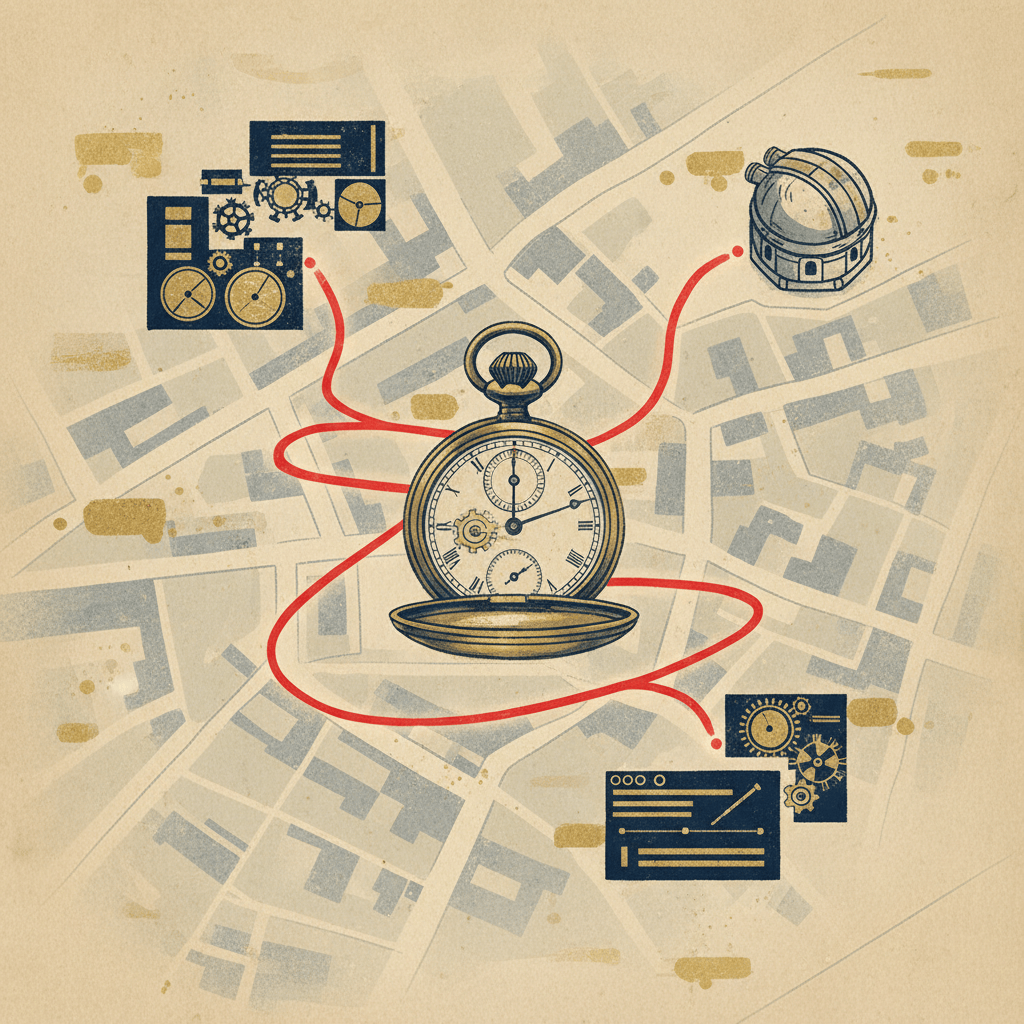
The correct time arrived in a handbag. In Royal Museums Greenwich’s account, Ruth Belville travelled weekly to the Royal Observatory, checked her pocket chronometer against its standard clock, then crossed London to visit 30–40 paying customers. They could compare their clocks with hers: precision delivered through a repeatable, personal appointment. [S1] [S1]
💡 Did You Know?
Ruth inherited the service rather than inventing it. Royal Museums Greenwich dates John Belville’s business to 1836; after his death in 1856, Maria continued it, passing the work to their daughter Ruth in 1892. The weekly delivery was a family enterprise across three successive careers. [S1] [S1] [S1]
The watch had a name, too: the supplied Science Museum Group object-record excerpt says Ruth called it ‘Mr. Arnold’. That record dates the family’s use of the watch from 1834 to Ruth’s retirement in 1940—a different starting point from Greenwich’s 1836 date for the service. [S2] [S2]
⭐ Why It Matters
The ritual included more than a glance at a clock. Greenwich describes a Monday journey by public transport, tea with the porter and a certificate of accuracy. The museum characterizes Ruth’s time service as accurate up to a tenth of a second—not merely as an informal exchange of approximate time. [S1] [S1]
Greenwich records Ruth’s working period as 48 years, alongside competition and expanding telegraph networks. Its account identifies BBC time broadcasts in 1924 and the speaking clock in 1936 as further challenges. Her route belonged to a changing landscape of time distribution, not a London without alternatives. [S1] [S1] [S1]
❤️ The W&M Take
For us, the charm is not simply that someone carried time in a handbag. It is that precision becomes a service: check, carry, compare, repeat. We think this story deserves a place beside the celebrated mechanisms of watchmaking, because it directs attention to the patient work that makes an accurate instrument useful.
Sources
- Who was the Greenwich Time Lady?
- Spring detent watch by John Arnold, used by Ruth Bellville and family to distribute GMT c.1834-1940 — attributed researched excerpt, verified 2026-11-05; publisher blocked fresh retrieval
Disclaimer: Every effort has been made to keep these watch facts accurate, but the world of horology is full of myths, disputed stories, and fascinating trivia. Consider these facts a starting point for discovery rather than the final word. If you have corrections or additional insights, let us know—we’re always happy to keep the record ticking in the right direction.
Read Next
- The 'Chronometer' Standard Was Once a Naval Necessity!
- The Big Ben Clock Was Once the World's Most Accurate Public Timekeeper
Watches And More · Watch Fact Archive · Companion site
Which part of Belville’s service interests you most: the chronometer, the weekly ritual or the relationship with her customers?
Discover more from WatchesAndMoreCO
Subscribe to get the latest posts sent to your email.


