2026-11-11 · Watches And More
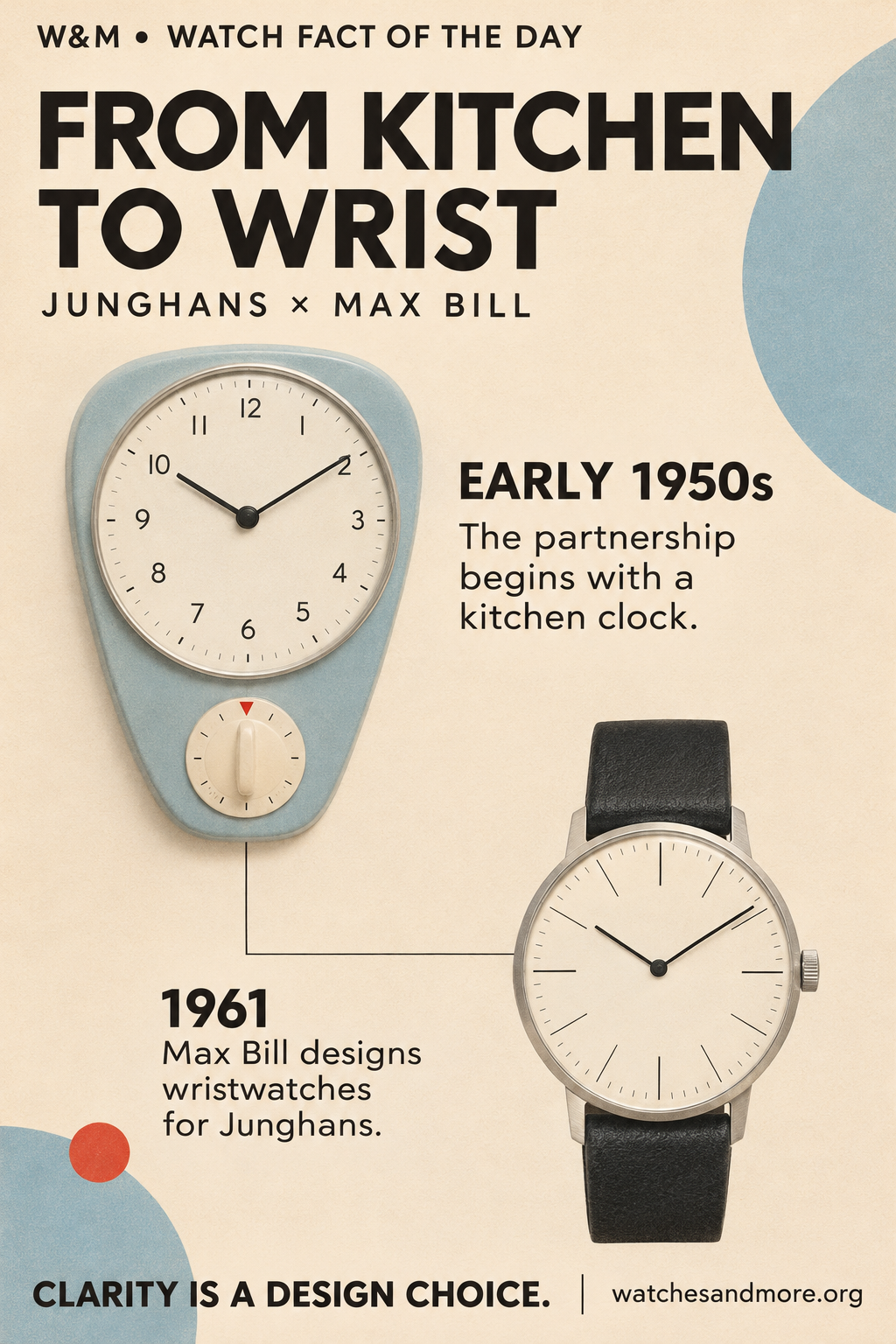
Twenty thousand watches a day—and a design approach described as purist. Junghans’s own history brings those two ideas together in 1961: it records 6,000 employees, 10,000 machines and exports to 100 countries, while dating Max Bill’s wristwatch designs to that same year. [S1] [S1]
For us, that juxtaposition is the story’s irresistible detail. Manufacturing scale answers how much a company can make; restrained design asks what each object should communicate. Those are different ambitions, and neither needs to cancel the other.
💡 Did You Know?
According to Junghans, the partnership began with a kitchen clock, not a wristwatch. In the early 1950s, the company considered commissioning an artist to design that everyday object; Bill developed the resulting clock with students. [S1] [S1]
Junghans also records Bill’s studies at the Bauhaus in Dessau and his role as a founder of Ulm’s design school. In the brand’s account, the Bauhaus connection is therefore biographical, not merely a label attached to a clean-looking dial. [S1]
⭐ Why It Matters
Junghans’s collection page explicitly connects its max bill models with the Bauhaus’s clear, minimalist style. That is how the manufacturer presents the partnership’s continuing significance: as a design philosophy carried through the collection, rather than simply a name from its historical timeline. [S2]
❤️ The W&M Take
Our take: the compelling lesson is not that simplicity defeated industry. It is that an everyday object deserved an artist’s attention. We think that makes this partnership worth revisiting: restraint can be a positive design decision, not an absence of imagination.
Sources
- Junghans — The company and Our History (official regional site)
- Junghans — max bill collection and Bauhaus design context (official regional site)
Disclaimer: Every effort has been made to keep these watch facts accurate, but the world of horology is full of myths, disputed stories, and fascinating trivia. Consider these facts a starting point for discovery rather than the final word. If you have corrections or additional insights, let us know—we’re always happy to keep the record ticking in the right direction.
Read Next
Watches And More · Watch Fact Archive · Companion site
What gives a watch its strongest identity: a distinctive shape, a clear dial, or the story of the person who designed it?

