
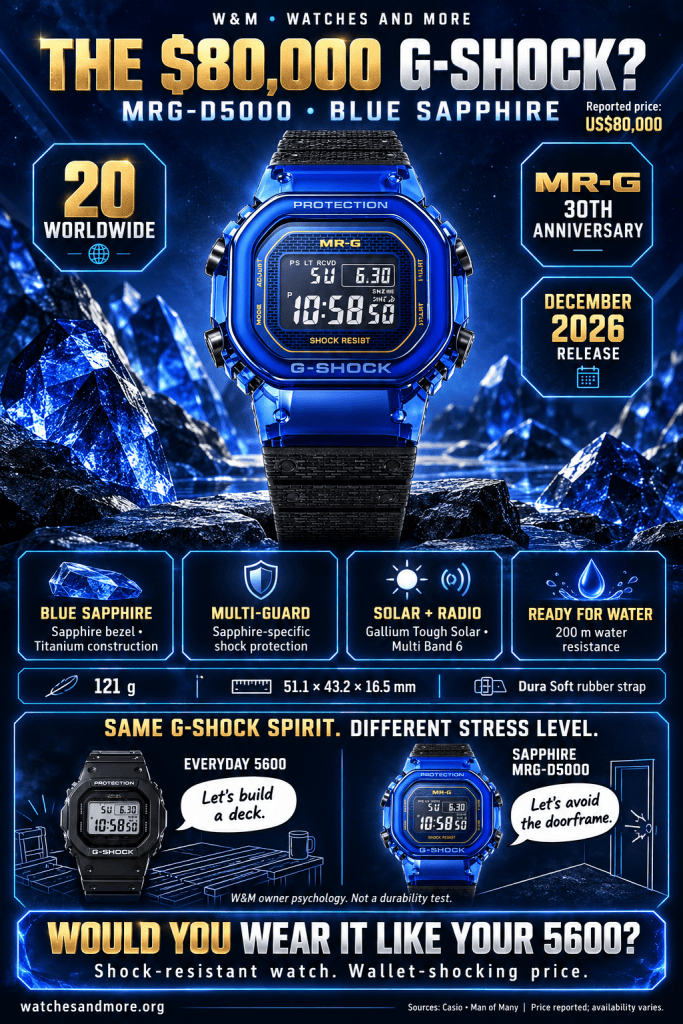
An $80,000 G-SHOCK? Meet the MRG-D5000 Blue Sapphire 💎⌚

Introducing the Casio G-SHOCK MRG-D5000 Blue Sapphire, a fancy watch that costs a jaw-dropping $80,000—because why use a regular watch when you can have a sapphire-laden wrist trophy? With only 20 pieces worldwide, it’s likely to be worn by collectors who treat it more like a delicate flower than a rugged timekeeper. While your everyday G-SHOCK 5600 can survive life’s scrapes and knocks, this sapphire beauty might leave you sweating over just sitting on your wrist. So, will you wear it like a champ or keep it under glass like a museum exhibit? The struggle is real!

Twenty pieces worldwide. Blue sapphire construction. And one question: will anyone actually wear it like a G-SHOCK?

Some watches make you look twice.

The Casio G-SHOCK MRG-D5000 Blue Sapphire might make you check the price twice, clean your glasses, and check it again.

US$80,000.

Both WatchGuys and Man of Many report that figure for Casio’s extraordinary sapphire square. Man of Many reports six examples destined for the United States, with availability staggered from December 2026 into June 2027.

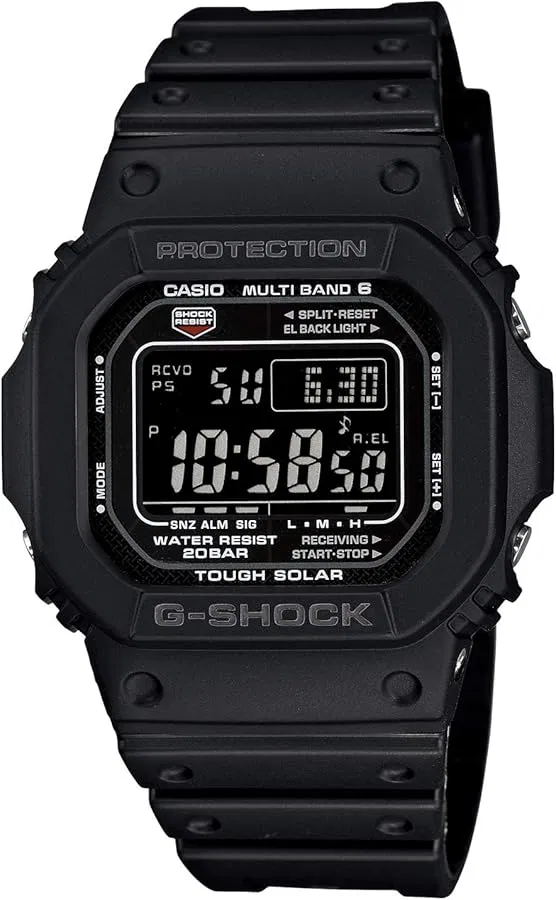
Meanwhile, somewhere out there, an everyday G-SHOCK 5600 is being knocked against a doorframe by someone who hasn’t thought about their watch since breakfast.

Both belong to the G-SHOCK family.

One shrugs off your day. The other might require you to sit down before reading the receipt.

💙 The Blue Is More Than a Colour

Casio announced the MRG-D5000 on October 1, 2026, confirming a worldwide edition of just 20 watches.

Its bezel is formed entirely from blue sapphire crystal, with sapphire components incorporated into a specially engineered shock-resistant case structure. Blue sapphire also appears in the screw-lock caseback.

This goes considerably beyond putting sapphire over the display.

It turns a material associated with clarity and luxury into a central part of the construction.

At a glance, someone unfamiliar with watches might mistake that translucent blue exterior for resin.

Imagine explaining that at a barbecue.

“Nice watch. My nephew has one.”

“Lovely. Does his come with a financial adviser?”
🔧 Making Sapphire Work the G-SHOCK Way

Hardness and impact resistance are different qualities. Resisting scratches does not automatically make a material forgiving of a sharp blow.

Casio’s answer is Multi-Guard Structure for Sapphire.

The design uses separate components and avoids screws in the sapphire assembly, removing features that could encourage cracking. Casio analysed how impact forces reach the material and developed the structure around protecting it.

That is serious engineering.

Whether an owner will feel comfortable putting it to the test is another matter.

The watch may be shock-resistant. Your reaction to dropping it may be considerably less controlled.

🆚 Everyday 5600 vs. Sapphire Showpiece

The familiar resin G-SHOCK 5600 represents a wonderfully straightforward ownership experience: put it on and get on with things.

The MRG-D5000 invites a rather different internal conversation.

The following comparison is W&M humour, rather than a specification test.

Everyday G-SHOCK 5600MRG-D5000 Blue Sapphire
“I’ll wear it while moving furniture.”“Let’s hire movers.”
Knocks the doorframe. Keeps walking.Knocks the doorframe. Checks breathing.
Gets left on the bedside table.Gets its own accommodation.
Someone asks the price. You tell them.Someone asks the price. You check who’s listening.
An everyday companion.An everyday conversation with your insurance provider.

The disparity is part of what makes this release fascinating.

Casio has taken a shape associated with practical, approachable toughness and carried it into extraordinary collector territory.

But will anyone treat this sapphire masterpiece with the same carefree familiarity as a regular 5600?

🌹 Eight Years to Make the Dream Work

Casio’s account places its sapphire concept in Basel in 2018. It could not yet meet the required performance standards.

Development continued. The multi-component approach appeared in the titanium MRG-B5000 in 2022, before the sapphire ambition reached production form in 2026.

The Blue Rose Project name reflects the pursuit of something seemingly impossible. Its construction draws inspiration from traditional Japanese timber-frame joints.

Years of persistence deserve recognition.

Even if the finished watch costs enough to make your existing Casio collection look suspiciously sensible.

📋 What Does Your US$80,000 Get You?

Casio lists the MRG-D5000 for December 2026, with these official specifications.

FeatureSpecification
Dimensions51.1 × 43.2 × 16.5 mm
Weight121 g
Case and bezel materialsTitanium and sapphire crystal
StrapDura Soft rubber
ClaspOne-touch three-fold clasp
Water resistance200 metres
PowerGallium Tough Solar
Time adjustmentMulti Band 6 radio-controlled
Front crystalSapphire with anti-reflective coating
Titanium treatmentDLC
Accuracy without calibration±15 seconds per month

You also get world time, a stopwatch, countdown timer, five daily alarms, and an LED backlight.

Yes, you can use an US$80,000 watch to time your frozen pizza.

Whether that improves the pizza remains unconfirmed.

✨ The Details Reward a Closer Look

The face retains the familiar brick motif, finished in blue vapour deposition. Casio specifies pure 24k gold for the MR-G mark and selected lettering.

The textured Dura Soft strap echoes that pattern, while individually numbered casebacks carry the DREAM PROJECT inscription.

These details give it an identity beyond “expensive square watch.”

Although “expensive square watch” will probably remain the family’s preferred description.

💡 Did You Know?

The “D” in MRG-D5000 pays tribute to the Dream Project.

Casio says its sapphire ingots take several months to produce, after which suitable sections are selected for colour and transparency.

Even the raw material requires patience.

Which gives you time to practise saying, “It’s an engineering achievement,” when someone asks why it costs that much.

💰 Collector’s Piece or Investment?

The reported price is US$80,000, not Canadian dollars.

WatchGuys offers resale forecasts, but those are dealer estimates. Its coverage states that the secondary market was not yet established.

Admire it, collect it, or debate it—but rarity alone does not guarantee appreciation.

Buying it because you love the engineering is one thing. Buying it because you assume the next person will pay more is a much less relaxing hobby.

⭐ Why It Matters

This watch broadens the conversation about luxury.

Its fascination comes from materials, manufacturing, and construction around a digital module. Those achievements deserve attention alongside traditional mechanical craftsmanship.

The price also exposes an entertaining tension.

A large part of G-SHOCK’s appeal is freedom from worry. You wear it and forget about it.

Can a watch retain that emotional freedom when its price makes you afraid to forget where you put it?

❤️ The W&M Take: Tough Enough to Wear—Expensive Enough to Hesitate?

I admire the ambition. I’d love to examine one up close.

I’d also be extremely aware of every table edge in the room.

Perhaps some owners will wear theirs everywhere, enjoying the engineering exactly as intended. Others may reserve it for special occasions and spend considerably more time looking at it than checking the time.

My everyday 5600 would probably watch all this from the workbench and wonder what the fuss was about.

The MRG-D5000 pushes G-SHOCK construction into remarkable territory. The humble 5600 still makes a very strong argument for getting on with your day.

And that leaves our question:

If you owned the sapphire G-SHOCK, would you wear it like your regular 5600—or would your toughest watch become the one you worried about most?


Sources & Further Reading

⌚ W&M Main Site • Companion Site • Watch Fact Archive

Watch Fact of the Day: The 1969 Space-Age Watch That Made Hands Float in Midair

Launched at the height of the space race, the Zodiac Astrographic featured a mesmerizing mystery dial where the hands and seconds indicator appeared to float en

Fun Quirk: Saturday, October 17, 2026

📅 Saturday, October 17, 2026

Launched at the height of the space race, the Zodiac Astrographic featured a mesmerizing mystery dial where the hands and seconds indicator appeared to float entirely untethered over the face. This illusion was achieved by printing the hour, minute, and second markers onto three stacked, transparent rotating sapphire or acrylic discs driven by a high-beat movement. The resulting effect made the red-dot seconds hand look like a satellite orbiting a sci-fi spacecraft.


Category: Fun Quirk

Disclaimer: Every effort has been made to keep these watch facts accurate, but the world of horology is full of myths, disputed stories, and fascinating trivia. Consider these facts a starting point for discovery rather than the final word. If you have corrections or additional insights, let us know—we’re always happy to keep the record ticking in the right direction.

🕐 Discover more watch facts, reviews, and buying guides at WatchesAndMore


🛍️ You Might Also Like

As an Amazon Associate and affiliate partner, WatchesAndMore earns from qualifying purchases.

🔥 Deal of the Day

G-Shock GWM5610-1 Solar Atomic

Casio

★★★★★ 4.8 (5,621 reviews)

$129

Offer expires in


🔥 Grab This Deal →


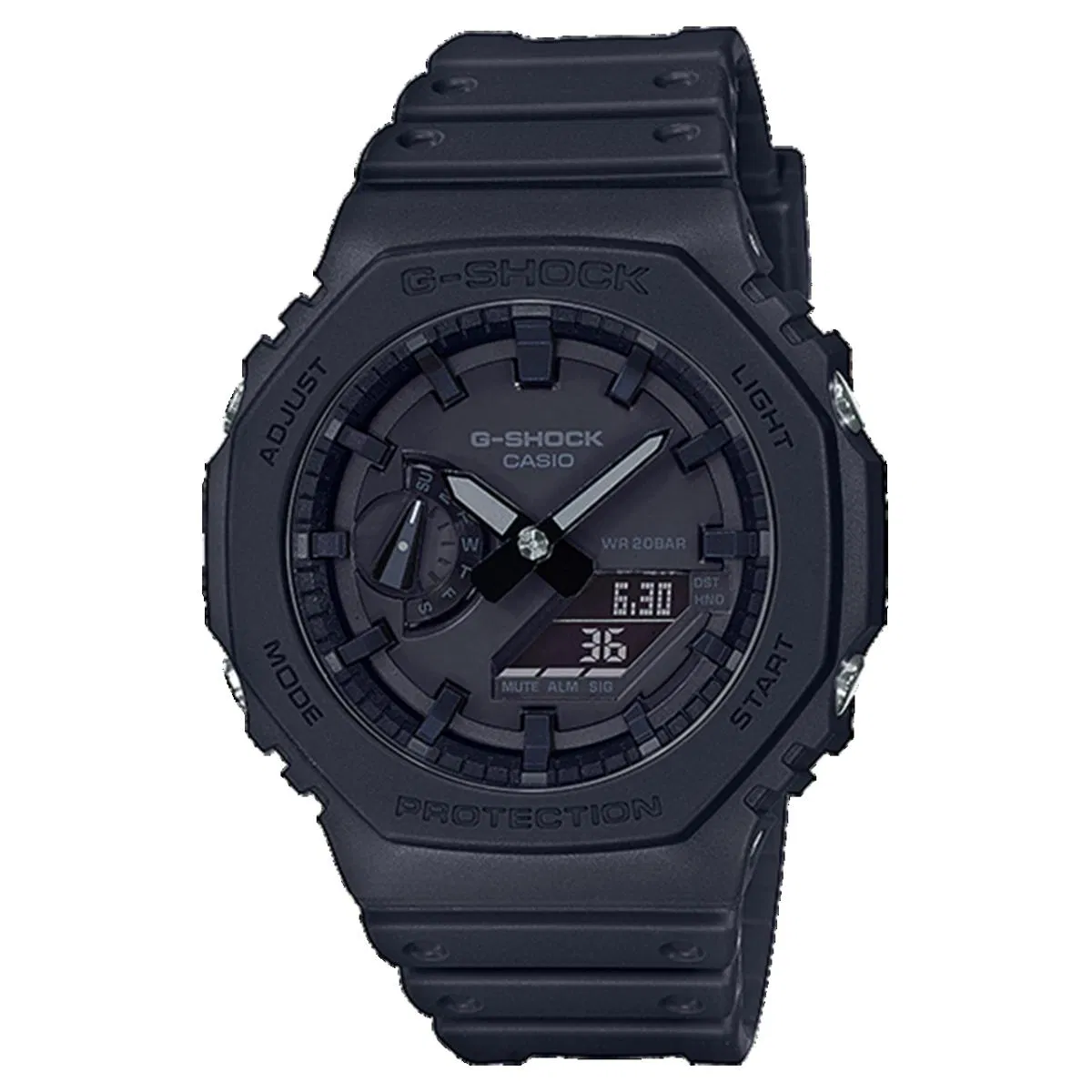
G-Shock GA2100-1A1 CasiOak

G-Shock GA2100-1A1 CasiOak

Casio

★★★★★ 4.8 (2,156 reviews)

$99


Check Price on Amazon →


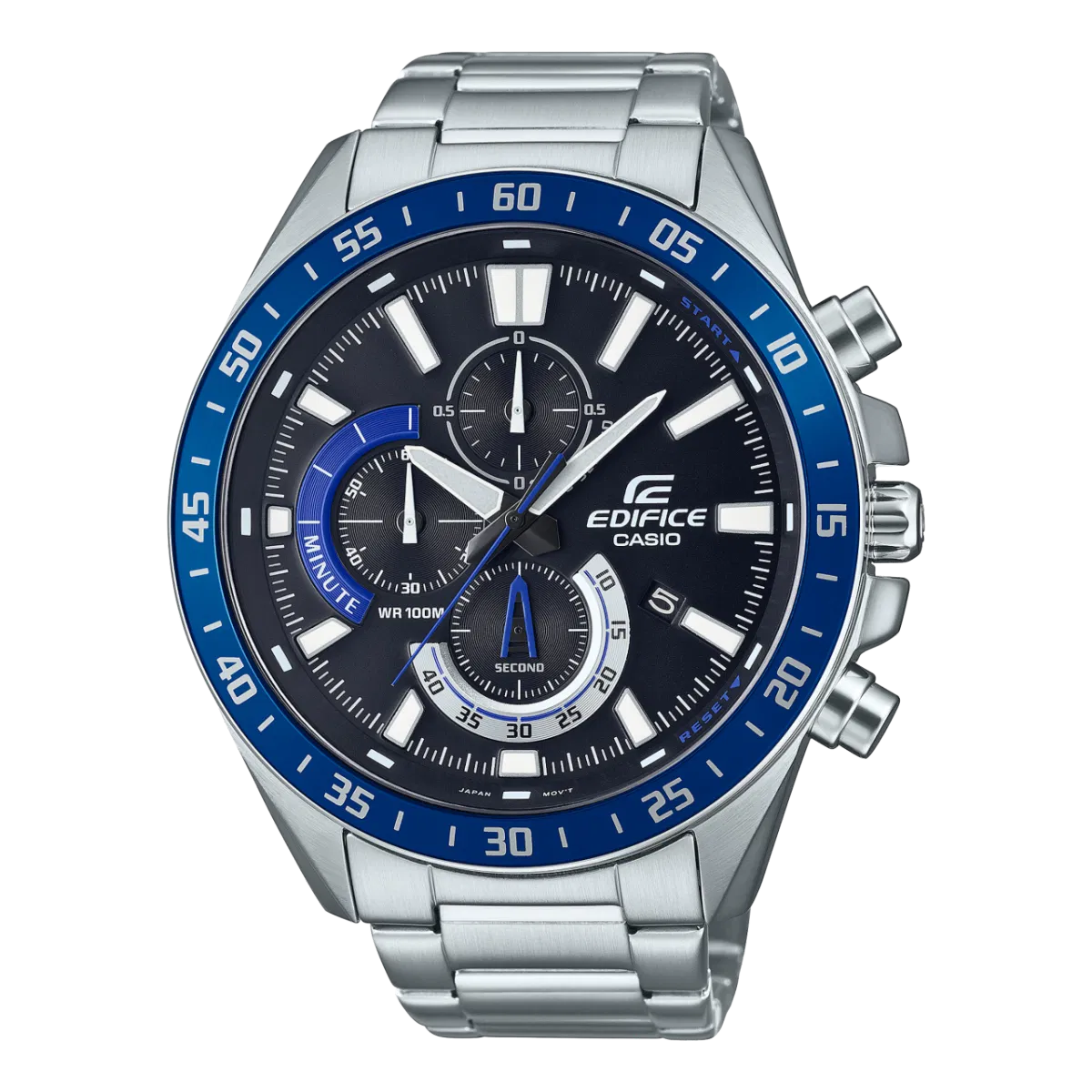
Casio Edifice Chronograph

Casio Edifice Chronograph

Casio

★★★★★ 4.7 (1,264 reviews)

$120


Check Price on Amazon →


Browse all 142+ expert-reviewed watches →

Watch Fact of the Day: The 1930s Watch That Transformed Into a Flashlight

In 1935, a clever Swiss manufacturer introduced the Niagara watch, which ingeniously doubled as a miniature electric flashlight. The case contained a tiny batte

Fun Quirk: Friday, October 16, 2026

📅 Friday, October 16, 2026

In 1935, a clever Swiss manufacturer introduced the Niagara watch, which ingeniously doubled as a miniature electric flashlight. The case contained a tiny battery-powered bulb that illuminated the dial from within when activated by a side pusher. It was an eccentric solution for night-time visibility long before tritium and modern luminescent paints became standard.


Category: Fun Quirk

Disclaimer: Every effort has been made to keep these watch facts accurate, but the world of horology is full of myths, disputed stories, and fascinating trivia. Consider these facts a starting point for discovery rather than the final word. If you have corrections or additional insights, let us know—we’re always happy to keep the record ticking in the right direction.

🕐 Discover more watch facts, reviews, and buying guides at WatchesAndMore


🛍️ You Might Also Like

As an Amazon Associate and affiliate partner, WatchesAndMore earns from qualifying purchases.

🔥 Deal of the Day

G-Shock GWM5610-1 Solar Atomic

Casio

★★★★★ 4.8 (5,621 reviews)

$129

Offer expires in


🔥 Grab This Deal →


G-Shock GA2100-1A1 CasiOak

G-Shock GA2100-1A1 CasiOak

Casio

★★★★★ 4.8 (2,156 reviews)

$99


Check Price on Amazon →


Casio Edifice Chronograph

Casio Edifice Chronograph

Casio

★★★★★ 4.7 (1,264 reviews)

$120


Check Price on Amazon →


Browse all 142+ expert-reviewed watches →

Watch Fact of the Day: The 57-Complication Masterpiece That Required a Hebrew Calendar

Unveiled in 2015 by Vacheron Constantin, the Reference 57260 pocket watch features an astonishing 57 distinct complications and took eight years to design and b

Record Breaker: Thursday, October 15, 2026

📅 Thursday, October 15, 2026

Unveiled in 2015 by Vacheron Constantin, the Reference 57260 pocket watch features an astonishing 57 distinct complications and took eight years to design and build. Among its most groundbreaking innovations is a fully mechanical Hebrew perpetual calendar, which required entirely new mathematical formulas to synchronize complex lunar and solar cycles. Weighing nearly a kilogram, this bespoke marvel stands as the most complicated mechanical watch ever created.


Category: Record Breaker

Disclaimer: Every effort has been made to keep these watch facts accurate, but the world of horology is full of myths, disputed stories, and fascinating trivia. Consider these facts a starting point for discovery rather than the final word. If you have corrections or additional insights, let us know—we’re always happy to keep the record ticking in the right direction.

🕐 Discover more watch facts, reviews, and buying guides at WatchesAndMore


🛍️ You Might Also Like

As an Amazon Associate and affiliate partner, WatchesAndMore earns from qualifying purchases.

🔥 Deal of the Day

Casio MDV106-1A Duro

Casio

★★★★★ 4.6 (8,934 reviews)

$59

Offer expires in


🔥 Grab This Deal →


Seiko 5 Sports SRPD55

Seiko 5 Sports SRPD55

Seiko

★★★★★ 4.7 (1,247 reviews)

$275


Check Price on Amazon →


Citizen Promaster Diver

Citizen Promaster Diver

Citizen

★★★★★ 4.7 (2,192 reviews)

$299


Check Price on Amazon →


Browse all 142+ expert-reviewed watches →

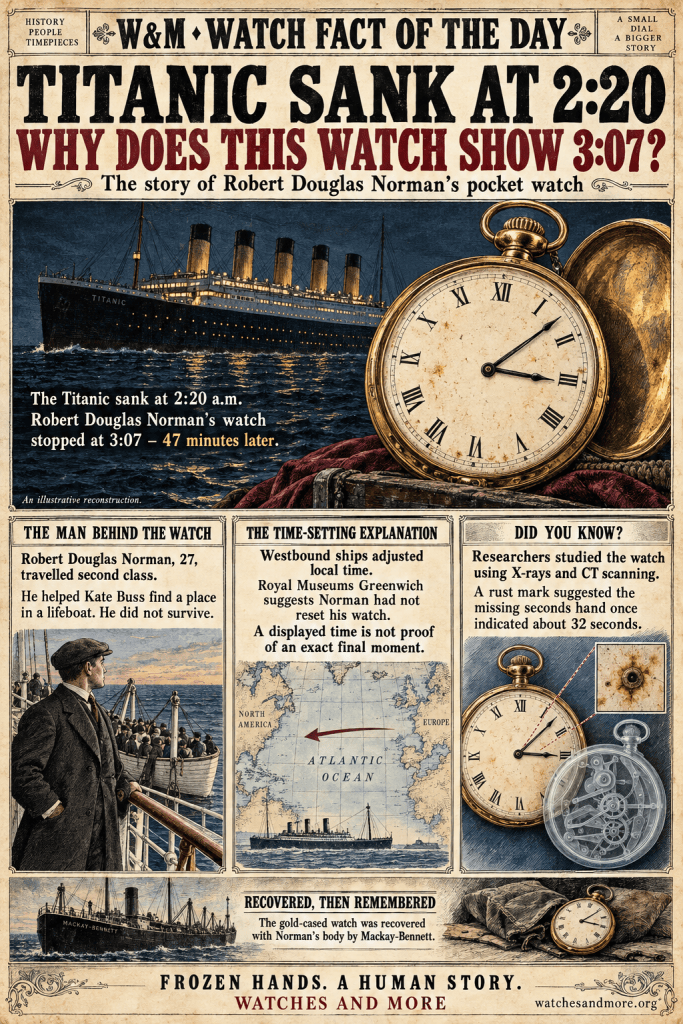
Watch Fact of the Day: Titanic Sank at 2:20—Why Does This Pocket Watch Show 3:07? ⌚🚢

The story of Robert Douglas Norman, a Titanic passenger, shines a light on the personal narratives often lost in history’s grand scale. His gold pocket watch, recovered after the tragedy, stopped at 3:07, raising questions about its time-setting amidst the ship’s sinking. Although Norman did not survive, his heroic actions in helping a fellow passenger find safety are highlighted through this object, symbolizing the humanity behind a historical event. The watch serves as a poignant reminder that every timepiece carries a story, bridging the past and present, making the memory of Norman and his journey feel timeless and significant.

Frozen hands. A puzzling time. And a human story behind one of Titanic’s most poignant surviving objects.

Titanic disappeared beneath the Atlantic at approximately 2:20 a.m. on April 15, 1912.

Yet a pocket watch recovered from one of its passengers shows 3:07.

Forty-seven minutes later.

Was the watch wrong? Had it continued running after the ship sank? Or was something else behind those motionless hands?

The explanation offered by Royal Museums Greenwich concerns an easily overlooked part of ocean travel: the time passengers set on their watches.

But before we explore the mystery, we should meet the man who carried it.

🧳 A Journey That Never Reached Its Destination

Robert Douglas Norman was 27, travelling aboard Titanic as a second-class passenger.

He was heading to Vancouver to visit his brother, with plans for further travel. Like so many aboard the liner, he had a destination, people waiting for him, and a future beyond the voyage.

His gold-cased pocket watch was one of the personal belongings that would eventually help preserve his story.

Today, its significance reaches far beyond its value as a timepiece.

🚢 A Place in a Lifeboat

According to Royal Museums Greenwich, Norman helped fellow passenger Kate Buss find a place in a lifeboat. He remained aboard and did not survive.

When the recovery vessel Mackay-Bennett later recovered his body, the watch was found among his clothing. Its rusted hands showed seven minutes past three.

That is what makes this object so affecting.

It connects a familiar historical event with one individual—and an act of assistance during a terrible night.

🕰️ Why 3:07 Doesn’t Match 2:20

A passenger’s watch was only as closely aligned with ship time as its setting allowed.

On a westbound Atlantic crossing, clocks were adjusted as the ship moved toward a different local time. Passengers needed to adjust their own watches accordingly.

Royal Museums Greenwich explains that Norman apparently had not reset his watch to the ship’s latest local time. Its displayed time therefore should not be read as directly equivalent to the recorded sinking time.

The important word is “apparently.” This is the museum’s explanation, rather than something the watch can independently prove.

The hands preserve a reading—not an automatically synchronised timestamp.

🔬 What Can a Stopped Watch Really Tell Us?

A recovered watch is physical evidence, but interpreting it requires care.

Was it running immediately before entering the water? How accurately was it set? How quickly did water stop the movement?

Horology curator Rory McEvoy explored these questions in a study of Norman’s watch using X-ray imaging and computed tomography, or CT. He described the 3:07 reading as intriguing and considered it probable that the unwaterproofed watch would have stopped within a minute of immersion.

That makes the frozen hands compelling evidence to investigate, rather than a precise record of Norman’s final moment.

Sometimes, the most fascinating watch story begins with asking what we can—and cannot—learn from the dial.

💡 Did You Know?

Researchers found a trace of a missing seconds hand.

McEvoy’s study reports that the watch’s seconds hand had deteriorated completely. However, a mark left in the rust on the dial suggested it had indicated approximately 32 seconds when it stopped.

Even a component that no longer survives can leave evidence behind.

⭐ Why It Matters

Titanic’s story is often told through the scale of the ship and the magnitude of the disaster.

A personal object brings that history closer.

Norman’s watch reminds us that the passengers were individuals carrying ordinary possessions toward extraordinary changes in their lives.

Its stopped hands invite a question about time. Its ownership asks us to remember a person.

That is where this watch’s deepest significance lies.

❤️ The W&M Take: More Than Frozen Hands

At Watches And More, we believe every watch has a story.

This one holds a particularly moving connection between an everyday object, an interrupted journey, and a passenger remembered for helping someone else reach a lifeboat.

The difference between 2:20 and 3:07 draws us into the investigation.

Robert Douglas Norman gives us a reason to remember it.

The watch stopped. Its power to tell his story did not.


⌚ Explore more stories behind remarkable timepieces:

What everyday object would you most want preserved to tell your story to future generations?

ETSY Shop
ETSY Shop
Redbubble Shop
Redbubble Shop
More Watch Facts
More Watch Facts

Watch Fact of the Day: The 19th-Century Watch That Tracked Time Across Two Cities

Before standard railway time zones synchronized the globe, pocket watches with dual dials became essential for travelers navigating differing local times. In th

Fun Quirk: Wednesday, October 14, 2026

📅 Wednesday, October 14, 2026

Before standard railway time zones synchronized the globe, pocket watches with dual dials became essential for travelers navigating differing local times. In the mid-1800s, ingenious watchmakers crafted pieces with dual gear trains allowing independent adjustment for home and local solar time. This early mechanical precursor to the modern GMT watch solved the chaotic discrepancy of neighboring towns running on their own sun-based meridians.


Category: Fun Quirk

Disclaimer: Every effort has been made to keep these watch facts accurate, but the world of horology is full of myths, disputed stories, and fascinating trivia. Consider these facts a starting point for discovery rather than the final word. If you have corrections or additional insights, let us know—we’re always happy to keep the record ticking in the right direction.

🕐 Discover more watch facts, reviews, and buying guides at WatchesAndMore


🛍️ You Might Also Like

As an Amazon Associate and affiliate partner, WatchesAndMore earns from qualifying purchases.

🔥 Deal of the Day

G-Shock GWM5610-1 Solar Atomic

Casio

★★★★★ 4.8 (5,621 reviews)

$129

Offer expires in


🔥 Grab This Deal →


G-Shock GA2100-1A1 CasiOak

G-Shock GA2100-1A1 CasiOak

Casio

★★★★★ 4.8 (2,156 reviews)

$99


Check Price on Amazon →


Casio Edifice Chronograph

Casio Edifice Chronograph

Casio

★★★★★ 4.7 (1,264 reviews)

$120


Check Price on Amazon →


Browse all 142+ expert-reviewed watches →

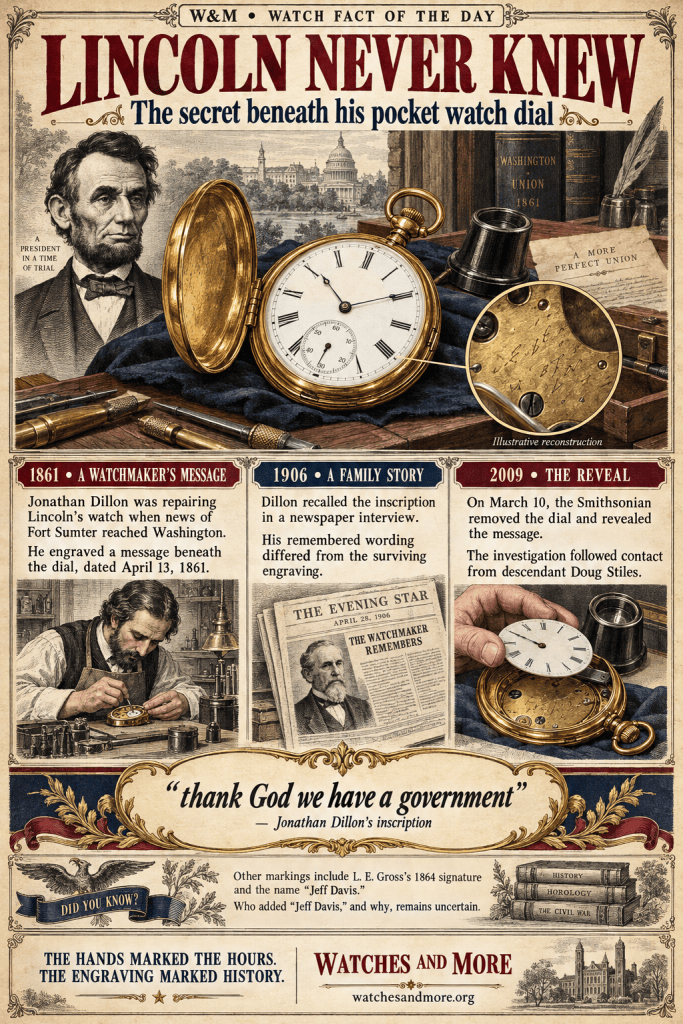
Watch Fact of the Day: The Pocket Watch That Guarded Abraham Lincoln’s Secret

Inside Abraham Lincoln’s pocket watch, a watchmaker hid an optimistic political secret during the American Civil War. When repairman Jonathan Dillon opened the

Faces of Horology: Tuesday, October 13, 2026

📅 Tuesday, October 13, 2026

Inside a president’s watch, an ordinary craftsman left an extraordinary message.

A gold pocket watch can hold more than gears, springs, and the passing seconds.

Abraham Lincoln’s held a hidden reaction to the outbreak of the American Civil War—a message scratched into its inner workings by a watchmaker.

The remarkable part?

According to the Smithsonian, Lincoln never knew it was there.

Up nextPlaylist — 5 videos5 videos

⚒️ A Repair Interrupted by History

In April 1861, Jonathan Dillon was repairing Lincoln’s watch at M.W. Galt and Co. in Washington, D.C., when news arrived that Confederate forces had attacked Fort Sumter.

Dillon responded with the tools of his trade.

He removed the dial and engraved a message on the metal beneath it, recording the attack and expressing gratitude that the country had a government. His inscription carries the date April 13, 1861, although the attack began on April 12.

Once concealed behind the dial, his words became a private record of a public crisis.

A watchmaker had found an unusual place to leave his mark on history.

🔍 A Family Story Meets the Evidence

Decades later, Dillon recalled the incident in a 1906 New York Times interview. His remembered wording included an optimistic declaration about slavery’s end.

But recollection and inscription would turn out to differ.

After Dillon’s great-great-grandson, Doug Stiles, contacted the Smithsonian, the museum investigated. On March 10, 2009, master watchmaker George Thomas carefully dismantled the timepiece and revealed the engraving.

The family story had a physical foundation.

The message was really there.

✍️ What the Watch Actually Said

The engraving records Fort Sumter’s attack, Dillon’s name, Washington, and the date. Its memorable expression of reassurance reads:

“thank God we have a government”

The inscription does not contain the explicit statement about slavery that Dillon later remembered.

That distinction makes the discovery especially compelling: opening the watch allowed historians to compare a story handed down through time with the original evidence.

💡 Did You Know?

Dillon wasn’t the only person to write inside the watch.

The Smithsonian identifies an 1864 signature by watchmaker L. E. Gross, as well as the name “Jeff Davis.” Who added that name, and whether it was a joke or an expression of Confederate sympathy, remains uncertain.

Behind one dial lay several intriguing traces of human history.

⭐ Why It Matters

This watch preserves something a grand monument rarely can: an individual’s immediate response to an uncertain moment.

Dillon was a craftsman at his bench when world-changing news reached him. His engraving reminds us that history happens to ordinary people, too—and sometimes they leave extraordinary evidence behind.

It also shows why examining an object matters. The surviving words tell their own story.

❤️ The W&M Take: History Beneath the Dial

At Watches And More, we believe every watch has a story.

Lincoln’s carried one its owner apparently never heard: a watchmaker’s declaration, tucked beneath the face that displayed the time.

The hands marked the hours. The hidden engraving marked a moment in history.


⌚ Keep exploring:

If you could leave a message inside a watch for someone to discover a century later, what would it say?

Category: Faces of Horology

Disclaimer: Every effort has been made to keep these watch facts accurate, but the world of horology is full of myths, disputed stories, and fascinating trivia. Consider these facts a starting point for discovery rather than the final word. If you have corrections or additional insights, let us know—we’re always happy to keep the record ticking in the right direction.

🕐 Discover more watch facts, reviews, and buying guides at WatchesAndMore


🛍️ You Might Also Like

As an Amazon Associate and affiliate partner, WatchesAndMore earns from qualifying purchases.

G-Shock GWM5610-1 Solar Atomic
🔥 Deal of the Day

G-Shock GWM5610-1 Solar Atomic

Casio

★★★★★ 4.8 (5,621 reviews)

$129

Offer expires in


🔥 Grab This Deal →

G-Shock GA2100-1A1 CasiOak


G-Shock GA2100-1A1 CasiOak

Casio

★★★★★ 4.8 (2,156 reviews)

$99


Check Price on Amazon →

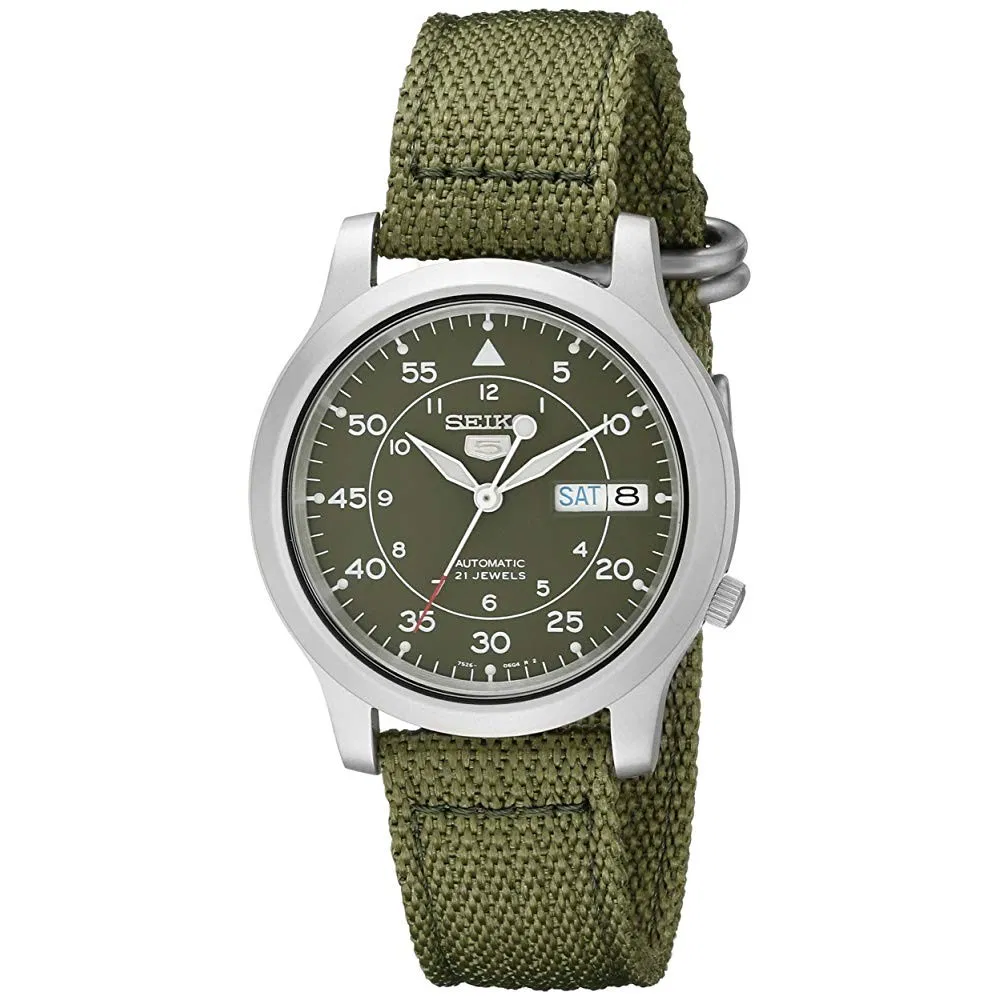
Seiko 5 SNK805 Green Military


Seiko 5 SNK805 Green Military

Seiko

★★★★★ 4.8 (6,961 reviews)

$89


Check Price on Amazon →


Browse all expert-reviewed watches →

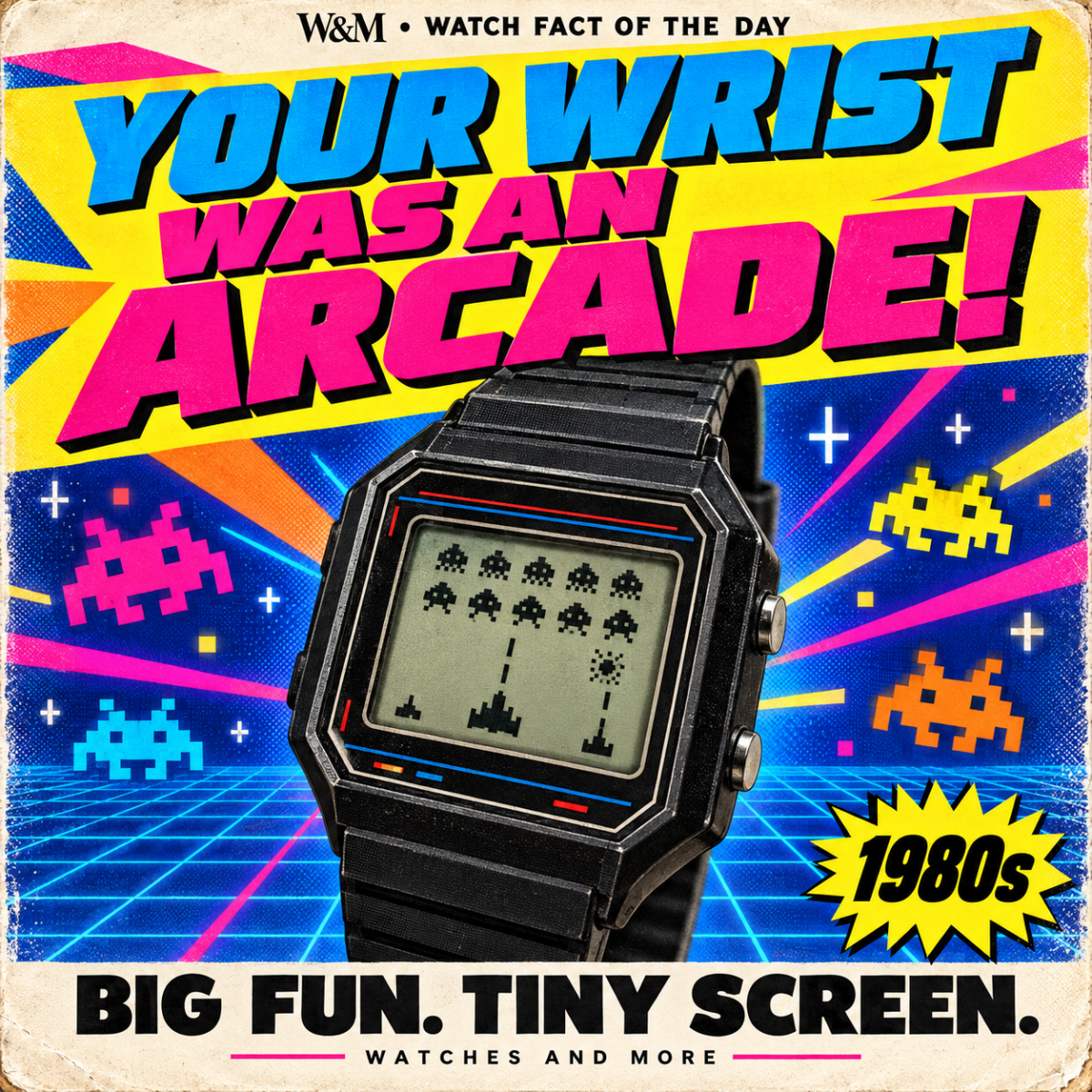
Watch Fact of the Day: The 1980s Watches That Turned Your Wrist into an Arcade 🕹️⌚

Once upon a time, before smartwatches decided to take over our wrists, there were tiny game watches that promised alien-slaying fun right on your wrist! Imagine battling invaders while also checking the time—multitasking level: expert! The first digital watches, like Seiko’s groundbreaking quartz chronograph, paved the way for the cheeky Casio GM-10, which snuck an arcade into your daily life. These little tech wonders transformed waiting into a thrilling space adventure, proving you don’t need a giant screen to have big fun. So, next time you glance at your wrist, remember: it once contained galaxies of gaming excitement!

Fun Quirk: Monday, October 12, 2026

📅 Monday, October 12, 2026

Before smartwatches, a few tiny buttons and an LCD screen were all you needed to battle aliens between checking the time.

Imagine looking down at your watch and facing an alien invasion.

Your mission? Move your spaceship, fire back, and survive—on a screen small enough to hide beneath your sleeve.

Welcome to the wonderfully geeky world of LCD game watches, where timekeeping met arcade action and your wrist became the coolest gadget in the room.

For a generation discovering digital technology, these watches offered something irresistible: a little piece of the future you could actually wear.

Before smartwatches, a few tiny buttons and an LCD screen were all you needed to battle aliens between checking the time.

Imagine looking down at your watch and facing an alien invasion.

Your mission? Move your spaceship, fire back, and survive—on a screen small enough to hide beneath your sleeve.

Welcome to the wonderfully geeky world of LCD game watches, where timekeeping met arcade action and your wrist became the coolest gadget in the room.

For a generation discovering digital technology, these watches offered something irresistible: a little piece of the future you could actually wear.

⏱️ First Came the Digital Revolution

Before watches could entertain us, manufacturers had to squeeze increasingly capable electronics into remarkably small cases.

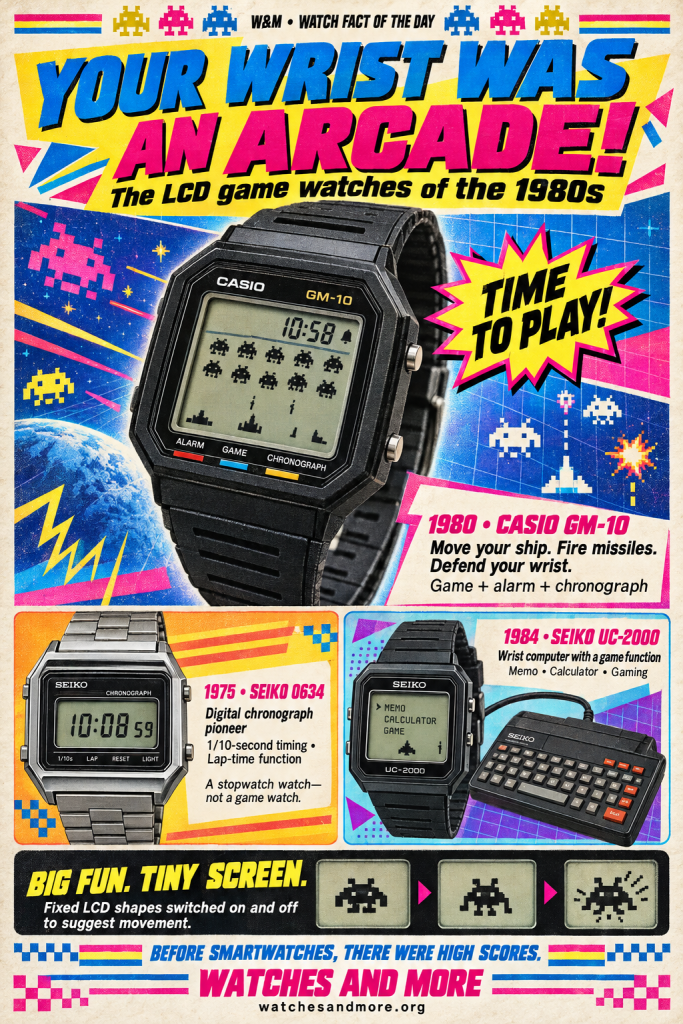
In 1975, Seiko introduced its 0634 digital quartz chronograph, which the company identifies as the world’s first digital quartz watch with a chronograph. It measured elapsed time to one-tenth of a second, included a lap-time function, and featured an internal light.

That watch didn’t contain a game. But it belonged to an exciting new era in which buttons and digital displays expanded what a wristwatch could do.

Once your watch could time a race, the next question practically asked itself:

Could it let you play one?

👾 Meet the Tiny Wrist Arcade

One memorable example was the Casio GM-10, also known as the Game-10, documented by vintage electronics specialists as a 1980 model.

Its attraction was a miniature space battle. Using two buttons on the right side, players manoeuvred a ship and fired missiles at attacking aliens. It also offered an alarm and chronograph, so the entertainment came alongside practical watch functions.

Think about the appeal.

An arcade machine was something you visited. A home console was something you sat down to play.

This game went wherever your wrist went.

Waiting around suddenly had possibilities. So did the dangerous phrase: “Just one more go.”

🕹️ Big Imagination, Tiny Screen

The magic of these early game watches came from how much entertainment designers could squeeze into so little space.

Many used fixed LCD shapes that switched on and off in sequence, creating the impression of movement. The games depended on simple actions, timing, and repetition rather than elaborate graphics.

A few changing shapes could become a challenge. A tiny button could become the difference between survival and defeat.

There’s a lovely design lesson in that: you don’t need a huge screen to create a big moment.

💡 Did You Know?

Seiko also put gaming into a wrist computer.

Its 1984 UC-2000 worked with an external controller and keyboard, using electromagnetic induction to transfer character data. Alongside memo and calculator functions, Seiko’s official history lists a game function.

That makes a fascinating pairing: Casio’s miniature arcade action and Seiko’s more ambitious approach to wrist computing.

The wrist was becoming a place to experiment.

⭐ Why It Matters

Game watches deserve a place in wearable technology history because they made a compelling promise:

A watch could be something you interacted with for pleasure.

We can see them as early expressions of an idea that modern smartwatches would explore much further: the wrist as a home for useful tools, information, and entertainment.

That’s a historical connection, rather than proof that game watches directly caused the smartwatch revolution. Their contribution was helping make a multifunction watch feel exciting—and personal.

They didn’t simply tell you the time.

They gave you a reason to spend a little time with them.

❤️ The W&M Take: High Scores, Small Screens, Huge Charm

At Watches And More, we love watches with a story. And a watch that lets you defend your wrist against aliens? That’s a pretty good one.

These little electronic adventures capture a wonderful moment in design history, when digital displays felt futuristic and manufacturers were willing to ask playful questions.

What else could a watch become?

Sometimes the answer was a calculator. Sometimes it was a wrist computer.

And sometimes, gloriously, it was an arcade.

Before gaming lived in our pockets, a little of it lived on our wrists.


⌚ Keep exploring the world of watches:

What would you choose for your wrist: a space battle, a racing game, or good old-fashioned timekeeping?

Category: Fun Quirk

Disclaimer: Every effort has been made to keep these watch facts accurate, but the world of horology is full of myths, disputed stories, and fascinating trivia. Consider these facts a starting point for discovery rather than the final word. If you have corrections or additional insights, let us know—we’re always happy to keep the record ticking in the right direction.

🕐 Discover more watch facts, reviews, and buying guides at WatchesAndMore


🛍️ You Might Also Like

As an Amazon Associate and affiliate partner, WatchesAndMore earns from qualifying purchases.

Seiko 5 SNK805 Green Military
🔥 Deal of the Day

Seiko 5 SNK805 Green Military

Seiko

★★★★★ 4.8 (6,961 reviews)

$89

Offer expires in


🔥 Grab This Deal →

Seiko 5 SNK809 Automatic


Seiko 5 SNK809 Automatic

Seiko

★★★★★ 4.7 (3,289 reviews)

$99


Check Price on Amazon →

Seiko 5 Sports SRPD55


Seiko 5 Sports SRPD55

Seiko

★★★★★ 4.7 (1,247 reviews)

$275


Check Price on Amazon →


Browse all expert-reviewed watches →

ETSY Shop
ETSY Shop
Redbubble Shop
Redbubble Shop
More Watch Facts
More Watch Facts

Watch Fact of the Day: The 1930s Watch That Transformed Into a Table Clock

In 1931, Movado introduced the Ermeto, a pocket-sized watch encased in a sliding leather sleeve that automatically wound the movement every time the case was op

Fun Quirk: Sunday, October 11, 2026

📅 Sunday, October 11, 2026

In 1931, Movado introduced the Ermeto, a pocket-sized watch encased in a sliding leather sleeve that automatically wound the movement every time the case was opened and closed. This ingenious design allowed the rugged timepiece to double as a bedside table clock or a pocket watch, making it a favorite among interwar travelers. Its hermetically sealed case protected the delicate movement from dust and moisture, giving birth to a truly versatile mid-century marvel.


Category: Fun Quirk

Disclaimer: Every effort has been made to keep these watch facts accurate, but the world of horology is full of myths, disputed stories, and fascinating trivia. Consider these facts a starting point for discovery rather than the final word. If you have corrections or additional insights, let us know—we’re always happy to keep the record ticking in the right direction.

🕐 Discover more watch facts, reviews, and buying guides at WatchesAndMore


🛍️ You Might Also Like

As an Amazon Associate and affiliate partner, WatchesAndMore earns from qualifying purchases.

🔥 Deal of the Day

G-Shock GWM5610-1 Solar Atomic

Casio

★★★★★ 4.8 (5,621 reviews)

$129

Offer expires in


🔥 Grab This Deal →


G-Shock GA2100-1A1 CasiOak

G-Shock GA2100-1A1 CasiOak

Casio

★★★★★ 4.8 (2,156 reviews)

$99


Check Price on Amazon →


Casio Edifice Chronograph

Casio Edifice Chronograph

Casio

★★★★★ 4.7 (1,264 reviews)

$120


Check Price on Amazon →


Browse all 142+ expert-reviewed watches →

Watch Fact of the Day: The Tiny Tritium Tubes That Made Watches Glow Without Charging 🌙⌚

In the 1970s, strict safety regulations surrounding radioactive materials prompted watchmakers to experiment with novel ways to display luminous elements. The r

Fun Quirk: Saturday, October 10, 2026

📅 Saturday, October 10, 2026

No flashlight. No backlight button. Just a little atomic science keeping the dial visible in the dark.

Imagine putting your watch in a dark drawer.

Hours later, you take it out. Its markers are still glowing—even though you never charged them under a lamp.

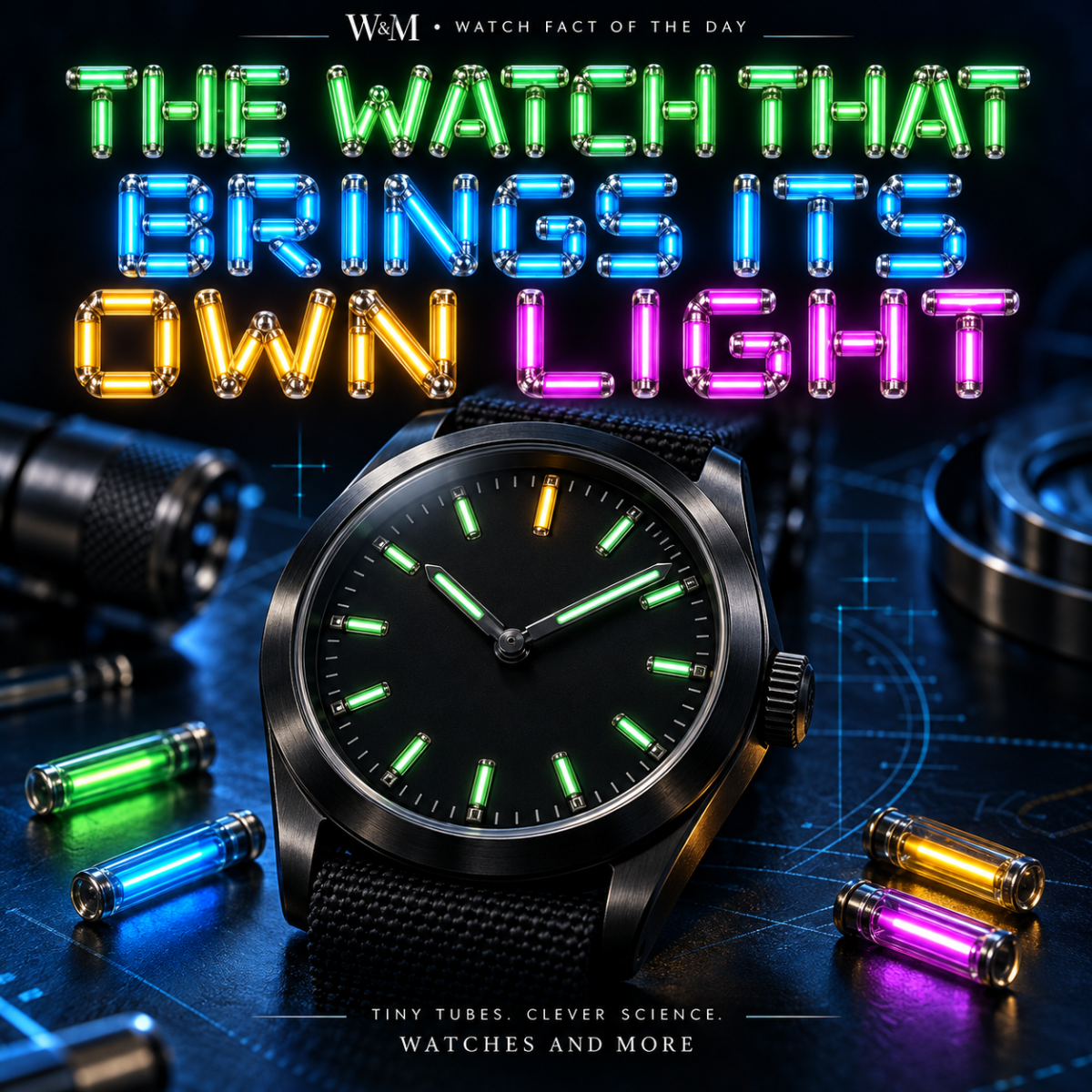
For watches fitted with tritium gas tubes, that’s the everyday magic: miniature light sources that generate their own illumination.

It’s a fascinating meeting of watchmaking, glass engineering, and physics. And those little glowing bars give the dial a character all its own.

🔬 Tiny Tubes, Clever Science

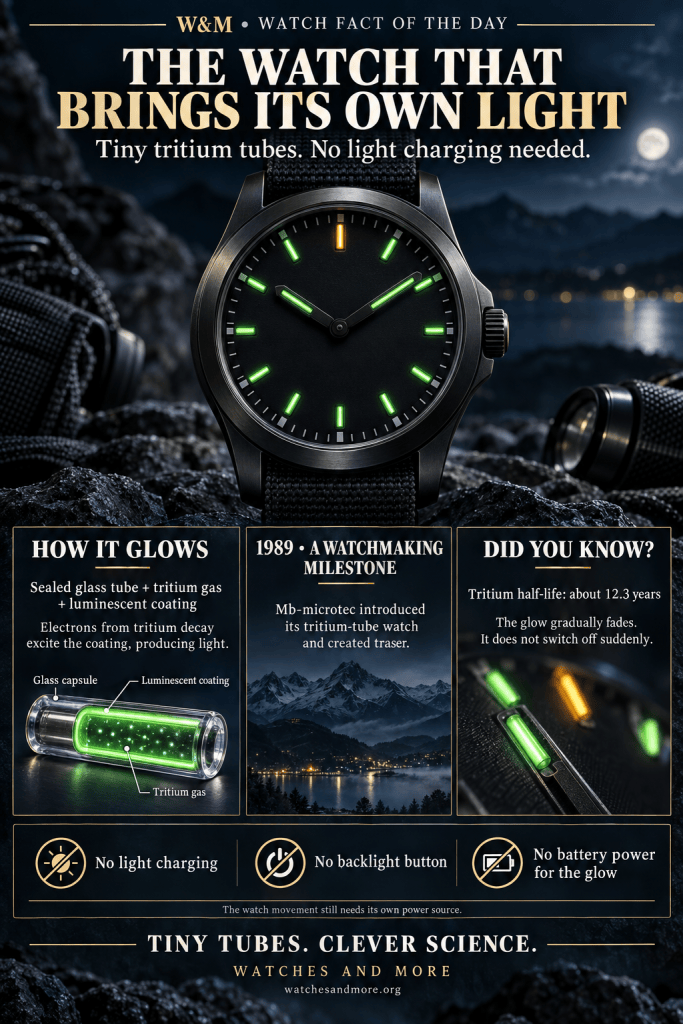
A tritium light tube is a miniature sealed glass capsule. Inside is tritium gas, while the inner surface carries a luminescent coating.

Tritium is a radioactive isotope of hydrogen. As it decays, it releases electrons that excite the coating, producing light. The coating determines the colour of the glow.

The result is wonderfully practical: illumination that needs no external light to charge it and no electricity from the watch battery.

The watch movement still needs its own power source. The glowing tubes handle their lighting independently.

Tiny capsules. Big idea.

⏱️ A Documented Watchmaking Milestone

Swiss specialist mb-microtec traces its history to 1969. Its official timeline identifies 1989 as the year it developed and introduced its self-illuminating watch, leading to the creation of the traser brand.

That milestone belongs to the story of sealed gas-tube illumination.

It’s worth keeping the terminology straight: tritium luminous paint and tritium gas tubes are different ways of using radioactive energy to produce light. A painted luminous marker isn’t a miniature glass capsule.

The tubes brought a distinctive physical element to the watch face—small components that could be positioned where readability mattered.

Watch Fact of the Day: The Tiny Tritium Tubes That Made Watches Glow Without Charging 🌙⌚

🌙 A Dial That Brings Its Own Light

Luminox provides a familiar example of this approach. Its watches place self-powered micro-gas tubes on the hands and hour markers, with tubes also used on bezels where required. They glow without needing exposure to an external light source.

For the wearer, the appeal is simple.

You can check the time in darkness without first reaching for a light or pressing a button.

For a designer, there’s another attraction: the little bars become part of the dial’s visual language. They can give it an instrument-like appearance, with the lighting components clearly contributing to its layout.

Function becomes part of the look.

💡 Did You Know?

The glow gradually weakens over time.

Tritium has a half-life of approximately 12.3 years. After that period, roughly half the original tritium remains. Its declining activity contributes to reduced light output as the tubes age.

A half-life isn’t an expiry date. The tubes don’t suddenly switch off on an anniversary.

Their light fades progressively—a reminder that even this remarkable technology follows the clock of physics.

⭐ Why It Matters

Tritium tubes offer an elegant solution to a very ordinary problem: reading the time when there’s little or no light.

They also show how a useful component can shape a product’s identity.

Those visible capsules help create the purposeful appearance associated with many tactical and outdoor watches. Their appeal comes from the connection between what you see and what it does.

It’s watch design with a practical reason behind the glow.

❤️ The W&M Take: A Little Physics on Your Wrist

Some watches impress us with elaborate movements. Others win us over with rugged cases or beautiful dials.

A tritium-tube watch adds another kind of fascination: tiny sealed light sources quietly doing their job in the dark.

No charging ritual for the lume. No button required.

Just a clever piece of engineering that makes an everyday glance at your wrist a little more interesting.

Sometimes the coolest watch feature is the one you appreciate after the lights go out.


⌚ Explore more watch stories:

What’s your favourite way to light up a watch: glowing paint, tritium tubes, or a classic digital backlight?

Category: Fun Quirk

Disclaimer: Every effort has been made to keep these watch facts accurate, but the world of horology is full of myths, disputed stories, and fascinating trivia. Consider these facts a starting point for discovery rather than the final word. If you have corrections or additional insights, let us know—we’re always happy to keep the record ticking in the right direction.

🕐 Discover more watch facts, reviews, and buying guides at WatchesAndMore


🛍️ You Might Also Like

As an Amazon Associate and affiliate partner, WatchesAndMore earns from qualifying purchases.

G-Shock GWM5610-1 Solar Atomic
🔥 Deal of the Day

G-Shock GWM5610-1 Solar Atomic

Casio

★★★★★ 4.8 (5,621 reviews)

$129

Offer expires in


🔥 Grab This Deal →

G-Shock GA2100-1A1 CasiOak


G-Shock GA2100-1A1 CasiOak

Casio

★★★★★ 4.8 (2,156 reviews)

$99


Check Price on Amazon →

Casio Edifice Chronograph


Casio Edifice Chronograph

Casio

★★★★★ 4.7 (1,264 reviews)

$120


Check Price on Amazon →


Browse all expert-reviewed watches →

ETSY Shop
ETSY Shop
Redbubble Shop
Redbubble Shop
More Watch Facts
More Watch Facts