In 1912, Movado introduced the Polyplan, a revolutionary wristwatch designed to fit the curve of the wrist by curving the watch case itself. To achieve this, th
📅 Friday, October 9, 2026
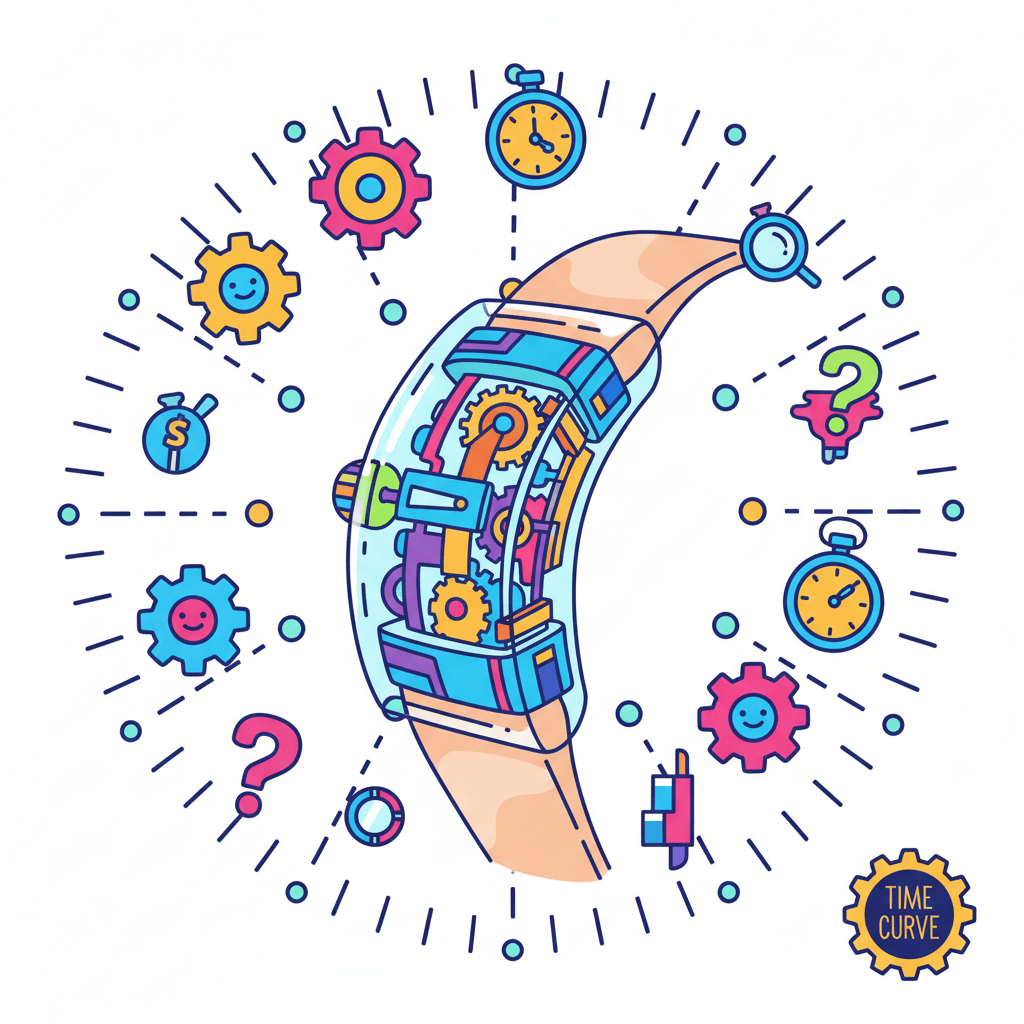
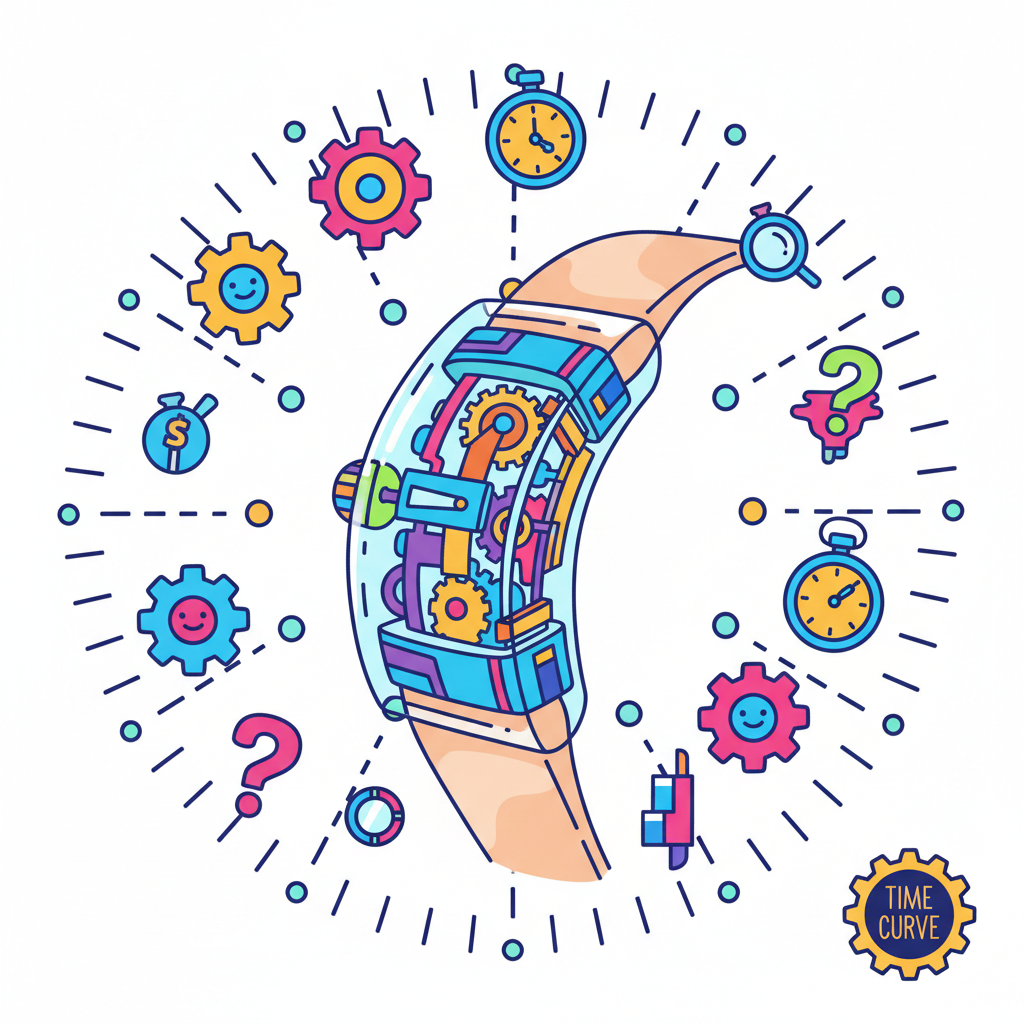
In 1912, Movado introduced the Polyplan, a revolutionary wristwatch designed to fit the curve of the wrist by curving the watch case itself. To achieve this, the internal movement had to be built on three distinct planes, presenting an extraordinary engineering challenge for watchmakers. Because they were so difficult and expensive to produce, fewer than a thousand were ever made, making them among the rarest vintage oddities today.
Category: Fun Quirk
Disclaimer: Every effort has been made to keep these watch facts accurate, but the world of horology is full of myths, disputed stories, and fascinating trivia. Consider these facts a starting point for discovery rather than the final word. If you have corrections or additional insights, let us know—we’re always happy to keep the record ticking in the right direction.
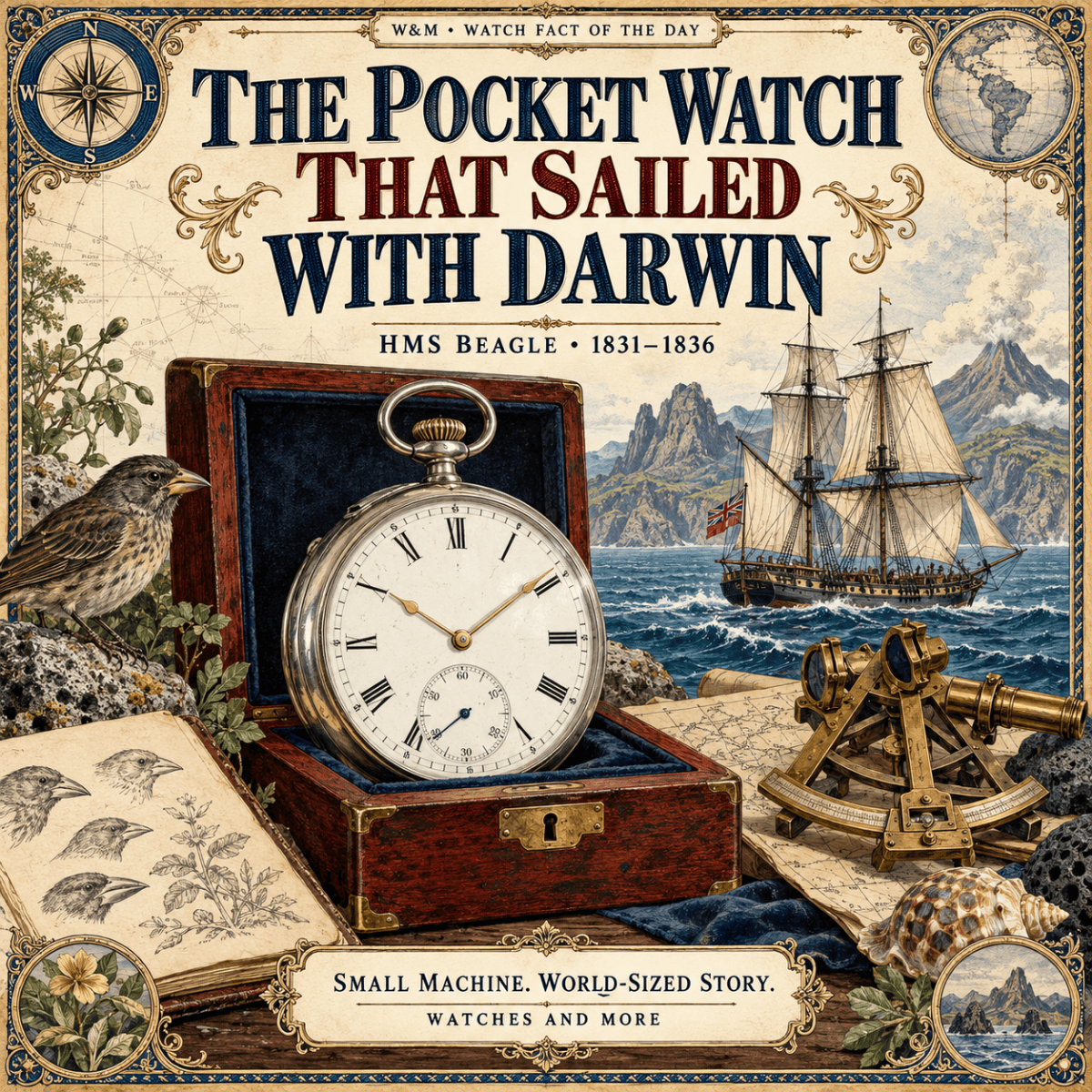
Ah, the tale of Charles Darwin’s trusty pocket watch, affectionately called “K.” This little timepiece didn’t just help you catch the bus—oh no, it navigated the high seas! Before GPS made it a couch potato, this stalwart chronometer hopped aboard HMS Beagle like a true adventurer. From 1831 to 1836, it helped map uncharted territories and summon crucial measurements to support Darwin’s theories, proving that sometimes, understanding the vast universe comes down to knowing if it’s tea time! So, next time you glance at your wrist, remember: watches have been making history, one tick at a time.
📅 Thursday, October 8, 2026
Watch Fact of the Day: The Pocket Watch That Sailed With Charles Darwin ⌚🌍
Before GPS, a remarkably accurate pocket timekeeper helped an expedition find its place in the world.
Charles Darwin’s voyage aboard HMS Beagle helped transform our understanding of life on Earth.
But alongside the specimens, notebooks, and geological observations was another extraordinary scientific story: the precision timekeeping that helped the expedition map the world.
Among its instruments was a pocket chronometer small enough to carry ashore—and important enough to earn its place in the history of exploration.
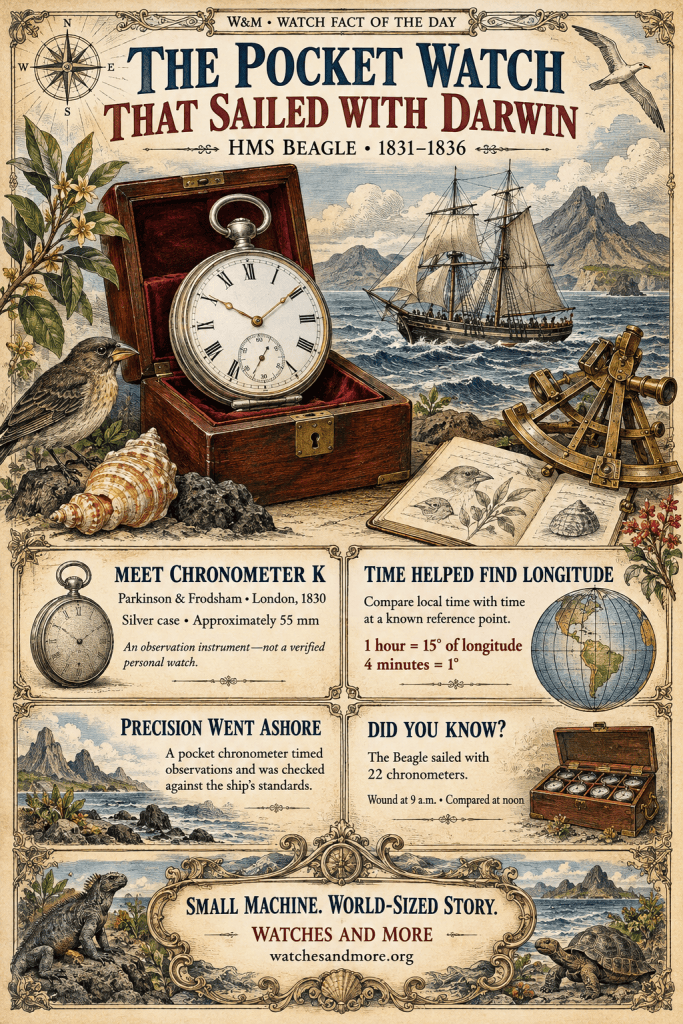
⚓ Meet Chronometer “K”
A surviving pocket chronometer made by Parkinson & Frodsham of London in 1830 is documented as having travelled on the Beagle’s second voyage, from 1831 to 1836, with Darwin aboard.
Known on the ship as “K,” it served as an observation chronometer, helping survey the South American coast. It was also taken ashore in the Galápagos Islands. Its silver case measures approximately 55 mm across, and it was supplied with a mahogany box.
This was much more than a handsome pocket watch.
It was portable precision equipment for a world without satellite navigation.
🧭 Why Finding Your Location Required Knowing the Time
At sea, knowing how far east or west you had travelled presented a formidable challenge.
One solution was to compare local time, determined through astronomical observations, with the time at a known reference location.
Because Earth turns through 360 degrees in 24 hours, one hour of time difference corresponds to 15 degrees of longitude. Just four minutes represents one degree.
That made an accurate timekeeper enormously valuable.
A watch could help answer a question far bigger than “What time is it?”
“Where are we?”
🔭 Precision That Went Ashore
Captain Robert FitzRoy’s account describes a pocket chronometer carried by hand in a small box for timing observations.
Before and after those observations, it was compared with the expedition’s standard chronometers. That checking mattered: the portable instrument connected field measurements with the carefully maintained timekeepers aboard ship.
Picture the contrast.
A small mechanical timepiece, protected in its box. A sextant directed toward the sky. An unfamiliar coastline waiting to be measured.
Exploration depended on curiosity—but it also depended on reliable instruments.
🌿 The Darwin Connection—Without the Embellishment
The Beagle voyage provided observations and collections that contributed to Darwin’s later development of evolution by natural selection. The pocket chronometer supported the expedition’s surveying work.
Those are powerful connections in their own right.
We don’t need to imagine Darwin personally consulting this particular watch for every discovery. Its documented role places it aboard the same remarkable expedition, helping establish the geographical framework within which exploration took place.
It sailed with Darwin. That alone is an extraordinary story.
💡 Did You Know?
The Beagle carried 22 chronometers when it sailed from England.
FitzRoy described a dedicated cabin where the instruments were secured in boxes surrounded by sawdust. They were wound daily at nine and compared at noon, with the routine entrusted to George James Stebbing.
Some instruments failed during the voyage, but FitzRoy reported that none of the expedition’s measurements depended on fewer than twelve chronometers.
Precision came from careful routines and comparison—not simply trusting one watch.
⭐ Why It Matters
This story reveals a quieter side of scientific discovery.
We remember the naturalist, the islands, and the ideas. Behind them stood instrument makers and surveyors whose work helped make the expedition possible.
A pocket chronometer brought meticulous engineering into the field. It linked the movement of tiny mechanical components with measurements on a planetary scale.
Sometimes, understanding a big world begins with a very small machine.
❤️ The W&M Take: A Watch With a World of History
At Watches And More, we believe every watch has a story.
This one connects London watchmaking, ocean voyages, coastal surveys, and an expedition that changed how humanity understood nature.
Its importance goes far beyond its silver case.
It reminds us that watches have been tools for discovery—carried wherever people needed dependable time to explore unfamiliar places.
Darwin studied the world. Precision timekeepers helped his expedition navigate it.
Which watch story fascinates you most: ocean exploration, aviation, or the journey into space?
Category: Military Watches
Disclaimer: Every effort has been made to keep these watch facts accurate, but the world of horology is full of myths, disputed stories, and fascinating trivia. Consider these facts a starting point for discovery rather than the final word. If you have corrections or additional insights, let us know—we’re always happy to keep the record ticking in the right direction.
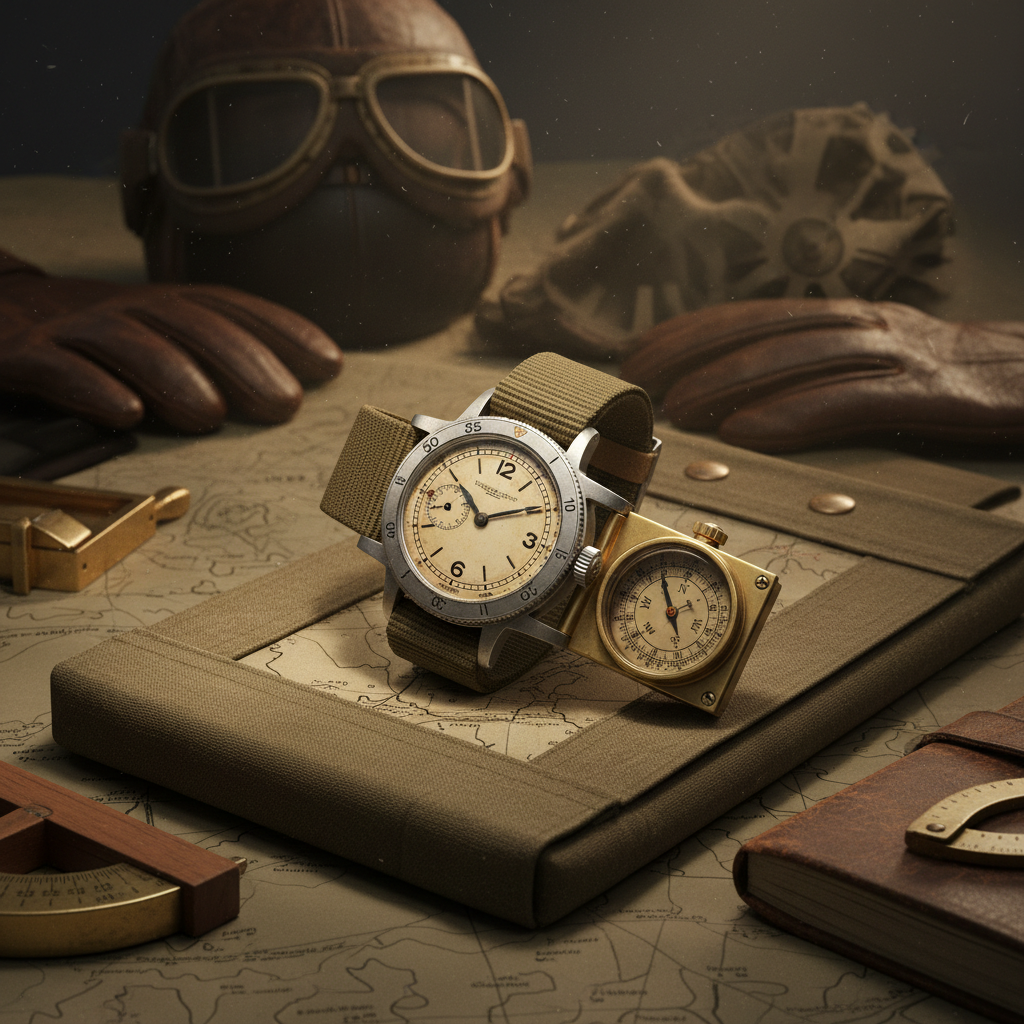
So, the Longines Weems Second-Setting watch is a cool piece of history, designed back in the 1930s for aviation. It helped pilots navigate over vast oceans without modern tech like GPS. The watch features a nifty rotating inner dial that syncs with radio time signals, allowing the seconds hand to keep moving while you adjust the scale. This innovation was crucial for accurate navigation, especially before WWII when timing mattered a lot. It’s not just about looking good—this watch was all about solving real problems for aviators. Basically, it’s a blend of mechanical brilliance and adventurous spirit!
📅 Wednesday, October 7, 2026
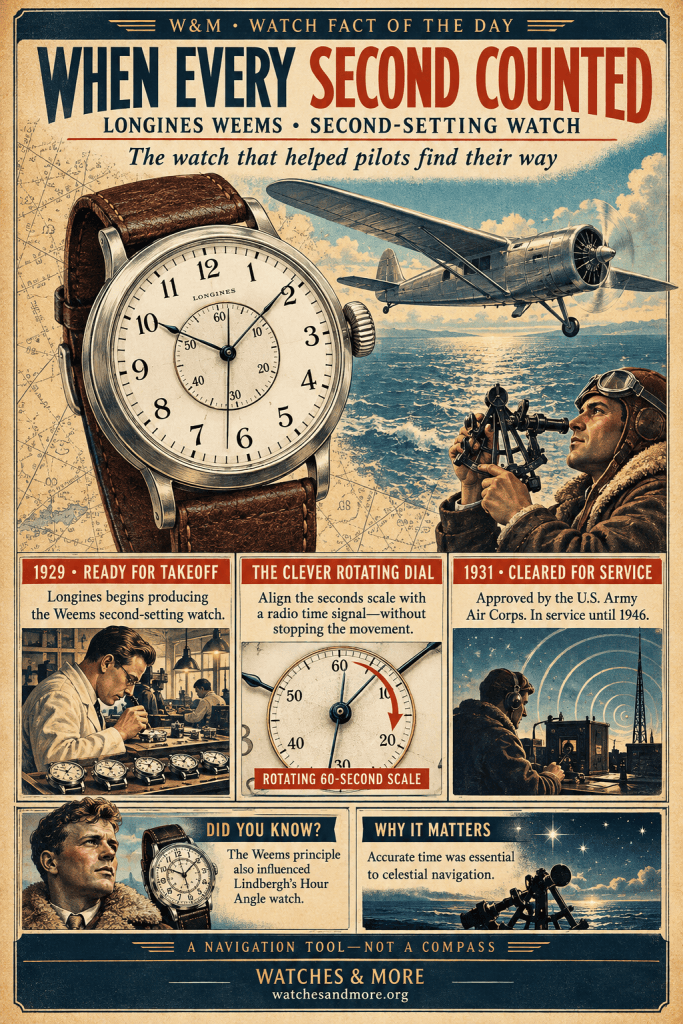
Longines Weems — When Every Second Counted ✈️⌚
Imagine flying over an ocean in the 1930s.
No GPS. No moving map. No friendly voice announcing that you’ve missed your turn.
Below you, an endless stretch of water. Above you, the sky—and on your wrist, a watch with a surprisingly clever trick.
The Longines Weems Second-Setting watch brought something essential to early aviation: a practical way to synchronize a mechanical watch with a radio time signal while its movement kept running.
Sometimes, the most impressive watch complication is the one that solves a real problem.
📻 The Genius Was in the Dial
Developed from the ideas of U.S. Navy officer and navigation instructor Philip Van Horn Weems, the design used a rotating inner disc marked with a 60-second scale.
Instead of stopping the seconds hand, the wearer moved the scale beneath it to match the radio time signal. Longines began producing the watch in 1929, bringing Weems’ navigation concept into a purpose-built timepiece.
Think of it as moving the ruler instead of moving the thing you’re measuring.
The seconds hand continued its journey around the dial. The adjusted scale provided the synchronized reading.
Simple idea. Brilliant application.
🌌 Why a Navigator Needed the Time
A compass helps answer: Which direction am I heading?
Celestial navigation helps answer another question: Where am I?
To work out a position using the Sun or stars, navigators combined observations with accurate time and navigation tables. A timing error could introduce an error into that calculation.
The watch supplied an essential part of the process. It worked alongside the navigator’s instruments, knowledge, and calculations.
That makes the Weems more interesting than a watch with an adventurous name. Its unusual dial had a job to do.
✈️ From Prewar Innovation to Wartime Service
This story began well before World War II.
According to Longines, the U.S. Army Air Corps approved the Weems Second-Setting Pilot Watch in August 1931, and it remained in service until 1946. Its military career therefore stretched from the pioneering aviation years into the WWII era.
It belonged to a world where navigating demanded preparation, concentration, and trust in your equipment.
A wristwatch could be part of the cockpit toolkit—and precision had a purpose far beyond arriving on time.
💡 Did You Know?
The Weems system also influenced the Longines Lindbergh Hour Angle watch. Charles Lindbergh incorporated the seconds-setting principle into his own navigation-watch design, adding another chapter to the connection between aviation and watchmaking.
⭐ Why It Matters
The Weems watch shows what happens when watchmaking responds to a practical challenge.
Its appeal goes deeper than vintage styling. That movable scale represents an elegant piece of problem-solving: give the navigator a usable, synchronized seconds reading while allowing the mechanism to keep ticking.
For watch enthusiasts, that is the magic of a great tool watch.
Every unusual detail tells you something about the people who needed it.
⌚ The W&M Take
We love a watch with a story—and this one has altitude.
The Longines Weems brings together mechanical ingenuity, radio signals, and the courage of early aviation. Looking at that rotating dial, you can almost picture a navigator listening for the next time signal above a dark ocean.
Before the blue dot on your phone, finding your way took skill—and a very good watch.
Disclaimer: Every effort has been made to keep these watch facts accurate, but the world of horology is full of myths, disputed stories, and fascinating trivia. Consider these facts a starting point for discovery rather than the final word. If you have corrections or additional insights, let us know—we’re always happy to keep the record ticking in the right direction.
In 1972, Hamilton’s Pulsar P1 redefined luxury wristwatches by replacing tick-tock with glow-glow. Picture this: a gold watch that shows time on a blank red LED screen, like a sci-fi prop! To view it, you had to press a button, making you feel like a time-traveling wizard. No gears, no ticking, just quartz magic. It cost a whopping $2,100—back when a small car was more budget-friendly. Celebs like Elvis and Nicholson jumped on this trend, proving that even the fanciest watches could go completely dark when you weren’t showing off! Wear the future, minus the tick!
📅 Tuesday, October 6, 2026
No hands. No ticking. Just glowing red numbers—and a glimpse of the future.
Imagine buying a luxury watch, looking down at your wrist, and seeing a blank screen.
In 1972, that was part of the appeal.
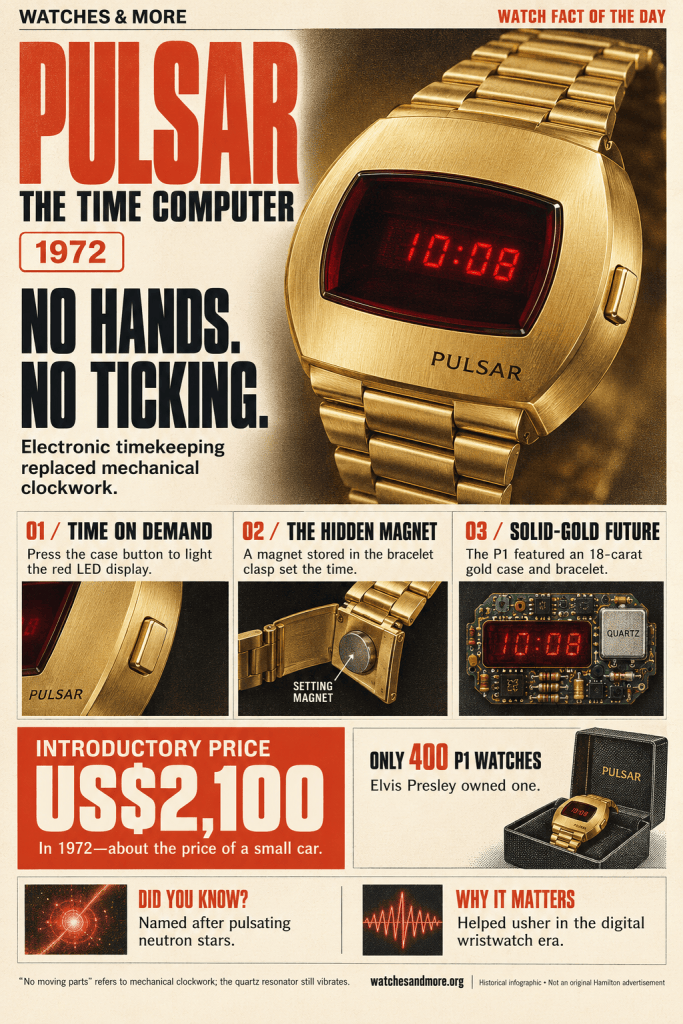
The Hamilton Pulsar P1 brought electronic digital timekeeping to the wrist in spectacular fashion. Unveiled as a prototype in 1970 and sold commercially in 1972, it looked perfectly at home in the space age. Press a button, and its dark screen suddenly came alive with red numbers. Swatch Group
For generations, telling time had meant watching hands travel around a dial. The Pulsar offered a different experience: time revealed through light.
⌚ A Watch Without the Clockwork
Developed through a partnership between Hamilton and electronics company ElectroData, the Pulsar replaced traditional mechanical clockwork with electronic timekeeping. Smithsonian describes it as a watch with no moving parts. National Museum of American History
There was no mainspring to wind, no gear train driving hands, and no escapement producing that familiar tick. Quartz-based electronics kept time, while light-emitting diodes—LEDs—displayed the numbers.
A small technical distinction makes the story even more interesting: “no moving parts” means no moving mechanical clockwork. The quartz resonator still vibrates microscopically to provide the timekeeping reference. Hamilton Watch
For a watch enthusiast, the fascinating part is the change in character. A mechanical watch reveals time through motion. The Pulsar revealed it through light.
🔴 Why You Had to Press a Button
Those glowing red numerals came with a practical limitation: the LED display consumed too much power to remain illuminated continuously.
The solution was time on demand.
Pressing the button on the side of the case briefly displayed the hours and minutes. Holding it longer showed the seconds. The watch continued keeping time while its screen was dark.
And here is an important detail: the magnet hidden in the bracelet clasp was used to set the time. The case button illuminated the display.National Museum of American History
Today, pressing a button to wake a screen feels ordinary. In the early 1970s, that little interaction could make checking the time feel like operating a piece of science-fiction equipment.
💰 The Future Came in Solid Gold
The original Pulsar P1 paired its electronics with an 18-carat yellow-gold case and bracelet. Its launch price was US$2,100, and Hamilton records Elvis Presley among the buyers of the original 400 watches. Swatch Group
Owning one meant wearing an unmistakable conversation starter: a luxury watch whose most striking feature disappeared when you stopped using it.
Hamilton’s historical retrospective also names Jack Nicholson among the Pulsar’s famous admirers. The stainless-steel P2 followed in 1973, bringing the concept to a wider audience. Swatch Group
The digital future was finding more wrists.
💡 Did You Know?
“Pulsar” was a name borrowed from astronomy. Pulsars are rotating neutron stars whose radiation can be detected as regularly recurring pulses—an evocative name for a futuristic electronic watch. Swatch Group
Hamilton marketed the watch as a “Time Computer.” That name captured the excitement surrounding its electronics, although the original watch was a timekeeping device rather than a general-purpose computer. National Museum of American History
⭐ Why It Matters
The Pulsar helped change what people expected a watch to look like—and how they expected to interact with it.
A dial no longer needed hands. Checking the time could involve waking a display. Advanced electronics could become the centerpiece of a luxury watch’s appeal.
For collectors, its significance goes beyond those unmistakable red numbers. It captures a moment when the future became something you could proudly wear.
Sometimes, a revolution in watchmaking arrives without making a single tick.
Disclaimer: Every effort has been made to keep these watch facts accurate, but the world of horology is full of myths, disputed stories, and fascinating trivia. Consider these facts a starting point for discovery rather than the final word. If you have corrections or additional insights, let us know—we’re always happy to keep the record ticking in the right direction.
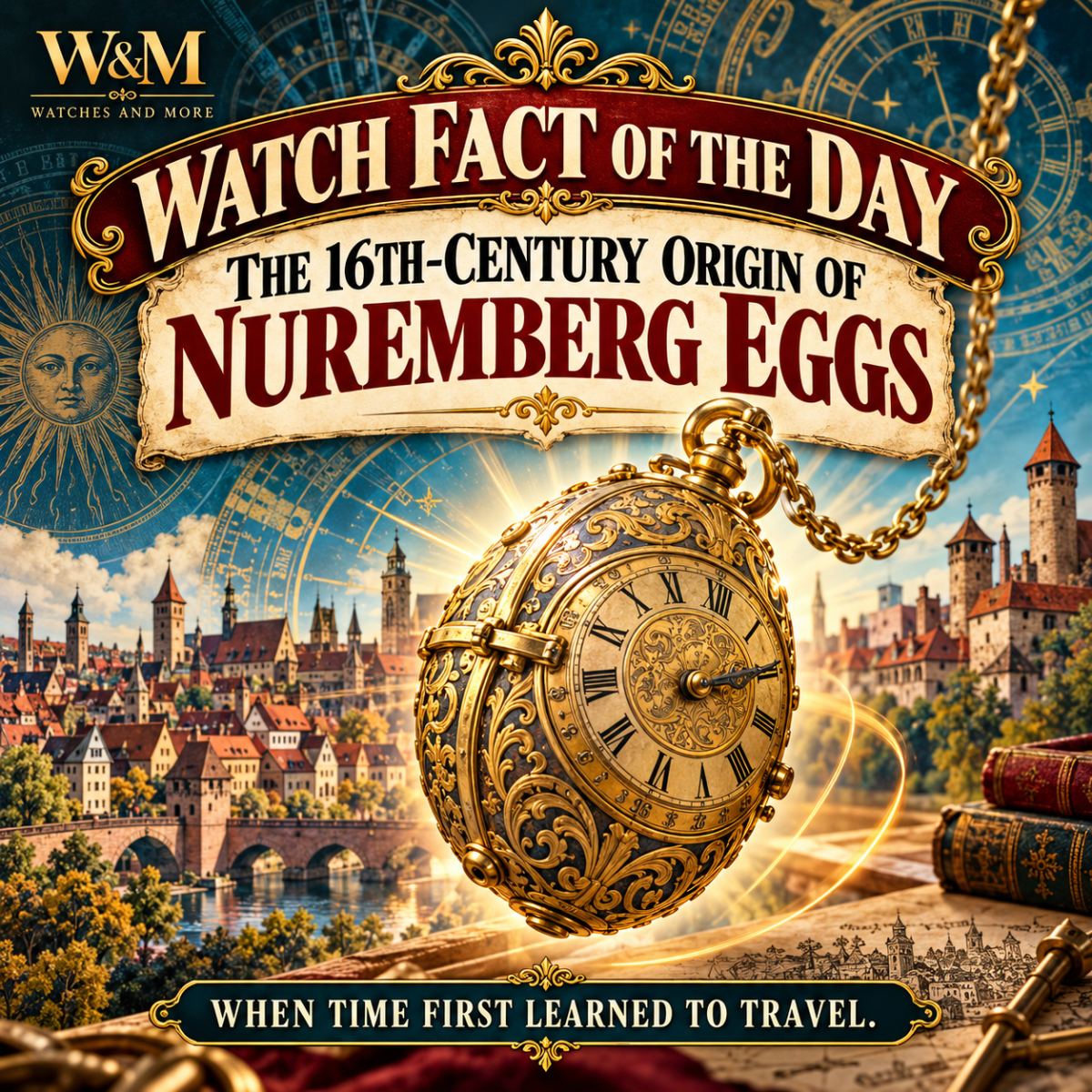
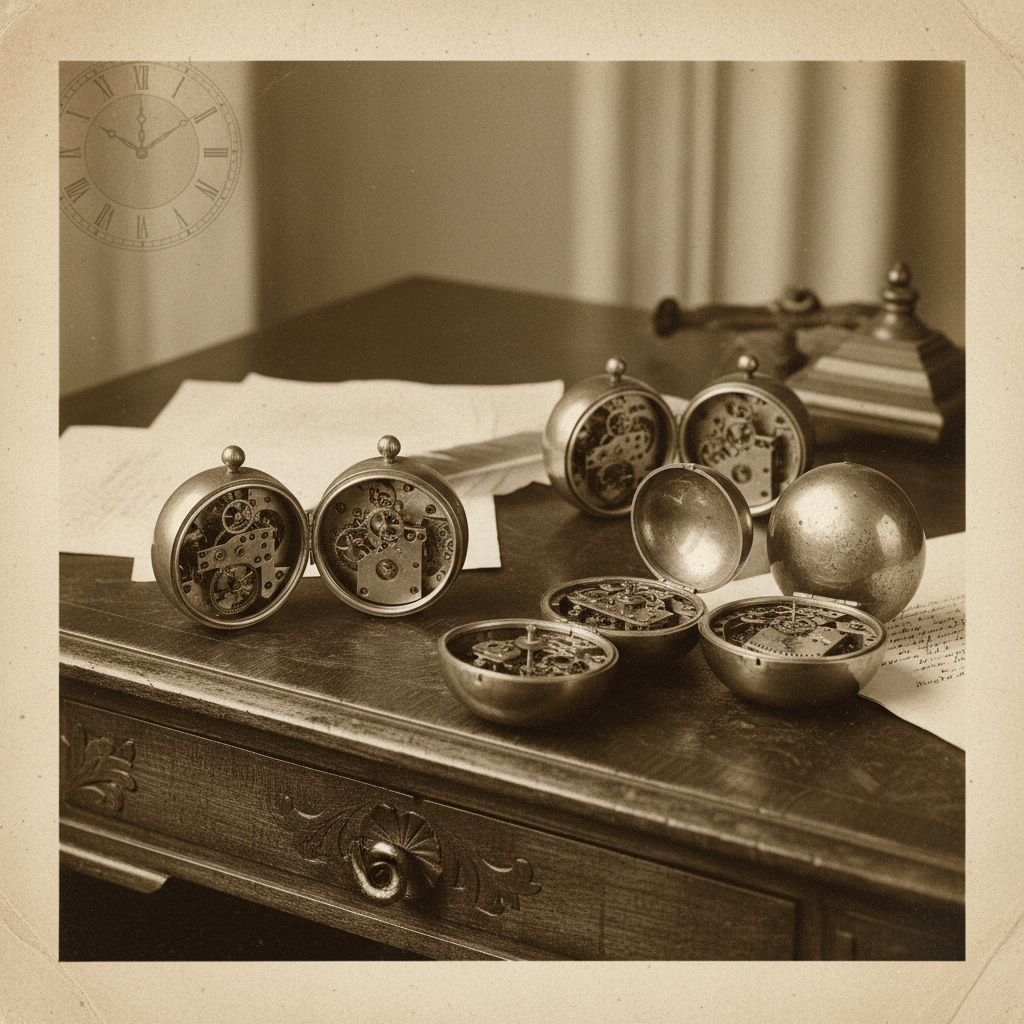
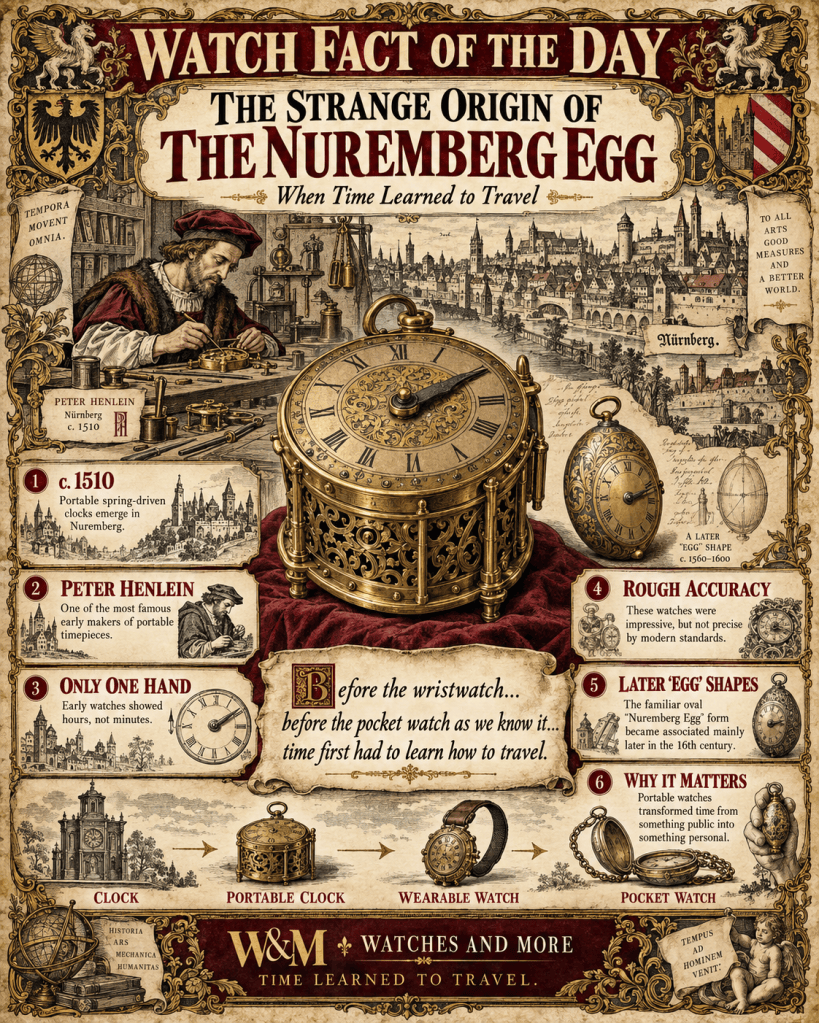
Once upon a time in the 16th century, clocks started to ditch their fixed homes and went mobile, thanks to a little something called spring mechanisms. Peter Henlein, the Houdini of time-telling, created chunky, drum-shaped clocks that could hang out with the rich. But don’t expect an elegant pocket watch; these bad boys only had a single hour hand – accuracy was more of a suggestion. Enter the Nuremberg Egg, a quirky timepiece born from a happy naming accident, showing us time could be personal. So, before watches were cool, they were just heavy jewelry that said, “I have time, roughly!”
📅 Monday, October 5, 2026
At the beginning of the 16th century, clocks were beginning to do something extraordinary:
THEY WERE LEAVING THE TABLE.
Spring-driven mechanisms allowed clockmakers to shrink timekeeping machines enough that wealthy owners could carry them on the body.
Nuremberg became one of the important centers of this emerging craft, and one of its most famous early makers was Peter Henlein.
By around 1510, Henlein was producing small portable spring-driven clocks that could continue running while being carried—an impressive achievement at a time when most clocks still depended on weights and fixed installations. Contemporary accounts praised his ability to make tiny multi-wheel clocks that could run while being worn or carried. Wikipedia
But those early devices were not quite the elegant pocket watches we imagine today.
They were often:
thick
drum-shaped
heavy
highly ornamental
and equipped with only:
ONE HOUR HAND.
Their accuracy was crude by modern standards, and they were as much pieces of status jewelry and mechanical curiosity as they were precision instruments. Wikipedia
🥚 So Where Did the “Egg” Come From?
Here’s where the story gets fun.
The famous oval watches now called “Nuremberg Eggs” became popular later in the 1500s—well after Henlein’s death in 1542. Historical summaries place the true egg-shaped forms mainly from around the 1580s. Wikipedia
Even the name may not originally have referred to the shape.
One explanation is that the German word “Eierlein”—little egg—developed from a corruption of an older diminutive for “little clock” or “little watch.” Only later did the egg association become literal in the shape of the cases. Wikipedia
So the famous nickname may have helped create the design people later associated with it.
That is wonderfully backwards.
Why Only One Hand?
Early portable watches were not accurate enough to justify a minute hand.
Their regulating systems were primitive, and daily errors could be substantial. Showing minutes would have suggested a precision the mechanism simply did not possess.
So the owner got:
THE HOUR.
APPROXIMATELY.
And that was enough.
This was still revolutionary.
For the first time, a person could carry mechanically measured time with them rather than relying entirely on a public clock, church bell, or fixed domestic clock.
💡 Did You Know?
Portable watches did not begin with Henlein.
The Met traces wearable watch development to around 1500 or slightly earlier, with smaller spring-driven portable clocks existing as early as the mid-15th century. Henlein’s importance was in the remarkable miniaturization and spread of portable timekeeping—not in single-handedly inventing the concept from nothing. The Metropolitan Museum of Art
That distinction actually makes the history more interesting.
The so-called Nuremberg Egg represents one of the great transitions in horology.
Before this period, time was mostly something you went somewhere to find.
A tower.
A church.
A room.
A public square.
Portable watches began turning time into something personal.
Something you could wear.
Something you could carry.
Something that belonged to you.
BEFORE THE WRISTWATCH…
BEFORE THE POCKET WATCH AS WE KNOW IT…
TIME FIRST HAD TO LEARN HOW TO TRAVEL.
Category: Watch History
Disclaimer: Every effort has been made to keep these watch facts accurate, but the world of horology is full of myths, disputed stories, and fascinating trivia. Consider these facts a starting point for discovery rather than the final word. If you have corrections or additional insights, let us know—we’re always happy to keep the record ticking in the right direction.
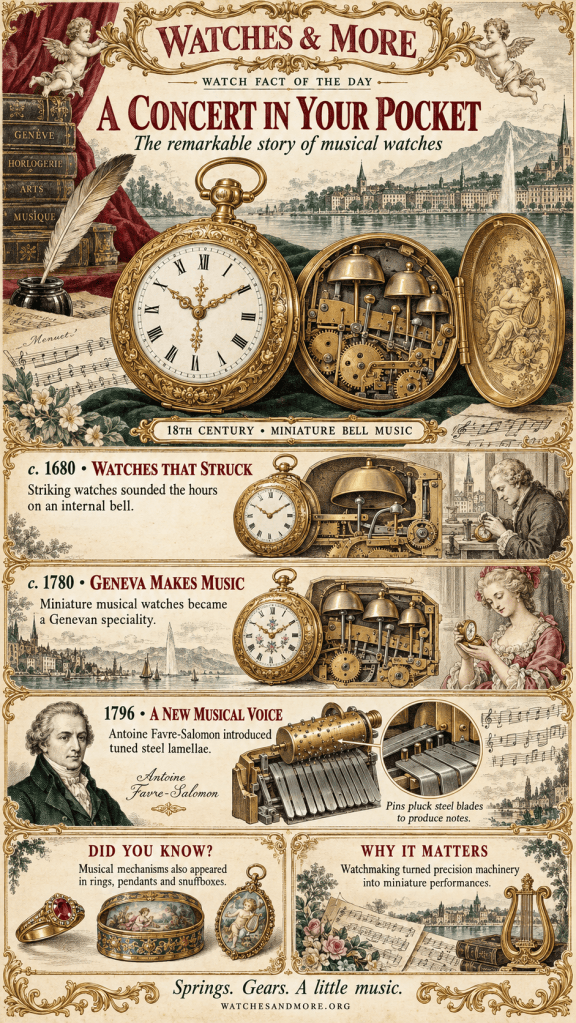
Musical miniaturization in watchmaking combines the elegance of timekeeping with the charm of melody, creating delightful mechanical wonders. In the 18th century, Genevan artisans pioneered musical pocket watches and mechanisms, transforming intricate craftsmanship into miniature concerts. These timepieces not only told time but also played enchanting tunes, captivating collectors and enthusiasts. Innovations, like the introduction of tuned steel lamellae, further enriched the musical experience, allowing for even greater creativity. Today, these historical creations remind us of the magic inherent in mechanics, where art and precision come together to evoke joy and nostalgia through music captured in time.
📅 Sunday, October 4, 2026
Before playlists and portable speakers, watchmakers found a wonderfully mechanical way to carry a tune.
Imagine reaching into your pocket, taking out an ornate watch, and hearing a delicate melody emerge from inside its case.
No battery. No speaker. Just springs, gears, and miniature musical machinery.
These remarkable timepieces brought together two arts that share an obsession with rhythm: watchmaking and music.
By the late 18th century, Genevan makers were turning musical pocket watches and other miniature musical objects into a speciality—creating tiny performances inside beautifully crafted cases.
🔔 Before the Melody Came the Bell
Watches were making themselves heard well before they became miniature music players.
A surviving Thomas Tompion traveling clock-watch from around 1680, now in the Metropolitan Museum of Art, strikes the hours on a bell inside its case and includes an alarm. It has separate mechanisms and power sources for timekeeping, striking, and sounding the alarm.
That was already an impressive achievement: a portable timekeeper that could announce itself.
Playing a recognizable tune added another challenge. Instead of repeatedly sounding one bell, a musical mechanism needed to produce different notes in a carefully arranged sequence.
🎶 A Concert in Miniature
During the 18th century, watchmakers in Geneva developed miniature carillons—mechanisms that played music on small bells—and incorporated them into pocket watches and other precious objects. Around 1780, this kind of musical miniaturization became a local speciality.
The broader tradition of mechanical bell music used pinned cylinders to control the sequence of notes. As the cylinder rotated, its pins triggered the mechanism in a predetermined pattern. Musical clocks preserved by Museum Speelklok demonstrate this approach.
Think of the cylinder as a mechanical score: the tune was encoded in the placement of its pins.
The charm lies in that physical relationship. Every note depended on something moving, engaging, and sounding at exactly the right moment.
⚙️ The 1796 Breakthrough: Steel Instead of Bells
Here’s where the familiar music-box sound enters the story.
In 1796, Genevan watchmaker Antoine Favre-Salomon introduced tuned steel lamellae, opening the way to even smaller musical mechanisms.
In this system, pins on a rotating cylinder plucked steel blades of different lengths. Each blade vibrated at its own musical pitch, and their arrangement gave rise to the description “comb music.” Early makers incorporated these mechanisms into small precious objects before they became familiar as standalone music boxes.
Tiny bells and tuned steel teeth represent different ways of producing the music. Both are ingenious; each gives the mechanism its own character.
🎭 When the Watch Became a Performance
Some makers went further, combining music with moving miniature figures.
A watch attributed to Piguet & Capt, dating to around 1805, takes the form of an elaborate perfume flask. Its musical mechanism accompanies an animated scene featuring a boy, a dog, and a woman playing a guitar.
Imagine the delight of revealing that hidden performance.
The object could tell time, play music, and animate a tiny scene—all through mechanical action. It’s easy to understand why these creations still fascinate collectors centuries later.
💡 Did You Know?
Musical miniaturization reached beyond pocket watches. The Museum of Music Automatons documents musical rings, pendants, snuffboxes, and other extraordinary objects, including a musical ring from around 1803.
A whole tune tucked into a ring? That’s an impressive answer to “what else can we make smaller?”
⭐ Why It Matters
These creations show how watchmaking can serve imagination as well as precision.
They also reveal an important distinction: a striking watch announces time, while a musical mechanism performs a sequence of notes. Their histories overlap through the craft of controlling energy, motion, and sound.
For enthusiasts, the appeal is wonderfully tangible. The music exists because someone worked out how to make tiny pieces move together.
⌚ The W&M Take
We often admire watches for what we can see: the dial, the finishing, the movement.
Musical watches invite us to listen, too.
There’s something irresistible about a carefully wound spring releasing its energy as a melody. It turns an intricate object into a brief experience—one you can hold in your hand.
Long before we carried our music digitally, watchmakers were finding ways to carry it mechanically.
💬 Would you choose a watch that plays a melody, or one that chimes the time? Tell us in the comments!
Category: Fun Quirk
Disclaimer: Every effort has been made to keep these watch facts accurate, but the world of horology is full of myths, disputed stories, and fascinating trivia. Consider these facts a starting point for discovery rather than the final word. If you have corrections or additional insights, let us know—we’re always happy to keep the record ticking in the right direction.
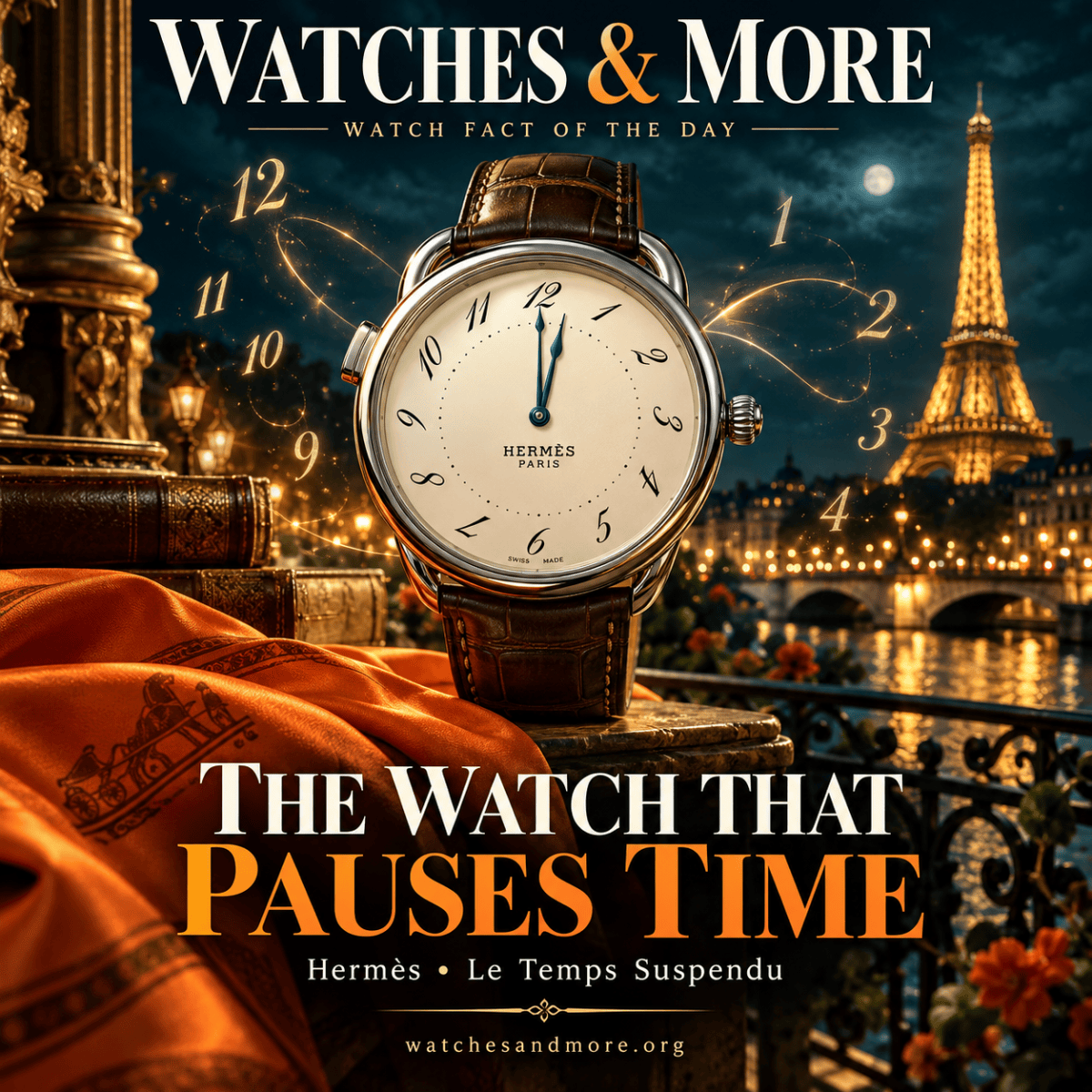
Hermès has created a quirky watch called the Arceau Le Temps Suspendu that lets you pause time with just a button press. Imagine savoring a perfect moment—a great chat or dinner—and being able to ignore the clock while still keeping track of time behind the scenes. Developed with a master watchmaker, this watch cleverly brings the hands to 12 o’clock, giving you the illusion of time standing still. It’s more than just a watch; it’s a reminder to really enjoy the moment without stressing over the next appointment. This nifty design even snagged a prize at the Grand Prix d’Horlogerie de Genève.
📅 Saturday, October 3, 2026
Hermès Le Temps Suspendu turns a wish we’ve all had into a wonderfully playful piece of watchmaking.
Ever enjoyed a moment so much that you wished you could stop the clock?
A great conversation. A quiet coffee. An evening with someone you love.
Hermès took that feeling and gave it a button.
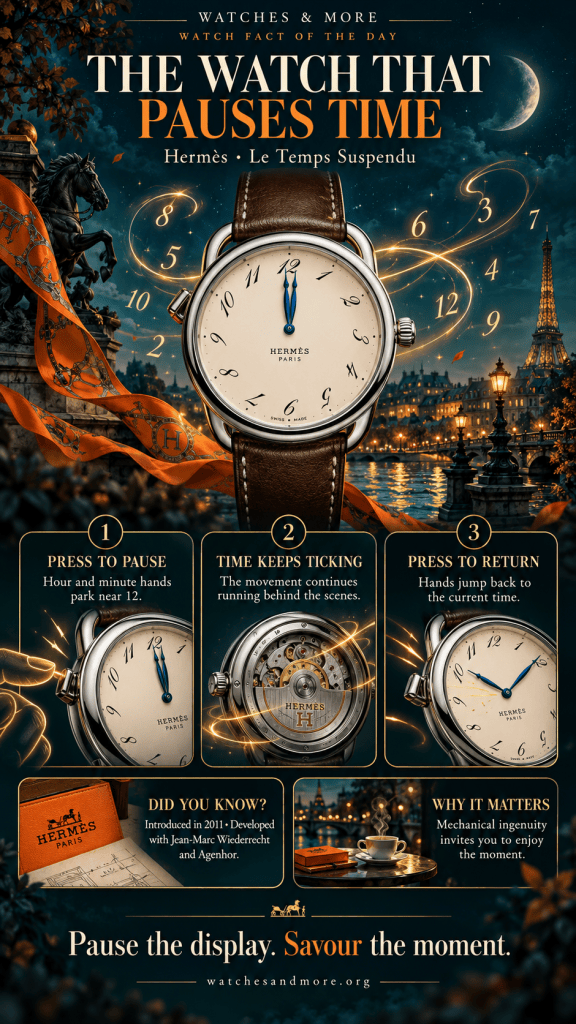
The Arceau Le Temps Suspendu, introduced in 2011, offers the mechanical illusion of pausing time—and lets you return to the present whenever you choose. Its name translates to “suspended time,” which captures the idea beautifully.
⏸️ One Press, and the Clock Takes a Break
Press the pusher and the hour and minute hands gather near 12 o’clock, abandoning their usual job of telling you the time.
Here’s a lovely detail: the hour and minute hands remain visible. They park near the top of the dial; on the original date-equipped model, it’s the date indicator that disappears. The result is a watch face that seems to have stepped outside its normal routine.
Imagine pressing that button as dinner arrives.
For a little while, your wrist stops reminding you how late it’s getting.
⚙️ The Movement Keeps the Secret
Behind this playful trick is serious mechanical ingenuity.
The suspension module was developed in cooperation with Agenhor and its founder, master watchmaker Jean-Marc Wiederrecht, a specialist in retrograde indications—hands that travel along a scale before returning to their starting position.
While the display is suspended, the mechanism continues keeping time behind the scenes. A second press brings the hands back to the current time, rather than restarting them from where you left off.
That’s the clever part. You get the pleasure of ignoring the clock without having to reset your watch afterward.
Time carries on. Your watch simply keeps it to itself for a while.
🥂 A Complication for Enjoying the Moment
Watch complications often help us manage something: a second time zone, an elapsed interval, a calendar.
Le Temps Suspendu offers something more personal—a small ritual for giving a moment your full attention.
Hermès describes its approach to watchmaking as an invitation to suspend time and enjoy our best moments. The mechanism gives that philosophy a physical expression: press a button, put the schedule aside, and enjoy where you are.
Of course, it won’t postpone your next meeting or make the parking meter more forgiving.
But as an invitation to linger? It’s hard to beat.
💡 Did You Know?
The Arceau Le Temps Suspendu won the Men’s Watch Prize at the 2011 Grand Prix d’Horlogerie de Genève. This whimsical idea earned recognition at one of watchmaking’s most prestigious awards ceremonies.
⭐ Why It Matters
Le Temps Suspendu shows how mechanical watchmaking can express an idea as well as perform a task.
Its appeal lies in the relationship between precision and pleasure. The mechanism takes care of the passing minutes while the wearer enjoys the freedom to stop watching them.
For watch enthusiasts, that makes it a wonderful example of engineering with personality: intricate machinery serving a simple, deeply human wish.
⌚ The W&M Take
We love watches for their movements, their designs, and the stories they carry.
This one adds a little theatre to the wrist—and a thoughtful reminder about what those ticking seconds are actually for.
You can’t freeze a perfect evening. You can choose to give it your attention.
And if your watch could politely stop telling you the time while you did, wouldn’t that be rather wonderful?
💬 If you had a “pause time” button on your watch, when would you press it? Tell us in the comments!
Category: Fun Quirk
Disclaimer: Every effort has been made to keep these watch facts accurate, but the world of horology is full of myths, disputed stories, and fascinating trivia. Consider these facts a starting point for discovery rather than the final word. If you have corrections or additional insights, let us know—we’re always happy to keep the record ticking in the right direction.
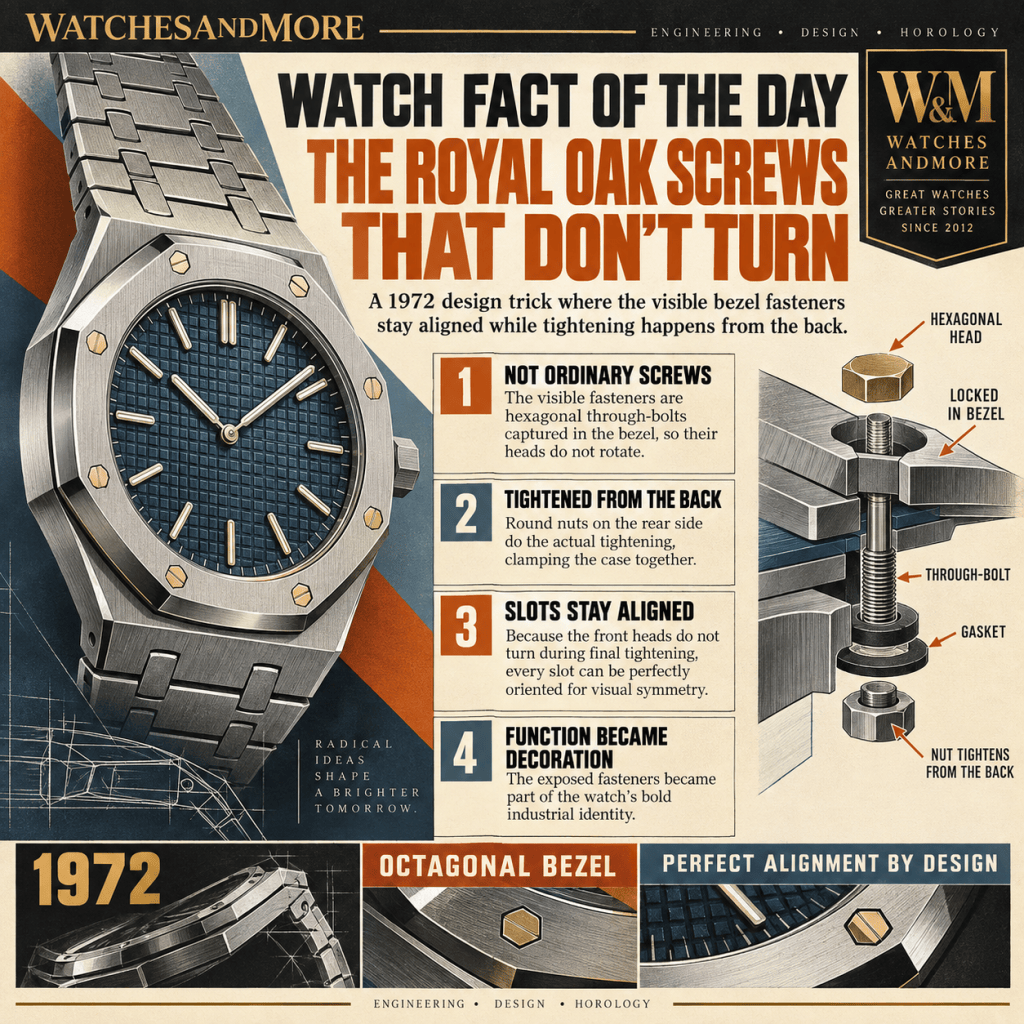
In 1970, Gérald Genta flipped the watch world on its head by introducing the Audemars Piguet Royal Oak, a timepiece rocking eight visible hexagonal fasteners that look like screws but behave more like the decorative knobs on a fancy cupboard. These “through-screws” don’t actually tighten at the front; they’re elegantly held in place and adjusted from the back. Think of them as screws with a flair for the dramatic—perfectly aligned for aesthetic pleasure rather than practical purposes. Who knew something so eye-catching could also be a structural hero? Welcome to watchmaking where function meets fashion, and everything else just ticks away!
📅 Friday, October 2, 2026
When Gérald Genta designed the Audemars Piguet Royal Oak in 1970, he created one of the most recognizable bezels in watch history.
Eight visible hexagonal fasteners.
Eight polished slots.
Eight perfectly controlled positions around an octagonal bezel.
To most people, they look like ordinary screws.
But they do not work like ordinary screws at all.
The Royal Oak’s visible fasteners are through-screws. Their hexagonal heads are captured inside matching hexagonal holes in the bezel, which prevents them from turning. From the rear of the watch, round nuts are threaded onto those screws and tightened to clamp the case together and compress the water-resistance gasket. AP Chronicles
That means the visible slot on the front is not used to tighten the watch.
It can simply be oriented precisely for appearance.
THE FRONT DOESN’T TURN.
THE BACK DOES THE TIGHTENING.
And that is why the Royal Oak’s bezel slots can appear so perfectly aligned.
Why Genta Did It This Way
The Royal Oak’s design was inspired in part by the architecture of a diver’s helmet, with visible external fasteners becoming part of the visual identity rather than something to hide.
Genta’s 1970 sketch already showed the concept: a wide bezel, eight exposed hexagonal fasteners, and a large gasket compressed between the bezel and monocoque case. Audemars Piguet’s archives note that the hexagonal heads were intentionally captured so they would not rotate while being locked from below. AP Chronicles
That was radical at the time.
Traditional luxury watchmaking usually concealed functional hardware.
The Royal Oak put it on display.
FUNCTION BECAME DECORATION.
💡 Did You Know?
The neat slot alignment that collectors admire is actually the result of a clever engineering shortcut around a problem that watchmakers normally face.
Ordinary screws cannot simply be tightened until all their slots line up perfectly. Thread starts, screw lengths, tolerances, and final torque all determine where a screw head stops. That is why aligned screws are generally impractical in conventional watchmaking. Hodinkee
The Royal Oak gets around that problem because the front fastener doesn’t rotate during final tightening.
The nut on the back does.
That is the trick.
⭐ Why It Matters
The Royal Oak is full of details where engineering and aesthetics are inseparable.
The screws are not merely decorative.
The alignment is not fake.
And the system is not just visual theater.
The eight through-screws actually help clamp the case together and compress the gasket that contributes to water resistance. AP Chronicles
So one of the most famous decorative details in modern watchmaking is also a real structural part of the watch.
HEXAGONAL HEAD ↓ LOCKED IN BEZEL ↓ THROUGH-SCREW ↓ NUT TIGHTENS FROM THE BACK
And the bottom payoff:
PERFECT ALIGNMENT
BY DESIGN, NOT LUCK.
Category: Fun Quirk
Disclaimer: Every effort has been made to keep these watch facts accurate, but the world of horology is full of myths, disputed stories, and fascinating trivia. Consider these facts a starting point for discovery rather than the final word. If you have corrections or additional insights, let us know—we’re always happy to keep the record ticking in the right direction.
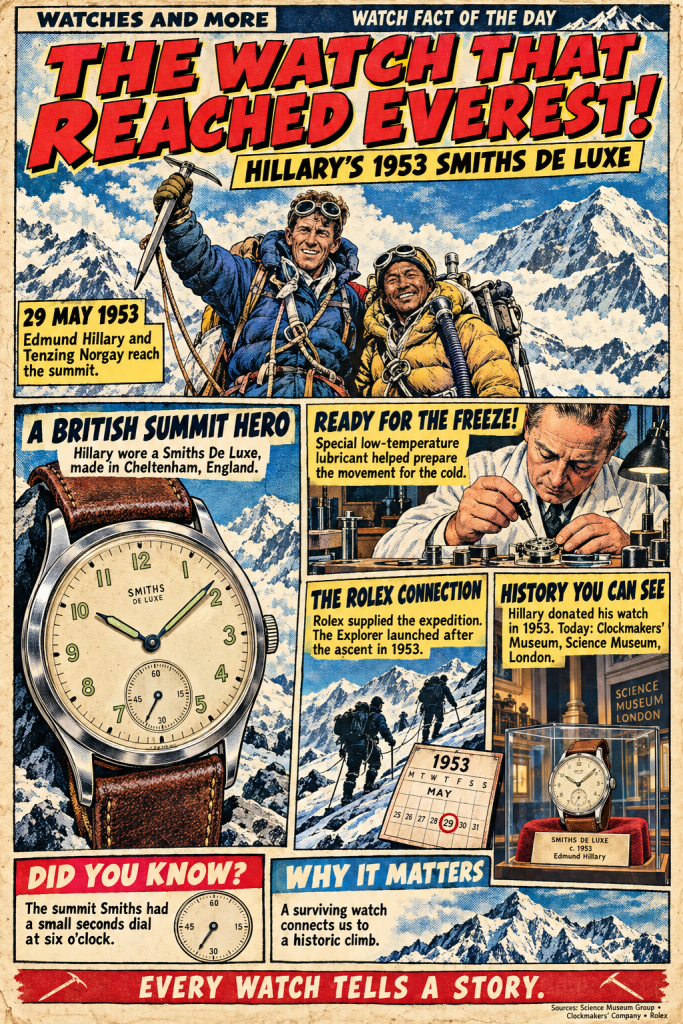
On May 29, 1953, Sir Edmund Hillary made history by summiting Mount Everest, all while wearing a humble yet remarkable Smiths De Luxe watch. Unlike the more commonly recognized Rolex Explorer, the Smiths, featuring a unique preparation for extreme cold, showcases the unseen details that make its story compelling. While Rolex supplied watches for the expedition, the Smiths watch directly connects to Hillary’s achievement, symbolizing British craftsmanship. Now displayed at the Science Museum in London, this small timepiece celebrates an extraordinary journey. It reminds us that every watch has a unique tale, and this one reached the very roof of the world.
📅 Thursday, October 1, 2026
A legendary mountain. A historic ascent. And a British watch that deserves its moment at the summit.
Mention Mount Everest to a watch enthusiast, and the Rolex Explorer probably comes to mind. Its connection to mountaineering is woven into watchmaking history.
But ask which watch Sir Edmund Hillary wore during his successful 1953 summit climb, and another name deserves the spotlight: Smiths De Luxe. The Science Museum Group identifies the surviving watch as the very timepiece Hillary wore on that historic ascent.
Sometimes, the most fascinating watch stories are waiting just beyond the familiar dial.
🏔️ A Small Watch on an Extraordinary Journey
On 29 May 1953, Edmund Hillary and Tenzing Norgay achieved the first confirmed ascent of Mount Everest. It was a shared triumph, supported by a much larger expedition and accomplished in conditions that pushed people and equipment to their limits.
Hillary’s Smiths was made in Cheltenham, England. Its silvered dial featured luminous Arabic numerals and a small seconds display at six o’clock. Inside sat a 15-jewel mechanical movement, protected by a steel waterproof case made by Dennison.
At a glance, it looks remarkably modest for a watch associated with such an enormous achievement.
That is part of its appeal. This was a timekeeper with a job to do.
❄️ The Detail That Helped It Face the Cold
One of the most interesting preparations was hidden inside.
Smiths treated Hillary’s watch with a special lubricant intended to withstand low temperatures. The Clockmakers’ Company confirms this preparation and records that Hillary reported the watch had performed very well.
It is an easy detail to overlook when admiring the dial, but it brings the story into focus: expedition equipment needed preparation for the environment it would encounter.
A handsome case could catch the eye. What happened inside it mattered on the mountain.
👑 Where Does Rolex Fit Into the Story?
Rolex’s Everest connection is real. The company supplied Oyster Perpetual watches to the 1953 expedition and had supported Himalayan exploration since the 1930s.
There is also an important timing detail: Rolex introduced the Explorer following the successful ascent, later in 1953. Its own history describes the model as a watch born from that achievement and the wider experience of expedition testing.
The distinction matters. Equipping an expedition, launching a watch inspired by its success, and identifying the watch Hillary wore to the summit are different historical claims.
The museum record gives Smiths a clear place in Hillary’s story. It does not, by itself, establish that Smiths was the only watch brand present at the summit.
🏛️ From Everest to the Museum
Hillary personally presented his Smiths watch to the Worshipful Company of Clockmakers in 1953.
Today, it is listed on display in the Clockmakers’ Museum gallery at London’s Science Museum—a surviving object connecting British watchmaking with one of the twentieth century’s defining adventures.
There is something special about that. The watch itself survives, allowing visitors to look beyond the legend and see the instrument.
💡 Did You Know?
Hillary’s summit watch had a small seconds subdial at six o’clock. Its appearance is quite different from the familiar black-dial, 3–6–9 design associated with the Rolex Explorer.
⭐ Why It Matters
The Smiths De Luxe reminds us to look closely at watch history. A famous association can draw us into a story; the surviving objects and records help us understand its details.
For watch lovers, that makes this modest British timepiece especially compelling. Its significance comes from the journey it accompanied.
Every watch tells a story. This one reached the roof of the world.
Watches And More — Exploring the stories behind the watches.
Category: Military Watches
Disclaimer: Every effort has been made to keep these watch facts accurate, but the world of horology is full of myths, disputed stories, and fascinating trivia. Consider these facts a starting point for discovery rather than the final word. If you have corrections or additional insights, let us know—we’re always happy to keep the record ticking in the right direction.
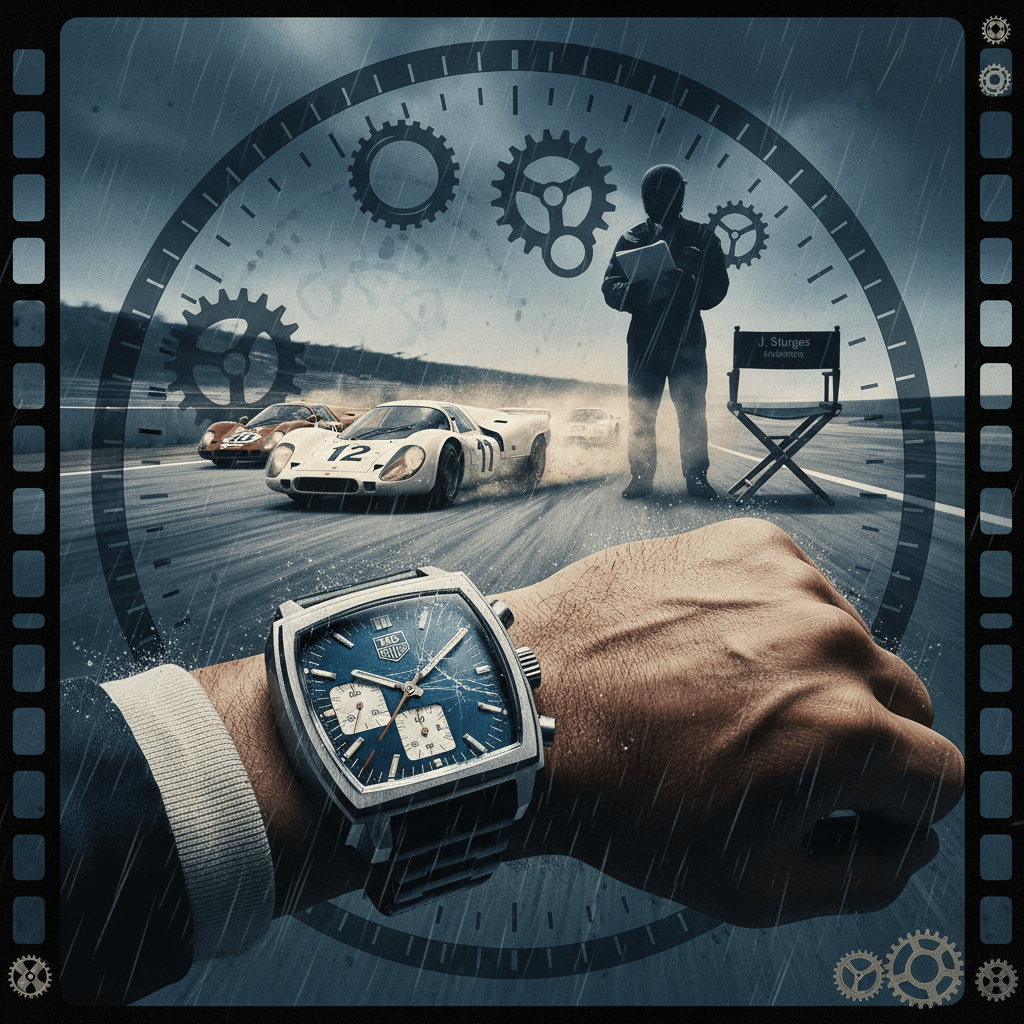
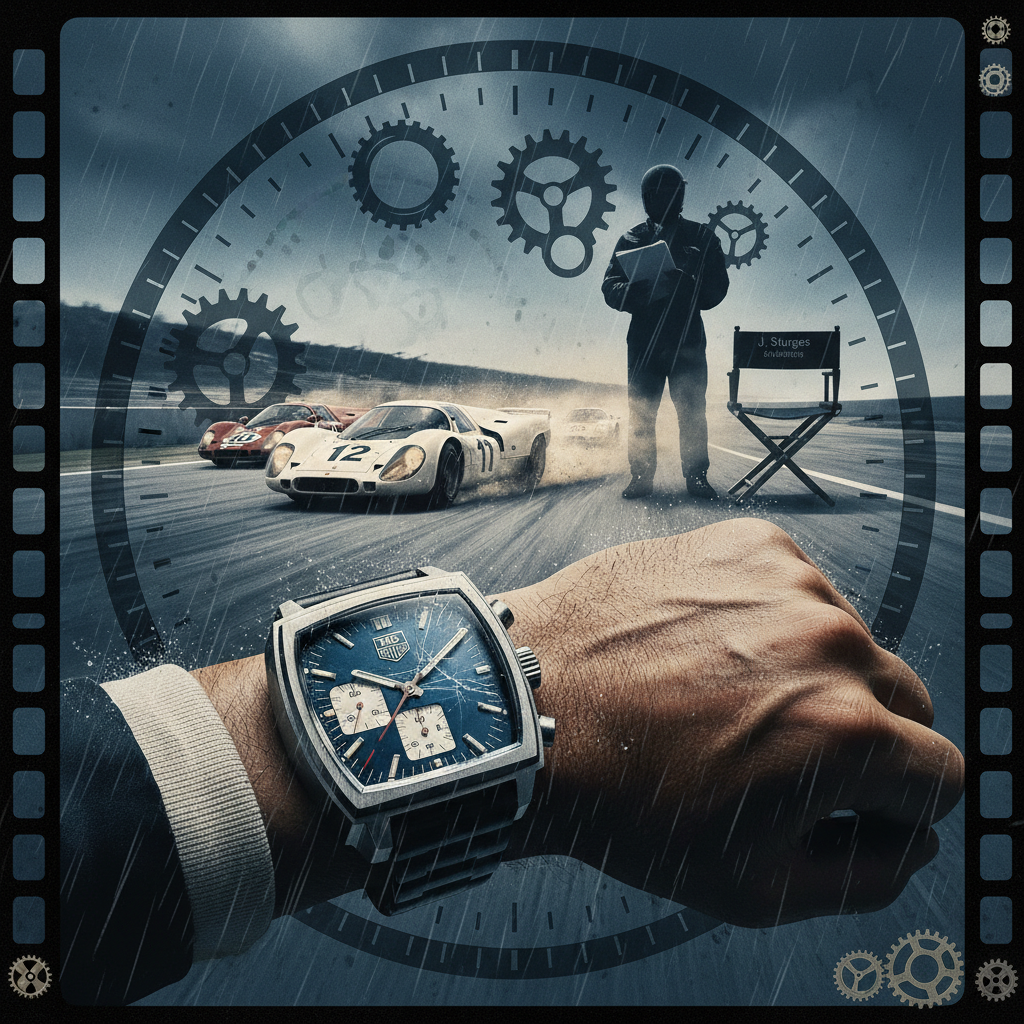
So, Steve McQueen in “Le Mans” isn’t just about racing; it’s also about the iconic Heuer Monaco watch he wore. He wanted to look the part of a real racer, drawing inspiration from pro racer Jo Siffert, who rocked a different Heuer model. McQueen’s choice of the blue Monaco was influenced by his suit’s branding and practicality during filming. Initially, the Monaco didn’t blow up but eventually gained fame. This watch now carries a story tied to McQueen, blending bold design and cinematic history. It’s a classic case of a small item making big cultural waves.
📅 Wednesday, September 30, 2026
A racing driver, a film prop table, and a square blue chronograph. Sometimes, that is all it takes to make watch history.
Picture Steve McQueen in Le Mans: racing overalls, an expression of absolute concentration, and a Heuer Monaco strapped to his wrist.
The pairing feels inevitable. The King of Cool wearing a watch with enough personality to hold its own beside him.
But behind that famous image is a more interesting story than simply copying another driver’s watch.
He Wanted to Look Like a Real Racer
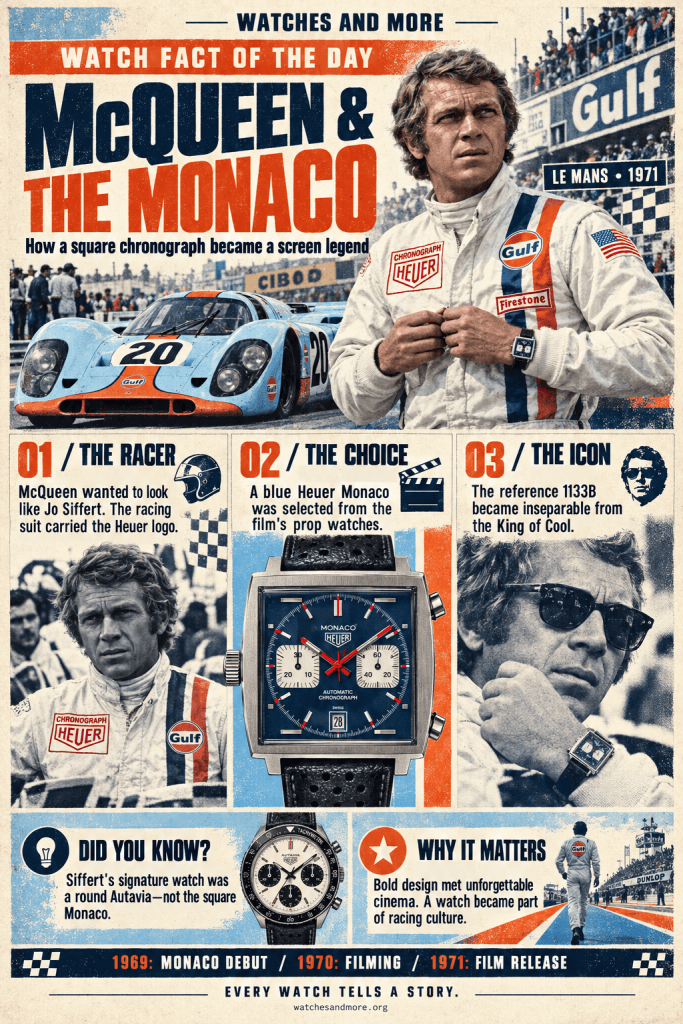
During production in 1970, McQueen wanted his character, Michael Delaney, to look convincing. For inspiration, he turned to professional racing driver Jo Siffert, who was involved with the film and had a relationship with Heuer.
According to Jack Heuer’s recollection, based on accounts from people on set, McQueen indicated that he wanted to look like Siffert. The driver supplied a white racing suit carrying the Heuer logo. The film would reach cinemas in 1971.
That choice helped set the direction for the watch.
If your racing suit says Heuer, a Heuer chronograph makes a pretty convincing finishing touch.
The Twist: Siffert’s Famous Watch Was an Autavia
Here is the detail that often gets lost in the retelling.
McQueen did not simply copy Siffert’s exact watch.
Siffert was famously associated with the Heuer Autavia reference 1163T, particularly the white dial version with blue accents that collectors know as the “Siffert” Autavia. McQueen’s screen watch was the blue dial Monaco reference 1133B.
The inspiration came from Siffert’s racing identity. The square chronograph took its own route into the picture.
And what a route it turned out to be.
A Prop Table Helped Make the Decision
TAG Heuer’s heritage account describes property master Don Nunley presenting McQueen with watches from several brands.
McQueen considered an Omega Speedmaster, but the Heuer branding on his suit helped steer the choice toward a Heuer. He selected a blue Monaco, and Nunley subsequently arranged for more watches and timing equipment to come from the manufacturer for filming.
There was a practical side, too. Jack Heuer’s account says Nunley needed matching watches for different production uses and a spare in case of damage.
A screen icon still has to survive the ordinary business of making a movie.
The Monaco Already Had Something to Say
Introduced in 1969, the Monaco combined a bold square case with Heuer’s new automatic chronograph technology. Its water resistant case, developed by supplier Piquerez, gave the design substance beyond its unusual appearance.
This was a watch that could catch your eye before you knew anything about its movement.
A blue dial. Contrasting white registers. Red accents. A silhouette you could recognise across a room.
On McQueen’s wrist, those details became part of a larger visual language: racing machinery, purposeful equipment, and effortless confidence.
To our eyes, the Monaco looks perfectly cast.
Becoming an Icon Took Time
It is tempting to imagine that Le Mans instantly turned the Monaco into a runaway success.
The history is less tidy. TAG Heuer acknowledges disappointing early sales, and the original collection was discontinued around 1975. A revival followed in 1997, helping establish the Monaco’s enduring place in watch culture.
That makes the story even better.
Some designs need time before the world catches up with them.
The Watches And More Take
The Monaco’s appeal is easy to understand when you look at that famous McQueen image. The watch contributes something unmistakable to the scene.
Its shape has confidence. Its colours have energy. Its connection to the film gives collectors a story they can carry on their own wrists.
And that is one of the pleasures of watches: a small object can hold a surprisingly large piece of culture.
Heuer supplied the chronograph. McQueen gave us an image we still remember.
Would you choose McQueen’s square Monaco or Siffert’s round Autavia? Let us know in the comments.
Every watch tells a story. This one came with racing overalls and the King of Cool.
💡 Did You Know?
Jo Siffert’s signature watch was a round Heuer Autavia—not the square Monaco McQueen wore in Le Mans. McQueen borrowed Siffert’s racing look, then gave the Monaco its own Hollywood identity.
⭐ Why It Matters
The Monaco shows how design and storytelling can work together. Its bold square case made it distinctive; McQueen’s appearance in Le Mans gave it a cultural connection that remains central to its identity.
Category: Watches on Screen
Disclaimer: Every effort has been made to keep these watch facts accurate, but the world of horology is full of myths, disputed stories, and fascinating trivia. Consider these facts a starting point for discovery rather than the final word. If you have corrections or additional insights, let us know—we’re always happy to keep the record ticking in the right direction.