
Watch Fact of the Day: The World’s First Titanium Watch Wasn’t Swiss or Swiss-Made!

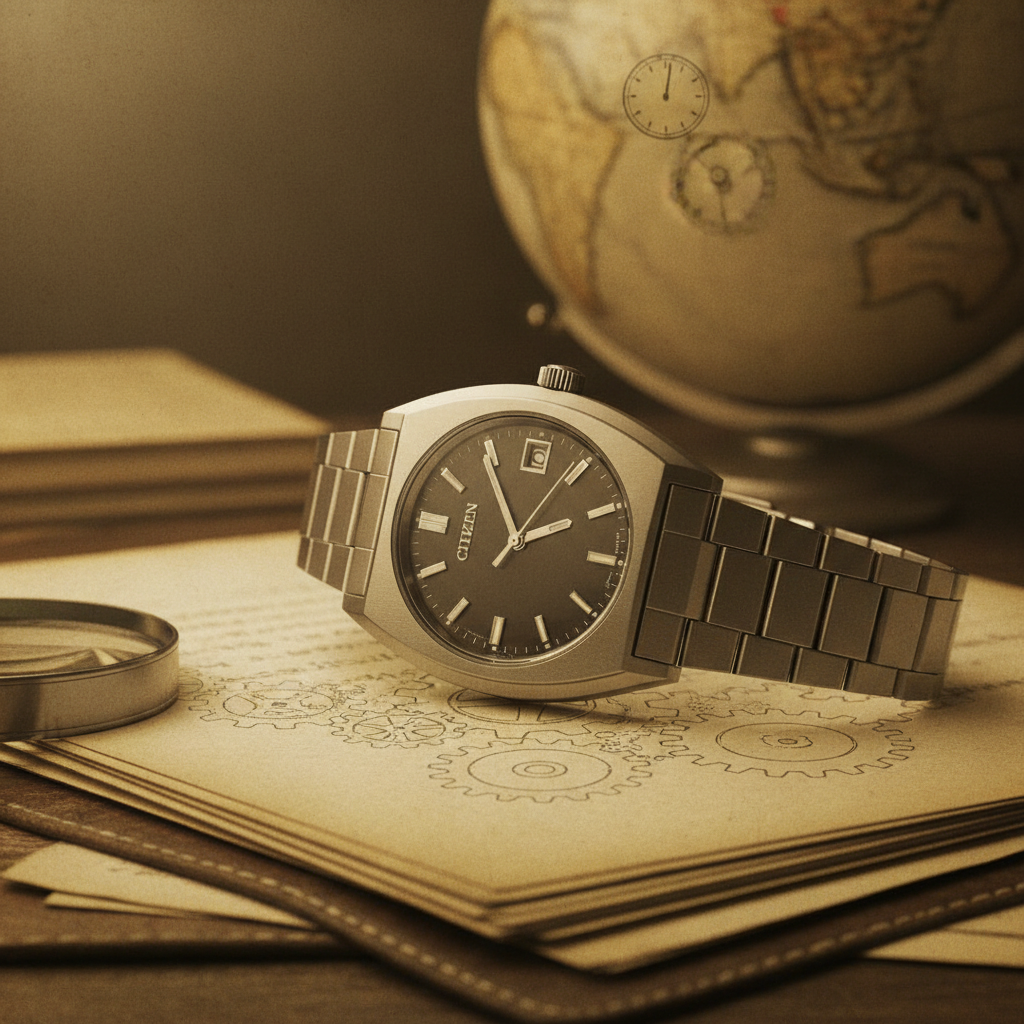
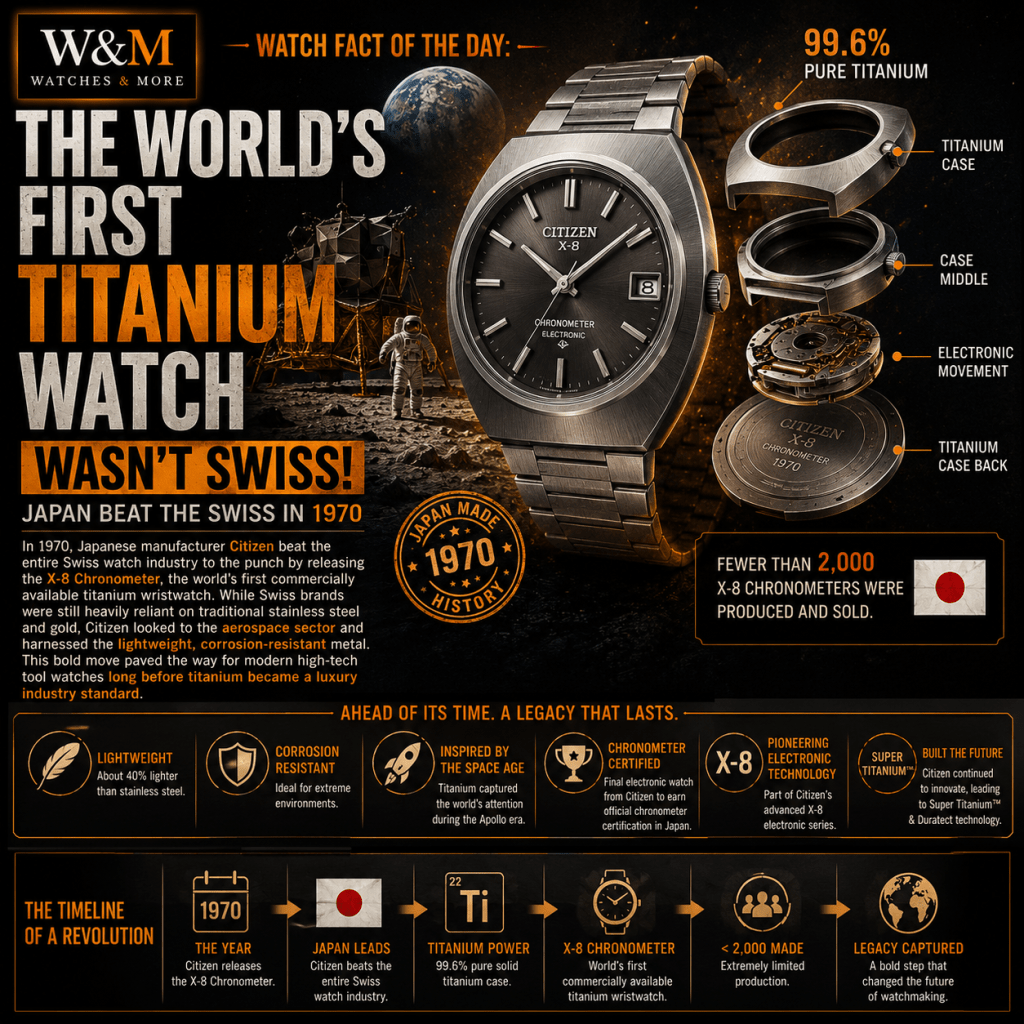
In 1970, Citizen made the bold move of launching the X-8 Chronometer, the first titanium wristwatch—because who needs stainless steel when you can rock aerospace-grade titanium? While Swiss watchmakers were busy polishing their gold, Citizen decided to take the road less traveled, battling the “triple trouble” of titanium’s machining quirks to create a watch that weighed less than a feather but looked just as fine. With only 2,000 units made, it was a rare gem in the watch world. Fast forward to today, and titanium is everywhere, proving that sometimes, being ahead of the curve really pays off—unless you’re late for dinner!

Watch History: Wednesday, August 12, 2026

📅 Wednesday, August 12, 2026

In 1970, Japanese watchmaker Citizen made history by releasing the X-8 Chronometer, recognized as the world’s first titanium wristwatch. While Swiss brands still favored traditional stainless steel and gold, Citizen boldly turned to aerospace-grade titanium—99.6% pure—to harness its lightweight, corrosion-resistant properties. This groundbreaking move not only preceded the Swiss by years but also set the stage for modern high-tech tool watches, long before titanium became a staple in luxury watchmaking.


The timing couldn’t have been better. During the 1960s, the Apollo program had focused global attention on titanium because of its light weight, strength and resistance to corrosion. Citizen’s engineers saw those same characteristics and realized they could make titanium an intriguing material for something far more personal: a wristwatch.

But actually manufacturing one was another matter. Titanium proved so troublesome that Citizen’s engineers nicknamed it “triple trouble” because of the difficulty involved in press-forming, machining and polishing it. Titanium shavings could stick to cutting tools, and achieving the beautifully finished surfaces expected of a watch case presented serious engineering challenges.

The resulting X-8 wasn’t merely an exotic case wrapped around a conventional mechanical watch, either. It belonged to Citizen’s pioneering electronic X-8 family, and the X-8 Chronometer became Citizen’s final electronic watch to receive official certification from the Japan Chronometer Inspection Institute. Production was brief: Citizen says fewer than 2,000 were sold.

More than half a century later, titanium has become a familiar material in everything from serious tool watches to high-end luxury pieces. Citizen itself continued developing the material for decades, eventually combining titanium processing with its Duratect surface-hardening technology to create Super Titanium™.

💡 Did You Know?

Titanium may be famous for being lightweight, but Citizen says pure titanium is about 40% lighter than stainless steel. That meant the 1970 Citizen X-8 Chronometer wasn’t just historically significant for using an exotic Space Age metal—it demonstrated that a watch case could be lighter, corrosion-resistant, and comfortable on the wrist without relying on conventional steel. More than half a century later, titanium has become one of watchmaking’s most desirable high-tech materials. ⌚🚀

Category: Watch History

Disclaimer: Every effort has been made to keep these watch facts accurate, but the world of horology is full of myths, disputed stories, and fascinating trivia. Consider these facts a starting point for discovery rather than the final word. If you have corrections or additional insights, let us know—we’re always happy to keep the record ticking in the right direction.

🕐 Discover more watch facts, reviews, and buying guides at WatchesAndMore


🛍️ You Might Also Like

As an Amazon Associate and affiliate partner, WatchesAndMore earns from qualifying purchases.
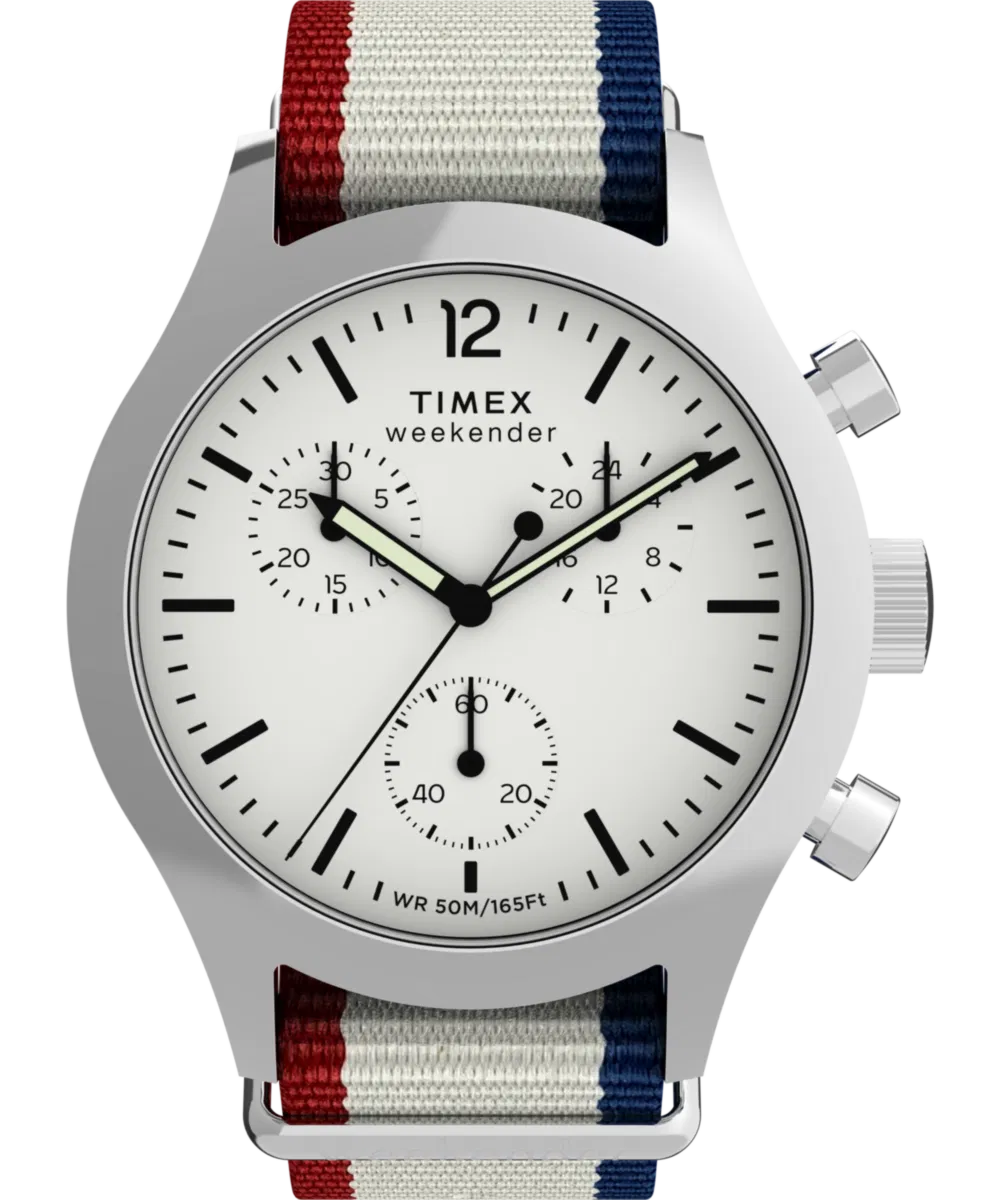
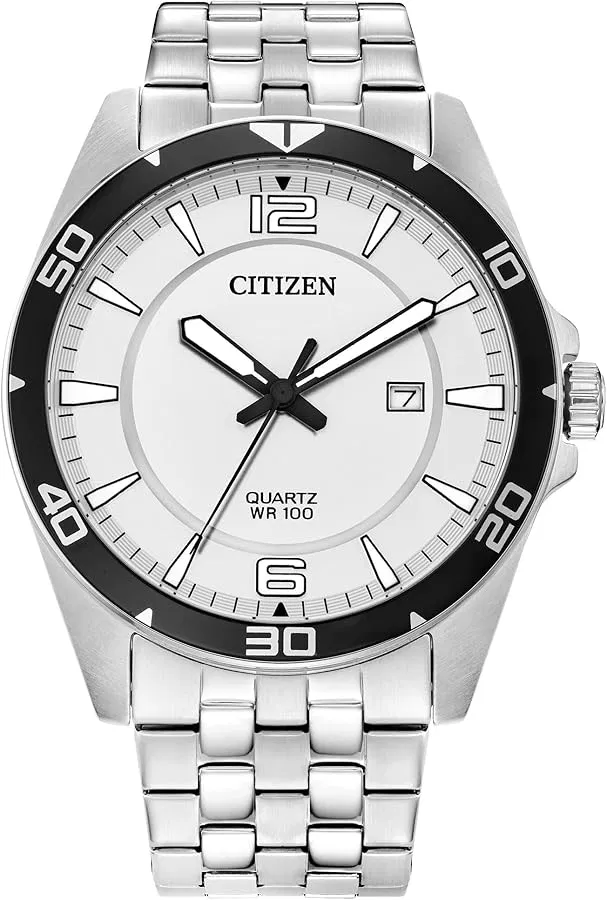
Citizen Quartz Classic Silver-Tone
🔥 Deal of the Day

Citizen Quartz Classic Silver-Tone

Citizen

★★★★★ 4.5 (1,407 reviews)

$120

Offer expires in


🔥 Grab This Deal →

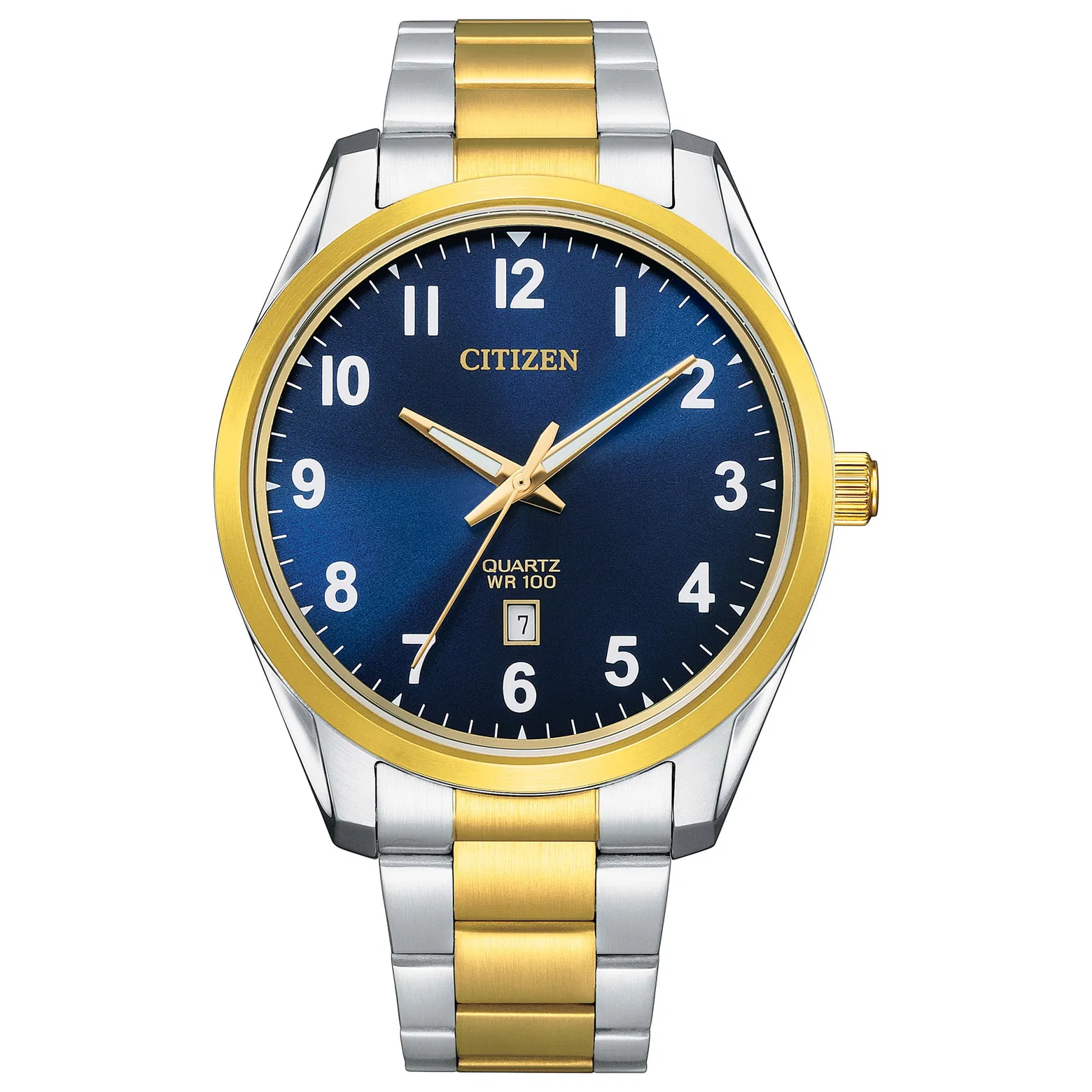
Citizen Quartz Two-Tone


Citizen Quartz Two-Tone

Citizen

★★★★★ 4.8 (2,403 reviews)

$90


Check Price on Amazon →


Browse all 142+ expert-reviewed watches →

ETSY Shop
ETSY Shop
Redbubble Shop
Redbubble Shop
More Watch Facts
More Watch Facts

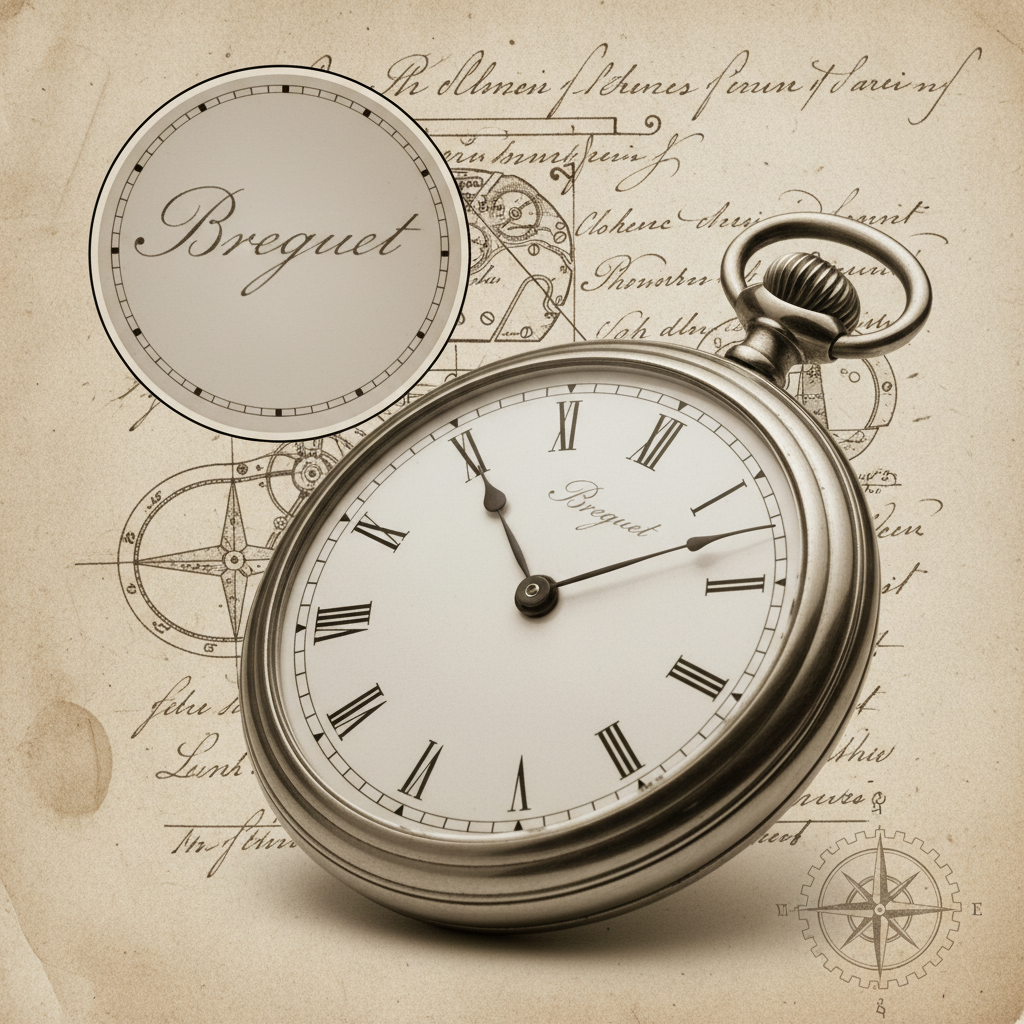
Watch Fact of the Day: Breguet’s Secret Signature: The 18th-Century Anti-Counterfeit Hack

In the late 18th century, watchmaker Abraham-Louis Breguet faced a hilarious dilemma: his watches were so popular that counterfeiters were all over them like cats on a warm laptop. To combat this, he invented a “secret signature” so tiny it could hide in plain sight! Using a fancy engraving method, he created a mark that only the keenest eyes (or best lighting) could spot. Fast forward over two hundred years, and Breguet’s secret signature still ticks on, serving as both an anti-counterfeiting measure and a tribute to Breguet’s original genius. Talk about a watch that’s not just on time, but also a bit sneaky!

Watch History: Tuesday, August 11, 2026

📅 Tuesday, August 11, 2026

By the late 18th century, Abraham-Louis Breguet had a problem most watchmakers could only dream of: his watches had become so desirable that counterfeiters were copying them. His response was remarkably sophisticated. Around 1795, Breguet began placing an extraordinarily small “secret signature” on the dials of his watches—a subtle authentication mark designed to be exceedingly difficult for imitators to reproduce.

The technique employed a pantograph engraving system and a fine dry/diamond point, allowing a larger master inscription to be reduced to microscopic proportions on the dial. Rather than appearing like an ordinary printed logo, the resulting engraving could virtually disappear under normal viewing conditions and reveal itself when examined carefully under raking or oblique light. Without the appropriate pantograph and master matrix, accurately reproducing it was extremely difficult.

That made the secret signature an ingenious early form of luxury-product authentication. Genuine examples could incorporate Breguet’s name, identifying information and, on certain Souscription watches, the watch number. A Breguet Souscription pocket watch now held by the British Museum, for example, carries a miniature secret inscription below the 12 o’clock position.

More than two centuries later, the tradition survives. Modern Breguet watches can still feature the secret signature—not simply as an anti-counterfeiting measure, but as a connection to Abraham-Louis Breguet’s original craftsmanship and one of watchmaking’s cleverest historical security features.

Category: Watch History

Disclaimer: Every effort has been made to keep these watch facts accurate, but the world of horology is full of myths, disputed stories, and fascinating trivia. Consider these facts a starting point for discovery rather than the final word. If you have corrections or additional insights, let us know—we’re always happy to keep the record ticking in the right direction.

🕐 Discover more watch facts, reviews, and buying guides at WatchesAndMore


🛍️ You Might Also Like

As an Amazon Associate and affiliate partner, WatchesAndMore earns from qualifying purchases.

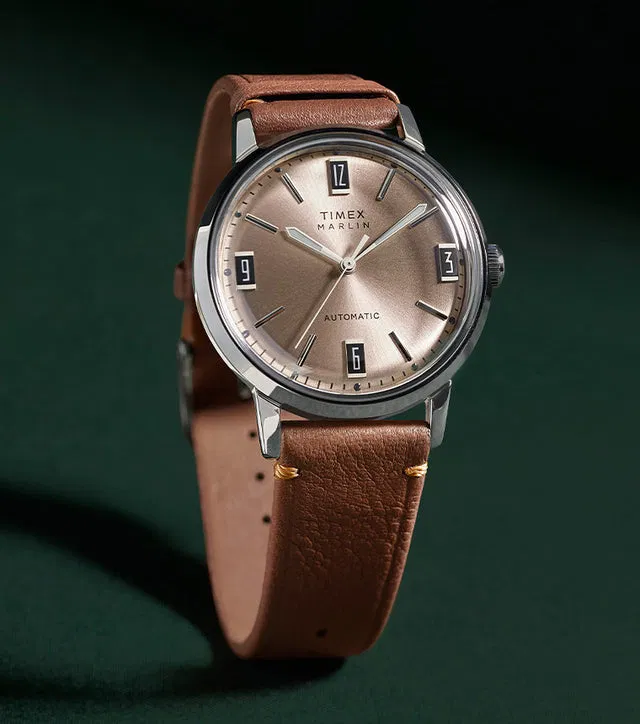
Timex Weekender Chronograph
🔥 Deal of the Day

Timex Weekender Chronograph

Timex

★★★★★ 4.5 (3,041 reviews)

$79
Offer expires in


🔥 Grab This Deal →

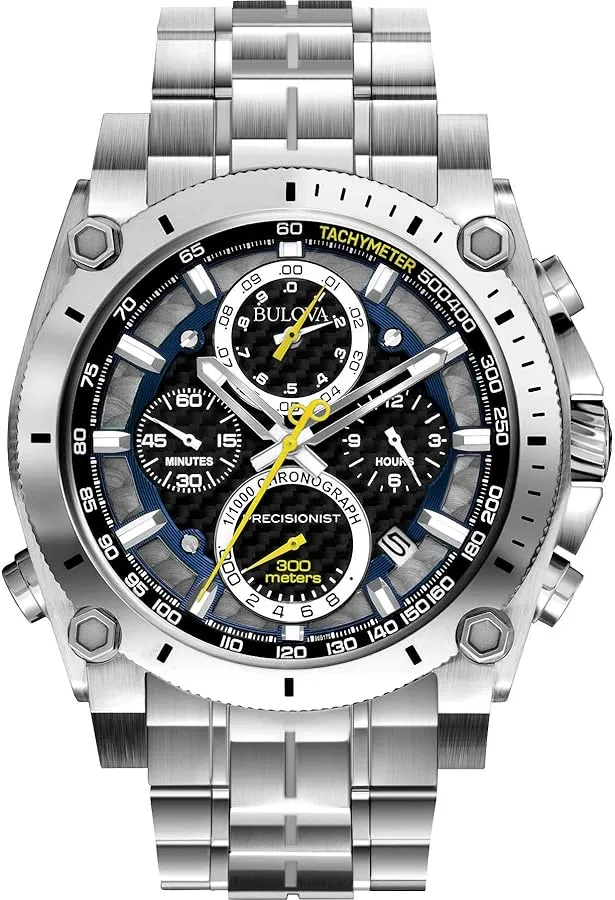
Bulova Precisionist


Bulova Precisionist

Bulova

★★★★★ 4.6 (1,100 reviews)

$219


Check Price on Amazon →

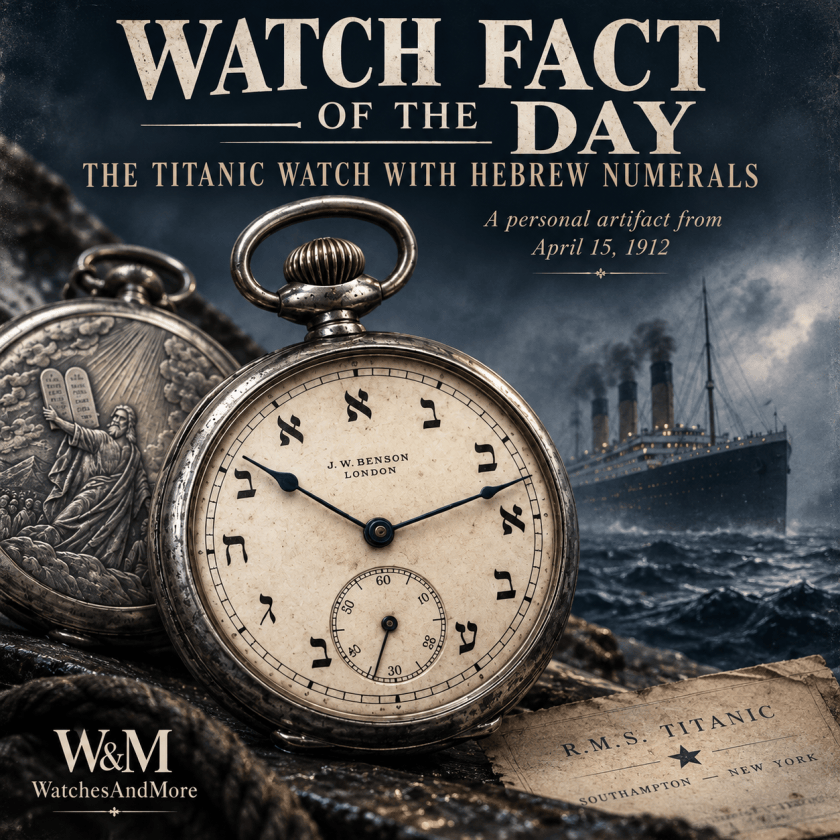
Timex Marlin Automatic 40mm


Timex Marlin Automatic 40mm

Timex

★★★★★ 4.7 (1,106 reviews)

$259


Check Price on Amazon →


Browse all 142+ expert-reviewed watches →
ETSY Shop
ETSY Shop
Redbubble Shop
Redbubble Shop
More Watch Facts
More Watch Facts

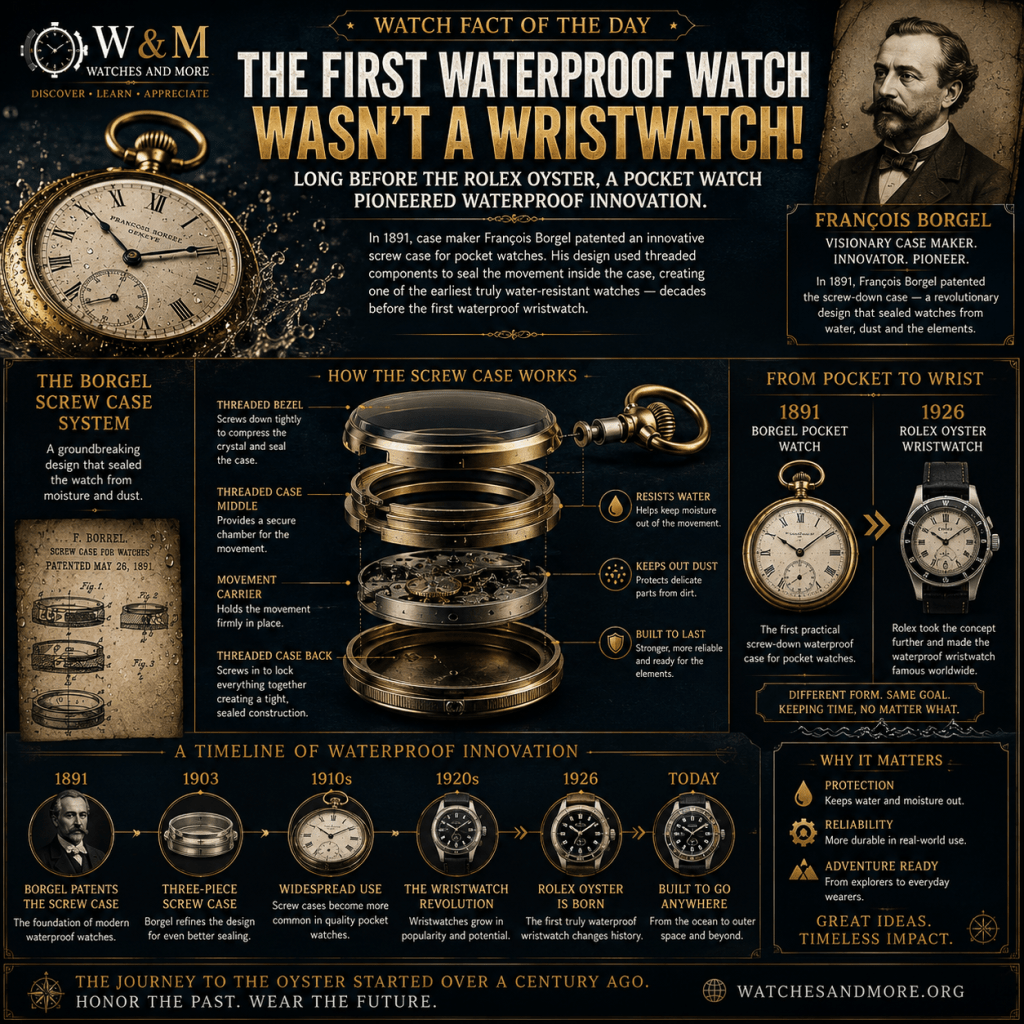
Watch Fact of the Day: The First Waterproof Watch Was Actually a Pocket Watch!

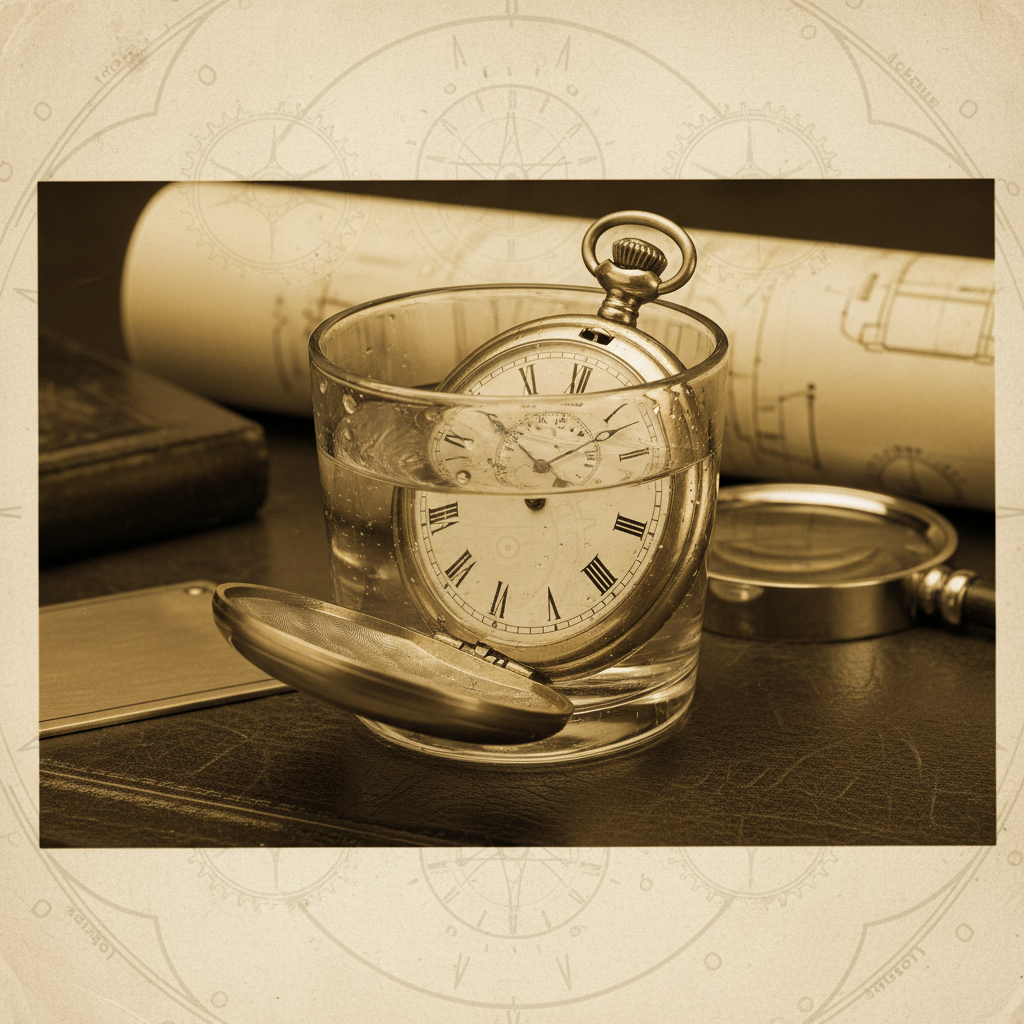
Once upon a time in the 1890s, a genius named François Borgel created the first waterproof pocket watch. Yes, before Rolex made it fashionable in 1926, Borgel was sealing time like a pro with his nifty screw-down case. It’s like he was the watchmaker’s version of a mad scientist, laying the groundwork for timepieces enduring monstrous water battles. So, while Rolex gets the glory, it’s Borgel who deserves the VIP pass to the horology hall of fame. Picture a gold pocket watch chilling half-submerged in water, like: “Before the Oyster, there was Borgel!” And there you have it, timekeeping’s legendary origin story—splash zone included!

Watch History: Friday, August 7, 2026

📅 Friday, August 7, 2026

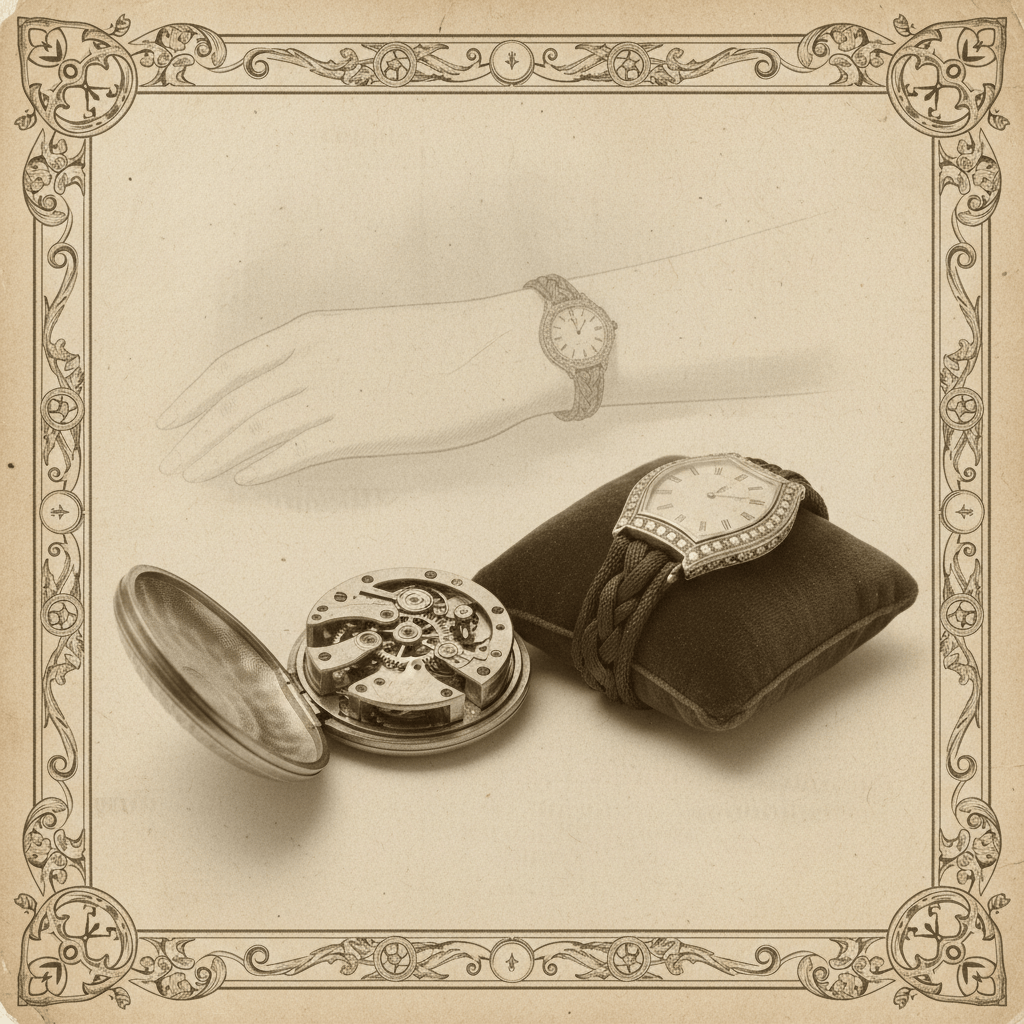
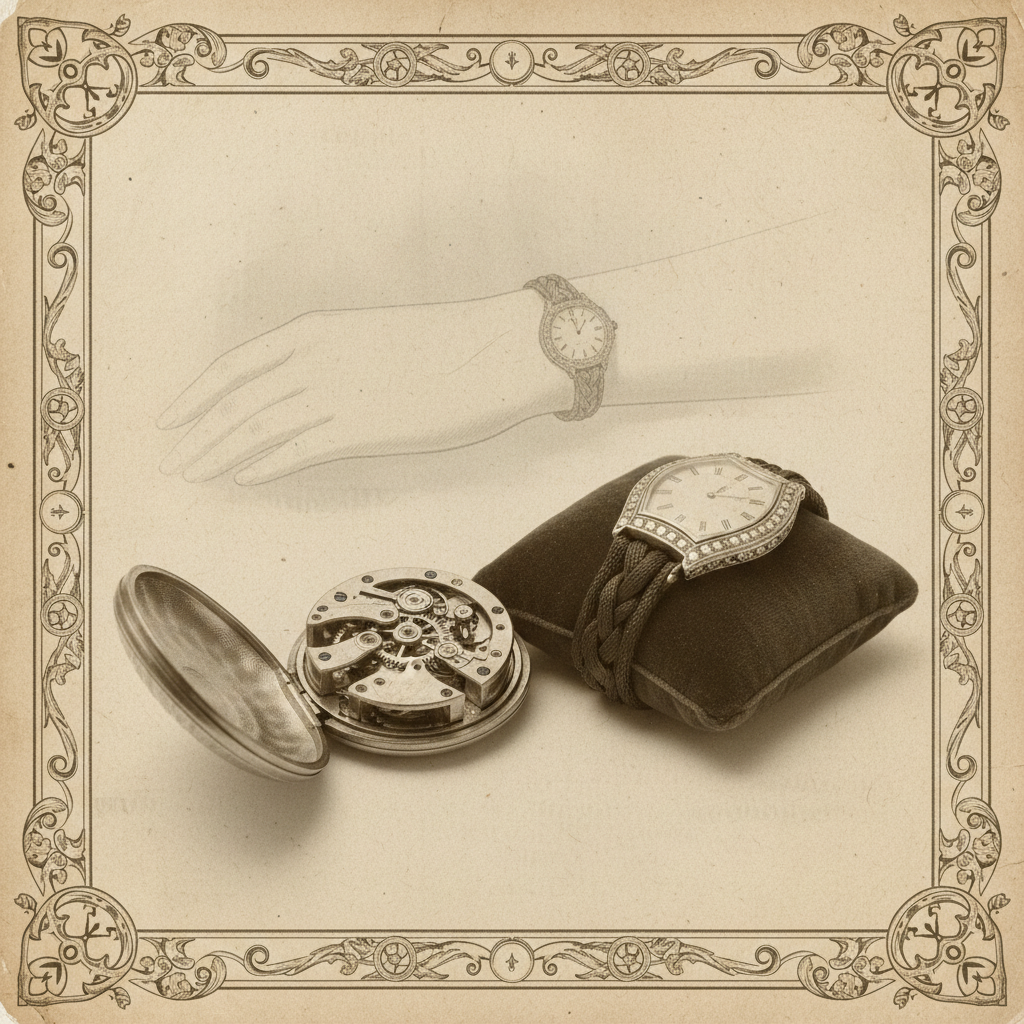
While Rolex is often credited with popularizing the waterproof wristwatch with its Oyster case in 1926, the very first truly waterproof timepiece was a pocket watch created by François Borgel in 1890. His patented screw-down case design, featuring a threaded bezel, case back, and crown, was revolutionary and predated Rolex’s innovation by decades. This early design laid crucial groundwork for the development of robust watches capable of withstanding the elements, long before wristwatches became commonplace.


Borgel continued refining the idea, eventually patenting a three-piece screw case in 1903 whose construction—with threaded components securing the case—anticipated principles that would later become important in waterproof wristwatch design. Borgel cases were subsequently used with movements from respected Swiss manufacturers, making his work an important chapter in the evolution from delicate pocket watches to rugged wristwatches capable of surviving demanding environments.

Then, in 1926, Rolex’s Oyster would take the concept of a sealed wristwatch to another level and, crucially, turn water resistance into something the public could understand and trust. But the road to the Oyster didn’t begin overnight: watchmakers and specialist case makers had been attacking the problem for decades.

💡 Did You Know?

Borgel’s contribution wasn’t primarily the watch movement—it was the case. That actually gives us a killer visual direction for the W&M infographic: an exploded Borgel pocket-watch case, showing how the components screwed together, followed by an evolutionary timeline leading toward the waterproof wristwatch.

Category: Watch History

Disclaimer: Every effort has been made to keep these watch facts accurate, but the world of horology is full of myths, disputed stories, and fascinating trivia. Consider these facts a starting point for discovery rather than the final word. If you have corrections or additional insights, let us know—we’re always happy to keep the record ticking in the right direction.

🕐 Discover more watch facts, reviews, and buying guides at WatchesAndMore


🛍️ You Might Also Like

As an Amazon Associate and affiliate partner, WatchesAndMore earns from qualifying purchases.

Timex Weekender Chronograph
🔥 Deal of the Day

Timex Weekender Chronograph

Timex

★★★★★ 4.5 (3,041 reviews)

$79

Offer expires in


🔥 Grab This Deal →

Bulova Precisionist


Bulova Precisionist

Bulova

★★★★★ 4.6 (1,100 reviews)

$219


Check Price on Amazon →

Timex Marlin Automatic 40mm


Timex Marlin Automatic 40mm

Timex

★★★★★ 4.7 (1,106 reviews)

$259


Check Price on Amazon →


Browse all 142+ expert-reviewed watches →
ETSY Shop
ETSY Shop
Redbubble Shop
Redbubble Shop
More Watch Facts
More Watch Facts

Watch Fact of the Day: The First Self-Winding Watch Was Invented Over Two Centuries Ago!

So, check it out! The self-winding watch isn’t just a modern thing; it actually dates back to the 18th century. This Swiss watchmaker named Abraham-Louis Perrelet invented the first self-winding mechanism around 1770 for pocket watches. His cool design had this oscillating weight that wound the mainspring just by moving. So no more manual winding! While the blog has some neat watch facts, keep in mind that horology is full of legends and debates. It’s meant to spark your curiosity, not be the final answer. Plus, there are some sweet deals on watches if you’re interested!

Watch History: Thursday, August 6, 2026

📅 Thursday, August 6, 2026

While often associated with modern luxury, the concept of a self-winding watch dates back to the 18th century. Abraham-Louis Perrelet, a Swiss watchmaker, is credited with inventing the first self-winding mechanism for pocket watches around 1770, long before wristwatches became common. His innovative design utilized an oscillating weight that moved with the wearer’s body, winding the mainspring and eliminating the need for manual winding.


Perrelet’s design featured an oscillating weight that moved as the wearer walked, transferring energy through a sophisticated system of gears to keep the mainspring wound. Although primitive by today’s standards, it represented a revolutionary leap in horological engineering. At a time when every mechanical watch required regular winding by hand, the idea of a watch that could “power itself” seemed almost magical.

Despite its brilliance, Perrelet’s invention did not immediately transform the watch industry. Pocket watches typically remained stationary in a waistcoat pocket for much of the day, limiting the movement available to drive the winding mechanism. As a result, early self-winding designs saw only limited adoption. The concept would later be refined by celebrated watchmakers such as Abraham-Louis Breguet, who improved the mechanism and introduced his own automatic “Perpétuelle” watches in the late 18th century.

The true breakthrough finally arrived in the 20th century with the rise of the wristwatch. Because a watch worn on the wrist is constantly in motion, automatic winding became far more practical and efficient. Innovations such as the full-rotor automatic system, pioneered by John Harwood in the 1920s and later perfected by manufacturers like Rolex, transformed Perrelet’s original concept into the automatic movements we know today.

Today, nearly every luxury mechanical watch brand offers automatic models, yet every oscillating rotor owes its existence to an idea conceived more than 250 years ago. Each gentle swing of a modern rotor is a tribute to Abraham-Louis Perrelet’s remarkable vision and one of the most influential inventions in the history of watchmaking.


💡 Did You Know?

Modern automatic watch rotors can rotate 360 degrees in both directions, harvesting energy from even the smallest wrist movements. Some of today’s most advanced winding systems are so efficient that just a few hours of normal daily wear can keep a watch running for several days without ever touching the crown.

Category: Watch History

Disclaimer: Every effort has been made to keep these watch facts accurate, but the world of horology is full of myths, disputed stories, and fascinating trivia. Consider these facts a starting point for discovery rather than the final word. If you have corrections or additional insights, let us know—we’re always happy to keep the record ticking in the right direction.

🕐 Discover more watch facts, reviews, and buying guides at WatchesAndMore


🛍️ You Might Also Like

As an Amazon Associate and affiliate partner, WatchesAndMore earns from qualifying purchases.

Timex Weekender Chronograph
🔥 Deal of the Day

Timex Weekender Chronograph

Timex

★★★★★ 4.5 (3,041 reviews)

$79

Offer expires in


🔥 Grab This Deal →

Bulova Precisionist


Bulova Precisionist

Bulova

★★★★★ 4.6 (1,100 reviews)

$219


Check Price on Amazon →

Timex Marlin Automatic 40mm


Timex Marlin Automatic 40mm

Timex

★★★★★ 4.7 (1,106 reviews)

$259


Check Price on Amazon →


Browse all 142+ expert-reviewed watches →

ETSY Shop
ETSY Shop
Redbubble Shop
Redbubble Shop
More Watch Facts
More Watch Facts

Watch Fact of the Day: The First Watch to Achieve Chronometer Certification Was Not Swiss!

In an unexpected twist of history, the first chronometer certificate didn’t come from Switzerland’s snowy peaks but from England, thanks to John Arnold’s pocket watch in 1779. Arnold’s No. 36 marine chronometer was a navigational superhero, ensuring sailors didn’t end up in the wrong country. While Swiss watchmakers eventually took the crown with their fancy competitions and the absolute tick-tock of precision, it was Arnold who set the timekeeping trend. So, the next time you flaunt your chronometer-certified wristwatch, just remember—its true lineage comes from dodging shipwrecks rather than the Alps. Who knew time could be so dramatic?

Watch History: Wednesday, August 5, 2026

📅 Wednesday, August 5, 2026

While Switzerland is synonymous with chronometer certification today, the first watch to officially receive a chronometer certificate was actually an English pocket chronometer made by John Arnold in 1779. His famous No. 36 marine chronometer was tested by the Board of Longitude and demonstrated exceptional accuracy, helping solve one of navigation’s greatest challenges. Long before Swiss observatories began certifying wristwatches, Arnold’s pioneering work laid the foundation for the precise timekeeping standards we now associate with the word “chronometer.”


During the 18th century, accurately determining a ship’s longitude at sea was one of the greatest scientific problems of the age. Even small timing errors could result in ships missing their destinations by many miles, often with disastrous consequences. John Arnold, alongside fellow English horologist Thomas Earnshaw, developed increasingly accurate marine chronometers capable of maintaining remarkable precision despite the constant motion, temperature changes, and humidity encountered aboard sailing vessels. Their innovations transformed ocean navigation and greatly improved the safety of global trade and exploration.

It wasn’t until the late 19th and early 20th centuries that Switzerland began establishing formal observatory trials in cities such as Geneva, Neuchâtel, and Kew-Teddington to evaluate the precision of mechanical watches. These competitions pushed manufacturers like Omega, Longines, Zenith, Patek Philippe, and Rolex to pursue ever-greater levels of accuracy. The modern COSC (Contrôle Officiel Suisse des Chronomètres) certification, introduced in 1973, continues this tradition by subjecting watch movements to rigorous multi-day testing in different positions and temperatures before they earn the prestigious title of Chronometer.

Today, the word chronometer has become a hallmark of exceptional precision, but its roots lie not in the mountains of Switzerland, but in Britain’s quest to master the seas. Every chronometer-certified wristwatch worn today carries a legacy that began over 240 years ago with pioneering English watchmakers striving to solve one of humanity’s greatest navigational challenges.


💡 Did You Know?

John Arnold was one of the first watchmakers to collaborate with Abraham-Louis Breguet, exchanging ideas that helped shape the future of precision watchmaking. Their friendship and shared innovations influenced many of the chronometer and escapement designs that would define horology for generations to come.

Category: Watch History

Disclaimer: Every effort has been made to keep these watch facts accurate, but the world of horology is full of myths, disputed stories, and fascinating trivia. Consider these facts a starting point for discovery rather than the final word. If you have corrections or additional insights, let us know—we’re always happy to keep the record ticking in the right direction.

🕐 Discover more watch facts, reviews, and buying guides at WatchesAndMore


☕ Help Support WatchesAndMore

If you enjoyed this article and would like to help support WatchesAndMore, consider visiting my Etsy Shop or browsing my designs on Redbubble. Every purchase helps support the continued creation of watch reviews, historical articles, buying guides, videos, and all the free content you enjoy here on the website and on YouTube.

Your support allows me to spend more time researching fascinating stories from the world of horology, testing new watches, and producing high-quality content for collectors and enthusiasts around the globe. Whether you’re looking for unique watch-themed merchandise or simply want to support the channel, every order is genuinely appreciated. Thank you for being part of the WatchesAndMore community—your support helps keep the passion for watches alive! ⌚🍻

ETSY Shop
ETSY Shop
Redbubble Shop
Redbubble Shop
More Watch Facts
More Watch Facts

🛍️ You Might Also Like

As an Amazon Associate and affiliate partner, WatchesAndMore earns from qualifying purchases.

Timex Weekender Chronograph
🔥 Deal of the Day

Timex Weekender Chronograph

Timex

★★★★★ 4.5 (3,041 reviews)

$79

Offer expires in


🔥 Grab This Deal →

Bulova Precisionist


Bulova Precisionist

Bulova

★★★★★ 4.6 (1,100 reviews)

$219


Check Price on Amazon →

Timex Marlin Automatic 40mm


Timex Marlin Automatic 40mm

Timex

★★★★★ 4.7 (1,106 reviews)

$259


Check Price on Amazon →


Browse all 142+ expert-reviewed watches →
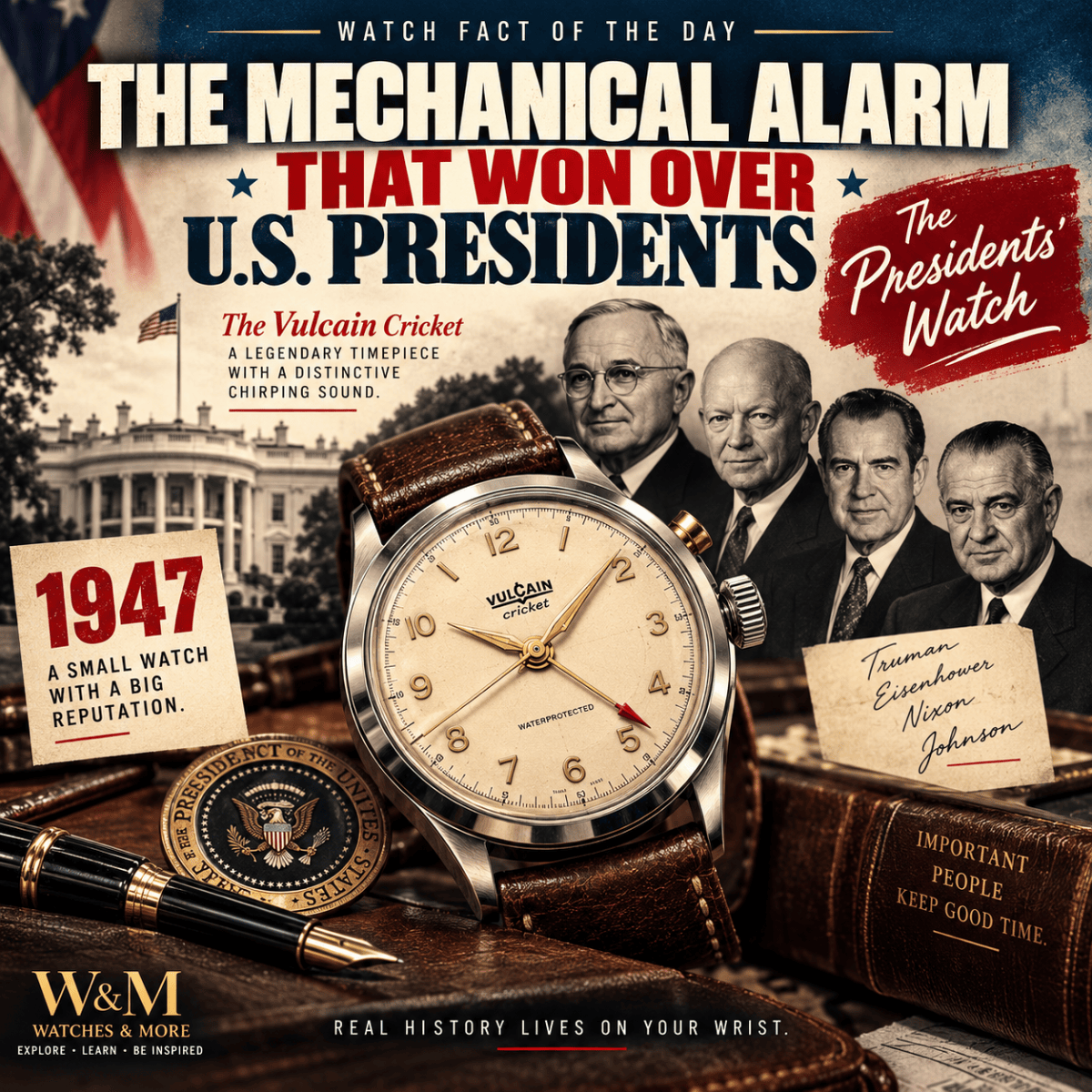
Watch Fact of the Day: The ‘Dirty Dozen’ Watches: British Military’s Secret Timekeepers!

So, back in World War II, the British Ministry of Defence hired 12 Swiss watchmakers to create tough, accurate, and waterproof watches for soldiers, known as the “Dirty Dozen.” Each watch had a black dial, luminous hands, and a “W.W.W.” engraving, focusing on durability over looks. These watches were made by brands like Omega and Longines, and while some are easier to find, Grana stands out as super rare. Today, the Dirty Dozen is a hot item for collectors, proving that even war-ready designs can become classic staples in watch history. Plus, the nickname? Totally came from collectors later on!

Watch History: Tuesday, August 4, 2026

📅 Tuesday, August 4, 2026

During World War II, the British Ministry of Defence commissioned 12 Swiss watch manufacturers to produce robust, accurate, and water-resistant wristwatches for their soldiers. These watches, known collectively by collectors as the ‘Dirty Dozen,’ each featured similar specifications, including a black dial, Arabic numerals, luminous hands, a railway minute track, and a specific ‘W.W.W.’ (Wrist Watch Waterproof) engraving on the case back. While not a single brand, this group represents a unique chapter in military watch history and a testament to wartime collaboration and precision.


Rather than relying on a single manufacturer, the British government turned to twelve respected Swiss companies to meet the enormous wartime demand. The chosen brands were Buren, Cyma, Eterna, Grana, Jaeger-LeCoultre, Lemania, Longines, IWC, Omega, Record, Timor, and Vertex. Although each company produced its watches slightly differently, they all adhered to the same military specification, ensuring soldiers received reliable timepieces regardless of the manufacturer. These watches were built for harsh battlefield conditions, emphasizing legibility, durability, and dependable accuracy over decorative finishing.

Today, the Dirty Dozen has become one of the most collectible groups of military watches in the world. Many enthusiasts enjoy the challenge of assembling a complete set of all twelve—a difficult and often expensive pursuit. Among them, Grana is considered the rarest, with only a relatively small number produced, making surviving examples especially desirable. In contrast, brands such as Omega and Longines manufactured significantly larger quantities, making them more attainable for collectors beginning their Dirty Dozen journey.

More than eighty years after they were issued, these watches continue to embody the philosophy that great tool watches are designed to perform under the toughest conditions. Their clean military aesthetics have inspired countless modern field watches, proving that a design created for wartime practicality can become timeless. Whether worn on the battlefield in the 1940s or admired in a modern collection, the Dirty Dozen remains a powerful symbol of functional watchmaking at its very best.


💡 Did You Know?

The nickname “Dirty Dozen” was never used by the British military. It was coined decades later by collectors, inspired by the famous 1967 war film The Dirty Dozen. Today, it’s one of the most recognizable names in vintage military watch collecting, even though the original watches were officially designated simply as W.W.W. (Wrist Watch Waterproof) models.

Category: Watch History

🕐 Discover more watch facts, reviews, and buying guides at WatchesAndMore


🛍️ You Might Also Like

As an Amazon Associate and affiliate partner, WatchesAndMore earns from qualifying purchases.

Timex Weekender Chronograph
🔥 Deal of the Day

Timex Weekender Chronograph

Timex

★★★★★ 4.5 (3,041 reviews)

$79

Offer expires in


🔥 Grab This Deal →

Bulova Precisionist


Bulova Precisionist

Bulova

★★★★★ 4.6 (1,100 reviews)

$219


Check Price on Amazon →

Timex Marlin Automatic 40mm


Timex Marlin Automatic 40mm

Timex

★★★★★ 4.7 (1,106 reviews)

$259


Check Price on Amazon →


Browse all 142+ expert-reviewed watches →
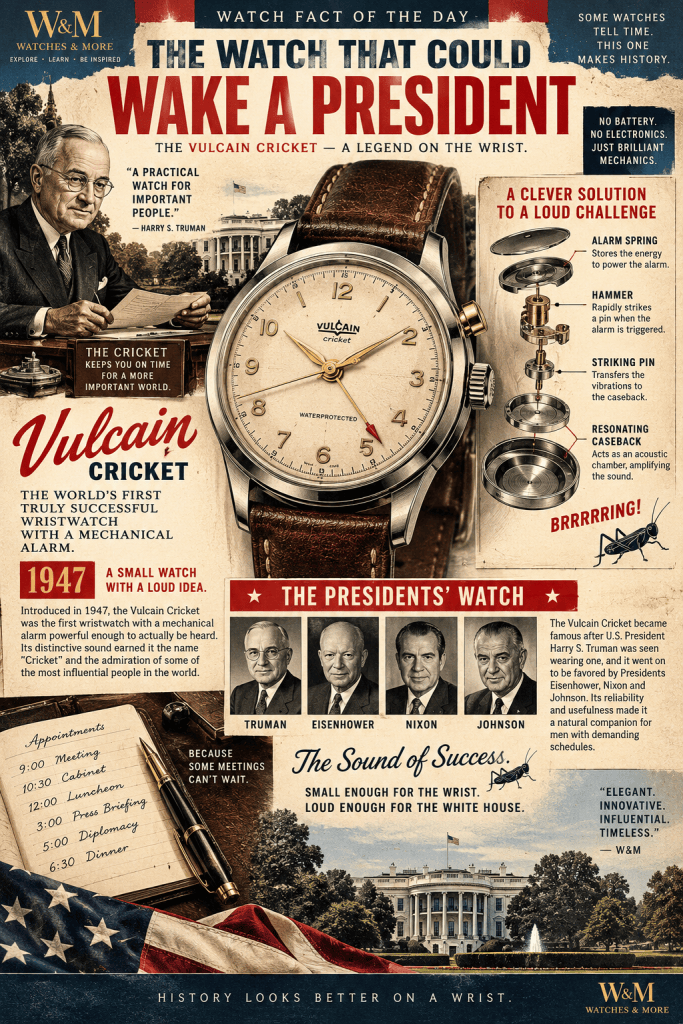
☕ Help Support WatchesAndMore

If you enjoyed this article and would like to help support WatchesAndMore, consider visiting my Etsy Shop or browsing my designs on Redbubble. Every purchase helps support the continued creation of watch reviews, historical articles, buying guides, videos, and all the free content you enjoy here on the website and on YouTube.

Your support allows me to spend more time researching fascinating stories from the world of horology, testing new watches, and producing high-quality content for collectors and enthusiasts around the globe. Whether you’re looking for unique watch-themed merchandise or simply want to support the channel, every order is genuinely appreciated. Thank you for being part of the WatchesAndMore community—your support helps keep the passion for watches alive! ⌚🍻

ETSY Shop
ETSY Shop
Redbubble Shop
Redbubble Shop
More Watch Facts
More Watch Facts

Watch Fact of the Day: The ‘Elephant’s Foot’ Was Once a Symbol of Watchmaking Prowess!

Back in the day, before fancy shock absorbers, watchmakers had to get creative to keep delicate balance staffs safe from bumps. One cool invention was the “elephant’s foot” pivot, a robust design that helped prevent breakage, even if it wasn’t a true shock absorber. While this was a neat workaround, it wasn’t until the 20th century that real game-changers like Incabloc came along, letting watches handle blows way better. The elephant’s foot is a reminder of how innovative early watchmakers were, relying on trial and error to keep timepieces ticking. Today’s watches are way tougher, thanks to these pioneering efforts!

Watch History: Saturday, August 1, 2026

📅 Saturday, August 1, 2026

Before the advent of modern shock absorption systems, watchmakers faced the challenge of protecting delicate balance staffs from impacts. Some early pocket watches featured a robust, mushroom-shaped balance staff pivot, affectionately nicknamed the ‘elephant’s foot’ due to its distinctive, wide base. This design, while not a true shock absorber, offered improved resilience compared to thinner pivots, showcasing an early ingenuity in protecting the heart of the watch.


Watch Fact of the Day: The 'Elephant's Foot' Was Once a Symbol of Watchmaking Prowess!
Watch Fact of the Day: The ‘Elephant’s Foot’ Was Once a Symbol of Watchmaking Prowess!

In the days before wristwatches became common, pocket watches were expected to survive the bumps and knocks of everyday life. One of the most vulnerable components inside any mechanical movement was the balance staff pivot—a tiny, highly polished axle that allowed the balance wheel to oscillate freely. A hard impact could easily snap this fragile pivot, rendering the watch useless until repaired. To combat this weakness, some watchmakers experimented with larger, reinforced pivot designs, including the distinctive “elephant’s foot,” which distributed stress over a broader area and reduced the likelihood of breakage.

Although the elephant’s foot design represented an important step forward, it was ultimately only a partial solution. The real breakthrough came in the 20th century with the introduction of dedicated shock protection systems such as Incabloc, KIF, and later Diashock. These ingenious spring-mounted jewel settings allowed the balance staff to move slightly during an impact before returning to its precise position, dramatically improving durability while maintaining excellent timekeeping accuracy. Today, nearly every quality mechanical watch benefits from some form of shock protection descended from these pioneering innovations.

The elephant’s foot is a fascinating reminder of the relentless creativity of early watchmakers. Long before sophisticated engineering and computer-aided design, craftsmen relied on careful observation, experimentation, and clever mechanical solutions to solve real-world problems. While few collectors will ever see one inside an antique pocket watch, it remains an important milestone in the ongoing quest to build more reliable and resilient timepieces.


💡 Did You Know?

A modern Incabloc shock protection system can allow a balance staff to survive impacts of thousands of times the force of gravity (G)—something that would have instantly broken the delicate pivots found in many 19th-century watches. It’s one of the reasons a modern mechanical watch is far more robust than its antique predecessors, despite using the same fundamental principles of timekeeping.

Category: Watch History

Disclaimer: Every effort has been made to keep these watch facts accurate, but the world of horology is full of myths, disputed stories, and fascinating trivia. Consider these facts a starting point for discovery rather than the final word. If you have corrections or additional insights, let us know—we’re always happy to keep the record ticking in the right direction.

🕐 Discover more watch facts, reviews, and buying guides at WatchesAndMore


🛍️ You Might Also Like

As an Amazon Associate and affiliate partner, WatchesAndMore earns from qualifying purchases.

Timex Weekender Chronograph
🔥 Deal of the Day

Timex Weekender Chronograph

Timex

★★★★★ 4.5 (3,041 reviews)

$79

Offer expires in


🔥 Grab This Deal →

Bulova Precisionist


Bulova Precisionist

Bulova

★★★★★ 4.6 (1,100 reviews)

$219


Check Price on Amazon →

Timex Marlin Automatic 40mm


Timex Marlin Automatic 40mm

Timex

★★★★★ 4.7 (1,106 reviews)

$259


Check Price on Amazon →


Browse all 142+ expert-reviewed watches →

☕ Help Support WatchesAndMore

If you enjoyed this article and would like to help support WatchesAndMore, consider visiting my Etsy Shop or browsing my designs on Redbubble. Every purchase helps support the continued creation of watch reviews, historical articles, buying guides, videos, and all the free content you enjoy here on the website and on YouTube.

Your support allows me to spend more time researching fascinating stories from the world of horology, testing new watches, and producing high-quality content for collectors and enthusiasts around the globe. Whether you’re looking for unique watch-themed merchandise or simply want to support the channel, every order is genuinely appreciated. Thank you for being part of the WatchesAndMore community—your support helps keep the passion for watches alive! ⌚🍻

ETSY Shop
ETSY Shop
Redbubble Shop
Redbubble Shop
More Watch Facts
More Watch Facts

Watch Fact of the Day: The ‘Waterproof’ Watch Was Once a Mythical Beast!

In 1926, Rolex decided to make a splash—literally—by patenting the ‘Oyster’ case, transforming the watch industry from a soggy mess of water-resistant myths into a dry haven of genuine waterproofness. Before this revolutionary moment, the idea of waterproof watches was about as reliable as an umbrella in a hurricane. With the ingenious screw-down crown and hermetically sealed design, Rolex flipped the script on watch-making. And while these chronometers are now fashionably safe from pool parties, remember: the world of horology is a wild ride filled with legends and half-told tales, so don your detective hat for more tick-tock trivia!

📅 Friday, July 31, 2026

Before Rolex patented the ‘Oyster’ case in 1926, truly waterproof watches were largely theoretical. Early attempts at water resistance involved fragile gaskets and screw-down crowns, but none offered reliable protection against the elements. The Oyster case, with its patented screw-down crown, case back, and bezel, revolutionized watchmaking by creating a hermetically sealed environment, making genuine waterproofness a reality for the first time.


The Watch That Defied Water

The breakthrough came from Hans Wilsdorf, founder of Rolex, who recognized that moisture and dust were the greatest enemies of a mechanical watch. By engineering a case that sealed tightly using a screw-down bezel, threaded case back, and the innovative Twinlock-style screw-down crown concept, Rolex created a watch capable of withstanding conditions that would have quickly destroyed earlier timepieces. The name “Oyster” was chosen because, like the shell of an oyster, the case formed a protective barrier around its precious contents.

The Oyster’s reputation was cemented in 1927 when British swimmer Mercedes Gleitze wore a Rolex Oyster while attempting to swim across the English Channel. Although she did not complete the crossing due to the harsh conditions, the watch remained fully functional after spending more than ten hours in cold seawater. Rolex capitalized on the achievement with one of history’s first truly successful testimonial advertising campaigns, displaying Oyster watches in aquariums in jewelry store windows to demonstrate their remarkable water resistance.

Today, nearly every modern sports watch owes something to the innovations pioneered by the Oyster case. Screw-down crowns, threaded case backs, synthetic gaskets, and improved sealing systems have become industry standards, allowing dive watches to withstand depths of hundreds—and in some cases thousands—of meters. What was once considered almost mythical in the early 20th century has become an everyday expectation for modern wristwatches.


💡 Did You Know?

The term “waterproof” is no longer used by most watch manufacturers. Instead, watches are rated as “water resistant” because no watch is permanently impervious to water. Gaskets age, seals wear, and regular pressure testing is recommended to ensure a watch continues to perform as intended—especially before swimming or diving.

Category: Watch History

Disclaimer: Every effort has been made to keep these watch facts accurate, but the world of horology is full of myths, disputed stories, and fascinating trivia. Consider these facts a starting point for discovery rather than the final word. If you have corrections or additional insights, let us know—we’re always happy to keep the record ticking in the right direction.

🕐 Discover more watch facts, reviews, and buying guides at WatchesAndMore


🛍️ You Might Also Like

As an Amazon Associate and affiliate partner, WatchesAndMore earns from qualifying purchases.

Timex Weekender Chronograph
🔥 Deal of the Day

Timex Weekender Chronograph

Timex

★★★★★ 4.5 (3,041 reviews)

$79

Offer expires in


🔥 Grab This Deal →

Bulova Precisionist


Bulova Precisionist

Bulova

★★★★★ 4.6 (1,100 reviews)

$219


Check Price on Amazon →

Timex Marlin Automatic 40mm


Timex Marlin Automatic 40mm

Timex

★★★★★ 4.7 (1,106 reviews)

$259


Check Price on Amazon →


Browse all 142+ expert-reviewed watches →

☕ Help Support WatchesAndMore

If you enjoyed this article and would like to help support WatchesAndMore, consider visiting my Etsy Shop or browsing my designs on Redbubble. Every purchase helps support the continued creation of watch reviews, historical articles, buying guides, videos, and all the free content you enjoy here on the website and on YouTube.

Your support allows me to spend more time researching fascinating stories from the world of horology, testing new watches, and producing high-quality content for collectors and enthusiasts around the globe. Whether you’re looking for unique watch-themed merchandise or simply want to support the channel, every order is genuinely appreciated. Thank you for being part of the WatchesAndMore community—your support helps keep the passion for watches alive! ⌚🍻

ETSY Shop
ETSY Shop
Redbubble Shop
Redbubble Shop
More Watch Facts
More Watch Facts

Watch Fact of the Day: The ‘Hack’ Function in Watches Was Born from Military Precision!

In a world where timing is everything, the ‘hack’ function on watches turns out to be the military’s secret sauce for synchronized chaos. Originally developed so soldiers could set their watches down to the tick, it transformed into a beloved feature for everyone, from casual timekeepers to luxury aficionados. The name comes from troops “hacking” their watches to get the exact second, proving precision can be key to success or failure—whether you’re bombarding an enemy or just trying to catch the bus. So, the next time you set your mechanical marvel, remember: it’s not just about fashion; it’s about historical warfare chic!

📅 Wednesday, July 29, 2026

The ‘hack’ function, which stops the second hand when the crown is pulled out, was not originally a feature for casual time-setting. It was developed during wartime to allow soldiers to synchronize their watches precisely to a master clock, ensuring coordinated movements and attacks. This military requirement for exact timing eventually became a common and useful feature in many mechanical watches.


The term “hack” comes from the military phrase “hack your watches,” an order given to troops to synchronize their timepieces to the exact second. By stopping the seconds hand, every soldier could wait for the command to resume the movement simultaneously, ensuring perfectly coordinated operations. Whether planning artillery barrages, airborne assaults, or naval maneuvers, precise timing often meant the difference between success and failure.

Early military watches from manufacturers such as Longines, Omega, Hamilton, IWC, and later Rolex incorporated hacking seconds to meet stringent military specifications. During World War II, synchronized timekeeping became essential across all branches of the armed forces. Pilots coordinated bombing runs, navigators calculated precise positions, and infantry units executed attacks based on synchronized watches rather than unreliable battlefield communications.

Today, the hack function is a standard feature on many mechanical watches, from affordable field watches to luxury Swiss timepieces. While most owners use it simply to set their watch accurately against an atomic clock or smartphone, its origins are rooted in one of the most demanding environments imaginable. It’s a small complication with a fascinating history, demonstrating how military innovation often finds its way into everyday life.


💡 Did You Know?

Many modern watch enthusiasts still synchronize their mechanical watches to internet-based atomic clocks or official time signals using the hack function. Pulling the crown at exactly 60 seconds, waiting for the reference clock to roll over to the next minute, and then pushing the crown back in allows the watch to be set almost perfectly to the second—a practice that continues a military tradition dating back more than 80 years.

Category: Watch History

Disclaimer: Every effort has been made to keep these watch facts accurate, but the world of horology is full of myths, disputed stories, and fascinating trivia. Consider these facts a starting point for discovery rather than the final word. If you have corrections or additional insights, let us know—we’re always happy to keep the record ticking in the right direction.

🕐 Discover more watch facts, reviews, and buying guides at WatchesAndMore


🛍️ You Might Also Like

As an Amazon Associate and affiliate partner, WatchesAndMore earns from qualifying purchases.

Timex Weekender Chronograph
🔥 Deal of the Day

Timex Weekender Chronograph

Timex

★★★★★ 4.5 (3,041 reviews)

$79

Offer expires in


🔥 Grab This Deal →

Bulova Precisionist


Bulova Precisionist

Bulova

★★★★★ 4.6 (1,100 reviews)

$219


Check Price on Amazon →

Timex Marlin Automatic 40mm


Timex Marlin Automatic 40mm

Timex

★★★★★ 4.7 (1,106 reviews)

$259


Check Price on Amazon →


Browse all 142+ expert-reviewed watches →
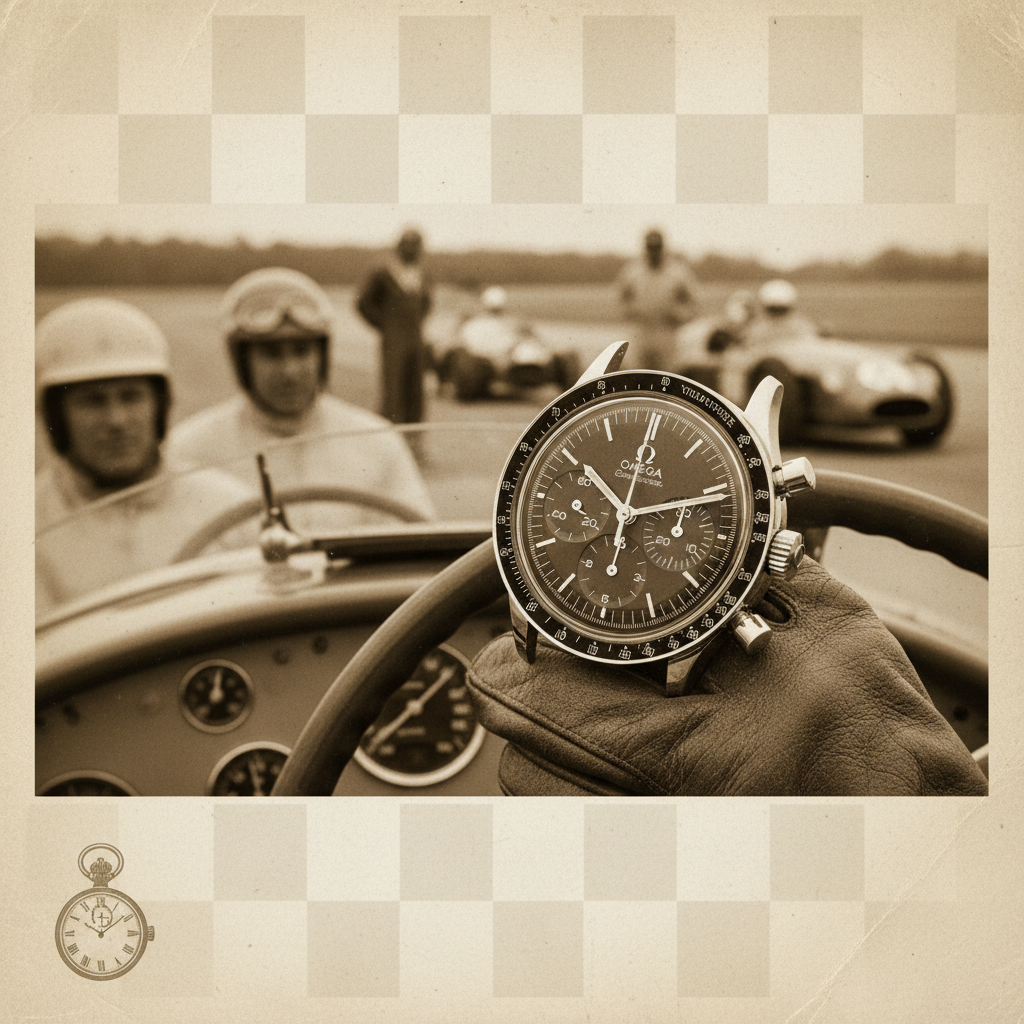
☕ Help Support WatchesAndMore

If you enjoyed this article and would like to help support WatchesAndMore, consider visiting my Etsy Shop or browsing my designs on Redbubble. Every purchase helps support the continued creation of watch reviews, historical articles, buying guides, videos, and all the free content you enjoy here on the website and on YouTube.

Your support allows me to spend more time researching fascinating stories from the world of horology, testing new watches, and producing high-quality content for collectors and enthusiasts around the globe. Whether you’re looking for unique watch-themed merchandise or simply want to support the channel, every order is genuinely appreciated. Thank you for being part of the WatchesAndMore community—your support helps keep the passion for watches alive! ⌚🍻

ETSY Shop
ETSY Shop
Redbubble Shop
Redbubble Shop
More Watch Facts
More Watch Facts

The Watch Advisor
Find Your Perfect Watch

Watch Fact of the Day: The ‘Chronometer’ Standard Was Once a Naval Necessity!

Ahoy, time travelers! Before GPS made sailing as easy as pie, sailors fought the “Longitude Problem” armed with nothing but a pint-sized pocket watch and a prayer. Enter John Harrison and his marine chronometers in the 18th century, which were more reliable than your cousin Bob’s fish stories. He lost only five seconds during an 81-day sea adventure, turning shipwrecks into relics of the past. Today, watches sporting the “Chronometer” label are the crème de la crème in watchmaking, with brands like Rolex strutting their stuff. So, while GPS may have an edge now, the tale of timekeeping legend lives on—just like that fish story!

📅 Monday, July 27, 2026

Before GPS, accurate timekeeping at sea was critical for navigation. Marine chronometers, highly precise portable timepieces, allowed sailors to determine their longitude by comparing local time to Greenwich Mean Time. This invention revolutionized seafaring, preventing countless shipwrecks and making global exploration and trade significantly safer.


The breakthrough came in the 18th century when English clockmaker John Harrison solved what had become known as the “Longitude Problem.” For centuries, sailors could determine their latitude with relative ease, but accurately calculating longitude while at sea remained one of navigation’s greatest challenges. Harrison’s revolutionary marine chronometers maintained exceptional accuracy despite the constant motion, changing temperatures, and humidity encountered aboard sailing ships. His work transformed maritime navigation and is considered one of the most important achievements in the history of horology.

The word “chronometer” itself has a very specific meaning in watchmaking. Today, it refers to a watch that has passed rigorous precision testing and earned official certification. In Switzerland, this is typically awarded by the Contrôle Officiel Suisse des Chronomètres (COSC), where each movement is tested over several days in multiple positions and temperatures. Only movements that meet strict accuracy standards are permitted to carry the prestigious “Chronometer” designation on their dial.

Modern chronometer-certified wristwatches continue this tradition of precision. Brands such as Rolex, Omega, Breitling, Tudor, and many others proudly produce chronometer-certified models, blending centuries of timekeeping heritage with modern manufacturing techniques. While GPS and atomic clocks have replaced marine chronometers for navigation, the chronometer certification remains one of the most respected indicators of mechanical accuracy and craftsmanship in the watch industry.


💡 Did You Know?

John Harrison’s first successful marine chronometer, known as H4, looked more like a large pocket watch than a ship’s clock. During sea trials in 1761, it lost only about five seconds on an 81-day voyage to Jamaica—an astonishing level of accuracy that forever changed navigation and proved that precise portable timekeeping was possible.

Category: Watch History

Disclaimer: Every effort has been made to keep these watch facts accurate, but the world of horology is full of myths, disputed stories, and fascinating trivia. Consider these facts a starting point for discovery rather than the final word. If you have corrections or additional insights, let us know—we’re always happy to keep the record ticking in the right direction.

🕐 Discover more watch facts, reviews, and buying guides at WatchesAndMore


🛍️ You Might Also Like

As an Amazon Associate and affiliate partner, WatchesAndMore earns from qualifying purchases.

Bulova Precisionist


Bulova Precisionist

Bulova

★★★★★ 4.6 (1,100 reviews)

$219


Check Price on Amazon →

Timex Marlin Automatic 40mm


Timex Marlin Automatic 40mm

Timex

★★★★★ 4.7 (1,106 reviews)

$259


Check Price on Amazon →


Browse all 75+ expert-reviewed watches →
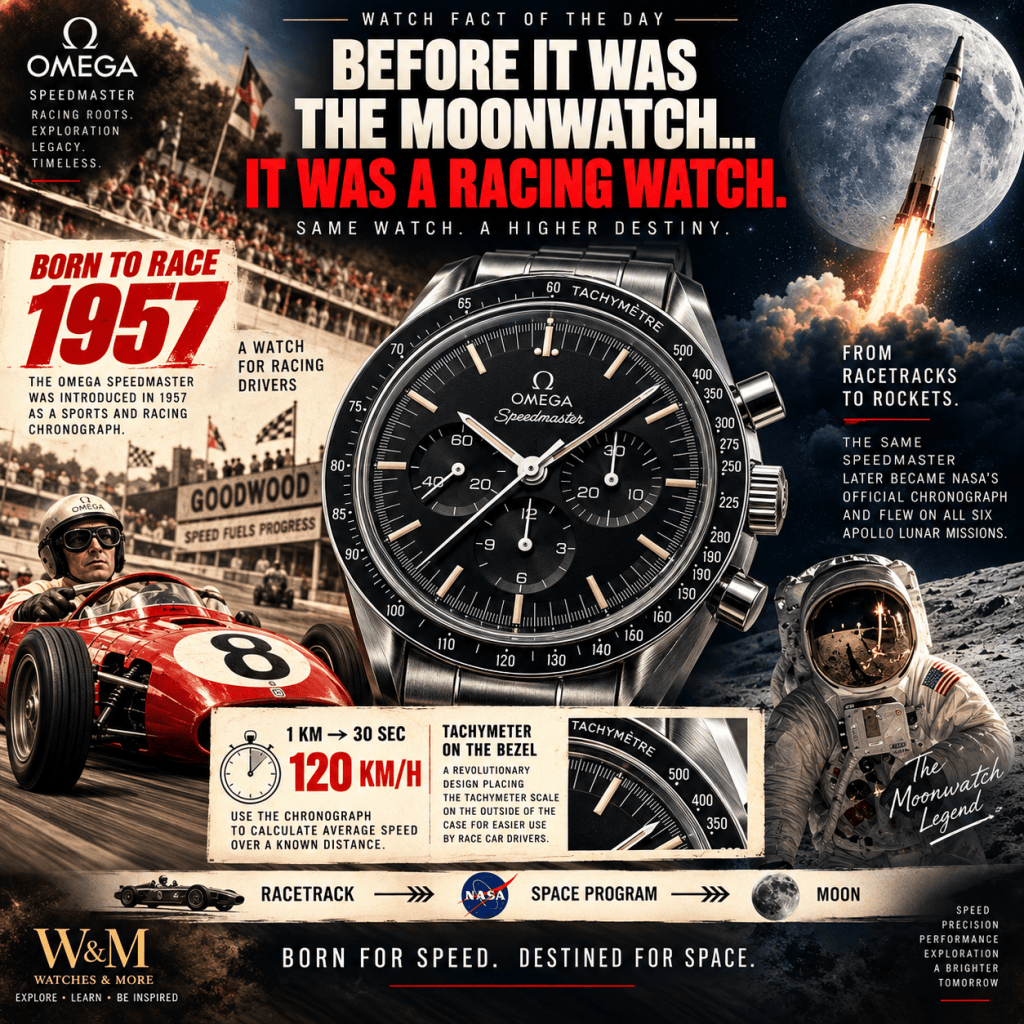
☕ Help Support WatchesAndMore

If you enjoyed this article and would like to help support WatchesAndMore, consider visiting my Etsy Shop or browsing my designs on Redbubble. Every purchase helps support the continued creation of watch reviews, historical articles, buying guides, videos, and all the free content you enjoy here on the website and on YouTube.

Your support allows me to spend more time researching fascinating stories from the world of horology, testing new watches, and producing high-quality content for collectors and enthusiasts around the globe. Whether you’re looking for unique watch-themed merchandise or simply want to support the channel, every order is genuinely appreciated. Thank you for being part of the WatchesAndMore community—your support helps keep the passion for watches alive! ⌚🍻

More Watch Facts
More Watch Facts