
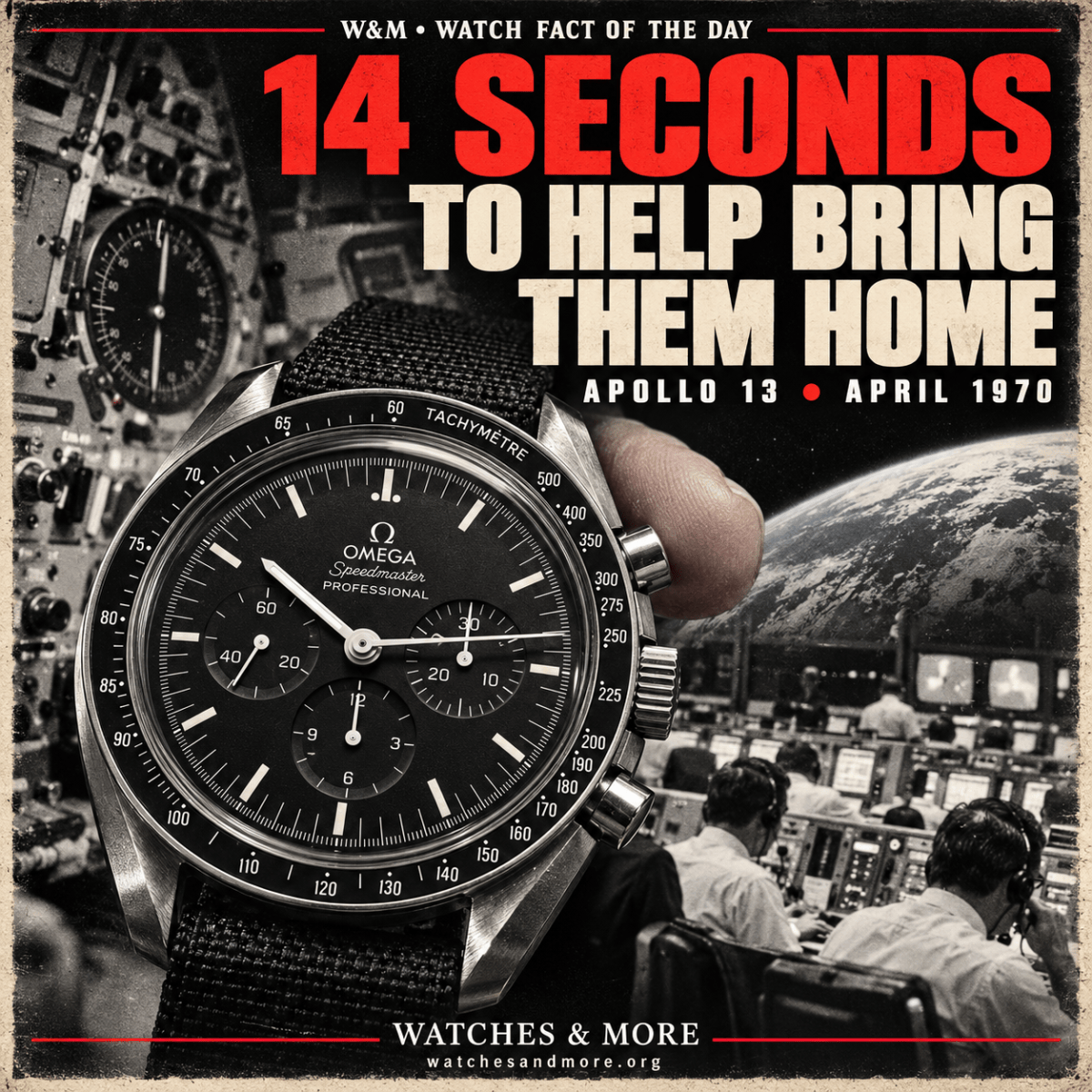
Three astronauts. A damaged spacecraft. And a wind-up watch with a critical job to do.
When Apollo 13 needed a crucial course correction, part of the crew’s survival plan came down to something you could wear on your wrist.
A mechanical chronograph.
The Omega Speedmaster Professional helped time the engine burn remembered as one of watchmaking’s most extraordinary fourteen seconds. OMEGA HK®
🚨 A Moon Mission Became a Fight to Get Home
Apollo 13 launched on April 11, 1970, carrying Jim Lovell, Jack Swigert, and Fred Haise toward what was intended to be humanity’s third Moon landing.
Then, on April 13, an oxygen-tank failure crippled the service module and disrupted the command module’s normal supply of electrical power, water, and oxygen. NASA
Landing on the Moon was no longer the objective.
Getting three men home was.
The lunar module, Aquarius, became their lifeboat. Resources intended for a lunar landing now had to support an emergency return journey. nasa.gov
🌍 Home Was in Sight. The Trajectory Still Mattered.
Reaching Earth’s vicinity was only part of the problem.
The crew needed a trajectory suitable for atmospheric entry. A short engine firing could make an important correction—but it still needed to be aimed and timed.
With spacecraft systems powered down to conserve precious energy, the astronauts drew on simpler references.
Lovell later described using Earth as a visual guide and an Omega watch to time a 14-second burn of the lunar module’s engine. Hodinkee
A familiar object had become part of an unfamiliar survival procedure.
⏱️ Fourteen Seconds on a Wristwatch
The familiar account credits Jack Swigert with timing, while Lovell controlled the spacecraft. Omega aboard the Apollo 13 mission
Omega’s history of the mission describes the Speedmaster’s role in the fourteen-second manoeuvre. Lovell’s own recollection also confirms that an Omega watch supplied the timing. OMEGA HK®
Press a pusher. Read the elapsed seconds. Signal the moment.
Those are ordinary chronograph actions.
What made this extraordinary was the setting: a damaged spacecraft, a carefully planned manoeuvre, and three lives depending on the whole procedure working.
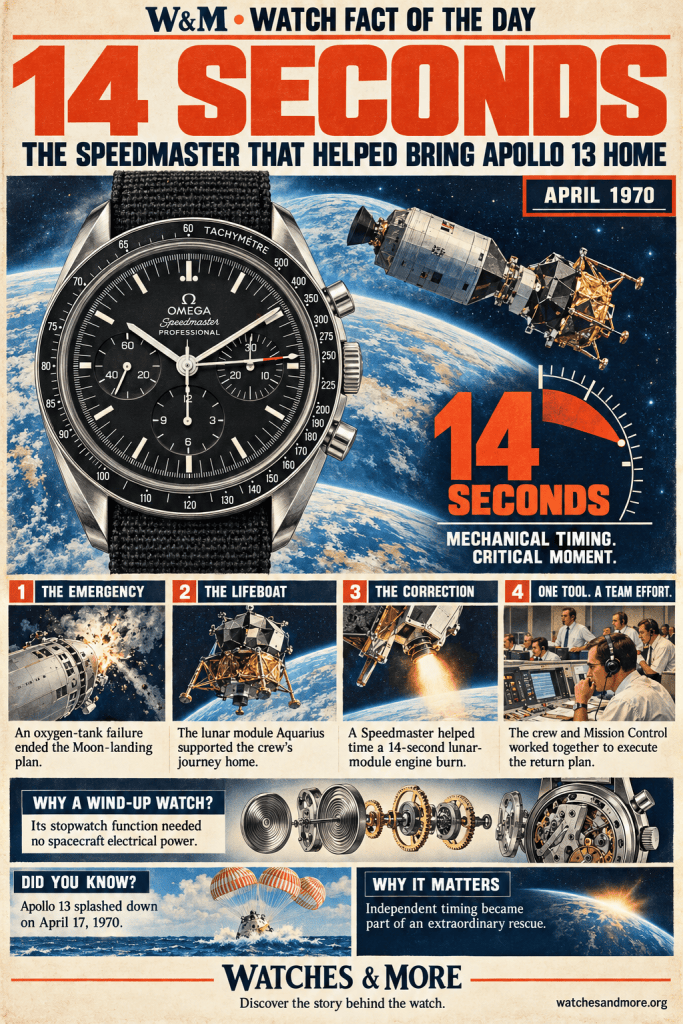
⚙️ The Mechanical Genius Was Its Independence
A chronograph combines a watch with a stopwatch function.
In a hand-wound mechanical watch, a mainspring stores energy, the movement regulates its release, and the chronograph mechanism measures elapsed time.
The practical advantage here was simple: the Speedmaster’s timing function did not draw on the spacecraft’s electrical supply.
Think of the stopwatch on your phone. The task is familiar.
Now imagine performing that task with a self-contained spring-driven mechanism, far from Earth, while conserving the power needed to finish the journey.
The watch did not calculate the trajectory. It helped the astronauts execute the plan.
🎯 What About the “Two Seconds” Claim?
The dramatic version says that being two seconds off would have sent Apollo 13 skipping into deep space.
The sources reviewed for this article do not establish that exact threshold, so it should not be presented as fact.
The documented story already carries enormous stakes: a correctly executed course correction helped the crew return safely.
Precision mattered. So did spacecraft control, navigation, communication, and the people working through the emergency on the ground. NASA credits the crew, ground personnel, and lunar-module systems together with making the safe return possible. nasa.gov
💡 Did You Know?
Apollo 13 was an April 1970 mission—not the 1969 Moon landing.
Its crew returned to Earth on April 17, splashing down in the Pacific. The mission had failed to land on the Moon, yet succeeded in bringing all three astronauts home. nasa.gov
That distinction is part of what makes its story so powerful.
⭐ Why It Matters
The Speedmaster’s Apollo 13 story is a reminder that useful engineering is measured by what it allows people to do.
Here, a compact mechanical instrument supplied an independent way to measure a critical interval.
It was one tool in a rescue built from training, teamwork, calculation, and ingenuity.
And for those few seconds, it had a job that mattered far beyond telling the time.
No software in the watch. Fourteen critical seconds. A place in the story of getting home. ⌚🌍🚀
Discover more remarkable timepieces in the W&M Watch Fact Archive.
Visit Watches & More and our companion site.