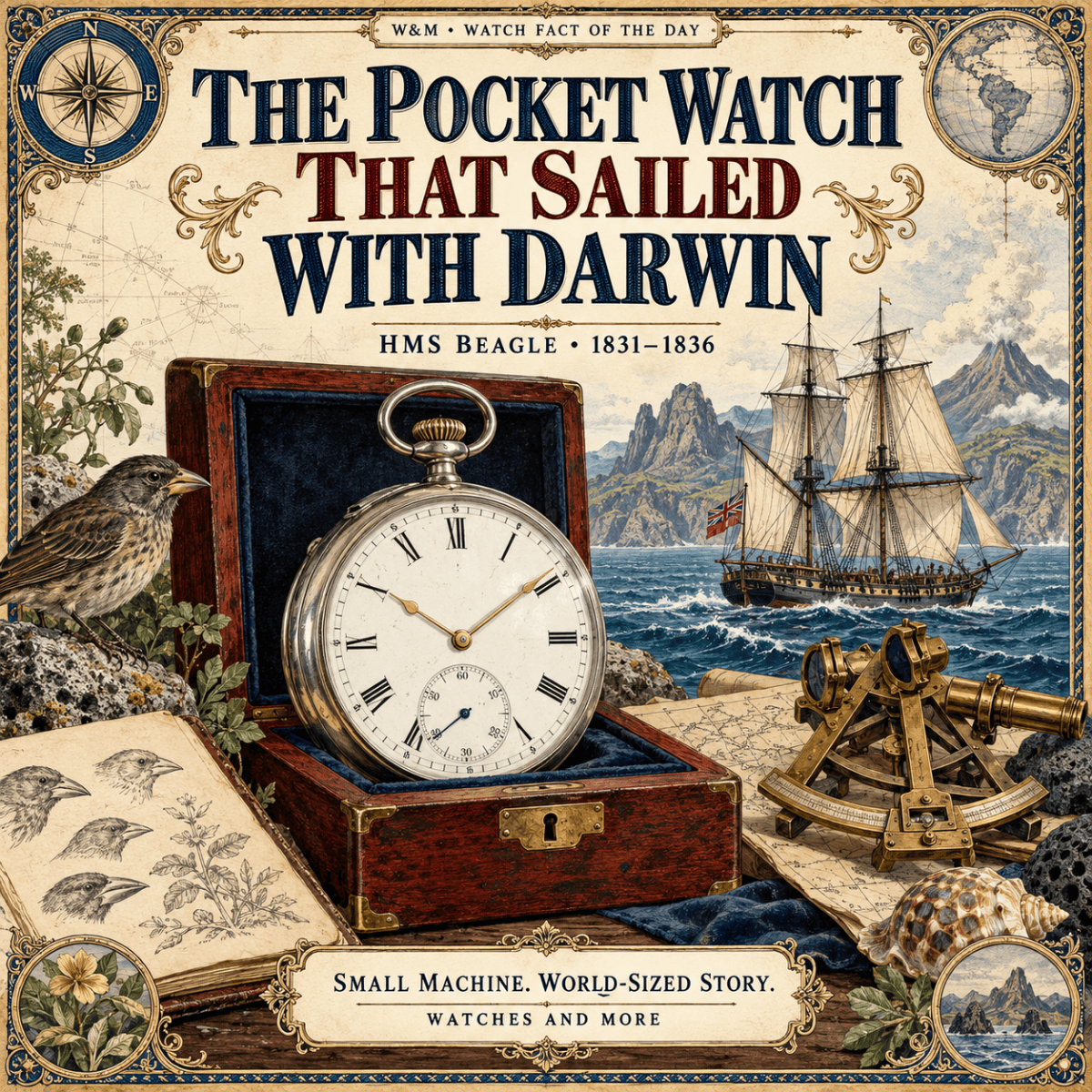
Watch Fact of the Day: The Pocket Watch That Sailed With Charles Darwin

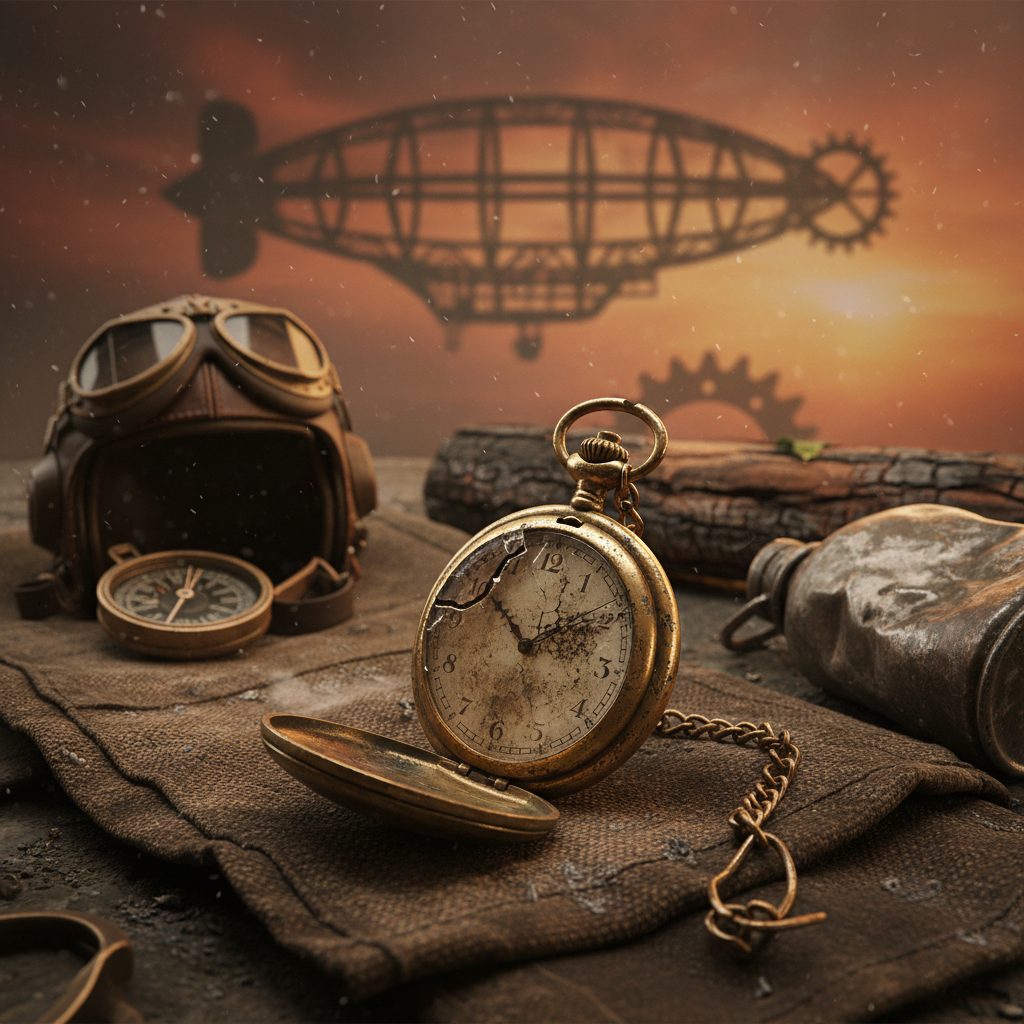
Ah, the tale of Charles Darwin’s trusty pocket watch, affectionately called “K.” This little timepiece didn’t just help you catch the bus—oh no, it navigated the high seas! Before GPS made it a couch potato, this stalwart chronometer hopped aboard HMS Beagle like a true adventurer. From 1831 to 1836, it helped map uncharted territories and summon crucial measurements to support Darwin’s theories, proving that sometimes, understanding the vast universe comes down to knowing if it’s tea time! So, next time you glance at your wrist, remember: watches have been making history, one tick at a time.

Military Watches: Thursday, October 8, 2026

📅 Thursday, October 8, 2026

Watch Fact of the Day: The Pocket Watch That Sailed With Charles Darwin ⌚🌍

Before GPS, a remarkably accurate pocket timekeeper helped an expedition find its place in the world.

Charles Darwin’s voyage aboard HMS Beagle helped transform our understanding of life on Earth.

But alongside the specimens, notebooks, and geological observations was another extraordinary scientific story: the precision timekeeping that helped the expedition map the world.

Among its instruments was a pocket chronometer small enough to carry ashore—and important enough to earn its place in the history of exploration.

⚓ Meet Chronometer “K”

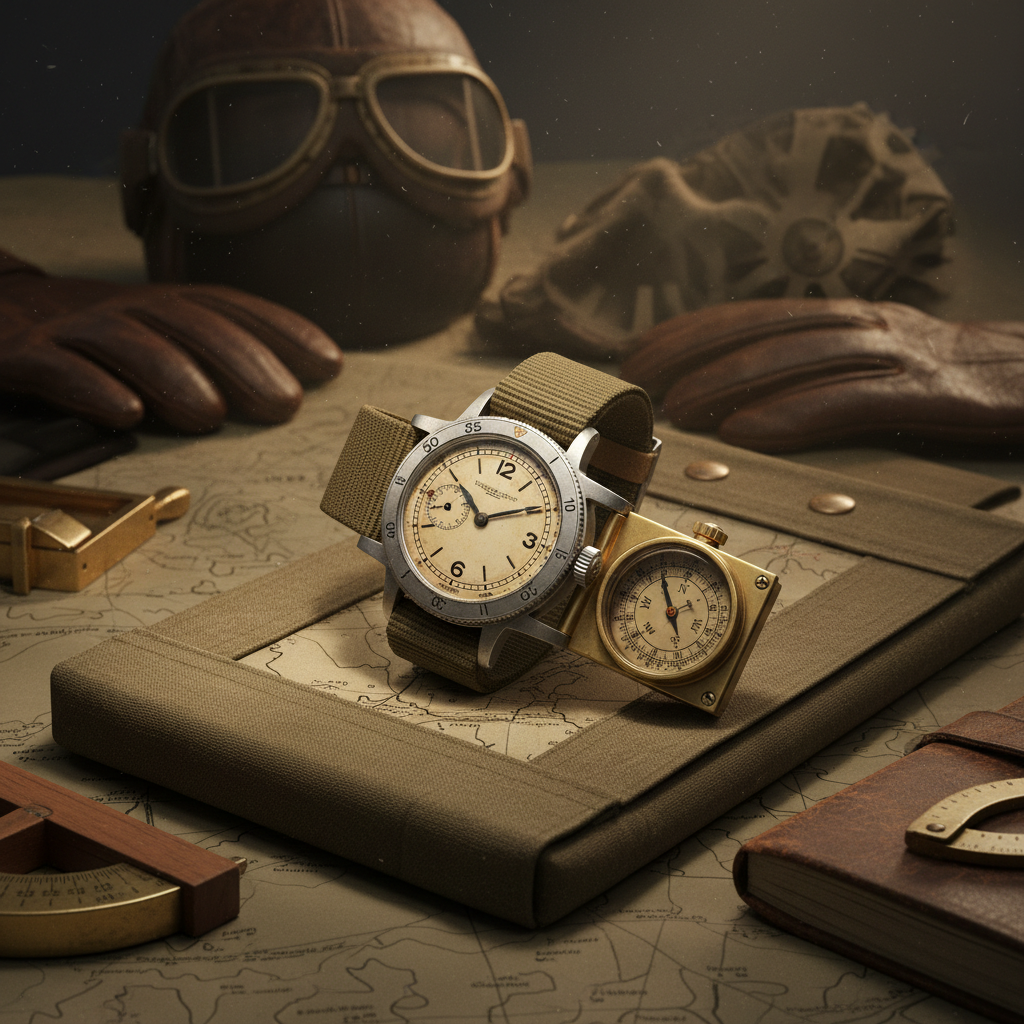
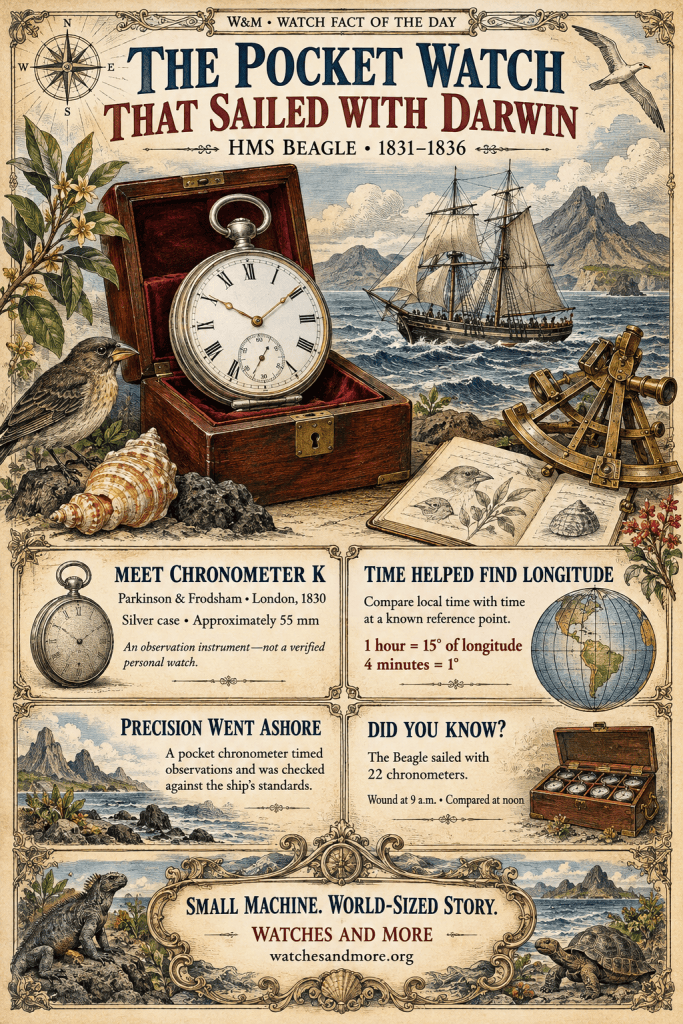
A surviving pocket chronometer made by Parkinson & Frodsham of London in 1830 is documented as having travelled on the Beagle’s second voyage, from 1831 to 1836, with Darwin aboard.

Known on the ship as “K,” it served as an observation chronometer, helping survey the South American coast. It was also taken ashore in the Galápagos Islands. Its silver case measures approximately 55 mm across, and it was supplied with a mahogany box.

This was much more than a handsome pocket watch.

It was portable precision equipment for a world without satellite navigation.
Watch Fact of the Day: The Pocket Watch That Sailed With Charles Darwin

🧭 Why Finding Your Location Required Knowing the Time

At sea, knowing how far east or west you had travelled presented a formidable challenge.

One solution was to compare local time, determined through astronomical observations, with the time at a known reference location.

Because Earth turns through 360 degrees in 24 hours, one hour of time difference corresponds to 15 degrees of longitude. Just four minutes represents one degree.

That made an accurate timekeeper enormously valuable.

A watch could help answer a question far bigger than “What time is it?”

“Where are we?”

🔭 Precision That Went Ashore

Captain Robert FitzRoy’s account describes a pocket chronometer carried by hand in a small box for timing observations.

Before and after those observations, it was compared with the expedition’s standard chronometers. That checking mattered: the portable instrument connected field measurements with the carefully maintained timekeepers aboard ship.

Picture the contrast.

A small mechanical timepiece, protected in its box. A sextant directed toward the sky. An unfamiliar coastline waiting to be measured.

Exploration depended on curiosity—but it also depended on reliable instruments.

🌿 The Darwin Connection—Without the Embellishment

The Beagle voyage provided observations and collections that contributed to Darwin’s later development of evolution by natural selection. The pocket chronometer supported the expedition’s surveying work.

Those are powerful connections in their own right.

We don’t need to imagine Darwin personally consulting this particular watch for every discovery. Its documented role places it aboard the same remarkable expedition, helping establish the geographical framework within which exploration took place.

It sailed with Darwin. That alone is an extraordinary story.

💡 Did You Know?

The Beagle carried 22 chronometers when it sailed from England.

FitzRoy described a dedicated cabin where the instruments were secured in boxes surrounded by sawdust. They were wound daily at nine and compared at noon, with the routine entrusted to George James Stebbing.

Some instruments failed during the voyage, but FitzRoy reported that none of the expedition’s measurements depended on fewer than twelve chronometers.

Precision came from careful routines and comparison—not simply trusting one watch.

⭐ Why It Matters

This story reveals a quieter side of scientific discovery.

We remember the naturalist, the islands, and the ideas. Behind them stood instrument makers and surveyors whose work helped make the expedition possible.

A pocket chronometer brought meticulous engineering into the field. It linked the movement of tiny mechanical components with measurements on a planetary scale.

Sometimes, understanding a big world begins with a very small machine.

❤️ The W&M Take: A Watch With a World of History

At Watches And More, we believe every watch has a story.

This one connects London watchmaking, ocean voyages, coastal surveys, and an expedition that changed how humanity understood nature.

Its importance goes far beyond its silver case.

It reminds us that watches have been tools for discovery—carried wherever people needed dependable time to explore unfamiliar places.

Darwin studied the world. Precision timekeepers helped his expedition navigate it.


⌚ Keep exploring:

Which watch story fascinates you most: ocean exploration, aviation, or the journey into space?

Category: Military Watches

Disclaimer: Every effort has been made to keep these watch facts accurate, but the world of horology is full of myths, disputed stories, and fascinating trivia. Consider these facts a starting point for discovery rather than the final word. If you have corrections or additional insights, let us know—we’re always happy to keep the record ticking in the right direction.

🕐 Discover more watch facts, reviews, and buying guides at WatchesAndMore


🛍️ You Might Also Like

As an Amazon Associate and affiliate partner, WatchesAndMore earns from qualifying purchases.
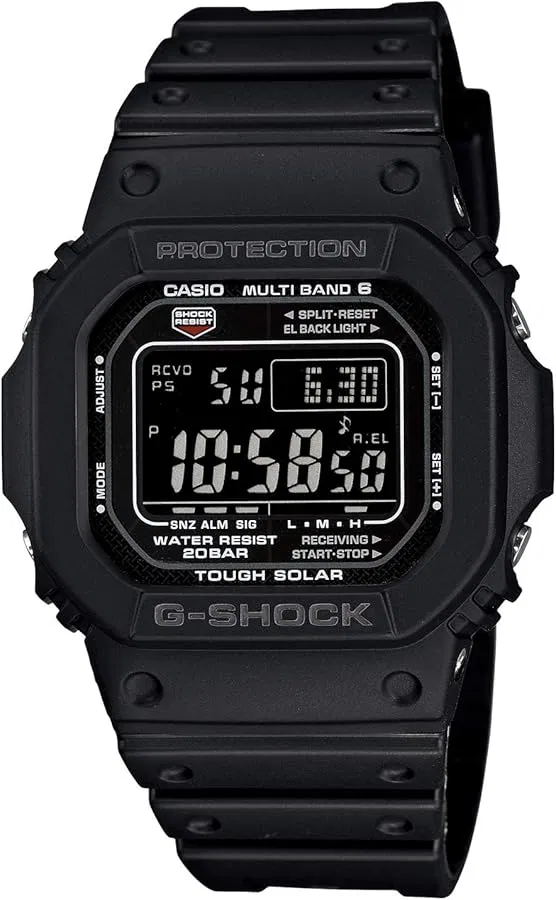
G-Shock GWM5610-1 Solar Atomic
🔥 Deal of the Day

G-Shock GWM5610-1 Solar Atomic

Casio

★★★★★ 4.8 (5,621 reviews)

$129

Offer expires in


🔥 Grab This Deal →

G-Shock GA2100-1A1 CasiOak


G-Shock GA2100-1A1 CasiOak

Casio

★★★★★ 4.8 (2,156 reviews)

$99


Check Price on Amazon →

Seiko 5 SNK805 Green Military


Seiko 5 SNK805 Green Military

Seiko

★★★★★ 4.8 (6,961 reviews)

$89


Check Price on Amazon →


Browse all expert-reviewed watches →

ETSY Shop
ETSY Shop
Redbubble Shop
Redbubble Shop
More Watch Facts
More Watch Facts

Watch Fact of the Day: The 1930s Watch That Helped Pilots Find Their Way

So, the Longines Weems Second-Setting watch is a cool piece of history, designed back in the 1930s for aviation. It helped pilots navigate over vast oceans without modern tech like GPS. The watch features a nifty rotating inner dial that syncs with radio time signals, allowing the seconds hand to keep moving while you adjust the scale. This innovation was crucial for accurate navigation, especially before WWII when timing mattered a lot. It’s not just about looking good—this watch was all about solving real problems for aviators. Basically, it’s a blend of mechanical brilliance and adventurous spirit!

Military Watches: Wednesday, October 7, 2026

📅 Wednesday, October 7, 2026

Longines Weems — When Every Second Counted ✈️⌚

Imagine flying over an ocean in the 1930s.

No GPS. No moving map. No friendly voice announcing that you’ve missed your turn.

Below you, an endless stretch of water. Above you, the sky—and on your wrist, a watch with a surprisingly clever trick.

The Longines Weems Second-Setting watch brought something essential to early aviation: a practical way to synchronize a mechanical watch with a radio time signal while its movement kept running.

Sometimes, the most impressive watch complication is the one that solves a real problem.

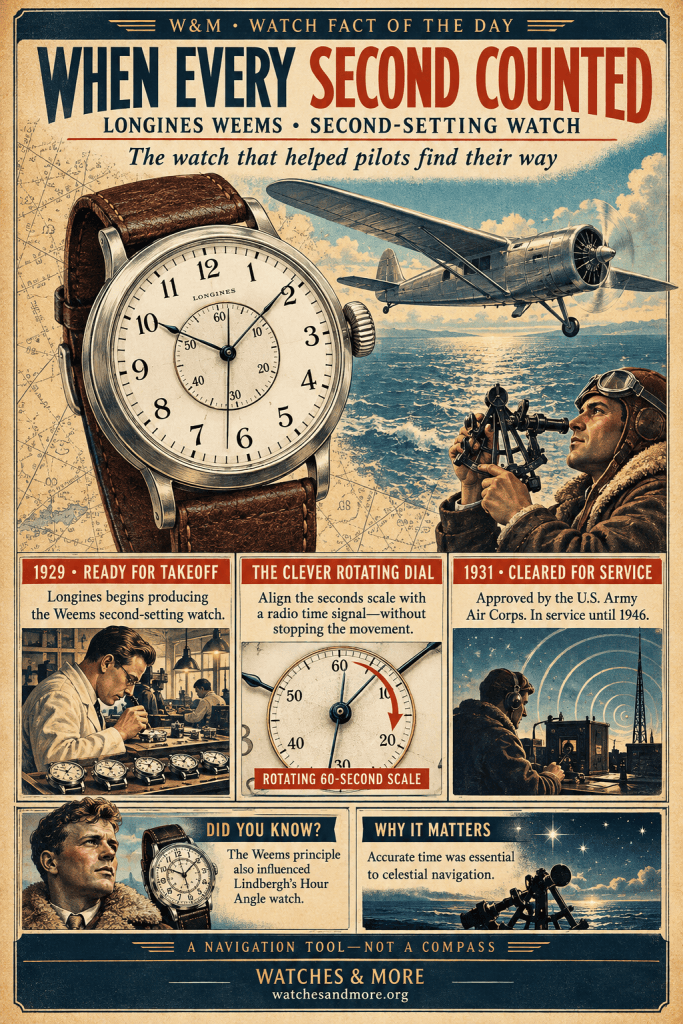
Vintage advertisement for the Longines Weems second-setting watch, featuring a close-up of the watch and an airplane in flight. Includes historical information about the watch, emphasizing its significance for pilots and celestial navigation.

📻 The Genius Was in the Dial

Developed from the ideas of U.S. Navy officer and navigation instructor Philip Van Horn Weems, the design used a rotating inner disc marked with a 60-second scale.

Instead of stopping the seconds hand, the wearer moved the scale beneath it to match the radio time signal. Longines began producing the watch in 1929, bringing Weems’ navigation concept into a purpose-built timepiece.

Think of it as moving the ruler instead of moving the thing you’re measuring.

The seconds hand continued its journey around the dial. The adjusted scale provided the synchronized reading.

Simple idea. Brilliant application.

🌌 Why a Navigator Needed the Time

A compass helps answer: Which direction am I heading?

Celestial navigation helps answer another question: Where am I?

To work out a position using the Sun or stars, navigators combined observations with accurate time and navigation tables. A timing error could introduce an error into that calculation.

The watch supplied an essential part of the process. It worked alongside the navigator’s instruments, knowledge, and calculations.

That makes the Weems more interesting than a watch with an adventurous name. Its unusual dial had a job to do.

✈️ From Prewar Innovation to Wartime Service

This story began well before World War II.

According to Longines, the U.S. Army Air Corps approved the Weems Second-Setting Pilot Watch in August 1931, and it remained in service until 1946. Its military career therefore stretched from the pioneering aviation years into the WWII era.

It belonged to a world where navigating demanded preparation, concentration, and trust in your equipment.

A wristwatch could be part of the cockpit toolkit—and precision had a purpose far beyond arriving on time.

💡 Did You Know?

The Weems system also influenced the Longines Lindbergh Hour Angle watch. Charles Lindbergh incorporated the seconds-setting principle into his own navigation-watch design, adding another chapter to the connection between aviation and watchmaking.

⭐ Why It Matters

The Weems watch shows what happens when watchmaking responds to a practical challenge.

Its appeal goes deeper than vintage styling. That movable scale represents an elegant piece of problem-solving: give the navigator a usable, synchronized seconds reading while allowing the mechanism to keep ticking.

For watch enthusiasts, that is the magic of a great tool watch.

Every unusual detail tells you something about the people who needed it.

⌚ The W&M Take

We love a watch with a story—and this one has altitude.

The Longines Weems brings together mechanical ingenuity, radio signals, and the courage of early aviation. Looking at that rotating dial, you can almost picture a navigator listening for the next time signal above a dark ocean.

Before the blue dot on your phone, finding your way took skill—and a very good watch.


Explore more stories behind the dial at WatchesAndMore.org, browse the W&M Watch Fact Archive, and discover our companion hub at WatchesAndMore.shop.

Category: Military Watches

Disclaimer: Every effort has been made to keep these watch facts accurate, but the world of horology is full of myths, disputed stories, and fascinating trivia. Consider these facts a starting point for discovery rather than the final word. If you have corrections or additional insights, let us know—we’re always happy to keep the record ticking in the right direction.

🕐 Discover more watch facts, reviews, and buying guides at WatchesAndMore


🛍️ You Might Also Like

As an Amazon Associate and affiliate partner, WatchesAndMore earns from qualifying purchases.

Longines Conquest V.H.P.
🔥 Deal of the Day

Longines Conquest V.H.P.

Longines

★★★★★ 4.6 (145 reviews)

$660

Offer expires in


🔥 Grab This Deal →

Also at: Watchmaxx

G-Shock GWM5610-1 Solar Atomic


G-Shock GWM5610-1 Solar Atomic

Casio

★★★★★ 4.8 (5,621 reviews)

$129


Check Price on Amazon →

G-Shock GA2100-1A1 CasiOak


G-Shock GA2100-1A1 CasiOak

Casio

★★★★★ 4.8 (2,156 reviews)

$99


Check Price on Amazon →


Browse all expert-reviewed watches →

ETSY Shop
ETSY Shop
More Watch Facts
More Watch Facts
Redbubble Shop
Redbubble Shop

Watch Fact of the Day: The True Watch That First Climbed Mount Everest

On May 29, 1953, Sir Edmund Hillary made history by summiting Mount Everest, all while wearing a humble yet remarkable Smiths De Luxe watch. Unlike the more commonly recognized Rolex Explorer, the Smiths, featuring a unique preparation for extreme cold, showcases the unseen details that make its story compelling. While Rolex supplied watches for the expedition, the Smiths watch directly connects to Hillary’s achievement, symbolizing British craftsmanship. Now displayed at the Science Museum in London, this small timepiece celebrates an extraordinary journey. It reminds us that every watch has a unique tale, and this one reached the very roof of the world.

Military Watches: Thursday, October 1, 2026

📅 Thursday, October 1, 2026

A legendary mountain. A historic ascent. And a British watch that deserves its moment at the summit.

Mention Mount Everest to a watch enthusiast, and the Rolex Explorer probably comes to mind. Its connection to mountaineering is woven into watchmaking history.

But ask which watch Sir Edmund Hillary wore during his successful 1953 summit climb, and another name deserves the spotlight: Smiths De Luxe. The Science Museum Group identifies the surviving watch as the very timepiece Hillary wore on that historic ascent.

Sometimes, the most fascinating watch stories are waiting just beyond the familiar dial.

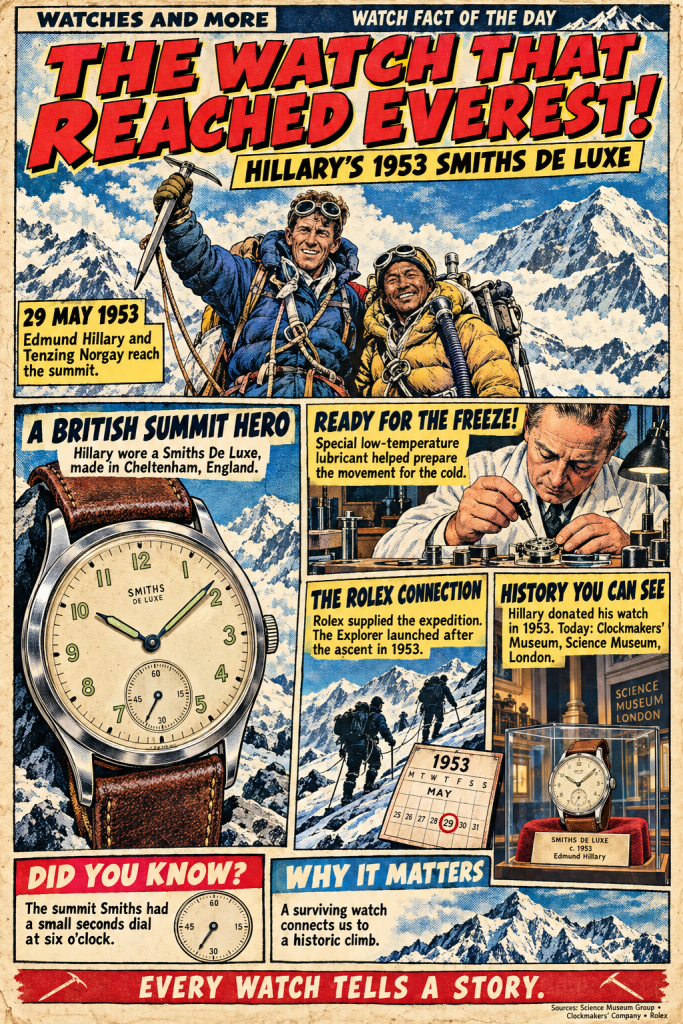
Illustration detailing the Smiths De Luxe watch worn by Edmund Hillary during the 1953 Everest expedition, featuring historical facts and images of climbers and the watch itself.

🏔️ A Small Watch on an Extraordinary Journey

On 29 May 1953, Edmund Hillary and Tenzing Norgay achieved the first confirmed ascent of Mount Everest. It was a shared triumph, supported by a much larger expedition and accomplished in conditions that pushed people and equipment to their limits.

Hillary’s Smiths was made in Cheltenham, England. Its silvered dial featured luminous Arabic numerals and a small seconds display at six o’clock. Inside sat a 15-jewel mechanical movement, protected by a steel waterproof case made by Dennison.

At a glance, it looks remarkably modest for a watch associated with such an enormous achievement.

That is part of its appeal. This was a timekeeper with a job to do.

❄️ The Detail That Helped It Face the Cold

One of the most interesting preparations was hidden inside.

Smiths treated Hillary’s watch with a special lubricant intended to withstand low temperatures. The Clockmakers’ Company confirms this preparation and records that Hillary reported the watch had performed very well.

It is an easy detail to overlook when admiring the dial, but it brings the story into focus: expedition equipment needed preparation for the environment it would encounter.

A handsome case could catch the eye. What happened inside it mattered on the mountain.

👑 Where Does Rolex Fit Into the Story?

Rolex’s Everest connection is real. The company supplied Oyster Perpetual watches to the 1953 expedition and had supported Himalayan exploration since the 1930s.

There is also an important timing detail: Rolex introduced the Explorer following the successful ascent, later in 1953. Its own history describes the model as a watch born from that achievement and the wider experience of expedition testing.

The distinction matters. Equipping an expedition, launching a watch inspired by its success, and identifying the watch Hillary wore to the summit are different historical claims.

The museum record gives Smiths a clear place in Hillary’s story. It does not, by itself, establish that Smiths was the only watch brand present at the summit.

🏛️ From Everest to the Museum

Hillary personally presented his Smiths watch to the Worshipful Company of Clockmakers in 1953.

Today, it is listed on display in the Clockmakers’ Museum gallery at London’s Science Museum—a surviving object connecting British watchmaking with one of the twentieth century’s defining adventures.

There is something special about that. The watch itself survives, allowing visitors to look beyond the legend and see the instrument.

💡 Did You Know?

Hillary’s summit watch had a small seconds subdial at six o’clock. Its appearance is quite different from the familiar black-dial, 3–6–9 design associated with the Rolex Explorer.

⭐ Why It Matters

The Smiths De Luxe reminds us to look closely at watch history. A famous association can draw us into a story; the surviving objects and records help us understand its details.

For watch lovers, that makes this modest British timepiece especially compelling. Its significance comes from the journey it accompanied.

Every watch tells a story. This one reached the roof of the world.

Watches And More — Exploring the stories behind the watches.

Category: Military Watches

Disclaimer: Every effort has been made to keep these watch facts accurate, but the world of horology is full of myths, disputed stories, and fascinating trivia. Consider these facts a starting point for discovery rather than the final word. If you have corrections or additional insights, let us know—we’re always happy to keep the record ticking in the right direction.

🕐 Discover more watch facts, reviews, and buying guides at WatchesAndMore


🛍️ You Might Also Like

As an Amazon Associate and affiliate partner, WatchesAndMore earns from qualifying purchases.
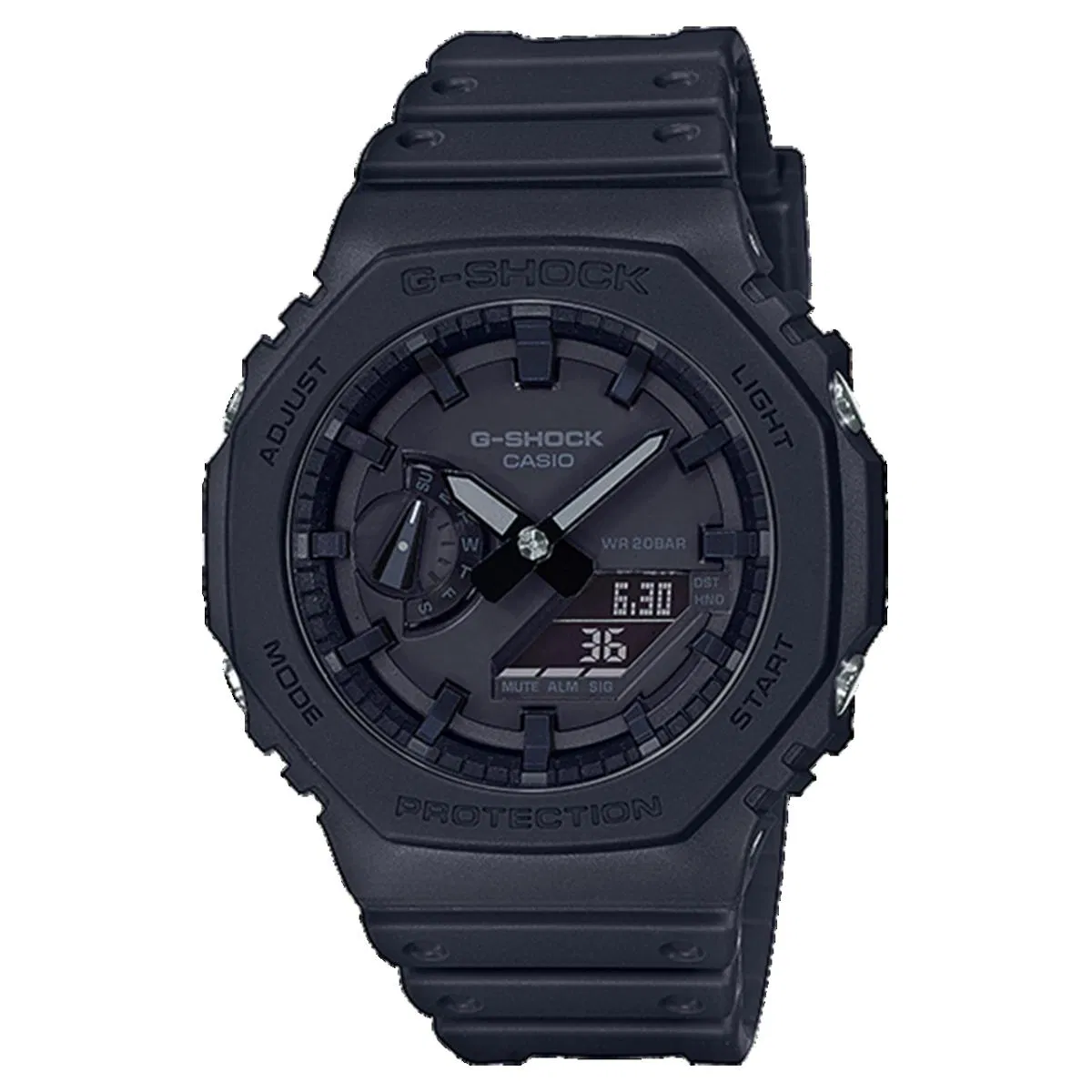
G-Shock GWM5610-1 Solar Atomic
🔥 Deal of the Day

G-Shock GWM5610-1 Solar Atomic

Casio

★★★★★ 4.8 (5,621 reviews)

$129

Offer expires in


🔥 Grab This Deal →

G-Shock GA2100-1A1 CasiOak


G-Shock GA2100-1A1 CasiOak

Casio

★★★★★ 4.8 (2,156 reviews)

$99


Check Price on Amazon →

Seiko 5 SNK805 Green Military


Seiko 5 SNK805 Green Military

Seiko

★★★★★ 4.8 (6,961 reviews)

$89


Check Price on Amazon →


Browse all expert-reviewed watches →

Watch Fact of the Day: The Stopwatch That Timed the First Flight at Kitty Hawk

On December 17, 1903, Wilbur and Orville Wright achieved a monumental breakthrough in aviation history, completing the first powered flight at Kitty Hawk. Using an unassuming hand-held stopwatch made by Gallet, they precisely recorded their flights: the first lasted 12 seconds over 120 feet, and the fourth reached 59 seconds across 852 feet. While the stopwatch itself appears ordinary, it symbolized the significance of timing in experimental flight and became an essential witness to this historic event. This simple instrument reminds us that remarkable achievements can stem from the smallest tools, ultimately transforming transportation and exploration for generations to come.

Military Watches: Monday, September 28, 2026

📅 Monday, September 28, 2026

Watch Fact of the Day: The Stopwatch That Timed the First Flight at Kitty Hawk

On the morning of December 17, 1903, Wilbur and Orville Wright stood on the windswept dunes near Kitty Hawk, North Carolina, ready to attempt something no one had yet achieved in a controlled, powered aircraft.

At 10:35 a.m., Orville climbed aboard the Wright Flyer.

Wilbur ran alongside.

The aircraft lifted from the rail.

And for exactly:

12 SECONDS

the world changed.

The Flyer traveled 120 feet before touching down. Later that same day, the brothers made three more flights, with the final attempt covering 852 feet in 59 seconds. Air and Space Museum

But how did they know those exact times?

They used a small hand-held stopwatch.

The National Air and Space Museum preserves that stopwatch today and identifies it as the instrument Wilbur and Orville used to time the historic flights at Kitty Hawk. Air and Space Museum

A Tiny Instrument at a Giant Moment

The stopwatch itself is remarkably ordinary-looking.

It has a nickel-plated case, a white porcelain dial with black Arabic numerals, and a smaller inset register for minutes.

No precious metal.

No complicated movement.

No dramatic decoration.

Just a practical timing instrument made by Gallet.

Yet on that cold December morning, it became one of the quiet witnesses to the birth of powered aviation. Smithsonian Institution

Why Timing Mattered

The Wright brothers were not simply trying to make an aircraft leave the ground.

They were conducting experiments.

Every flight produced data:

distance

duration

wind

control

engine performance

The stopwatch turned those fleeting seconds into measurable evidence.

The first flight:

12 SECONDS

120 FEET

The fourth:

59 SECONDS

852 FEET The Library of Congress

Those numbers became part of aviation history because someone measured them.

💡 Did You Know?

The Wright Flyer was powered by a lightweight engine built with the help of their mechanic Charlie Taylor.

Taylor helped design the engine and did virtually all of the machine work needed to produce it. The crankcase was made from aluminum—an important weight-saving choice for the Flyer. Air and Space Museum

So while the stopwatch did not make the airplane fly, it was there to record exactly how long humanity stayed airborne.

That makes it a beautiful reminder that big breakthroughs often depend on very small instruments.

⭐ Why It Matters

The Wright brothers’ stopwatch is not famous because it was luxurious.

It matters because it measured a moment no one had ever measured before.

12 SECONDS

That was enough.

Enough to prove controlled powered flight was possible.

Enough to open the door to aviation.

Enough to change transportation, warfare, exploration, commerce, and eventually spaceflight.

THE AIRPLANE MADE HISTORY.

THE STOPWATCH COUNTED THE SECONDS.


Category: Military Watches

Disclaimer: Every effort has been made to keep these watch facts accurate, but the world of horology is full of myths, disputed stories, and fascinating trivia. Consider these facts a starting point for discovery rather than the final word. If you have corrections or additional insights, let us know—we’re always happy to keep the record ticking in the right direction.

🕐 Discover more watch facts, reviews, and buying guides at WatchesAndMore


🛍️ You Might Also Like

As an Amazon Associate and affiliate partner, WatchesAndMore earns from qualifying purchases.
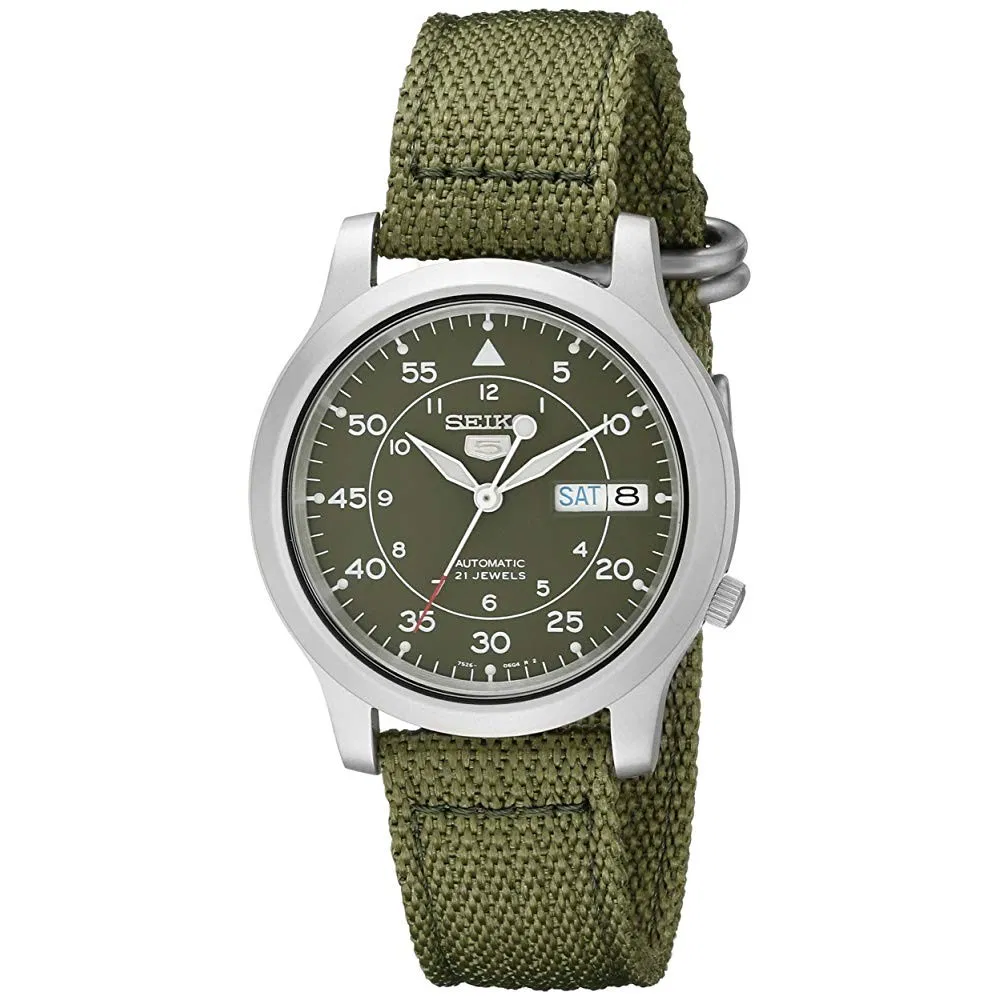
G-Shock GWM5610-1 Solar Atomic
🔥 Deal of the Day

G-Shock GWM5610-1 Solar Atomic

Casio

★★★★★ 4.8 (5,621 reviews)

$129

Offer expires in


🔥 Grab This Deal →

G-Shock GA2100-1A1 CasiOak


G-Shock GA2100-1A1 CasiOak

Casio

★★★★★ 4.8 (2,156 reviews)

$99


Check Price on Amazon →

Seiko 5 SNK805 Green Military


Seiko 5 SNK805 Green Military

Seiko

★★★★★ 4.8 (6,961 reviews)

$89


Check Price on Amazon →


Browse all expert-reviewed watches →

ETSY Shop
ETSY Shop
Redbubble Shop
Redbubble Shop
More Watch Facts
More Watch Facts

Watch Fact of the Day: The Seiko Diver Proven in Antarctica

In 1965, Seiko unleashed the 62MAS, a watch that made splashes—and probably more than a few ice cubes—out in the wild. Designed for divers, it survived the Antarctic from 1966 to 1969, proving it was ready for action instead of just posing as a pretty accessory. With its tough features and automatic charm, it paved the way for Seiko’s future dive watches, like the Tuna and Turtle. Forget mythical tales; this watch has real icy adventures to brag about. So, while it may not wear a cape, the 62MAS is the true hero of horology—defying nature like a pro!

Military Watches: Sunday, September 27, 2026

📅 Sunday, September 27, 2026

When Seiko introduced the 62MAS in 1965, it became the company’s first purpose-built diver’s watch—and Japan’s first of its kind. With an automatic movement, strong luminous markers, a rotating timing bezel, and 150 meters of water resistance, it was designed to be a serious working tool rather than a fashion accessory. Seiko Philippines (Official Store)

Its real test came soon afterward.

From 1966 to 1969, members of the Japanese Antarctic Research Expedition wore the 62MAS in one of the harshest environments on Earth. Sub-zero temperatures, snow, ice, moisture, and remote field conditions subjected the watch to the kind of punishment that no showroom demonstration could replicate. Seiko later pointed to that Antarctic service as an important early proof of the diver’s durability and reliability. Seiko Philippines (Official Store)

That matters because the 62MAS arrived at a pivotal moment in Seiko’s history.

The company was just beginning to establish itself as a serious maker of professional sports watches, and the 62MAS became the design and engineering foundation for generations of Seiko divers that followed. Its simple black dial, large luminous markers, date window, and no-nonsense case architecture created a visual language Seiko still revisits today. Monochrome Watches

💡 Did You Know?

The 62MAS is known by collectors today by a nickname derived from its 6217-series movement/reference and “automatic self-dater” identity, but its historical significance is much bigger than the nickname itself.

It was the starting point for a dive-watch family tree that eventually produced icons such as the 6105, the Tuna, the Turtle, and the modern Prospex line. Monochrome Watches

⭐ Why It Matters

The 62MAS didn’t need a mythical 50-day-under-the-ice survival story to be impressive.

It already had something better:

REAL ANTARCTIC SERVICE.

That’s what gives the watch its place in Seiko history.

It wasn’t just designed to look rugged.

It was actually used in an environment where equipment failure could matter.

1965 — SEIKO’S FIRST DIVER

1966–1969 — ANTARCTIC EXPEDITION USE

150 METERS — BUILT FOR REAL CONDITIONS


Category: Military Watches

Disclaimer: Every effort has been made to keep these watch facts accurate, but the world of horology is full of myths, disputed stories, and fascinating trivia. Consider these facts a starting point for discovery rather than the final word. If you have corrections or additional insights, let us know—we’re always happy to keep the record ticking in the right direction.

🕐 Discover more watch facts, reviews, and buying guides at WatchesAndMore


🛍️ You Might Also Like

As an Amazon Associate and affiliate partner, WatchesAndMore earns from qualifying purchases.

Seiko 5 SNK805 Green Military
🔥 Deal of the Day

Seiko 5 SNK805 Green Military

Seiko

★★★★★ 4.8 (6,961 reviews)

$89

Offer expires in


🔥 Grab This Deal →

Seiko 5 SNK809 Automatic


Seiko 5 SNK809 Automatic

Seiko

★★★★★ 4.7 (3,289 reviews)

$99


Check Price on Amazon →

Seiko 5 SNK803 Military


Seiko 5 SNK803 Military

Seiko

★★★★★ 4.7 (7,467 reviews)

$89


Check Price on Amazon →


Browse all 142+ expert-reviewed watches →

ETSY Shop
ETSY Shop
Redbubble Shop
Redbubble Shop
More Watch Facts
More Watch Facts

Watch Fact of the Day: The Bulova Accutron Astronaut That Flew With X-15 Pilots

The Bulova Accutron Astronaut is a cool piece of watch history, famous for being an electronic watch that predates quartz models. It used a unique tuning-fork movement, which made it super reliable for pilots flying in extreme conditions. This watch was even worn by X-15 pilots and CIA A-12 pilots on top-secret missions. On May 15, 1963, astronaut Gordon Cooper took an Accutron into space on his Mercury mission, where he relied on it for timing during a manual re-entry. Overall, the Accutron Astronaut showcases a pivotal moment in watch development, bridging the gap between mechanical and quartz technology.

Military Watches: Wednesday, September 23, 2026

📅 Wednesday, September 23, 2026

Before quartz watches took over the world—and before the Omega Speedmaster became synonymous with spaceflight—another electronic watch was already proving itself in some of the most extreme flying environments imaginable.

The Bulova Accutron Astronaut, powered by the remarkable Calibre 214 tuning-fork movement, became a tool watch for pilots operating at the very edge of conventional aviation.

Unlike a traditional mechanical watch, the Accutron did not regulate time with a balance wheel oscillating a few times per second.

Instead, its electrically powered tuning fork vibrated at:

360 HZ

That extraordinarily high frequency gave the movement exceptional stability for its era and helped make it well suited to high-speed, high-altitude environments. Historical accounts note that the Accutron’s low-inertia tuning-fork system handled high G-loads and temperature changes particularly well.

🚀 Then Came the X-15

The North American X-15 was not an ordinary airplane.

It was a rocket-powered experimental aircraft launched from beneath a B-52, designed to explore hypersonic flight, high-altitude control, extreme heating, and the edge of space.

Across 199 flights, the program eventually reached:

MACH 6.7

354,200 FEET

The data gathered helped shape later Mercury, Gemini, Apollo, and Space Shuttle development.

And according to Accutron, the Accutron Astronaut became the officially issued watch for X-15 pilots.

That is a remarkable piece of watch history.

This wasn’t merely a watch styled to look futuristic.

It was being worn by pilots flying one of the most advanced experimental aircraft ever built.

🕵️ And Then the CIA Wanted It

The story didn’t stop with the X-15.

The Accutron Astronaut was later issued to CIA pilots flying the Lockheed A-12, the secret reconnaissance aircraft developed for extreme-altitude, Mach 3-class missions. Accutron’s own history specifically notes the watch’s use by A-12 pilots.

Suddenly this one watch had connections to:

rocket planes

high-altitude reconnaissance

NASA

the CIA

early human spaceflight

Not bad for something that hummed instead of ticked. 😂⌚

Infographic about the Bulova Accutron Astronaut watch, highlighting its history with NASA and its use by X-15 pilots, featuring details about its technology and significance in space exploration.

🌎 Gordon Cooper Takes It Into Orbit

On May 15, 1963, Mercury astronaut Gordon Cooper launched aboard Faith 7 for the final mission of Project Mercury.

He completed more than 22 orbits and spent over 34 hours in space. Late in the mission, automatic control and electrical problems forced Cooper to conduct a manual re-entry. Despite those failures, he brought the capsule down with exceptional precision in the Pacific.

Contemporary and later historical accounts show Cooper wearing an Accutron Astronaut during the mission.

Cooper later recalled relying on a wristwatch during his manual re-entry calculations, though NASA’s current mission summaries do not identify the watch model in that specific moment.

So I’d phrase our article carefully:

The Accutron went with him into space.

His manual timing helped bring Faith 7 home.

That gives us the truth without overstating what the surviving NASA documentation specifically proves.

💡 Did You Know?

The Accutron Astronaut wasn’t really designed like a conventional dress watch at all.

It used:

a 24-hour hand

a rotating 24-hour bezel

a tuning-fork movement

electronic regulation

—all features that made it particularly useful to pilots operating across time zones and in demanding flight environments.

And the name Astronaut turned out to be remarkably appropriate.

⭐ Why It Matters

The Accutron Astronaut represents a strange transitional moment in watchmaking.

Mechanical watches still ruled.

Quartz hadn’t yet conquered the industry.

And here was a humming electronic watch using a tuning fork to achieve better stability in extreme environments.

It wasn’t quite mechanical.

It wasn’t quartz.

It was something entirely different.

And it found its way onto the wrists of:

X-15 PILOTS

CIA A-12 PILOTS

MERCURY ASTRONAUTS

That’s a serious résumé.

BEFORE QUARTZ.

BEFORE THE MOONWATCH LEGEND.

THERE WAS THE HUM OF THE ACCUTRON.


Category: Military Watches

Disclaimer: Every effort has been made to keep these watch facts accurate, but the world of horology is full of myths, disputed stories, and fascinating trivia. Consider these facts a starting point for discovery rather than the final word. If you have corrections or additional insights, let us know—we’re always happy to keep the record ticking in the right direction.

🕐 Discover more watch facts, reviews, and buying guides at WatchesAndMore


🛍️ You Might Also Like

As an Amazon Associate and affiliate partner, WatchesAndMore earns from qualifying purchases.

Bulova Precisionist
🔥 Deal of the Day

Bulova Precisionist

Bulova

★★★★★ 4.6 (1,100 reviews)

$219

Offer expires in


🔥 Grab This Deal →

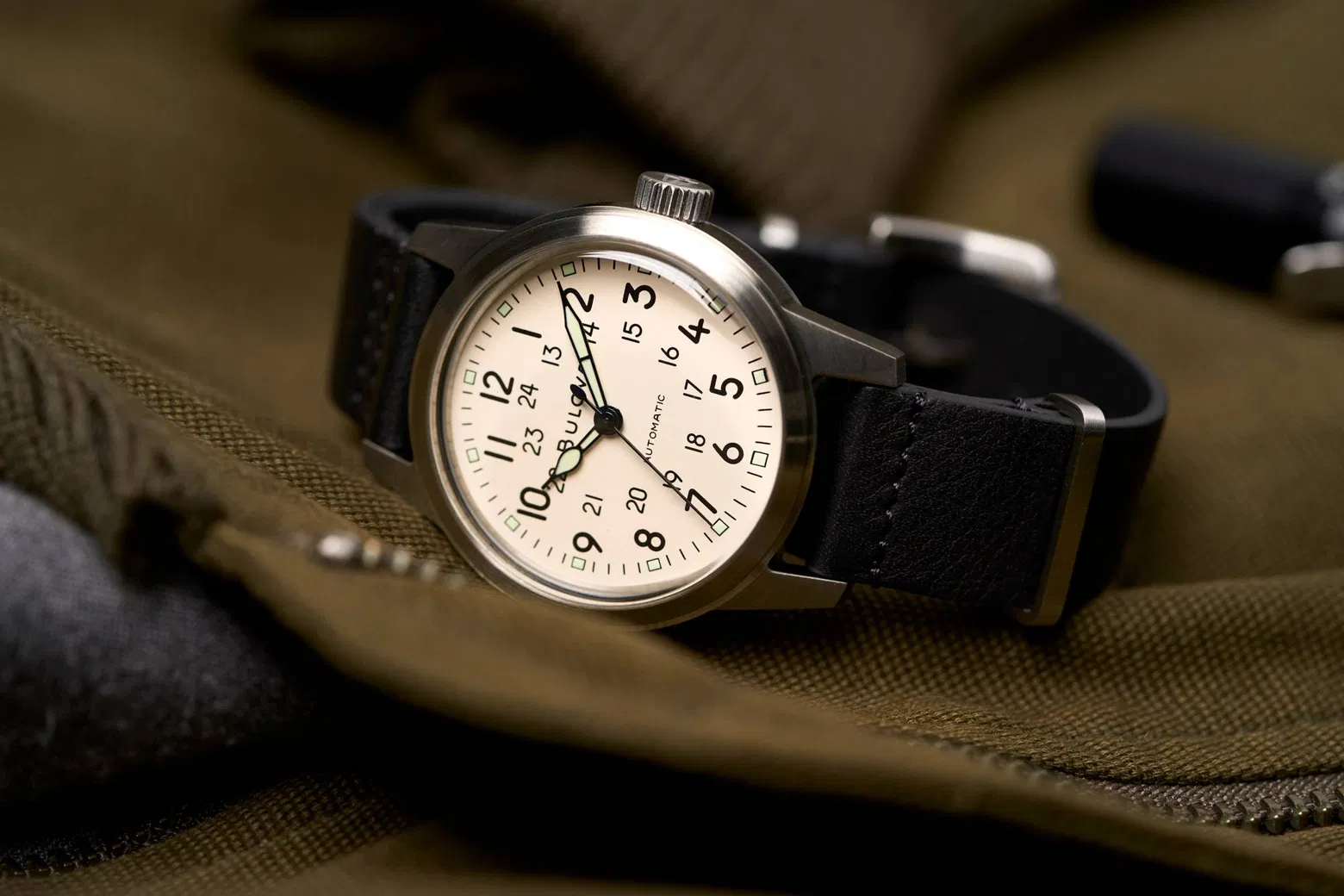
Bulova Military Hack Automatic


Bulova Military Hack Automatic

Bulova

★★★★☆ 4.4 (1,286 reviews)

$450


Check Price on Amazon →

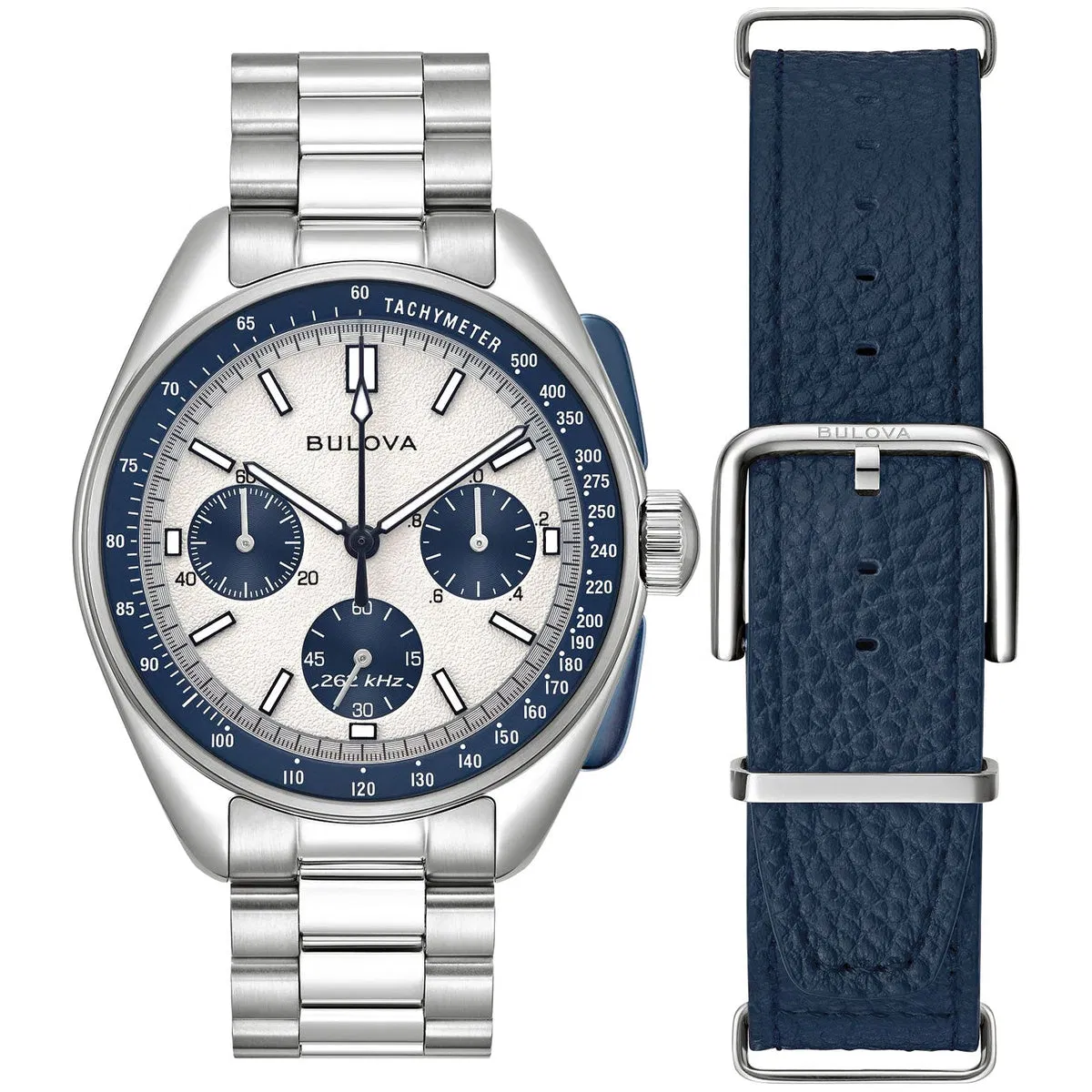
Bulova Lunar Pilot Chronograph


Bulova Lunar Pilot Chronograph

Bulova

★★★★★ 4.6 (810 reviews)

$478


Check Price on Amazon →


Browse all expert-reviewed watches →

Watch Fact of the Day: The Pocket Watch That Survived the Hindenburg Disaster

When the Hindenburg airship burst into flames in Lakehurst, New Jersey, in 1937, passenger Ernst Wendler carried a gold pocket watch in his vest. Miraculously r

Military Watches: Monday, September 21, 2026

📅 Monday, September 21, 2026

On the evening of May 6, 1937, the German airship LZ 129 Hindenburg approached the Naval Air Station at Lakehurst, New Jersey, after crossing the Atlantic from Frankfurt.

At approximately 7:25 p.m., while the ship was attempting to land, fire appeared near the stern. Within roughly half a minute, the enormous hydrogen-filled airship was engulfed and collapsing toward the ground. Of the 97 people aboard, 35 died, along with one member of the ground crew. HISTORY CHANNEL ITALIA

Among the crew was Walter Banholzer, a 28-year-old engine mechanic from Rottweil, Germany.

A vintage pocket watch that survived the Hindenburg disaster, showing signs of damage and history, surrounded by newspaper clippings and facts about the event. The background features an image of the Hindenburg in flames with a timeline of the disaster.

Banholzer had worked aboard the Hindenburg during its operational career and was assigned to the starboard aft engine section. At the time of the landing, however, he had been sent forward with several other crewmen to help compensate for the airship being tail-heavy. When the fire erupted, the flames tore rapidly through the ship. Banholzer survived the initial crash but was gravely burned and later died from his injuries. facesofthehindenburg.blogspot.com

What remained from that night included one extraordinary personal object:

His pocket watch.

A watch later offered by Hermann Historica was described as Walter Banholzer’s Omega pocket chronograph, carried during the Hindenburg disaster and partially destroyed by fire. The watch bears a 0.900 silver hallmark, the initials “WB” engraved on the cover, a damaged enamel dial with Roman numerals, and a small seconds register at 6 o’clock. It was sold with supporting photographs and family provenance documentation. Invaluable

The condition tells its own story.

The case is scorched.

The enamel dial is damaged.

The movement survived only partially intact.

It is not a pristine collector’s watch.

It is a witness.

💡 Did You Know?

Banholzer’s location aboard the Hindenburg was misunderstood for decades.

Early diagrams placed him in an engine gondola at the time of the fire. Later research using witness testimony and crew-position records showed that he had actually been sent forward toward the bow shortly before the disaster to help trim the tail-heavy airship. facesofthehindenburg.blogspot.com

That detail matters because it brings us closer to the human reality of the final minutes.

He was not simply “aboard the Hindenburg.”

He was working.

Following orders.

Helping prepare the ship to land.

And carrying an ordinary personal timepiece that would outlive him.

⭐ Why It Matters

Historic disasters often become enormous stories.

Names.

Numbers.

Photographs.

Headlines.

The Hindenburg became one of the most recognizable images in aviation history, and the catastrophe helped destroy public confidence in passenger airships. HISTORY CHANNEL ITALIA

But objects like Banholzer’s watch make those events personal again.

Not an airship.

Not a headline.

One mechanic.

One pocket watch.

One evening in 1937.

That is why surviving artifacts matter.

They shrink history back down to human scale.


Category: Military Watches

Disclaimer: Every effort has been made to keep these watch facts accurate, but the world of horology is full of myths, disputed stories, and fascinating trivia. Consider these facts a starting point for discovery rather than the final word. If you have corrections or additional insights, let us know—we’re always happy to keep the record ticking in the right direction.

🕐 Discover more watch facts, reviews, and buying guides at WatchesAndMore


🛍️ You Might Also Like

As an Amazon Associate and affiliate partner, WatchesAndMore earns from qualifying purchases.

G-Shock GWM5610-1 Solar Atomic
🔥 Deal of the Day

G-Shock GWM5610-1 Solar Atomic

Casio

★★★★★ 4.8 (5,621 reviews)

$129

Offer expires in


🔥 Grab This Deal →

G-Shock GA2100-1A1 CasiOak


G-Shock GA2100-1A1 CasiOak

Casio

★★★★★ 4.8 (2,156 reviews)

$99


Check Price on Amazon →

Seiko 5 SNK805 Green Military


Seiko 5 SNK805 Green Military

Seiko

★★★★★ 4.8 (6,961 reviews)

$89


Check Price on Amazon →


Browse all 142+ expert-reviewed watches →

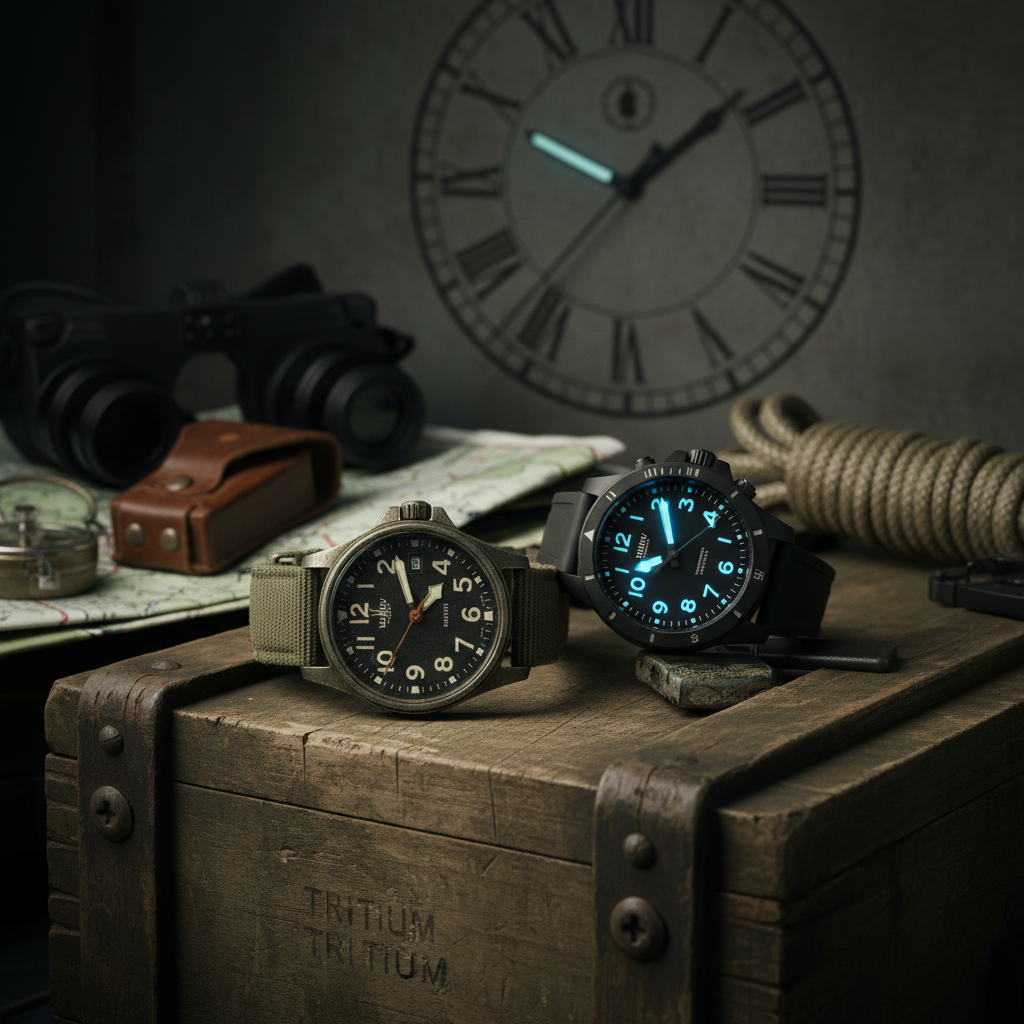
Watch Fact of the Day: The Military Watch That Made Darkness Its Specialty

Luminox watches are like that friend who never runs out of battery—talk about commitment! Forget the fuss of charging or hunting for a button in the dark; these watches flaunt Luminox Light Technology that continuously glows thanks to self-powered micro gas light tubes. You can read the time even if it’s pitch black, and they last up to 25 years. Collaborating with Navy SEALs back in the day, Luminox ensured your watch is as tough as your morning coffee. So, when the lights go out, just look down and bask in your illuminated wrist, knowing time waits for no one—especially not for a dead battery!

Military Watches: Sunday, September 20, 2026

📅 Sunday, September 20, 2026

Most luminous watches need one of two things.

They either need to be charged by light, or they need electrical power to illuminate the display.

Luminox took a different route.

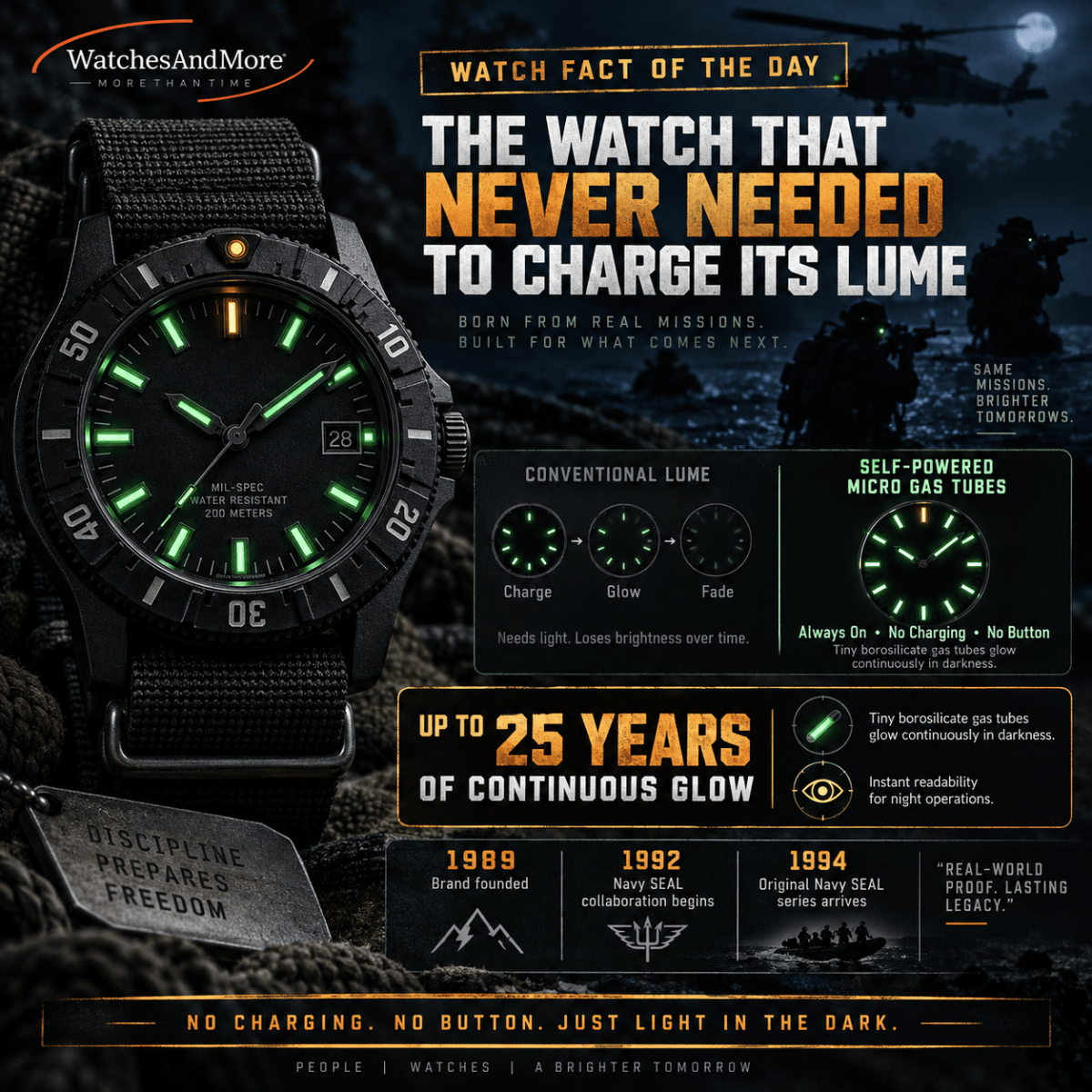
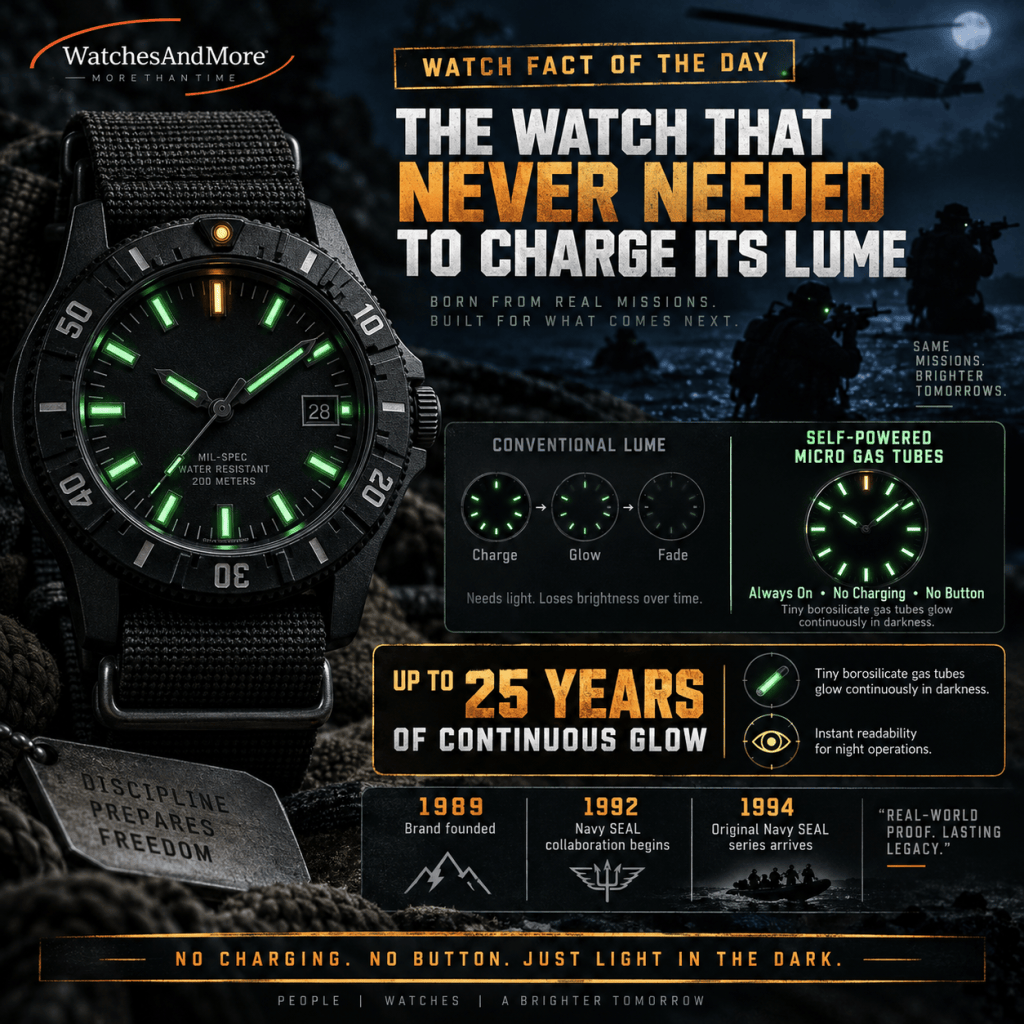
Its signature Luminox Light Technology, or LLT, uses tiny self-powered micro gas light tubes installed on the hands, hour markers and, on some models, the bezel. These borosilicate glass capsules remain illuminated continuously, allowing the watch to be read in complete darkness without pressing a button or first exposing it to a light source. Luminox Watches

And the duration is remarkable.

Luminox says the system provides visibility for up to:

25 YEARS

The intensity is guaranteed to remain constant for the first ten years, after which the glow gradually becomes weaker as the gas loses energy. Luminox Watches

That distinction matters because conventional photoluminescent materials work differently.

A material such as Super-LumiNova® must first absorb energy from natural or artificial light. It then releases that stored energy gradually, typically remaining visibly luminous for a matter of hours.

Luminox’s system is simply:

ALWAYS ON.

No charging.

No button.

No additional battery consumption.

Just continuous visibility. Luminox Watches

🌙 Then the Navy SEAL Connection Happened

Luminox had been producing high-visibility sports watches since 1989.

Then, in 1992, Chief Nick North, the Assistant Research, Development, Test and Evaluation officer for the Navy SEALs, was tasked with finding a more dependable watch for night missions.

According to Luminox, North discovered the company’s illumination technology and worked with Luminox to develop a watch specifically for SEAL use. Luminox Watches

The result became the Original Navy SEAL 3000 Series, first introduced commercially in 1994.

Its combination of:

continuous night visibility

light weight

rugged construction

water resistance

made it one of the watches most closely associated with the Luminox identity. Luminox Canada

💡 Did You Know?

The name Luminox itself tells you exactly what the company wanted to represent.

LUMI — derived from light

NOX — Latin for night

In other words:

LIGHT IN THE DARK.

That philosophy became the brand’s defining feature. Luminox Watches

⭐ Why It Matters

The important innovation wasn’t simply that Luminox made a bright watch.

It was that the watch could remain immediately readable without depending on the wearer to do anything first.

That distinction matters in environments where visibility has to be instant.

No:

“Did I charge the lume?”

No:

“Where’s the illumination button?”

Instead:

LOOK DOWN.

READ THE TIME.

That practicality helped transform self-powered micro-gas illumination from a specialized technology into one of the most recognizable features in modern tactical-watch design.

1989 — LUMINOX BEGINS

1992 — NAVY SEAL COLLABORATION

1994 — ORIGINAL 3000 SERIES

UP TO 25 YEARS OF CONTINUOUS GLOW


Category: Military Watches

Disclaimer: Every effort has been made to keep these watch facts accurate, but the world of horology is full of myths, disputed stories, and fascinating trivia. Consider these facts a starting point for discovery rather than the final word. If you have corrections or additional insights, let us know—we’re always happy to keep the record ticking in the right direction.

🕐 Discover more watch facts, reviews, and buying guides at WatchesAndMore


🛍️ You Might Also Like

As an Amazon Associate and affiliate partner, WatchesAndMore earns from qualifying purchases.

G-Shock GWM5610-1 Solar Atomic
🔥 Deal of the Day

G-Shock GWM5610-1 Solar Atomic

Casio

★★★★★ 4.8 (5,621 reviews)

$129

Offer expires in


🔥 Grab This Deal →

G-Shock GA2100-1A1 CasiOak


G-Shock GA2100-1A1 CasiOak

Casio

★★★★★ 4.8 (2,156 reviews)

$99


Check Price on Amazon →

Seiko 5 SNK805 Green Military


Seiko 5 SNK805 Green Military

Seiko

★★★★★ 4.8 (6,961 reviews)

$89


Check Price on Amazon →


Browse all expert-reviewed watches →

Watch Fact of the Day: The Legend of Hanhart’s Iconic Red Chronograph Pusher

Ah, the infamous red pusher on a Hanhart pilot’s chronograph! It’s like the watch world’s version of a “don’t touch” sign, ensuring pilots don’t accidentally reset their crucial timing—because, you know, hitting the wrong button could be a bit of a timing disaster. Introduced in 1939, this vibrant button has also spawned a whimsical legend: a lovesick pilot had his button painted red with nail polish by his girlfriend, so he’d think of her while soaring through the skies. Whether true or not, it’s a fun tale that adds sparkle to an otherwise serious timepiece. One button, two stories—talk about a ticking mystery!

Watch Fact of the Day: The Legend of Hanhart’s Iconic Red Chronograph Pusher

📅 Saturday, September 12, 2026

Look at a classic Hanhart pilot’s chronograph and one detail immediately jumps out.

That red pusher. 🔴

It has become such a recognizable part of Hanhart’s design language that today it almost functions as a visual signature for the German watchmaker.

But unlike many decorative flourishes in watchmaking, the red button originally had a very practical purpose.

In 1939, Hanhart introduced its Tachy Tele and legendary Calibre 41 pilot chronographs following the company’s first series-produced Calibre 40 chronograph of 1938. Some of these early watches featured a distinctive red-lacquered chronograph pusher. Hanhart Chronographen

The reason was simple:

DON’T PRESS THIS BY ACCIDENT.

For a pilot relying on elapsed time, accidentally resetting the chronograph could erase an important timing measurement. The bright signal color made the reset control immediately recognizable and warned the wearer against pressing it unintentionally. Hanhart itself says the feature was intended to prevent pilots from inadvertently resetting their stopped time. Hanhart Chronographen

But that’s only half the story.

Because somewhere along the way, that little red button acquired one of the most romantic legends in watchmaking.

❤️ The Nail Polish Legend

According to Hanhart’s own telling of the folklore, a pilot prepared to leave home for another flight.

After saying goodbye, he later looked down at his Hanhart chronograph in the hangar and discovered something unexpected.

One of the pushers had been painted red with nail polish by the woman he loved.

The idea was that whenever he looked at the red button during his mission, he would think of her—and remember to return safely home. Hanhart Chronographen

There’s just one problem.

Nobody knows whether it actually happened.

And wonderfully, Hanhart itself acknowledges that uncertainty. On its current 417 ES Heritage material, the manufacture tells the romantic story and then explicitly says that it is unclear whether the legend is true. Hanhart Chronographen

That distinction is important for our Watch Fact.

We have:

DOCUMENTED HISTORY: 🔴
The red pusher served as a visual warning against accidentally resetting the chronograph.

And:

HOROLOGICAL FOLKLORE: ❤️
A pilot’s lover supposedly painted the button with red nail varnish so he would think of her and return safely.

Put those two stories together and you get one of watchmaking’s great little mysteries.

💡 Did You Know?

The red pusher wasn’t merely an aesthetic choice on watches equipped with a flyback chronograph.

A flyback allows the running chronograph to be reset and restarted immediately with a single press. That makes the function extremely useful when timing consecutive events—but it also makes an accidental press particularly consequential.

On modern Hanhart flyback models, the company still explains the red reset pusher as a warning against unintentionally resetting the elapsed time. Hanhart Chronographen

So that tiny splash of color was effectively an early form of human-interface design:

BLACK PUSHER → OPERATE

🔴 RED PUSHER → THINK BEFORE YOU PRESS

And that was happening on a mechanical wristwatch in 1939.

⭐ Why It Matters

This is exactly the kind of story that makes vintage watches fascinating.

You could look at the red pusher and assume:

“That’s just Hanhart’s design signature.”

But behind that tiny detail is an entire story involving aviation, chronograph functionality, cockpit usability, wartime-era watchmaking—and possibly even a bottle of red nail polish.

What began as a practical warning eventually became something much bigger:

A TRADEMARK.

A LEGEND.

A SYMBOL OF HANHART.

And Hanhart continues using the red-pusher identity today. Its modern watches reinterpret the feature using contemporary materials, including red HyCeram® on some current models. Hanhart Chronographen

ONE RED BUTTON.

TWO STORIES.

ONE HOROLOGICAL LEGEND.

And BBC Creative Department is already halfway through the infographic. 😂🔥

This one should look like a 1939 German aviation magazine × pilot’s flight log × wartime mechanical-instrument advertisement.

Almost everything is monochrome:

charcoal • aged ivory • aircraft aluminium • faded leather • black-and-white photography

Except for ONE THING.

🔴 THE PUSHER.

Brilliant deep red.

Centerpiece: enormous vintage Hanhart pilot chronograph, slightly angled, with the red reset button practically glowing against the otherwise desaturated image.

On one side:

THE DOCUMENTED PURPOSE

✈️ PILOT TIMING
↓
⏱️ CHRONOGRAPH RUNNING
↓
🔴 RED = DON’T RESET ACCIDENTALLY

On the other:

THE LEGEND

💅 RED NAIL POLISH
↓
❤️ REMEMBER HER
↓
✈️ COME HOME SAFELY

And across the top:

WHY WAS THIS BUTTON PAINTED RED?

Then the bottom payoff:

FUNCTION BECAME TRADITION.

TRADITION BECAME A LEGEND.

Ohhhhh yeah.


Category: Military Watches

Disclaimer: Every effort has been made to keep these watch facts accurate, but the world of horology is full of myths, disputed stories, and fascinating trivia. Consider these facts a starting point for discovery rather than the final word. If you have corrections or additional insights, let us know—we’re always happy to keep the record ticking in the right direction.

🕐 Discover more watch facts, reviews, and buying guides at WatchesAndMore


🛍️ You Might Also Like

As an Amazon Associate and affiliate partner, WatchesAndMore earns from qualifying purchases.

G-Shock GWM5610-1 Solar Atomic
🔥 Deal of the Day

G-Shock GWM5610-1 Solar Atomic

Casio

★★★★★ 4.8 (5,621 reviews)

$129

Offer expires in


🔥 Grab This Deal →

G-Shock GA2100-1A1 CasiOak


G-Shock GA2100-1A1 CasiOak

Casio

★★★★★ 4.8 (2,156 reviews)

$99


Check Price on Amazon →

Seiko 5 SNK805 Green Military


Seiko 5 SNK805 Green Military

Seiko

★★★★★ 4.8 (6,961 reviews)

$89


Check Price on Amazon →


Browse all 142+ expert-reviewed watches →

Watch Fact of the Day: Panerai’s Secret Decades as a Strictly Military Supplier

So, Panerai started out making watches for the Italian Navy before becoming a luxury brand we know today. Back in the 1910s, they supplied military gear and developed radium-based compounds for visibility in darkness. They really got going in the 1930s with underwater watches for special ops, leading to the iconic Radiomir in the 40s, which was designed for harsh conditions. But it wasn’t until 1993 that they opened up to civilians, letting everyday folks buy their seriously cool designs. So, what looks like a fashion statement today was actually built for military purposes first.

Military Watches: Tuesday, September 8, 2026

📅 Tuesday, September 8, 2026

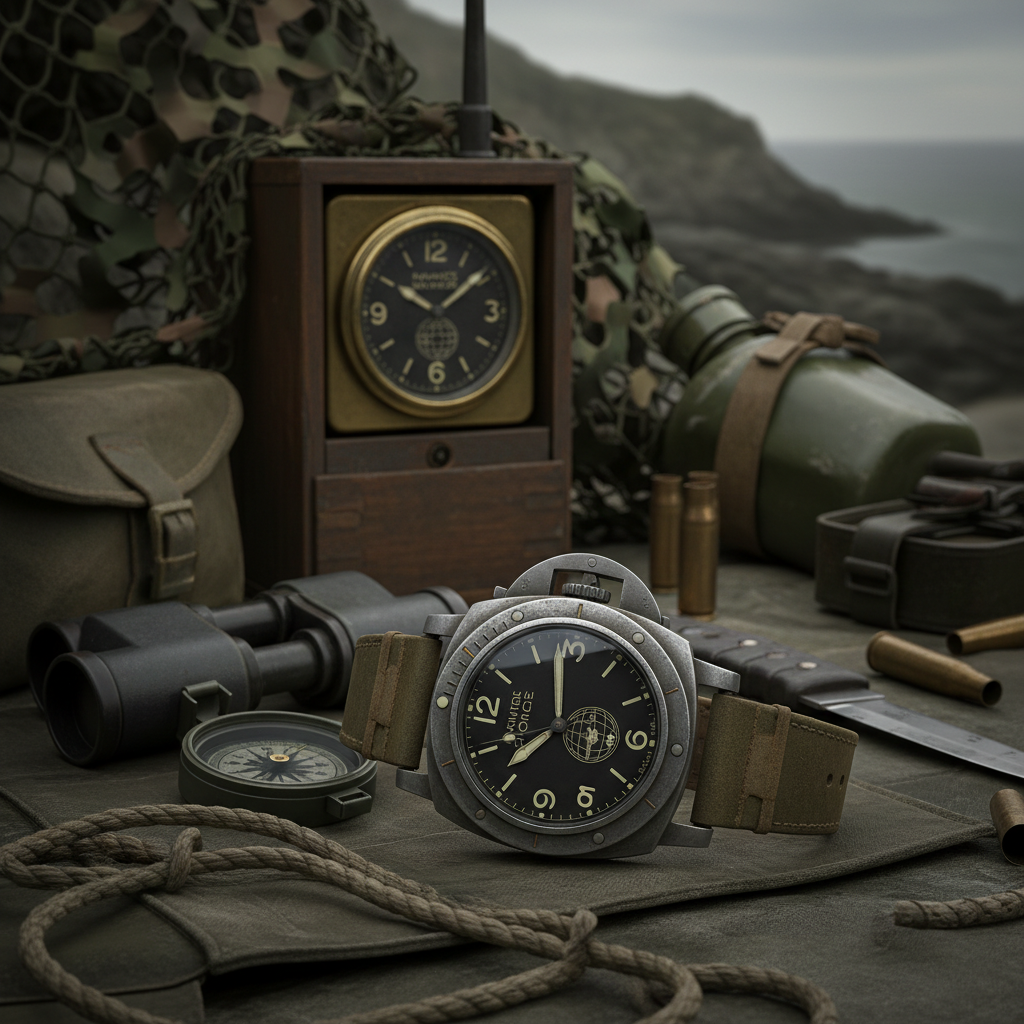
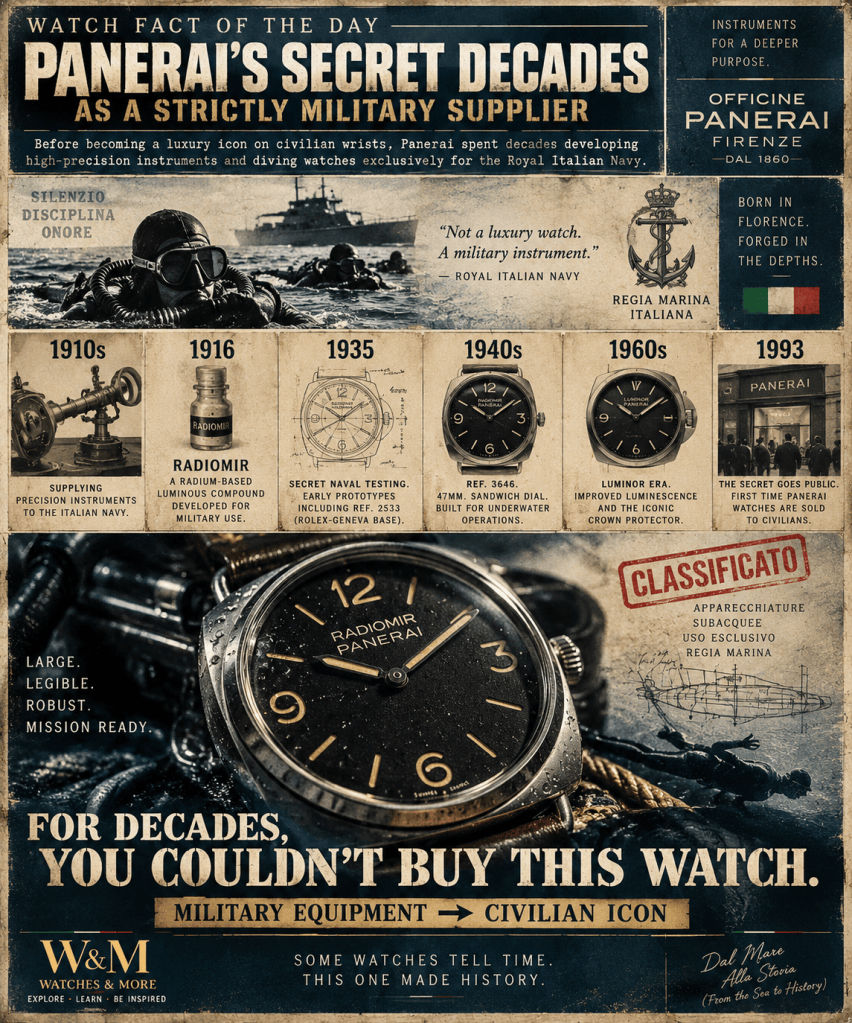
Long before Panerai became one of the most recognizable names in luxury sports watches, its oversized timepieces weren’t sitting in boutique windows. They were being developed as military instruments for Italian naval forces, and for decades the watches and much of the technology behind them remained far removed from the civilian market.

Panerai’s military relationship actually predates its famous diving watches. Beginning in the 1910s, the Florentine company supplied the Italian Navy with precision instruments, including naval combat sights. In 1916, Panerai documented the name Radiomir for a radium-based luminous compound developed to make military instruments readable in darkness.

Then things became considerably more interesting beneath the surface.

In 1935, the Royal Italian Navy began a secret program involving new underwater assault vehicles and operators. Panerai participated by developing specialized instruments, including experimental underwater watches. According to Panerai’s account of Italian Navy archives, several prototypes were commissioned for testing, with Ref. 2533, based on a watch supplied by Rolex-Geneva and modified by Panerai, emerging as the best result.

By the 1940s came the legendary Radiomir Ref. 3646. It was enormous by contemporary standards: approximately 47 mm, with a cushion-shaped steel case, welded wire lugs and a long water-resistant leather strap designed to fit over protective diving clothing. Inside was a hand-wound Cortebert/Rolex 618 pocket-watch-derived calibre.

But arguably its most important feature was what happened in darkness.

Panerai developed its now-famous sandwich dial, using overlapping plates and large cut-out numerals and markers so the luminous material underneath could shine through strongly. Radiomir’s radium-based compound provided extraordinary visibility in poor-light conditions—exactly what naval operators needed underwater. The hazardous radium material was eventually replaced by a lower-radiation tritium-based compound called Luminor, which would give another legendary Panerai family its name.

The watches weren’t luxury accessories. They were purpose-built military tools, developed around requirements for visibility, water resistance, robustness and operation under extreme conditions. Panerai itself says the watches were produced strictly for military use and used by the forces into the early 1970s, while their designs remained protected by military secrecy.

And that’s what makes 1993 such an extraordinary dividing line in Panerai history.

For the first time, Officine Panerai entered the civilian watch market, unveiling limited and numbered versions of the Luminor, Luminor Marina and Mare Nostrum. The collection was presented on September 10, 1993, appropriately enough at the military harbor of La Spezia aboard the Italian Navy vessel Durand De La Penne. Panerai’s own historical account explicitly describes this moment as relieving CEO Dino Zei from maintaining military secrecy over these products.

Suddenly, a design language that had spent decades associated with naval specialists could be purchased by ordinary enthusiasts.

💡 Did You Know?

Those gigantic early Panerai watches weren’t oversized simply to make a fashion statement. The 47 mm case, highly luminous dial, minimal hour markings and long strap all made sense as functional equipment intended to remain legible and wearable in demanding underwater conditions—including over protective clothing.

What looks unmistakably “Panerai” today was largely born from function rather than fashion.

47 MM CASE → MAXIMUM LEGIBILITY

SANDWICH DIAL → POWERFUL LUMINESCENCE

LONG STRAP → OVER DIVING GEAR
ROBUST CONSTRUCTION → MILITARY DUTY

⭐ Why It Matters

Panerai’s story is unusual because the civilian luxury brand effectively arrived after much of its visual identity had already been established for an entirely different purpose.

The cushion-shaped cases, enormous numerals, sandwich dials, luminous displays and later crown-protection system weren’t originally designed to make a watch recognizable from across a cocktail lounge.

They were solutions to military requirements.

Then in 1993, the secret finally stepped into civilian life.

BUILT FOR THE NAVY.

HIDDEN FOR DECADES.

RELEASED TO THE PUBLIC.


Category: Military Watches

Disclaimer: Every effort has been made to keep these watch facts accurate, but the world of horology is full of myths, disputed stories, and fascinating trivia. Consider these facts a starting point for discovery rather than the final word. If you have corrections or additional insights, let us know—we’re always happy to keep the record ticking in the right direction.

🕐 Discover more watch facts, reviews, and buying guides at WatchesAndMore


🛍️ You Might Also Like

As an Amazon Associate and affiliate partner, WatchesAndMore earns from qualifying purchases.

G-Shock GWM5610-1 Solar Atomic
🔥 Deal of the Day

G-Shock GWM5610-1 Solar Atomic

Casio

★★★★★ 4.8 (5,621 reviews)

$129

Offer expires in


🔥 Grab This Deal →

G-Shock GA2100-1A1 CasiOak


G-Shock GA2100-1A1 CasiOak

Casio

★★★★★ 4.8 (2,156 reviews)

$99


Check Price on Amazon →

Seiko 5 SNK805 Green Military


Seiko 5 SNK805 Green Military

Seiko

★★★★★ 4.8 (6,961 reviews)

$89


Check Price on Amazon →


Browse all 142+ expert-reviewed watches →