

Watch Fact of the Day: The Stopwatch That Timed the First Flight at Kitty Hawk

On December 17, 1903, Wilbur and Orville Wright achieved a monumental breakthrough in aviation history, completing the first powered flight at Kitty Hawk. Using an unassuming hand-held stopwatch made by Gallet, they precisely recorded their flights: the first lasted 12 seconds over 120 feet, and the fourth reached 59 seconds across 852 feet. While the stopwatch itself appears ordinary, it symbolized the significance of timing in experimental flight and became an essential witness to this historic event. This simple instrument reminds us that remarkable achievements can stem from the smallest tools, ultimately transforming transportation and exploration for generations to come.

Military Watches: Monday, September 28, 2026

📅 Monday, September 28, 2026

Watch Fact of the Day: The Stopwatch That Timed the First Flight at Kitty Hawk

On the morning of December 17, 1903, Wilbur and Orville Wright stood on the windswept dunes near Kitty Hawk, North Carolina, ready to attempt something no one had yet achieved in a controlled, powered aircraft.

At 10:35 a.m., Orville climbed aboard the Wright Flyer.

Wilbur ran alongside.

The aircraft lifted from the rail.

And for exactly:

12 SECONDS

the world changed.

The Flyer traveled 120 feet before touching down. Later that same day, the brothers made three more flights, with the final attempt covering 852 feet in 59 seconds. Air and Space Museum

But how did they know those exact times?

They used a small hand-held stopwatch.

The National Air and Space Museum preserves that stopwatch today and identifies it as the instrument Wilbur and Orville used to time the historic flights at Kitty Hawk. Air and Space Museum

A Tiny Instrument at a Giant Moment

The stopwatch itself is remarkably ordinary-looking.

It has a nickel-plated case, a white porcelain dial with black Arabic numerals, and a smaller inset register for minutes.

No precious metal.

No complicated movement.

No dramatic decoration.

Just a practical timing instrument made by Gallet.

Yet on that cold December morning, it became one of the quiet witnesses to the birth of powered aviation. Smithsonian Institution

Why Timing Mattered

The Wright brothers were not simply trying to make an aircraft leave the ground.

They were conducting experiments.

Every flight produced data:

distance

duration

wind

control

engine performance

The stopwatch turned those fleeting seconds into measurable evidence.

The first flight:

12 SECONDS

120 FEET

The fourth:

59 SECONDS

852 FEET The Library of Congress

Those numbers became part of aviation history because someone measured them.

💡 Did You Know?

The Wright Flyer was powered by a lightweight engine built with the help of their mechanic Charlie Taylor.

Taylor helped design the engine and did virtually all of the machine work needed to produce it. The crankcase was made from aluminum—an important weight-saving choice for the Flyer. Air and Space Museum

So while the stopwatch did not make the airplane fly, it was there to record exactly how long humanity stayed airborne.

That makes it a beautiful reminder that big breakthroughs often depend on very small instruments.

⭐ Why It Matters

The Wright brothers’ stopwatch is not famous because it was luxurious.

It matters because it measured a moment no one had ever measured before.

12 SECONDS

That was enough.

Enough to prove controlled powered flight was possible.

Enough to open the door to aviation.

Enough to change transportation, warfare, exploration, commerce, and eventually spaceflight.

THE AIRPLANE MADE HISTORY.

THE STOPWATCH COUNTED THE SECONDS.


Category: Military Watches

Disclaimer: Every effort has been made to keep these watch facts accurate, but the world of horology is full of myths, disputed stories, and fascinating trivia. Consider these facts a starting point for discovery rather than the final word. If you have corrections or additional insights, let us know—we’re always happy to keep the record ticking in the right direction.

🕐 Discover more watch facts, reviews, and buying guides at WatchesAndMore


🛍️ You Might Also Like

As an Amazon Associate and affiliate partner, WatchesAndMore earns from qualifying purchases.
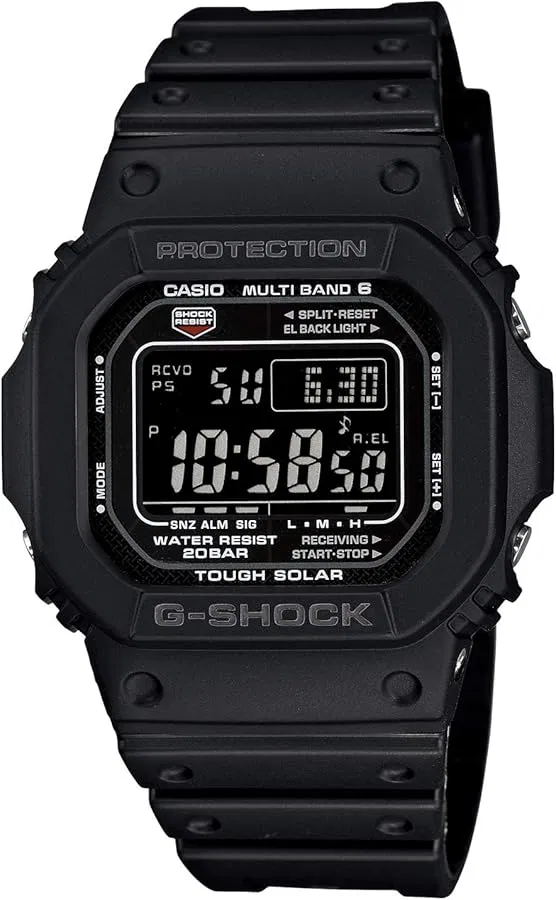
G-Shock GWM5610-1 Solar Atomic
🔥 Deal of the Day

G-Shock GWM5610-1 Solar Atomic

Casio

★★★★★ 4.8 (5,621 reviews)

$129

Offer expires in


🔥 Grab This Deal →

G-Shock GA2100-1A1 CasiOak


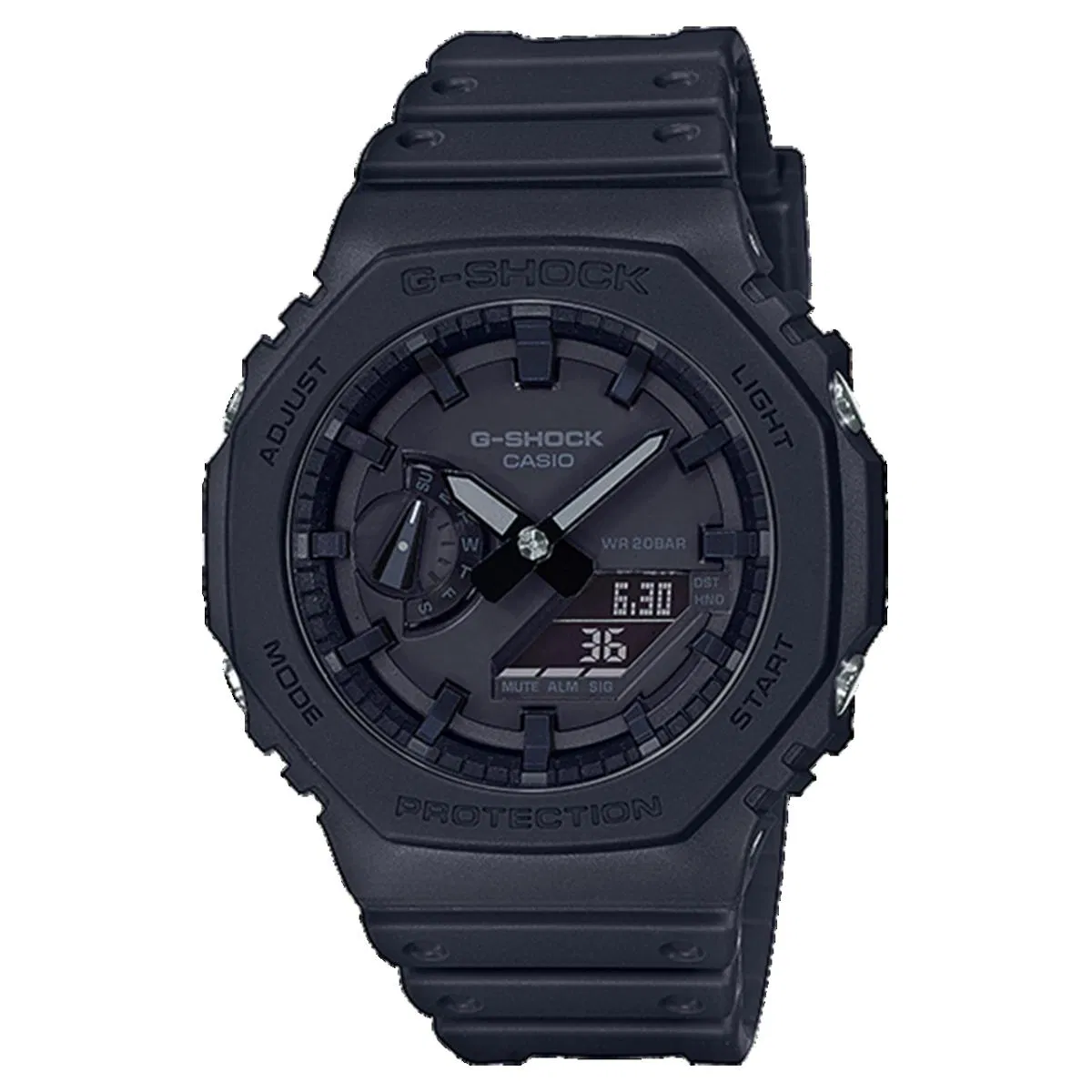
G-Shock GA2100-1A1 CasiOak

Casio

★★★★★ 4.8 (2,156 reviews)

$99


Check Price on Amazon →

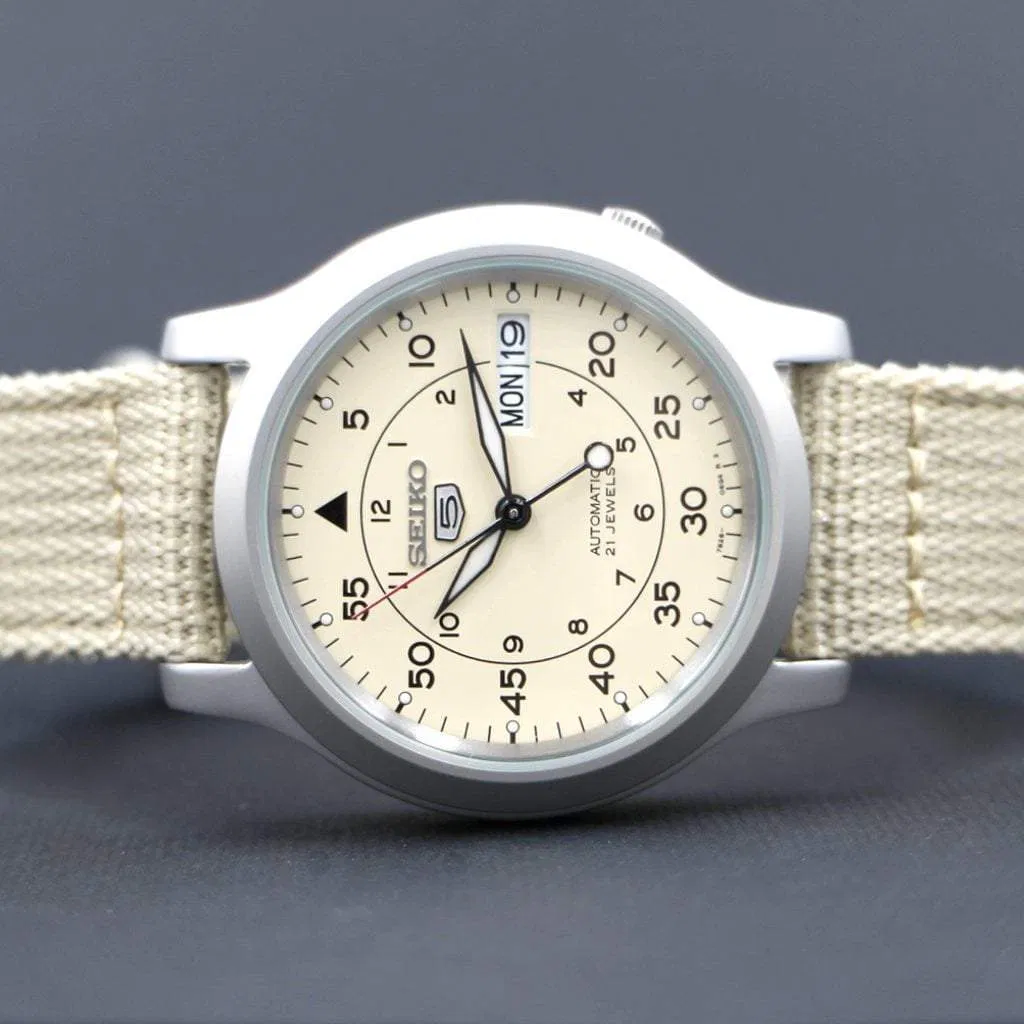
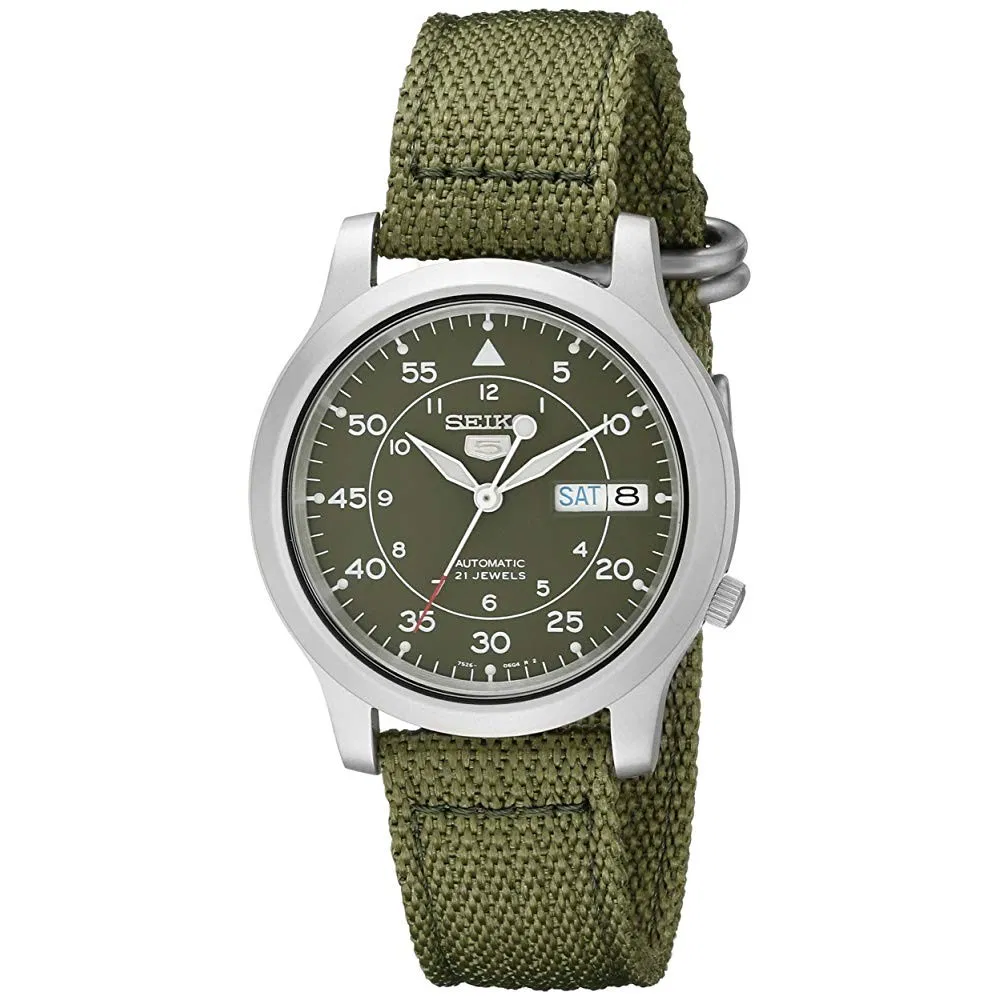
Seiko 5 SNK805 Green Military


Seiko 5 SNK805 Green Military

Seiko

★★★★★ 4.8 (6,961 reviews)

$89


Check Price on Amazon →


Browse all expert-reviewed watches →

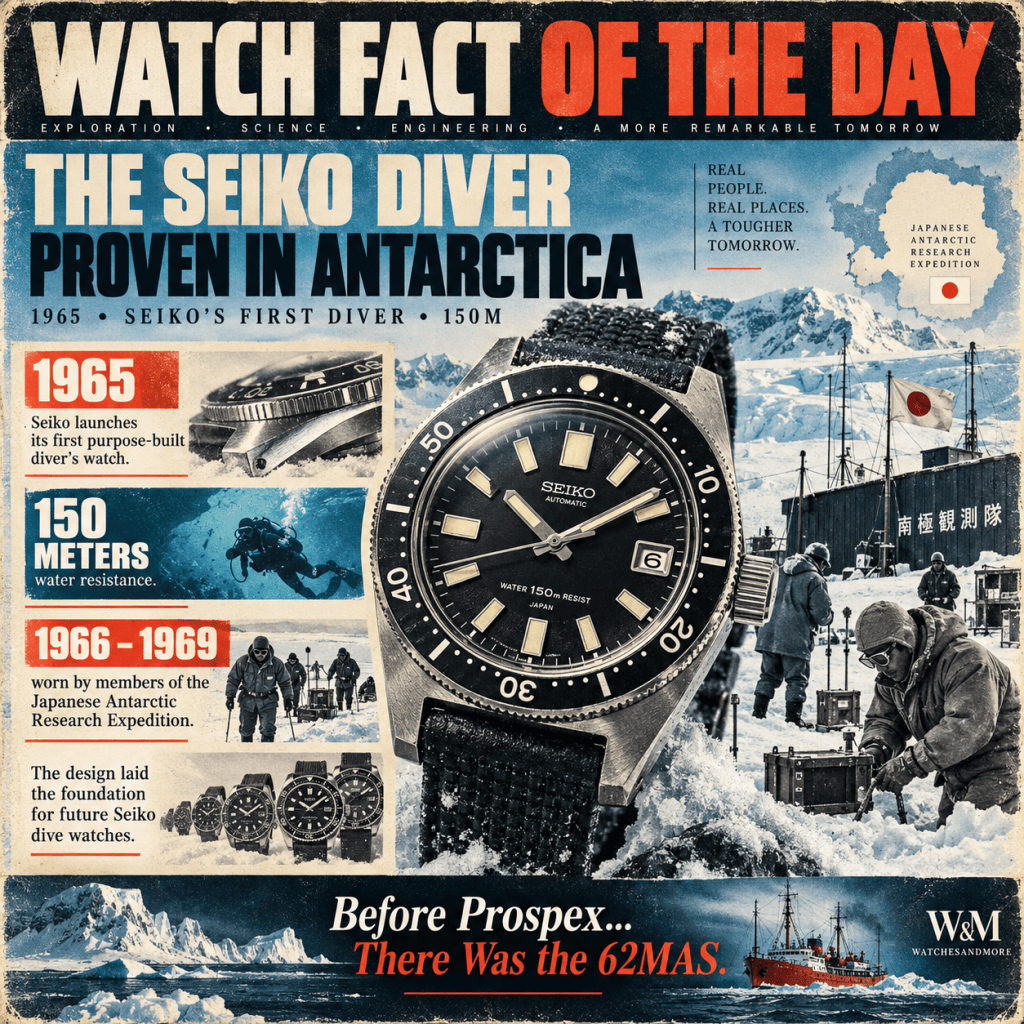
Watch Fact of the Day: The Seiko Diver Proven in Antarctica

In 1965, Seiko unleashed the 62MAS, a watch that made splashes—and probably more than a few ice cubes—out in the wild. Designed for divers, it survived the Antarctic from 1966 to 1969, proving it was ready for action instead of just posing as a pretty accessory. With its tough features and automatic charm, it paved the way for Seiko’s future dive watches, like the Tuna and Turtle. Forget mythical tales; this watch has real icy adventures to brag about. So, while it may not wear a cape, the 62MAS is the true hero of horology—defying nature like a pro!

Military Watches: Sunday, September 27, 2026

📅 Sunday, September 27, 2026

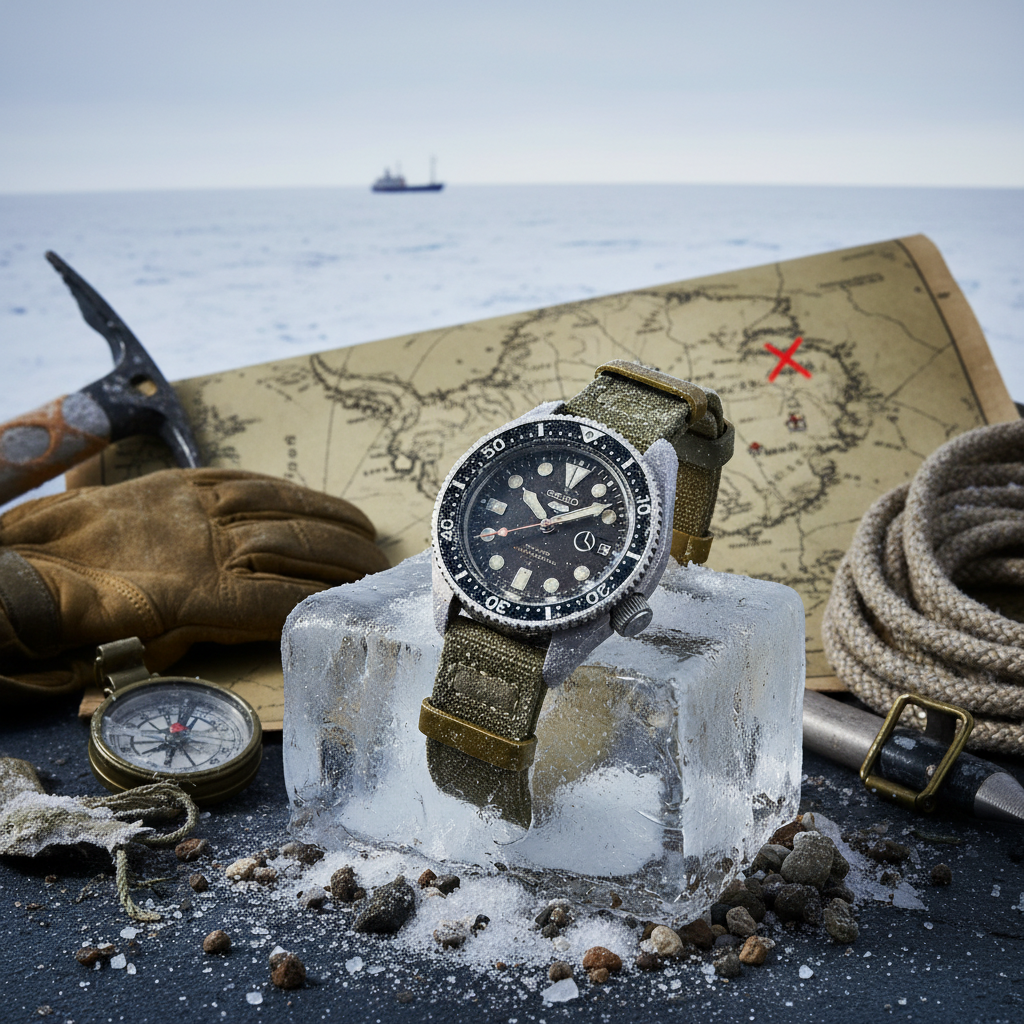
When Seiko introduced the 62MAS in 1965, it became the company’s first purpose-built diver’s watch—and Japan’s first of its kind. With an automatic movement, strong luminous markers, a rotating timing bezel, and 150 meters of water resistance, it was designed to be a serious working tool rather than a fashion accessory. Seiko Philippines (Official Store)

Its real test came soon afterward.

From 1966 to 1969, members of the Japanese Antarctic Research Expedition wore the 62MAS in one of the harshest environments on Earth. Sub-zero temperatures, snow, ice, moisture, and remote field conditions subjected the watch to the kind of punishment that no showroom demonstration could replicate. Seiko later pointed to that Antarctic service as an important early proof of the diver’s durability and reliability. Seiko Philippines (Official Store)

That matters because the 62MAS arrived at a pivotal moment in Seiko’s history.

The company was just beginning to establish itself as a serious maker of professional sports watches, and the 62MAS became the design and engineering foundation for generations of Seiko divers that followed. Its simple black dial, large luminous markers, date window, and no-nonsense case architecture created a visual language Seiko still revisits today. Monochrome Watches

💡 Did You Know?

The 62MAS is known by collectors today by a nickname derived from its 6217-series movement/reference and “automatic self-dater” identity, but its historical significance is much bigger than the nickname itself.

It was the starting point for a dive-watch family tree that eventually produced icons such as the 6105, the Tuna, the Turtle, and the modern Prospex line. Monochrome Watches

⭐ Why It Matters

The 62MAS didn’t need a mythical 50-day-under-the-ice survival story to be impressive.

It already had something better:

REAL ANTARCTIC SERVICE.

That’s what gives the watch its place in Seiko history.

It wasn’t just designed to look rugged.

It was actually used in an environment where equipment failure could matter.

1965 — SEIKO’S FIRST DIVER

1966–1969 — ANTARCTIC EXPEDITION USE

150 METERS — BUILT FOR REAL CONDITIONS


Category: Military Watches

Disclaimer: Every effort has been made to keep these watch facts accurate, but the world of horology is full of myths, disputed stories, and fascinating trivia. Consider these facts a starting point for discovery rather than the final word. If you have corrections or additional insights, let us know—we’re always happy to keep the record ticking in the right direction.

🕐 Discover more watch facts, reviews, and buying guides at WatchesAndMore


🛍️ You Might Also Like

As an Amazon Associate and affiliate partner, WatchesAndMore earns from qualifying purchases.

Seiko 5 SNK805 Green Military
🔥 Deal of the Day

Seiko 5 SNK805 Green Military

Seiko

★★★★★ 4.8 (6,961 reviews)

$89

Offer expires in


🔥 Grab This Deal →

Seiko 5 SNK809 Automatic


Seiko 5 SNK809 Automatic

Seiko

★★★★★ 4.7 (3,289 reviews)

$99


Check Price on Amazon →

Seiko 5 SNK803 Military


Seiko 5 SNK803 Military

Seiko

★★★★★ 4.7 (7,467 reviews)

$89


Check Price on Amazon →


Browse all 142+ expert-reviewed watches →

ETSY Shop
ETSY Shop
Redbubble Shop
Redbubble Shop
More Watch Facts
More Watch Facts

Watch Fact of the Day: The Hidden History of the Waterproof Mechanical Watch

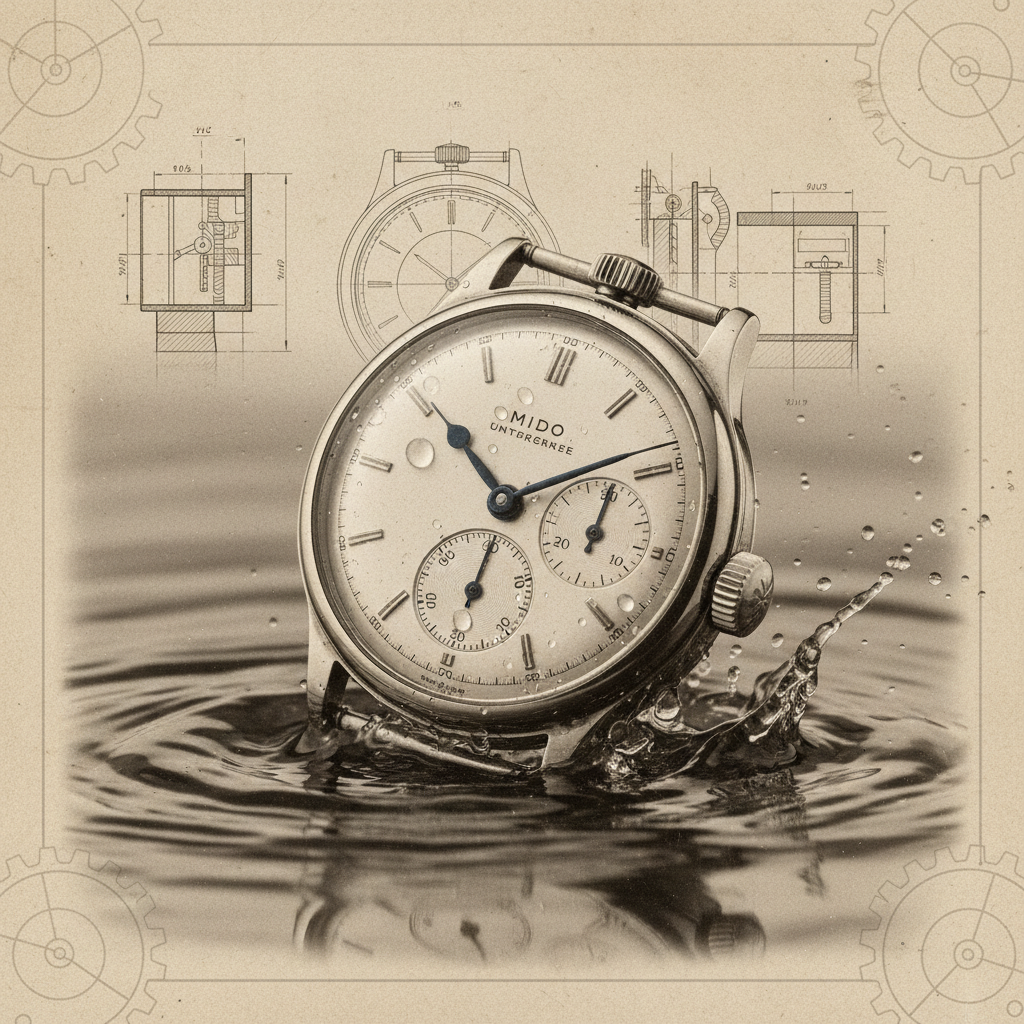
So, back in the day, Swiss watchmakers had a tough time keeping water out of their watches, which could ruin them. Mido was one of the pioneers in tackling this issue with its Aquadura system that used a cork gasket around the crown to keep moisture at bay while still letting you wind or set the time. This innovation led to the Multifort line, focusing on rugged, everyday watches that handle all sorts of conditions. Mido’s cork solution was super effective and paved the way for today’s standards in sports watches, showing that sometimes, old-school materials can do the job just fine.

Watch History: Saturday, September 26, 2026

📅 Saturday, September 26, 2026

Long before modern dive watches became icons, Swiss watchmakers were already fighting one of mechanical horology’s oldest enemies:

WATER.

Moisture could enter through the crown, case joints, or crystal and quickly damage steel components inside the movement. Rust, corrosion, and contaminated lubricants could turn a perfectly good watch into a repair nightmare.

Mido became one of the early brands to take that problem seriously.

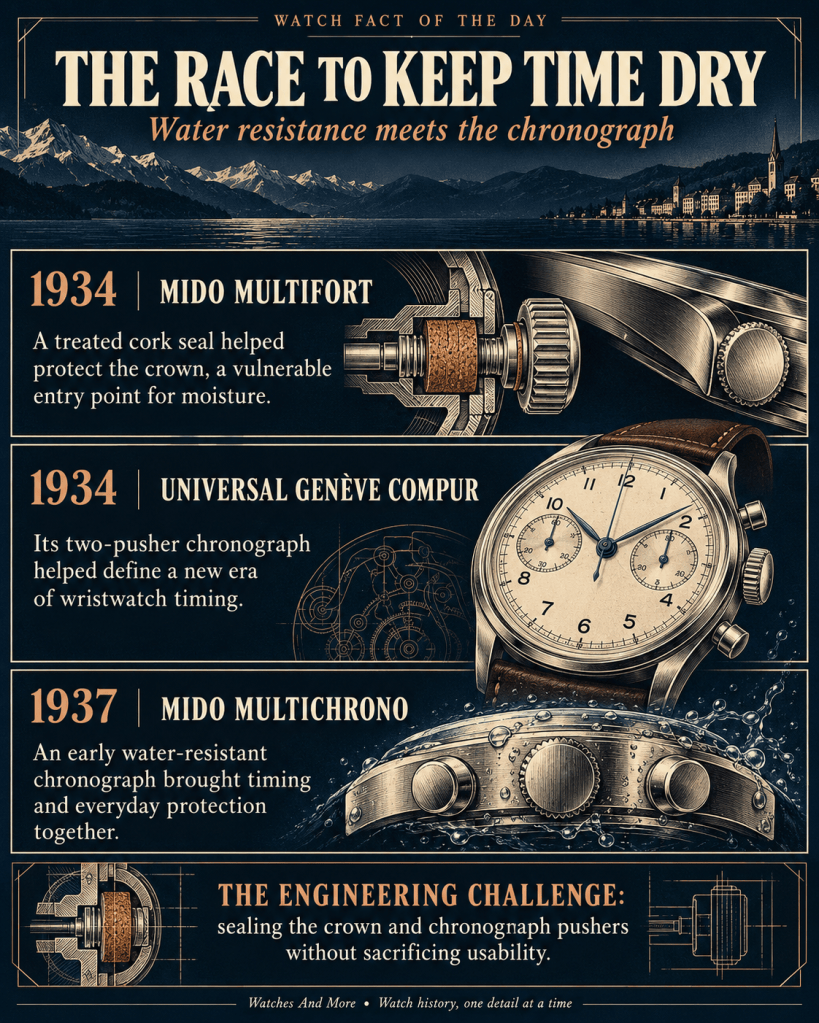
One of its best-known solutions was the Aquadura system, which used a specially treated cork gasket surrounding the crown stem. The cork remained compressed around the winding stem, helping form a barrier against water and dust while still allowing the crown to be operated. Mido’s own technical material continued describing Aquadura as a distinctive system for improving water resistance decades later. MIDO Watches

That sounds simple today.

In the early years of wristwatch engineering, it was anything but.

Why the Crown Was Such a Problem

A watch case can be sealed relatively easily if nothing has to move through it.

But the crown does.

The wearer has to pull it.

Turn it.

Wind the watch.

Set the time.

Every moving interface creates a possible entry point for moisture.

Mido’s cork system addressed that vulnerable area by maintaining pressure around the crown stem rather than relying only on a rigid metal fit.

MOVING PART + FLEXIBLE SEAL = BETTER PROTECTION

That became part of Mido’s broader reputation for practical, robust watches.

Where the Multifort Fits In

The Multifort became one of Mido’s defining lines and was associated with the brand’s push toward durable everyday wristwatches.

Rather than chasing only elegance, Mido leaned into the idea that a watch should be able to handle:

water

dust

shocks

temperature changes

That philosophy helped shape the kind of utility watch we now take for granted.

And eventually, Mido would extend the Multifort family into chronographs and other sportier configurations.

💡 Did You Know?

The clever thing about the Aquadura system was the material choice.

Cork seems primitive next to modern synthetic gaskets, but it had useful properties:

compressible

resilient

capable of maintaining contact around a moving stem

That made it surprisingly effective for early watch sealing.

Modern Mido documentation still describes the Aquadura concept as a cork gasket surrounding the crown stem. MIDO Watches

⭐ Why It Matters

Today we expect a sports watch to survive rain, sweat, washing hands, and sometimes swimming.

That expectation had to come from somewhere.

Early water-resistant watchmaking was built one vulnerable point at a time:

caseback

crystal

crown

pushers

gaskets

The crown was one of the hardest problems.

Mido’s cork-seal approach was an early and elegant answer.

BEFORE SCREW-DOWN CROWNS BECAME STANDARD…

SOME WATCHMAKERS TRUSTED CORK.


Category: Watch History

Disclaimer: Every effort has been made to keep these watch facts accurate, but the world of horology is full of myths, disputed stories, and fascinating trivia. Consider these facts a starting point for discovery rather than the final word. If you have corrections or additional insights, let us know—we’re always happy to keep the record ticking in the right direction.

🕐 Discover more watch facts, reviews, and buying guides at WatchesAndMore


🛍️ You Might Also Like

ETSY Shop
ETSY Shop
Redbubble Shop
Redbubble Shop
More Watch Facts
More Watch Facts

As an Amazon Associate and affiliate partner, WatchesAndMore earns from qualifying purchases.

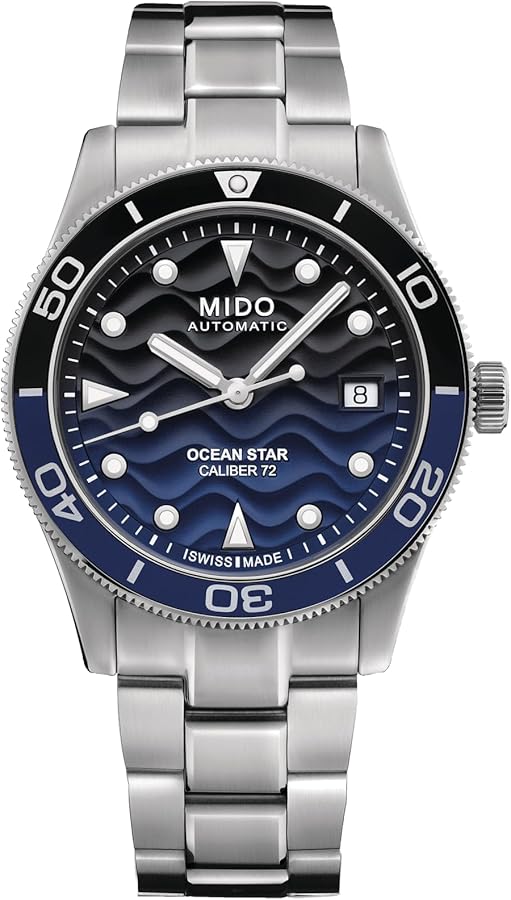
Mido Ocean Star Automatic
🔥 Deal of the Day

Mido Ocean Star Automatic

Mido

★★★★★ 4.8 (124 reviews)

$1279

Offer expires in


🔥 Grab This Deal →

Also at: Ashford

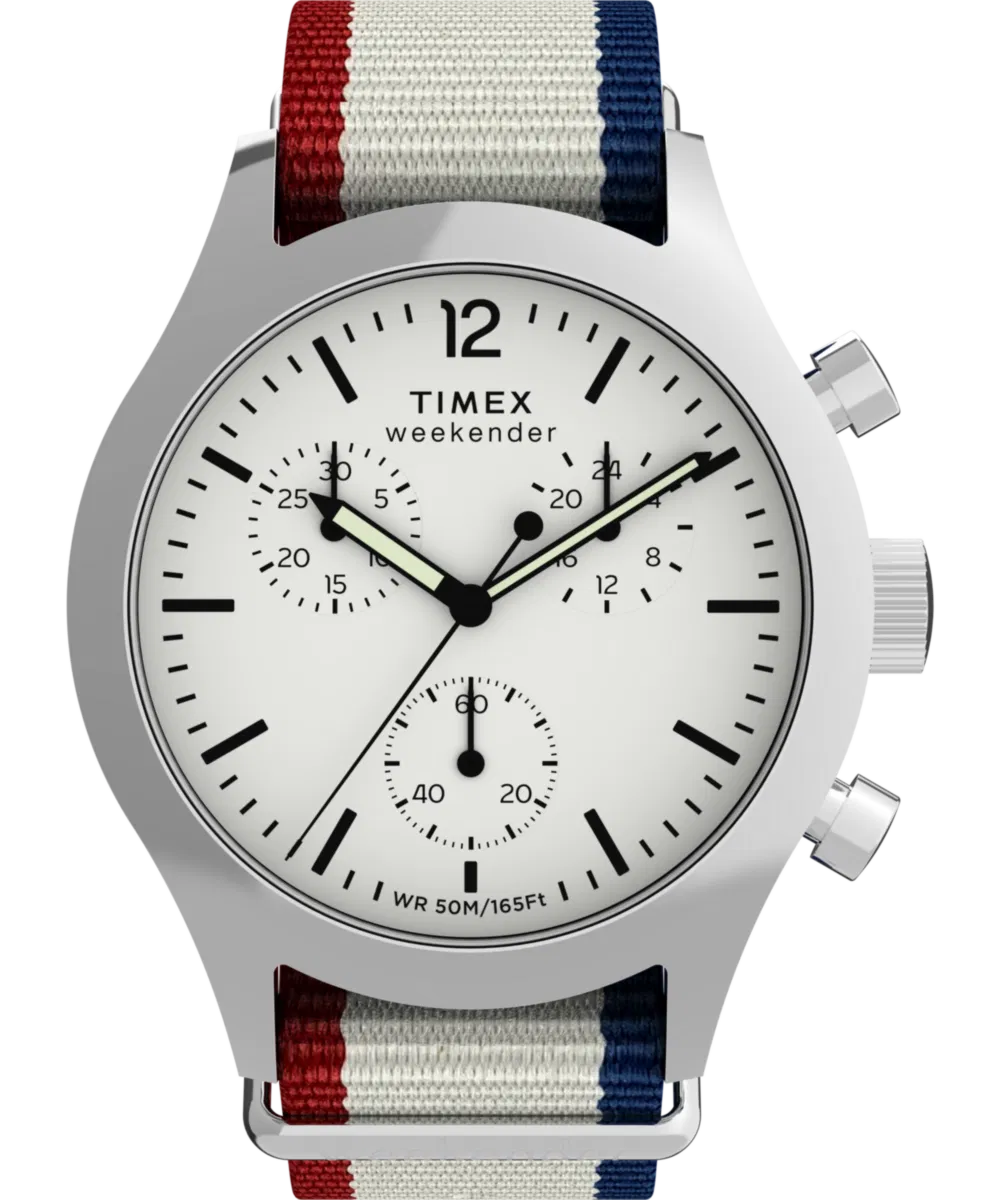
Timex Weekender Chronograph


Timex Weekender Chronograph

Timex

★★★★★ 4.5 (3,041 reviews)

$79


Check Price on Amazon →

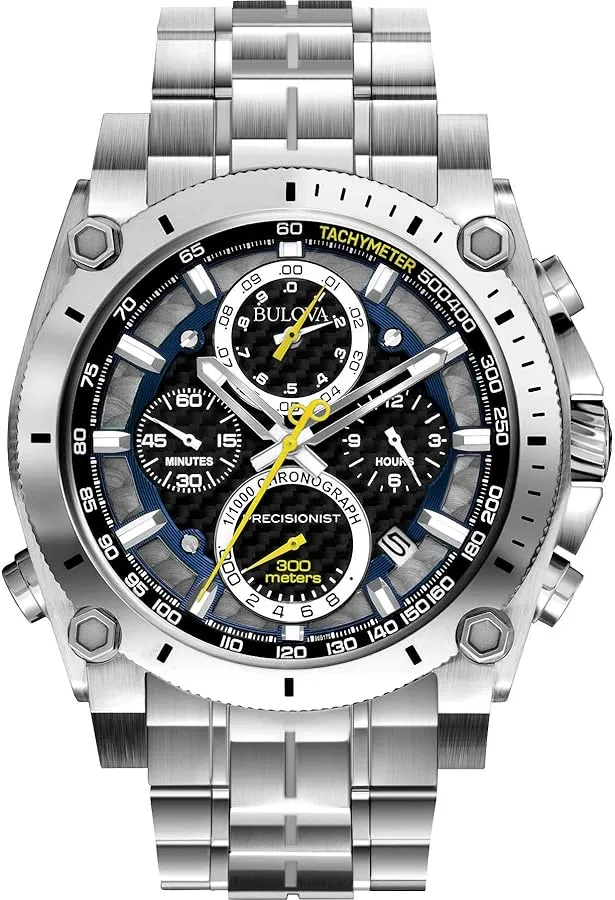
Bulova Precisionist


Bulova Precisionist

Bulova

★★★★★ 4.6 (1,100 reviews)

$219


Check Price on Amazon →


Browse all 142+ expert-reviewed watches →

Watch Fact of the Day: The Watch You Could Read With Your Fingertips

Way back when, before all the tech we have today, watchmakers created tactile or Braille watches for folks who couldn’t see the time. These watches had raised hour markers and hands you could feel, making time-checking super discreet and accessible. The concept isn’t new; similar designs date back to the late 1700s. By the early 1900s, watches specifically for the visually impaired were popping up. They featured protective covers and sturdy hands, allowing wearers to tell the time silently and privately. It’s a cool reminder: accessible design has roots that go way deep, proving independence can come from something as simple as touch.

Fun Quirk: Friday, September 25, 2026

📅 Friday, September 25, 2026

Long before talking watches, smartphones, or voice assistants, watchmakers found a remarkably simple way to make time accessible to people who could not rely on sight:

LET THEM FEEL IT.

Special tactile or “Braille” watches used raised hour markers and hands that could be read by touch. Many later examples used a hinged crystal or protective cover that could be lifted so the wearer could place a fingertip directly on the dial without damaging the watch during normal wear. The American Foundation for the Blind describes this as the traditional Braille-watch layout: lift the hinged crystal, then feel the hour markers and the positions of the hands.

The idea itself had deep roots. Watches designed to tell time by touch existed centuries earlier. Breguet sold its first famous montre à tact in 1799—a watch with an external pointer and hour markers that could be read without looking at the dial. Those watches were not originally created specifically for blind users, but the same basic principle—translating time into something tactile—would later become especially valuable for accessibility.

By the late 19th and early 20th centuries, purpose-built tactile watches were clearly being made for blind and partially sighted people. Museums Victoria preserves a mid-to-late-19th-century fob watch with raised numerals and Braille markings, and early-20th-century examples continued the concept into wristwatches.

How Did They Work?

A conventional watch tells time visually.

A tactile watch turns the dial into a physical map.

The wearer opens the protective cover and feels:

raised markers → where the hours are

short hand → the hour

long hand → the minutes

The hands had to be robust enough to tolerate gentle touch without being easily displaced, and the protective cover helped keep the dial and hands safe when the watch was closed.

That meant the time could be checked:

SILENTLY.

PRIVATELY.

WITHOUT LIGHT.

💡 Did You Know?

The history of tactile timekeeping is closely connected to another earlier watchmaking idea: reading the time in darkness.

The Smithsonian preserves a “touch watch” given to Helen Keller when she was young. Its design used pins around the case corresponding to the hours and an external moving hand that could be felt by touch. The watch had originally been developed as a way to tell time in the dark, but its tactile design made it especially useful for someone who was blind.

That gives us a beautiful through-line:

TIME BY SIGHT

became

TIME BY SOUND

and also

TIME BY TOUCH

⭐ Why It Matters

This is a great reminder that accessibility design is not a modern invention.

Watchmakers were solving accessibility problems mechanically long before electronics arrived.

No speaker.

No synthesized voice.

No vibration motor.

No screen reader.

Just:

HINGE.

RAISED MARKERS.

STRONG HANDS.

TOUCH.

And that gave blind and low-vision users something incredibly important:

independence.

The watch didn’t announce the time to everyone nearby.

It let the wearer discover it discreetly with a fingertip.

That makes these tactile watches more than curiosities.

They are early examples of inclusive industrial design.

BEFORE WATCHES TALKED…

SOME WERE MADE TO BE FELT.


Category: Fun Quirk

Disclaimer: Every effort has been made to keep these watch facts accurate, but the world of horology is full of myths, disputed stories, and fascinating trivia. Consider these facts a starting point for discovery rather than the final word. If you have corrections or additional insights, let us know—we’re always happy to keep the record ticking in the right direction.

🕐 Discover more watch facts, reviews, and buying guides at WatchesAndMore


🛍️ You Might Also Like

As an Amazon Associate and affiliate partner, WatchesAndMore earns from qualifying purchases.
G-Shock GWM5610-1 Solar Atomic
🔥 Deal of the Day

G-Shock GWM5610-1 Solar Atomic

Casio

★★★★★ 4.8 (5,621 reviews)

$129

Offer expires in


🔥 Grab This Deal →

G-Shock GA2100-1A1 CasiOak


G-Shock GA2100-1A1 CasiOak

Casio

★★★★★ 4.8 (2,156 reviews)

$99


Check Price on Amazon →

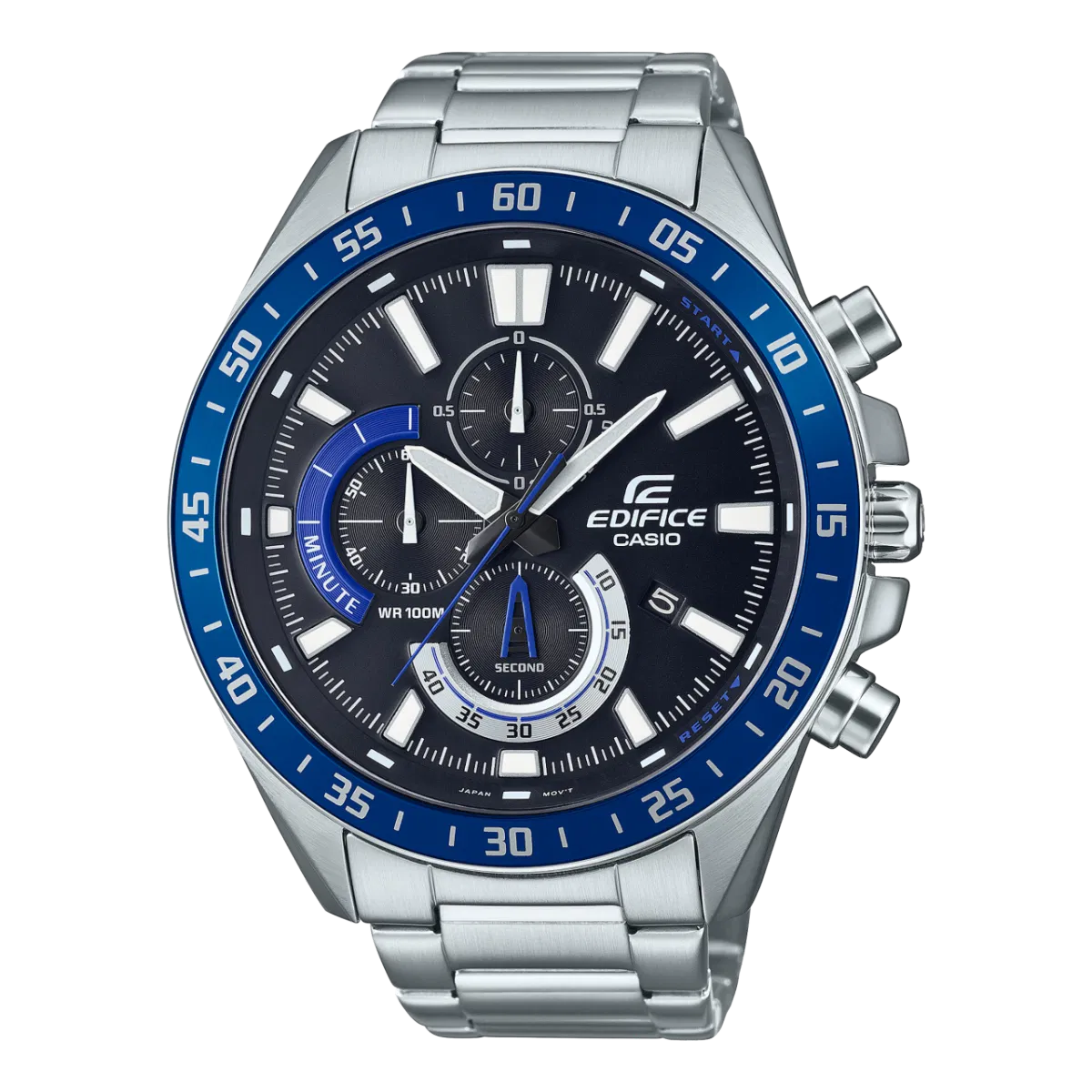
Casio Edifice Chronograph


Casio Edifice Chronograph

Casio

★★★★★ 4.7 (1,264 reviews)

$120


Check Price on Amazon →


Browse all 142+ expert-reviewed watches →

Redbubble Shop
Redbubble Shop
More Watch Facts
More Watch Facts
ETSY Shop
ETSY Shop

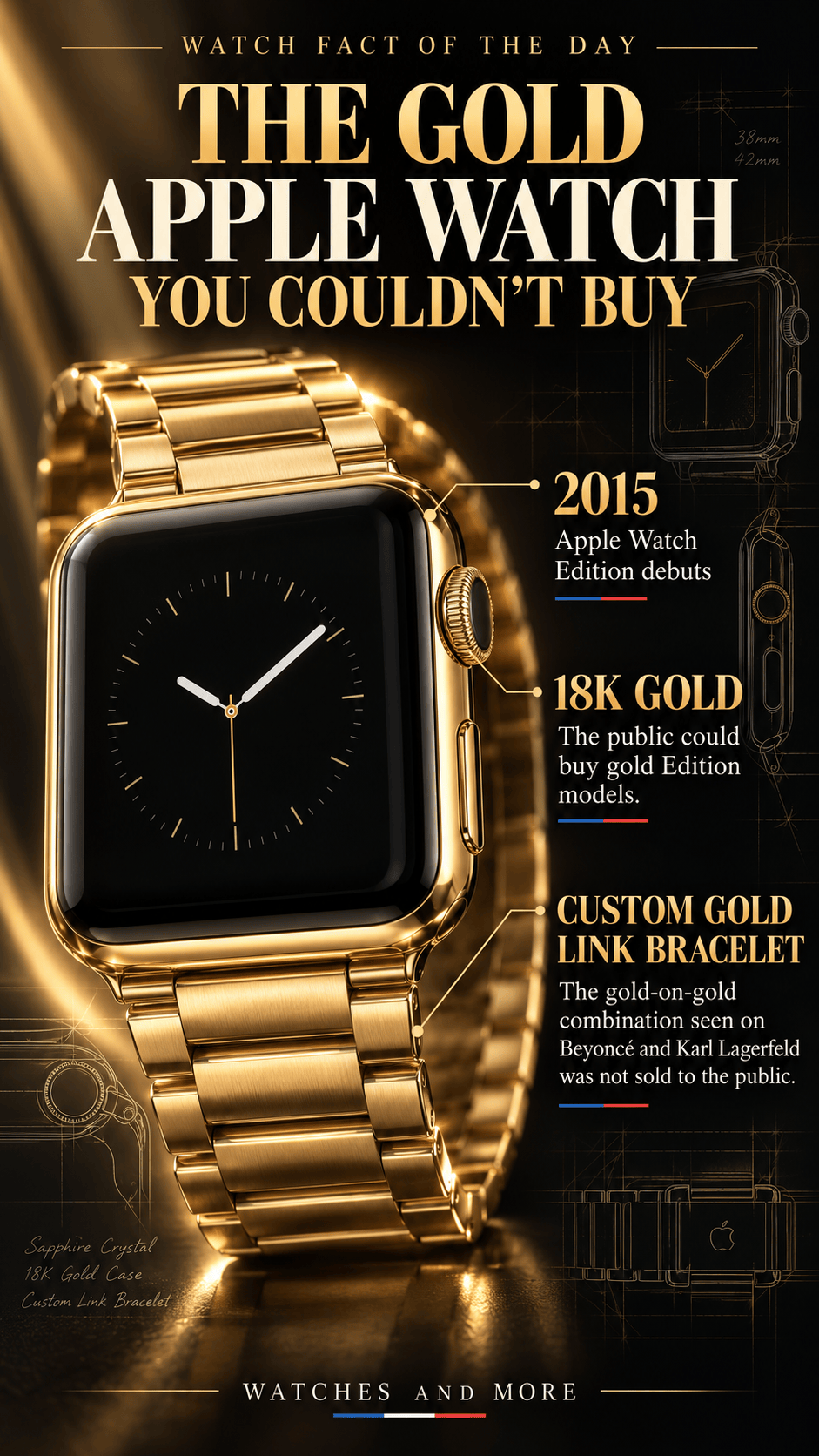
Watch Fact of the Day: The Gold Apple Watch You Couldn’t Buy

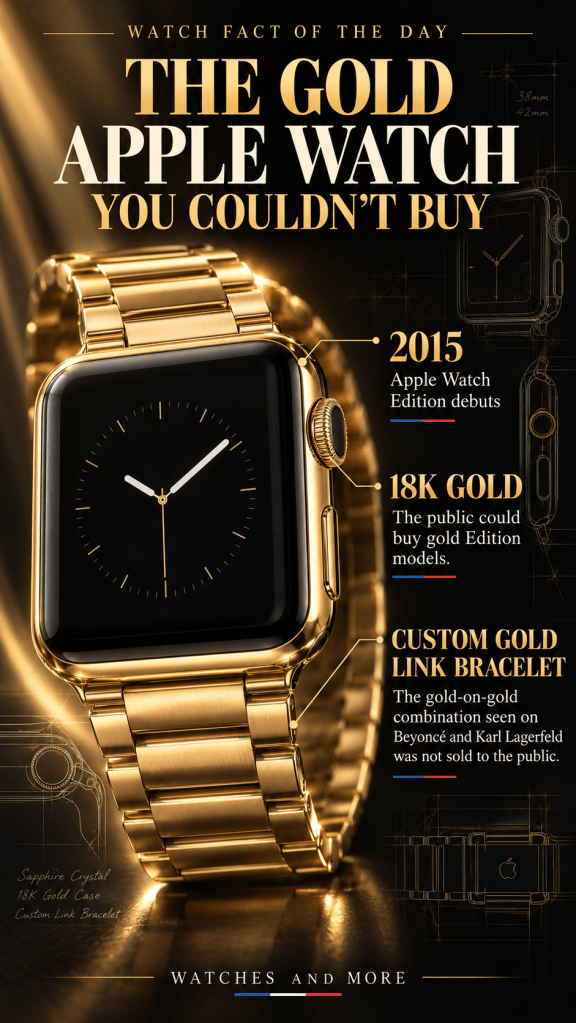
In a bold move in 2015, Apple didn’t just drop a smartwatch; it flung itself into the luxury watch ring with the Apple Watch Edition—18-karat gold versions starting at $10,000! But hold onto your wallets, because designer Karl Lagerfeld was spotted sporting a custom gold model with an exclusive Link Bracelet that Apple didn’t even sell. Soon, Beyoncé and Kanye joined the bling parade, showcasing editions that made the retail price look like pocket change. It’s a weird tale of how tech and luxury collided, reminding us that even in a world packed with software updates, the bling factor remains eternally fashionable!

Watch Culture: Thursday, September 24, 2026

📅 Thursday, September 24, 2026

When Apple entered the smartwatch market in 2015, it didn’t just launch a piece of consumer electronics.

It also tried something almost unheard of for a technology company:

It entered the luxury-watch world.

The most extravagant version was the Apple Watch Edition, made in custom 18-karat yellow or rose gold. Apple said the alloys were specially developed to be harder than standard gold, and the watches were paired with sapphire crystal and premium straps.

At launch, the collection started at roughly US$10,000 and climbed to US$17,000 for the most expensive retail configurations.

That alone was extraordinary.

But Apple went even further.

✨ The Apple Watch You Couldn’t Order

Shortly before the public launch, fashion designer Karl Lagerfeld was photographed wearing a yellow-gold Apple Watch Edition with something Apple did not sell:

A matching solid-gold Link Bracelet.

His assistant described the watch as being specially made for Lagerfeld, and contemporary reports treated it as a custom Apple piece rather than a public retail configuration.

Then Beyoncé appeared wearing what looked like the same gold-on-gold configuration.

And soon after, Kanye West was seen with one too.

By then, it became clear that Apple had created something even more exclusive than the already-expensive Edition:

A GOLD APPLE WATCH THAT MONEY ALONE COULDN’T BUY.

💎 Why the Bracelet Mattered

Apple offered metal Link Bracelets for its stainless-steel watches.

But it never put a gold Link Bracelet into the regular catalogue.

That meant the custom watches seen on Lagerfeld, Beyoncé, and West sat outside the normal product line.

Contemporary reporting suggested that these pieces were likely worth far more than the $17,000 retail Edition, simply because of the amount of gold in the bracelet—but Apple never published an official retail price because the configuration was never publicly sold.

That makes them fascinating from a collector’s perspective.

They are not just rare watches.

They represent a strange moment when:

Silicon Valley

met

fashion

met

luxury horology

met

celebrity culture.

💡 Did You Know?

Apple was very deliberately positioning the first-generation Watch as a fashion object, not merely a gadget.

Before the official launch, Apple previewed the Watch at luxury and fashion venues including Colette in Paris, Selfridges in London, and Isetan in Tokyo.

And seeing custom gold versions on major fashion and music figures reinforced that positioning.

The message was obvious:

THIS WASN’T JUST TECH.

THIS WAS STATUS.

⭐ Why It Matters

The first Apple Watch Edition remains one of the strangest luxury experiments in modern watch history.

Traditional high-end watches often justify their price through:

mechanical complexity

hand finishing

precious metals

heritage

rarity

Apple took a completely different route.

It took a rapidly evolving piece of consumer technology…

and wrapped it in 18-karat gold.

Then, for a tiny number of highly visible people, it made versions that apparently went beyond even the retail Edition.

That creates a fascinating contradiction.

The software aged.

The hardware became obsolete.

But the gold case—and the story behind those custom pieces—remained.

TECHNOLOGY AGED.

THE RARITY DIDN’T.


Category: Watch Culture

Disclaimer: Every effort has been made to keep these watch facts accurate, but the world of horology is full of myths, disputed stories, and fascinating trivia. Consider these facts a starting point for discovery rather than the final word. If you have corrections or additional insights, let us know—we’re always happy to keep the record ticking in the right direction.

🕐 Discover more watch facts, reviews, and buying guides at WatchesAndMore


🛍️ You Might Also Like

As an Amazon Associate and affiliate partner, WatchesAndMore earns from qualifying purchases.
G-Shock GWM5610-1 Solar Atomic
🔥 Deal of the Day

G-Shock GWM5610-1 Solar Atomic

Casio

★★★★★ 4.8 (5,621 reviews)

$129

Offer expires in


🔥 Grab This Deal →

G-Shock GA2100-1A1 CasiOak


G-Shock GA2100-1A1 CasiOak

Casio

★★★★★ 4.8 (2,156 reviews)

$99


Check Price on Amazon →

Seiko 5 SNK805 Green Military


Seiko 5 SNK805 Green Military

Seiko

★★★★★ 4.8 (6,961 reviews)

$89


Check Price on Amazon →


Browse all 142+ expert-reviewed watches →

Watch Fact of the Day: The Bulova Accutron Astronaut That Flew With X-15 Pilots

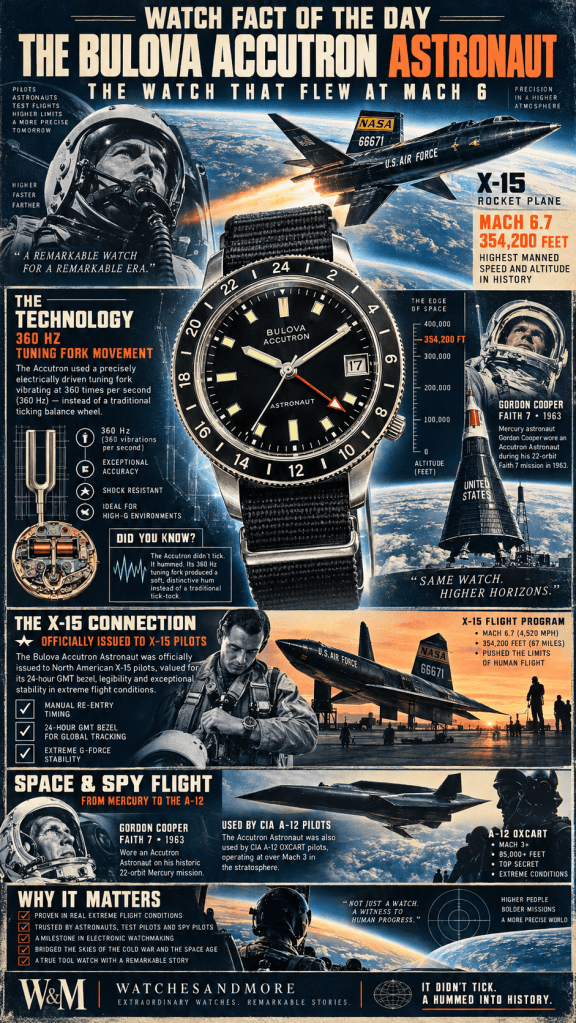
The Bulova Accutron Astronaut is a cool piece of watch history, famous for being an electronic watch that predates quartz models. It used a unique tuning-fork movement, which made it super reliable for pilots flying in extreme conditions. This watch was even worn by X-15 pilots and CIA A-12 pilots on top-secret missions. On May 15, 1963, astronaut Gordon Cooper took an Accutron into space on his Mercury mission, where he relied on it for timing during a manual re-entry. Overall, the Accutron Astronaut showcases a pivotal moment in watch development, bridging the gap between mechanical and quartz technology.

Military Watches: Wednesday, September 23, 2026

📅 Wednesday, September 23, 2026

Before quartz watches took over the world—and before the Omega Speedmaster became synonymous with spaceflight—another electronic watch was already proving itself in some of the most extreme flying environments imaginable.

The Bulova Accutron Astronaut, powered by the remarkable Calibre 214 tuning-fork movement, became a tool watch for pilots operating at the very edge of conventional aviation.

Unlike a traditional mechanical watch, the Accutron did not regulate time with a balance wheel oscillating a few times per second.

Instead, its electrically powered tuning fork vibrated at:

360 HZ

That extraordinarily high frequency gave the movement exceptional stability for its era and helped make it well suited to high-speed, high-altitude environments. Historical accounts note that the Accutron’s low-inertia tuning-fork system handled high G-loads and temperature changes particularly well.

🚀 Then Came the X-15

The North American X-15 was not an ordinary airplane.

It was a rocket-powered experimental aircraft launched from beneath a B-52, designed to explore hypersonic flight, high-altitude control, extreme heating, and the edge of space.

Across 199 flights, the program eventually reached:

MACH 6.7

354,200 FEET

The data gathered helped shape later Mercury, Gemini, Apollo, and Space Shuttle development.

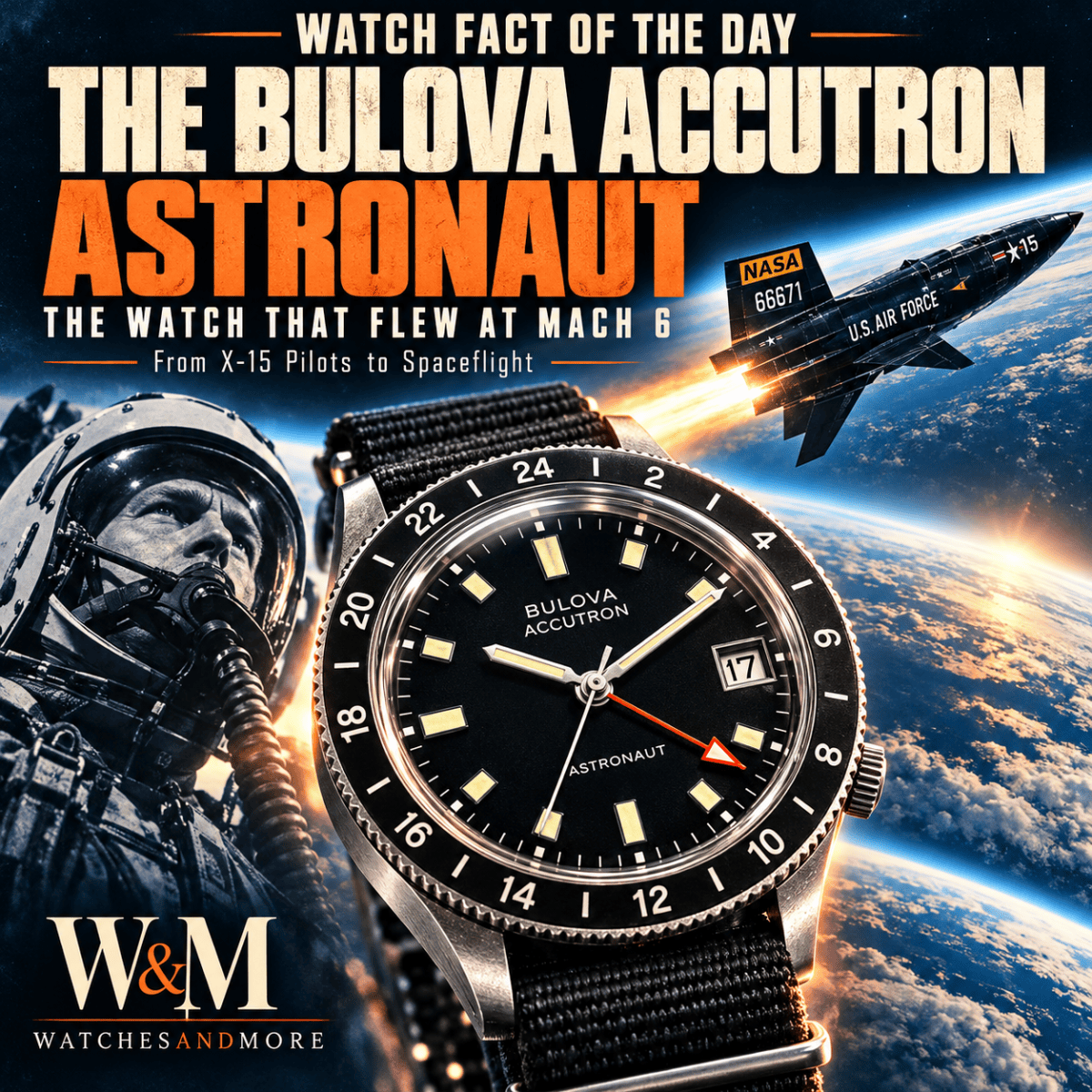
And according to Accutron, the Accutron Astronaut became the officially issued watch for X-15 pilots.

That is a remarkable piece of watch history.

This wasn’t merely a watch styled to look futuristic.

It was being worn by pilots flying one of the most advanced experimental aircraft ever built.

🕵️ And Then the CIA Wanted It

The story didn’t stop with the X-15.

The Accutron Astronaut was later issued to CIA pilots flying the Lockheed A-12, the secret reconnaissance aircraft developed for extreme-altitude, Mach 3-class missions. Accutron’s own history specifically notes the watch’s use by A-12 pilots.

Suddenly this one watch had connections to:

rocket planes

high-altitude reconnaissance

NASA

the CIA

early human spaceflight

Not bad for something that hummed instead of ticked. 😂⌚

Infographic about the Bulova Accutron Astronaut watch, highlighting its history with NASA and its use by X-15 pilots, featuring details about its technology and significance in space exploration.

🌎 Gordon Cooper Takes It Into Orbit

On May 15, 1963, Mercury astronaut Gordon Cooper launched aboard Faith 7 for the final mission of Project Mercury.

He completed more than 22 orbits and spent over 34 hours in space. Late in the mission, automatic control and electrical problems forced Cooper to conduct a manual re-entry. Despite those failures, he brought the capsule down with exceptional precision in the Pacific.

Contemporary and later historical accounts show Cooper wearing an Accutron Astronaut during the mission.

Cooper later recalled relying on a wristwatch during his manual re-entry calculations, though NASA’s current mission summaries do not identify the watch model in that specific moment.

So I’d phrase our article carefully:

The Accutron went with him into space.

His manual timing helped bring Faith 7 home.

That gives us the truth without overstating what the surviving NASA documentation specifically proves.

💡 Did You Know?

The Accutron Astronaut wasn’t really designed like a conventional dress watch at all.

It used:

a 24-hour hand

a rotating 24-hour bezel

a tuning-fork movement

electronic regulation

—all features that made it particularly useful to pilots operating across time zones and in demanding flight environments.

And the name Astronaut turned out to be remarkably appropriate.

⭐ Why It Matters

The Accutron Astronaut represents a strange transitional moment in watchmaking.

Mechanical watches still ruled.

Quartz hadn’t yet conquered the industry.

And here was a humming electronic watch using a tuning fork to achieve better stability in extreme environments.

It wasn’t quite mechanical.

It wasn’t quartz.

It was something entirely different.

And it found its way onto the wrists of:

X-15 PILOTS

CIA A-12 PILOTS

MERCURY ASTRONAUTS

That’s a serious résumé.

BEFORE QUARTZ.

BEFORE THE MOONWATCH LEGEND.

THERE WAS THE HUM OF THE ACCUTRON.


Category: Military Watches

Disclaimer: Every effort has been made to keep these watch facts accurate, but the world of horology is full of myths, disputed stories, and fascinating trivia. Consider these facts a starting point for discovery rather than the final word. If you have corrections or additional insights, let us know—we’re always happy to keep the record ticking in the right direction.

🕐 Discover more watch facts, reviews, and buying guides at WatchesAndMore


🛍️ You Might Also Like

As an Amazon Associate and affiliate partner, WatchesAndMore earns from qualifying purchases.

Bulova Precisionist
🔥 Deal of the Day

Bulova Precisionist

Bulova

★★★★★ 4.6 (1,100 reviews)

$219

Offer expires in


🔥 Grab This Deal →

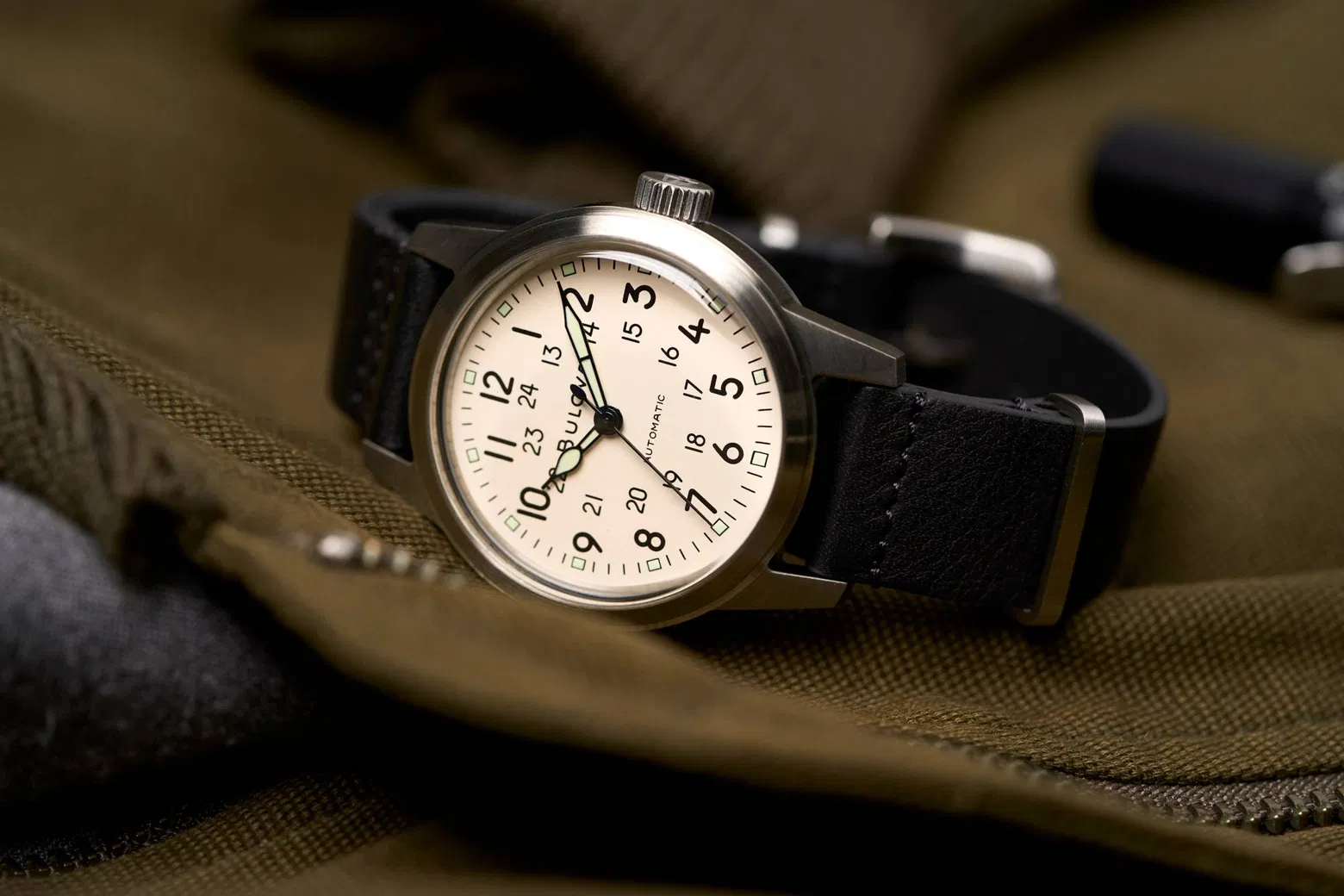
Bulova Military Hack Automatic


Bulova Military Hack Automatic

Bulova

★★★★☆ 4.4 (1,286 reviews)

$450


Check Price on Amazon →

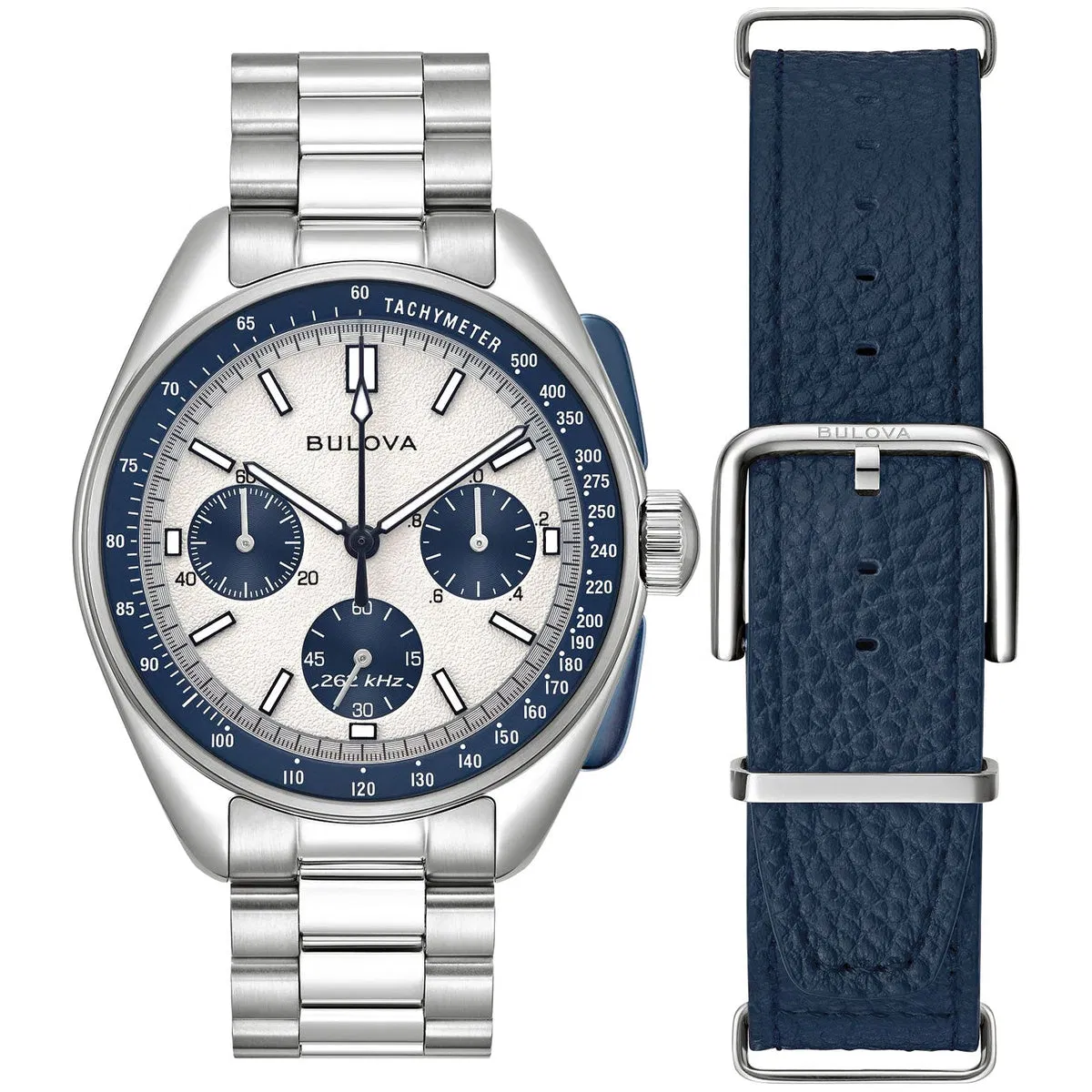
Bulova Lunar Pilot Chronograph


Bulova Lunar Pilot Chronograph

Bulova

★★★★★ 4.6 (810 reviews)

$478


Check Price on Amazon →


Browse all expert-reviewed watches →

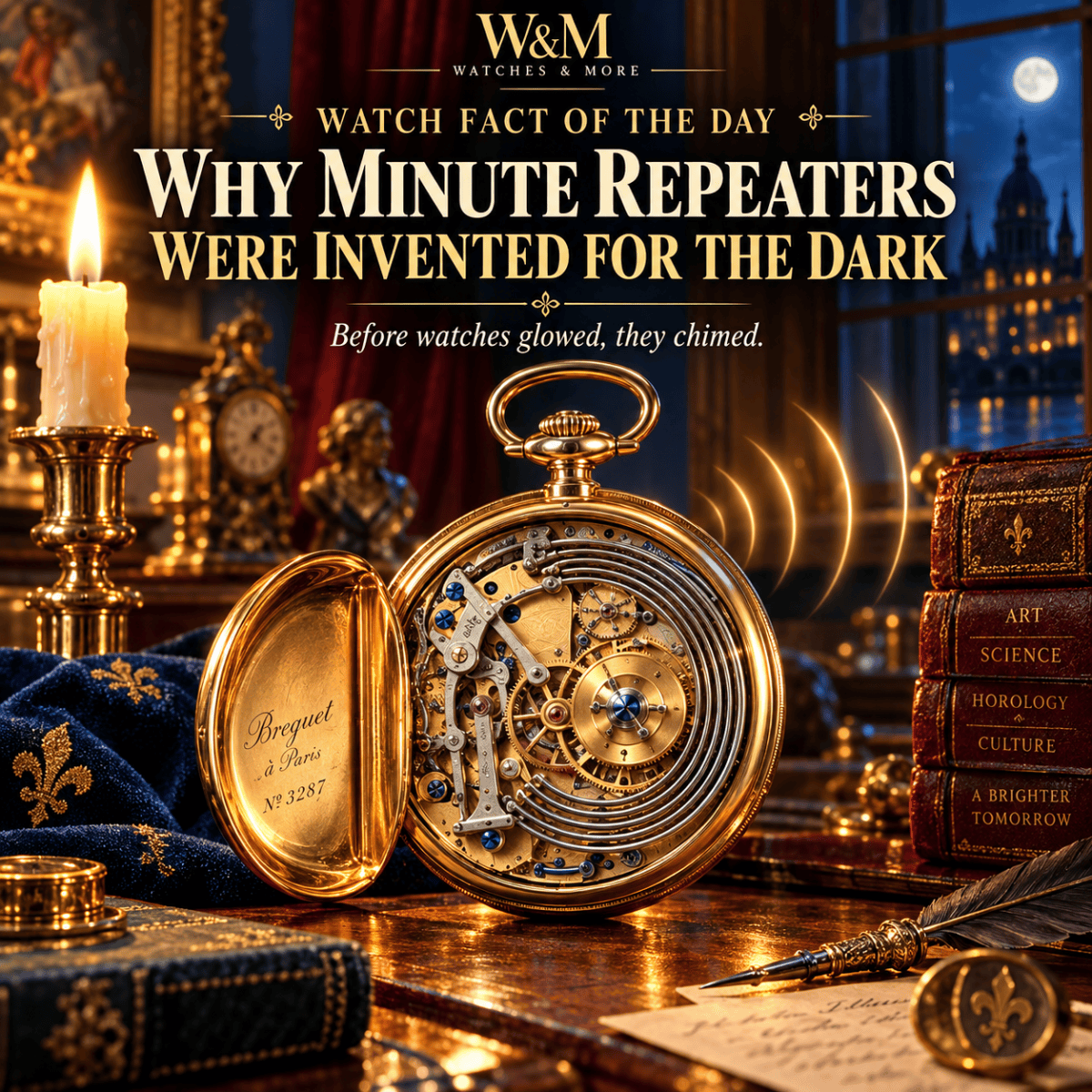
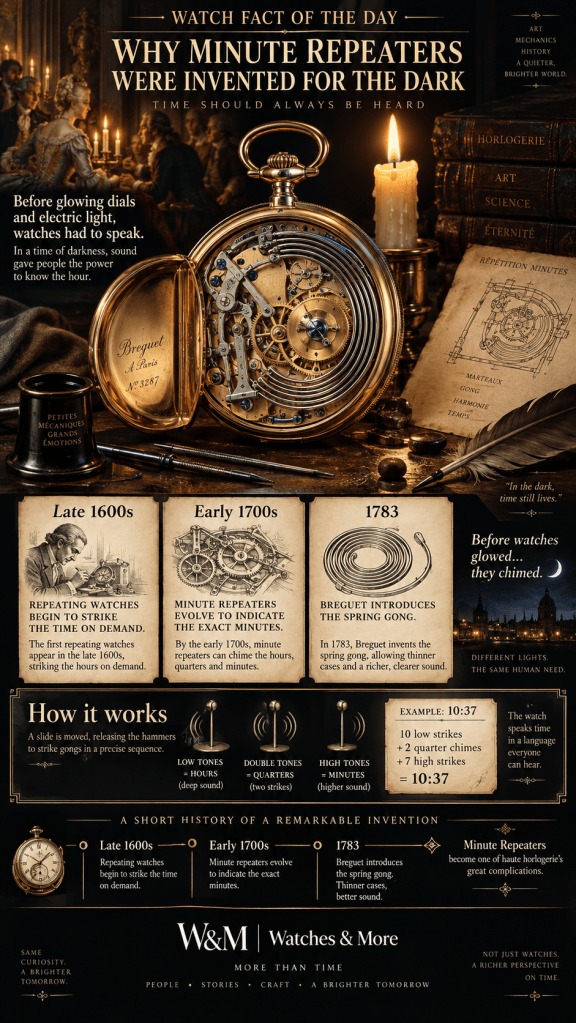
Watch Fact of the Day: Why Minute Repeaters Were Invented for the Dark

Long ago, telling time in the dark was a challenge, leading to the revolutionary invention of speaking watches in the late 1600s. These ingenious mechanisms allowed users to hear the time through a series of musical chimes, transforming timekeeping into a delightful auditory experience. The innovation continued with Breguet’s spring gong in the late 1700s, which improved sound quality and design. Although the need for such watches diminished with the advent of easier lighting methods, the minute repeater evolved into a remarkable piece of artistry in watchmaking. Today, these intricate devices embody a blend of tradition and technical mastery, showcasing the beauty of horology.

Watch History: Tuesday, September 22, 2026

📅 Tuesday, September 22, 2026

Long before luminous paint, electric lights, or glowing digital displays, checking the time at night could be surprisingly inconvenient.

If you woke in a dark room, reading a watch or clock meant finding a candle, lamp, or other light source first.

Watchmakers came up with a much more elegant solution:

MAKE THE WATCH SPEAK.

By the late 1600s, English watchmakers were developing repeating watches that could strike the time on demand. Early quarter repeaters announced the hours and quarter-hours, and by the early 1700s watchmakers in southern Germany had developed mechanisms capable of indicating the minutes as well. Haute Horlogerie

That was the breakthrough.

Instead of needing to see the dial, the owner could activate a slide or pushpiece and simply listen.

A traditional minute repeater translates the time into three acoustic signals:

LOW TONES = HOURS

TWO-TONE CHIMES = QUARTERS

HIGH TONES = REMAINING MINUTES

Watch Fact of the Day: Why Minute Repeaters Were Invented for the Dark

So if the time were 10:37, the watch would strike:

10 hour tones

then

2 quarter-hour sequences

then

7 minute tones

A mechanical watch had effectively become an audible time calculator.

🔔 Breguet Made It Smaller — and Better

Early repeating watches generally struck tiny bells housed inside the case.

That worked, but bells took up valuable space.

In 1783, Abraham-Louis Breguet introduced a major improvement by replacing the traditional bell with a spring gong. The gong could be coiled around the movement, helping make repeating watches thinner while also improving the quality and character of the sound. The idea was so effective that other watchmakers quickly adopted it. Montres Breguet

That innovation helped shape the architecture of the minute repeater we recognize today.

💡 Did You Know?

The modern matchstick didn’t appear until 1845.

The Fondation Haute Horlogerie notes that once matches made candles and oil lamps much easier to light, demand for repeating watches declined. But by then, the minute repeater had evolved beyond pure necessity and become one of watchmaking’s most technically prestigious complications. Haute Horlogerie

In other words, the technology survived long after the original practical problem became easier to solve.

Why?

Because watchmakers had turned a night-time convenience into mechanical art.

⭐ Why It Matters

A minute repeater is one of those complications that reminds us how differently watches were once used.

Today, we think of a watch primarily as something we look at.

A repeater was designed to be:

HEARD.

And making a tiny mechanical object produce clear, musical tones is extraordinarily difficult.

A modern minute repeater must coordinate:

racks

snails

hammers

gongs

springs

timing mechanisms

all while keeping the entire sequence synchronized with the actual time shown on the dial.

That is why minute repeaters remain among the most demanding complications in haute horlogerie. Breguet still describes the minute repeater as a mechanism that makes time audible through precise interaction between hammers and gongs.


Category: Watch History

Disclaimer: Every effort has been made to keep these watch facts accurate, but the world of horology is full of myths, disputed stories, and fascinating trivia. Consider these facts a starting point for discovery rather than the final word. If you have corrections or additional insights, let us know—we’re always happy to keep the record ticking in the right direction.

🕐 Discover more watch facts, reviews, and buying guides at WatchesAndMore


🛍️ You Might Also Like

As an Amazon Associate and affiliate partner, WatchesAndMore earns from qualifying purchases.
Timex Weekender Chronograph
🔥 Deal of the Day

Timex Weekender Chronograph

Timex

★★★★★ 4.5 (3,041 reviews)

$79

Offer expires in


🔥 Grab This Deal →

Bulova Precisionist


Bulova Precisionist

Bulova

★★★★★ 4.6 (1,100 reviews)

$219


Check Price on Amazon →

Timex Marlin Automatic 40mm


Timex Marlin Automatic 40mm

Timex

★★★★★ 4.7 (1,106 reviews)

$259


Check Price on Amazon →


Browse all 142+ expert-reviewed watches →

ETSY Shop
ETSY Shop
Redbubble Shop
Redbubble Shop
More Watch Facts
More Watch Facts

Watch Fact of the Day: The Pocket Watch That Survived the Hindenburg Disaster

When the Hindenburg airship burst into flames in Lakehurst, New Jersey, in 1937, passenger Ernst Wendler carried a gold pocket watch in his vest. Miraculously r

Military Watches: Monday, September 21, 2026

📅 Monday, September 21, 2026

On the evening of May 6, 1937, the German airship LZ 129 Hindenburg approached the Naval Air Station at Lakehurst, New Jersey, after crossing the Atlantic from Frankfurt.

At approximately 7:25 p.m., while the ship was attempting to land, fire appeared near the stern. Within roughly half a minute, the enormous hydrogen-filled airship was engulfed and collapsing toward the ground. Of the 97 people aboard, 35 died, along with one member of the ground crew. HISTORY CHANNEL ITALIA

Among the crew was Walter Banholzer, a 28-year-old engine mechanic from Rottweil, Germany.

A vintage pocket watch that survived the Hindenburg disaster, showing signs of damage and history, surrounded by newspaper clippings and facts about the event. The background features an image of the Hindenburg in flames with a timeline of the disaster.

Banholzer had worked aboard the Hindenburg during its operational career and was assigned to the starboard aft engine section. At the time of the landing, however, he had been sent forward with several other crewmen to help compensate for the airship being tail-heavy. When the fire erupted, the flames tore rapidly through the ship. Banholzer survived the initial crash but was gravely burned and later died from his injuries. facesofthehindenburg.blogspot.com

What remained from that night included one extraordinary personal object:

His pocket watch.

A watch later offered by Hermann Historica was described as Walter Banholzer’s Omega pocket chronograph, carried during the Hindenburg disaster and partially destroyed by fire. The watch bears a 0.900 silver hallmark, the initials “WB” engraved on the cover, a damaged enamel dial with Roman numerals, and a small seconds register at 6 o’clock. It was sold with supporting photographs and family provenance documentation. Invaluable

The condition tells its own story.

The case is scorched.

The enamel dial is damaged.

The movement survived only partially intact.

It is not a pristine collector’s watch.

It is a witness.

💡 Did You Know?

Banholzer’s location aboard the Hindenburg was misunderstood for decades.

Early diagrams placed him in an engine gondola at the time of the fire. Later research using witness testimony and crew-position records showed that he had actually been sent forward toward the bow shortly before the disaster to help trim the tail-heavy airship. facesofthehindenburg.blogspot.com

That detail matters because it brings us closer to the human reality of the final minutes.

He was not simply “aboard the Hindenburg.”

He was working.

Following orders.

Helping prepare the ship to land.

And carrying an ordinary personal timepiece that would outlive him.

⭐ Why It Matters

Historic disasters often become enormous stories.

Names.

Numbers.

Photographs.

Headlines.

The Hindenburg became one of the most recognizable images in aviation history, and the catastrophe helped destroy public confidence in passenger airships. HISTORY CHANNEL ITALIA

But objects like Banholzer’s watch make those events personal again.

Not an airship.

Not a headline.

One mechanic.

One pocket watch.

One evening in 1937.

That is why surviving artifacts matter.

They shrink history back down to human scale.


Category: Military Watches

Disclaimer: Every effort has been made to keep these watch facts accurate, but the world of horology is full of myths, disputed stories, and fascinating trivia. Consider these facts a starting point for discovery rather than the final word. If you have corrections or additional insights, let us know—we’re always happy to keep the record ticking in the right direction.

🕐 Discover more watch facts, reviews, and buying guides at WatchesAndMore


🛍️ You Might Also Like

As an Amazon Associate and affiliate partner, WatchesAndMore earns from qualifying purchases.
G-Shock GWM5610-1 Solar Atomic
🔥 Deal of the Day

G-Shock GWM5610-1 Solar Atomic

Casio

★★★★★ 4.8 (5,621 reviews)

$129

Offer expires in


🔥 Grab This Deal →

G-Shock GA2100-1A1 CasiOak


G-Shock GA2100-1A1 CasiOak

Casio

★★★★★ 4.8 (2,156 reviews)

$99


Check Price on Amazon →

Seiko 5 SNK805 Green Military


Seiko 5 SNK805 Green Military

Seiko

★★★★★ 4.8 (6,961 reviews)

$89


Check Price on Amazon →


Browse all 142+ expert-reviewed watches →

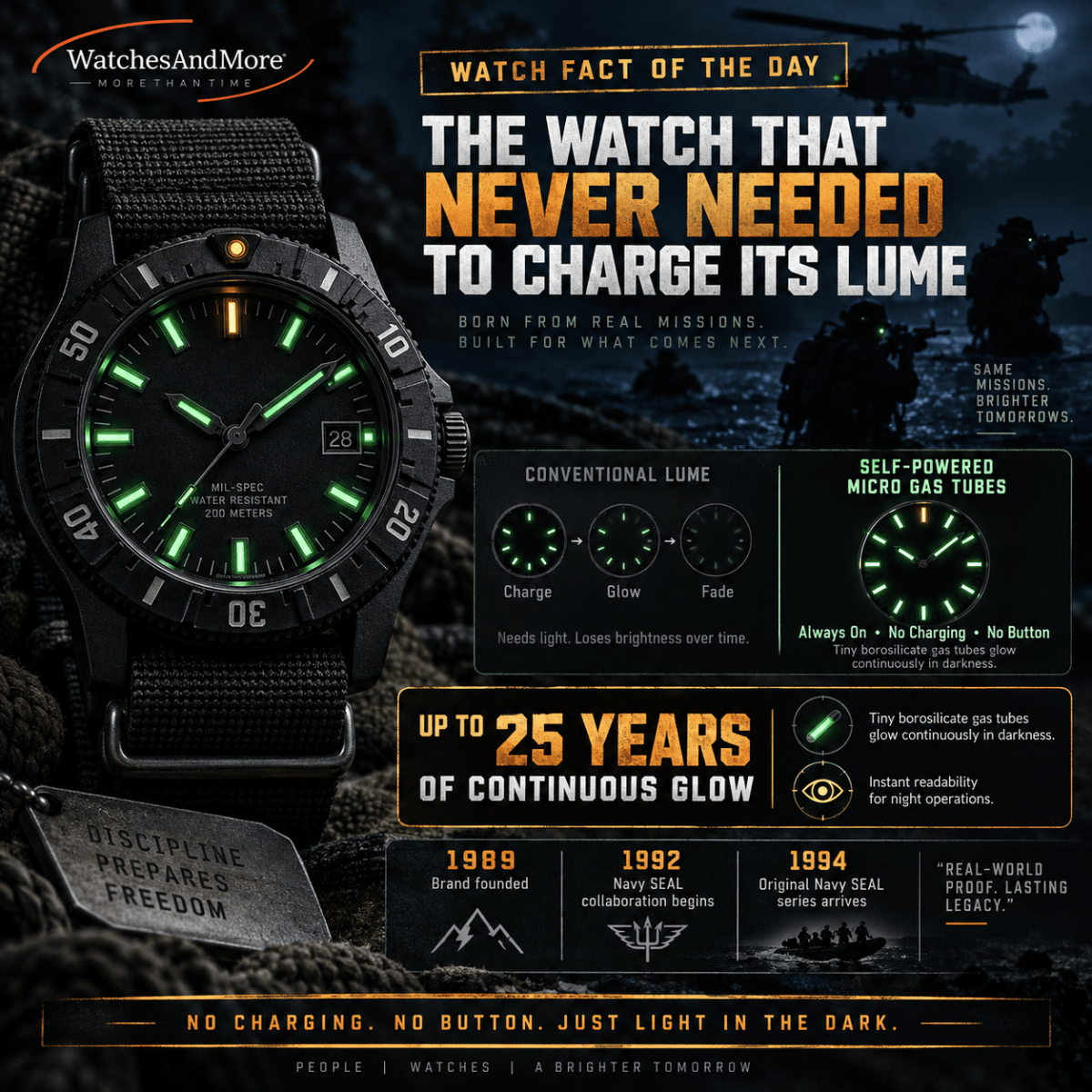
Watch Fact of the Day: The Military Watch That Made Darkness Its Specialty

Luminox watches are like that friend who never runs out of battery—talk about commitment! Forget the fuss of charging or hunting for a button in the dark; these watches flaunt Luminox Light Technology that continuously glows thanks to self-powered micro gas light tubes. You can read the time even if it’s pitch black, and they last up to 25 years. Collaborating with Navy SEALs back in the day, Luminox ensured your watch is as tough as your morning coffee. So, when the lights go out, just look down and bask in your illuminated wrist, knowing time waits for no one—especially not for a dead battery!

Military Watches: Sunday, September 20, 2026

📅 Sunday, September 20, 2026

Most luminous watches need one of two things.

They either need to be charged by light, or they need electrical power to illuminate the display.

Luminox took a different route.

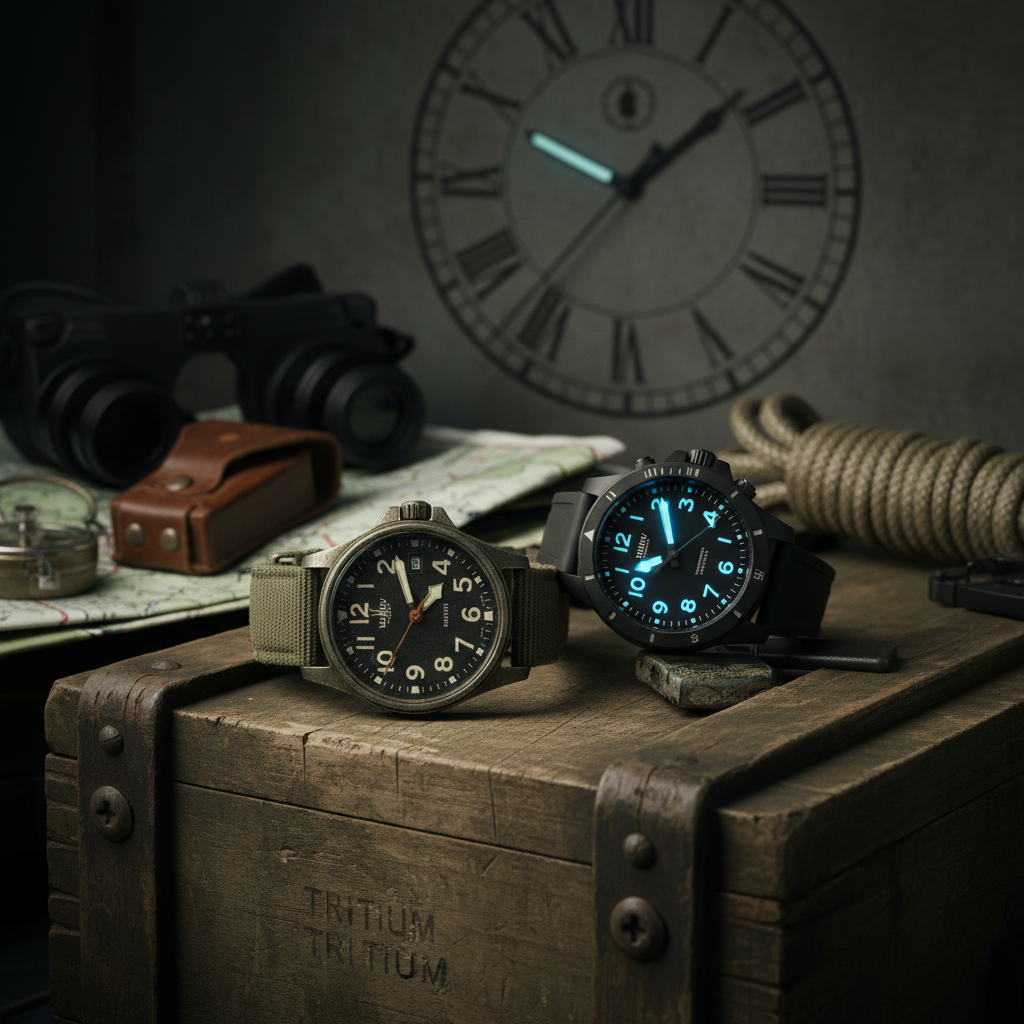
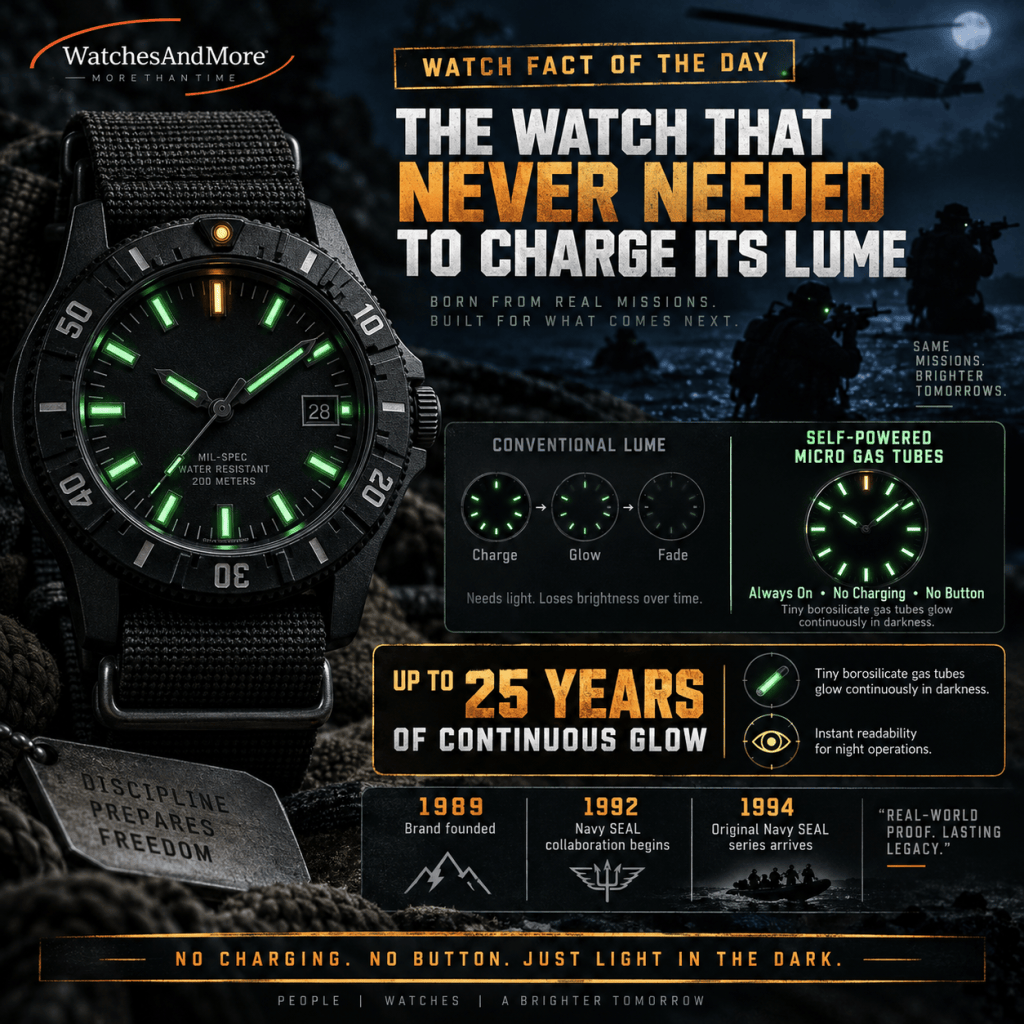
Its signature Luminox Light Technology, or LLT, uses tiny self-powered micro gas light tubes installed on the hands, hour markers and, on some models, the bezel. These borosilicate glass capsules remain illuminated continuously, allowing the watch to be read in complete darkness without pressing a button or first exposing it to a light source. Luminox Watches

And the duration is remarkable.

Luminox says the system provides visibility for up to:

25 YEARS

The intensity is guaranteed to remain constant for the first ten years, after which the glow gradually becomes weaker as the gas loses energy. Luminox Watches

That distinction matters because conventional photoluminescent materials work differently.

A material such as Super-LumiNova® must first absorb energy from natural or artificial light. It then releases that stored energy gradually, typically remaining visibly luminous for a matter of hours.

Luminox’s system is simply:

ALWAYS ON.

No charging.

No button.

No additional battery consumption.

Just continuous visibility. Luminox Watches

🌙 Then the Navy SEAL Connection Happened

Luminox had been producing high-visibility sports watches since 1989.

Then, in 1992, Chief Nick North, the Assistant Research, Development, Test and Evaluation officer for the Navy SEALs, was tasked with finding a more dependable watch for night missions.

According to Luminox, North discovered the company’s illumination technology and worked with Luminox to develop a watch specifically for SEAL use. Luminox Watches

The result became the Original Navy SEAL 3000 Series, first introduced commercially in 1994.

Its combination of:

continuous night visibility

light weight

rugged construction

water resistance

made it one of the watches most closely associated with the Luminox identity. Luminox Canada

💡 Did You Know?

The name Luminox itself tells you exactly what the company wanted to represent.

LUMI — derived from light

NOX — Latin for night

In other words:

LIGHT IN THE DARK.

That philosophy became the brand’s defining feature. Luminox Watches

⭐ Why It Matters

The important innovation wasn’t simply that Luminox made a bright watch.

It was that the watch could remain immediately readable without depending on the wearer to do anything first.

That distinction matters in environments where visibility has to be instant.

No:

“Did I charge the lume?”

No:

“Where’s the illumination button?”

Instead:

LOOK DOWN.

READ THE TIME.

That practicality helped transform self-powered micro-gas illumination from a specialized technology into one of the most recognizable features in modern tactical-watch design.

1989 — LUMINOX BEGINS

1992 — NAVY SEAL COLLABORATION

1994 — ORIGINAL 3000 SERIES

UP TO 25 YEARS OF CONTINUOUS GLOW


Category: Military Watches

Disclaimer: Every effort has been made to keep these watch facts accurate, but the world of horology is full of myths, disputed stories, and fascinating trivia. Consider these facts a starting point for discovery rather than the final word. If you have corrections or additional insights, let us know—we’re always happy to keep the record ticking in the right direction.

🕐 Discover more watch facts, reviews, and buying guides at WatchesAndMore


🛍️ You Might Also Like

As an Amazon Associate and affiliate partner, WatchesAndMore earns from qualifying purchases.

G-Shock GWM5610-1 Solar Atomic
🔥 Deal of the Day

G-Shock GWM5610-1 Solar Atomic

Casio

★★★★★ 4.8 (5,621 reviews)

$129

Offer expires in


🔥 Grab This Deal →

G-Shock GA2100-1A1 CasiOak


G-Shock GA2100-1A1 CasiOak

Casio

★★★★★ 4.8 (2,156 reviews)

$99


Check Price on Amazon →

Seiko 5 SNK805 Green Military


Seiko 5 SNK805 Green Military

Seiko

★★★★★ 4.8 (6,961 reviews)

$89


Check Price on Amazon →


Browse all expert-reviewed watches →

Watch Fact of the Day: The 3D-Printed Titanium Watch That Breaks Traditional Design Rules

The emergence of metal 3D printing marks a transformative revolution in watchmaking, allowing designers to create intricate structures that were previously impossible with traditional methods. Techniques like Selective Laser Melting enable the construction of lightweight yet robust titanium cases, offering innovative designs such as the TAG Heuer Monaco Split-Seconds Chronograph Air 1. Brands like Panerai and independent artisans are also embracing this technology, incorporating unique aesthetics and complex geometries into their creations. This evolution not only expands creative potential but also harmonizes modern manufacturing with traditional craftsmanship, rejuvenating the world of horology with exciting new possibilities.

Fun Quirk: Saturday, September 19, 2026

📅 Saturday, September 19, 2026

For most of watchmaking history, a metal case began as a solid piece of material.

Steel, gold, or titanium would be cut, drilled, milled, turned, and polished until the unwanted material was removed and the final shape emerged.

Metal 3D printing reverses that entire idea.

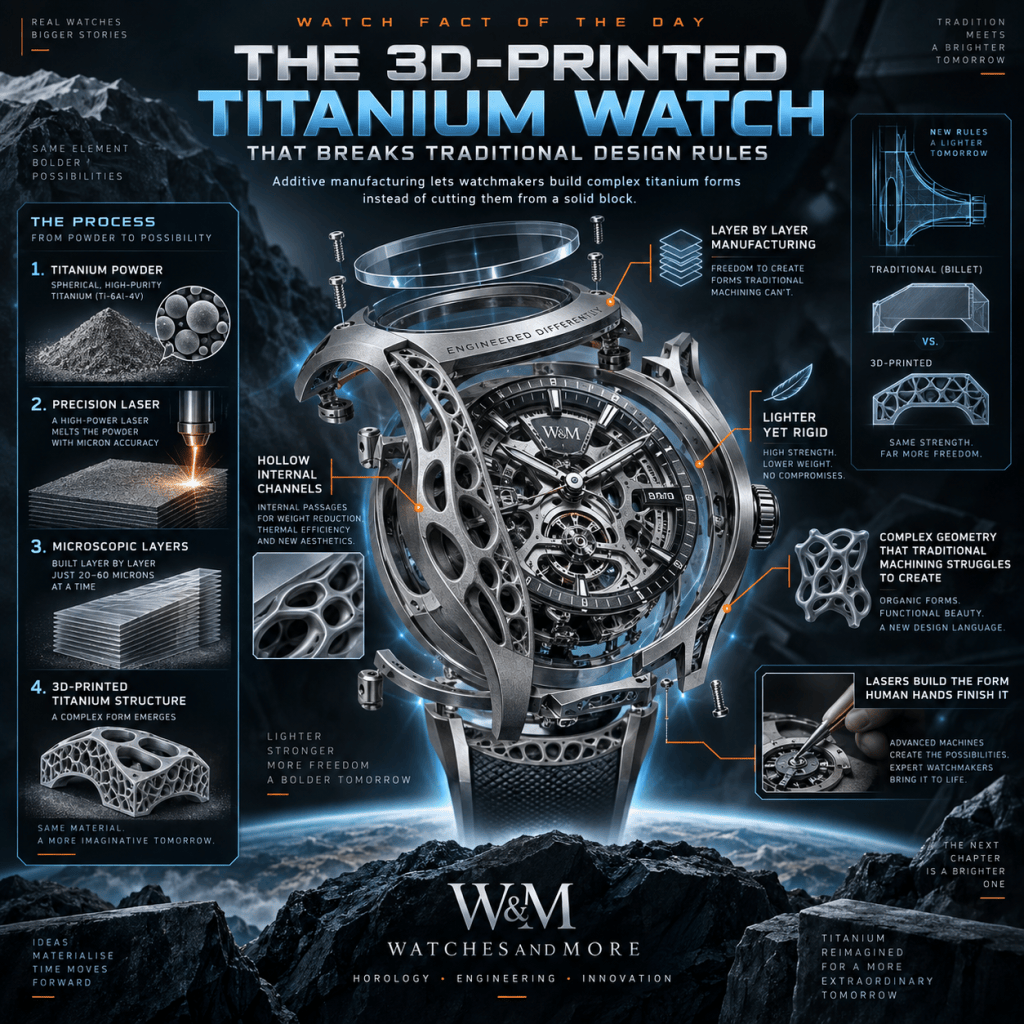
Instead of carving a watch case out of a solid block, technologies such as Selective Laser Melting (SLM) and Direct Metal Laser Sintering (DMLS) build titanium structures layer by microscopic layer from metal powder. A laser selectively fuses each layer according to a digital model until a complete three-dimensional component exists. TAG Heuer Official Magazine

And that changes what watch designers are physically capable of making.

Traditional machining works beautifully when cutting tools can reach the surfaces that need to be removed. But it becomes far more difficult when designers want internal cavities, enclosed channels, skeletal lattices, deep undercuts, or organic structures hidden inside a case.

Additive manufacturing can simply build those forms into the component from the beginning.

DON’T CUT THE EMPTY SPACE OUT.

BUILD THE EMPTY SPACE IN.

That sounds subtle, but it is a huge shift.

One striking modern example is the TAG Heuer Monaco Split-Seconds Chronograph Air 1, introduced in 2025. Its Grade 5 titanium case is produced using Selective Laser Melting, allowing TAG Heuer to create a dramatically hollowed architecture that the company says would be impossible to manufacture conventionally. The resulting case is less a traditional metal shell and more like a miniature structural chassis inspired by performance engineering. TAG Heuer Official Magazine

Panerai has been exploring a similar idea for years.

Its DMLS titanium cases are built layer by layer from titanium powder and can contain internal cavities that reduce mass while preserving the strength required from a large sports-watch case. Recent technical reporting on Panerai’s DMLS construction cites the brand’s claim that these cases can be about 25% lighter than conventional titanium versions of comparable design, while remaining more than 50% lighter than steel. Time and Watches

Independent watchmakers are pushing the aesthetic side even further.

Dutch brand Holthinrichs uses 3D-printed Grade 5 titanium to create skeletal lugs, complex architectural surfaces, and case geometries shaped by founder Michiel Holthinrichs’ background in architecture. Some models deliberately leave portions of the raw printed texture visible beside hand-polished surfaces, turning the manufacturing process itself into part of the design language. Fratello Watches

And emerging makers such as Apiar have used additive manufacturing to create titanium cases from thousands of extremely thin layers, including open lattice structures that would be considerably harder to realize through conventional machining alone. WatchPro USA

💡 Did You Know?

One of the most fascinating advantages of metal 3D printing is that a watch case can be solid where strength is required and hollow where material contributes little.

That means designers can think more like aerospace engineers:

LOAD PATHS → STRUCTURE

UNNECESSARY MASS → REMOVE IT

INTERNAL SPACE → ENGINEER IT

COMPLEXITY → PRINT IT

Instead of asking:

“CAN A CUTTING TOOL REACH THIS?”

they can ask:

“CAN WE DRAW IT IN 3D?”

That is a fundamentally different design philosophy.

⭐ Why It Matters

For centuries, watch design has been constrained partly by the tools used to manufacture watches.

Lathes encourage certain forms.

Milling machines encourage others.

Stamping creates another set of possibilities.

Additive manufacturing introduces a completely new vocabulary.

HOLLOW STRUCTURES

INTERNAL LATTICES

ORGANIC GEOMETRY

ULTRA-LIGHT TITANIUM

SHAPES THAT CAN’T EASILY BE MILLED

And here’s the part I love:

The finished object can still be hand-finished by traditional craftspeople.

So once again, new technology isn’t necessarily replacing traditional watchmaking.

It’s giving traditional finishing and mechanical horology new shapes to work with.

LASERS BUILD THE FORM.

HUMAN HANDS FINISH IT.


Category: Fun Quirk

Disclaimer: Every effort has been made to keep these watch facts accurate, but the world of horology is full of myths, disputed stories, and fascinating trivia. Consider these facts a starting point for discovery rather than the final word. If you have corrections or additional insights, let us know—we’re always happy to keep the record ticking in the right direction.

🕐 Discover more watch facts, reviews, and buying guides at WatchesAndMore


🛍️ You Might Also Like

As an Amazon Associate and affiliate partner, WatchesAndMore earns from qualifying purchases.
G-Shock GWM5610-1 Solar Atomic
🔥 Deal of the Day

G-Shock GWM5610-1 Solar Atomic

Casio

★★★★★ 4.8 (5,621 reviews)

$129

Offer expires in


🔥 Grab This Deal →

G-Shock GA2100-1A1 CasiOak


G-Shock GA2100-1A1 CasiOak

Casio

★★★★★ 4.8 (2,156 reviews)

$99


Check Price on Amazon →

Casio Edifice Chronograph


Casio Edifice Chronograph

Casio

★★★★★ 4.7 (1,264 reviews)

$120


Check Price on Amazon →


Browse all expert-reviewed watches →