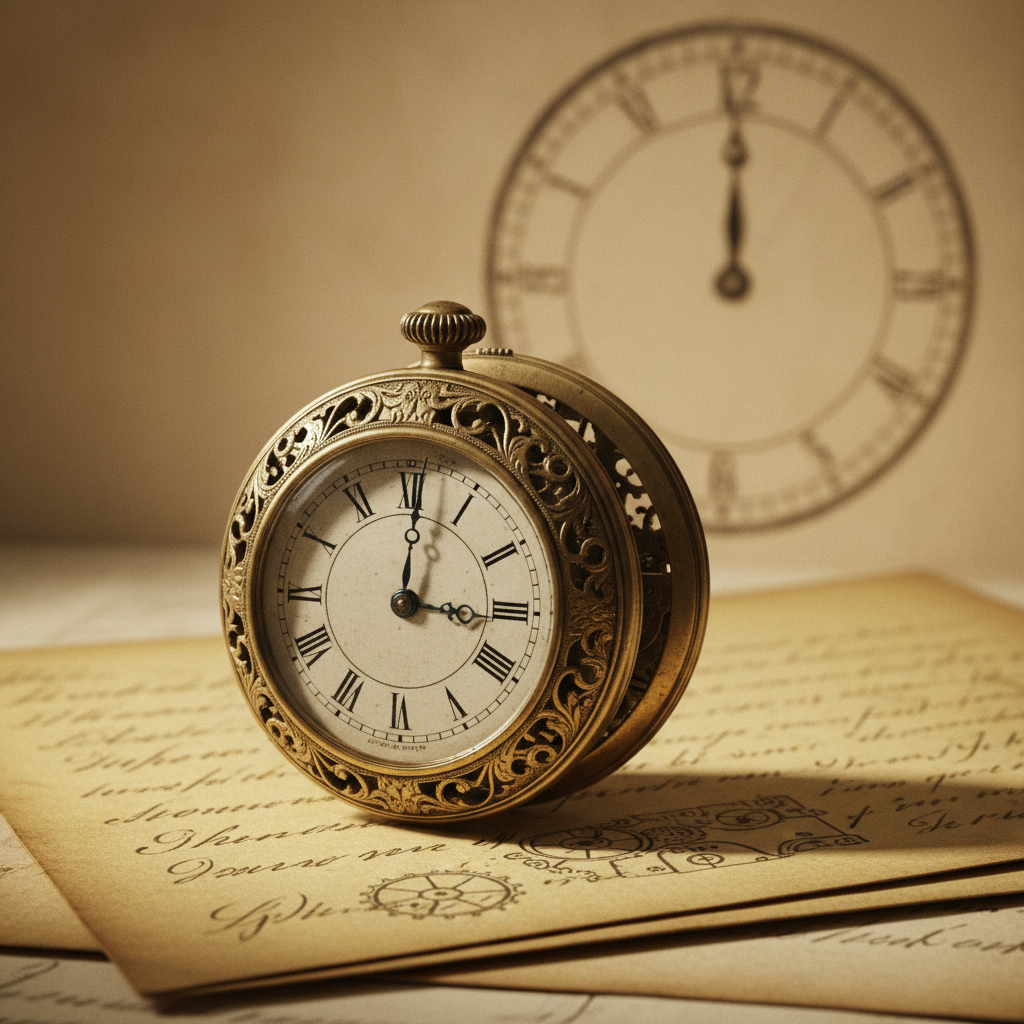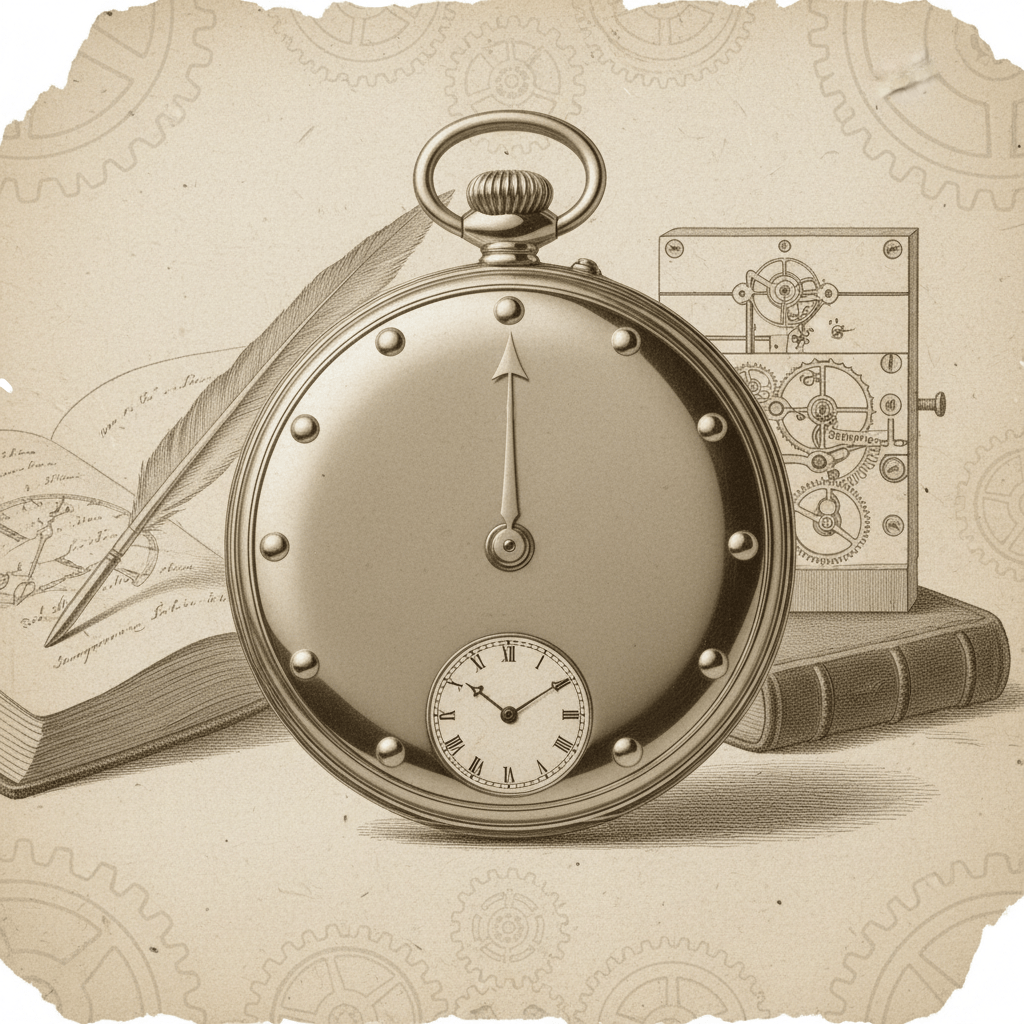
Henry Graves and the Patek Philippe Supercomplication

Delivered in 1933, the Henry Graves Supercomplication combined 24 complications with a personalized sky chart. Explore its mechanisms and collecting history.

Watch Fact of the Day
Watch History: Tuesday, October 27, 2026

📅 Tuesday, October 27, 2026

Some collectors want rarity. Henry Graves wanted watchmakers to redefine what a portable watch could do.

The Henry Graves Jr. Supercomplication is a pocket watch built around extraordinary ambition. It brings several ways of measuring, displaying, and sounding time into a single mechanical object.

🏛️ A Commission with Something to Prove

The American banker was an important Patek Philippe patron. Sotheby’s places his commission within the collecting competition associated with Graves and automobile manufacturer James Ward Packard. The completed watch was delivered on 19 January 1933.

The rivalry is a memorable hook, but the more rewarding story is what such commissions asked the watchmakers to achieve. A collector’s request had to become a workable arrangement of physical mechanisms.

⚙️ Twenty-Four Complications

The watch is conventionally described as having 24 complications. Its functions include calendar information, chiming, split-seconds timing, and astronomical indications. Each imposes demands for space, stored energy, and controls.

Combining them is not simply a matter of packing independent gadgets into a larger case. Hands must clear one another, settings must remain accessible, and the owner needs a way to understand the displays.

🌌 A Personal View of the Sky

One of the most evocative features is a sky chart related to Graves’s location in New York. It turns the universal movement of the stars into a display connected to one person’s home.

That personalization changes the meaning of complexity. This was an object shaped around an owner’s interests, not just an exercise in adding as many indicators as possible.

💡 Did You Know?

The Supercomplication held its complication record until Patek Philippe’s Calibre 89 arrived in 1989. Later achievements do not diminish what the earlier watch accomplished within the tools and methods of its own era.

⭐ Why It Matters

The watch demonstrates the relationship between demanding patronage and ambitious craft. A commission can support work that ordinary production would struggle to justify.

It also gives collectors a richer question than price: what did this object ask its makers to solve, and why do their solutions still fascinate us?

A great complicated watch contains the ambition that brought its mechanisms together.

📚 Sources & Further Reading

Sotheby’s — Henry Graves Supercomplication, lot 345


Join the Conversation

What would your dream complicated watch do? Share your thoughts in the comments below.

Read Next

Category: Watch History

Disclaimer: Every effort has been made to keep these watch facts accurate, but the world of horology is full of myths, disputed stories, and fascinating trivia. Consider these facts a starting point for discovery rather than the final word. If you have corrections or additional insights, let us know—we’re always happy to keep the record ticking in the right direction.

🕐 Discover more watch facts, reviews, and buying guides at WatchesAndMore

Explore watches in the W&M Watch Database.

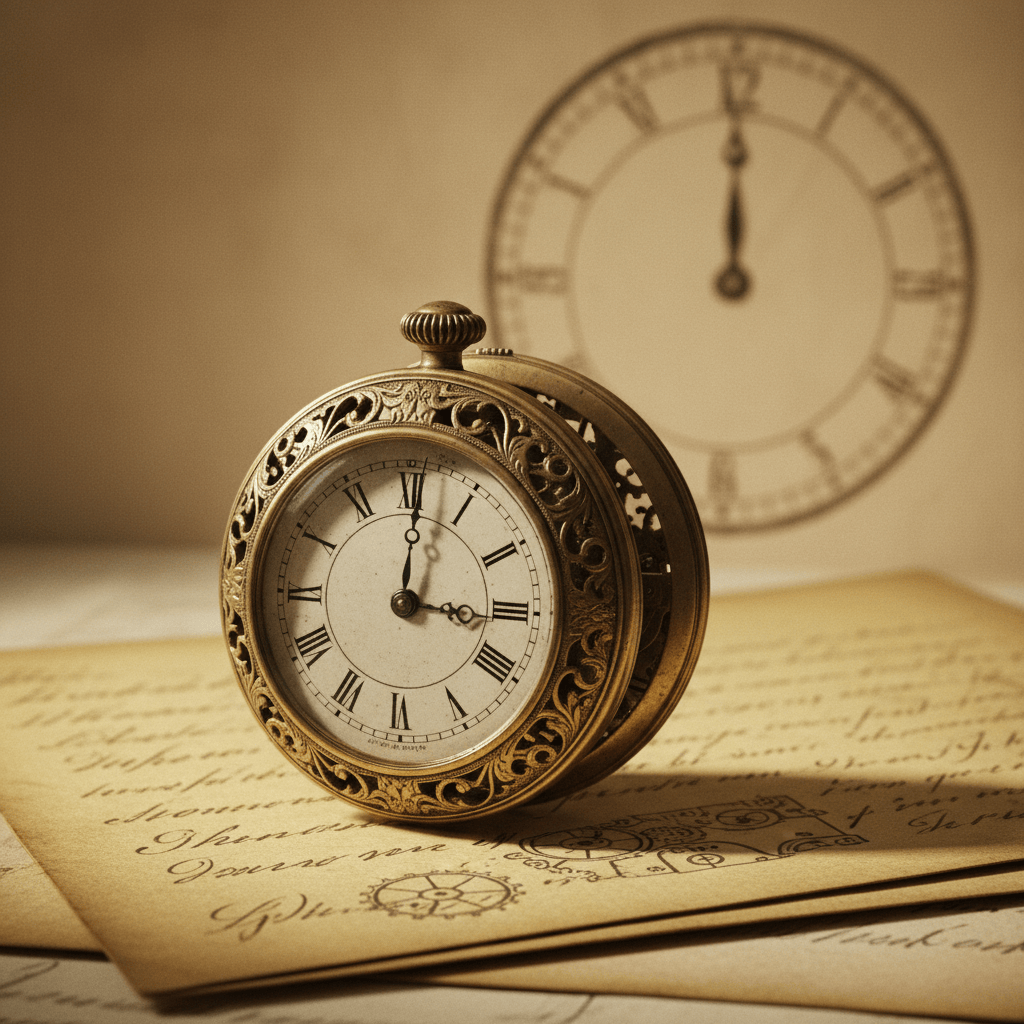
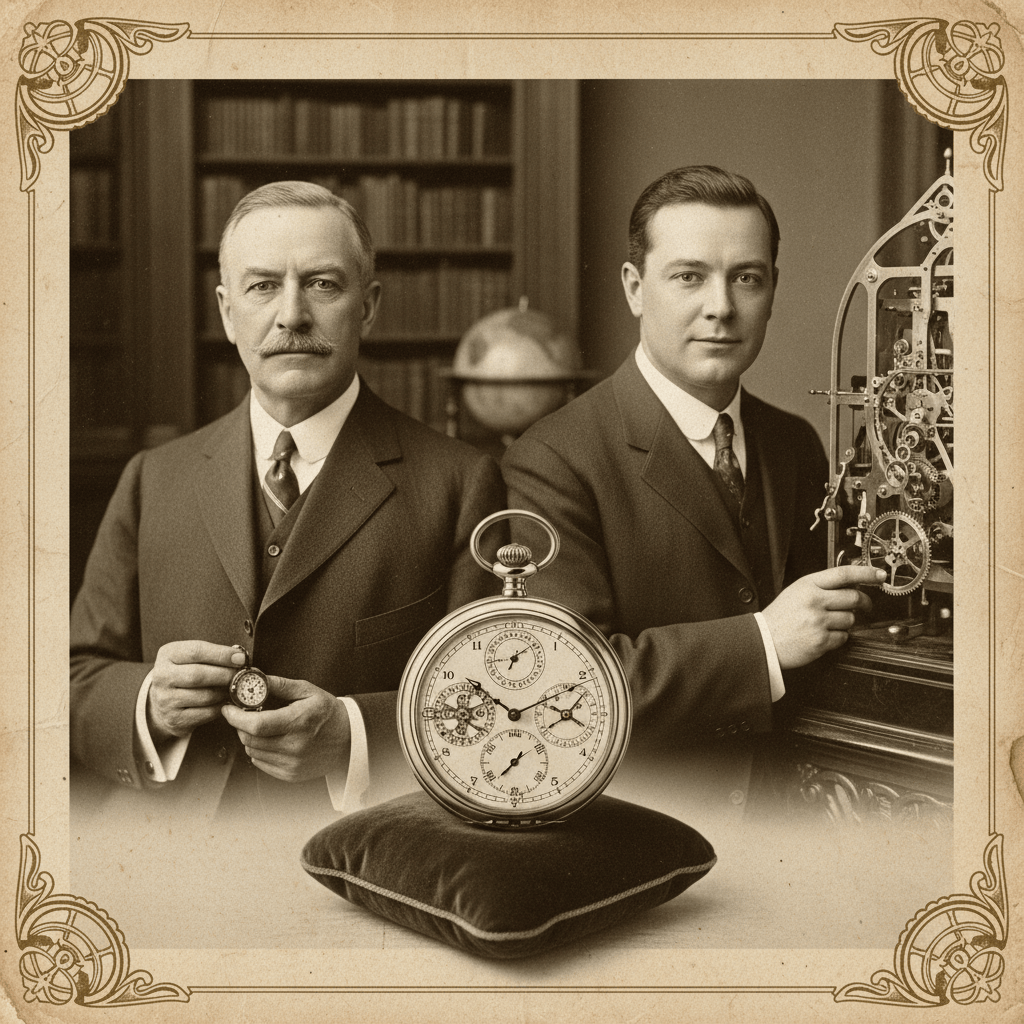
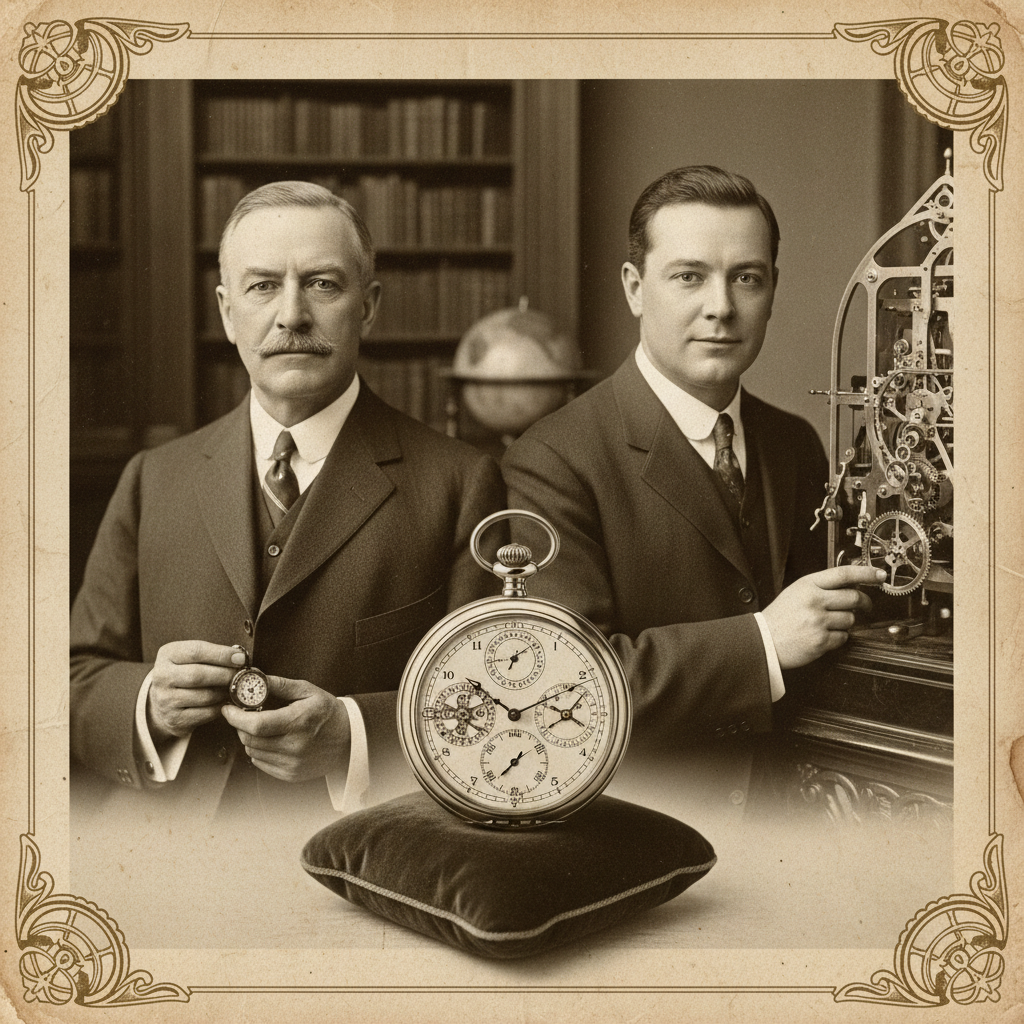
Patek Philippe’s 24-complication pocket watch, with a sky chart for New York, was delivered to Henry Graves Jr. in 1933.
Watches & More infographic. Editorial illustrations.

Hermès Le Temps Suspendu: The Watch That Hides the Time

Hermès and Agenhor created a watch that withdraws its hands while keeping time running. Discover the mechanism behind the poetic idea.

Watch Fact of the Day

Fun Quirk: Monday, October 26, 2026

📅 Monday, October 26, 2026

You cannot stop time. You can ask your watch to stop showing it for a while.

Imagine a conversation you do not want to interrupt with another glance at your wrist. Hermès turned that feeling into a mechanical complication. With Arceau Le Temps Suspendu, the display takes a temporary holiday while the underlying timekeeping continues.

🕰️ A Different Question

Agenhor, the specialist workshop behind the complication, traces the project to an idea about suspending time. The original watch launched in 2011 after three years of development. Instead of offering more information, it created a way to withdraw it.

Most complications add something to read: another date, another time zone, another measured interval. Here, the emotional appeal is permission to look away. The mechanism gives that thought a physical expression.

⚙️ The Movement Keeps the Secret

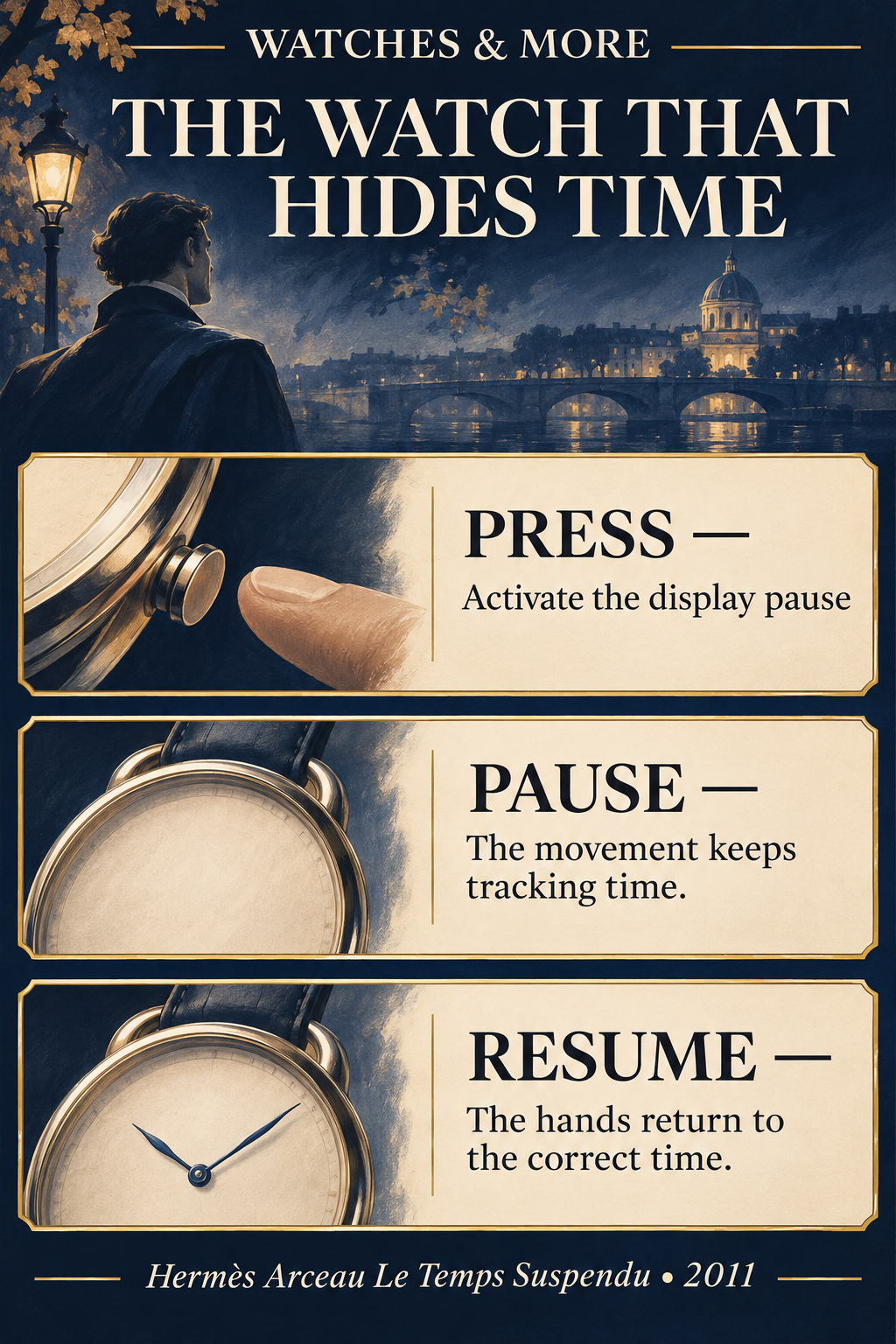
Agenhor explains that a module disconnects the hour and minute hands from the main gear train when the function is activated. The hands withdraw from their normal time display, while the watch continues tracking the passing time.

When the ordinary display resumes, the hands return to the correct reading. The wearer does not need to calculate how long the pause lasted or reset the watch. The time was preserved even while it was hidden.

⏸️ Why It Is Different from Stopping

Stopping a watch interrupts the measurement of time. Suspending this display changes the information presented to the wearer. That distinction separates two activities that normally seem inseparable: keeping time and showing it.

The result invites a different appreciation of complexity. The cleverness lies in controlling what the mechanism reveals, rather than filling the dial with another indicator.

💡 Did You Know?

Agenhor describes the development as protected by two patents. The simple-looking gesture conceals the work of disengaging the display and restoring it to a meaningful reading.

⭐ Why It Matters

Le Temps Suspendu shows how watchmaking can express a feeling about time. Its purpose is understandable even to somebody with no interest in gears: some moments are better enjoyed without repeatedly checking the hour.

The minutes keep moving. For a while, you are free to stop watching them.

📚 Sources & Further Reading

Agenhor — A Mechanical Poem: Suspended Time with Hermès


Join the Conversation

Would hiding the time help you enjoy the moment? Share your thoughts in the comments below.

Read Next

Category: Fun Quirk

Disclaimer: Every effort has been made to keep these watch facts accurate, but the world of horology is full of myths, disputed stories, and fascinating trivia. Consider these facts a starting point for discovery rather than the final word. If you have corrections or additional insights, let us know—we’re always happy to keep the record ticking in the right direction.

🕐 Discover more watch facts, reviews, and buying guides at WatchesAndMore

Explore watches in the W&M Watch Database.

Hermès Le Temps Suspendu pauses the display while the movement keeps time, then restores the correct reading.
Watches & More infographic. Editorial illustrations.

The Unusual Alarm of the Breguet Ring Watch

A Breguet ring watch sold in 1836 used a tiny needle alarm. Its documented details reveal an extraordinary miniature timepiece.

Watch Fact of the Day

Fun Quirk: Monday, October 26, 2026

📅 Monday, October 26, 2026

Long before a silent notification could buzz on your wrist, a remarkable ring delivered its reminder directly to a finger.

A watch small enough to wear as jewellery is impressive. Add an alarm, and the design becomes more demanding: the maker must find room for the controls, stored energy, and a way to attract attention. A surviving Breguet ring watch answers that last question in an unexpected way.

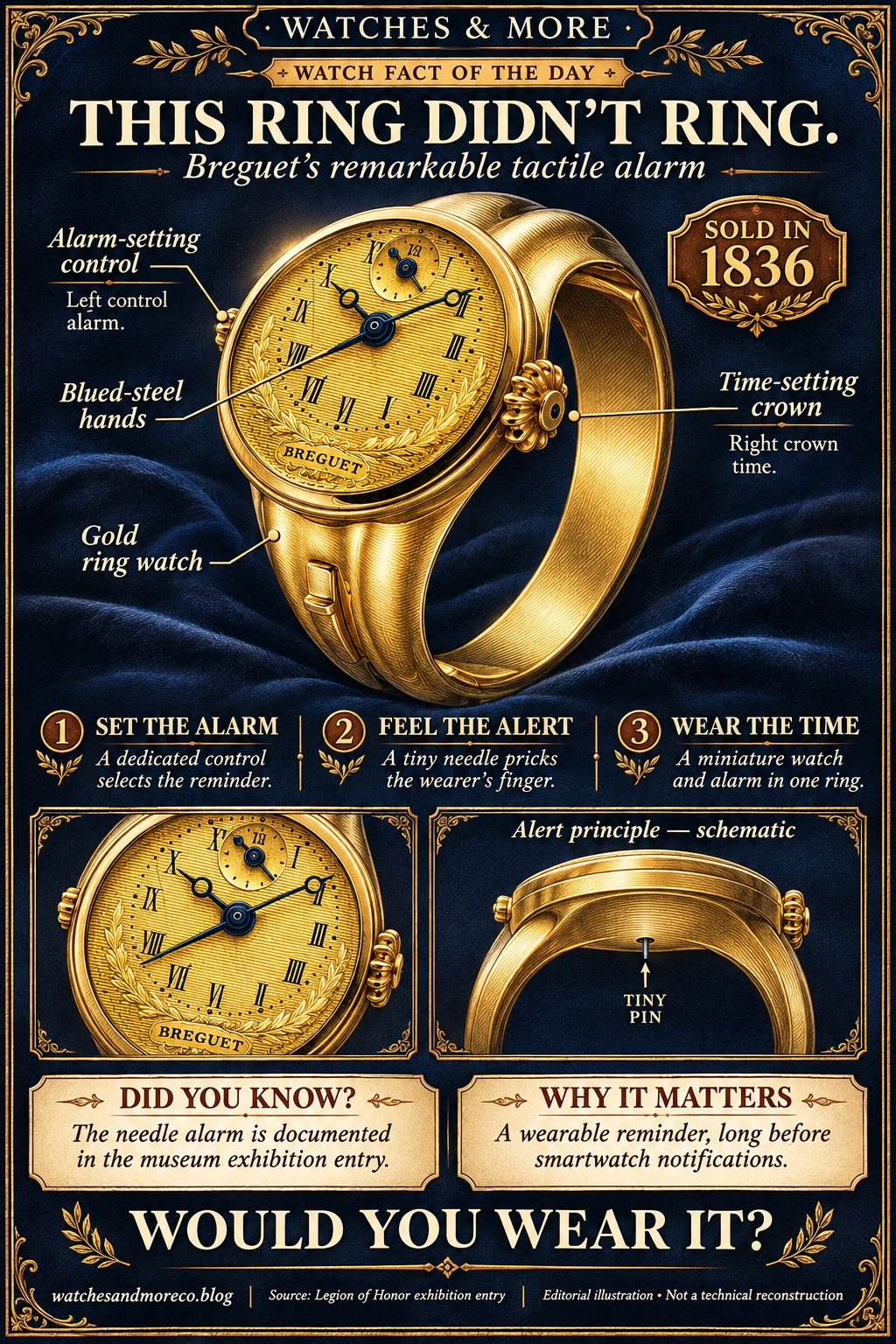
Watches & More infographic showing a gold Breguet ring watch sold in 1836, its time and alarm controls, and a conceptual illustration of the tiny pin used for a tactile reminder.
Breguet’s gold ring watch, sold in 1836: a miniature timepiece with a tactile alarm. Editorial illustration; the alarm-pin detail is schematic, not a technical reconstruction.

💍 A Documented Miniature

The Legion of Honor exhibition entry describes a gold ring watch from the Montres Breguet collection, sold in 1836. At about 25 mm across, it combines a time display and mechanical alarm in an exceptionally compact object.

Sold is the careful wording. The catalogue date should not be turned into a claim that Abraham-Louis Breguet personally constructed it in 1836. It is an object from the history of the Breguet house.

📍 A Reminder You Could Feel

The exhibition description explicitly records a small needle that pricks the finger when the alarm operates. A crown on the right winds and sets the time; a smaller control on the left sets the alarm.

Those details establish a purposeful tactile alert. They do not tell us how forceful the contact was, whether it pierced skin, or whether it reliably woke a sleeping wearer. The mechanism is fascinating without adding those unsupported dramatic claims.

🔎 More Than a Novelty

The catalogue also describes Roman numerals, a small seconds indication, blued-steel Breguet hands, and a ruby cylinder escapement. This was a considered timepiece, not merely a decorative ring with a clock face.

Miniaturization changes every decision. Controls must remain usable, the case must protect the mechanism, and the alarm must coexist with the movement. The achievement lies in integrating these demands within a wearable object.

💡 Did You Know?

The needle alarm appears in the museum exhibition description itself. It is a feature supported by a specific object record rather than just a frequently repeated anecdote.

⭐ Why It Matters

The ring belongs to the long history of wearable reminders. Its purpose is familiar: discreetly tell one person that a chosen moment has arrived. Modern vibration alerts meet much the same human need through different engineering.

A tiny timepiece can reveal a surprisingly large history of wearable technology.

📚 Sources & Further Reading

Legion of Honor exhibition catalogue — Small gold ring-watch


Join the Conversation

Would you choose a sound alarm or a silent wrist alert? Share your thoughts in the comments below.

Read Next

Category: Fun Quirk

Disclaimer: Every effort has been made to keep these watch facts accurate, but the world of horology is full of myths, disputed stories, and fascinating trivia. Consider these facts a starting point for discovery rather than the final word. If you have corrections or additional insights, let us know—we’re always happy to keep the record ticking in the right direction.

🕐 Discover more watch facts, reviews, and buying guides at WatchesAndMore

Explore watches in the W&M Watch Database.

Why Watches Show 10:10 in Advertisements

The positioning of watch hands at the time of 10:10 has become a popular convention in watch advertising, offering a visually balanced presentation that highlights the design. This arrangement not only keeps the brand name visible but also creates a friendly impression, resembling a smiling face. Research supports that watches displayed at 10:10 receive more positive evaluations, emphasizing the impact of thoughtful design choices. This practice reflects how minute adjustments can significantly influence perception. Next time you encounter a watch ad, take a moment to appreciate how the displayed time shapes your view of the product, revealing the artistry in watch design.

Watch Fact of the Day

Watch Culture: Sunday, October 25, 2026

📅 Sunday, October 25, 2026

Different brands. Different watches. The same familiar pose.

Open a watch catalogue and look past the polished cases and beautiful dials.

Notice the hands.

Again and again, they point upwards in that familiar open V: somewhere around 10:10.

Coincidence? Hardly. Those hands are helping present the watch before you have read a word of the advertisement.

🎯 A Watch’s Best Angle

Around 10:10, the hour and minute hands spread across the upper dial, creating a visually balanced arrangement.

In a 2014 NPR interview, Timex design director Giorgio Galli explained his preference in terms of showing the dial clearly. For him, the appeal was the composition rather than a deliberate smiling face. TPR

Think of it as a product’s preferred camera pose: an arrangement chosen to show its design at its best.

That is a strong explanation for the convention’s appeal. It does not establish one definitive moment when the entire industry adopted it.

👀 Making Room for the Name

Seiko provides a particularly clear example.

The company says it has used 10:08:42 for catalogue photographs of its analogue watches since 1964. That arrangement separates the three hands and keeps the brand name and logo visible. It also gives the upward-facing hands a pleasing appearance. seikowatches.com

So “10:10” is useful shorthand for a family of carefully chosen settings—not a universal instruction to the second.

Nor does that pose guarantee every marker, date window, or subdial will remain uncovered. The best arrangement depends on the watch.

CLICK HERE TO VIEW YouTube VIDEO

🙂 Is the Watch Really Smiling?

The smiling-watch explanation has more behind it than advertising folklore.

A 2017 study published in Frontiers in Psychology compared photographs showing watches at 10:10, 11:30, and 8:20.

Participants rated the 10:10 watches more positively, and a separate experiment found that the arrangement resembled a smiling face.

The researchers also reported more favourable purchase-intention ratings for 10:10. That measures a response to photographs, rather than demonstrating increased real-world sales. frontiersin.org

A pleasing layout may also feel friendly.

🧭 So Why Did the Convention Begin?

The evidence supports several reasons for using it: visual balance, clear presentation, visible branding, and a potentially positive emotional impression.

It does not justify saying the convention began purely for symmetry—or dismissing the smile as a myth.

A designer’s explanation, a brand’s photography rules, and a psychology experiment answer different questions. Together, they make the story more interesting than a single marketing secret.

💡 Did You Know?

Seiko’s preferred setting includes the seconds hand.

At 10:08:42, all three hands contribute to the composition. Even the slender hand you might barely notice has a role in presenting the dial. seikowatches.com

⭐ Why It Matters

Watch advertising reminds us how much design can communicate through a tiny adjustment.

The product stays the same. Move its hands, and the balance of the photograph changes.

Next time you see a watch advertisement, take a second look. Where are the hands guiding your eyes?

Sometimes, the time on a watch tells you how it wants to be seen. ⌚

Join the Conversation

Had you noticed the repeated time in watch advertisements? Share your thoughts in the comments below.

Read Next


Watches & More — Discover the story behind the watch.

Explore more Watch Facts • Visit Watches & More • Visit our companion site

Category: Watch Culture

Disclaimer: Every effort has been made to keep these watch facts accurate, but the world of horology is full of myths, disputed stories, and fascinating trivia. Consider these facts a starting point for discovery rather than the final word. If you have corrections or additional insights, let us know—we’re always happy to keep the record ticking in the right direction.

🕐 Discover more watch facts, reviews, and buying guides at WatchesAndMore


Explore watches in the W&M Watch Database.
ETSY Shop
ETSY Shop
Redbubble Shop
Redbubble Shop
More Watch Facts
More Watch Facts

📚 Sources & Further Reading

Further reading: seikowatches.com

Richard Mille RM 62-01: A Mechanical Watch with a Vibrating Alarm

The RM 62-01 delivers a mechanical alarm through vibration. Explore the travel functions and engineering behind this Richard Mille and Airbus collaboration.

Watch Fact of the Day

Fun Quirk: Saturday, October 24, 2026

📅 Saturday, October 24, 2026

No audible bell. No electronic notification. A mechanical reminder intended for the wearer alone.

A watch alarm usually announces itself. A hammer rings or a case buzzes, attracting attention through sound. The Richard Mille RM 62-01 Tourbillon Vibrating Alarm ACJ makes its signal a sensation on the wrist.

✈️ Designed for Discretion

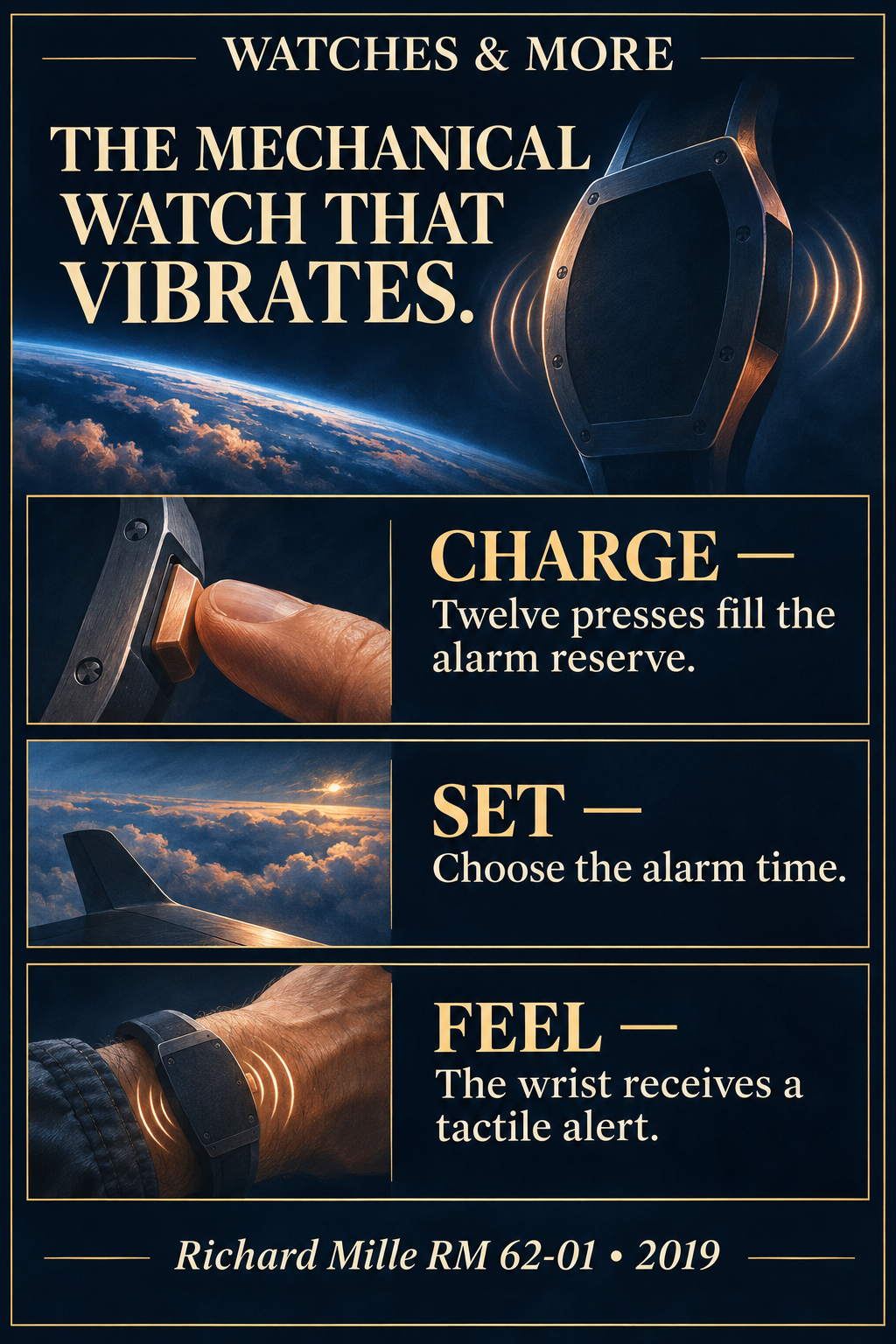
Introduced in 2019, the RM 62-01 was the second collaboration between Richard Mille and Airbus Corporate Jets. The manufacturer presents discretion as central to its design: an alert should reach its owner without disturbing others nearby.

That objective sounds familiar to anyone using a silent phone reminder. Pursuing it through a manually wound mechanical watch creates a very different set of problems involving energy, space, and the transmission of vibration.

⚙️ The Case Becomes Part of the Mechanism

Richard Mille contrasts the alarm with a hammer striking a gong, pillar, or case. Its titanium and Carbon TPT structure is designed to direct vibrations towards the wrist while protecting the movement.

The exterior therefore has a functional role beyond appearance and protection. The choice of materials and construction helps determine how the owner experiences the alert.

🌍 More Than a Reminder

The movement also provides a tourbillon, oversize date, and second time zone. The alarm can be set to the nearest minute on a 24-hour basis, with its own activation, AM/PM, and energy-reserve indications.

Those displays answer practical questions. Is the alarm armed? Is it set for morning or evening? Does it have enough energy? Even an elaborate mechanism needs a clear interface.

💡 Did You Know?

The alarm is charged by pressing a pusher rather than repeatedly turning the crown. Richard Mille specifies twelve presses to fill its alarm reserve. The timekeeping movement has a separate 70-hour reserve.

⭐ Why It Matters

The RM 62-01 shows that a complication can change the channel through which time reaches us. Moving hands, chimes, and tactile signals are different answers to the same communication problem.

Its link with historic alarm watches is the human requirement: provide a reliable prompt at a chosen moment.

Sometimes a complicated watch makes its strongest impression by keeping quiet.

📚 Sources & Further Reading

Richard Mille — RM 62-01 historical model


Join the Conversation

Would a silent mechanical alarm be useful to you? Share your thoughts in the comments below.

Read Next

Category: Fun Quirk

Disclaimer: Every effort has been made to keep these watch facts accurate, but the world of horology is full of myths, disputed stories, and fascinating trivia. Consider these facts a starting point for discovery rather than the final word. If you have corrections or additional insights, let us know—we’re always happy to keep the record ticking in the right direction.

🕐 Discover more watch facts, reviews, and buying guides at WatchesAndMore

Explore watches in the W&M Watch Database.

Richard Mille RM 62-01 alarm sequence: charge with twelve presses, set the alarm, then feel the alert.
Watches & More infographic. Editorial illustrations.

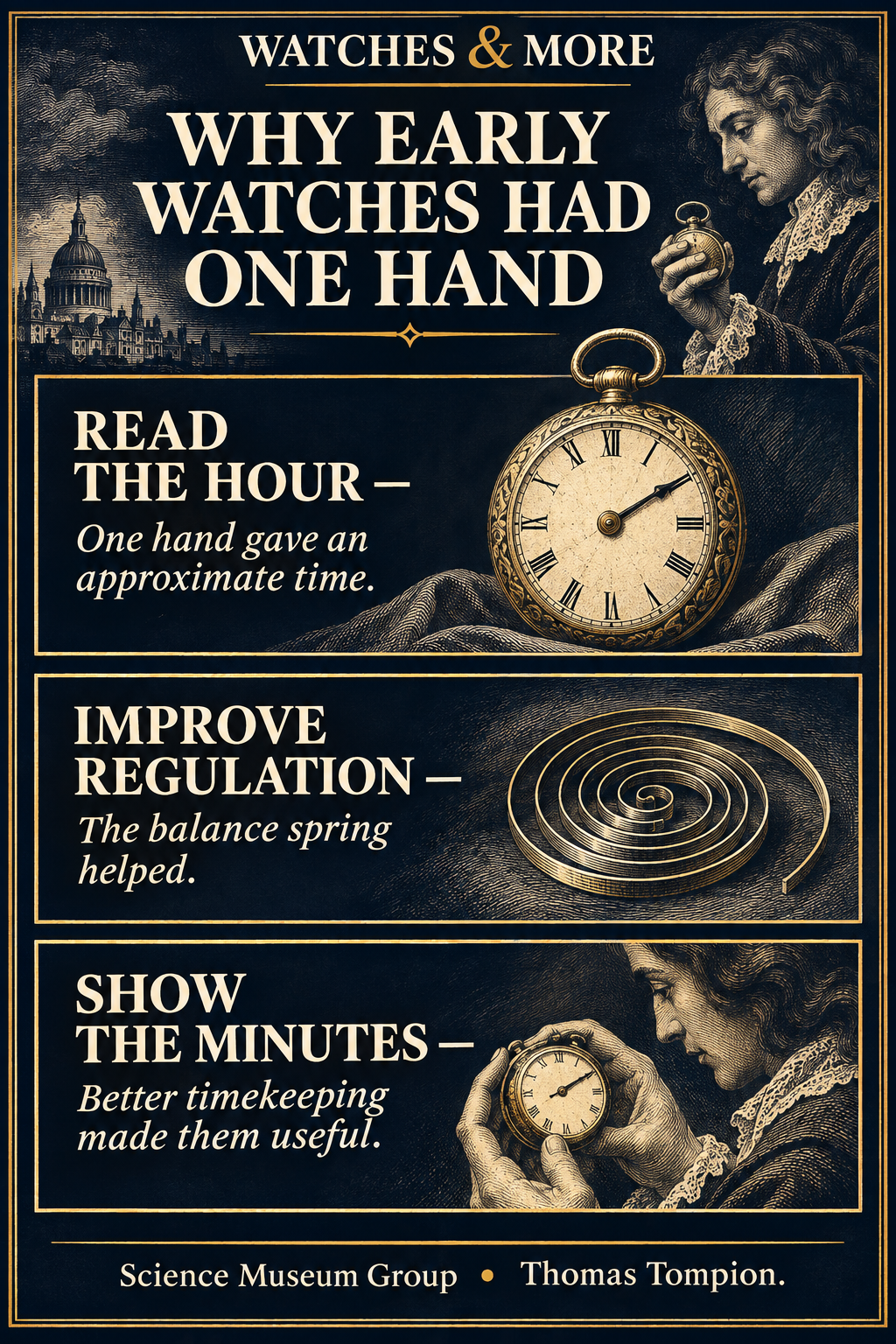
Why Early Watches Had Only One Hand

Early watches often showed only the hour. Improvements in regulation made minutes useful and changed how watchmakers designed their dials.

Watch Fact of the Day

Watch History: Friday, October 23, 2026

📅 Friday, October 23, 2026

A missing minute hand could be an honest statement about what a watch could reliably measure.

An early watch with one hand may look surprisingly modern. Minimalist to our eyes, perhaps—but for its original owner, the display reflected a different relationship between timekeeping precision and the information worth showing.

⌚ The Hour Was the Main Event

Many early portable watches used an hour hand, with its position between the numerals suggesting an approximate reading. Fine divisions have limited practical value if the mechanism cannot keep their time dependably.

A dial can contain tiny markings without making the watch more accurate. Display resolution and actual performance are separate qualities, even when a beautifully engraved scale makes them seem inseparable.

⚙️ A Change Inside the Movement

The balance spring brought a major improvement in the seventeenth century. The Science Museum Group describes Christiaan Huygens’s application of the spiral spring in 1675, Robert Hooke’s competing claim, and early watches made by Thomas Tompion under Hooke’s direction.

As regulation improved, reliable minute readings became more useful. The mechanism’s new capabilities encouraged watchmakers to give that information a more prominent place.

🔎 A Watch That Celebrated Minutes

A Tompion watch dated 1675–1679 in the Science Museum collection puts minutes on the main dial, with hours and seconds on subsidiary displays. It reverses the hierarchy we usually expect.

The museum interprets the layout as celebrating the ability to show minutes reliably. Its design makes a technical development visible: newly meaningful information receives the most important space.

💡 Did You Know?

That Tompion watch’s small hour dial counts to six rather than twelve. Historic displays often require us to learn their conventions before deciding what looks unusual or incomplete.

⭐ Why It Matters

The single-hand story is about matching information to capability. Adding a hand cannot create precision by itself.

It also invites a slower way of reading time. A broad sense of the hour may sometimes be all a wearer wants, even though modern technology can supply much finer measurements.

The extra hand became more valuable when the mechanism made its information worth trusting.

📚 Sources & Further Reading

Science Museum Group — Early balance spring watch by Thomas Tompion


Category: Watch History

Disclaimer: Every effort has been made to keep these watch facts accurate, but the world of horology is full of myths, disputed stories, and fascinating trivia. Consider these facts a starting point for discovery rather than the final word. If you have corrections or additional insights, let us know—we’re always happy to keep the record ticking in the right direction.

🕐 Discover more watch facts, reviews, and buying guides at WatchesAndMore


Read Next

Nuremberg Eggs and the Origins of Portable Timekeeping

Zodiac Astrographic: The 1969 Watch with Floating Hands

Join the Conversation

Could you live with a watch that shows only the hour? Share your thoughts in the comments.

Explore watches in the W&M Watch Database.

Early watches showed approximate hours. The balance spring improved regulation and made minute readings more useful.
Watches & More infographic. Editorial illustrations.

Breguet Tact Watches: Telling Time by Touch

Breguet’s tact watches used an external pointer and raised markers to make the hour readable by touch. Discover the ingenuity behind the 1799 idea.

Watch Fact of the Day

Watch History: Wednesday, October 21, 2026

📅 Wednesday, October 21, 2026

Before a glowing screen could light the night, a pointer and raised markers offered another way to find the hour.

Imagine holding a watch without opening it or lifting it to your eyes. Your finger follows an arrow on the case and finds its position against surrounding studs. The time becomes something you can feel.

🖐️ Reading the Outside of a Watch

Breguet dates the commercial introduction of its montre à tact to 1799. Its historical account describes an external pointer corresponding to the hour hand, with markers placed around the case.

The pointer’s relationship to the markers gives the wearer an approximate time. This differs from a tactile watch whose owner opens a cover and touches hands on the dial. Here, the useful indication is brought to the outside.

🌙 Discretion and Darkness

The arrangement could be helpful when light was unavailable, or when openly checking the time might seem impolite. It allowed a discreet reading without visibly studying a watch face.

A tactile design can serve several circumstances. It does not follow that every example was made specifically for a blind owner; that question requires evidence about the individual watch and its commission.

💎 When Decoration Helps the Function

Breguet describes examples embellished with enamel, pearls, and diamonds. Raised ornamental elements could also provide a reference for the fingertips, combining function with a richly decorated exterior.

The result challenges a familiar division between useful instrument and jewellery. A single detail can contribute to appearance and operation at the same time.

💡 Did You Know?

Breguet records tact watch No. 611 as sold to Mrs. Bonaparte, later Empress Joséphine, in February 1800. A documented object brings the invention close to a named wearer and a specific moment.

⭐ Why It Matters

The conventional dial is one possible interface, not an inevitable form. Sound, touch, and light offer other ways for a watch to communicate.

The tact watch also encourages precise language: feeling an hour pointer between markers should not automatically be described as an exact minute display.

Ingenious timekeeping sometimes begins by asking whether we need to look at the dial at all.

📚 Sources & Further Reading

Breguet — Sale of the first tact watch


Category: Watch History

Disclaimer: Every effort has been made to keep these watch facts accurate, but the world of horology is full of myths, disputed stories, and fascinating trivia. Consider these facts a starting point for discovery rather than the final word. If you have corrections or additional insights, let us know—we’re always happy to keep the record ticking in the right direction.

🕐 Discover more watch facts, reviews, and buying guides at WatchesAndMore


Read Next

The Unusual Alarm of the Breguet Ring Watch

Vox Temporis: A Watch That Sounds Out the Minutes

Join the Conversation

Would you rather read the time by touch or hear it chimed? Share your thoughts in the comments.

Explore watches in the W&M Watch Database.
Tide-Tracking Pocket Watches: Timekeeping for the Sea

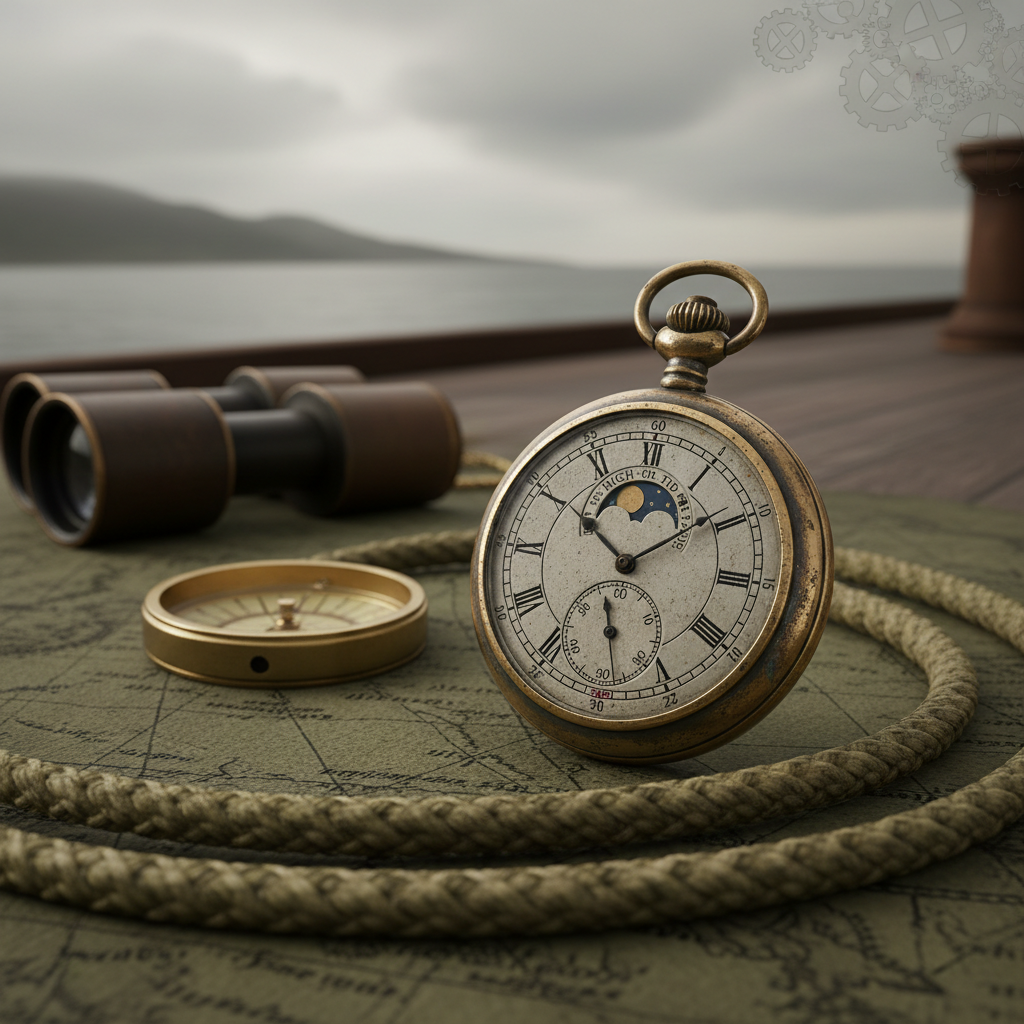
In the late 1800s, specialized marine pocket watches were developed with tide-predicting complications for naval navigators. These intricate mechanisms factored

Watch Fact of the Day

Military Watches: Tuesday, October 20, 2026

📅 Tuesday, October 20, 2026

⌚ Watch Fact of the Day: The 19th-Century Pocket Watch That Tracked the Tides

Before tide apps, watchmakers put the rhythms of the Moon and sea onto a dial.

A watch could tell you the hour. An unusual one could also help tell you when the tide would turn.

Imagine a harbour at low water: boats resting on exposed mud, channels narrowing, and a departure waiting on the sea.

For coastal travel, knowing the time was only part of the problem. Knowing the tide mattered too.

Long before digital forecasts, watchmakers found ways to bring tidal information into portable timepieces. One documented example dates to around 1830—earlier than the late-Victorian era we might imagine.

🌊 A Tide Display in Your Pocket

A Bonhams catalogue records a silver, double-sided pocket watch with tidal and moon-age indications, dated circa 1830.

One face combined the time display with calendar information. The other carried additional indications, including the tide and the Moon’s age.

The catalogue describes a key-wound fusee-and-verge movement and a case measuring approximately 55 mm. onthedash.com

This was an ambitious collection of information to carry in a pocket.

But the description does not identify it as standard naval equipment or establish that a particular captain used it. The surviving object supports a more precise claim: nineteenth-century watchmakers built pocket watches with tidal displays.

🌙 Why the Moon Matters

The tide does not follow the ordinary clock neatly.

A mean lunar day lasts approximately 24 hours and 50 minutes. In a simplified semidiurnal pattern, successive high tides are about 12 hours and 25 minutes apart. Tides and water levels

Those repeating astronomical relationships give clockmakers something to represent through gearing and scales.

Think of it as an early mechanical information display: translating a natural cycle into a position you can read.

The exact gearing of the circa-1830 watch is not explained in the auction description, so its mechanism should not be assumed from its dial alone.

⚙️ The Idea Was Older Still

The British Museum holds a remarkable watch by George Margetts, with a gold case hallmarked 1778.

Its enamel astronomical dial showed the Sun and Moon’s positions in the zodiac, the Moon’s age, and high-water times for named ports, including London, Hull, Plymouth, and Dublin.

The display also carried spring- and neap-tide markings. British Museum

That places portable tidal information firmly in the eighteenth century, rather than making it a late-1800s invention.

🧭 A Clever Display, With Local Limits

A tide indication is not a universal forecast for every harbour.

Coastline shape, seabed depth, and weather affect water levels and timing. Some places have one high tide per lunar day; others have two, sometimes of unequal height. National Oceanic and Atmospheric Administration

A repeating lunar cycle provides a useful foundation. It does not capture every local condition.

That makes tidal watches fascinating examples of mechanical modelling, while leaving room for the charts, observations, and local knowledge required at sea.

💡 Did You Know?

The British Museum describes Margetts’s 1778 watch as an eighteenth-century luxury likely intended for a scientifically curious gentleman or amateur astronomer. British Museum

A maritime complication does not automatically make its watch a working sailor’s instrument.

Sometimes, the attraction was carrying an astonishing explanation of the world in your pocket.

⭐ Why It Matters

Tidal watches show how far watchmakers could stretch the purpose of a timepiece.

Beyond counting hours, they sought to connect a small dial with much larger rhythms: the Moon overhead and the water along the shore.

The comparison with a modern tide app is irresistible. Both make a natural cycle easier to consult—but a historical dial represents only what its design can model.

One pocket watch. The Moon’s rhythm. A glimpse of the sea’s timetable. ⌚🌊


Watches & More — Discover the story behind the watch.

Explore more Watch Facts • Our main site • Our companion site

Category: Military Watches

Disclaimer: Every effort has been made to keep these watch facts accurate, but the world of horology is full of myths, disputed stories, and fascinating trivia. Consider these facts a starting point for discovery rather than the final word. If you have corrections or additional insights, let us know—we’re always happy to keep the record ticking in the right direction.

🕐 Discover more watch facts, reviews, and buying guides at WatchesAndMore


Read Next

HMS Beagle’s Pocket Chronometer: Timekeeping on Darwin’s Voyage

Vulliamy’s Traveller’s Watch: Two Times Before Time Zones

Join the Conversation

Which would you use more on a coastal trip: a tide display or a second time zone? Share your thoughts in the comments.

Explore watches in the W&M Watch Database.

ETSY Shop
ETSY Shop
Redbubble Shop
Redbubble Shop
More Watch Facts
More Watch Facts

Eterna’s 1914 Alarm Wristwatch: A Wearable Wake-Up Call

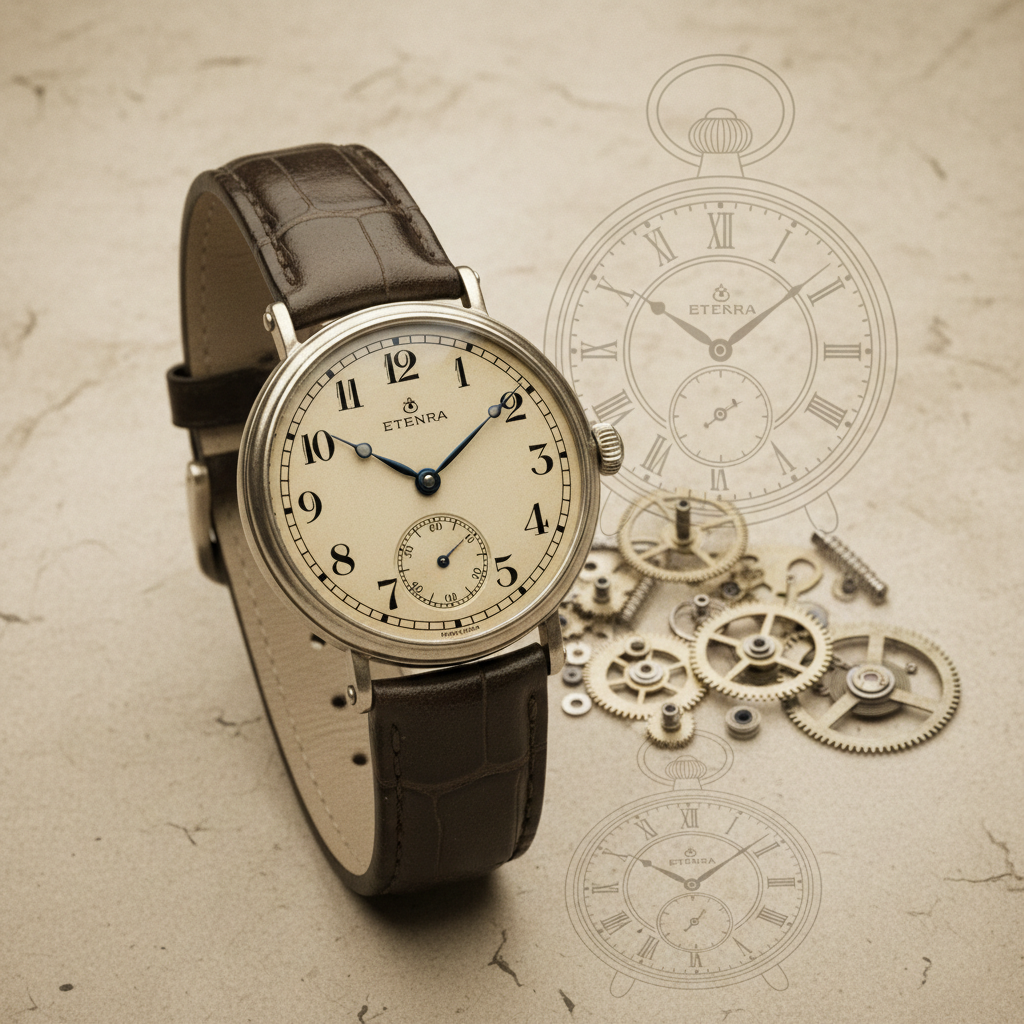
In 1914, Eterna dropped the ultimate timepiece bombshell: the first-ever alarm wristwatch! Forget always asking “What time is it?” Now, your watch could actually *tell* you to wake up—or at least quietly remind you for a scant six seconds. Talk about limited but ambitious! While it couldn’t belt out a wake-up call with the gusto of a rooster, it did manage to fit a buzzing mechanism into a clever little package. So next time your smartwatch interrupts your scrolling, tip your hat to Eterna for paving the way—though we’re still waiting on a wristwatch that shouts, “GET UP!”

Watch Fact of the Day

Watch History: Monday, October 19, 2026

📅 Monday, October 19, 2026

Before digital beeps and vibrating smartwatches, Eterna gave the wristwatch a mechanical voice.

Imagine a watch that does more than wait for you to look at it.

At the appointed moment, it interrupts.

Today, that sounds ordinary. But in 1914, putting an alarm into a production wristwatch was a remarkable proposition.

Eterna’s pioneering alarm watch brought a familiar bedside-clock idea to a much smaller, wearable package—and helped establish a new role for the wristwatch.

🔔 A Little Watch With Something to Say

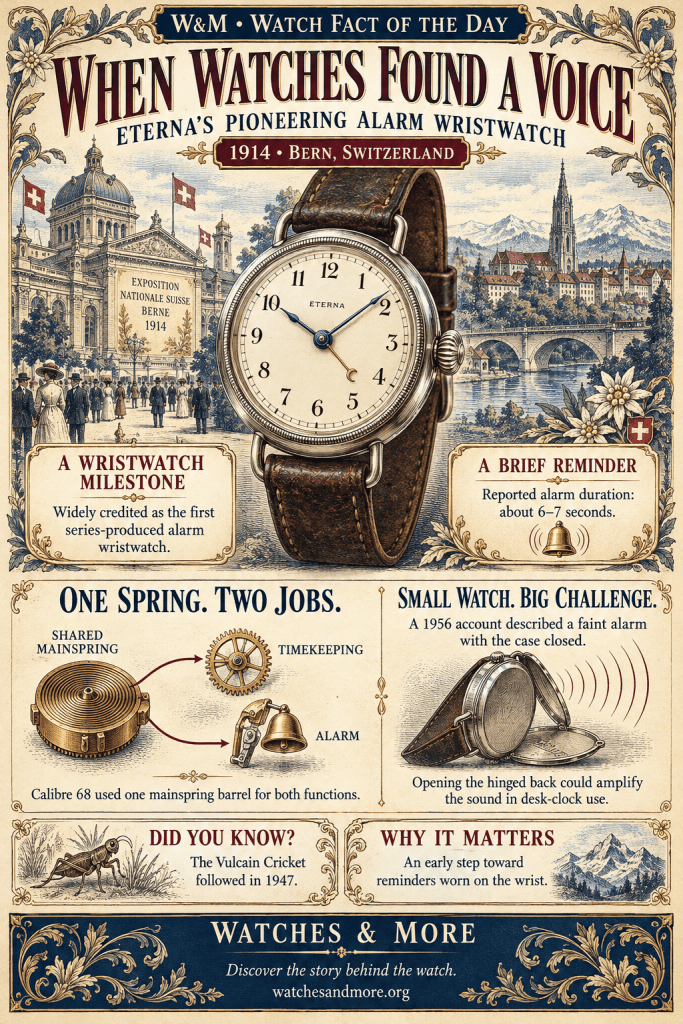
Eterna is widely credited with introducing the first series-produced alarm wristwatch in 1914, presenting it at the Swiss National Exhibition in Bern. The watch blog

That wording matters. Alarm watches and experimental wearable reminders had earlier histories; Eterna’s milestone concerns a wristwatch offered in series production. Grail Watch Wiki

It was an early answer to a question that still shapes watches today:

What if your watch could remind you of the time, instead of making you remember to check?

⚙️ One Spring, Two Jobs

The challenge was more than making a familiar mechanism smaller.

Inside the case, the watch needed to keep time, recognise a preset alarm time, and turn stored energy into sound.

Eterna’s calibre 68 used a shared mainspring barrel to supply both timekeeping and the alarm. A 1956 account by Louis Loze describes an alarm set using the bezel, with a lever allowing it to be switched off. Grail Watch Wiki

One energy source had to do two very different jobs.

That is an elegant packaging solution—but it also reveals the compromises facing an early mechanical alarm.

⏱️ The Six-Second Story

Modern accounts describe the early alarm as sounding for approximately six to seven seconds.

That makes “about six seconds” a better description than an exact, universal duration.

Teddy Baldassarre’s history of alarm watches connects that brief performance with the constraints of a single small barrel powering both functions. It also notes that alarm vibration could interfere with timekeeping. Teddy Baldassarre

This was pioneering technology with limitations.

The achievement was getting the reminder onto the wrist at all.

🛏️ Could It Really Wake You Up?

A mechanical alarm on the wrist sounds like the perfect travelling wake-up companion.

But the historical evidence calls for a little restraint.

Loze’s 1956 account describes the sound as relatively faint with the case closed. It also describes a hinged back that allowed the watch to serve as a desk clock, with the sound amplified in that position. Grail Watch Wiki

So, while “the watch that could wake you up” makes an appealing headline, the firmer historical claim is simpler:

Eterna put an audible alarm into a production wristwatch.

🧭 A Different Kind of Watch Function

A chronograph lets its owner measure an interval. An alarm addresses another everyday need: remembering a moment before it arrives.

That gives this little Eterna a surprisingly familiar personality.

Think of an appointment, a departure, or a task that needs attention. The attraction is the same as a modern reminder: set it, carry it, and let the device call you back.

The experience was entirely mechanical, but the ambition feels very current.

💡 Did You Know?

The famous Vulcain Cricket arrived in 1947, more than three decades after Eterna’s 1914 introduction.

The Cricket helped popularise the mechanical alarm wristwatch, but Eterna’s earlier contribution deserves its own place in the story. Teddy Baldassarre

⭐ Why It Matters

The Eterna alarm watch shows that important innovations do not always arrive in their most polished form.

Its brief alarm and acoustic limitations are part of the story. They reveal how difficult it was to make a compact watch both a precise timekeeper and an effective reminder.

More than a century later, the idea remains familiar every time something on our wrist asks for our attention.

A few seconds of sound. A lasting idea: your watch could tell you when it mattered. ⌚🔔


Discover more remarkable timepieces in the W&M Watch Fact Archive.

Visit Watches & More and our companion site.

Category: Watch History

Disclaimer: Every effort has been made to keep these watch facts accurate, but the world of horology is full of myths, disputed stories, and fascinating trivia. Consider these facts a starting point for discovery rather than the final word. If you have corrections or additional insights, let us know—we’re always happy to keep the record ticking in the right direction.

🕐 Discover more watch facts, reviews, and buying guides at WatchesAndMore


Read Next

The Unusual Alarm of the Breguet Ring Watch

Richard Mille RM 62-01: A Mechanical Watch with a Vibrating Alarm

Join the Conversation

Would you wear a mechanical alarm watch today? Share your thoughts in the comments.

Explore watches in the W&M Watch Database.
ETSY Shop
ETSY Shop
Redbubble Shop
Redbubble Shop
More Watch Facts
More Watch Facts

📚 Sources & Further Reading

Further reading: Fondation de la Haute Horlogerie — watchmaking glossary

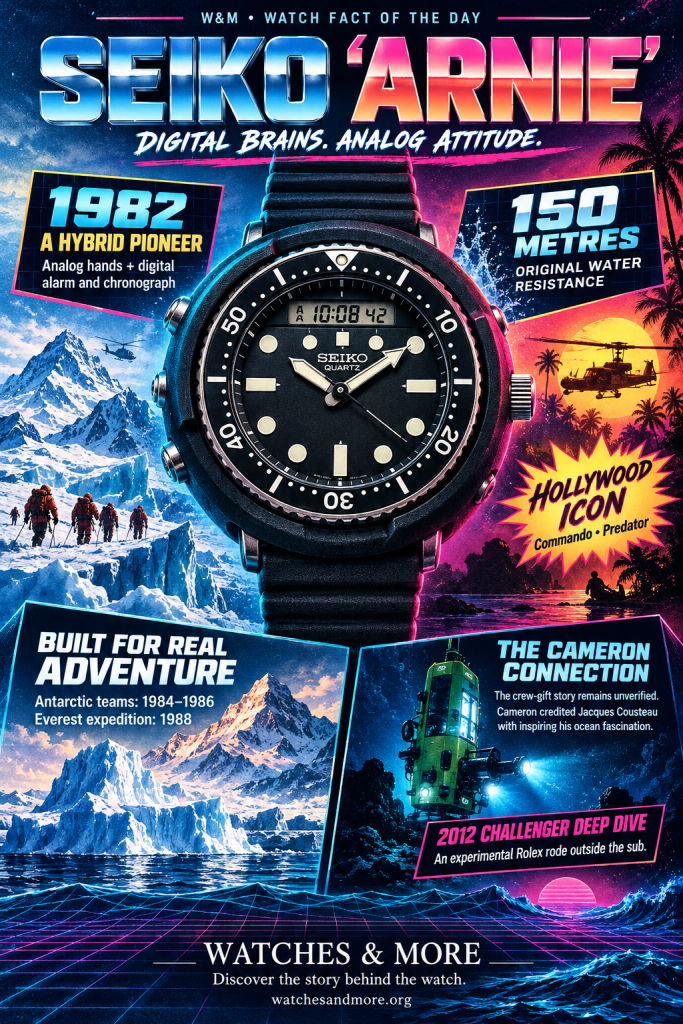
Seiko H558 “Arnie”: The Watch Behind the Deep-Sea Legend

The Seiko H558, nicknamed the “Arnie,” is a legendary dive watch known for its bold design and hybrid tech that fuses analog and digital features. It gained fame thanks to Arnold Schwarzenegger in films like Commando and Predator but has its own serious adventure cred. Beyond Hollywood, it was part of many expeditions like Antarctic missions and the Everest climb in the late ’80s. While James Cameron’s connection is interesting, it’s not really verified; he’s more recognized for another Rolex during deep-sea dives. Overall, the H558 mixes cutting-edge style with rich history, making it a hot topic for watch fans.

Watch Fact of the Day

Watches on Screen: Sunday, October 18, 2026

📅 Sunday, October 18, 2026

An unmistakable eighties diver, a Hollywood connection, and a story that deserves a closer look.

Some watches seem born for adventure.

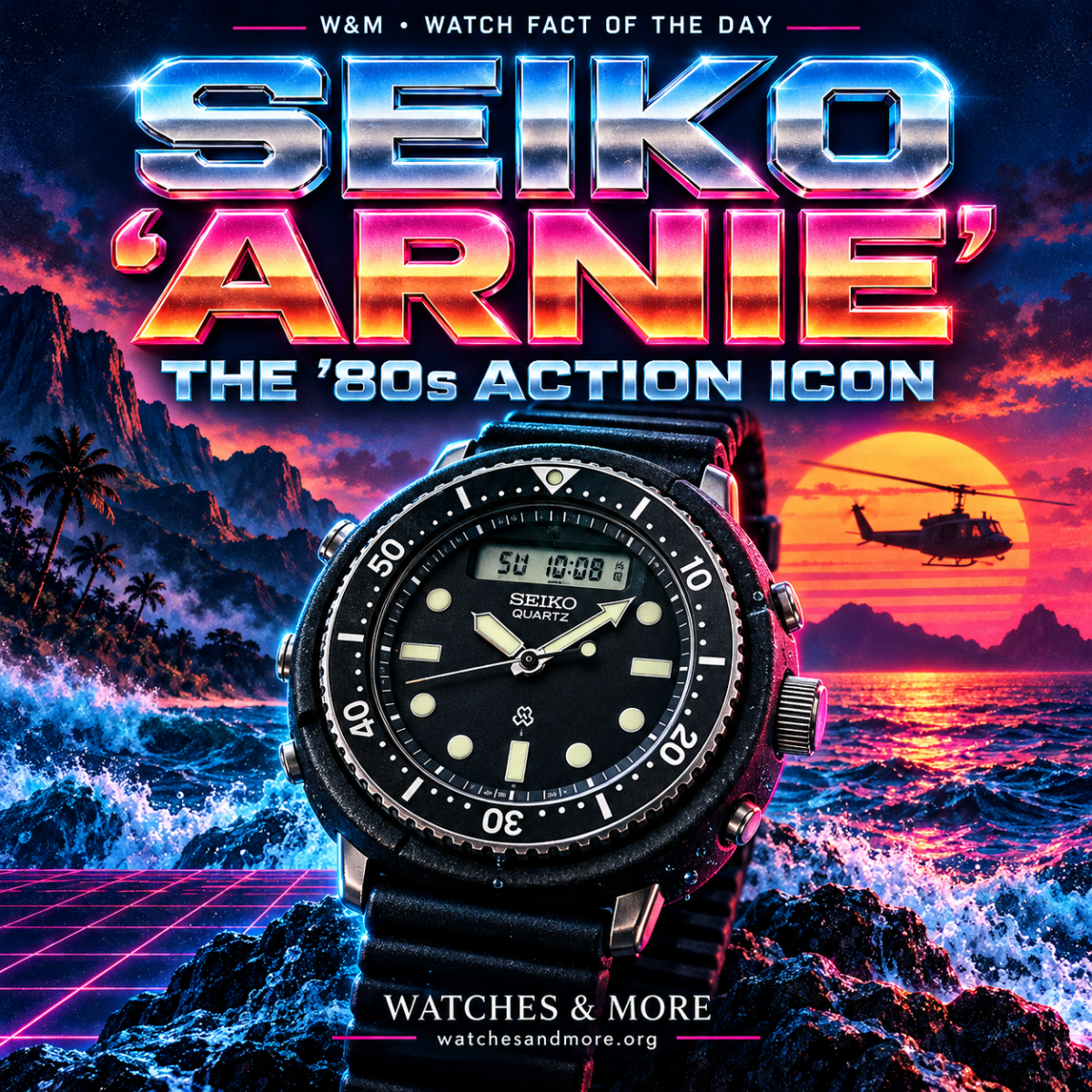
The Seiko H558 certainly looks the part: bold hands, a small digital window, and a chunky protective surround that gives it the presence of expedition equipment.

Collectors know it as the “Arnie.” Attach James Cameron’s name to it, and an intriguing tale emerges: a gift from the crew of The Abyss that supposedly helped ignite his deep-sea obsession.

It is a wonderful hook. But the documented history takes us somewhere different—and the watch has plenty of adventure credentials of its own.

🌊 Where Cameron’s Ocean Obsession Began

Long before The Abyss, Cameron was already fascinated by the underwater world.

In a 2012 interview with Eos, he credited Jacques Cousteau, his childhood in Canada, and learning to scuba dive at sixteen with setting him on that path. His exploration ambitions grew from those early experiences.

The claim that an H558-5009 gifted during The Abyss inspired that passion remains unverified. Eos

Fortunately, the Seiko’s own story needs very little embellishment.

🤖 A Diver With Two Personalities

Introduced in 1982, Seiko’s hybrid diver combined traditional analog hands with a digital display, an alarm, and a chronograph. Its original water-resistance rating was 150 metres.

Seiko describes it as the world’s first hybrid diver’s watch with both an alarm and chronograph.

There was thoughtful design behind that futuristic face, too: the LCD at twelve o’clock tilted upward to improve readability. Seiko Design 140

The combination had unmistakable appeal. Traditional hands gave it the familiar appearance of a dive watch, while digital functions delivered the technological excitement of the early eighties.

Part underwater instrument. Part science-fiction wrist gadget.

🎬 How It Became the “Arnie”

Arnold Schwarzenegger helped turn the H558 into a screen icon through appearances in Commando and Predator.

Seiko’s own UK boutique acknowledges the “Arnie” nickname and its Commando connection. HODINKEE’s examination of Predator identifies Schwarzenegger’s watch as an H558, probably an H558-5009—a useful qualification when discussing the exact reference. Seiko Official UK Online Store

The visual fit was perfect.

A large, purposeful watch. Camouflage. Helicopters. Eighties action-movie ambition.

Some watches disappear into a costume. This one became part of the character.

🧊 Real Expeditions Behind the Movie-Star Image

The hybrid diver’s adventures extended beyond film sets.

Seiko records its use by Japanese Antarctic wintering teams from 1984 to 1986, followed by the 1988 Japan–China–Nepal Everest expedition. Seiko Design 140

Those are substantial credentials for a watch often remembered first as an action-movie accessory.

Its distinctive appearance caught Hollywood’s eye, but its expedition history gives enthusiasts another reason to appreciate it.

🚢 What About Cameron’s Historic Deep Dive?

On 26 March 2012, Cameron made his historic solo descent to Challenger Deep aboard DEEPSEA CHALLENGER.

The experimental watch exposed to ocean pressure outside the submersible was a Rolex Deepsea Challenge, attached to its manipulator arm. Rolex documents its operation during the descent. Environment

There is no verified basis for presenting the Seiko as the inspiration or engineering benchmark for that mission.

The H558’s achievements and Cameron’s exploration career each offer compelling stories without requiring that connection.

💡 Did You Know?

The original hybrid diver placed its digital window at twelve o’clock.

On Seiko’s H855-powered 40th-anniversary reinterpretation, the larger display moved to six o’clock, alongside added functions including a diving log, depth measurement, and temperature measurement. Seiko Design 140

A small detail offers a quick clue when comparing generations.

⭐ Why It Matters

The Seiko H558 captures an exciting moment in watch design: electronic functions were expanding what a traditional tool watch could do.

Its appeal comes from that combination of useful technology, distinctive styling, expedition history, and cinematic personality.

For watch enthusiasts, that is more than enough reason to celebrate it.

Bold hands. Digital brains. Plenty of eighties attitude. ⌚🌊


Discover more remarkable timepieces in the W&M Watch Fact Archive.

Visit Watches & More and explore our companion site.

Category: Watches on Screen

Disclaimer: Every effort has been made to keep these watch facts accurate, but the world of horology is full of myths, disputed stories, and fascinating trivia. Consider these facts a starting point for discovery rather than the final word. If you have corrections or additional insights, let us know—we’re always happy to keep the record ticking in the right direction.

🕐 Discover more watch facts, reviews, and buying guides at WatchesAndMore


Read Next

Watch Fact of the Day: The Seiko Diver Proven in Antarctica

Longines Weems: The Second-Setting Watch for Early Aviators

Join the Conversation

What is your favourite watch from an adventure film? Share your thoughts in the comments.

Explore watches in the W&M Watch Database.

📚 Sources & Further Reading

Further reading: Seiko — movement-specific instruction manuals