

📅 Friday, October 2, 2026
When Gérald Genta designed the Audemars Piguet Royal Oak in 1970, he created one of the most recognizable bezels in watch history.
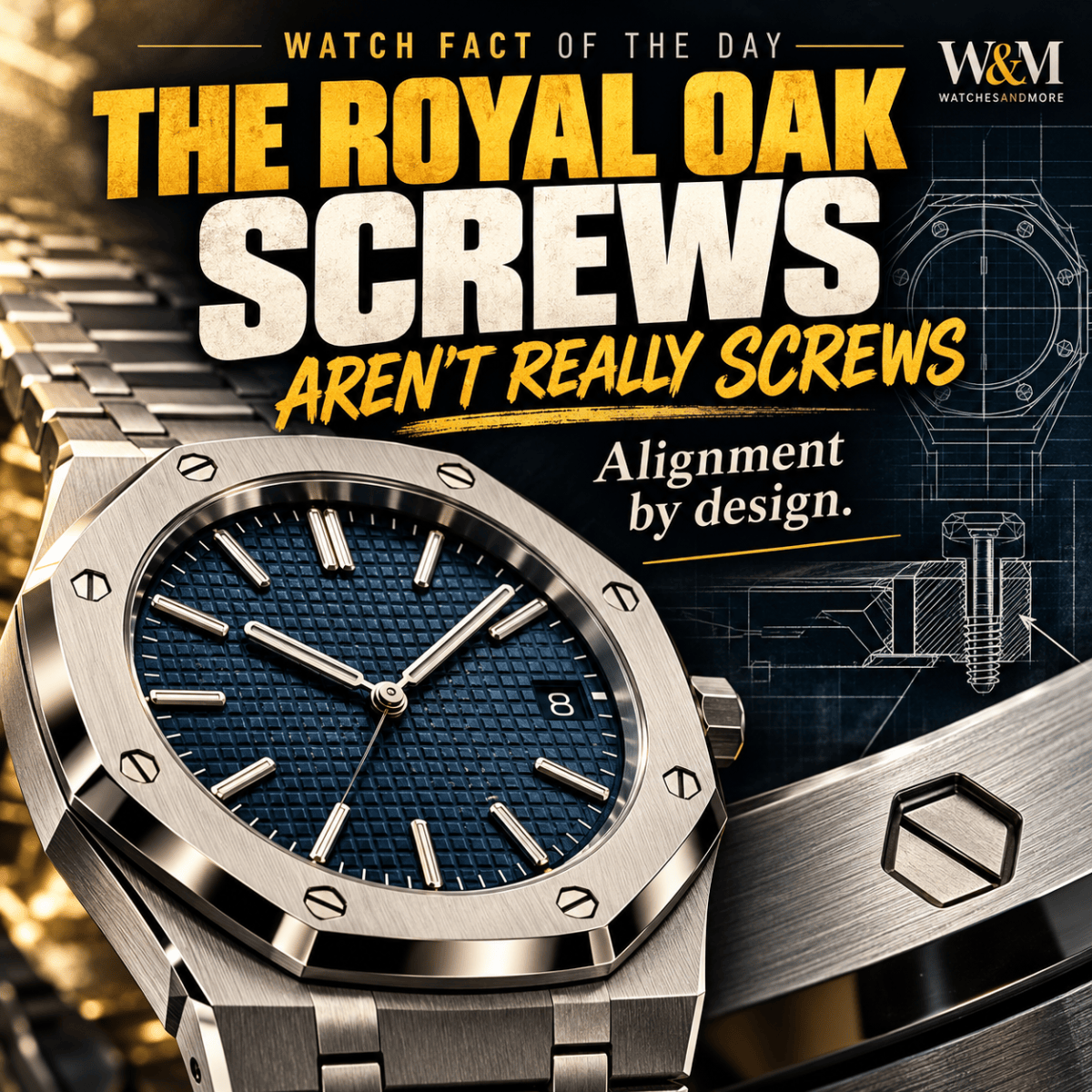
Eight visible hexagonal fasteners.
Eight polished slots.
Eight perfectly controlled positions around an octagonal bezel.
To most people, they look like ordinary screws.
But they do not work like ordinary screws at all.
The Royal Oak’s visible fasteners are through-screws. Their hexagonal heads are captured inside matching hexagonal holes in the bezel, which prevents them from turning. From the rear of the watch, round nuts are threaded onto those screws and tightened to clamp the case together and compress the water-resistance gasket. AP Chronicles
That means the visible slot on the front is not used to tighten the watch.
It can simply be oriented precisely for appearance.

THE FRONT DOESN’T TURN.
THE BACK DOES THE TIGHTENING.
And that is why the Royal Oak’s bezel slots can appear so perfectly aligned.
Why Genta Did It This Way
The Royal Oak’s design was inspired in part by the architecture of a diver’s helmet, with visible external fasteners becoming part of the visual identity rather than something to hide.
Genta’s 1970 sketch already showed the concept: a wide bezel, eight exposed hexagonal fasteners, and a large gasket compressed between the bezel and monocoque case. Audemars Piguet’s archives note that the hexagonal heads were intentionally captured so they would not rotate while being locked from below. AP Chronicles
That was radical at the time.
Traditional luxury watchmaking usually concealed functional hardware.
The Royal Oak put it on display.
FUNCTION BECAME DECORATION.
💡 Did You Know?
The neat slot alignment that collectors admire is actually the result of a clever engineering shortcut around a problem that watchmakers normally face.
Ordinary screws cannot simply be tightened until all their slots line up perfectly. Thread starts, screw lengths, tolerances, and final torque all determine where a screw head stops. That is why aligned screws are generally impractical in conventional watchmaking. Hodinkee
The Royal Oak gets around that problem because the front fastener doesn’t rotate during final tightening.
The nut on the back does.
That is the trick.
⭐ Why It Matters
The Royal Oak is full of details where engineering and aesthetics are inseparable.
The screws are not merely decorative.
The alignment is not fake.
And the system is not just visual theater.
The eight through-screws actually help clamp the case together and compress the gasket that contributes to water resistance. AP Chronicles
So one of the most famous decorative details in modern watchmaking is also a real structural part of the watch.
THEY LOOK LIKE SCREWS.
THEY DON’T TURN LIKE SCREWS.
AND THAT’S EXACTLY WHY THEY LINE UP.
This one is absolutely made for a W&M visual.
I’m seeing 1972 Swiss industrial-design magazine × Gérald Genta sketchbook × technical case cutaway.
Headline:
THE ROYAL OAK SCREWS THAT DON’T TURN
Then a cutaway:
HEXAGONAL HEAD
↓
LOCKED IN BEZEL
↓
THROUGH-SCREW
↓
NUT TIGHTENS FROM THE BACK
And the bottom payoff:
PERFECT ALIGNMENT
BY DESIGN, NOT LUCK.
Category: Fun Quirk
Disclaimer: Every effort has been made to keep these watch facts accurate, but the world of horology is full of myths, disputed stories, and fascinating trivia. Consider these facts a starting point for discovery rather than the final word. If you have corrections or additional insights, let us know—we’re always happy to keep the record ticking in the right direction.
🕐 Discover more watch facts, reviews, and buying guides at WatchesAndMore
🛍️ You Might Also Like
As an Amazon Associate and affiliate partner, WatchesAndMore earns from qualifying purchases.



Browse all expert-reviewed watches →


