
Watch Fact of the Day: The 1930s Watch That Helped Pilots Find Their Way

So, the Longines Weems Second-Setting watch is a cool piece of history, designed back in the 1930s for aviation. It helped pilots navigate over vast oceans without modern tech like GPS. The watch features a nifty rotating inner dial that syncs with radio time signals, allowing the seconds hand to keep moving while you adjust the scale. This innovation was crucial for accurate navigation, especially before WWII when timing mattered a lot. It’s not just about looking good—this watch was all about solving real problems for aviators. Basically, it’s a blend of mechanical brilliance and adventurous spirit!

Military Watches: Wednesday, October 7, 2026

📅 Wednesday, October 7, 2026

Longines Weems — When Every Second Counted ✈️⌚

Imagine flying over an ocean in the 1930s.

No GPS. No moving map. No friendly voice announcing that you’ve missed your turn.

Below you, an endless stretch of water. Above you, the sky—and on your wrist, a watch with a surprisingly clever trick.

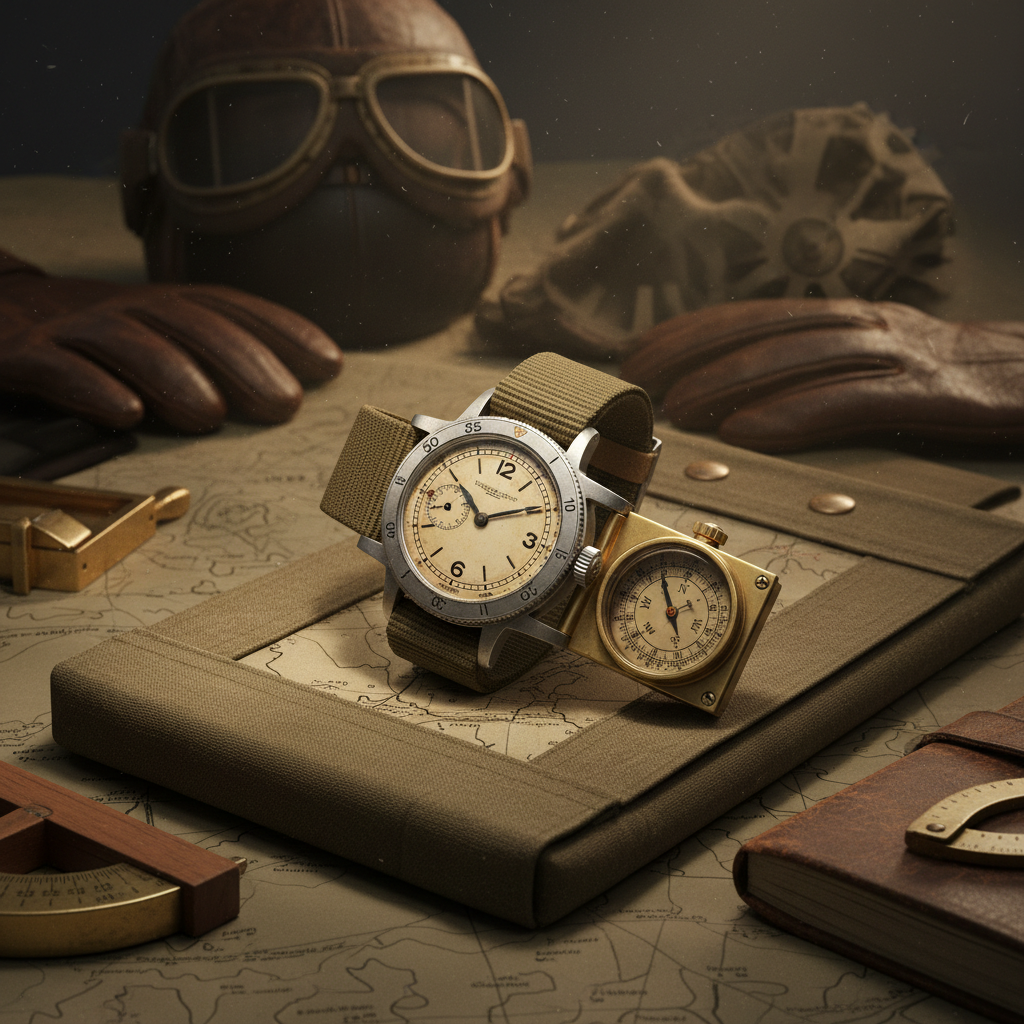
The Longines Weems Second-Setting watch brought something essential to early aviation: a practical way to synchronize a mechanical watch with a radio time signal while its movement kept running.

Sometimes, the most impressive watch complication is the one that solves a real problem.
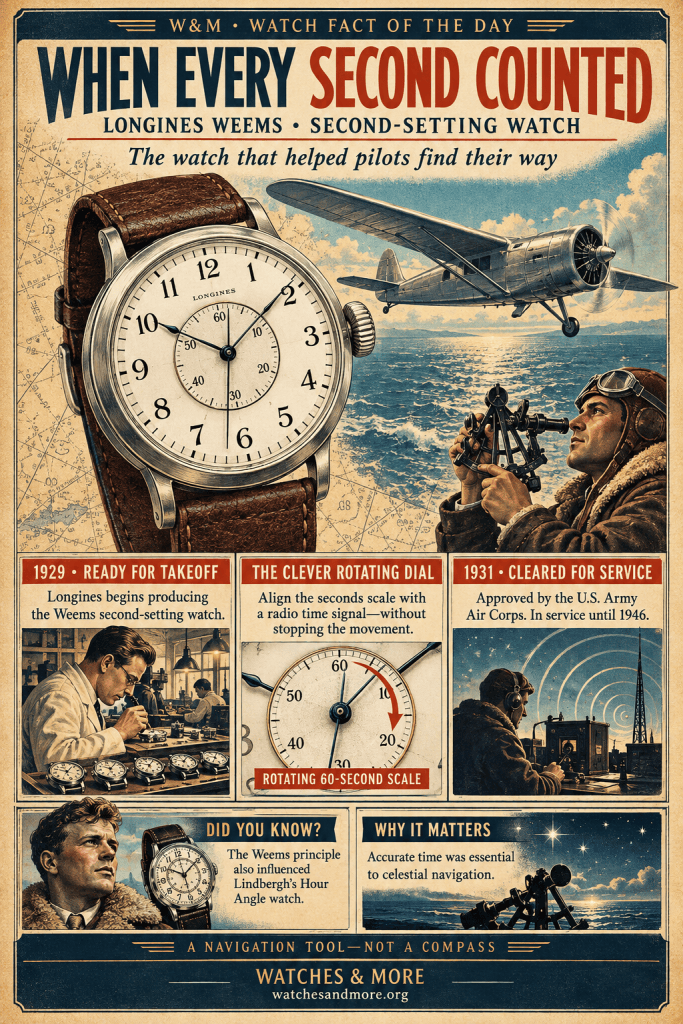
Vintage advertisement for the Longines Weems second-setting watch, featuring a close-up of the watch and an airplane in flight. Includes historical information about the watch, emphasizing its significance for pilots and celestial navigation.

📻 The Genius Was in the Dial

Developed from the ideas of U.S. Navy officer and navigation instructor Philip Van Horn Weems, the design used a rotating inner disc marked with a 60-second scale.

Instead of stopping the seconds hand, the wearer moved the scale beneath it to match the radio time signal. Longines began producing the watch in 1929, bringing Weems’ navigation concept into a purpose-built timepiece.

Think of it as moving the ruler instead of moving the thing you’re measuring.

The seconds hand continued its journey around the dial. The adjusted scale provided the synchronized reading.

Simple idea. Brilliant application.

🌌 Why a Navigator Needed the Time

A compass helps answer: Which direction am I heading?

Celestial navigation helps answer another question: Where am I?

To work out a position using the Sun or stars, navigators combined observations with accurate time and navigation tables. A timing error could introduce an error into that calculation.

The watch supplied an essential part of the process. It worked alongside the navigator’s instruments, knowledge, and calculations.

That makes the Weems more interesting than a watch with an adventurous name. Its unusual dial had a job to do.

✈️ From Prewar Innovation to Wartime Service

This story began well before World War II.

According to Longines, the U.S. Army Air Corps approved the Weems Second-Setting Pilot Watch in August 1931, and it remained in service until 1946. Its military career therefore stretched from the pioneering aviation years into the WWII era.

It belonged to a world where navigating demanded preparation, concentration, and trust in your equipment.

A wristwatch could be part of the cockpit toolkit—and precision had a purpose far beyond arriving on time.

💡 Did You Know?

The Weems system also influenced the Longines Lindbergh Hour Angle watch. Charles Lindbergh incorporated the seconds-setting principle into his own navigation-watch design, adding another chapter to the connection between aviation and watchmaking.

⭐ Why It Matters

The Weems watch shows what happens when watchmaking responds to a practical challenge.

Its appeal goes deeper than vintage styling. That movable scale represents an elegant piece of problem-solving: give the navigator a usable, synchronized seconds reading while allowing the mechanism to keep ticking.

For watch enthusiasts, that is the magic of a great tool watch.

Every unusual detail tells you something about the people who needed it.

⌚ The W&M Take

We love a watch with a story—and this one has altitude.

The Longines Weems brings together mechanical ingenuity, radio signals, and the courage of early aviation. Looking at that rotating dial, you can almost picture a navigator listening for the next time signal above a dark ocean.

Before the blue dot on your phone, finding your way took skill—and a very good watch.


Explore more stories behind the dial at WatchesAndMore.org, browse the W&M Watch Fact Archive, and discover our companion hub at WatchesAndMore.shop.

Category: Military Watches

Disclaimer: Every effort has been made to keep these watch facts accurate, but the world of horology is full of myths, disputed stories, and fascinating trivia. Consider these facts a starting point for discovery rather than the final word. If you have corrections or additional insights, let us know—we’re always happy to keep the record ticking in the right direction.

🕐 Discover more watch facts, reviews, and buying guides at WatchesAndMore


🛍️ You Might Also Like

As an Amazon Associate and affiliate partner, WatchesAndMore earns from qualifying purchases.
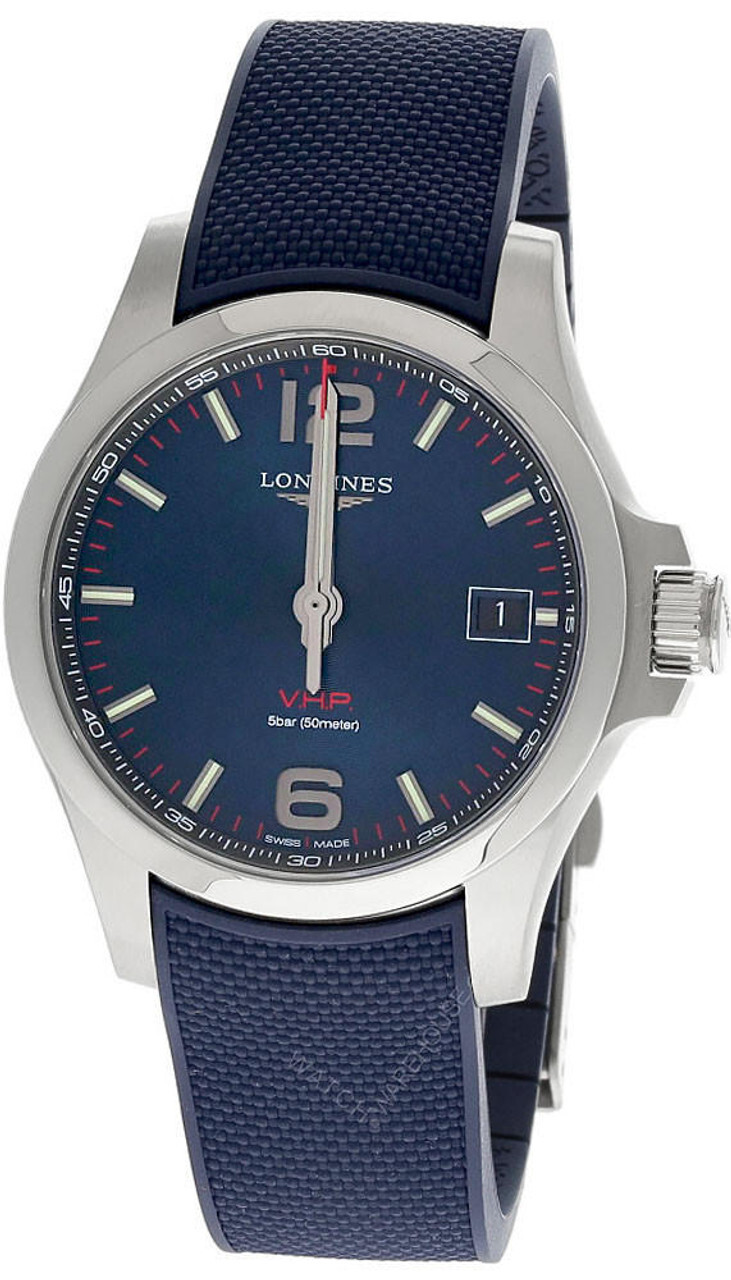
Longines Conquest V.H.P.
🔥 Deal of the Day

Longines Conquest V.H.P.

Longines

★★★★★ 4.6 (145 reviews)

$660

Offer expires in


🔥 Grab This Deal →

Also at: Watchmaxx

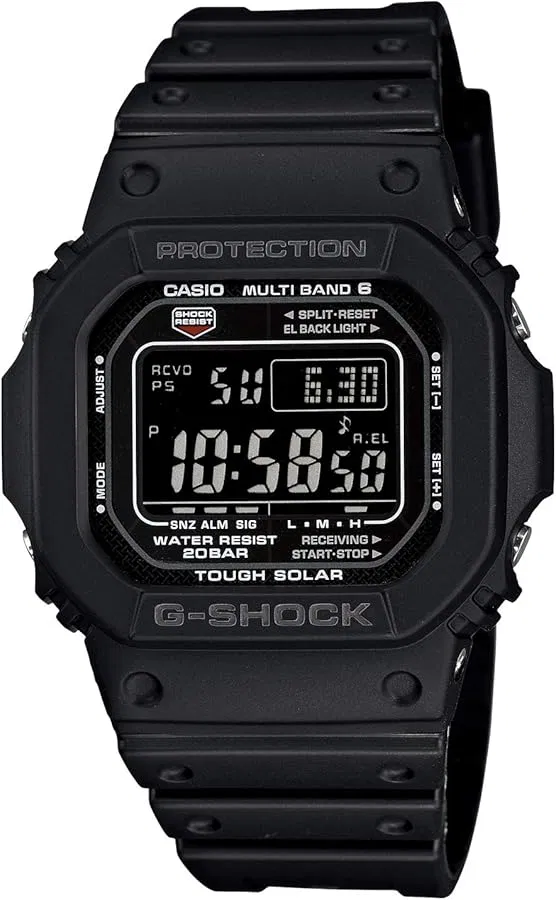
G-Shock GWM5610-1 Solar Atomic


G-Shock GWM5610-1 Solar Atomic

Casio

★★★★★ 4.8 (5,621 reviews)

$129


Check Price on Amazon →

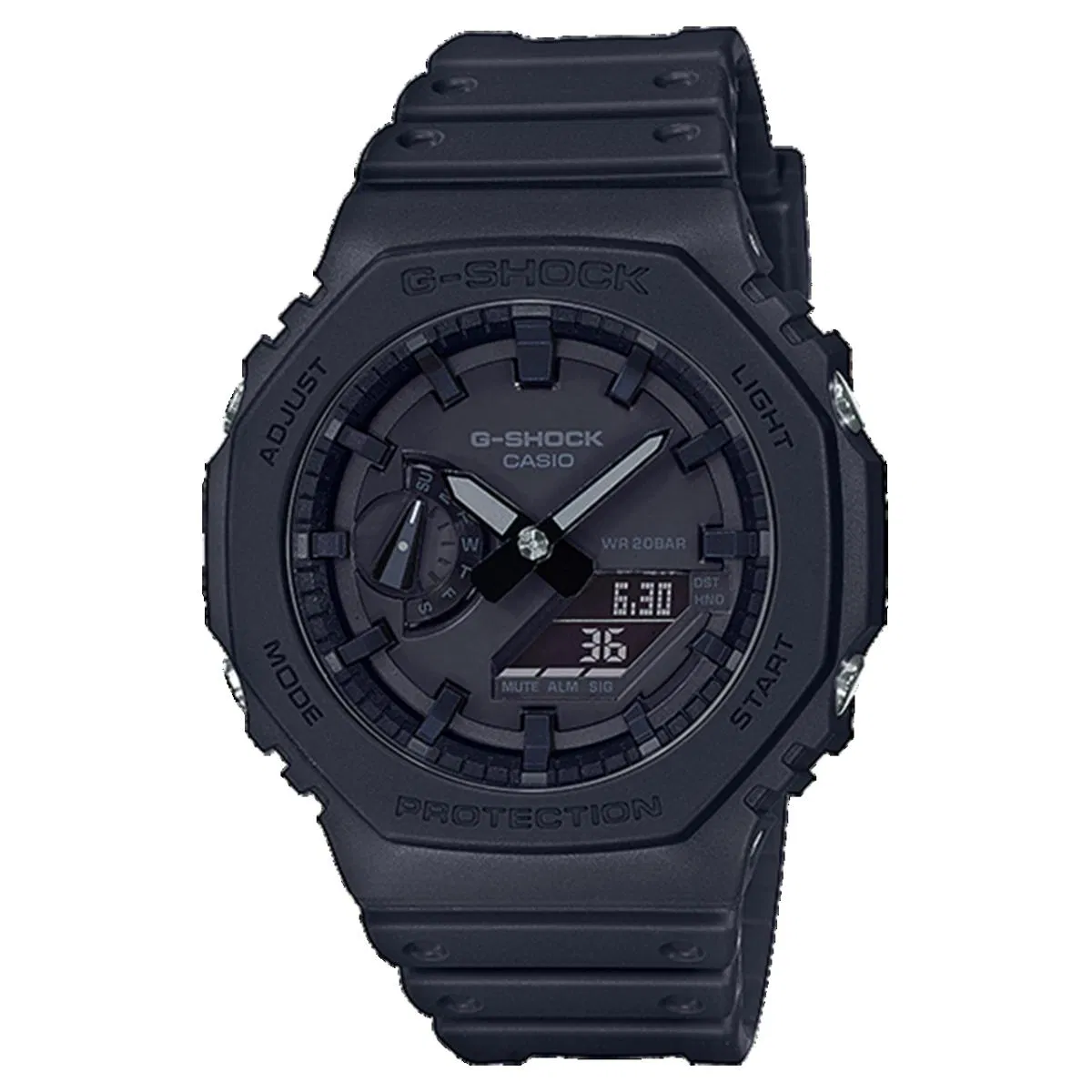
G-Shock GA2100-1A1 CasiOak


G-Shock GA2100-1A1 CasiOak

Casio

★★★★★ 4.8 (2,156 reviews)

$99


Check Price on Amazon →


Browse all expert-reviewed watches →

ETSY Shop
ETSY Shop
More Watch Facts
More Watch Facts
Redbubble Shop
Redbubble Shop

Watch Fact of the Day: Longines Holds the Oldest Unchanged Trademark at WIPO

Longines has been around dealing with counterfeit watch issues since the 19th century, way before it became a luxury brand. They introduced their iconic winged-hourglass symbol to help buyers tell real Longines watches apart from fakes. The trademark was registered in Switzerland in 1889 and went international in 1893, making it the oldest active trademark still in effect today. While the logo has evolved, that original design continues to appear on watch backs. So, after 137 years, Longines has maintained a strong brand identity, navigating through plenty of changes in the watch industry and proving that some things really do stand the test of time.

Brand Spotlight: Wednesday, September 9, 2026

📅 Wednesday, September 9, 2026

Long before watch companies became global luxury brands, Longines was already thinking about something every modern manufacturer worries about: counterfeiting. As the Saint-Imier watchmaker’s reputation grew during the 19th century, imitation products began attempting to benefit from the name it had established. Longines responded with a symbol that would become one of the most enduring identities in watchmaking—the winged hourglass.

The story actually begins before the trademark registration itself. Longines says that by 1867, it was already using both the Longines name and winged-hourglass symbol as guarantees of origin and quality. The emblem was applied to its watches so buyers could distinguish genuine Longines products from counterfeits.

Then came the legal protection.

In 1889, Ernest Francillon registered the Longines name and winged-hourglass trademark in Switzerland. Four years later, on March 27, 1893, it entered the international system established under the Madrid Agreement as International Registration No. 14. Thirteen international applications had preceded it—but those earlier registrations eventually lapsed.

That left Longines holding an extraordinary distinction.

According to WIPO, the original Longines winged-hourglass mark has been continually used and never modified, making it the oldest valid trademark in WIPO’s International Registry. WIPO was still describing the Longines mark as the oldest trademark remaining in effect in its 2024 Madrid System materials, while a 2026 WIPO feature again identified the winged hourglass as the oldest valid trademark in the International Registry.

And there’s a fascinating wrinkle here: the trademark that holds the record isn’t necessarily identical to the modern Longines logo you see prominently displayed on today’s watch dials.

WIPO explains that the original trademark continues to appear on the backs of Longines watches, while an updated interpretation appears on the dial. The historic registered mark incorporates the winged hourglass within a more elaborate emblem—making the surviving legal identity itself a little piece of 19th-century watchmaking history.

The longevity is remarkable when you consider what happened during those intervening years.

Mechanical watches gave way to wristwatches. Two world wars passed. Aviation transformed transportation. Quartz nearly rewrote the Swiss watch industry. Digital watches arrived. Computers, smartphones and smartwatches followed.

Yet that trademark remained protected.

1889 → 2026: 137 years.

And the story is particularly appropriate for a watch company because the winged hourglass itself represents something Longines has managed exceptionally well:

time passing without identity disappearing.

💡 Did You Know?

Longines wasn’t the first trademark entered into the international registry.

Its international registration was No. 14.

The first thirteen registrations simply didn’t maintain their protection continuously. Longines did. WIPO notes that the first international trademark registration belonged to Swiss chocolate producer Russ-Suchard, but that original registration eventually ceased to be in force.

So Longines didn’t win this record by being first through the door.

IT WON BY NEVER LEAVING.

⭐ Why It Matters

We usually think of trademarks as marketing—something designed to make a company recognizable.

For Longines in the 19th century, the winged hourglass also served a more practical purpose: protecting identity, reputation and authenticity from imitators.

That makes the emblem more than decoration.

It is effectively a 137-year chain of brand identity stretching from a Swiss watch factory in Saint-Imier to the modern international intellectual-property system.

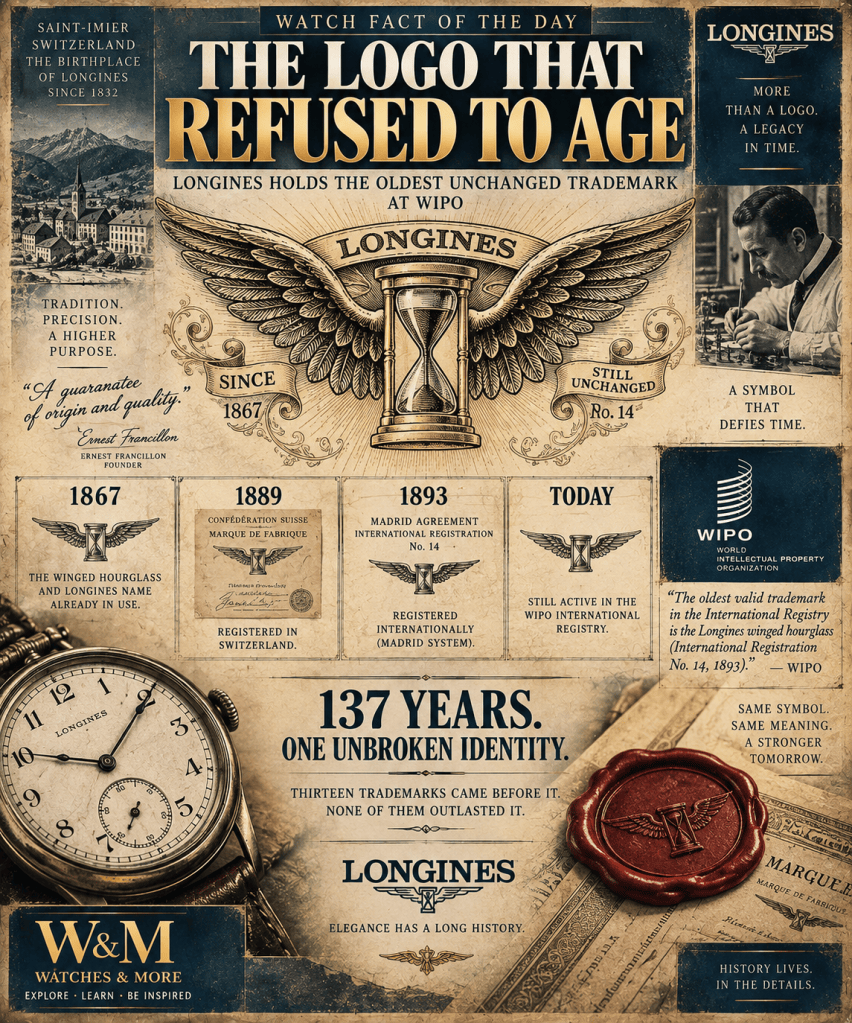
1867 — THE SYMBOL IS USED

1889 — REGISTERED IN SWITZERLAND

1893 — REGISTERED INTERNATIONALLY

TODAY — STILL ACTIVE

And BBC Creative Department has just been handed an absolute gift. 😂⌛🪽

I’m seeing the infographic as a late-1880s Swiss trademark certificate × Belle Époque watchmaker’s advertisement—aged ivory paper, deep Longines blue, burgundy sealing wax, black engraved linework, antique gold foil, elaborate Victorian borders and beautiful copperplate typography.

Dead center: an enormous engraved winged hourglass, with one wing stretching toward 1889 and the other toward TODAY.

Above it:

THE LOGO THAT REFUSED TO AGE

Then an original-looking registration document:

SWITZERLAND — 1889
↓
MADRID SYSTEM — 1893
↓
INTERNATIONAL REGISTRATION No. 14
↓

STILL ACTIVE TODAY

And across the bottom:

137 YEARS.

ONE UNBROKEN IDENTITY.

Then the killer little Collector’s Note:

THIRTEEN TRADEMARKS CAME BEFORE IT.

NONE OF THEM OUTLASTED IT.


Category: Brand Spotlight

Disclaimer: Every effort has been made to keep these watch facts accurate, but the world of horology is full of myths, disputed stories, and fascinating trivia. Consider these facts a starting point for discovery rather than the final word. If you have corrections or additional insights, let us know—we’re always happy to keep the record ticking in the right direction.

🕐 Discover more watch facts, reviews, and buying guides at WatchesAndMore


🛍️ You Might Also Like

As an Amazon Associate and affiliate partner, WatchesAndMore earns from qualifying purchases.

Longines Conquest V.H.P.
🔥 Deal of the Day

Longines Conquest V.H.P.

Longines

★★★★★ 4.6 (145 reviews)

$660

Offer expires in


🔥 Grab This Deal →

Also at: Watchmaxx

Timex Weekender Chronograph


Timex Weekender Chronograph

Timex

★★★★★ 4.5 (3,041 reviews)

$79


Check Price on Amazon →

Bulova Precisionist


Bulova Precisionist

Bulova

★★★★★ 4.6 (1,100 reviews)

$219


Check Price on Amazon →


Browse all expert-reviewed watches →