

📅 Sunday, August 23, 2026
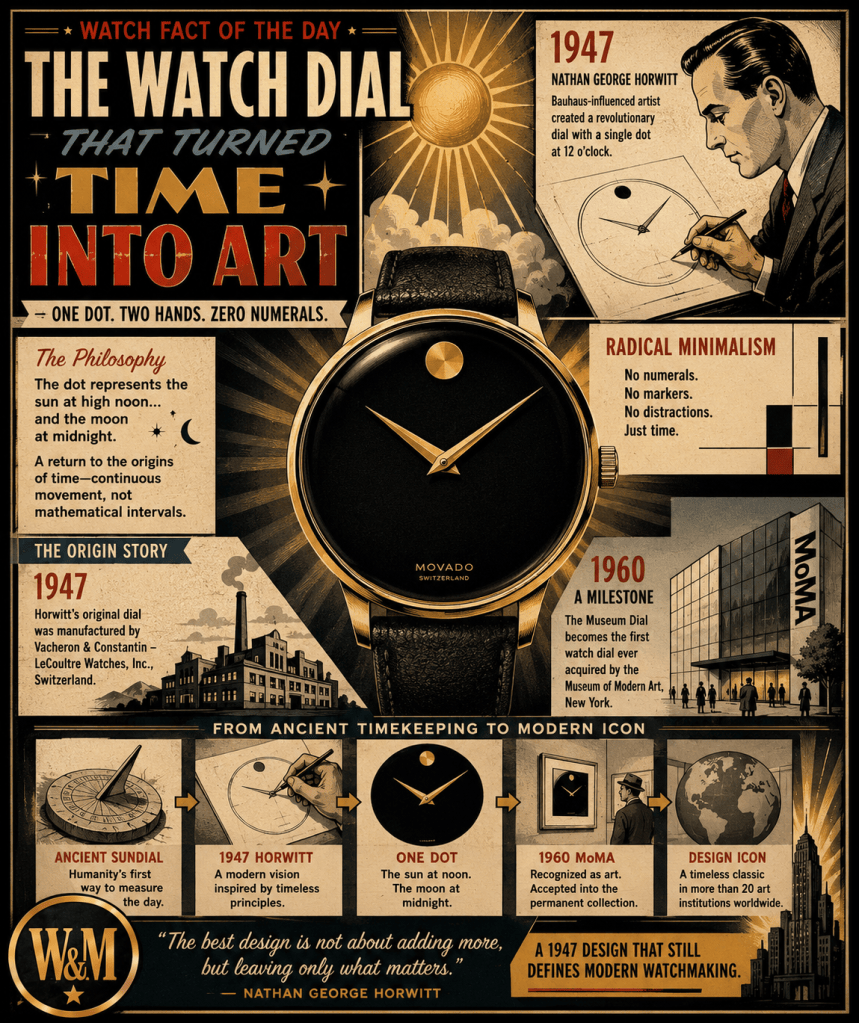
Designed by Bauhaus-influenced artist Nathan George Horwitt in 1947, the iconic Movado Museum dial features a single gold dot at 12 o’clock representing the sun at high noon. While Movado eventually adopted it as their signature look, the design was originally created with the philosophical goal of representing time as a continuous movement rather than mathematical intervals. It became the first watch dial ever acquired by the Museum of Modern Art in New York.
In 1947, American industrial designer Nathan George Horwitt created one of the most radical watch dials of the 20th century by doing something almost unthinkable: he removed virtually everything. No numerals. No conventional hour markers. No decorative clutter. Against the stark dial remained only the hands and a single circular marker at 12 o’clock. Horwitt’s minimalist creation would eventually become inseparable from Movado and one of the most instantly recognizable designs in modern watchmaking.
But that solitary dot wasn’t merely minimalist decoration. Horwitt looked back to perhaps humanity’s oldest method of measuring the day: the sundial. Movado explains that the dot represents the sun at high noon—and the moon at midnight. Rather than covering the dial with numbers that divide time into discrete units, Horwitt stripped the display back to a relationship between the movement of the hands and one celestial reference point.
That makes the Museum Dial a fascinating paradox. It looks futuristic, yet its central idea reaches back thousands of years. A mechanical watch—one of humanity’s most sophisticated timekeeping machines—was visually reduced to something reminiscent of watching a shadow travel around a sundial beneath the sun. Movado describes Horwitt’s design as an exploration of the concept of time that removed unnecessary complications and returned time-telling to its origins.
But Here’s Where the Story Gets Really Interesting…
The dial wasn’t originally born as simply another Movado model. MoMA’s own collection identifies the 1947 object as Nathan George Horwitt’s “Wristwatch Face” and lists its manufacturer as Vacheron & Constantin—Le Coultre Watches, Inc., Switzerland. The museum records it as white gold with an enameled dial and credits it as a gift from Horwitt himself. That makes the early history considerably more interesting than the simplified version in which Horwitt simply designed “the Movado dial” in 1947.
Horwitt’s design subsequently became deeply associated with Movado, and the company transformed that extraordinarily sparse visual language into its defining identity. Today the Museum concept appears throughout Movado’s collections, and the company says versions of the design can be found in more than 20 art institutions around the world.
Then came the achievement that gave the design its enduring name. In 1960, the Museum Dial entered the permanent collection of New York’s Museum of Modern Art. Movado describes it as the first watch dial accepted into MoMA’s permanent collection, while MoMA’s current catalogue confirms the object number 335.1960, its 1947 design date and Horwitt as its designer.
There’s something wonderfully appropriate about that recognition. Most watchmakers spend enormous effort adding information to a dial—indices, scales, complications, subdials and displays. Horwitt achieved immortality by doing almost exactly the opposite. He took nearly everything away.
Category: Brand Spotlight
Disclaimer: Every effort has been made to keep these watch facts accurate, but the world of horology is full of myths, disputed stories, and fascinating trivia. Consider these facts a starting point for discovery rather than the final word. If you have corrections or additional insights, let us know—we’re always happy to keep the record ticking in the right direction.
🕐 Discover more watch facts, reviews, and buying guides at WatchesAndMore
🛍️ You Might Also Like
As an Amazon Associate and affiliate partner, WatchesAndMore earns from qualifying purchases.
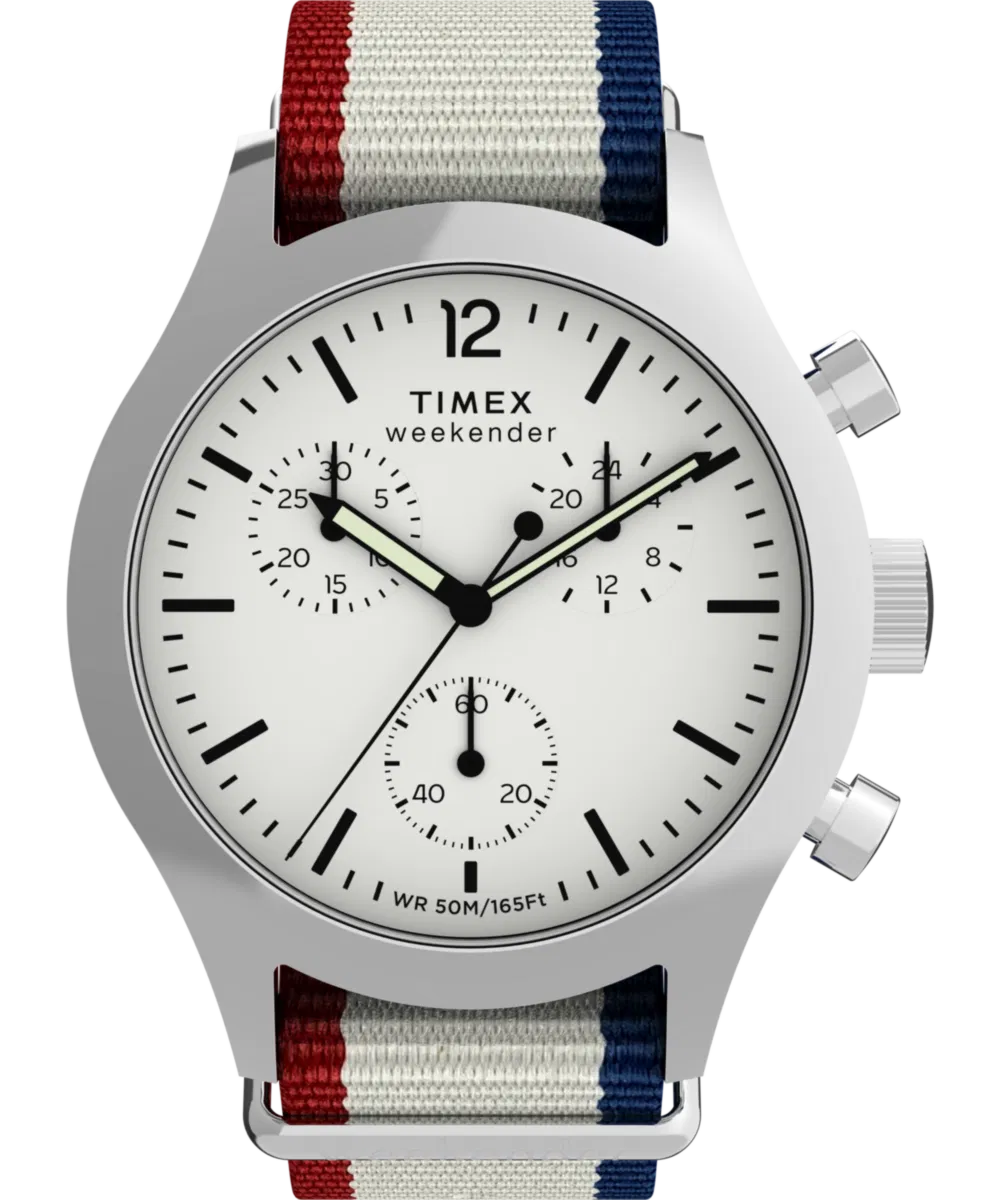
Timex
★★★★★ 4.5 (3,041 reviews)
$79

Browse all expert-reviewed watches →