
Eterna’s 1914 Alarm Wristwatch: A Wearable Wake-Up Call

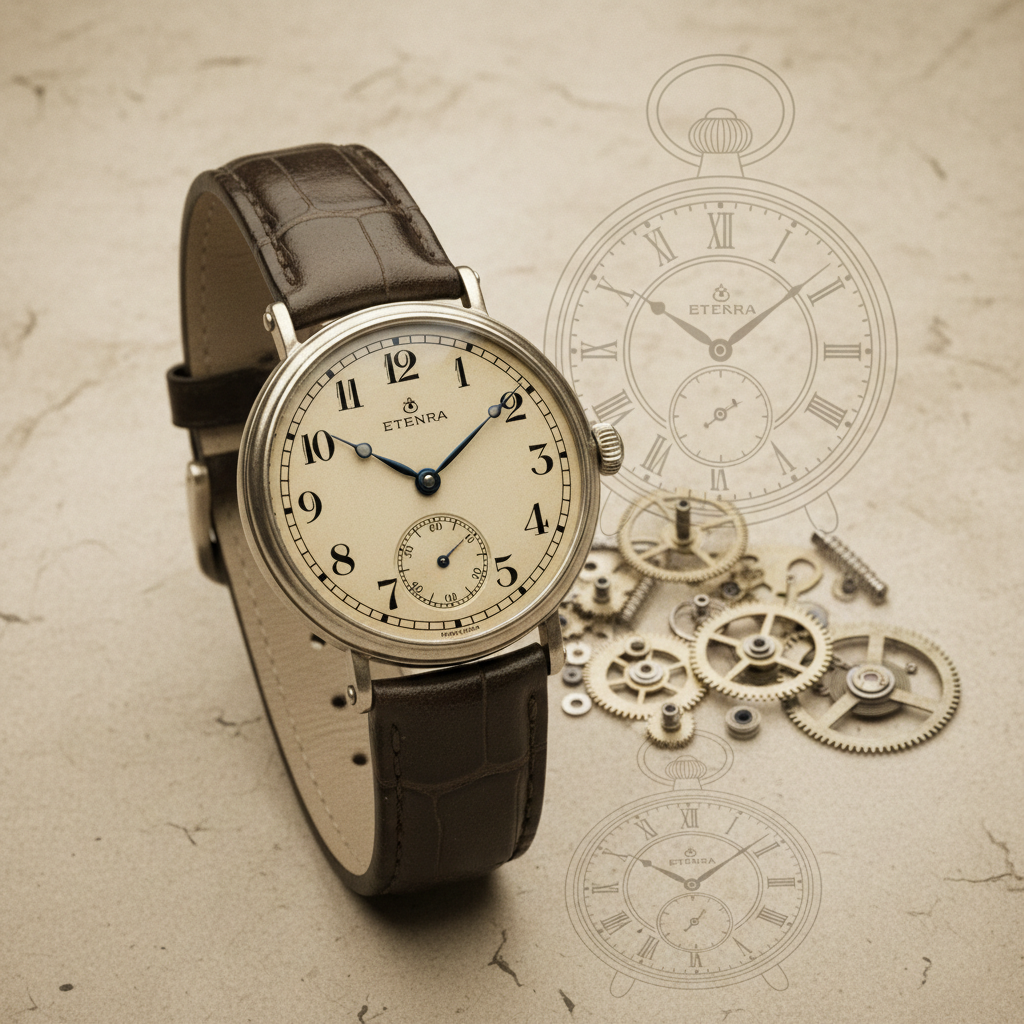
In 1914, Eterna dropped the ultimate timepiece bombshell: the first-ever alarm wristwatch! Forget always asking “What time is it?” Now, your watch could actually *tell* you to wake up—or at least quietly remind you for a scant six seconds. Talk about limited but ambitious! While it couldn’t belt out a wake-up call with the gusto of a rooster, it did manage to fit a buzzing mechanism into a clever little package. So next time your smartwatch interrupts your scrolling, tip your hat to Eterna for paving the way—though we’re still waiting on a wristwatch that shouts, “GET UP!”

Watch Fact of the Day
Watch History: Monday, October 19, 2026

📅 Monday, October 19, 2026

Before digital beeps and vibrating smartwatches, Eterna gave the wristwatch a mechanical voice.

Imagine a watch that does more than wait for you to look at it.

At the appointed moment, it interrupts.

Today, that sounds ordinary. But in 1914, putting an alarm into a production wristwatch was a remarkable proposition.

Eterna’s pioneering alarm watch brought a familiar bedside-clock idea to a much smaller, wearable package—and helped establish a new role for the wristwatch.

🔔 A Little Watch With Something to Say

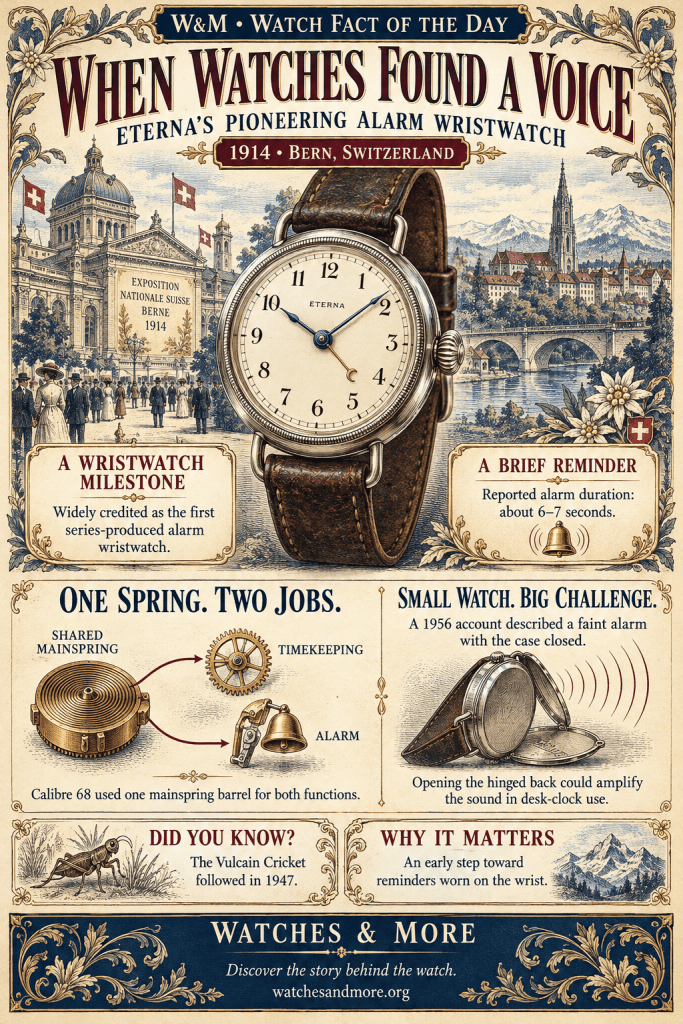
Eterna is widely credited with introducing the first series-produced alarm wristwatch in 1914, presenting it at the Swiss National Exhibition in Bern. The watch blog

That wording matters. Alarm watches and experimental wearable reminders had earlier histories; Eterna’s milestone concerns a wristwatch offered in series production. Grail Watch Wiki

It was an early answer to a question that still shapes watches today:

What if your watch could remind you of the time, instead of making you remember to check?
⚙️ One Spring, Two Jobs

The challenge was more than making a familiar mechanism smaller.

Inside the case, the watch needed to keep time, recognise a preset alarm time, and turn stored energy into sound.

Eterna’s calibre 68 used a shared mainspring barrel to supply both timekeeping and the alarm. A 1956 account by Louis Loze describes an alarm set using the bezel, with a lever allowing it to be switched off. Grail Watch Wiki

One energy source had to do two very different jobs.

That is an elegant packaging solution—but it also reveals the compromises facing an early mechanical alarm.

⏱️ The Six-Second Story

Modern accounts describe the early alarm as sounding for approximately six to seven seconds.

That makes “about six seconds” a better description than an exact, universal duration.

Teddy Baldassarre’s history of alarm watches connects that brief performance with the constraints of a single small barrel powering both functions. It also notes that alarm vibration could interfere with timekeeping. Teddy Baldassarre

This was pioneering technology with limitations.

The achievement was getting the reminder onto the wrist at all.

🛏️ Could It Really Wake You Up?

A mechanical alarm on the wrist sounds like the perfect travelling wake-up companion.

But the historical evidence calls for a little restraint.

Loze’s 1956 account describes the sound as relatively faint with the case closed. It also describes a hinged back that allowed the watch to serve as a desk clock, with the sound amplified in that position. Grail Watch Wiki

So, while “the watch that could wake you up” makes an appealing headline, the firmer historical claim is simpler:

Eterna put an audible alarm into a production wristwatch.

🧭 A Different Kind of Watch Function

A chronograph lets its owner measure an interval. An alarm addresses another everyday need: remembering a moment before it arrives.

That gives this little Eterna a surprisingly familiar personality.

Think of an appointment, a departure, or a task that needs attention. The attraction is the same as a modern reminder: set it, carry it, and let the device call you back.

The experience was entirely mechanical, but the ambition feels very current.

💡 Did You Know?

The famous Vulcain Cricket arrived in 1947, more than three decades after Eterna’s 1914 introduction.

The Cricket helped popularise the mechanical alarm wristwatch, but Eterna’s earlier contribution deserves its own place in the story. Teddy Baldassarre

⭐ Why It Matters

The Eterna alarm watch shows that important innovations do not always arrive in their most polished form.

Its brief alarm and acoustic limitations are part of the story. They reveal how difficult it was to make a compact watch both a precise timekeeper and an effective reminder.

More than a century later, the idea remains familiar every time something on our wrist asks for our attention.

A few seconds of sound. A lasting idea: your watch could tell you when it mattered. ⌚🔔


Discover more remarkable timepieces in the W&M Watch Fact Archive.

Visit Watches & More and our companion site.

Category: Watch History

Disclaimer: Every effort has been made to keep these watch facts accurate, but the world of horology is full of myths, disputed stories, and fascinating trivia. Consider these facts a starting point for discovery rather than the final word. If you have corrections or additional insights, let us know—we’re always happy to keep the record ticking in the right direction.

🕐 Discover more watch facts, reviews, and buying guides at WatchesAndMore


Read Next

The Unusual Alarm of the Breguet Ring Watch

Richard Mille RM 62-01: A Mechanical Watch with a Vibrating Alarm

Join the Conversation

Would you wear a mechanical alarm watch today? Share your thoughts in the comments.

Explore watches in the W&M Watch Database.

ETSY Shop
ETSY Shop
Redbubble Shop
Redbubble Shop
More Watch Facts
More Watch Facts

📚 Sources & Further Reading

Further reading: Fondation de la Haute Horlogerie — watchmaking glossary

Watch Fact of the Day: The Pocket Watches That Played Music on Tiny Bells

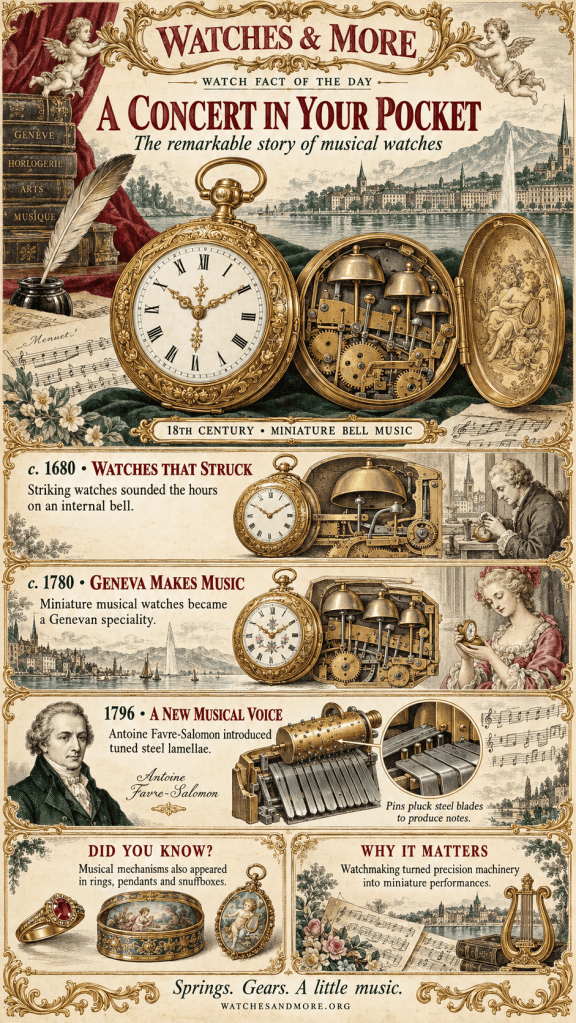
Musical miniaturization in watchmaking combines the elegance of timekeeping with the charm of melody, creating delightful mechanical wonders. In the 18th century, Genevan artisans pioneered musical pocket watches and mechanisms, transforming intricate craftsmanship into miniature concerts. These timepieces not only told time but also played enchanting tunes, captivating collectors and enthusiasts. Innovations, like the introduction of tuned steel lamellae, further enriched the musical experience, allowing for even greater creativity. Today, these historical creations remind us of the magic inherent in mechanics, where art and precision come together to evoke joy and nostalgia through music captured in time.

Fun Quirk: Sunday, October 4, 2026

📅 Sunday, October 4, 2026

Before playlists and portable speakers, watchmakers found a wonderfully mechanical way to carry a tune.

Imagine reaching into your pocket, taking out an ornate watch, and hearing a delicate melody emerge from inside its case.

No battery. No speaker. Just springs, gears, and miniature musical machinery.

These remarkable timepieces brought together two arts that share an obsession with rhythm: watchmaking and music.

By the late 18th century, Genevan makers were turning musical pocket watches and other miniature musical objects into a speciality—creating tiny performances inside beautifully crafted cases.

🔔 Before the Melody Came the Bell

Watches were making themselves heard well before they became miniature music players.

A surviving Thomas Tompion traveling clock-watch from around 1680, now in the Metropolitan Museum of Art, strikes the hours on a bell inside its case and includes an alarm. It has separate mechanisms and power sources for timekeeping, striking, and sounding the alarm.

That was already an impressive achievement: a portable timekeeper that could announce itself.

Playing a recognizable tune added another challenge. Instead of repeatedly sounding one bell, a musical mechanism needed to produce different notes in a carefully arranged sequence.

🎶 A Concert in Miniature

During the 18th century, watchmakers in Geneva developed miniature carillons—mechanisms that played music on small bells—and incorporated them into pocket watches and other precious objects. Around 1780, this kind of musical miniaturization became a local speciality.

The broader tradition of mechanical bell music used pinned cylinders to control the sequence of notes. As the cylinder rotated, its pins triggered the mechanism in a predetermined pattern. Musical clocks preserved by Museum Speelklok demonstrate this approach.

Think of the cylinder as a mechanical score: the tune was encoded in the placement of its pins.

The charm lies in that physical relationship. Every note depended on something moving, engaging, and sounding at exactly the right moment.

Infographic titled 'A Concert in Your Pocket' detailing the history of musical watches, featuring illustrations of pocket watches, musical mechanisms, and historical figures, along with timelines from the 18th century to the 1790s.

⚙️ The 1796 Breakthrough: Steel Instead of Bells

Here’s where the familiar music-box sound enters the story.

In 1796, Genevan watchmaker Antoine Favre-Salomon introduced tuned steel lamellae, opening the way to even smaller musical mechanisms.

In this system, pins on a rotating cylinder plucked steel blades of different lengths. Each blade vibrated at its own musical pitch, and their arrangement gave rise to the description “comb music.” Early makers incorporated these mechanisms into small precious objects before they became familiar as standalone music boxes.

Tiny bells and tuned steel teeth represent different ways of producing the music. Both are ingenious; each gives the mechanism its own character.

🎭 When the Watch Became a Performance

Some makers went further, combining music with moving miniature figures.

A watch attributed to Piguet & Capt, dating to around 1805, takes the form of an elaborate perfume flask. Its musical mechanism accompanies an animated scene featuring a boy, a dog, and a woman playing a guitar.

Imagine the delight of revealing that hidden performance.

The object could tell time, play music, and animate a tiny scene—all through mechanical action. It’s easy to understand why these creations still fascinate collectors centuries later.

💡 Did You Know?

Musical miniaturization reached beyond pocket watches. The Museum of Music Automatons documents musical rings, pendants, snuffboxes, and other extraordinary objects, including a musical ring from around 1803.

A whole tune tucked into a ring? That’s an impressive answer to “what else can we make smaller?”

⭐ Why It Matters

These creations show how watchmaking can serve imagination as well as precision.

They also reveal an important distinction: a striking watch announces time, while a musical mechanism performs a sequence of notes. Their histories overlap through the craft of controlling energy, motion, and sound.

For enthusiasts, the appeal is wonderfully tangible. The music exists because someone worked out how to make tiny pieces move together.

⌚ The W&M Take

We often admire watches for what we can see: the dial, the finishing, the movement.

Musical watches invite us to listen, too.

There’s something irresistible about a carefully wound spring releasing its energy as a melody. It turns an intricate object into a brief experience—one you can hold in your hand.

Long before we carried our music digitally, watchmakers were finding ways to carry it mechanically.

💬 Would you choose a watch that plays a melody, or one that chimes the time? Tell us in the comments!

Category: Fun Quirk

Disclaimer: Every effort has been made to keep these watch facts accurate, but the world of horology is full of myths, disputed stories, and fascinating trivia. Consider these facts a starting point for discovery rather than the final word. If you have corrections or additional insights, let us know—we’re always happy to keep the record ticking in the right direction.

🕐 Discover more watch facts, reviews, and buying guides at WatchesAndMore


🛍️ You Might Also Like

As an Amazon Associate and affiliate partner, WatchesAndMore earns from qualifying purchases.

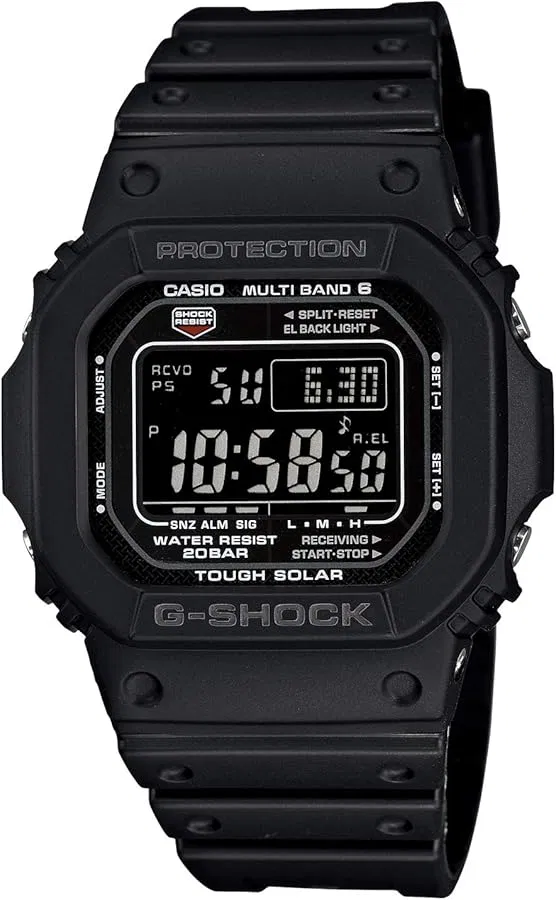
G-Shock GWM5610-1 Solar Atomic
🔥 Deal of the Day

G-Shock GWM5610-1 Solar Atomic

Casio

★★★★★ 4.8 (5,621 reviews)

$129

Offer expires in


🔥 Grab This Deal →

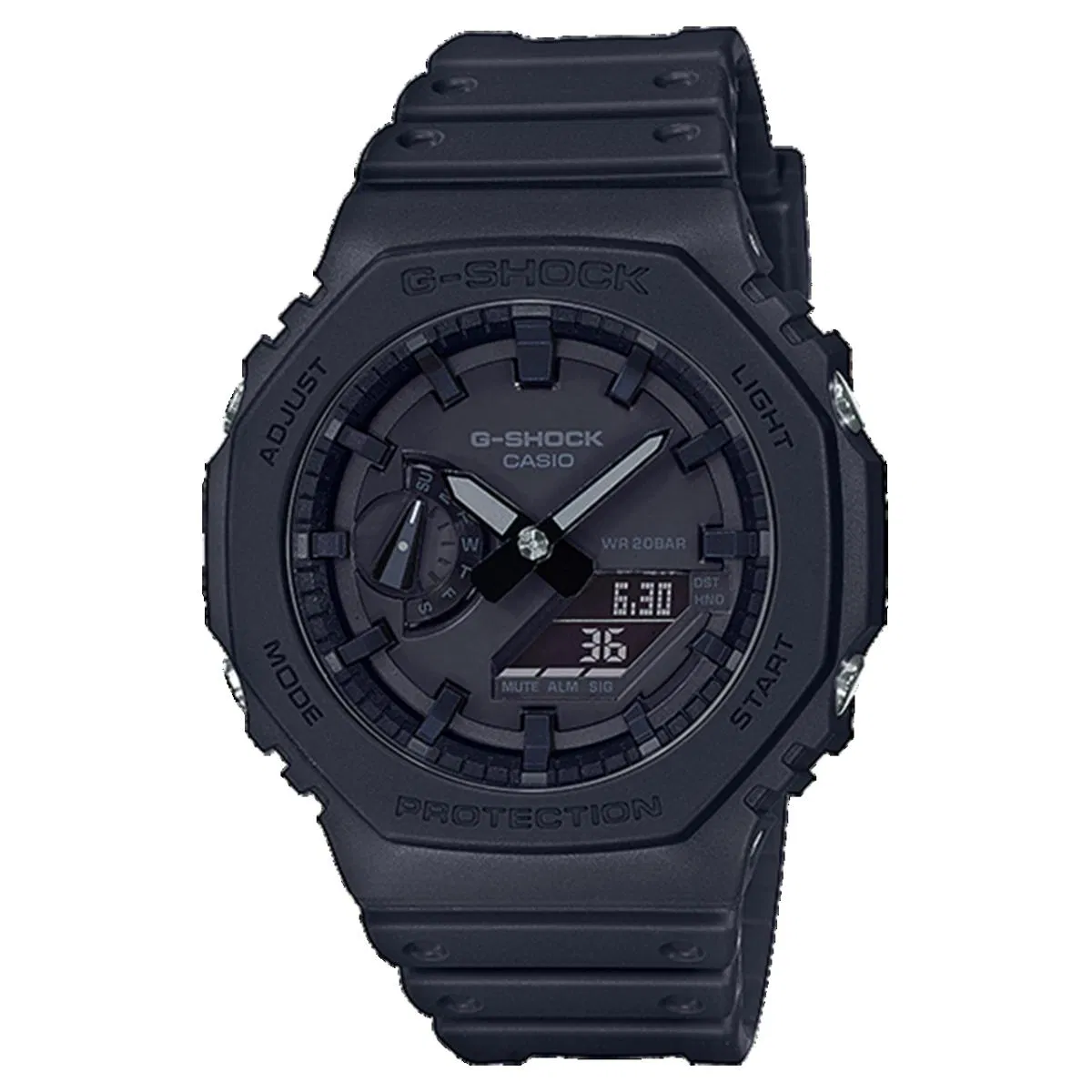
G-Shock GA2100-1A1 CasiOak


G-Shock GA2100-1A1 CasiOak

Casio

★★★★★ 4.8 (2,156 reviews)

$99


Check Price on Amazon →

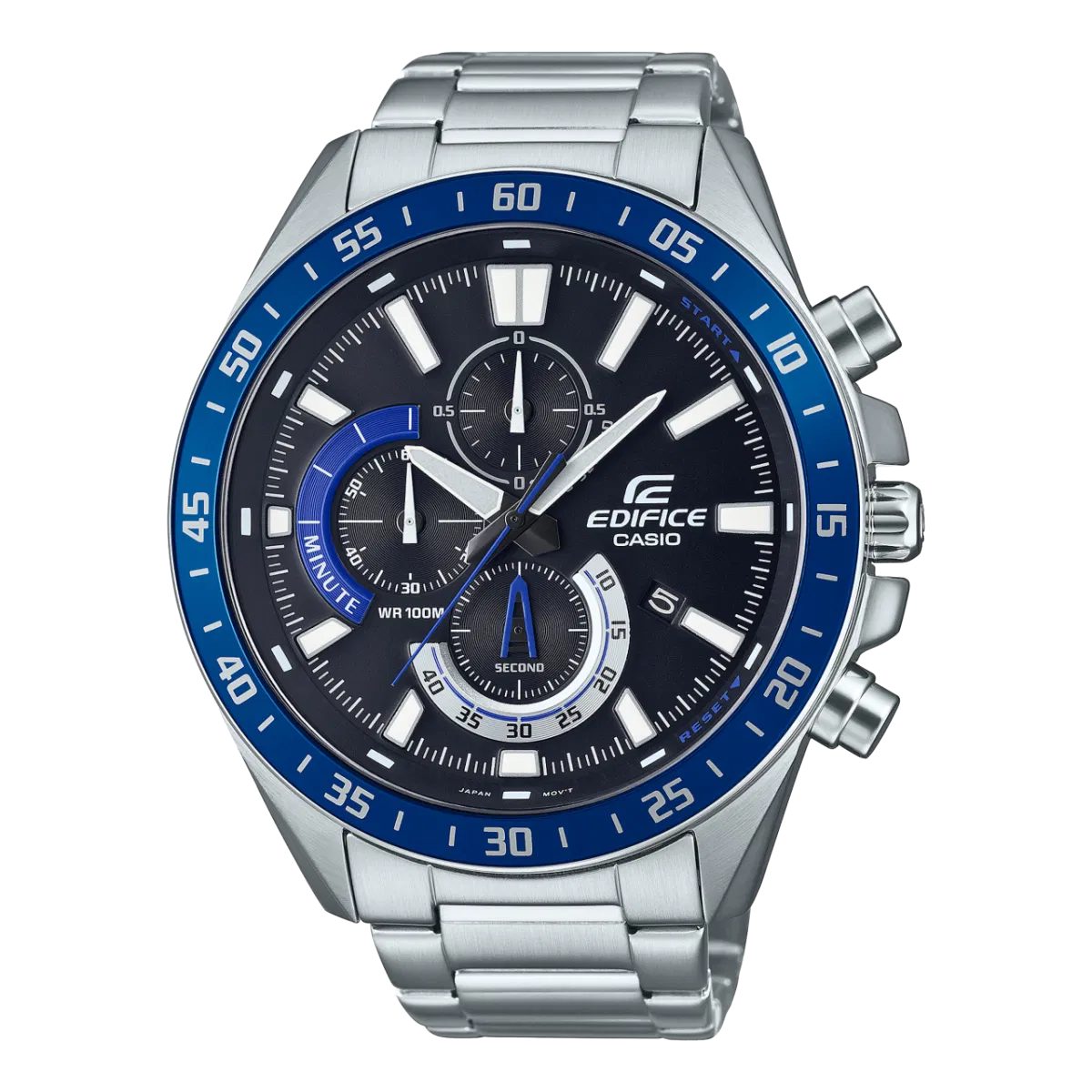
Casio Edifice Chronograph


Casio Edifice Chronograph

Casio

★★★★★ 4.7 (1,264 reviews)

$120


Check Price on Amazon →


Browse all expert-reviewed watches →

WatchesAndMore Blog: https://watchesandmoreco.blog/posts-page/

WatchesAndMore Main Site: https://watchesandmore.org/

WatchesAndMore Companion Site: https://www.watchesandmore.shop/