

Watch Fact of the Day: Why the Royal Oak’s “Screws” Don’t Turn

In 1970, Gérald Genta flipped the watch world on its head by introducing the Audemars Piguet Royal Oak, a timepiece rocking eight visible hexagonal fasteners that look like screws but behave more like the decorative knobs on a fancy cupboard. These “through-screws” don’t actually tighten at the front; they’re elegantly held in place and adjusted from the back. Think of them as screws with a flair for the dramatic—perfectly aligned for aesthetic pleasure rather than practical purposes. Who knew something so eye-catching could also be a structural hero? Welcome to watchmaking where function meets fashion, and everything else just ticks away!

Fun Quirk: Friday, October 2, 2026

📅 Friday, October 2, 2026

When Gérald Genta designed the Audemars Piguet Royal Oak in 1970, he created one of the most recognizable bezels in watch history.

Eight visible hexagonal fasteners.

Eight polished slots.

Eight perfectly controlled positions around an octagonal bezel.

To most people, they look like ordinary screws.

But they do not work like ordinary screws at all.

The Royal Oak’s visible fasteners are through-screws. Their hexagonal heads are captured inside matching hexagonal holes in the bezel, which prevents them from turning. From the rear of the watch, round nuts are threaded onto those screws and tightened to clamp the case together and compress the water-resistance gasket. AP Chronicles

That means the visible slot on the front is not used to tighten the watch.

It can simply be oriented precisely for appearance.

Watch Fact of the Day: Why the Royal Oak’s “Screws” Don’t Turn

THE FRONT DOESN’T TURN.

THE BACK DOES THE TIGHTENING.

And that is why the Royal Oak’s bezel slots can appear so perfectly aligned.

Why Genta Did It This Way

The Royal Oak’s design was inspired in part by the architecture of a diver’s helmet, with visible external fasteners becoming part of the visual identity rather than something to hide.

Genta’s 1970 sketch already showed the concept: a wide bezel, eight exposed hexagonal fasteners, and a large gasket compressed between the bezel and monocoque case. Audemars Piguet’s archives note that the hexagonal heads were intentionally captured so they would not rotate while being locked from below. AP Chronicles

That was radical at the time.

Traditional luxury watchmaking usually concealed functional hardware.

The Royal Oak put it on display.

FUNCTION BECAME DECORATION.

💡 Did You Know?

The neat slot alignment that collectors admire is actually the result of a clever engineering shortcut around a problem that watchmakers normally face.

Ordinary screws cannot simply be tightened until all their slots line up perfectly. Thread starts, screw lengths, tolerances, and final torque all determine where a screw head stops. That is why aligned screws are generally impractical in conventional watchmaking. Hodinkee

The Royal Oak gets around that problem because the front fastener doesn’t rotate during final tightening.

The nut on the back does.

That is the trick.

⭐ Why It Matters

The Royal Oak is full of details where engineering and aesthetics are inseparable.

The screws are not merely decorative.

The alignment is not fake.

And the system is not just visual theater.

The eight through-screws actually help clamp the case together and compress the gasket that contributes to water resistance. AP Chronicles

So one of the most famous decorative details in modern watchmaking is also a real structural part of the watch.

THEY LOOK LIKE SCREWS.

THEY DON’T TURN LIKE SCREWS.

AND THAT’S EXACTLY WHY THEY LINE UP.

This one is absolutely made for a W&M visual.

I’m seeing 1972 Swiss industrial-design magazine × Gérald Genta sketchbook × technical case cutaway.

Headline:

THE ROYAL OAK SCREWS THAT DON’T TURN

Then a cutaway:

HEXAGONAL HEAD
↓
LOCKED IN BEZEL
↓
THROUGH-SCREW
↓
NUT TIGHTENS FROM THE BACK

And the bottom payoff:

PERFECT ALIGNMENT

BY DESIGN, NOT LUCK.

Category: Fun Quirk

Disclaimer: Every effort has been made to keep these watch facts accurate, but the world of horology is full of myths, disputed stories, and fascinating trivia. Consider these facts a starting point for discovery rather than the final word. If you have corrections or additional insights, let us know—we’re always happy to keep the record ticking in the right direction.

🕐 Discover more watch facts, reviews, and buying guides at WatchesAndMore


🛍️ You Might Also Like

As an Amazon Associate and affiliate partner, WatchesAndMore earns from qualifying purchases.

G-Shock GWM5610-1 Solar Atomic
🔥 Deal of the Day

G-Shock GWM5610-1 Solar Atomic

Casio

★★★★★ 4.8 (5,621 reviews)

$129

Offer expires in


🔥 Grab This Deal →

G-Shock GA2100-1A1 CasiOak


G-Shock GA2100-1A1 CasiOak

Casio

★★★★★ 4.8 (2,156 reviews)

$99


Check Price on Amazon →

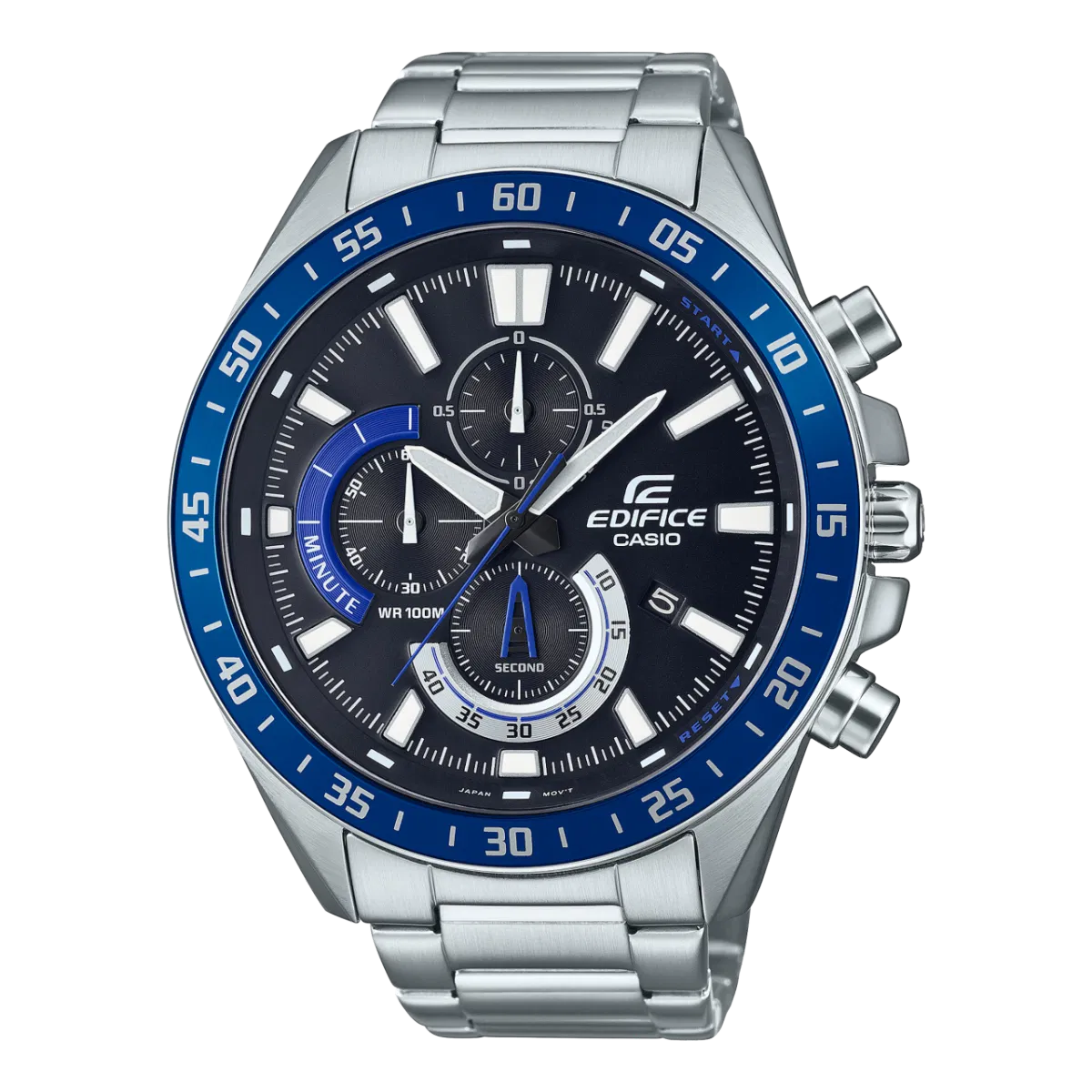
Casio Edifice Chronograph


Casio Edifice Chronograph

Casio

★★★★★ 4.7 (1,264 reviews)

$120


Check Price on Amazon →


Browse all expert-reviewed watches →

Watch Fact of the Day: The Watch Designed in One Night

Legendary watch designer Gérald Genta received an urgent call at 4:00 PM from Audemars Piguet’s managing director demanding an unprecedented steel luxury sports

Fun Quirk: Friday, August 28, 2026

📅 Friday, August 28, 2026

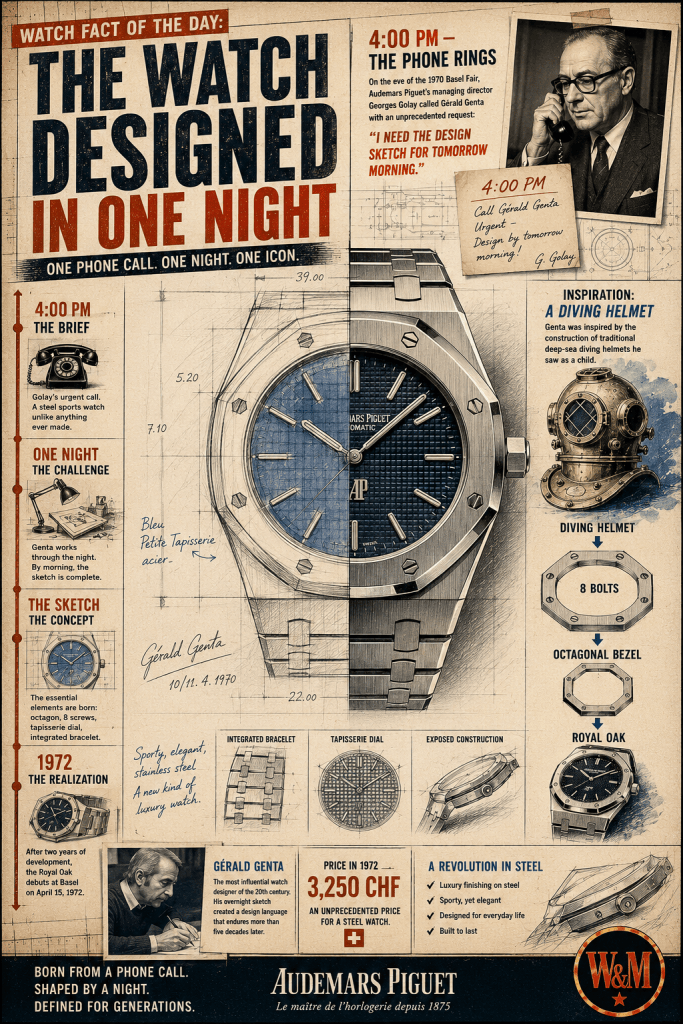
Legendary watch designer Gérald Genta received an urgent call at 4:00 PM from Audemars Piguet’s managing director demanding an unprecedented steel luxury sports watch by the next morning. Drawing inspiration from a traditional deep-sea diving helmet, Genta sketched the iconic octagonal, screw-accented design overnight.


On the eve of the 1970 Basel Fair, Audemars Piguet managing director Georges Golay gave Gérald Genta one of the most consequential rush jobs in watchmaking history. At approximately 4:00 PM, Golay called the legendary designer and asked for something audacious: a steel sports watch unlike anything that had existed before. There was one catch—he wanted the design by the following morning. Genta went to his drawing board and, in a single night, produced the basic form of what would become the Audemars Piguet Royal Oak. AP Chronicles

The request itself reflected changing tastes. Three distributors working with Audemars Piguet had identified demand for a watch that could somehow combine sportiness, elegance and stainless steel at a level normally associated with precious-metal luxury watches. This was a radical proposition around 1970. Instead of treating steel merely as a practical material, the eventual Royal Oak would treat it almost like precious metal, using exceptionally elaborate finishing to turn the case and bracelet into part of the luxury proposition. AP Chronicles

Genta found his inspiration in an unusual childhood memory. He recalled watching a diver being fitted with a traditional diving helmet near Geneva’s Pont de la Machine. The helmet’s bolts and protective rubber seal had fascinated him because the diver’s life literally depended upon that construction remaining watertight. When Golay asked for the unprecedented sports watch, that memory returned. Genta translated the industrial language of the diving helmet into an octagonal bezel, eight visible fasteners and a visible gasket. AP Chronicles

And Genta didn’t stop with the bezel. His overnight drawing already contained many of the elements that would define the finished Royal Oak: the dramatic case, integrated bracelet with tapering links, blue patterned dial and exposed construction details. AP’s archive identifies the surviving original as a gouache-and-pencil drawing on card, produced during the night of April 10–11, 1970. The remarkable thing isn’t merely that Genta produced a rough concept overnight—the essential visual DNA of the Royal Oak was already there. AP Chronicles

But the Royal Oak wasn’t immediately ready for customers. Turning Genta’s sketch into an actual watch proved enormously challenging, particularly because of the complicated steel case and integrated bracelet. Case makers were sufficiently concerned about manufacturing the design that early development work involved more malleable gold before the final steel execution. The bracelet itself became an extraordinary manufacturing challenge, with differently sized components required to achieve its distinctive taper. AP Chronicles

After roughly two years of development, the finished Royal Oak finally made its official debut at the Basel Fair on April 15, 1972. The original Reference 5402 measured approximately 39 mm—large enough for the era to acquire the famous “Jumbo” nickname—and combined its radical exterior with the ultra-thin automatic Calibre 2121. AP describes the launch as genuinely polarizing: some observers were shocked by the unconventional watch, while others immediately recognized its appeal. AP Chronicles

The gamble ultimately changed the vocabulary of luxury watch design. Instead of hiding screws, seams and structural elements, the Royal Oak celebrated them. Instead of disguising stainless steel as something more precious, it demonstrated that steel itself could become luxurious through design and finishing. And instead of separating an elegant watch from a sports watch, Genta created an object intended to inhabit both worlds. More than five decades later, Audemars Piguet still describes those lines—sketched in one night—as the foundation of a recognizable design language that has endured for generations. Audemars Piguet

✏️ Did You Know?

There’s an especially wonderful twist in Genta’s recollection: he said he actually misunderstood Golay’s brief. Genta thought he had heard a request for a steel sports watch with unprecedented water resistance, which helped trigger his memory of the diving helmet. That apparent misunderstanding contributed to the exposed gasket, eight fasteners and industrial architecture that became some of the most recognizable details in modern watchmaking.

Category: Fun Quirk

Disclaimer: Every effort has been made to keep these watch facts accurate, but the world of horology is full of myths, disputed stories, and fascinating trivia. Consider these facts a starting point for discovery rather than the final word. If you have corrections or additional insights, let us know—we’re always happy to keep the record ticking in the right direction.

🕐 Discover more watch facts, reviews, and buying guides at WatchesAndMore


🛍️ You Might Also Like

As an Amazon Associate and affiliate partner, WatchesAndMore earns from qualifying purchases.

G-Shock GWM5610-1 Solar Atomic
🔥 Deal of the Day

G-Shock GWM5610-1 Solar Atomic

Casio

★★★★★ 4.8 (5,621 reviews)

$129

Offer expires in


🔥 Grab This Deal →

G-Shock GA2100-1A1 CasiOak


G-Shock GA2100-1A1 CasiOak

Casio

★★★★★ 4.8 (2,156 reviews)

$99


Check Price on Amazon →

Casio Edifice Chronograph


Casio Edifice Chronograph

Casio

★★★★★ 4.7 (1,264 reviews)

$120


Check Price on Amazon →


Browse all 142+ expert-reviewed watches →