📅 Wednesday, September 9, 2026
Long before watch companies became global luxury brands, Longines was already thinking about something every modern manufacturer worries about: counterfeiting. As the Saint-Imier watchmaker’s reputation grew during the 19th century, imitation products began attempting to benefit from the name it had established. Longines responded with a symbol that would become one of the most enduring identities in watchmaking—the winged hourglass.
The story actually begins before the trademark registration itself. Longines says that by 1867, it was already using both the Longines name and winged-hourglass symbol as guarantees of origin and quality. The emblem was applied to its watches so buyers could distinguish genuine Longines products from counterfeits.
Then came the legal protection.
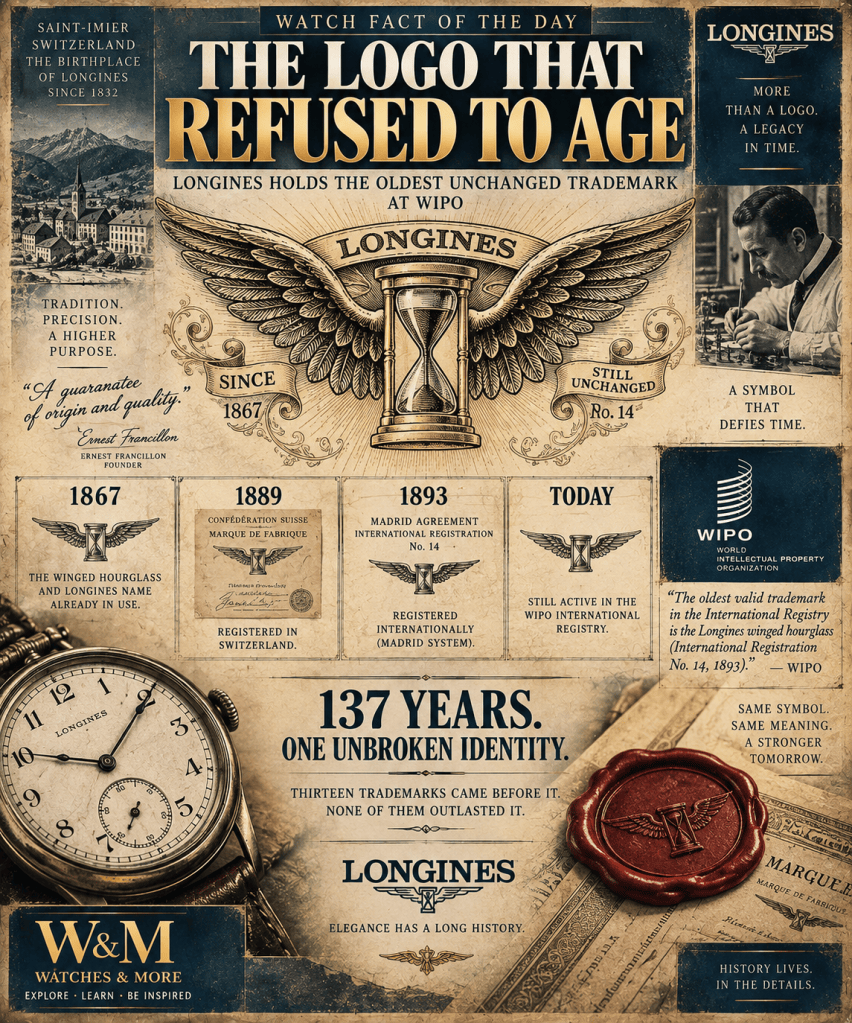
In 1889, Ernest Francillon registered the Longines name and winged-hourglass trademark in Switzerland. Four years later, on March 27, 1893, it entered the international system established under the Madrid Agreement as International Registration No. 14. Thirteen international applications had preceded it—but those earlier registrations eventually lapsed.
That left Longines holding an extraordinary distinction.
According to WIPO, the original Longines winged-hourglass mark has been continually used and never modified, making it the oldest valid trademark in WIPO’s International Registry. WIPO was still describing the Longines mark as the oldest trademark remaining in effect in its 2024 Madrid System materials, while a 2026 WIPO feature again identified the winged hourglass as the oldest valid trademark in the International Registry.
And there’s a fascinating wrinkle here: the trademark that holds the record isn’t necessarily identical to the modern Longines logo you see prominently displayed on today’s watch dials.
WIPO explains that the original trademark continues to appear on the backs of Longines watches, while an updated interpretation appears on the dial. The historic registered mark incorporates the winged hourglass within a more elaborate emblem—making the surviving legal identity itself a little piece of 19th-century watchmaking history.
The longevity is remarkable when you consider what happened during those intervening years.
Mechanical watches gave way to wristwatches. Two world wars passed. Aviation transformed transportation. Quartz nearly rewrote the Swiss watch industry. Digital watches arrived. Computers, smartphones and smartwatches followed.
Yet that trademark remained protected.
1889 → 2026: 137 years.
And the story is particularly appropriate for a watch company because the winged hourglass itself represents something Longines has managed exceptionally well:
time passing without identity disappearing.
💡 Did You Know?
Longines wasn’t the first trademark entered into the international registry.
Its international registration was No. 14.
The first thirteen registrations simply didn’t maintain their protection continuously. Longines did. WIPO notes that the first international trademark registration belonged to Swiss chocolate producer Russ-Suchard, but that original registration eventually ceased to be in force.
So Longines didn’t win this record by being first through the door.
IT WON BY NEVER LEAVING.
⭐ Why It Matters
We usually think of trademarks as marketing—something designed to make a company recognizable.
For Longines in the 19th century, the winged hourglass also served a more practical purpose: protecting identity, reputation and authenticity from imitators.
That makes the emblem more than decoration.
It is effectively a 137-year chain of brand identity stretching from a Swiss watch factory in Saint-Imier to the modern international intellectual-property system.
1867 — THE SYMBOL IS USED
1889 — REGISTERED IN SWITZERLAND
1893 — REGISTERED INTERNATIONALLY
TODAY — STILL ACTIVE
And BBC Creative Department has just been handed an absolute gift. 😂⌛🪽
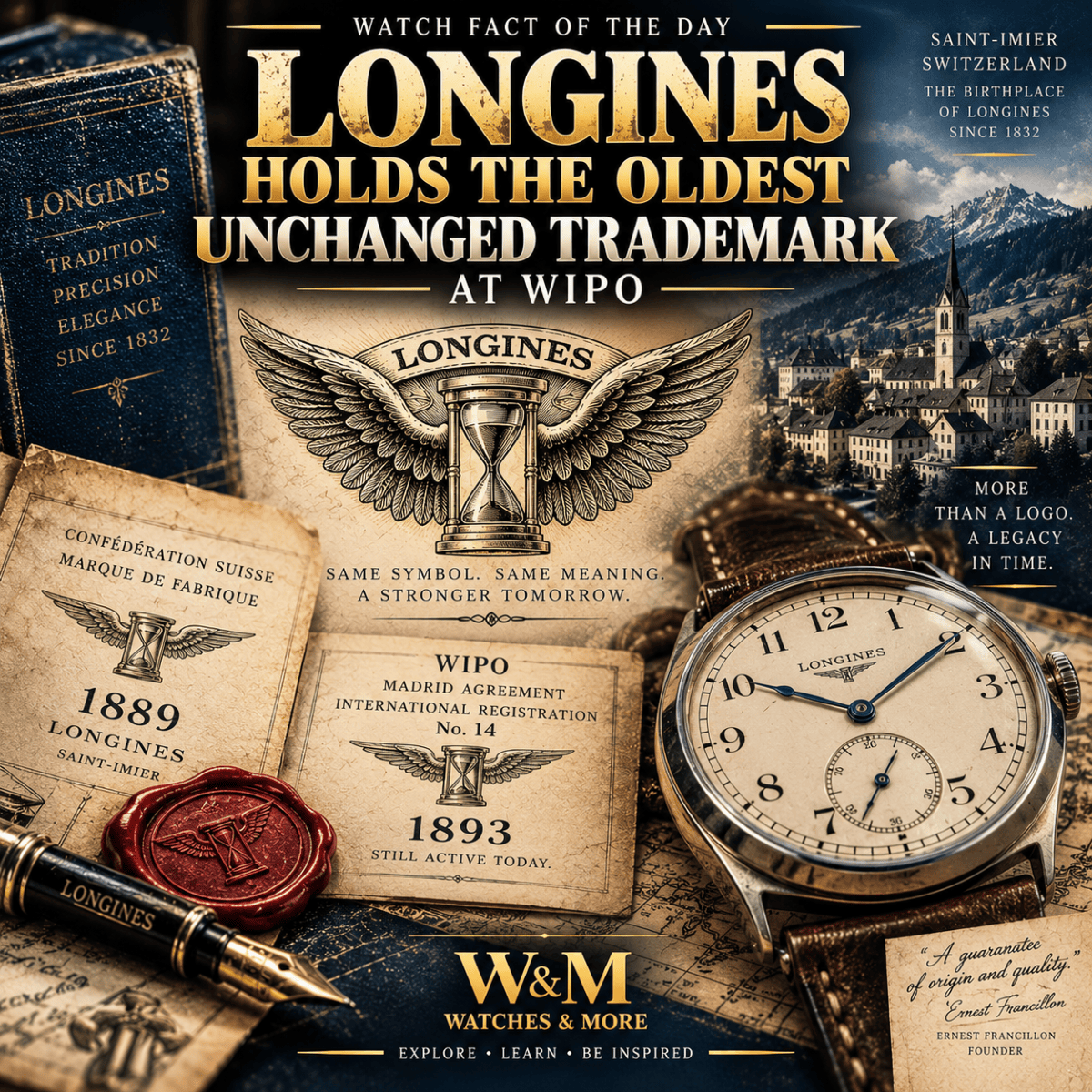
I’m seeing the infographic as a late-1880s Swiss trademark certificate × Belle Époque watchmaker’s advertisement—aged ivory paper, deep Longines blue, burgundy sealing wax, black engraved linework, antique gold foil, elaborate Victorian borders and beautiful copperplate typography.
Dead center: an enormous engraved winged hourglass, with one wing stretching toward 1889 and the other toward TODAY.
Above it:
THE LOGO THAT REFUSED TO AGE
Then an original-looking registration document:
SWITZERLAND — 1889
↓
MADRID SYSTEM — 1893
↓
INTERNATIONAL REGISTRATION No. 14
↓
STILL ACTIVE TODAY
And across the bottom:
137 YEARS.
ONE UNBROKEN IDENTITY.
Then the killer little Collector’s Note:
THIRTEEN TRADEMARKS CAME BEFORE IT.
NONE OF THEM OUTLASTED IT.
Category: Brand Spotlight
Disclaimer: Every effort has been made to keep these watch facts accurate, but the world of horology is full of myths, disputed stories, and fascinating trivia. Consider these facts a starting point for discovery rather than the final word. If you have corrections or additional insights, let us know—we’re always happy to keep the record ticking in the right direction.
🕐 Discover more watch facts, reviews, and buying guides at WatchesAndMore
🛍️ You Might Also Like
As an Amazon Associate and affiliate partner, WatchesAndMore earns from qualifying purchases.