


📅 Tuesday, October 6, 2026
No hands. No ticking. Just glowing red numbers—and a glimpse of the future.
Imagine buying a luxury watch, looking down at your wrist, and seeing a blank screen.
In 1972, that was part of the appeal.
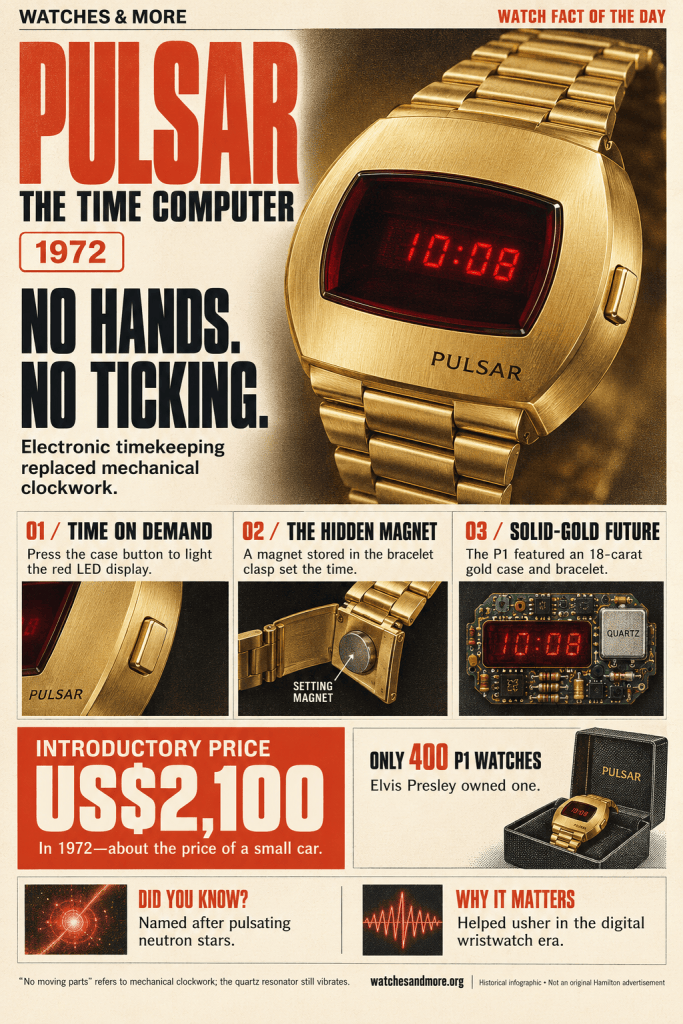
The Hamilton Pulsar P1 brought electronic digital timekeeping to the wrist in spectacular fashion. Unveiled as a prototype in 1970 and sold commercially in 1972, it looked perfectly at home in the space age. Press a button, and its dark screen suddenly came alive with red numbers. Swatch Group
For generations, telling time had meant watching hands travel around a dial. The Pulsar offered a different experience: time revealed through light.
⌚ A Watch Without the Clockwork
Developed through a partnership between Hamilton and electronics company ElectroData, the Pulsar replaced traditional mechanical clockwork with electronic timekeeping. Smithsonian describes it as a watch with no moving parts. National Museum of American History
There was no mainspring to wind, no gear train driving hands, and no escapement producing that familiar tick. Quartz-based electronics kept time, while light-emitting diodes—LEDs—displayed the numbers.
A small technical distinction makes the story even more interesting: “no moving parts” means no moving mechanical clockwork. The quartz resonator still vibrates microscopically to provide the timekeeping reference. Hamilton Watch
For a watch enthusiast, the fascinating part is the change in character. A mechanical watch reveals time through motion. The Pulsar revealed it through light.
🔴 Why You Had to Press a Button
Those glowing red numerals came with a practical limitation: the LED display consumed too much power to remain illuminated continuously.
The solution was time on demand.
Pressing the button on the side of the case briefly displayed the hours and minutes. Holding it longer showed the seconds. The watch continued keeping time while its screen was dark.
And here is an important detail: the magnet hidden in the bracelet clasp was used to set the time. The case button illuminated the display. National Museum of American History
Today, pressing a button to wake a screen feels ordinary. In the early 1970s, that little interaction could make checking the time feel like operating a piece of science-fiction equipment.
💰 The Future Came in Solid Gold
The original Pulsar P1 paired its electronics with an 18-carat yellow-gold case and bracelet. Its launch price was US$2,100, and Hamilton records Elvis Presley among the buyers of the original 400 watches. Swatch Group
How expensive was that? Smithsonian compares the price with the cost of a small car at the time. National Museum of American History
Owning one meant wearing an unmistakable conversation starter: a luxury watch whose most striking feature disappeared when you stopped using it.
Hamilton’s historical retrospective also names Jack Nicholson among the Pulsar’s famous admirers. The stainless-steel P2 followed in 1973, bringing the concept to a wider audience. Swatch Group
The digital future was finding more wrists.
💡 Did You Know?
“Pulsar” was a name borrowed from astronomy. Pulsars are rotating neutron stars whose radiation can be detected as regularly recurring pulses—an evocative name for a futuristic electronic watch. Swatch Group
Hamilton marketed the watch as a “Time Computer.” That name captured the excitement surrounding its electronics, although the original watch was a timekeeping device rather than a general-purpose computer. National Museum of American History
⭐ Why It Matters
The Pulsar helped change what people expected a watch to look like—and how they expected to interact with it.
A dial no longer needed hands. Checking the time could involve waking a display. Advanced electronics could become the centerpiece of a luxury watch’s appeal.
For collectors, its significance goes beyond those unmistakable red numbers. It captures a moment when the future became something you could proudly wear.
Sometimes, a revolution in watchmaking arrives without making a single tick.
Explore more remarkable stories in the W&M Watch Fact Archive.
Discover more at WatchesAndMore.org and visit our companion site, WatchesAndMore.shop.
Category: Fun Quirk
Disclaimer: Every effort has been made to keep these watch facts accurate, but the world of horology is full of myths, disputed stories, and fascinating trivia. Consider these facts a starting point for discovery rather than the final word. If you have corrections or additional insights, let us know—we’re always happy to keep the record ticking in the right direction.
🕐 Discover more watch facts, reviews, and buying guides at WatchesAndMore
🛍️ You Might Also Like
As an Amazon Associate and affiliate partner, WatchesAndMore earns from qualifying purchases.



Browse all expert-reviewed watches →