


📅 Sunday, October 4, 2026
Before playlists and portable speakers, watchmakers found a wonderfully mechanical way to carry a tune.
Imagine reaching into your pocket, taking out an ornate watch, and hearing a delicate melody emerge from inside its case.
No battery. No speaker. Just springs, gears, and miniature musical machinery.
These remarkable timepieces brought together two arts that share an obsession with rhythm: watchmaking and music.
By the late 18th century, Genevan makers were turning musical pocket watches and other miniature musical objects into a speciality—creating tiny performances inside beautifully crafted cases.
🔔 Before the Melody Came the Bell
Watches were making themselves heard well before they became miniature music players.
A surviving Thomas Tompion traveling clock-watch from around 1680, now in the Metropolitan Museum of Art, strikes the hours on a bell inside its case and includes an alarm. It has separate mechanisms and power sources for timekeeping, striking, and sounding the alarm.
That was already an impressive achievement: a portable timekeeper that could announce itself.
Playing a recognizable tune added another challenge. Instead of repeatedly sounding one bell, a musical mechanism needed to produce different notes in a carefully arranged sequence.
🎶 A Concert in Miniature
During the 18th century, watchmakers in Geneva developed miniature carillons—mechanisms that played music on small bells—and incorporated them into pocket watches and other precious objects. Around 1780, this kind of musical miniaturization became a local speciality.
The broader tradition of mechanical bell music used pinned cylinders to control the sequence of notes. As the cylinder rotated, its pins triggered the mechanism in a predetermined pattern. Musical clocks preserved by Museum Speelklok demonstrate this approach.
Think of the cylinder as a mechanical score: the tune was encoded in the placement of its pins.
The charm lies in that physical relationship. Every note depended on something moving, engaging, and sounding at exactly the right moment.
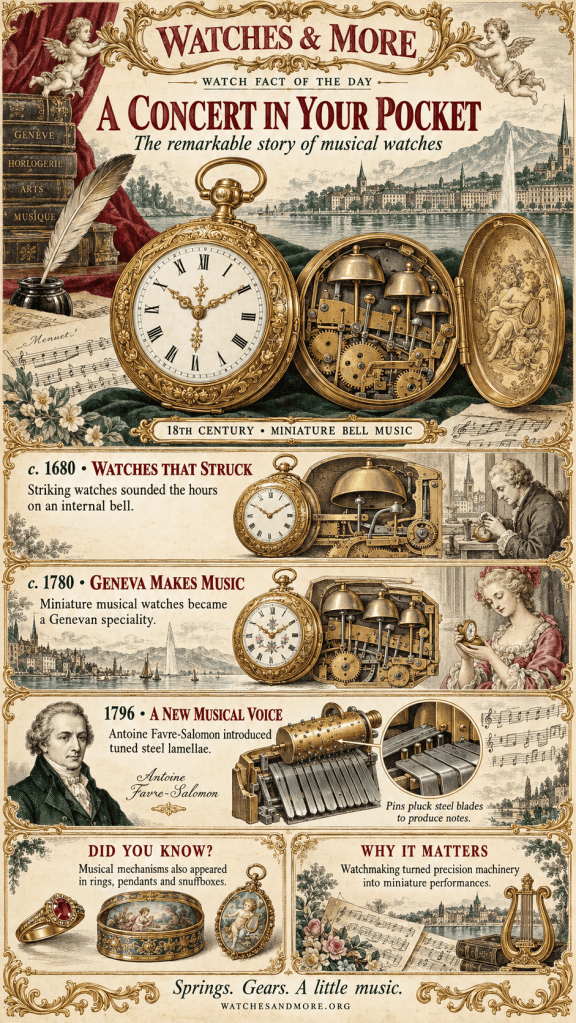
⚙️ The 1796 Breakthrough: Steel Instead of Bells
Here’s where the familiar music-box sound enters the story.
In 1796, Genevan watchmaker Antoine Favre-Salomon introduced tuned steel lamellae, opening the way to even smaller musical mechanisms.
In this system, pins on a rotating cylinder plucked steel blades of different lengths. Each blade vibrated at its own musical pitch, and their arrangement gave rise to the description “comb music.” Early makers incorporated these mechanisms into small precious objects before they became familiar as standalone music boxes.
Tiny bells and tuned steel teeth represent different ways of producing the music. Both are ingenious; each gives the mechanism its own character.
🎭 When the Watch Became a Performance
Some makers went further, combining music with moving miniature figures.
A watch attributed to Piguet & Capt, dating to around 1805, takes the form of an elaborate perfume flask. Its musical mechanism accompanies an animated scene featuring a boy, a dog, and a woman playing a guitar.
Imagine the delight of revealing that hidden performance.
The object could tell time, play music, and animate a tiny scene—all through mechanical action. It’s easy to understand why these creations still fascinate collectors centuries later.
💡 Did You Know?
Musical miniaturization reached beyond pocket watches. The Museum of Music Automatons documents musical rings, pendants, snuffboxes, and other extraordinary objects, including a musical ring from around 1803.
A whole tune tucked into a ring? That’s an impressive answer to “what else can we make smaller?”
⭐ Why It Matters
These creations show how watchmaking can serve imagination as well as precision.
They also reveal an important distinction: a striking watch announces time, while a musical mechanism performs a sequence of notes. Their histories overlap through the craft of controlling energy, motion, and sound.
For enthusiasts, the appeal is wonderfully tangible. The music exists because someone worked out how to make tiny pieces move together.
⌚ The W&M Take
We often admire watches for what we can see: the dial, the finishing, the movement.
Musical watches invite us to listen, too.
There’s something irresistible about a carefully wound spring releasing its energy as a melody. It turns an intricate object into a brief experience—one you can hold in your hand.
Long before we carried our music digitally, watchmakers were finding ways to carry it mechanically.
💬 Would you choose a watch that plays a melody, or one that chimes the time? Tell us in the comments!
Category: Fun Quirk
Disclaimer: Every effort has been made to keep these watch facts accurate, but the world of horology is full of myths, disputed stories, and fascinating trivia. Consider these facts a starting point for discovery rather than the final word. If you have corrections or additional insights, let us know—we’re always happy to keep the record ticking in the right direction.
🕐 Discover more watch facts, reviews, and buying guides at WatchesAndMore
🛍️ You Might Also Like
As an Amazon Associate and affiliate partner, WatchesAndMore earns from qualifying purchases.




Browse all expert-reviewed watches →
WatchesAndMore Blog: https://watchesandmoreco.blog/posts-page/
WatchesAndMore Main Site: https://watchesandmore.org/
WatchesAndMore Companion Site: https://www.watchesandmore.shop/
📚 Sources & Further Reading
Further reading: Fondation de la Haute Horlogerie — watchmaking glossary
Read Next
Discover more from WatchesAndMoreCO
Subscribe to get the latest posts sent to your email.


