
📅 Friday, July 24, 2026
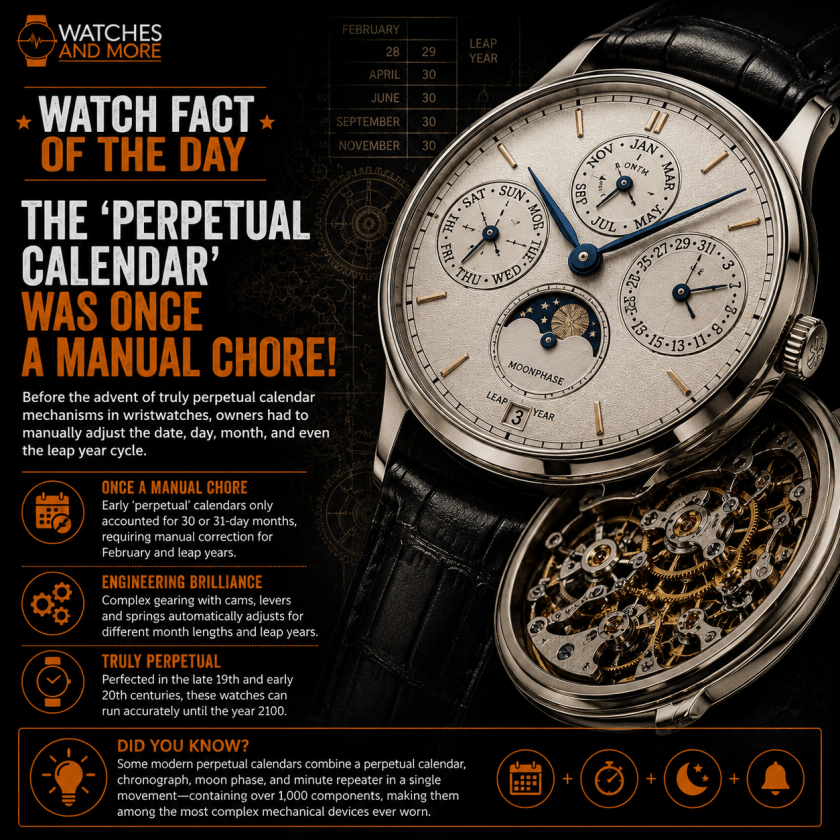
Before the advent of truly perpetual calendar mechanisms in wristwatches, owners had to manually adjust the date, day, month, and even the leap year cycle. Early ‘perpetual’ calendars only accounted for months with 30 or 31 days, requiring manual correction for February and leap years. It wasn’t until the late 19th and early 20th centuries that watchmakers perfected the complex gearing to automatically handle these variations, making it a truly ‘perpetual’ complication.
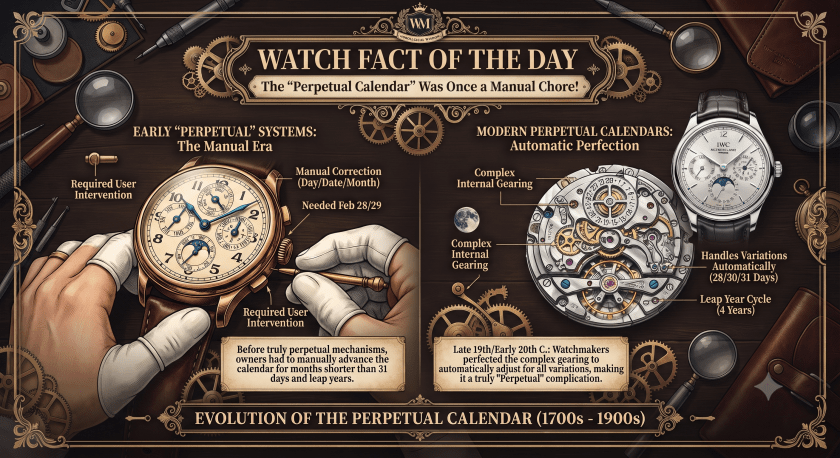
A true perpetual calendar is one of the greatest achievements in mechanical watchmaking. Using an intricate network of levers, cams, gears, and springs, the movement “knows” the length of each month and automatically advances the calendar accordingly. It even recognizes leap years, correctly displaying February 29 every four years without requiring intervention. Once properly set, a perpetual calendar can continue displaying the correct date until the year 2100, when the Gregorian calendar skips a leap year because century years must be divisible by 400 to qualify. At that point, even these remarkable watches will require a single manual adjustment.
The level of engineering involved is astonishing. Many perpetual calendar movements contain hundreds of additional components dedicated solely to the calendar mechanism. Watchmakers must carefully synchronize every indication—date, day, month, leap year, and often the moon phase—so they all change in perfect harmony, usually around midnight. A tiny mistake during assembly can throw the entire system out of sequence, making these among the most demanding complications to manufacture and service.
Today, perpetual calendars remain one of the “Holy Trinity” of traditional grand complications, alongside the tourbillon and the minute repeater. Prestigious manufacturers such as Patek Philippe, Audemars Piguet, Vacheron Constantin, and IWC continue to produce extraordinary perpetual calendar watches that blend centuries-old mechanical ingenuity with modern precision. For collectors, owning one is like wearing a miniature mechanical computer on the wrist—one that can keep track of the calendar for generations.
💡 Did You Know?
Some modern perpetual calendars are so advanced that they combine a perpetual calendar, chronograph, moon phase, and minute repeater in a single movement. These “grand complications” can contain well over 1,000 individual components, making them some of the most complex mechanical devices ever worn on the wrist.
Disclaimer: Every effort has been made to keep these watch facts accurate, but the world of horology is full of myths, disputed stories, and fascinating trivia. Consider these facts a starting point for discovery rather than the final word. If you have corrections or additional insights, let us know—we’re always happy to keep the record ticking in the right direction.
Category: Watch History
🕐 Discover more watch facts, reviews, and buying guides at WatchesAndMore
🛍️ You Might Also Like
As an Amazon Associate and affiliate partner, WatchesAndMore earns from qualifying purchases.
Browse all 75+ expert-reviewed watches →