
📅 Wednesday, September 30, 2026
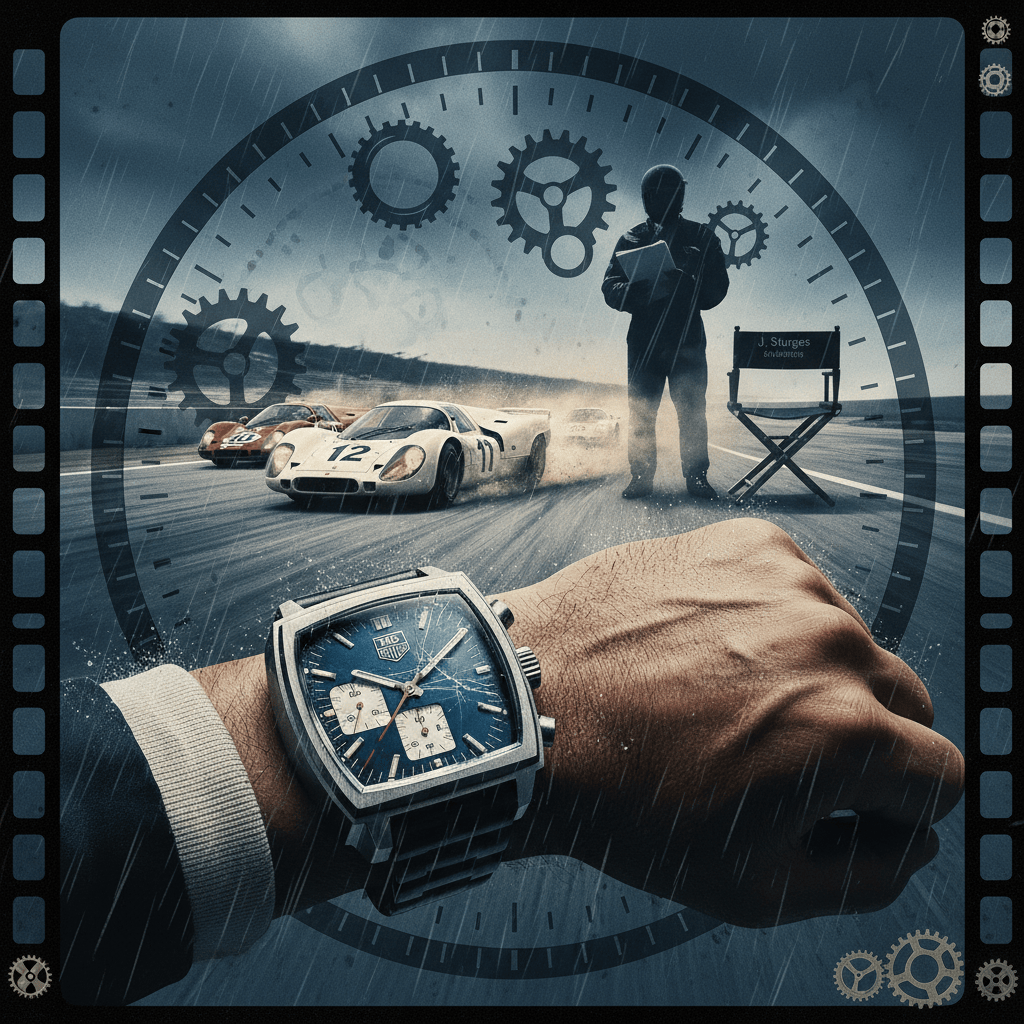
A racing driver, a film prop table, and a square blue chronograph. Sometimes, that is all it takes to make watch history.
Picture Steve McQueen in Le Mans: racing overalls, an expression of absolute concentration, and a Heuer Monaco strapped to his wrist.
The pairing feels inevitable. The King of Cool wearing a watch with enough personality to hold its own beside him.
But behind that famous image is a more interesting story than simply copying another driver’s watch.
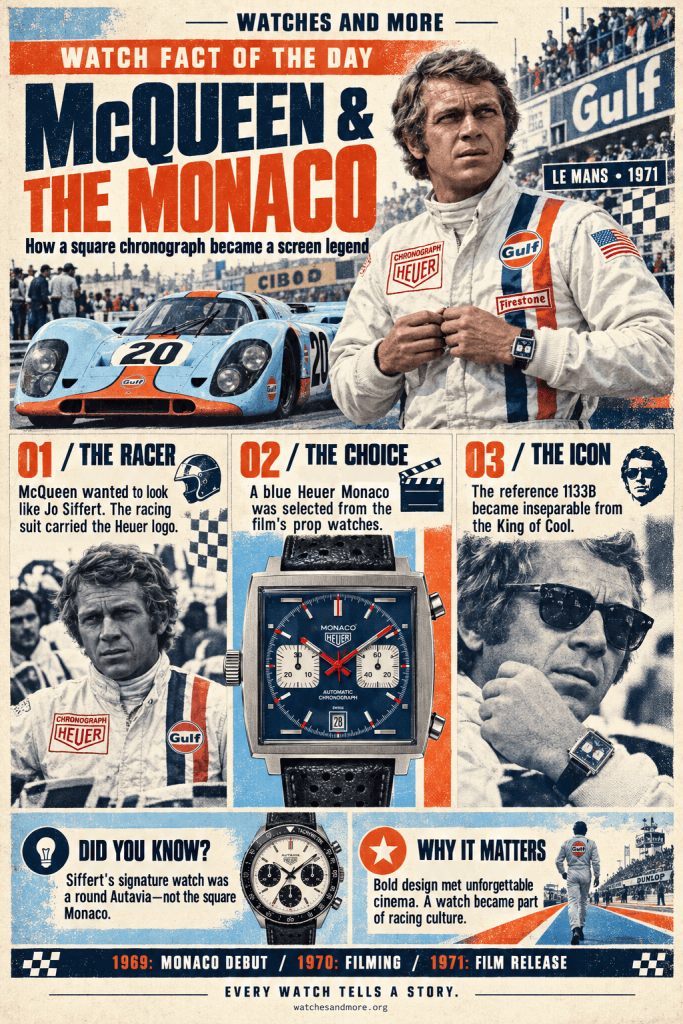
He Wanted to Look Like a Real Racer
During production in 1970, McQueen wanted his character, Michael Delaney, to look convincing. For inspiration, he turned to professional racing driver Jo Siffert, who was involved with the film and had a relationship with Heuer.
According to Jack Heuer’s recollection, based on accounts from people on set, McQueen indicated that he wanted to look like Siffert. The driver supplied a white racing suit carrying the Heuer logo. The film would reach cinemas in 1971.
That choice helped set the direction for the watch.
If your racing suit says Heuer, a Heuer chronograph makes a pretty convincing finishing touch.
The Twist: Siffert’s Famous Watch Was an Autavia
Here is the detail that often gets lost in the retelling.
McQueen did not simply copy Siffert’s exact watch.
Siffert was famously associated with the Heuer Autavia reference 1163T, particularly the white dial version with blue accents that collectors know as the “Siffert” Autavia. McQueen’s screen watch was the blue dial Monaco reference 1133B.
The inspiration came from Siffert’s racing identity. The square chronograph took its own route into the picture.
And what a route it turned out to be.
A Prop Table Helped Make the Decision
TAG Heuer’s heritage account describes property master Don Nunley presenting McQueen with watches from several brands.
McQueen considered an Omega Speedmaster, but the Heuer branding on his suit helped steer the choice toward a Heuer. He selected a blue Monaco, and Nunley subsequently arranged for more watches and timing equipment to come from the manufacturer for filming.
There was a practical side, too. Jack Heuer’s account says Nunley needed matching watches for different production uses and a spare in case of damage.
A screen icon still has to survive the ordinary business of making a movie.
The Monaco Already Had Something to Say
Introduced in 1969, the Monaco combined a bold square case with Heuer’s new automatic chronograph technology. Its water resistant case, developed by supplier Piquerez, gave the design substance beyond its unusual appearance.
This was a watch that could catch your eye before you knew anything about its movement.
A blue dial. Contrasting white registers. Red accents. A silhouette you could recognise across a room.
On McQueen’s wrist, those details became part of a larger visual language: racing machinery, purposeful equipment, and effortless confidence.
To our eyes, the Monaco looks perfectly cast.
Becoming an Icon Took Time
It is tempting to imagine that Le Mans instantly turned the Monaco into a runaway success.
The history is less tidy. TAG Heuer acknowledges disappointing early sales, and the original collection was discontinued around 1975. A revival followed in 1997, helping establish the Monaco’s enduring place in watch culture.
That makes the story even better.
Some designs need time before the world catches up with them.
The Watches And More Take
The Monaco’s appeal is easy to understand when you look at that famous McQueen image. The watch contributes something unmistakable to the scene.
Its shape has confidence. Its colours have energy. Its connection to the film gives collectors a story they can carry on their own wrists.
And that is one of the pleasures of watches: a small object can hold a surprisingly large piece of culture.
Heuer supplied the chronograph. McQueen gave us an image we still remember.
Would you choose McQueen’s square Monaco or Siffert’s round Autavia? Let us know in the comments.
Every watch tells a story. This one came with racing overalls and the King of Cool.
💡 Did You Know?
Jo Siffert’s signature watch was a round Heuer Autavia—not the square Monaco McQueen wore in Le Mans. McQueen borrowed Siffert’s racing look, then gave the Monaco its own Hollywood identity.
⭐ Why It Matters
The Monaco shows how design and storytelling can work together. Its bold square case made it distinctive; McQueen’s appearance in Le Mans gave it a cultural connection that remains central to its identity.
Category: Watches on Screen
Disclaimer: Every effort has been made to keep these watch facts accurate, but the world of horology is full of myths, disputed stories, and fascinating trivia. Consider these facts a starting point for discovery rather than the final word. If you have corrections or additional insights, let us know—we’re always happy to keep the record ticking in the right direction.
🕐 Discover more watch facts, reviews, and buying guides at WatchesAndMore
🛍️ You Might Also Like
As an Amazon Associate and affiliate partner, WatchesAndMore earns from qualifying purchases.

Browse all 142+ expert-reviewed watches →
📚 Sources & Further Reading
Further reading: Fondation de la Haute Horlogerie — watchmaking glossary
Join the Conversation
Which detail in this story interests you most, and would it influence what you wear or collect? Share your thoughts in the comments below.
Read Next
- Omega Speedmaster and Apollo 13: The Critical 14 Seconds
- Watch Fact of the Day: The Legend of Hanhart’s Iconic Red Chronograph Pusher
🛍️ Explore designs, gifts and more at the W&M companion shop.

