

⌚ Watch Fact of the Day: The Everyday Casio That Ended Up in Counter-Terrorism Files
The F-91W became famous for simple, affordable timekeeping. Its appearance in intelligence assessments tells a much more complicated story.
A black resin case. A familiar digital display. Three little buttons.
The Casio F-91W looks like the opposite of expensive spy equipment.
Yet this ordinary digital watch acquired an extraordinary association: it appeared in American counter-terrorism assessments involving detainees at Guantánamo Bay. NCPR News
The surprising question is not what secret technology Casio put inside it.
It is how a watch designed for everyday life became something intelligence analysts regarded as a clue.
🕵️ The Real Story Behind the Spy-File Hook
A tempting headline asks: “Why did the CIA flag anyone buying this watch?”
The documented story is narrower.
NPR’s reporting on the Guantánamo files describes the F-91W appearing in detainee assessments and a threat-indicator guide. Officials associated it with alleged links to al-Qaida training and explosives activity. NCPR News
That does not establish a blanket CIA programme flagging ordinary shoppers.
The distinction makes the story more revealing: it concerns how analysts interpreted a common possession in a particular detention and intelligence context.
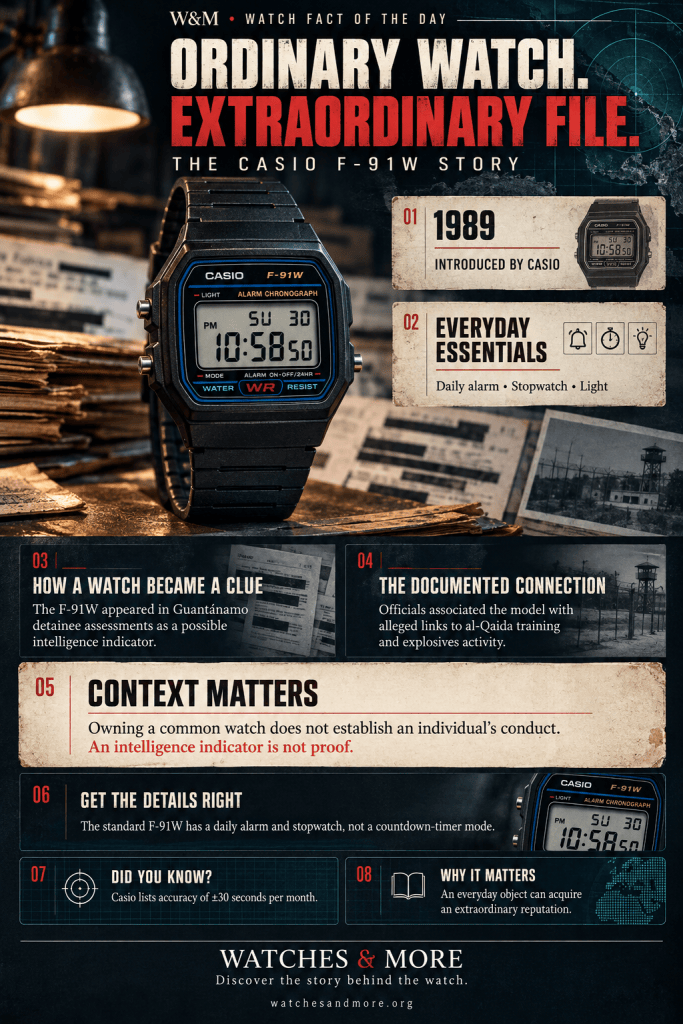
⌚ An Ordinary Watch With Useful Basics
Casio dates the F-91W’s introduction to 1989. casio.com
Its familiar package includes a daily alarm, stopwatch, light, and digital time-and-date display. Casio specifies accuracy of ±30 seconds per month.
The standard model has a daily alarm and stopwatch; it does not offer a user countdown-timer mode. CASIO CANADA
There is no need to imagine exotic technology to understand the watch’s everyday appeal. Its functions are straightforward and accessible.
It is a small tool for ordinary routines.
📁 When a Watch Became a Clue
The files’ association with explosives-related activity gave the F-91W a reputation far beyond its original purpose.
But an intelligence indicator and proof of an individual’s conduct are different things.
NPR’s reporting highlighted precisely that difficulty: deciding whether possession of the watch justified suspicion when the same product was widely available to ordinary people. NCPR News
A familiar object can acquire a sinister association without that association describing everyone who owns it.
That tension is the heart of this watch story.
🔎 A Model Number Mattered
The distinction even appeared in court.
In Sulayman v. Obama, a 2010 opinion discussed the government’s claim that a detainee possessed an F-91W. The court noted that the record did not establish which Casio model he had.
It ultimately did not resolve that watch-model question, relying on other evidence when denying the petition. OpenJurist
The episode illustrates why precision matters: even the difference between “a Casio” and “this particular Casio” could become part of a serious argument.
CLICK HERE TO SEE YOUTUBE VIDEO
💡 Did You Know?
The F-91W’s correct launch year is 1989, according to Casio itself. Its enduring design remains central to how the company presents the watch. Casio Classic Digital Watch
For many owners, the appeal is immediate recognition: that little rectangular face looks like a watch they have known for years.
⭐ Why It Matters
The F-91W’s unusual history connects watch design with a much larger question: how much can an everyday possession tell us about its owner?
A product can be practical, popular, misused, and misunderstood. Those histories can coexist.
For watch enthusiasts, the Casio remains interesting because so much cultural meaning has gathered around such a modest object.
An everyday watch. An extraordinary paper trail. A reminder that context matters. ⌚📁
Discover more stories in the W&M Watch Fact Archive.
Visit Watches & More and our companion site.