
2026-11-20 · Watches And More
A watch that listens to the world’s timekeepers—and a little booklet that explains the conversation.
Imagine leaving your watch by the window before bed. While you sleep, it attempts to receive a time signal and correct itself. By morning, the most interesting thing it has done may be something you never saw.
That quiet trick is at the heart of the Junghans MEGA story. But how does information from a distant transmitter become the time on your wrist? And why does a watch that can set itself still need instructions?
📻 The 1990 Watch That Learned to Listen
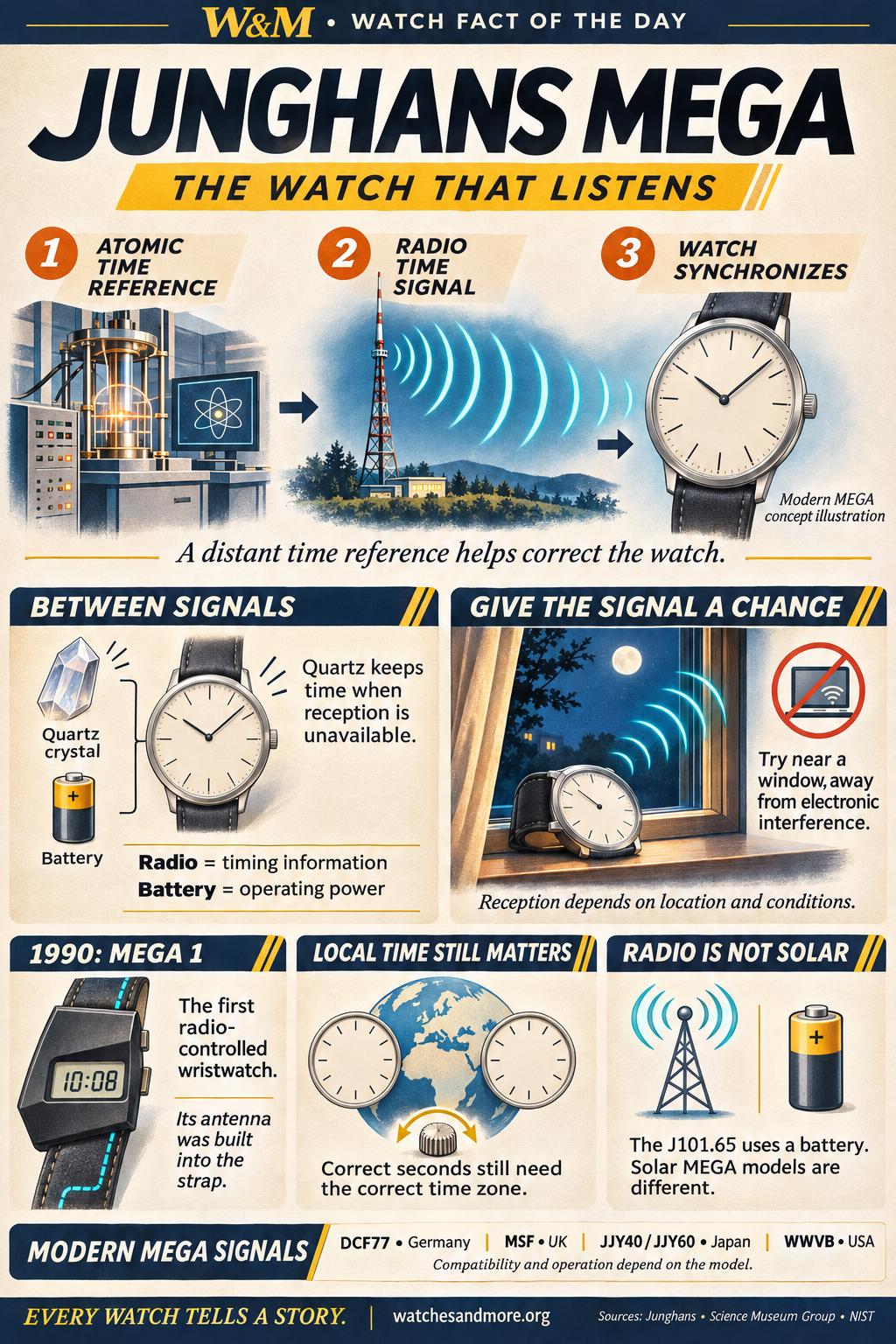
In 1990, Junghans introduced the MEGA 1, the world’s first radio-controlled wristwatch. The Science Museum Group records its digital quartz movement, FROG Design case and an especially clever detail: the receiving antenna was built into the strap.
It synchronized with the German long-wave time broadcast, linked to atomic clocks in Braunschweig. Within reception range across much of Europe, the wearer could benefit from that distant reference. Outside it, the MEGA 1 continued as a quartz watch. Explore the museum’s MEGA 1 record.
For a watch enthusiast, that strap detail is wonderful. Usually, changing a strap changes the outfit. Here, the strap had an engineering job, too.
⚙️ What Actually Happens When a Watch Receives the Time?
A radio-controlled watch combines its own quartz timekeeping with an external reference. Think of it as a musician checking a tuning note: the reference helps keep things aligned, while the instrument continues working between checks.
NIST explains that America’s WWVB station near Fort Collins broadcasts a coded time signal at 60 kHz. The watch’s receiver decodes the information and uses it to synchronize its internal clock. Between receptions, a quartz oscillator keeps time.
The familiar description “atomic watch” can be misleading. The atomic reference is elsewhere; there is no tiny atomic clock tucked beneath the dial. Your wrist gets the benefit of the broadcast without carrying the laboratory. NIST explains how radio-controlled timekeepers work.
⌚ From MEGA 1 to Modern MEGA
MEGA covers different generations and movements. The original digital watch and a modern analogue model should not be treated as if they share one instruction booklet.
For a concrete modern example, Junghans lists the Meister MEGA reference 58/7500.02 with its J101.65 radio-controlled movement, date display, crown or app setting and a second hand that advances in half-second steps. Classic dress-watch looks can hide rather modern behavior. See Junghans’s model specifications.

🌍 Where Does the Modern Signal Come From?
Junghans’s MEGA FAQ lists five compatible broadcasts: DCF77 in Germany, MSF in Britain, JJY40 and JJY60 in Japan, and WWVB in the United States. These are regional broadcasts, not a guarantee of worldwide reception. Its FAQ describes automatic nighttime synchronization and continued quartz operation without reception. Read the manufacturer’s reception guidance.
For the J101.65, the linked manual specifies approximately 1–15 minutes to set with good reception. A manual transmitter search ends after 15 minutes if unsuccessful, and quartz timekeeping continues. J101.65 manual, sections 4 and 7.
🪟 Why the Windowsill Can Beat the Bedside Table
A coverage map cannot tell the whole story inside your home. NIST explains that electrical interference can overwhelm a weak signal, while metal structures can shield it. Nighttime often offers better WWVB reception conditions.
Junghans recommends placing the J101.65 near a window, away from nearby electronic devices, and changing its position if reception fails. NIST reception advice · Junghans manual, section 4.2
Yes, a sophisticated watch may occasionally appreciate a better seat by the window. We can relate.
🧭 Accurate Seconds, Wrong Hour?
Receiving a time reference and choosing local time are separate jobs. WWVB broadcasts UTC; NIST explains that the receiving device uses the selected time zone to produce local time. An exact whole-hour error can therefore point to a setting issue. NIST’s broadcast FAQ.
The J101.65 manual provides crown adjustments in hourly steps and a separate mode for time zones including half-hour and quarter-hour offsets. It also describes synchronization using smartphone time data through the Junghans app. Check the instructions matching your movement before operating the controls. J101.65 manual, sections 3–4.
💡 Did You Know?
Junghans quotes a maximum quartz-mode deviation of ±8 seconds per year in its MEGA FAQ. It also describes Intelligent Time Correction, checking the second-hand position against the most recently received time information 1,440 times daily. Those internal checks are different from receiving 1,440 fresh radio broadcasts. Junghans accuracy FAQ.
And radio control does not mean solar power. The documented J101.65 uses a CR1025 battery, with a typical life of approximately two years. Radio supplies timing information; the battery supplies operating energy. J101.65 technical information.
⭐ Why It Matters
The MEGA story expands what we mean by watchmaking ingenuity. Precision can involve an antenna, a receiver and careful electronic control as well as finely finished gears.
Its instructions reveal the practical engineering behind the convenience: how to check reception, adjust the displayed hour and understand what the hands are telling you. They turn a mysterious feature into something an owner can use confidently.
❤️ The W&M Take
There is something deeply appealing about a watch quietly listening for the right time. The drama takes place beyond the dial, across the distance between a transmitter and a wrist.
And the instruction booklet? Give it a second look. Sometimes the best watch story is hiding in the part of the box we are most tempted to ignore.
Would you choose the futuristic original MEGA 1 or a classic-looking modern MEGA with its technology tucked out of sight?
Sources & Further Reading
- Science Museum Group — Junghans MEGA 1, 1990
- Junghans — Manufacturing and company history
- Junghans — Meister MEGA 58/7500.02 specifications
- Junghans — MEGA calibre J101.65 operating manual (PDF; English section)
- Junghans — MEGA frequently asked questions
- Junghans — Find the manual for your model or calibre
- NIST — How radio-controlled clocks work and reception troubleshooting
- NIST — Radio broadcast FAQ
Disclaimer: Every effort has been made to keep these watch facts accurate, but the world of horology is full of myths, disputed stories, and fascinating trivia. Consider these facts a starting point for discovery rather than the final word. If you have corrections or additional insights, let us know—we’re always happy to keep the record ticking in the right direction.


