
Watch Fact of the Day · Watches And More
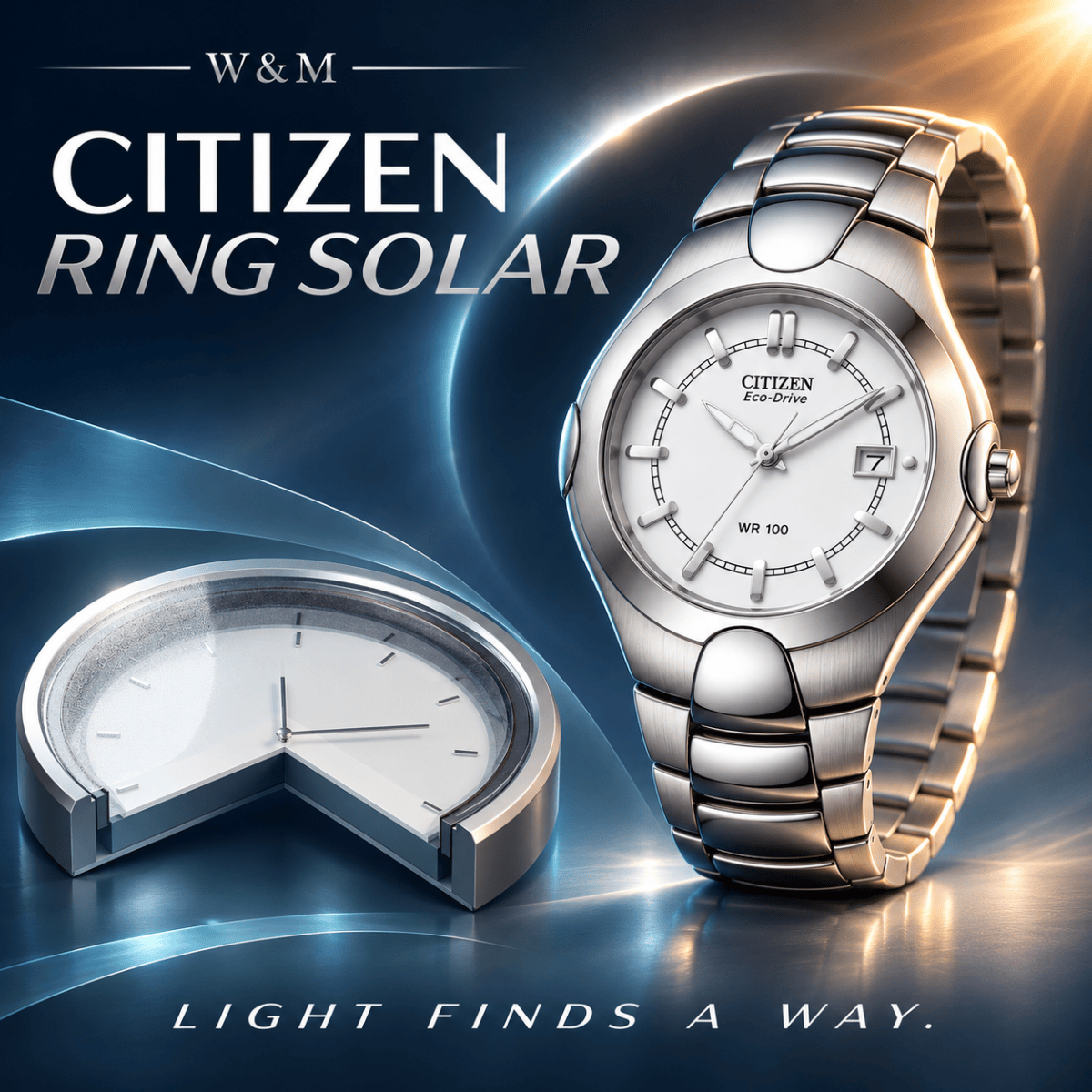
How do you make a light-powered watch with a dial that blocks light? Citizen’s answer was to move the power collector.
Imagine designing a solar-powered watch with a handsome, opaque metal dial. There’s one awkward conversation waiting at the engineering desk: how is the light supposed to reach the solar cell underneath it?
Citizen’s Ring Solar approach gives that problem an elegant answer. Place the light-collecting cell around the dial’s edge instead. The face can then be opaque without blocking the cell’s intended light path.
This is the story of how changing the location of a component opened new possibilities for the entire watch—and why the 2001 Eco-Drive ECLISSE deserves a closer look.
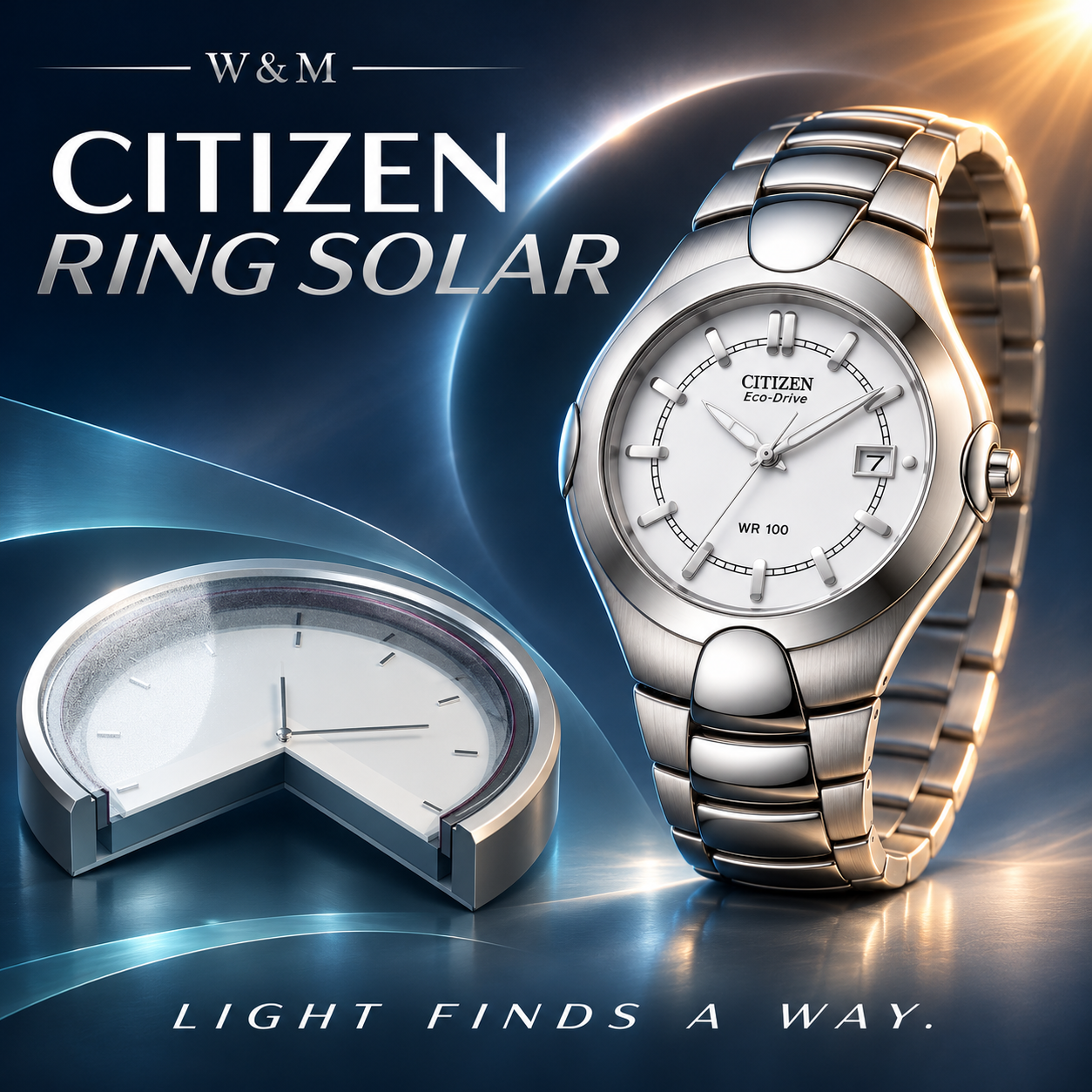
🎬 Watch: A Solar Watch With a Metal Dial?!
A solar watch needs light. An opaque metal dial blocks it. Our companion W&M Short explores Citizen’s clever answer: collect the light around the rim. Discover the idea behind the 2001 Eco-Drive ECLISSE and the tiny arrangement that gave its designers more freedom. Small ring. Big idea. Light finds a way.
Watch the Citizen Ring Solar Short on YouTube, then explore the detailed cutaway and engineering story below.
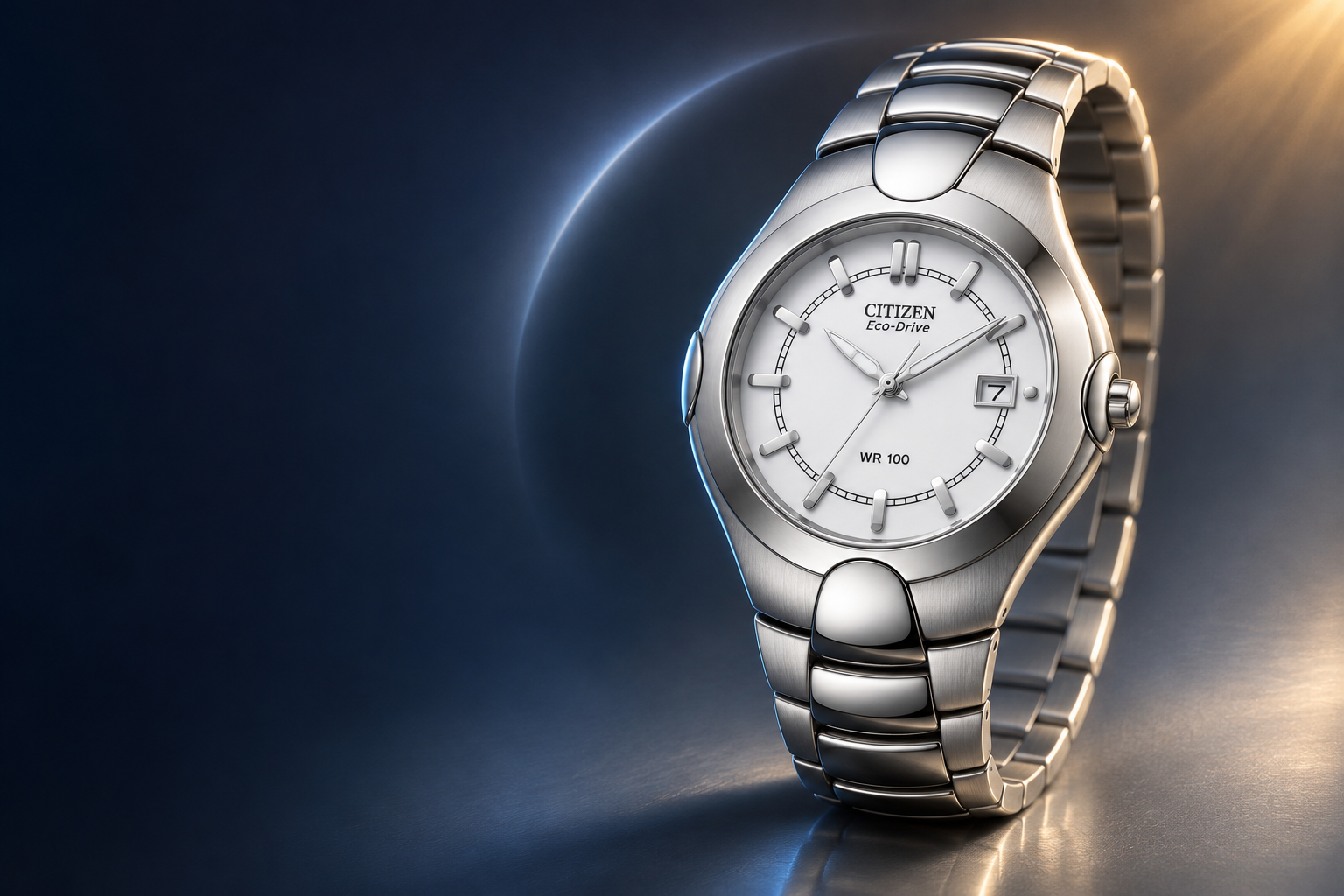
Light finds another way in. Our ECLISSE product artwork puts the white dial, rounded steel case and flowing bracelet in the spotlight. The clever engineering is tucked around the face, leaving the dial free to look like a dial.
☀️ First, the Design Problem: A Dial With Two Jobs
Many Eco-Drive models use a cell beneath the dial. The dial must be translucent enough to admit light without revealing that cell. [Citizen: Eco-Drive technology]
Think of a lampshade: it can pass light without giving you a clear view of the bulb. That analogy helps explain the optical requirement, although a watch dial has a very different construction.
It also explains the design challenge. The dial is simultaneously a face for the watch and part of the light’s route to its power source.
💍 Ring Solar: Give the Light Another Entrance
Citizen describes Ring Solar as a ring-shaped solar cell around the dial’s circumference. Its designers gain more freedom because the dial no longer needs to transmit light to a cell underneath. [Citizen]
A 2002 technical paper by five Citizen engineers also documents the development in the engineering literature. Its abstract describes a flexible-film cell placed inside the case around the dial, removing the need for light to pass through the face. The paper appeared in Micromechatronics, volume 46, issue 3, pages 32–42. [Technical paper and abstract]
The solar cell still needs illumination. Moving it creates another collection route; it does not make an opaque metal dial transmit light or turn the watch into a perpetual-motion machine.
🕰️ Meet the Pioneer: The 2001 Eco-Drive ECLISSE
Citizen’s design archive dates the Eco-Drive ECLISSE to 2001 and identifies it as the first Eco-Drive to receive light with a ring-shaped solar cell. The documented reference is CTV66-0351, with Calibre F810, a stainless-steel case and design credited to Nobuji Kaneda. [Citizen’s ECLISSE archive]
Rather than sitting flat beneath the dial, its film cell followed the inner side of the case beneath the crystal. That opened the way for a metal face. Citizen describes the ECLISSE dial as having an opaque white painted finish with a polished coating.
Its name comes from the Italian word for “eclipse.” The rounded case and flowing bracelet made the technology part of a cohesive design, rather than leaving it looking like an engineering demonstration strapped to your wrist.
The breakthrough wasn’t a new indication on the dial. It was greater freedom to create the dial itself.
🔬 The Clever Bit: More Than Bending a Solar Panel
Citizen’s retrospective includes an engineer’s explanation of the F810. Flexible, strip-shaped solar cells were formed into a cylinder, with their receiving surfaces perpendicular to the dial. The team then investigated charging performance under different conditions. [Citizen: Engineer’s Eye]
The account describes replacing a conventional four-in-series arrangement with a single-stage configuration. This helped keep charging stable when the watch was tilted or only part of the collector received light, such as when a sleeve partly shaded it. A voltage-boosting circuit addressed the lower generation voltage.
Citizen also explains how diffuse skylight can reach the surrounding cell. The design therefore required attention to electrical behavior and real wearing conditions, alongside the physical shape of the collector.
“Move the cell” is the short version. Making the relocated cell work reliably was the engineering project.
🔎 Inside Ring Solar: Follow the Light
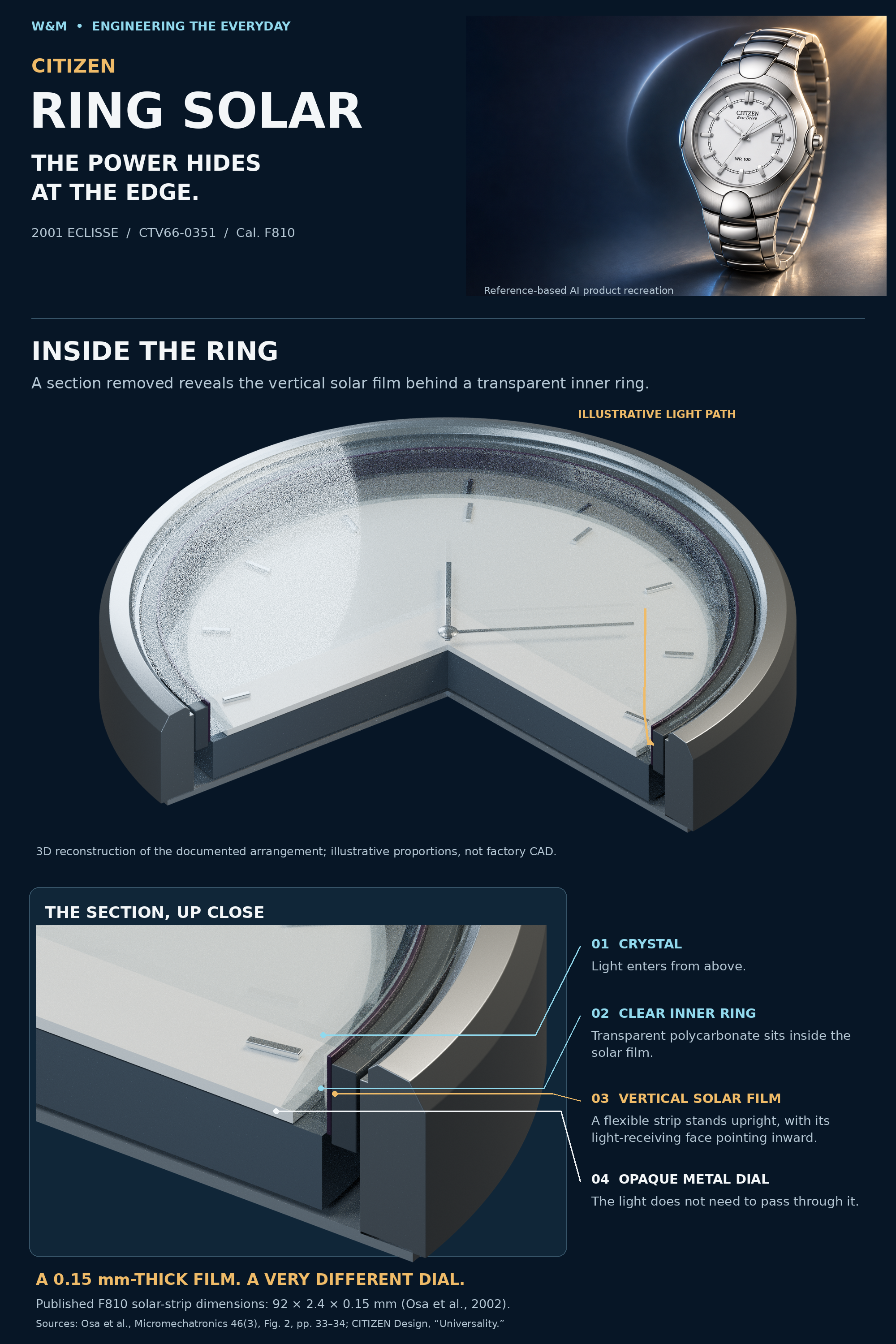
The cutaway makes the arrangement easier to see: a transparent polycarbonate inner ring sits between the opaque dial and the upright solar film. Light entering through the crystal can reach the collector through that clear ring. The solar film’s receiving surface faces inward around the dial, rather than lying flat beneath it.
The original F810 engineering paper gives the solar strip’s dimensions as 92 × 2.4 × 0.15 mm. Our enlarged section separates the layers visually; the remaining proportions and the indicated light path are illustrative. [Osa et al., 2002, Fig. 2 and printed pp. 33–34]
🎨 What Did That Freedom Actually Look Like?
The 2008 CALENDRIER, reference BU0011-63Z, Calibre 8730, provides another documented example. Citizen’s archive explicitly identifies its ring-solar construction and explains that the flexible cell around the dial permitted a metal face. [Citizen: CALENDRIER]
That mattered because the designers could exploit metal’s color, luster and finish. A layered, multifunction display with a moon phase made the face the visual focus, while the case and bracelet were kept comparatively restrained.
This is a useful distinction: Ring Solar is an arrangement used in particular watches, rather than a claim that every Eco-Drive has the same internal layout.
🚀 Don’t Confuse Ring Solar With the Later Eco-Drive RING
There is also a watch named Eco-Drive RING. Citizen introduced that concept in 2009, followed by a 250-piece worldwide limited edition in 2012. It collected light through the sides of the case. [Citizen’s February 2012 announcement]
Its curved sapphire-covered perimeter and hollowed lugs made the light-gathering structure a visible design feature. The production reference was BU1020-08A, powered by Calibre 8712.
Keep the chronology straight: the ECLISSE’s 2001 ring-solar debut came before the 2009 concept and 2012 release bearing the RING name. Similar language should not flatten those separate chapters into one launch.
💡 Did You Know? Citizen’s Solar Story Began Much Earlier
Citizen’s 1976 Crystron Solar Cell used eight single-crystal solar cells arranged on its dial to charge a secondary battery. Citizen identifies it as the world’s first light-powered analogue quartz watch—a narrower claim than “the first solar watch of any kind.” [Citizen’s historical archive]
That makes the contrast especially enjoyable: early technology could announce its presence across the face; later engineering could give the face more freedom by moving the collector elsewhere.
🔋 Solar Cell and Rechargeable Cell: Two Different Jobs
The light-collecting solar cell generates electrical energy; the rechargeable cell stores it. Eco-Drive uses rechargeable storage, so routine replacement of a disposable battery is unnecessary. Citizen still recommends servicing, explaining that aging lubricants and wear can increase consumption and shorten running duration. [Citizen: battery and servicing guidance]
In other words, a light-powered watch has energy storage. “No regular battery changes” should not be read as “no battery” or “no maintenance ever.”
For owners, illumination also matters. Citizen confirms that fluorescent lighting can recharge Eco-Drive, while sunlight is more efficient. Follow the particular calibre’s charging guidance, and avoid excessive heat, including hot vehicle dashboards. [Citizen: charging FAQ]
⭐ Why It Matters
Ring Solar demonstrates a design choice, rather than an automatic performance upgrade. Citizen credits its under-dial Standard Solar arrangement with high conversion efficiency and uses it in many models, including power-intensive watches. The published distinction is about matching the collection system to the watch. [Citizen: solar-cell arrangements]
For anyone interested in design, the broader lesson is wonderfully practical: when one component creates a constraint, reconsider its placement. A change at the edge can transform what becomes possible in the center.
❤️ The W&M Take: A Small Move With a Big Payoff
Watchmaking often celebrates adding something: another hand, another complication, another reason to explain the price to your spouse.
This story celebrates moving something.
The ECLISSE makes an overlooked engineering decision worth noticing. Its face could look elegantly simple because the designers and engineers had done something rather clever around the perimeter.
Citizen didn’t ask an opaque dial to let the light through. It gave the light another entrance.
Sources & Further Reading
- Citizen: Eco-Drive technology and solar-cell arrangements
- Citizen Design: ECLISSE (2001), CTV66-0351
- Citizen Design: Universality and the F810 engineer’s explanation
- Osa et al. (2002): “New Eco-Drive Watch” with Ring-shaped solar cell
- Citizen Design: CALENDRIER (2008), BU0011-63Z
- Citizen: Eco-Drive RING production announcement (2012)
- Citizen: historical archive and Crystron Solar Cell (1976)
- Citizen: rechargeable cells and servicing
- Citizen: charging FAQ
Disclaimer: Every effort has been made to keep these watch facts accurate, but the world of horology is full of myths, disputed stories, and fascinating trivia. Consider these facts a starting point for discovery rather than the final word. If you have corrections or additional insights, let us know—we’re always happy to keep the record ticking in the right direction.
Read Next
- Citizen X-8 Chronometer: The Titanium Pioneer of 1970
- Equation of Time: Why Your Watch and the Sun Disagree
Watches And More · Watch Fact Archive · Companion site
If you could choose a decorative dial without a translucency requirement, what material or visual treatment would you explore?

