
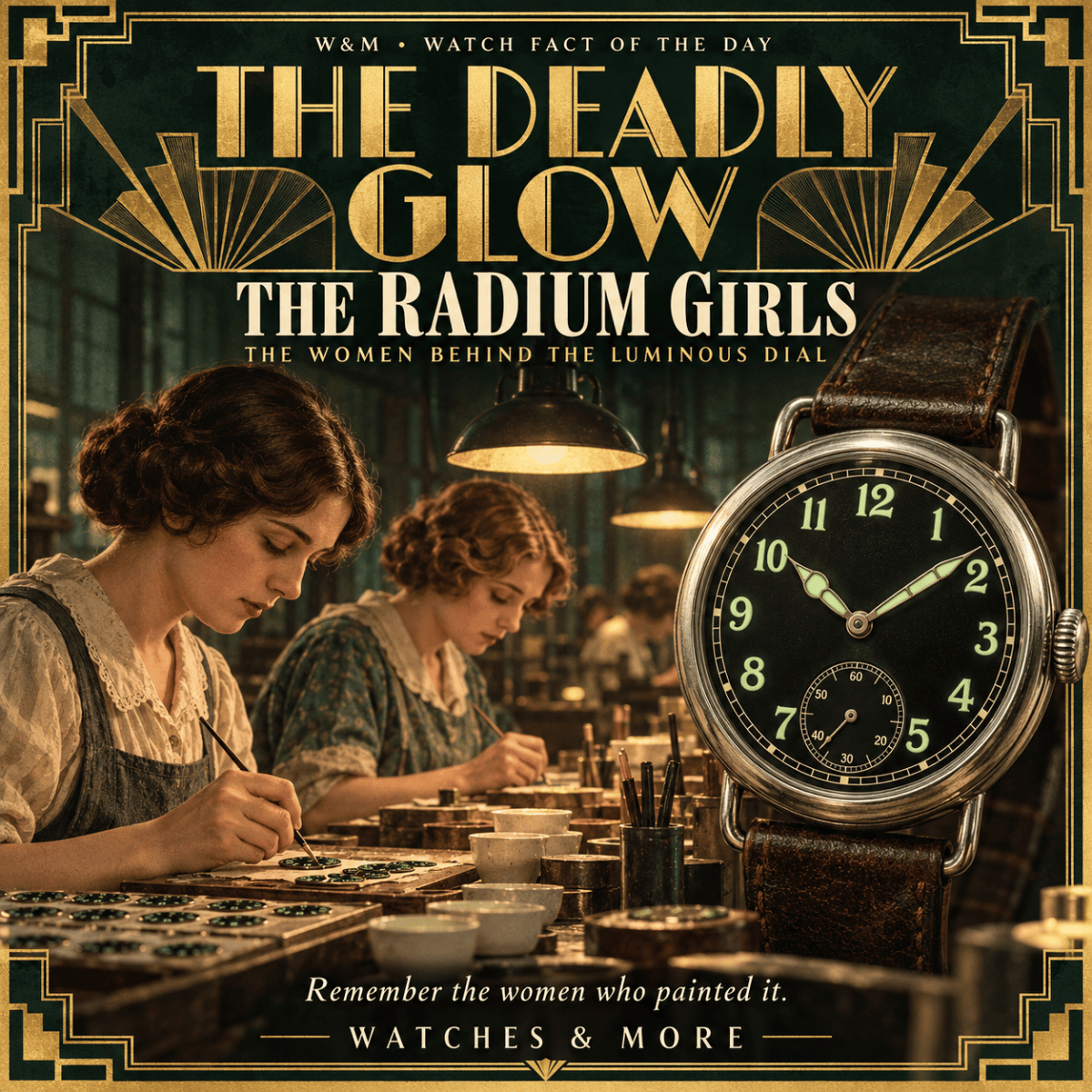
The dial glowed in the dark. The danger was hidden in the work.
They were told to put the paintbrush in their mouths. The paint contained radium.
In the early twentieth century, luminous watch dials offered something extraordinary: time you could read after the lights went out.
For the women painting those tiny numbers, that convenience carried a devastating cost.
They became known as the Radium Girls. Their story belongs alongside the inventions and achievements of watchmaking—because the people behind a dial matter as much as the mechanism beneath it.
🌙 A Watch That Made Its Own Light
Imagine the appeal before illuminated phone screens: raise your wrist in darkness and see the hands immediately.
Radium-based paint made that possible without a battery or a button.
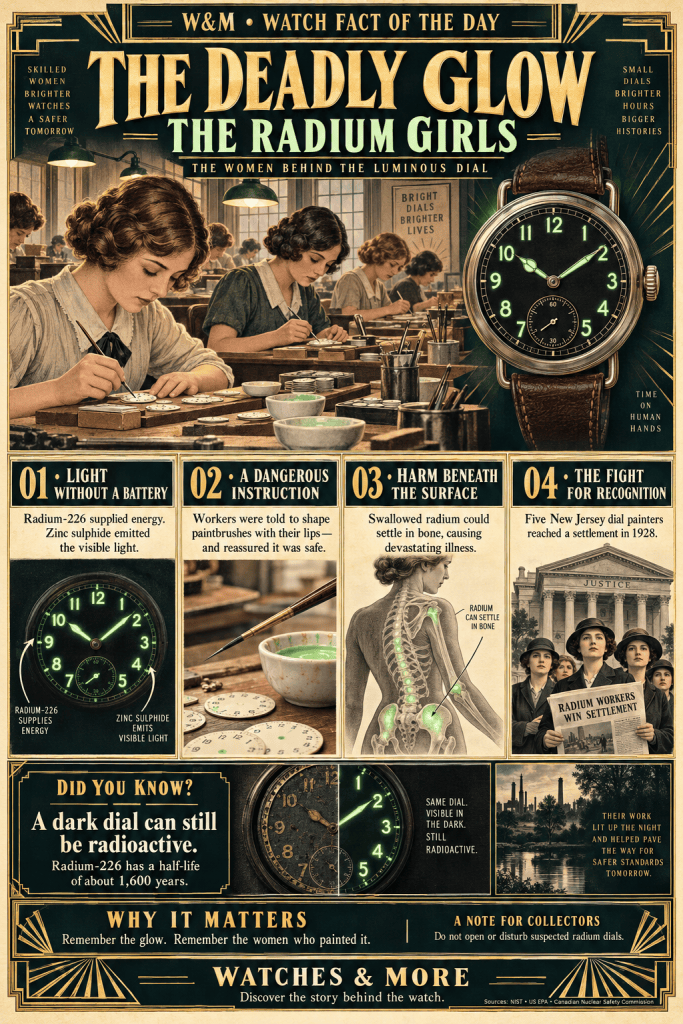
The technology combined a radioactive material, commonly radium-226, with a phosphor such as zinc sulphide. Radiation supplied energy to the phosphor, which emitted visible light.
The important distinction: the familiar luminous paint relied on a mixture. It was not simply radium glowing green by itself. Former Air Capitol Dial
The ingenuity was in making light available continuously. The tragedy was in how workers were exposed while producing it.
🖌️ Tiny Numbers. A Terrible Instruction.
Painting small dial markings required a fine brush.
Factory supervisors instructed women to shape their camel-hair brushes with their lips, a practice known as lip-pointing. NIST’s historical account records that workers who questioned the technique were reassured it was safe.
Repeatedly bringing a contaminated brush to the mouth meant swallowing radioactive material. NIST
Accounts also describe some workers applying the paint to their teeth for amusement, trusting its supposed harmlessness. But that startling detail should not eclipse the routine workplace instruction that exposed them. history.com
🦴 The Danger Went Beneath the Surface
The body can handle absorbed radium in a similar way to calcium, depositing it in bone.
There, it becomes an internal source of radiation. US EPA
The women suffered devastating illnesses. Historical accounts describe severe jaw damage, blood disorders, and skeletal injuries. Some died young. NIST
A glowing dial was the visible product. The harm accumulating inside its makers was far harder to see.
⚖️ The Women Who Challenged the Story
The Radium Girls were more than victims of a disastrous material.
They pursued recognition and compensation.
In New Jersey, five former dial painters challenged the U.S. Radium Corporation. Their case reached a settlement in 1928 after delays and intense public attention.
Physicist Elizabeth Hughes helped establish evidence of internal contamination by measuring radioactivity associated with radon in the women’s breath. NIST
It is a remarkable connection: a substance swallowed during precision work could leave evidence years later in an exhaled breath.
The settlement could not restore their health. It helped bring their treatment into public view.
💡 Did You Know?
A radium dial can stop glowing without becoming non-radioactive.
Radium-226 has a half-life of approximately 1,600 years. Visible brightness is not a reliable test for whether an old dial still contains radioactive material. nuclearsafety.gc.ca
For collectors, the practical point is simple: do not open or disturb suspected radium dials yourself. Seek a specialist familiar with radioactive timepieces. US EPA
CLICK HERE TO SEE YouTube VIDEO
⭐ Why It Matters
Modern photoluminescent materials such as Super-LumiNova offer a different approach: they absorb light and release it afterwards, without radioactive material. luminox.com
The familiar afterglow remains. Its energy source has changed.
The Radium Girls remind us to look beyond a product’s beauty and usefulness—to the conditions under which it was made, and the people whose skilled hands made it possible.
Remember the glow. Remember the women who painted it. ⌚
Watches & More — Discover the story behind the watch.
More Watch Facts • Our main site • Our companion site