

Equation of Time: Why Your Watch and the Sun Disagree

Because Earth’s orbit is elliptical and its axis is tilted, true solar time doesn’t match our standard 24-hour civil clocks, fluctuating by up to 16 minutes thr

Fun Quirk: Monday, November 2, 2026

📅 Monday, November 2, 2026

Your watch and a sundial can disagree even when both are working perfectly. The Equation of Time explains why—and a remarkable watch complication makes that difference visible.

We organise life around uniform hours and minutes. The Sun follows a less convenient schedule. The interval between successive solar noons varies slightly through the year, so apparent solar time, read from the real Sun, gradually moves ahead of or behind local mean solar time.
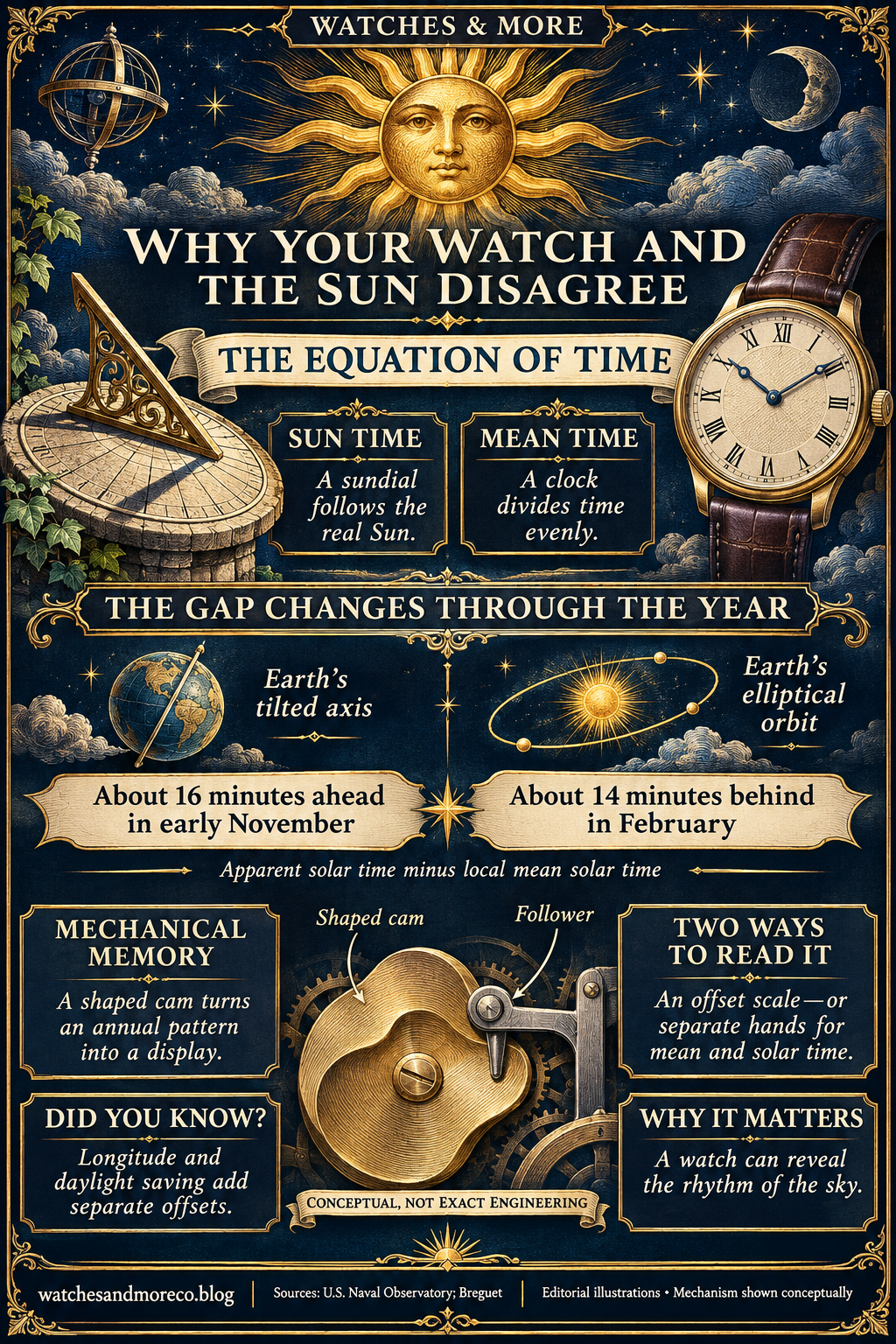
W&M infographic comparing apparent solar time and mean solar time, explaining the seasonal offset and a conceptual cam display.
Apparent solar time minus local mean solar time: roughly 16 minutes ahead in early November and 14 minutes behind in February. Editorial illustrations; mechanism shown conceptually.

☀️ Why the Sun Does Not Keep an Even Schedule

Two effects combine: Earth travels around the Sun in an elliptical orbit, and its rotational axis is tilted. Together, they make the Sun’s apparent progress uneven compared with an imaginary “mean Sun” moving at a steady rate.

The resulting difference is called the Equation of Time. Using apparent solar time minus mean solar time, it reaches roughly 16 minutes ahead in early November and 14 minutes behind in February. Some watch displays use the opposite sign convention, so the maker’s instructions matter.

⚙️ An Astronomical Pattern Stored in Metal

An Equation of Time watch uses a carefully profiled cam and a feeler to translate the annual pattern into a mechanical indication. As the mechanism advances through the calendar, the changing cam profile moves a lever that controls the display.

This is a mechanical representation of a predictable astronomical cycle. The watch does not need to see the sky, and the complication does not correct an inaccurate movement. It adds another way to read time.

⌚ Two Ways to Show the Difference

A conventional display gives an offset on a graduated scale. The wearer applies that difference to the corresponding mean-time reading to obtain apparent solar time.

A running equation of time takes a more direct approach. Breguet’s Marine Tourbillon Équation Marchante 5887 uses separate minute hands for mean and solar time. Its cam-and-feeler mechanism drives the equation indication, allowing the two readings to appear together. The watch also combines a tourbillon and perpetual calendar.

💡 Did You Know?

Longitude and daylight saving time introduce separate differences between a sundial and your everyday clock. An Equation of Time indication alone does not automatically account for all of them. Compare local apparent solar time with local mean solar time first, rather than assuming every sundial should match your time-zone clock.

⭐ Why It Matters

This complication connects a wristwatch to the sky with something you can actually read: the changing gap between two ways of defining time. It makes an abstract relationship tangible through the movement of a hand.

Your watch divides the day evenly. The Equation of Time reveals the Sun’s changing rhythm.

📚 Sources & Further Reading

U.S. Naval Observatory — The Equation of Time
Australian Bureau of Meteorology — The Equation of Time
Breguet — Marine Tourbillon Équation Marchante 5887

Join the Conversation

Would you choose a watch that follows the Sun, or is one minute hand enough? Share your thoughts below.


Category: Fun Quirk

Disclaimer: Every effort has been made to keep these watch facts accurate, but the world of horology is full of myths, disputed stories, and fascinating trivia. Consider these facts a starting point for discovery rather than the final word. If you have corrections or additional insights, let us know—we’re always happy to keep the record ticking in the right direction.

🕐 Discover more watch facts, reviews, and buying guides at WatchesAndMore


🛍️ You Might Also Like

As an Amazon Associate and affiliate partner, WatchesAndMore earns from qualifying purchases.

🔥 Deal of the Day

G-Shock GWM5610-1 Solar Atomic

Casio

★★★★★ 4.8 (5,621 reviews)

$129

Offer expires in

🔥 Grab This Deal →
G-Shock GA2100-1A1 CasiOak

G-Shock GA2100-1A1 CasiOak

Casio

★★★★★ 4.8 (2,156 reviews)

$99

Check Price on Amazon →
Casio Edifice Chronograph

Casio Edifice Chronograph

Casio

★★★★★ 4.7 (1,264 reviews)

$120

Check Price on Amazon →

Browse all 142+ expert-reviewed watches →

Watch Fact of the Day: The Mechanical Watch That Remembered for You!

Back in the day, before smartphones made reminders a breeze, Jaeger-LeCoultre dropped the Memovox in 1950, an awesome mechanical watch that buzzed to remind wearers of appointments and meetings. Instead of just telling the time, it used a cool mechanical alarm system built into the gears. By 1958, they leveled up with the Memovox Parking, which alerted drivers when their parking meter was about to expire. Fast forward to today, and while we rely on smart tech, the Memovox is a rad reminder of how ingenious watchmakers were at solving everyday problems with vintage gear.

📅 Saturday, August 15, 2026

Long before smartphones, calendar notifications and digital reminders, mechanical watches could literally remind their owners when it was time to do something. In 1950, Jaeger-LeCoultre introduced the Memovox, a mechanical alarm watch whose name means “voice of memory.” Using a separate crown and rotating central indicator, the wearer could preset a specific time while the watch continued keeping normal time. When that moment arrived, a tiny mechanical hammer caused the watch to buzz on the wrist, creating a remarkably practical analog reminder for meetings, appointments and everyday life.

The Mechanical Memory Watch

The secret was an ingenious mechanical alarm system built directly into the movement. Rather than simply displaying information for the wearer to remember, the Memovox could actively demand their attention when the selected time arrived. Its independently adjustable alarm mechanism stored its own energy and, when triggered, rapidly activated a hammer that produced the Memovox’s unmistakable vibrating sound. In an era of paper appointment books and desk calendars, having a mechanical reminder strapped directly to your wrist was remarkably futuristic.

By 1958, Jaeger-LeCoultre had taken the idea even further with the wonderfully quirky Memovox Parking. Drivers could use markings on its rotating inner disc to set the amount of time remaining on a parking meter. The mechanical alarm would then buzz when the purchased parking time was nearing its end—essentially giving motorists a 1950s mechanical parking notification decades before the smartphone existed. It transformed sophisticated watchmaking into a solution for an incredibly ordinary problem: remembering when it was time to get back to the car.

Today, vibrating phones and smartwatch alerts make reminders seem completely ordinary, but the Memovox demonstrates just how creatively watchmakers once approached the same problem using springs, gears, levers and mechanical ingenuity alone. What began as a practical “voice of memory” for appointments evolved into specialized models designed for everything from parking to travel and diving. More than seven decades later, the Memovox remains a wonderful reminder that mechanical watches weren’t always created simply to tell time—sometimes, they were designed to remember it for you.


💡 Did You Know?

The original Memovox wasn’t simply marketed as an alarm clock for your wrist. Vintage advertising positioned it as a “memory aid” for the busy professional—something that could remind its owner about appointments throughout the day.

Category: Fun Quirk

Disclaimer: Every effort has been made to keep these watch facts accurate, but the world of horology is full of myths, disputed stories, and fascinating trivia. Consider these facts a starting point for discovery rather than the final word. If you have corrections or additional insights, let us know—we’re always happy to keep the record ticking in the right direction.

🕐 Discover more watch facts, reviews, and buying guides at WatchesAndMore


🛍️ You Might Also Like

As an Amazon Associate and affiliate partner, WatchesAndMore earns from qualifying purchases.

G-Shock GWM5610-1 Solar Atomic
🔥 Deal of the Day

G-Shock GWM5610-1 Solar Atomic

Casio

★★★★★ 4.8 (5,621 reviews)

$129

Offer expires in


🔥 Grab This Deal →

G-Shock GA2100-1A1 CasiOak


G-Shock GA2100-1A1 CasiOak

Casio

★★★★★ 4.8 (2,156 reviews)

$99


Check Price on Amazon →

Casio Edifice Chronograph


Casio Edifice Chronograph

Casio

★★★★★ 4.7 (1,264 reviews)

$120


Check Price on Amazon →


Browse all expert-reviewed watches →

ETSY Shop
ETSY Shop
Redbubble Shop
Redbubble Shop
More Watch Facts
More Watch Facts

💡 Did You Know?

The movement, case, dial and strap contribute different things to a watch’s character. Comparing those parts separately can reveal why two similar-looking watches feel different to own.

⭐ Why It Matters

The details are most useful when connected to the wearer’s needs and the design’s purpose. This story offers another way to look beyond the name on the dial.

📚 Sources & Further Reading

Further reading: Fondation de la Haute Horlogerie — watchmaking glossary

Join the Conversation

Which detail in this story interests you most, and would it influence what you wear or collect? Share your thoughts in the comments below.

Read Next

🛍️ Explore designs, gifts and more at the W&M companion shop.