


Watch Fact of the Day · November 27, 2026 · Watches And More
A quartz watch needs more than a battery. It needs a reliable electrical connection—and that tiny detail can make the difference between ticking and silence.
You fit a fresh battery. You expect the seconds hand to jump into action.
Nothing.
Before declaring the watch deceased, consider a less dramatic possibility: the battery may have energy, but the movement may not be receiving it properly.
This article is about watch battery contacts—the small conductive parts that connect a cell to the watch’s electronics. We’ll explain their job, examine a documented Seiko example, and show why “new battery” and “working watch” are not always the same thing.
🎬 Watch: Fresh Battery. Dead Watch?!
A fresh cell. A stubborn seconds hand. One tiny connection with a surprisingly big job. Our W&M Short turns this quartz-watch mystery into a neon-soaked ’80s adventure, exploring how battery contacts help deliver power to the movement. Tiny part. Big responsibility.
Watch “Fresh Battery. Dead Watch?!” on YouTube Shorts. The video illustrates one possible contact fault; a stopped watch can also have other electrical or mechanical causes.
🔋 The Battery Is the Power Source, Not the Whole System
A battery establishes a voltage between its positive and negative terminals. To power a watch, those terminals must connect to the movement through an intended electrical path.
Think of a desk lamp: a good bulb and a live outlet are not enough if the plug isn’t making contact. A watch has a much smaller version of that connection problem.
The battery contacts are the interface between stored energy and functioning electronics. The exact arrangement varies by movement. You cannot assume that a visible clip, screw or metal plate serves the same electrical role in every watch.
⚙️ What Happens After the Power Arrives?
In a conventional analog quartz watch, the powered electronics maintain the quartz oscillator and use its rhythm as a timing reference. The circuit drives a step motor, which turns the gears and hands.
Grand Seiko’s own mechanism explanation describes that sequence: battery, quartz oscillator, integrated circuit, step motor, gears and hands. These components have different responsibilities. The battery provides energy; the oscillator provides the reference used to keep time. [Grand Seiko]
We explored the timing sequence in “32,768 Vibrations, One Tiny Tick.” Today we’re stopping at the entrance: the connection that lets the system run at all.
🔍 The Evidence: Seiko’s Caliber 7546A
Seiko’s technical guide for the 7546A gives us a specific example. Its service procedure includes a section called “Check Battery Conductivity.”
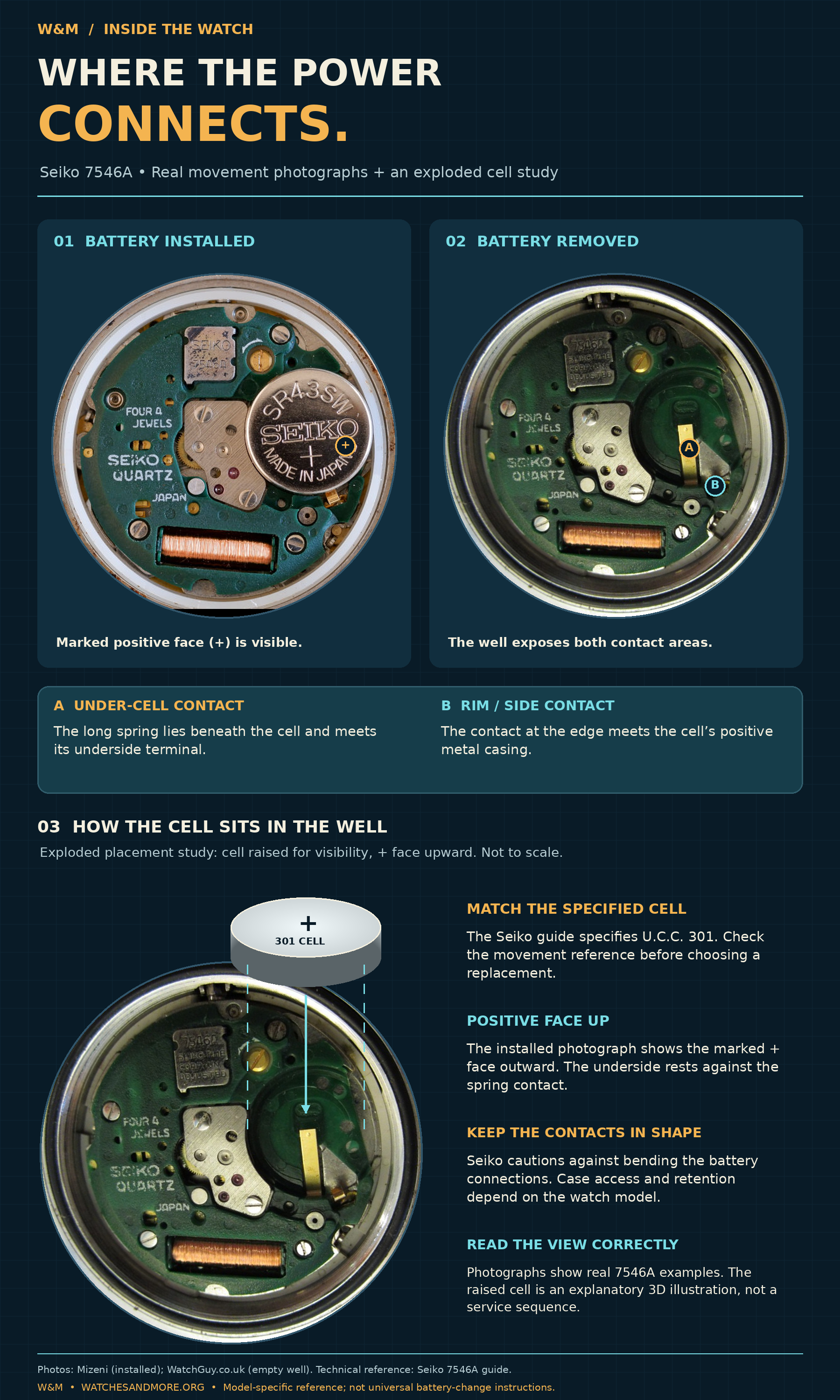
The guide directs a technician to check the screw securing the battery connection’s positive terminal and inspect the connecting surfaces for foreign matter. It also cautions against bending the connection parts.
That is a useful discovery. A battery’s electrical condition and the quality of its connection are treated as separate checks.
The guide’s wider troubleshooting sequence also examines the circuit, its output connections, the coil and the mechanical portion. A contact fault is one possibility—not an automatic diagnosis for every stopped watch. These details belong to the 7546A; they are not universal repair instructions. [Seiko Technical Guide, checking and adjustment]
📸 Inside the Battery Well: See the Connection
Compare the installed and removed cell in real Seiko 7546A examples. The photographs reveal the spring beneath the battery and the contact at its rim; the raised-cell illustration makes the seating orientation easier to understand. Case access and battery retention vary between watch models.
🧩 Why “It Fits” Is Only Part of the Answer
Watch batteries are specified components, not interchangeable little silver decorations.
For example, Renata’s data sheet identifies its 380 / SR936W as a high-drain silver-oxide cell with a nominal voltage of 1.55 volts, a diameter of 9.50 mm and a height of 3.60 mm. Those specifications describe that cell—not every watch battery. It is not being recommended here as a replacement for the 7546A. [Renata data sheet]
The practical lesson is straightforward: identify the battery specified for the actual movement. CASIO’s Module 3595 instructions explicitly say to use the specified type and warn that a different type can cause malfunction. [CASIO]
A battery compartment is not a “close enough” competition.
🛠️ What a Stopped Watch Actually Tells You
Usually, less than you might think. A symptom is a starting point, rather than a verdict.
| Observation | What it does—and doesn’t—establish |
|---|---|
| The watch has stopped. | The cause still needs investigation; a flat battery is one possibility. |
| A replacement cell is installed, but it still won’t run. | Check the specified cell and the movement’s service requirements. The battery-to-circuit connection is one of the checks documented for the Seiko example. |
| A digital display is dim or blank. | CASIO lists these among possible low-battery signs for Module 3595. They are not a universal diagnosis for every display problem. |
CASIO recommends battery replacement by its retailer or authorized service center, including an inspection for proper water resistance. A battery change involves the condition of the watch as well as the cell itself. [CASIO operating precautions]
💡 Did You Know? Your First Battery Has Already Been Working.
A watch’s battery does not necessarily begin its working life on the day you buy it.
Seiko explains that the factory-installed battery has already been used to monitor function and performance, so it may not last the full stated number of years after purchase. An earlier-than-expected first replacement does not, on its own, prove something is wrong. [Seiko battery FAQ]
🛡️ Even Luxury Quartz Watches Take Battery Changes Seriously
Grand Seiko’s 9F provides another revealing detail. Its protective shield construction helps prevent dust from entering the gear train during battery changes.
The manufacturer also describes a sealed environment around the step motor’s pivot to help preserve its lubricating oil. Even at this level of watchmaking, the routine act of changing a cell is something the engineers have designed around. [Grand Seiko: protective construction]
There’s a nice reminder here: convenience on the outside can conceal considerable care on the inside.
⭐ Why It Matters
This small connection changes how we think about reliability.
It is tempting to divide a watch into impressive components and unimportant supporting parts. But the impressive components depend on those supporting parts doing their jobs.
A contact does not need to be beautiful, famous or complicated. It needs to connect reliably. When it doesn’t, the result can be as noticeable as a much more dramatic failure.
For owners, the useful takeaway is to ask for a diagnosis rather than repeatedly guessing at batteries. Seiko also advises replacing an exhausted battery promptly to reduce the risk of leakage damage. [Seiko]
❤️ The W&M Take: A Very Small Part With a Very Big Job
A battery contact is unlikely to get a glamorous advertising campaign. Nobody queues outside a boutique to admire a particularly dependable terminal.
Yet it helps make the entire watch possible.
At Watches And More, that is exactly the kind of overlooked detail we enjoy: a small, practical piece of engineering with an outsized role in the story.
The battery brings the energy. The connection makes it available. The watch does the rest.
⚡ No Connection. No Tick.
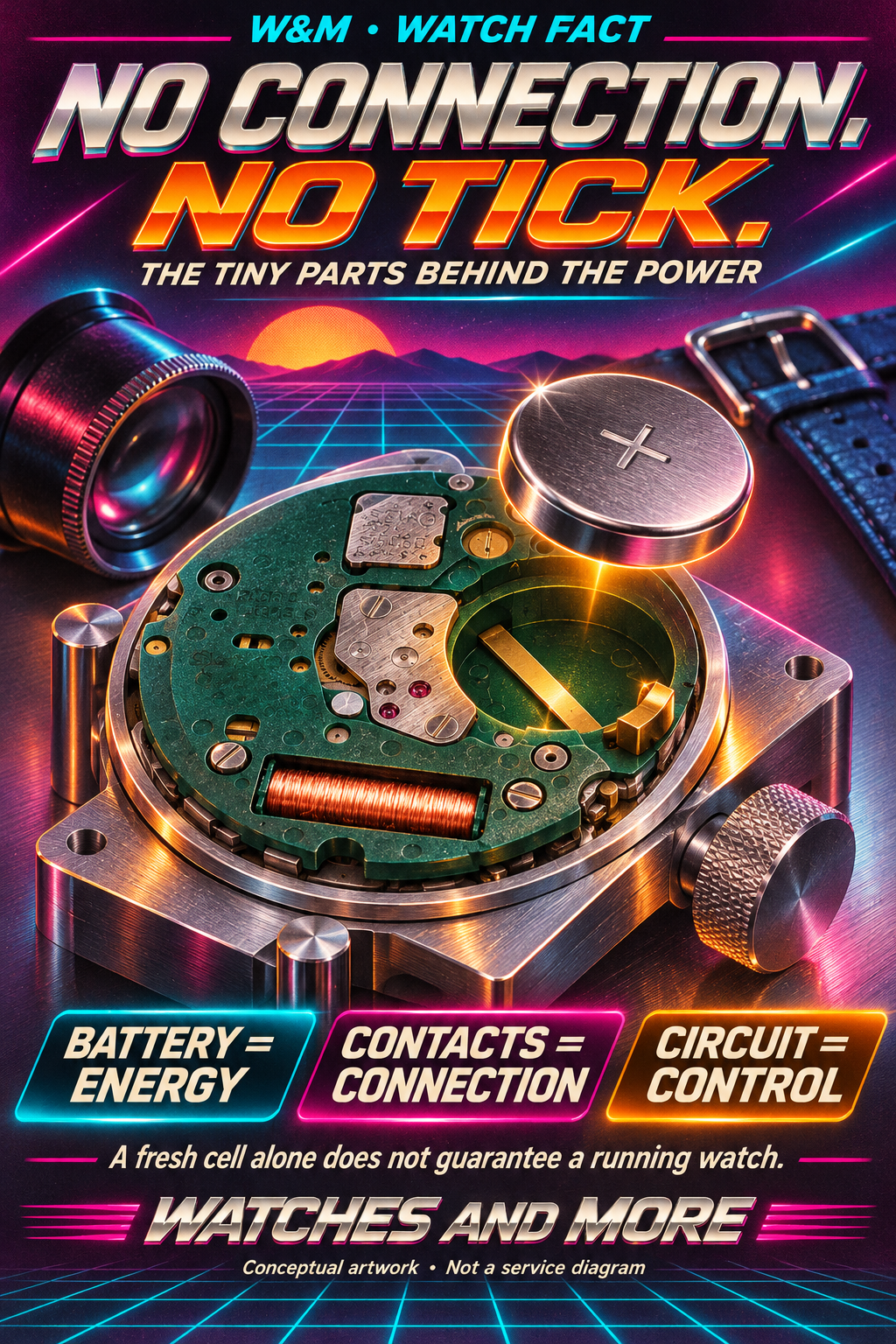
We gave this overlooked component the full ’80s future-tech treatment. Beneath the neon and chrome is the same practical point: the battery supplies energy, the contacts make the connection, and the circuit controls the watch’s operation. A fresh cell alone does not guarantee a running watch.
Sources & Further Reading
- Seiko Caliber 7546A Technical Guide — checking and adjustment, especially printed pp. 18–21
- Grand Seiko: How a quartz movement works; protective shield construction
- Renata: 380 / SR936W silver-oxide battery technical data sheet
- CASIO: Module 3595 precautions — battery replacement and low battery power
- Seiko: Where can I have my watch battery replaced?
Disclaimer: Every effort has been made to keep these watch facts accurate, but the world of horology is full of myths, disputed stories, and fascinating trivia. Consider these facts a starting point for discovery rather than the final word. If you have corrections or additional insights, let us know—we’re always happy to keep the record ticking in the right direction.
Read Next
- Apple Watch Cellular: Leaving the iPhone Behind, Not Every Dependency
- Hamilton Pulsar P1: The 1972 LED Time Computer
Watches And More · Watch Fact Archive · Companion site
Have you ever had a watch that still wouldn’t run after a battery change? What turned out to be the cause?

