
Watch Fact of the Day

📅 Thursday, October 29, 2026
A lid opens. A tiny bird appears, moves, and sings. Then it disappears into its decorated case.
It sounds like an electronic toy, but watchmakers achieved this performance through springs, gears, cams, and moving air. Singing-bird automata belong to a world where precision mechanics entertained as well as measured.
🐦 More Than a Pocket-Watch Story
Surviving objects include boxes and other decorative forms, sometimes incorporating a watch. Describing every one as an eighteenth-century pocket watch hides important differences. A specific surviving object provides a firmer starting point.
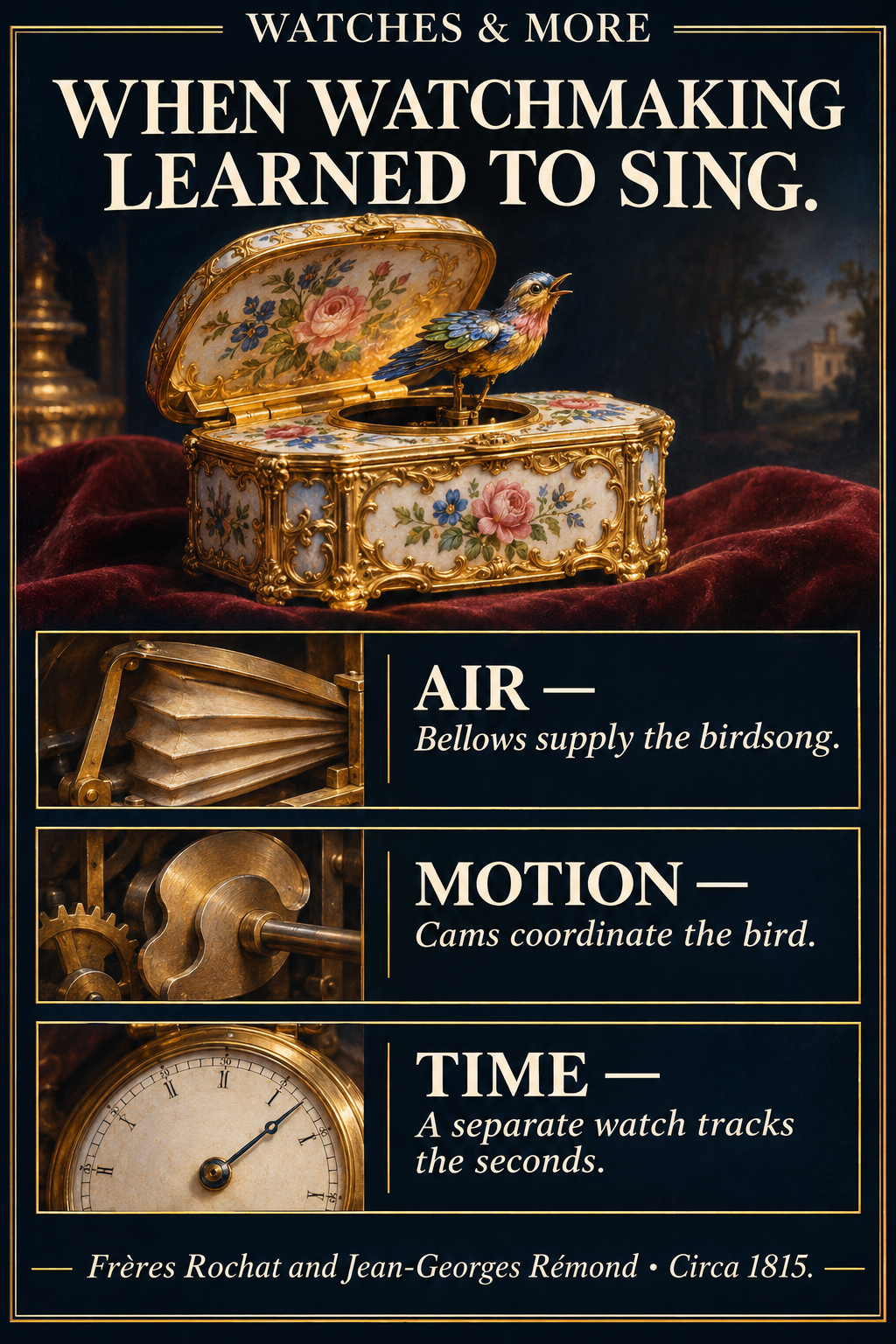
Christie’s catalogues a gold-and-enamel box dated circa 1815, with a movement marked for Frères Rochat and a case marked for Jean-Georges Rémond. It combines an animated bird, a musical mechanism, and a centre-seconds watch.
🌬️ How a Mechanical Bird Sings
The catalogue describes a chain-and-fusee mechanism, cylindrical bellows, and eight cams controlling the bird’s performance. The creature rotates and moves its head, wings, and tail in time with the mechanically produced birdsong.
Cams are shaped controllers that translate rotation into a sequence of actions. Their coordination helps turn separate movements into something that appears alive. The performance is created physically, rather than replayed through a speaker.
🎵 Three Machines in One Object
The same example includes a separate musical pin barrel acting on vibrating steel elements. Its watch has another movement. Birdsong, instrumental music, and timekeeping are therefore distinct systems sharing the case.
That distinction makes the object more interesting. A maker had to coordinate not just a charming exterior but the different energy demands, controls, and spaces occupied by several mechanisms.
💡 Did You Know?
The circa-1815 box measures approximately 95 by 60 by 25 mm. At the end of the performance, the bird retreats and its lid closes automatically. The disappearance is another part of the engineered sequence.
⭐ Why It Matters
These timepieces reveal a broader meaning of horology. The same skills that controlled a hand could choreograph a bird, create music, or produce an illusion.
The delight comes from seeing a familiar form of entertainment achieved through an unfamiliar method.
Before digital animation, a tiny mechanical bird could still steal the room.
📚 Sources & Further Reading
Christie’s — Frères Rochat and Jean-Georges Rémond, circa 1815
Join the Conversation
Which would amaze you more: a singing watch or a musical watch? Share your thoughts in the comments below.
Read Next
- Vox Temporis: A Watch That Sounds Out the Minutes
- Henry Graves and the Patek Philippe Supercomplication
Category: Fun Quirk
Disclaimer: Every effort has been made to keep these watch facts accurate, but the world of horology is full of myths, disputed stories, and fascinating trivia. Consider these facts a starting point for discovery rather than the final word. If you have corrections or additional insights, let us know—we’re always happy to keep the record ticking in the right direction.
🕐 Discover more watch facts, reviews, and buying guides at WatchesAndMore